The Youth’s Instructor, Vol. 48, No. 41.

ON THE TROPIC OF CAPRICORN
Earlier text: ON THE TROPIC OF CAPRICORN

ONE RAINY DAY

Drip, drippity-drip, fell the raindrops from the gray skies outside the window; and, deary me, drip, drippity-drip, fell the teardrops from a pair of gray eyes inside the window. Just as if that would help any! But it was such a serious matter. For days Ida had looked forward to this morning,—her birthday morning,—for she had been promised a long ride with papa and mama, to visit a dear aunt in the city. And when she awoke, the first thought in her mind was the visit, and the first sound in her ears was the rain. She was so disappointed that she could not eat her breakfast; and now, at ten o’clock, it was raining harder than ever, both indoors and out; for papa had said that if it should stop by ten o’clock, they might still go.
Unable to bear the sight of the falling rain any longer, Ida threw herself down on the sofa, and hid her face in the cushions. Mama, who had tried in vain to comfort her little girl, or interest her in some work, was glad to see her lie down; for she was sure that something would soon happen to comfort, if not to interest, her. What happened proved to be interesting, too; for in a few minutes the rain stopped falling, and Ida put on her hat, and went out in the garden. The sun was very hot, and all the flowers hung their heads feebly. She went around to the east side of the house, where the pansy-beds were, and found all the dear little flower-faces drooping sadly.
“Dear Pansies,” said she, “why do you droop so this bright morning?”
“O Little Ida!” said they, “it is too bright; the sun is too hot. If it would only rain a little, we would hold up our faces again.”
She went into the corn-field: the long blades were hanging limply from their stalks, and some of them looked a little yellow.
“Good Corn,” said she, “why do you not stand up straight and green, as you did a while ago?”
“We need rain,” said the Corn. “Our roots are drying out; and if it does not soon rain, we shall die.”
Then Ida went out on the road; and there she met the old white duck and her nine little yellow ducklings, moping along, and quacking mournfully.
“Ducky,” said Ida, “why don’t you take your little ones to the pond this fine, bright morning?”
“Pond?” said the Duck, “alas! there is no pond any longer. We have been so long without rain that the place where the pond was is now only a dry hollow. Quack! quack! I wish it would rain!”
And all the little Ducks said, “Peep! peep! we wish it would rain!”
“Well, I know there is water in the brook, anyway,” said Ida, and away she went down the road to the bridge. She could hardly believe her eyes—the brook was dry! “Oh, oh! I wonder what has become of all the little fishes!”
Then she heard a little splash, and looking down, she saw a tiny pool under the bridge, and in it one little fish.
“All my brothers and sisters are gone,” he said. “When the water began to get low, they started down to the river. They begged me to go, too; but I loved the brook and the bridge: and I said, ‘Surely it will rain soon;’ so I stayed. And now I am ready to die for lack of water. Oh, I hope it will rain soon.”
BAREHEAD, ALTHOUGH THE SUN WAS WARM
“I hope so, too,” said Ida. “Now I will go to the big mill-pond; for there is always plenty of water there.”
Yes, there was water in the mill-pond; but the miller was standing idly in his door.
“Good morning, Mr. Miller,” said she; “why are you not grinding wheat this beautiful morning?”
“Ah, Little Girl!” he replied, “there is not enough water in the pond to turn my wheel, so I am not able to grind. If it does not rain soon, I shall have to give up my mill and go away.”
“I am very sorry, sir,” said Ida; “I hope it will soon rain.” And then, she did not just know how it happened, she was at the river, many miles away. There she saw a fine ship, not moving swiftly along, but standing quite still.
“Fair Ship,” said she, “why are you standing idly here? Have you nothing to do?”
“Dear Little Girl,” answered the Ship, “I am full of wheat and corn and flour. Kind men and women in the city sent me out, laden with food, for the poor people in a land where there is famine for lack of rain. But the summer has been dry, and the river is so low that I am stranded on a sandbar.”
“Oh, dear!” cried Ida, “I gave the money from my ‘Do-without Box’ to help buy bread for them. I wish it would rain! I wish it would rain!”
Then, all at once, she was back on the sofa, and heard the “drip, drippity-drip” of the rain.
“Oh, I am so glad it is raining!” she cried. And jumping up, she climbed on mama’s lap, and told her all about it. “I’m sorry I was so cross about the rain this morning; I did not think how much it was needed,” she exclaimed.
“Well, dear, I’m sorry you did not get your ride; but we needed the rain very much, and we can have our pleasure another day.”
After dinner Ida busied herself with the pretty presents she had received, but which she had felt too mournful to look at in the morning. She was so busy and happy that she did not notice that the rain had ceased falling until she heard wheels on the driveway. Running to the window, she saw papa in the buggy, waiting to take mama and herself for a drive. In a few minutes they were ready; and as she went out, she could not help noticing how fresh and green everything looked. Peeping around the corner of the house, she saw all the little pansy-faces raised happily to her own.
“I’m so glad it rained,” she said as she climbed into the buggy. Over in the corn-field the beautiful green leaves sparkled in the sun. And the old duck and her little ones were all diving, swimming, and quacking in the pond. As Ida and her parents crossed the bridge, a beautiful trout sprang from the water, and Ida was glad to notice that the brook was higher than it had been for some weeks.
“It must have rained hard all night in the hills,” said papa; “yesterday the brook was dry.”
They heard the miller whistling cheerily as they passed the mill; the pond was rising rapidly, and by to-morrow the wheel would be running again.
When it was nearly sundown, they turned toward home. Ida sat very still; and at last papa said, “A penny for your thoughts, dearie.”
“I was just wondering if my ship had got clear of the sandbar yet.”
“Your ship? What ship?” asked papa.
Then Ida had to tell the story all over again. Papa smiled, and patted her cheek when she had finished.
After all, it was a very happy little girl who ended the day by repeating the verse mama gave her to learn: “He . . . sendeth rain on the just and on the unjust.” AUNT BETTY.

OUR COUNTRY COUSIN

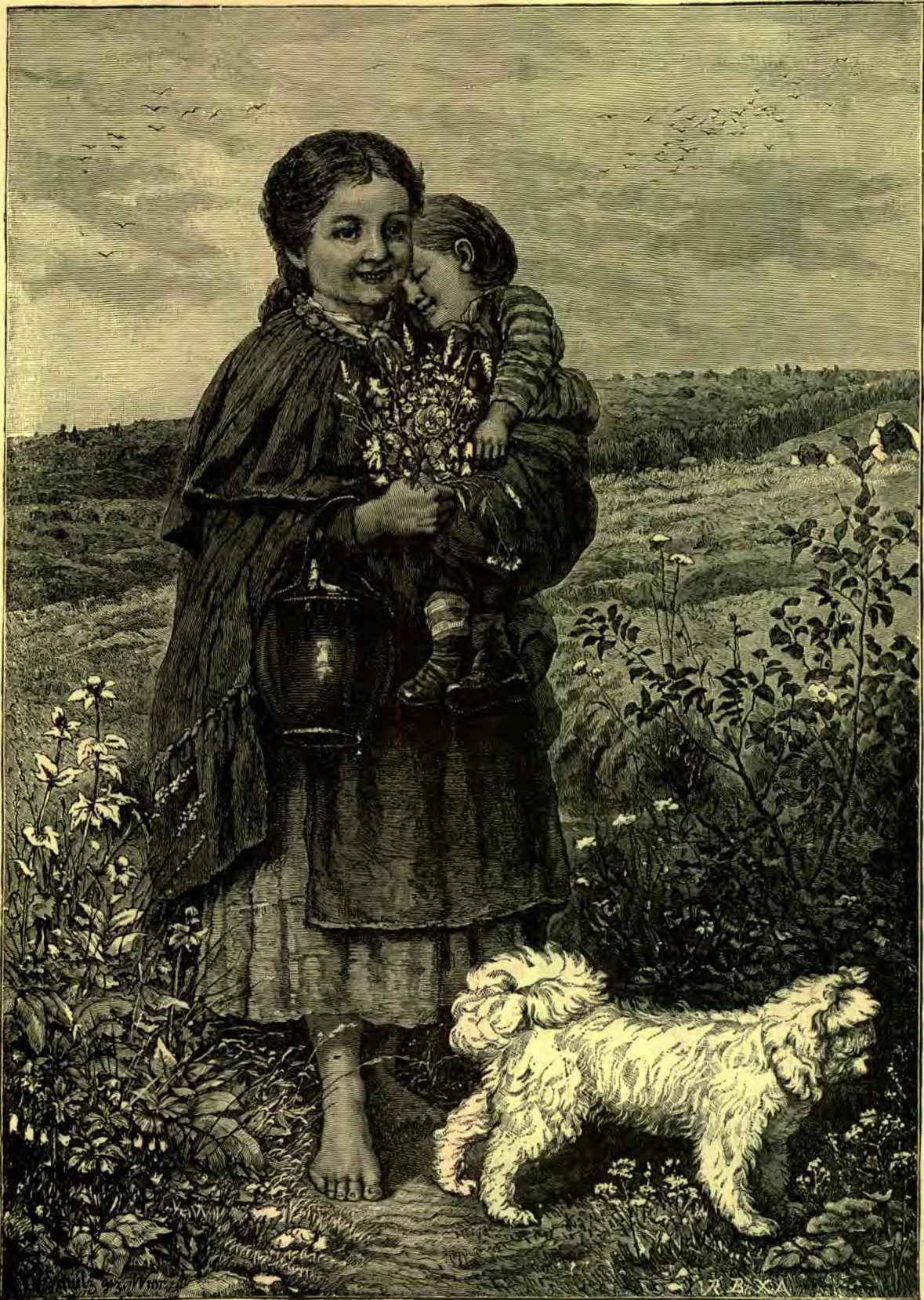
Our country cousin's father lives A humdrum life on grandpa's farm; There I have seen her, day by day, A dinner-bucket on her arm, Go down into the harvest fields, Barehead, although the sun was warm, Smiling — as if such homely tasks Held anything to please or charm.
Our country cousin knows the flowers And ferns in every woodland nook; Knows where the wild birds build their nests, Which love the upland, which the brook (I am not sure that I can tell A wren or robin from a rook); And, what is queer, she learned it all Without a teacher or a book.
Our country cousin's dresses look Each like to each as pea to pea; She never saw a “picture” hat, She wears no frills nor finery: Yet if you'd say to me some day, “Your Cousin Jane—what like is she?” I'd say, “My country cousin is A girl as sweet as girl can be.”
ELIZABETH ROSSER.

WHAT DICKIE BIRD'S SINGING DID

Dorothy had been in the large manufacturing village six long spring days.
And for five mornings—even the one that rained—Grandma Holman had hung Dick out in the arbor, almost close to the street, a few minutes before was heard the tramp, tramp, of the hurrying men on their way to the mills.
“What — can — grandma — do — it — for?” questioned Dorothy, slowly, from her daintily curtained window, as if purposely giving herself plenty of time to think out the reason. “It can't be it's a constitutional; for grandma does all the walking.”
Dick began pouring out a volume of liquid notes.
“He's trying to explain — I guess he must have heard me,” laughed Dorothy.
She listened a moment.
“It's lovely singing, Mr. Dick, but I don't understand bird-talk, even when it's sung; so I guess I'll have to find out from grandma why you have to leave the sitting-room every morning.”
“Get up bright and early to-morrow,” said grandma, “and you'll see.” Then, mysteriously, “You'll want to be down before the men go to the mills.”
“But what does Dick —”
“Tut! tut!” and grandma playfully put her finger over Dorothy's lips. “That's just what I want you to see!”
The next morning Dorothy was up with grandpa. While he was making the fire, she peeped into the sitting-room.
“Going to — well, I don't know what,” said Dorothy, curiously, “but something!”
“Be sure to watch the men's faces,” cautioned grandma when all was ready, and Dorothy had taken her place by the gate.
“Your watchtower, eh?” laughed grandpa, stepping into the yard.
“They're coming — the men!” exclaimed Dorothy, excitedly. “Now, Mr. Dick!”
Dick never sang more sweetly.
“I — I know now!” cried delighted Dorothy. “You're just a little home missionary, Mr. Dick!”
Dick never stopped his singing for the compliment.
“The first man looked awfully gloomy before he heard Dick,” explained Dorothy; “but when he heard the music, he just smiled all over, and walked ever so much more briskly. Then that lame man was saying something real cross-like to the boy that was with him; but when he noticed Dick's singing, he just laughed his ugly words all away. The man with the dinner-pail never looked up till he got opposite; and when he heard Dick, he began to whistle. And then — why, grandma, Dick just made them all over, and got them ready for their work!”
“And that's his mission, dearie,—every morning to sing some brightness into the poor workingmen's lives. They work better for it, and feel —”
“Better!” interrupted Dorothy, gayly. Isn't it a splendid plan, grandma?”
“Yes, dear, and perhaps others besides Dick could follow it, if they tried.”—Sunday School Times.

THE LAW NOT AGAINST THE PROMISE

(October 27, 1900)
LESSON TEXT.—Gal. 3:17-21, first part.
MEMORY VERSES.—Rom. 5:20, 21.
In this lesson you will find a part of the previous lesson repeated. This is done that we may the better study the connection, and also that we may become more thoroughly familiar with the text and its teachings. If the lesson seems short, dig the deeper into it; you will not lose your reward.

QUESTIONS

1. How long after the confirming of the covenant with Abraham was the law given at Sinai? Who confirmed the covenant? V. 17. How was it confirmed? Heb. 6:13, 14.
2. What effect could the law have upon the covenant? Gal. 3:17.
3. What did God promise to Abraham in the covenant? Then if the inheritance was of promise, by what could it not come? V. 18. What is included in the promise of the inheritance?
4. What could not the law do? V. 17. What question does Paul ask concerning the law? What answer is given? V. 19, first part. What is the relation of the law to transgression, or sin? Rom. 3:20. What conditions led to the giving of the law at Sinai?
5. Till what time was the law added or proclaimed? What promise was made to the seed? V. 19; compare with V. 18. Why did the Lord engrave the law upon stone? In the new covenant, where does the Lord promise to write his law? Jer. 31:33;
6. By whom was the law ordained? In whose hands? V. 19, last part. Who is this mediator? 1 Tim. 2:5. Between whom does he mediate? Compare Gal. 3:20 with 1 Tim. 2:5;
7. What is the relation of the law to the promises of God? Gal. 3:21, first part. What is the purpose of the law in securing man’s salvation? Rom. 5:20, 21;

NOTES

PUT ON THE SHOE

Have you heard that old saw of the Persians, That saying both witty and true,— “The whole world is covered with leather To him who is shod with a shoe”? Fine calfskin, or kid, or morocco, Great cavalry boots armed with steel, The daintiest, jauntiest slippers, Great brogues, tumbled down at the heel,— What matter the differing fashions?— The richest and poorest of you Will find the whole world clad in leather As soon as you put on your shoe! Before, it was cold and uneven, Rough pebbles and sharp bits of glass: Now, presto! a smooth and warm pavement Wherever it please you to pass.
But ah! there’s a maid—have you seen her?— A little maid, cheery and sweet, Who daintily trips, yet I see not What leather she wears on her feet; For I know by her sunny eyes’ sparkle, And by the calm curve of her mouth, And by the kind grace of her manners, Like warm breezes fresh from the south,— That wherever her dainty foot falleth On loving task speeding or sent (The cobbler may laugh, but I care not), She is shod with the Shoe of Content.
And, little maid, so light-hearted, I’d like your wee shoe for my own (But borrowing’s out of the question, For me, with my “sevens” outgrown); So whisper the secret, I pray you,— Come, what is the shop and the street, And where is the cobbler who fashions Such beautiful gear for the feet?
I’ll offer to give him a treasure Will make his big spectacles shine, If only two shoes—somewhat larger— Like your little shoes can be mine! And then I will don them, and leaping Off over the world will I go, Off over my frets and my worries, Off over my aches and my woe; And loudly to all limping grumblers My shoemaker cheer shall be sent— “The whole world is covered with gladness To him who is shod with content!”
—Amos R. Wells.

The Habit of Forbearance in the Home

WOULD you make yourself dear to every domestic scene you enter, form the habit of forbearance, and all your kindred will bless your face for its own benediction. Your very coming in at the door shall be as a balm; and that comfort is not insignificant which is repeated, a drop of sweetness in every draft, a thousand and a million times. And the effect of forbearance will be not only to make you comfortable to others, but to deepen the power, and harmonize the development, of your own soul.—C. A. Bartol.

Our Premium Testament

As an aid to daily Bible study, and to memorizing the Scriptures, there is nothing better than a pocket-edition. We have secured a beautiful Vest-pocket New Testament, size 4 x 2¾ in., that we offer, postpaid, with the INSTRUCTOR one year, for only $1.00. Well printed, in ruby type, as shown; Flexible Covers, Round Corners, Red under Gold Edges,—a splendid little book.

ST. MATTHEW, 13.

42 The queen of the south shall rise up in the judgment with this generation, and shall condemn it; for she came from the uttermost parts of the earth to hear the wisdom of Solomon; and, behold, a greater than Solomon is here. 43 When the unclean spirit is gone out of a man, he walketh through dry places, seeking rest, and findeth none. 44 Then he saith, I will return into my house from whence I came out; and when he is come, he findeth it empty, swept, and garnished. 45 Then goeth he, and taketh
50 For whosoever shall do the will of my Father which is in heaven, the same is my brother, and sister, and mother.

CHAPTER 13.

3 The parable of the sower and the seed: 18 the exposition. 24 The parable of the tares, 31 of the mustard seed, 33 of the leaven, 44 of the hid treasure, 45 of the pearl, 47 of the drawnet. 53 Christ is contemned of his own countrymen.
1 The same day went Jesus out of the house, and sat by the sea side. 2 And great multitudes were gathered together unto him, so that he went into a ship, and sat; and the whole multitude stood on the shore.
This offer is made to both renewals and new subscribers. Address—
THE YOUTH’S INSTRUCTOR, BATTLE CREEK, MICH.
E. W. Meddaugh and Henry B. Joy, Receivers.

CHICAGO & GRAND TRUNK R'Y.

Trains leave Battle Creek.

WEST-BOUND FROM BATTLE CREEK.

No. 9, Mail and Express, to Chicago........................ 12.15 P. M.
No. 1, Chicago Express, to Chicago........................ 8.30 A. M.
No. 3, Lehigh Valley Express, to Chicago................... 3.50 P. M.
No. 5, International Express.............................. 2.15 A. M.
No. 75, Mixed, to South Bend............................... 8.30 A. M.
Nos. 9 and 75, daily, except Sunday.
Nos. 1, 3, and 5, daily.

EAST-BOUND FROM BATTLE CREEK.

No. 8, Mail and Express, East and Detroit.................. 3.45 P. M.
No. 4, Lehigh Express, East and Canada..................... 8.27 P. M.
No. 6, Atlantic Express, East and Detroit................. 2.25 A. M.
No. 2, Express, East and Detroit.......................... 6.50 A. M.
No. 74, Mixed (starts from Nichols)....................... 7.15 A. M.
Nos. 8 and 74, daily, except Sunday.
Nos. 4, 6, and 2, daily.
W. C. CUNLIFFE, Agent, BATTLE CREEK.
G. W. VAUX, G. P. A., CHICAGO.

WANTED

LADY AGENTS to handle Health Garments. Will give 30 days' time to those that furnish references. Men wanted also for useful article for farmers. Catalogue free. Address W. S. Dann, 1599 Burt St., Omaha, Neb.

The ... Instructor Premium Bible

A Self-Pronouncing Teachers' Reference Bible, containing the celebrated *_Teachers' Helps_*, and comprising nearly 400 pages. Also a complete series of fifteen new maps.
We have received many good words from those who have earned, or otherwise obtained, one of our Premium Bibles. A few of these we give to our readers:—
A sister in Minnesota says: “The INSTRUCTOR Premium Bible received, and I am more than pleased in every way.”
A Kansas brother says: “The Premium Bible is better than I expected. Am much pleased with the self-pronouncing feature.”
James Harvey, Dumont, Colo., writes: “I received the Premium Bible, and am much pleased with it. I think it is the best Bible ever published for the money.”
A brother in Colorado writes to express his appreciation of the help the Bible is to his family and himself. He says: “The Bible you sent me is better than anything I ever expected to get for that amount. I can not tell you how much it has helped my family, and how thankful we are to have it. It is so plain and easy to read that the most ignorant can understand and enjoy it.”
From a brother in Loup City, Neb.: “After carefully examining the Self-Pronouncing S. S. Teachers' Reference Bible, I am satisfied that it is the best all-round book of the kind I have ever seen for the money. The self-pronouncing feature is indeed excellent. Even good readers frequently blunder over the pronunciation of some unfamiliar Bible name; but this feature of the INSTRUCTOR Bible enables one to read aloud with confidence, and be sure of the pronunciation.”
Elder O. C. Godsmark, who ordered one of these Bibles, with the INSTRUCTOR for one year, for one who had lately accepted the truth under his labors, acknowledged the receipt of the book in these words: “The Bible sent to Mr. —— was received all right, and he is more than pleased with it. It certainly is a beauty, well bound, and contains the best helps I ever saw in any Bible. I know Bibles are cheap now, but I do not see how so good a book as that can be given with the INSTRUCTOR for one year at so low a price. Any one wishing a splendid Bible could do no better for the money than that.”
This beautiful book is bound in Imperial Seal Binding, Tuck Edges, known as “Divinity Circuit,” Rounded Corners, Full Red under Gilt Edges.
We offer this Bible, postpaid, for only Six New Yearly Subscriptions at 75 cents; or Twelve New Six Months' Subscriptions at 40 cents.
We will also send it, postpaid, with the INSTRUCTOR one year for $2.25. For 20 cents extra we will stamp your name in gold upon the cover.
See our PREMIUM NEW TESTAMENT offer in another column.
Address all orders to—
The Youth's Instructor,
Battle Creek, Michigan.

ATTENTION

Back of the massive building, the thrilling book, the wonderful painting or statue, the delightful poem, the marvelous bridge, there is knowledge, fitness; and back of these, preparation; and with the preparation, always attention, attention, ATTENTION. “The one serviceable, safe, certain, remunerative, attainable quality in every study and every pursuit, is the quality of attention,” says one whose success in his own work is unquestioned, and who has therefore earned the right to speak. Effect always follows cause: the result can be no greater nor better nor more worthy than the effort. It is a mistake to dream of some great achievement in the future, while spending idly and carelessly the preparation-time. Achievement will come as the result of honest work, in exact proportion to it, and in no other way.

FOR EVERY DAY OF THE WEEK

Sunday:

God sends great angels in our sore dismay, But little ones go in and out all day. —Frederick Langbridge.

Monday:

What shall I do to gain eternal life? Discharge aright The simple dues with which each day is rife? Yea, with thy might. —Schiller.

Tuesday:

“Evil thoughts are more dangerous than wild beasts. Keep your head and your heart full of good thoughts, and bad ones will find no room. The cup that is full will hold no more.”

Wednesday:

Employ the gift thou hast. Whate’er it be, with true and earnest care; And this endeavor shall not be the last: Each good performed another shall prepare. —Mrs. Guernsey.

Thursday:

God mingles the cup of our life aright— The bitter and sweet, the dark and the bright— That he gives to our hand each day; But forbidden sweets we into it press, We add to it borrowed bitterness, And so miss its blessing alway. —Forward.

Friday:

We live by days. They are the leaves folded back each night in the great volume that we write. They are our autobiography. Each day takes us not newly, but as a tale continued. It finds us what yesterday left us; and as we go on, every day is telling truths about us to every other day, showing the kind of being that is to be handed on to it, making of us something better or something worse, as we decide. —J. F. Ware.

Sabbathe:

“The Lord is not slack concerning his promise, as some men count slackness; but is long-suffering to usward, not willing that any should perish, but that all should come to repentance.” 2 Peter 3:9.

NEEDED

To be of some use in this big, busy world; to be assured that the comfort and happiness of those you love is made greater by your efforts; to have a place in the great white harvest field, and to know that if you do not reap faithfully, perhaps some precious grain will forever remain ungarnered—all this is a high privilege. Yet how much it may mean—how much it really does mean—is too often lost sight of by those on whom rests some heavy burden of labor or responsibility. It is so natural to look at those whose lives appear to be cast in more pleasant places, to sigh for the leisure, the opportunity, that wait upon them, when it may be that they, in turn, wish for our health, perhaps even for the very work we fret at and rebel under. Each loses sight of his own high calling,—to do faithfully the work that has been especially appointed to him,—in coveting his neighbor’s good, forgetting that what is his neighbor’s good might be anything but good for him.
The truth is that every one, each in his place, is needed. In the words of the old, childish song, each “has a work that no other can do.” Whether or not we shall do our work “bravely, and wisely, and well,” is for each to decide for himself.
As you go about your daily work, do not despise it because of its littleness—it rests with you to raise it above that: nor chafe under its restrictions as a “grind”—“even a grind may be a blessing,” said one, sadly, not long ago, whose enforced leisure hung heavily on her eager hands: nor shirk it because it is disagreeable—only be sure that you are agreeable while you are doing it: nor deplore its commonness—in God’s great plan for the universe, in which every child of his has a place, nothing is “common.” So shall it be that, busy and burdened and perplexed though you are—
“Some sweet and tender thing shall grow To stronger life because of you.”
Always the world needs sunshine, and sympathy, and love—the clear shining of the Christian’s lamp of hope. Fellow pilgrims there are, too, many of them, whose lamps have gone out in the rough wind, or failed for lack of oil, who need your help. Yes, dear young Christian, you are needed, now, to-day, wherever you are. And the call is to service! Is your answer, “Here am I”?
Continue reading: TWO MORE