Review and Herald Publishing Company · Battle Creek, Michigan · Apr 20, 1899
500,000 Sermons, and Still Preaching
By Editor
“GO YE Into all the world, and preach the Gospel to every creature.”
500,000 Sermons, and Still Preaching.
One thing at a time, and that well done, Is the winning rule when the race is won.
Don’t Bother Us with Inquiries Now.
At Present We simply wish to BRAND YOUR BRAIN with “500,000.”
Don’t Send Us Any Orders Now.
SAMOA
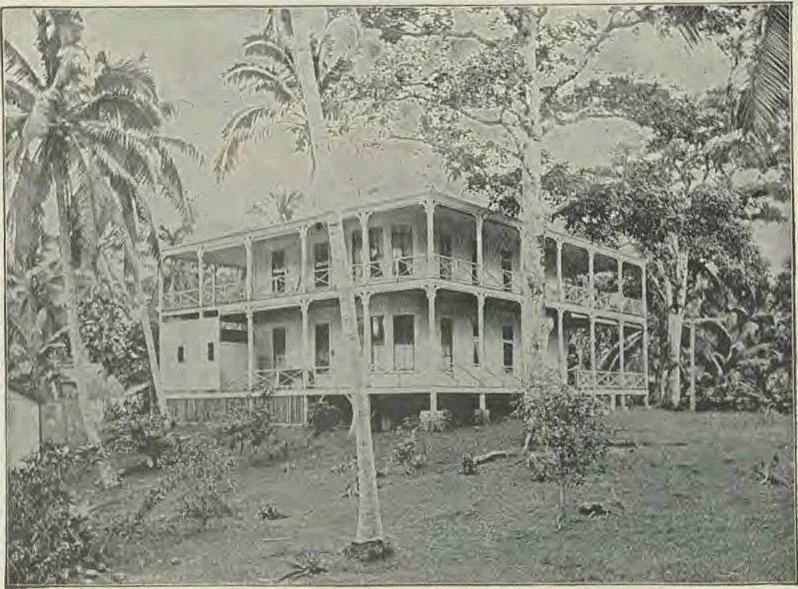
The following graphic account of the troublous times this far-away island is now passing through was written in a personal letter to the editor by Mrs. F. E. Braucht, who, with her husband, the physician in charge of our sanitarium at Apia, went to Samoa in 1895. The accompanying illustration gives an excellent view of the sanitarium, which is situated on high ground, and is comfortable and airy.
OUR SANITARIUM AT APIA.
“APIA, SAMOA, Jan. 2, 1899.
“We are in the midst of very exciting times here in Samoa. The Samoans are at war, and the last few days have been uneasy ones for the white people as well as the natives.
“About five months ago King Malietoa died; and since that time the people have been trying to make a new king. There are two parties,—one for Mataafa, a high chief; and one for Malietoa Tanu, son of the old king. Mataafa is a Catholic, and Malietoa belongs to the London Missionary Society’s church. Since the war began, it has appeared that the majority of the people are for Mataafa. His side numbers about thirty-five hundred armed men, while the loyal party has only about two thousand men. They could come to no agreement among themselves; so, according to the Berlin treaty, the matter was brought before the chief justice, who is an American, to decide. For a week or more he heard the evidence on each side in the court; and December 31 at eleven o’clock was the time set for him to make public his decision. As the Mataafa party had threatened to exterminate the whites if the chief justice decided against them, and it was feared they would begin an immediate attack, you may know that Sabbath, December 31, was an anxious day for us.
“We met for a special season of prayer in the forenoon, to humble ourselves before God, and ask his protection. Shortly after eleven o’clock the news came that Malietoa was king; and though the natives had been uneasy all the morning, running to and fro with guns, axes, and huge knives, the excitement now became more intense. Many of the natives who lived near by came with their trunks, boxes, sewing-machines, and all sorts of valuables, begging us to take them into our houses. They said that as soon as the war broke out, the other party, if they came out ahead, would burn their houses and take their goods; so we let them store their goods in our buggy-shed and in the storeroom over the boiler. We had taken a number of boxes into the house several days before this, too. There was great excitement all Sabbath afternoon; but it was hoped the matter would be settled without a battle.
“Sunday morning was a little more quiet, but the two parties were stationed, and ready to fight, should a gun be fired. Each side was waiting for the other to begin. Sunday afternoon, just before five o’clock, we heard a great shouting, beating of drums, etc., and hundreds of the Mataafa party came down the road in front of our house. They304came like a pack of hungry wolves, howling as only savages can. The Malietoa people met them just below our house, and there the battle began. Bullets were flying in every direction. Some of the neighbor women came hurrying to us with their children for protection. We all went into an inner room, where we stayed until the thickest of the battle was over. It was awful to hear the banging of the guns and the howling of the natives. One man fell not far from our house, and the enemy immediately cut his head off. That is their custom. They get all the heads they can, to carry to their king. At first the battle was all around us, on every side of the house; but after a little the men moved on down toward Apia, and fought in the streets among the stores. The Samoans are not usually good marksmen; and although they make a horrible noise when they fight, not many are killed. They kept on fighting as long as they could see, and all night long we could hear the guns firing in every direction. I would not like to spend many such nights as last night was.
SAMOAN WARRIOR.
“This morning the Mataafa party came past our house again, yelling, hooting, and flourishing their guns, axes, and horrible knives. The Malietoa party, however, had gone off to the English man-of-war about twelve o’clock in the night, and were all around the vessel in their small boats. The Mataafa party did not dare go out there to attack them, for fear the man-of-war would shell them. The Malietoa people are all out there yet; and the others are having their own way on shore, burning the loyal party’s houses and plundering their stores. We have seen houses burning in every direction to-day. We are thankful indeed that thus far we are unharmed, though we do not know what moment the natives may turn against the white people. Any little thing might set them off.
“The government here is in a bad state. Samoa, you know, has been under the protection of Germany, England, and America; but Germany takes sides with the rebel party, and opposes England and America; so we do not know how the trouble will end. This morning the German consul wanted to go over and recognize Mataafa as king; but the British and American consuls said they could not do that; Mataafa and his party are rebels, and they would continue to regard them as such until they received orders from home.
“TUESDAY, January 3.
“Everything seems rather quiet this morning. The Malietoa people came on shore last night, and will be held as prisoners at Mulinu’u Point by the other party until they see fit to let them go, or something is done by the three powers. The young king, Malietoa, is still on board the man-of-war. The prisoners made some arrangements yesterday with the Mataafa people, the rebel chiefs promising not to harm the Malietoa folks. The loyal party left their firearms on board the vessel. We do not know what the day will bring forth, but hope matters will all be settled without further bloodshed. We have been quite busy thus far to-day, taking care of the wounded. The natives have been rather slow about bringing them.”
From later accounts we learn that the trouble grew till it was no longer safe for white persons to remain on the island, and they found refuge on the war-ships in the harbor.
Our Interest and Love for Missionaries Abroad
How our interest and love should go out to our missionaries in this and other places, who are glad to go into “all the world” to preach to all men the blessed gospel of our Saviour’s soon coming!
THOSE WHO SUCCEED.
No answer comes to those who pray,
And idle stand,
Waiting for stones to roll away
At God's command;
He will not break the binding cords
Upon us laid
If we depend on pleading words,
And do not aid.
When hands are idle, words are vain
To move the stone;
An aiding angel would disdain
To work alone;
But he who prayeth, and is strong
In faith and need,
And toileth earnestly, erelong
Will sure succeed.
— Selected.
The Resurrection of Lazarus.
By Ellen G. White
IV.
The cries of the mourners prevented Martha’s words from being heard. On hearing the message, Mary rose hastily, and with an eager look on her face, left the room. Thinking that she had gone to the grave to weep, the mourners followed her. When she reached the place where Jesus was waiting, she knelt at his feet, and said, with quivering lips, “Lord, if thou hadst been here, my brother had not died.” The noise made by the mourners was painful to her; for she longed for a few quiet words alone with Jesus. But she knew of the envy and jealousy cherished in the hearts of some present against Christ, and she was restrained from fully expressing her grief.
“When Jesus therefore saw her weeping, and the Jews also weeping which came with her, he groaned in the spirit, and was troubled.” He read the hearts of all assembled. He saw that with many, what was looked upon as a demonstration of grief, was only pretense. He knew that some in the company, now manifesting hypocritical sorrow, would erelong be planning the death, not only of the mighty miracle-worker, but of the one to be raised from the dead. There were tender hearts in the throng, but there were also hypocrites. These pretended to manifest grief, but their hearts were full of malignity. Christ could have stripped from them their robe of pretended sorrow; he could have revealed their real sentiments. But he restrained his righteous indignation. The words that he could in all truth have spoken, he did not speak, because of the loved one kneeling at his feet in sorrow, who truly believed in him.
“Where have ye laid him?” he asked. “They said unto him, Lord, come and see.” Together they proceeded to the grave. It was a mournful scene. Lazarus had been much beloved, and his sisters wept for him with breaking hearts, while those who had been his friends mingled their tears with those of the bereaved sisters. In view of this human distress, and of the fact that the afflicted friends could mourn over the dead while the Saviour of the world stood by, who had power to raise from the dead, “Jesus wept.” Though he was the Son of God, he had taken human nature upon him, and he was moved by human sorrow. His tender, pitiful heart is ever awakened to sympathy by suffering. He weeps with those who weep, and rejoices with those who rejoice.
But it was not only because of his human sympathy with Mary and Martha, that Jesus wept. There was in his tears a sorrow as high above human sorrow as the heavens are higher than the earth. Christ did not weep for Lazarus; for he was about to call him from the grave. He wept because those now united with Mary in mourning for Lazarus would soon plan the death of him who was the resurrection and the life. But how unable were the unbelieving Jews rightly to interpret his tears! Some, who could see nothing more than the outward circumstances of the scene before him as a cause for his grief, said, softly, “Behold how he loved him!” Others, seeking to drop the seed of unbelief in the hearts of those present, said, derisively, “Could not this man, which opened the eyes of the blind, have caused that even this man should not have died?” If it was in Christ’s power to save Lazarus, why did he suffer him to die?
With prophetic eye Christ saw the enmity of the Pharisees and Sadducees. He knew that they were premeditating his death. He was the Son of the infinite God; and yet, a victim to Jewish hatred and infatuation, he was soon to be laid in the grave. In three days he was to rise, thus becoming for all “the resurrection and the life;” but the power to give men life was to be gained by passing through death. And at his death few save the disciples would weep over their disappointed hopes.
MRS. E. G. WHITE.
Love as the Mark of the Christian
LOVE is the badge of the Christian.
APRIL'S COMING UP THE HILL.
By Mary Mapes Dodge
Now the noisy winds are still;
April's coming up the hill!
All the spring is in her train,
Led by shining ranks of rain;
Pit, pat, patter, clatter,
Sudden sun, and clatter, patter!
First the blue, and then the shower;
Bursting bud, and smiling flower;
Brooks set free with tinkling ring;
Birds too full of song to sing;
Crisp old leaves astir with pride,
Where the timid violets hide;
All things ready with a will,—
April's coming up the hill!
—Mary Mapes Dodge.
MAKING HOME PEACEFUL.
By Mrs. L. D. Avery-Stuttle
XX.
FORGETFUL of the fact that the old man had ever aroused her envy and unreasoning jealousy, Grandmother Sharpe spoke of Deacon Beardsley, after his death, only in language of praise.
Well, it is always so. Grandmother Sharpe was not alone in this peculiarity. It is human nature. Strange that while our dear ones are with us, we are too often keenly alive to their faults, while we are blind to their virtues. But when the hand which in life we refused to take, or were too busy to hold in the warm clasp of brotherly love and friendship, is cold in death; and the timid feet, whose every stumble in life we were so quick to notice and censure, no longer climb life's hill by our side,—then we awake, as out of sleep, to see our mistake; and as if we could make amends for our neglect, we seek, like Grandmother Sharpe, to raise by our kindly words a monument for the departed.
The old man's heart had been so full of God's word, that it fell from his lips as the natural language of his soul. Sometimes a verse of Scripture would be the only answer he would make to a question: many times it was all the answer needed. But often, especially to Reginald, these apt replies had been only irritating and exasperating. But already the careless boy regrets the bitter, thoughtless words he gave the patient old man on that last evening,—the last words he ever spoke to him. He even wonders what his grandfather had wanted to say to him that night when he asked him to come to his room. The old man's pleading words ring in his ears with strange persistence He can not silence their echo. If he gives an unkind, disrespectful word to his father, memory brings back at once the soft, tremulous voice now silent forever, with its inspired words of reproof:—
“The eye that mocketh at his father, and despiseth to obey his mother, the ravens of the valley shall pluck it out, and the young eagles shall eat it.” Whenever he falls under the influence of evil companions, he never gives heed to their evil advice but under the continual protest of that gentle voice forever ringing in his ear: “My son, if sinners entice thee, consent thou not.” The rude lad, who had always objected to being “preached at,” was forced to listen to many and many a sermon engraved deeply upon his heart, long after the kindly voice of the “old preacher” was silent.
Mothers, do you feel discouraged because your wayward son heeds not your tears and prayers? Teachers, are you about ready to give up the battle because your pupils will not heed your words—the words of God? Hear him speak, faithless one: “For as the rain cometh down, and the snow from heaven, and returneth not thither, but watereth the earth, and maketh it bring forth and bud, that it may give seed to the sower, and bread to the eater: so shall my word be that goeth forth out of my mouth: it shall not return unto me void, but it shall accomplish that which I please, and it shall prosper in the thing whereto I sent it.” The oath of the Eternal is pledged: shall we believe it? It is the will of the All-father that the gentle voice of his aged servant shall ever “cry aloud,” and “spare not,” even though the years may come and go. Like the gentle Shepherd who left the ninety and nine, and sought the one lost sheep until he found it, so the influence of those precious words of God, repeated so often by his servant, will faithfully and persistently pursue the wayward youth over the mountains of sin and the dark deserts of unbelief, until the angels around the throne shall echo the glad song: “This my son was dead, and is alive again; he was lost, and is found.”
Ah, the word of God! it is never lost;
It is clean and white and pure;
O, bid it welcome within thy heart,
It will cleanse the temple, and ne'er depart;
For the word of God is sure.
There was one childish heart whose grief over the departure of grandpa was deep and sincere. Flossie was not to be comforted. Especially did she miss him when the little limbs grew weary,307and the tired eyelids drooped; for at such times it was that grandpa used to take the slender little form in his arms, and in his peculiarly gentle voice, tell her his sweetest stories. And grandpa's stories had always served as panaceas when everything else failed to soothe and comfort the afflicted child.
With each succeeding day, it becomes more and more apparent to James Beardsley that he is fast losing what little influence he has ever had over his son. With a sinking at his heart, he notices the ever-increasing evil effect of bad companions upon him. The lad's mother still seems to be completely blind, not only to his faults, but also to his danger. “When he is older, James, he will be all right. Of course he likes young company; you must n't think you can put an old head on young shoulders.” With such arguments as these, Ellen Beardsley would seek to quiet her own and her husband's conscience.
MRS. L. D. AVERY-STUTTLE.
(To be continued.)
SWEET PEAS CLUBS.
By A. L. Millet
TEN or twelve boys and girls who have not much money, and yet would like to do something to brighten some darker life, and add blessing to their own, might form a Sweet Peas Club, and supply some hospital with these lovely blossoms.
There are several reasons for clubbing. The blossoms of the sweet pea should all be gathered every day; for if pods are allowed to form, the vines will stop blooming. The best time to pick them is in the morning, while the dew is yet on them, and the hot sun has not robbed them of their freshness. One member’s bunch alone might not be very large; but when all are together, the club would have a fine supply.
Members should take turns in receiving the flowers every day, and delivering them at the hospital. If you live so far away from such an institution as to make it necessary to send blossoms by express, arrangements can sometimes be made with the express companies to take them free.
Instead of a hospital, the club might supply the sick of their own Sabbath-school, or of the neighborhood. There are always many who love these dainty blossoms, but who are not able to raise them,—overworked mothers, busy working-girls, the sick, and the aged. Some clubs may be large and successful enough to supply these, and yet have flowers to spare for a hospital. However you may dispose of your blossoms, you may be sure there is no flower that will give better results for good care, or bring more sweet perfume or dainty beauty to an invalid.
To some it might seem advisable to have the vines in one big plot, which the members would take turns in caring for; but in the end, this plan would probably not prove satisfactory. By having separate plots, each member would not only feel responsible for the success or failure of his own plot, but would find many odd minutes to care for the flowers, when he might think it would take too long to go to the general garden-plot.
The seeds will cost very little: five or ten cents will buy as many as one person will need. Get mixed seed, made up mostly of bright colors.
As soon as danger of frost is past, dig a trench about one foot wide, eighteen inches deep, and as long as necessary for your supply of seed. If you can, place the trench where the vines will receive the morning sun, but be shaded in the afternoon. The best thing for the plants to climb upon is woven-wire fencing, four feet high, enough of which can be bought for a few cents. Set stout poles firmly at the ends of the bed, and tightly stretch the wire between them. This may be done after the vines come up, if one is very careful. Fill the trench two thirds full with a mixture of about two thirds good garden soil and one third well rotted manure.
Put in the seeds, two together, about one inch deep and three or four inches apart, in a row, through the middle of the bed. Discard the very small seeds, and do not wet the soil unless quite dry. When necessary to moisten the soil, do not soak it; for then when it dries, a hard crust will bake on top, and the tender shoots will hardly be able to push through. As the young plants grow, gradually fill up the trench; in this way you will obtain the benefits of deep planting without its danger and delay.
Be very careful never to allow the plants to suffer for water, but do not water them every day, a little at a time. When needed, give the vines a thorough watering before the sun is on them, or after it is off; and on the following day stir the soil, and break it up fine, one or two inches deep. This will prevent the surface from baking and the moisture from escaping. The same may also be accomplished by keeping the soil covered with litter. This must be well-rotted; otherwise it may burn the plants. This latter plan is not so good, for the reason that it does not let the air into the soil.
A. L. MILLET.
HOW TO DRAW FLOWERS IN PEN AND INK.
By Eva M. Carter
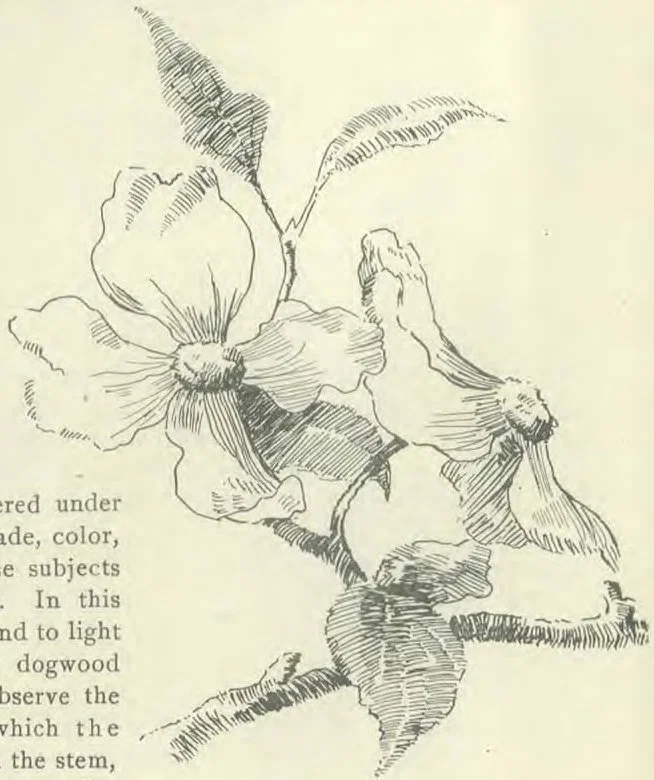
DOGWOOD BLOSSOM.
CLOVER.
Flowers not only make the world more beautiful; but no matter where they are grown, their refining, purifying influence is perceived. I have been thinking that perhaps the INSTRUCTOR girls and boys would like to have some instruction in making pen-and-ink drawings of flowers; and I am sure they will find this study pleasant and of benefit.
In taking up the work, a simple knowledge of botany and the form of leaves will be a material help. It is not necessary to know the botanical name of each flower, as many of these are difficult to remember; but a certain understanding of their parts, and of the general laws of their growth, is essential.
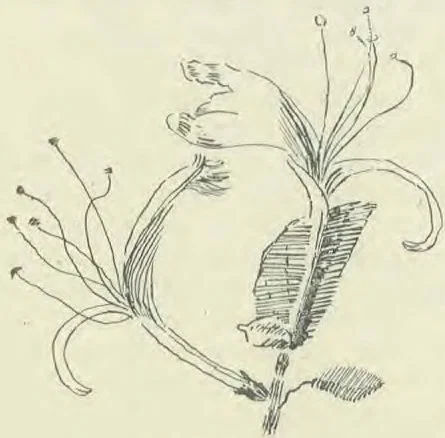
HONEYSUCKLE.
Pen-work done solely for study should be considered under four distinct conditions; namely, form, light and shade, color, and texture. It is not necessary to include all these subjects in one drawing; but each should receive attention. In this talk we will consider the subject as related to form and to light and shade. Taking, for example, the early spring dogwood blossom, we observe the manner in which the flower is set on the stem, the way the leaves spring out, and the character and shape of the petals. All this will come under the head of form.
In drawing flowers from nature, it will be more satisfactory for the beginner not to make too large an attempt, but to arrange a few blossoms in a simple way.
First make a preliminary pencil sketch, with a hard lead-pencil, on a sheet of smooth white paper or bristol-board, and only outline the shadows. When this is done, go to work with your pen. An ordinary sharp school pen is as good as any, and the ink must be absolutely black.
Endeavor to avoid many outlines, and draw in the petals as simply as possible. Try to express fearlessly your conception of the group of blossoms before you; and if the attempt is a failure, try again, as the flowers will last several days.
We will now consider the light and shade in the drawing. The darker part of the flowers turned away from the light is apparent. Notice the shadows of the leaves, and the light and shade on the stem. The lines which form the shading should be closely and more evenly drawn where the shadow is darkest. In shading the rounded stems, be careful that the lines of shade follow the form of the stem; that is, curved lines must be used to shade any object whose surface is curved. Let the light which strikes your study come from only one window, as otherwise the shadows will be confused.
Although many discouragements and failures attend these pen-studies, the true flower-lover can not but rejoice in the beauty that lies before him, as he earnestly tries to reproduce309it in pen and ink. There is a charm about this work; and the more deeply one can feel the shape and texture of that which is before him, the more truly will the likeness finally appear upon his paper.
We will consider the subject of color and texture in our next talk. EVA M. CARTER.
A USEFUL DESK.
By W. K. Loughborough
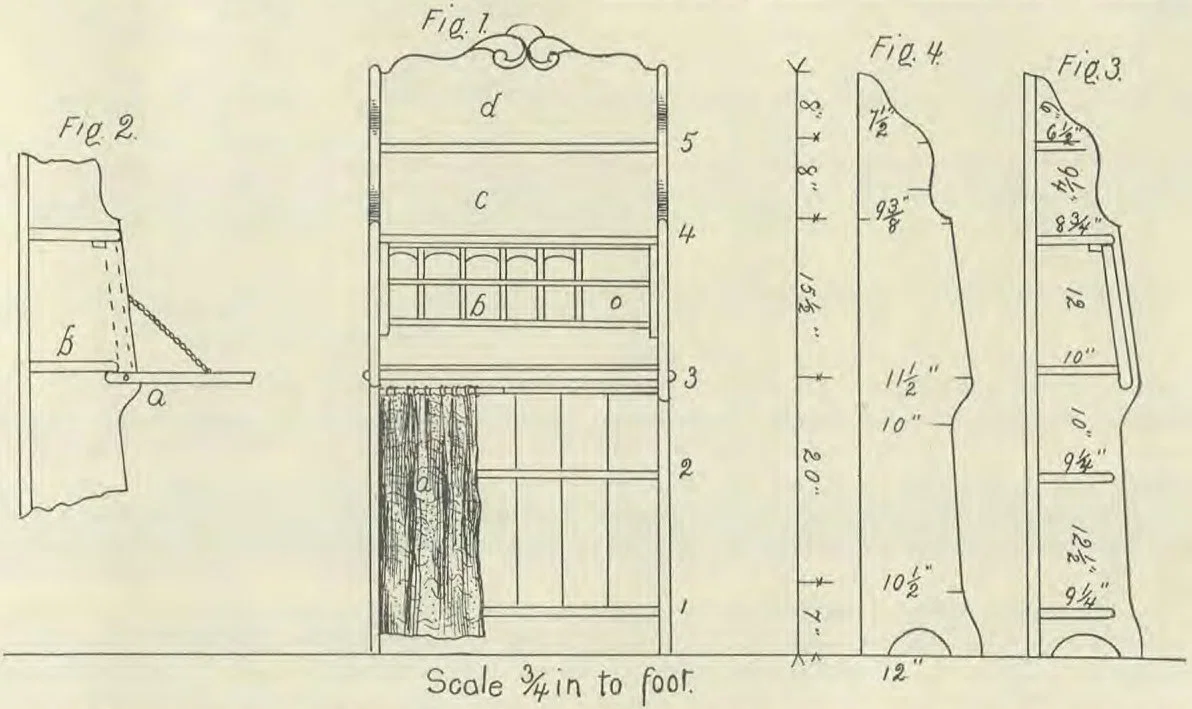
Perhaps by this time you have learned enough about the use of tools so that, with some directions, you can make a useful piece of furniture. The one here represented is the Chautauqua desk. It makes a good bookcase for a small library, also a writing-desk, with pigeonholes.
Scale ¾ in. to foot.
Fig. 1 gives the front view of the desk. It has five shelves, as you will see, numbered at the right of the desk, beginning at the bottom, 1, 2, 3, etc. In front of the lower shelves, at 3 in Fig. 1, is a brass curtain-rod, with curtain and rings, which you can draw over the shelves below. See a, Fig. 1.
At b you will see some pigeonholes. These are made of thin lumber, and shoved in between the sides. Two three-fourths-inch screws at each end will hold them in place. There is one drawer, also a shelf for paper. The lumber for these need not be over three eighths of an inch for the outside and one fourth of an inch for the divisions. Above these are two shelves, at 4 and 5.
The back of the desk, up to the fourth shelf, is made of one-half-inch lumber, placed perpendicularly, and nailed to the shelves with one-fourth-inch small wire nails. The boards on the back at c and d are placed horizontally, just the reverse of those at the bottom. These should be of the same thickness as the boards of the sides. The back to the upper part is made of two boards, which come together in the center of the top shelf, at 5.
In front of the pigeonholes is a lid, or door, that can be turned down to write on. You can make it of one board, with or without cleats nailed on the ends. The cleats would prevent its warping, but if you give attention to what I have written in a previous article, and use a piece of board from near the center of the log, with the grain running through it, the shelf will not be likely to warp.
In Fig. 2, at a, you will see the lid let down, ready for use. When lowered, it runs under the shelf at b. At the round, black spot put in a two-and-one-half-inch round-headed, nickel-plated screw. This makes the hinge for it to turn on. In Fig. 3 you will see this door closed. After it is closed, make the holes for the screws. They should come just below the shelf, so that the door, when turned down, will strike the under side of the shelf, b, in Fig. 2, which gives it a support. Then with a little brass chain, which you can get at a hardware store, fastened at each310end with a small screw, the shelf will be solid. You will need to put a piece of wood about three fourths of an inch wide and three eighths of an inch thick under shelf 4, for the door to strike against.
For the sides of the bookcase take two boards about five feet long and twelve inches wide. At the left of Fig. 4 you will see a perpendicular line, with short, horizontal lines running out from it. From the bottom up to the first line is seven inches; to the next, twenty inches; then fifteen and one-half inches; then eight inches; then eight inches more to the top. Joint off one edge of your board for the sides. Square off the bottom end, then on the back edge (see Fig. 4), seven inches from bottom, make pencil mark; then twenty inches above, make another; and so on upward, according to those marked on the perpendicular line. Now a few words about getting the shape of the side boards: The bottom is twelve inches wide; at your first mark from bottom it is ten and one-half inches wide; at your twenty-inch mark, it is eleven and one-half inches wide; about four or five inches below this, it is ten inches; from ten to ten and one-half inches down the line it is straight. Now the line from eleven and one-half upward inclines, or leans, a little; so it is nine and three-eighths inches at your next mark. Just below seven and one-half inches it curves in about one inch. The bottom ends, that rest on the floor, are two and one-half inches, giving two inches rise between them. With these points in mind, you can readily mark out the sides of the desk.
In Fig. 3 the width of the shelves is given. The two bottom shelves are nine and one-fourth inches wide; the next, ten inches; the other two, eight and three-fourths and six and one-half inches respectively. The edges are rounded a little. The shelves are two feet and six inches long, and set into the sides about one fourth of an inch. Find the heights for shelves in Fig. 3.
The best wood of which to make this desk is red oak; however, you can make it of such wood as you may have. You can nail through from the outside, then putty up nicely.
What I designed to tell you this time about the use of the wood-scraper I shall have to leave until next week, as it would make this article too long.
W. K. Loughborough.
HOW THE DAFFODILS GROW.
OUT in the garden there are tiny green spears shooting up through the black mold. They are not much to look at now, but we know that in a little while they will reach up straight and strong to the light; and up from the green sheath folded so tightly now will come the golden trumpet of the daffodil, or the white narcissus, with its gold-rimmed cup.
Where have they been all winter? We have not seen them in the garden-beds. Much of the time the snow has covered the place where they are now springing up. But the ground was bare and brown, with only a tangle of dead leaves and stems showing above the surface.
Down underground, curled up into a tight white ball, the daffodils lay asleep. Safely wrapped up they lay all through the winter, like a baby in its cradle, sending out tiny rootlets in search of food, and growing plump and strong in their cosy nest. Long before we heard the bluebirds sing, something stirred down there in the dark, and said to the daffodils: “Wake up! It is time you were coming to the light.” And the daffodils heard, and began to push their white shoots up through the dark. Now they stand in the garden-bed, strong and brave, while the winds whistle about them. In a little while they will hold up their golden trumpets, and give a merry welcome to the spring.311
But it has taken all winter for them to get ready for this spring blossoming. I wonder if, when the bulbs were planted last fall, and left in the dark to grow, they thought they were forgotten, and rebelled at their fate. No, I do not think so. It was the only way. God planned the time that the little white bulb needed to mature its forces, and prepare the bud that lay at its heart to be a beautiful blossom, just as he plans for little children, that they may grow quietly and happily, laying the foundations of a sturdy manhood and womanhood. That is what the school-days are for, and the pleasant home with father and mother to care for the little ones.
God wants us to make the most of this time of preparation. Now is the time to nourish brain and body with all that God has provided, just as the daffodil sends out its rootlets to draw food from the earth. All around you are a thousand things which he has provided for your use and comfort; make the most of them, then, so that when God whispers to you that your work is ready, that he has something for you to do, you will be prepared for whatever he has for you. You can not tell beforehand what it is to be; the daffodil did not know what it would become under God’s sunshine and rain; but every one who obeys God, just as the daffodil did, will find a purpose in his plans that it will be a joy to fulfil.—Selected.
Good Thoughts Are Blessed Guests
“Good thoughts are blessed guests, and should be heartily welcomed, well fed, and much sought after. Like rose-leaves, they give out a sweet smell if laid up in the jar of memory.”