“Rest, little sister,” her sisters said—
Violet purple, and Wild-rose red—
“Rest, dear, rest till the sun comes out,
Till the hedges bud, and the grass-blades sprout.
We are safe in the kindly earth, and warm;
In the upper world there are sleet and storm.
Wait, dear, for the robin’s true, clear note,
For the sound of a drifting wing afloat,
For the laughter bright of an April shower,
To call and wake you, sweet Crocus Flower.”
But brave-heart Crocus said never a word,
Nor paused to listen for note of bird,
Or laugh of rain-drop. In rough, green vest
And golden bonnet, herself she dressed
By the light of a glowworm’s friendly spark,
And softly crept up the stairway dark,
Out through the portal of frozen mold,
Into the wide world, bleak and cold.
But somehow, a sunbeam found the place
Where the snow made room for her lifted face.
— Madeline S. Bridges.
THE CREATION OF MAN.
By M. E. Cady
In our studies thus far, we have seen the Lord build a world out of nothing. When it was first created, “it was without form, and void; and darkness was upon the face of the deep. And the Spirit of God moved upon the face of the waters.” The all-wise Creator did not leave the earth in this unfinished condition; for “he created it not in vain, he formed it to be inhabited.”
The first thing that brought order out of confusion was the creation of light and heat. These forces changed the water to vapor. Then God created the atmosphere, which is his means of lifting up the clouds from the earth. The work of the first two days was to construct a system whereby the water might be lifted up into the firmament. This being done, the Creator caused the dry land to appear, by gathering the waters together into one place. The dry land was to form a home for man and the lower animals. Not only was it to provide for them a home, but it was to supply them with daily food. “And God said, Let the earth bring forth grass, the herb yielding seed, and the fruit-tree yielding fruit after his kind.” In his wisdom, God had already provided for the maintenance of plant-life; for without light and heat, the plants could not live; and without water to nourish them, they would cease to grow.
After the Lord had planted the earth with vegetation, he placed permanent resources of light and heat in the heavens,—the sun, the moon, the stars. The sun was to rule the day, and the moon was to rule the night. Even as the Lord provided light, heat, air, water, and soil, before he created the plants, so he provided food before he created the animals that were to be sustained by it.
For the animals that he created, he made three homes,—one in the water, one in the air, and one on the land. After he had brought into existence the fishes of the sea, the fowls of the air, and the creatures which were to live on the dry land, he said: “Let us make man in our image, after our likeness: and let them have dominion over the fish of the sea, and over the fowl of the air, and over the cattle, and over all the earth, and over every creeping thing that creepeth upon the earth. So God created man in his own image, in the312image of God created he him; male and female created he them.”
Man was the climax of God’s creative works. He was made a little lower than the angels, and was crowned with glory and honor. The holy pair were placed in Eden. They were surrounded with everything that was attractive. The name of the father of the human family was Adam, and the name of the mother was Eve. God placed them in the garden, not to spend their time in an idle way, but to dress the garden and to keep it. Man was endowed with powers of mind which were far greater than any possessed by the lower orders of creation. He could study and think about the wisdom and power of God, as revealed in his handiwork. He was holy and righteous in character; for man was made upright in the beginning. He was provided with a wonderful organism. David, in speaking of the human organism, said, “I will praise thee; for I am fearfully and wonderfully made.” Like the plants, man was formed from the dust of the ground; but the all-wise Creator endowed him with a body and a mind which were superior to anything that he had before created on the earth.
In our next lesson we will take up the study of the wonderful body that God has given to man.
M. E. CADY.
A PLEASANT FACE.
“HAVE I a pleasant face, mama? Teacher said we must bring a pleasant face to school.”
It was a pleasant face that was lifted for the good-by kiss; and as the little fellows scampered off to school, I thought I saw why they had been so easily governed of late. “A pleasant face”! One can not keep that, and find much room for impatience and fretting. And how much brighter it makes the rest of the house! You can not wear a cross, angry face, and then put on a pleasant one suddenly, and have it fit. The ugly face leaves creases and furrows and wrinkles that must be smoothed out before the pleasant face looks as if it belonged there. “Practise makes perfect;” and if you have a scowl most of the time, you will find it is a great deal easier to scowl than to smile. If you want a pleasant face, put it on the first thing in the morning, like the little boy who “buttoned on his smile” with his collar. Then it will come to fit so well that you need not be afraid of its slipping down at inconvenient times, and showing a scowl underneath.—Little Christian.
THE CHLOROPHYL CELL.
By W. S. Chapman
II.
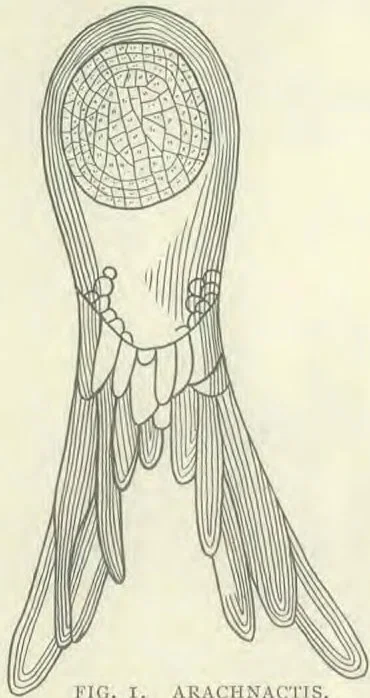
Some jellyfish are very large, while others are so small as to be almost invisible. Here is one of those small phosphorescent animals that illuminate the coast-line on still nights. It is called Arachnactis (“spider-formed”), and is a predatory animal, living upon others. It has a voracious appetite. The arachnactis is smaller than the hydroid, yet too highly organized to be the creature we are looking for, as it has a mouth, stomach, eyes, etc. See Fig. 1.
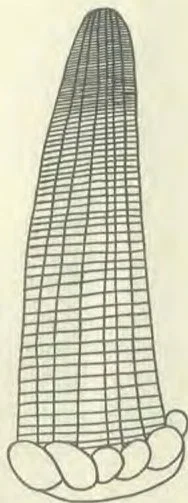
If we could catch one of the larger jellyfish, and turn it over on its back, to open its mouth, which is underneath, in the center of its body, we would find, tucked away in the corners, a tiny creature, with a big name,—Bicidiæ. This is a parasite that lives on the large jellyfish. See Fig. 2.
FIG. I. ARACHNACTIS.
FIG. 2. BICIDIÆ.
All these creatures are very small, but none can be the one we are looking for. Why?—One reason is that there are others yet smaller, and we are looking for the very lowest form of life. “Is it in the air?” you ask. Oh, no; those are all consumers: none of them create; they only destroy. Well, then, where can we go to resume our search? There is nothing so small upon the earth as the little creatures we have already examined, and the invisible lives of the air are all destructive agents; where, then, can we find a field for investigation?
But we have not yet exhausted the resources of the sea. So far, we have barely skimmed over its surface. Let us now descend into it for a mile or so. “A mile!” you exclaim; “why, nothing lives that deep in the ocean. The water is intensely cold, and it is dark as midnight down there. Besides, the pressure is so great that nothing could exist beyond a certain depth; even wrecks of vessels never descend far, but float on the surface of this awful depth of water.”
Yes, it was once thought that life could not exist at a greater depth in the ocean than the sun’s rays could penetrate, but it is now known that the ocean bottom teems with countless forms of life, great and small, many of them beautiful beyond power to describe, and most of them capable of casting a phosphorescent glow around them; so that the great ocean depths are illuminated with God’s living lights.
W. S. CHAPMAN.
Living Lights
“LIVING lights”! “Ye are the light of the world.” Are you a “living light” in a dark place?
TIME: A. D. 31. PLACE: Capernaum. PERSONS; Jesus and his disciples, the paralytic and his friends, Pharisees and multitude, Matthew.
QUESTIONS.
1. In consequence of the leper’s public testimony, what did Jesus do? Mark 1: 45.
2. Where did Christ again appear? Mark 2: 1. When this was noised abroad, what happened? V. 2. Who are mentioned as being present on this occasion? Luke 5: 17.
3. While Jesus was speaking, who was brought to the place, and in what manner? Mark 2: 3. What novel method did the bearers of the palsied man employ to come into the presence of Jesus? V. 4. What laudable traits of character do we see in these men?—Tact, perseverance, and faith.
4. What did Jesus say to the afflicted one? V. 5; Matt. 9: 2. How did these words disturb the feelings of the scribes? Mark 2: 6, 7. What questions did Jesus direct to them? Vs. 8, 9. How was he enabled to read their thoughts?—This power was given him of God, as he needed it in his work.
5. How did the Saviour prove his ability to forgive sin? Vs. 10-12. What was the effect of this manifestation of power? Where did the Saviour next go? By whom was he followed? V. 13.
6. Whom did he meet on the way? What was Matthew doing? Matt. 9: 9. What did the Saviour bid him do? How promptly did he respond?
SYNOPSIS.
It is interesting to note how the way was prepared for Christ’s ministry in Capernaum. The report of his first miracle reached Capernaum from Cana; and on his return from Samaria, he is sought by the nobleman of Capernaum, whose child is at the point of death. The healing of the child and the nobleman’s faith prepare Capernaum to receive the Lord. The people’s faith makes possible the doing of mighty works. The report of Christ’s miracles at Capernaum is met with unbelief in Nazareth. The second visit to Capernaum is attended with more convincing display of divine power. The demoniac is healed, Peter’s wife’s mother is restored to health, and crowds of afflicted persons are set free. When the interest at Capernaum seems at its height, Jesus takes a tour to other cities in Galilee; but the mistaken zeal of the healed leper forces him to withdraw from public ministry for a season, as it furnishes his enemies an excuse for prohibiting his ministry. His third visit to Capernaum follows.
NOTES.
1. At Capernaum, Jesus dwelt in the intervals of his journeys to and fro, and it came to be known as “his own city.” . . . Capernaum itself was well adapted to be the center of the Saviour’s work. Being on the highway from Damascus to Jerusalem and Egypt, and to the Mediterranean Sea, it was a great thoroughfare of travel. . . . Here Jesus could meet all nations and all ranks, the rich and the great, as well as the poor and lowly, and his lessons would be carried to other countries.—“The Desire of Ages,” page 252.
2. This paralytic had lost all hope of recovery. His disease was the result of a life of sin, and his sufferings were embittered by remorse. . . . They [the Pharisees] had coldly pronounced him incurable, and abandoned him to the wrath of God. . . . Yet it was not physical restoration he desired so much as relief from the burden of sin. . . . The cry of the dying man was, “O that I might come into His presence!”—Id., page 267.
3. Jesus was teaching in the house of Peter. . . . His disciples sat close about him, and “there were Pharisees and doctors of the law sitting by, which were come out of every town of Galilee, and Judea, and Jerusalem.” These had come as spies, seeking an accusation against Jesus.—Id., page 268.
4. At his suggestion [that of the paralytic] his friends bore him to the top of the house, and breaking up the roof, let him down at the feet of Jesus.—Id., page 268.
5. Eastern houses had outside stairs leading to the roofs. Matt. 24: 17. The roof constructions were light rafters stretched from wall to wall, on which were thickly and evenly laid short sticks. Over these was a layer of fine brushwood, with a coating of mortar next. Over all this was spread an earthy substance of carbonate of lime, clay, and sand. In cases of poverty, common earth, mixed with ashes, lime, and chopped straw, was used. To break up such a roof was merely to scrape back the dirt, and remove the short sticks.—Geikie’s “Life and Words of Christ,” Vol. II, page 22.
6. And the power of the Lord was present to heal . . . The Spirit of life brooded over the assembly, but Pharisees and doctors did not discern its presence.—“Desire of Ages,” page 268.
7. While the paralytic was yet at home, the Saviour had brought conviction to his conscience. . . . Jesus had watched the first glimmer of faith grow into a belief that he was the sinner’s only helper.—Id., page 268.
8. In simple faith he accepted the words of Jesus. . . . Jesus had declared that the sins of the paralytic were forgiven. The Pharisees caught at these words as blasphemy.—Id., page 269.
9. Jesus gave them double evidence of his heavenly origin and power by laying bare their hearts, and by commanding the paralytic to arise, take up his bed, and go to his own house.
10. It required nothing less than creative power to restore health to that decaying body. . . . The same power that gave life to the body, had renewed the heart. . . . There are to-day thousands suffering from physical disease, who, like the paralytic, are longing for the message, “Thy sins are forgiven.”—Id., page 270.314
11. From the home of Peter, . . . they [the scribes and Pharisees] went away to invent new schemes for silencing the Son of God. Leprosy and palsy were not so terrible as bigotry and unbelief.—Id., page 271.
12. Christ longed to heal the Pharisees, priests, scribes, and rulers, and gave them repeated testimony of his love. He longs to heal you. Let the Saviour in.
13. Tax-gatherers were not merely the instruments of Roman oppression; they were extortioners on their own account. . . . The Pharisees had judged Matthew according to his employment, but Jesus saw in this man a heart open for the reception of truth.—Id., page 272.
14. Principle is always exacting. No man can succeed in the service of God unless the whole heart is in his work, and he counts all things but loss for the excellency of the knowledge of Christ.—Id., page 273.
INTERNATIONAL LESSON NOTES.
(April 30, 1899.)
CIRCUMSTANCES.
No sooner had Judas left the room than, as if it had been relieved of some ghastly incubus, the spirits of the little company revived. The presence of that haunted soul lay with a weight of horror on the heart of the Master; and no sooner had he departed, than the sadness of the feast seems to have been sensibly relieved. The solemn exultation that dilated the soul of their Lord—that joy like the sense of boundless sunlight beyond earth-born mists—communicated itself to the spirits of his followers. In sweet, tender communion, perhaps two hours glided away at that quiet banquet.—Farrar.
THE PROMISE OF THE SPIRIT.
Before offering himself as the sacrificial victim, Christ sought for the most essential and complete gift to bestow upon his followers,—a gift that would bring within their reach the boundless resources of grace. . . . Before this the Spirit had been in the world; from the very beginning of the work of redemption he had been moving upon men's hearts. . . . The Holy Spirit is Christ's representative, but divested of the personality of humanity, and independent thereof. Cumbered with humanity, Christ could not be in every place personally. Therefore it was to their interest that he should go to the Father, and send the Spirit to be his successor on earth. By the Spirit the Saviour would be accessible to all.—“The Desire of Ages,” pages 668, 669.
The Spirit is a permanent manifestation of the presence of God—God in us. The Greek word “comfortless” means orphaned. God's children are to live in conscious communion with him through the Spirit, which is given to convince, convict, counsel, and comfort.
The promise [of the Spirit] belongs to us as much as to the first disciples. . . . The power of God awaits our demand and reception. This promised blessing, claimed by faith, brings all other blessings in its train.—Id., page 672.
THE TEST OF LOVE.
“If ye love me, keep my commandments.” Christ saves men, not in sin, but from sin; and those who love him will show their love by obedience. All true obedience comes from the heart. It was heart-work with Christ. . . . Through an appreciation of the character of Christ, through communion with God, sin will become hateful to us. . . . The Lord will teach us our duty just as willingly as he will teach somebody else. If we come to him in faith, he will speak his mysteries to us personally. . . . And they [those who ask] will receive not only wisdom, but strength. Power for obedience, for service, will be imparted to them as Christ has promised. . . . And “whatsoever we ask, we receive of him, because we keep his commandments, and do those things that are pleasing in his sight.”—Id., page 668.
THE SPIRIT'S WORK.
“He that loveth me, shall be loved of my Father, and I will love him, and will manifest myself to him.” Jesus read the future of his disciples. He saw one brought to the scaffold, one to the cross, one to exile among the lonely rocks of the sea, others to persecution and death. He encouraged them with the promise that in every trial he would be with them. That promise has lost none of its force. . . . At all times and in all places, in all sorrows and in all afflictions, when the outlook seems dark and the future perplexing, and we feel helpless and alone, the Comforter will be sent in answer to the prayer of faith.—Id., page 669.
The Spirit was to be given as a regenerating agent, and without this the sacrifice of Christ would have been of no avail. . . . Sin could be resisted and overcome only through the mighty agency of the third person of the Godhead, who would come with no modified energy, but in the fulness of divine power.—Id., page 671.
“He shall glorify me.” . . . The very image of God is to be reproduced in humanity. The honor of God, the honor of Christ, is involved in the perfection of the character of his people. . . . Only when the truth is accompanied to the heart by the Spirit, will it quicken the conscience or transform the life. . . . No amount of education, no advantages, however great, can make one a channel of light without the co-operation of the Spirit of God. The sowing of the gospel seed will not be a success unless the seed is quickened into life by the dew of heaven.—Id., pages 671, 672.
NOTE AND COMMENT
Opportunities for Electricians.—The Philippine Islands, numbering several hundred, some of them exceeding in size many of our States, present a wide field for electricians, as, it is said, there are but seven hundred and fifty miles of telegraph-lines in the whole group.
American Locomotives.—Early last winter the Midland Railway Company, of Great Britain, gave orders for twenty American locomotives, ten to the Baldwin Company, of Philadelphia; and ten to the company in Schenectady, N. Y. This aroused considerable criticism by English manufacturers, but the railway company justified its course by saying that the engines were needed sooner than they could be obtained at home. Now comes another order to the Philadelphia concern, from the Great Northern Company, for twenty locomotives. This is causing much comment315and surprise in London engineering and official circles, as the British manufacturers were unable to supply the engines in less than eighteen months, while the present contract stipulates their delivery in four months.
Former Impossibilities Are Present Utilities.—Many things which would have been pronounced utterly impossible in the time of the preceding generation are now an every-day affair. One of these is the transmission of letters from Paris to Berlin, a distance of seven hundred and fifty miles, in thirty-five minutes. This feat is accomplished by the use of pneumatic tubes.
Tolstoi's Home Life.—This great Russian writer and philanthropist believes it is not right to accumulate money. His wife is rich, and the whole family is well-to-do. Before he adopted his present views, he made over to his wife the rights to certain books, which he has later renounced, and from which she, much against his will, still receives money, refusing to relinquish her interests. His later works are all common property as soon as published, as he will not copyright them.
Wireless Telegraphy.—Not long ago a message was sent from the lighthouse situated high on the chalk cliffs of the Isle of Thanet, Kent, England, to the lightboat stationed at the “Goodwin Sands,” twelve miles distant in the North Sea. Since then the same feat at the same distance has been accomplished in France by placing the instruments on the tops of towers ninety feet high. It is proposed to make use of this invention in conveying messages to different sections of an army in time of war.
Free Booklet
Treating on Health and Hygiene . . . Mailed to your address . . .
Why Don’t You Be Good to Yourself?
Stop talking drugs and patented poisons. Investigate the newer and saner method of curing diseases, by using—
The Kellogg Sanitas Folding Hot Air Medicated and Vapor Bath.
Adapted to the hygienic and physiological requirements of every man, woman and child. RECOMMENDED BY LEADING PHYSICIANS. CURES La Grippe, Colds, Rheumatism, Throat Affections, Aches, and Pains. Equalizes the circulation. Reduces flesh harmlessly and speedily, and beautifies the complexion.
Men and women make good wages managing agencies and bath parlors. Address with stamp,—
THE KELLOGG SANITAS CO.,
101 East Main St. Battle Creek, Mich.
THE CHRISTIAN EDUCATOR
For March, which was delayed for special reasons, is just issued. It contains matter of unusual interest to INSTRUCTOR readers, and the publishers design to send each a free sample copy. If you have not received it by the time this number of the INSTRUCTOR reaches you, please ask your Sabbath-school superintendent for it. Every youth who reads the INSTRUCTOR should take the Educator for his parents. It will cost you only twenty-five cents a year if you get the March number with the Special Coupon. Your order must be mailed before April 30.
The Bible and the Youth’s Instructor
By Editor
The clubbing list of the Youth’s Instructor with other periodicals has been discontinued. The premiums have been dropped, except to those who are now working for premiums, in which cases they should send in enough subscriptions at 75 cents to make up the amount of money required at the old rates.
The Instructor Bible has been so favorably received that it has been decided to continue this offer, as follows:—
The Bible and the Youth’s Instructor.
We will send the Self-pronouncing Sabbath-school Teachers’ Reference Bible, post-paid, and one yearly subscription to the Instructor, for $2.25; or we will send the Bible, post-paid, for six new yearly subscriptions to the Instructor at 75 cents (or $4.50).
Please send all orders, and make all drafts, money-orders, etc., payable to the Review and Herald Pub. Co., Battle Creek, Mich.
TO REACH BATTLE CREEK FROM CHICAGO, BUFFALO, DETROIT, OR TOLEDO,
Purchase tickets reading over the
MICHIGAN CENTRAL
“The Niagara Falls Route.”
A First-class Line for First-class Travel, between CHICAGO and NEW YORK and BOSTON. Elegantly equipped through trains pass Battle Creek in each direction daily.
R. N. R. WHEELER, Ticket Agent, Battle Creek.
O. W. RUGGLES, Gen’l P. and T. Agt., Chicago, Ill.
GRAND TRUNK RAILWAY SYSTEM.
By E. H. Hughes; A. S. Parker
Time Card in Effect Feb. 5, 1899.
C. & G. T. DIVISION.
West-bound from Battle Creek.
No. 11, Mail and Express, to Chicago... 12.00 A. M.
No. 1, Chicago Express, to Chicago... 9.00 A. M.
No. 3, Lehigh Valley Express, to Chicago... 5.40 P. M.
No. 5, Pacific Express, to Chicago with sle'p'r 12.55 A. M.
No. 75, Mixed, to South Bend... 7.30 A. M.
Nos. 11 and 75 daily, except Sunday.
Nos. 1, 3, and 5 daily.
East-bound from Battle Creek.
No. 10, Mail and Express to Port Huron, East and Detroit... 3.45 P. M.
No. 4, Lehigh Express, to Port Huron and East... 8.27 P. M.
No. 6, Atlantic Express, to Port Huron, East, and Detroit... 2.25 A. M.
No. 8, Lehigh Express to Saginaw, Bay City, Port Huron, and East... 6.50 A. M.
No. 74, Mixed, to Durand (Starts at Nichols)... 7.30 A. M.
All points in NEW ENGLAND, THE MARITIME PROVINCES, GREAT BRITAIN, and the CONTINENT.
Illustrated literature, time-tables, and full particulars, upon application to—
J. FRANCIS LEE, Gen. Agent,
Passenger Department,
228 So. Clark St., Chicago.
Branch } 76 Ottawa St., Grand Rapids, Mich.
Offices: } Room D, Chamber of Commerce, Cincinnati, O.
} 315 Chestnut St., St. Louis, Mo.
FREE! ABSOLUTELY FREE!
By E. E. Miles
Your address on a postal will bring you FREE by return mail, goods that you can sell for 25 cents. Dare you believe it? Try us and see. This offer is made in good faith, and you do us a favor by responding. Address—
E. E. MILES, South Lancaster, Mass.
BOYS AND GIRLS,
By Editor
What department in the INSTRUCTOR is most helpful to you? Which articles do you enjoy most? and which do you find most practical in the everyday work of life? The editor would be glad to have every young reader send an answer to these questions.
Another thing: Isn’t there something of special note near your home, that all the widely scattered INSTRUCTOR family would be interested in,—some natural wonder; some landmark rich in historical association; some mine, or mill, or factory different from those in other parts of the country? Our Southern friends have a wide range of subjects. Who will tell us how pineapples are grown? or about an orange grove in full bloom? or how raisins are prepared for the market? or—but why should the enumeration go further? The field is unlimited. However, I must not forget our friends, the birds. Some of you who love them—and who does not?—can tell, in a few well-chosen words, what you yourselves have observed concerning them. Two or three such paragraphs would be worth far more both to you and to the INSTRUCTOR than a whole page gleaned from some book.
If you can send a pen or pencil sketch, or a photograph, illustrating your subject, so much the better.
Planting Sweet Peas for Club Members
READ the article on Sweet Peas Clubs in another column, and act on its suggestions. It is time now to plant the seed; and if you follow the directions carefully, you will be rewarded with a liberal supply of these lovely blossoms. Be sure to remember the aged in this ministry; for no one will be more truly grateful for the old-fashioned posies. There may be several boys and girls who can not belong to a club, but these may have a “club of one.” Where there are two or more in one family, they could form a little home club. The INSTRUCTOR would be glad to hear from those who take up this work.
GIFTS AND GIVERS.
THE principle set forth in the incident related below, touches the vital point in giving. It is just as natural now for men and women to measure the value of a gift by its amount as it was when Jesus sat over against the treasury, and watched the people as they brought their gifts. It was not those who from their wealth “cast in much,” you remember, who received the Master’s approving smile; but the one whose gift “meant something” to her,—even “all her living.”
“Two women were talking recently, in a large city, of a check for fifty thousand dollars that had been given by a very wealthy woman toward a charity in which they were both interested.
“‘What a splendid gift it was! how magnificently generous!’ cried one.
“‘A magnificent amount, certainly,’ said the other, thoughtfully, ‘but not so generous, I think, as the majority of gifts we receive.’
“‘Why, what do you mean?’ asked the other, astonished.
“‘I mean,’ said her friend, ‘that ten dollars from Mrs. M——, or five dollars from Mrs. R——, or half a dollar from Lilian S—— represents more hearty interest and real generosity than a hundred thousand dollars from that rich woman, who never feels a pinch because she gives. Self-denial makes true generosity. I would rather have ten thousand five-dollar subscriptions from poorer givers than one fifty-thousand-dollar subscription from a rich man or woman. Fifty thousand one-dollar subscriptions would be better still, for the same reason. We could far better spare our rich than our poor givers. The real giving of the world everywhere comes from the majority of the people, who can not give much, who are, indeed, often ashamed of the little they can give, but whose gifts carry the fragrance of love and self-denial with them, and bless the cause that receives them. We must give until we feel it, to find the happiness of giving.’”