MEENIE’S back was aching badly, and big tears stood in her blue eyes as she gazed out into the alley. The day was cold, and the wind blustered through the narrow street as if in a tempest of passion. Papers whirled hither and yon, a piece of tin hanging loose on the house opposite clanged a noisy protest, the children shouted and yelled in derision, though their tattered garments were scant defense against the cold. A group of sparrows were chattering and quarreling over a crust of bread, vanishing as a hungry-looking cat skulked hurriedly across the area, only to renew the debate more vigorously when their enemy had disappeared. There was nothing very cheery in the prospect,—“Nothing but walks and windows and cobwebs—all of it broken and dirty,” as Meenie said, in a tired little voice.
Meenie was what the boys of the alley tersely dubbed “a tie-in.” Poor little girl! A year ago she was racing, quarreling, playing, with the most sturdy of them. Now she was looking down upon the boisterous group with bitter rebellion in her little heart, and angry tears in her eyes. Why should she have suffered the accident which left her poor spine all twisted and hurt? What had she done more than the others, that she should be tied down and in, helpless as a baby? And the rebellion and the tears grew bigger and bigger as she gazed and pondered.
Just as the tears were threatening to fall, the door of her room was pushed open, and a dirty little face peered timidly in.
“You there, Meenie?” queried a small voice. Meenie turned her head slowly, still lost in the misery of her own thoughts. Then her face brightened.
“Yes, I’m always in. Come on.”
“I’ve got suthin’. Want to see?” and the in- truder advanced boldly, with a tightly clenched fist held behind him.
“What is it?” demanded Meenie. “Lemme guess first. Marble?”
“Nop,” with a delighted chuckle.
“Picture?”
“Nop.”
“Buzzer?”
A contemptuous shake of the head.
“I dunno. Lemme see now.”
The newcomer advanced a grimy fist, and slowly unrolled the dirty fingers, disclosing a bran new dime. There was a gasp of wonder, delight, astonishment.
“Bud,” whispered Meenie, in an awed voice, “where’d you get it? Ain’t it a beauty! My! but it’s fine. What are you going to do with it? Ole Nan’ll whip you if she catches you not giving it to her.”
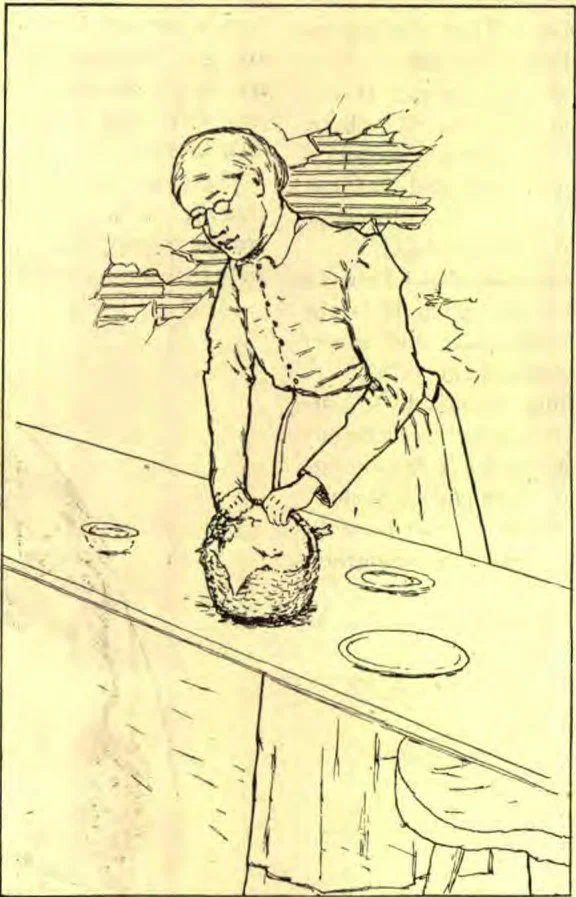
“A BOARD PLACED ON TWO CHAIRS”
“Ole Nan ain’t going to catch me, though. Nobody saw me pick it up. I was a racing Jim Flannigan down the alley, an’ I caught my toe on sumpin’, an’ down I goes; an’ when I rolled over to get up, there lay the dime a shinin’ an’ a shinin’. I grabbed it, an’ nobody saw it but me. I just wish I had all of ’em I could carry.”
Meenie reached out her hand and touched the coin with one finger. “What you going to do with it?” she again demanded.
“Guess ’gen,” and Bud’s eyes danced with roguish delight.
“No, I’m tired guessing,” as her back gave a twinge. “’Sides I never guess right. What are you?”
Bud reached over and whispered in her ear. A flush of pleasure spread over Meenie’s face, and she leaned back in her chair, and gazed at him with shining eyes.
“O Bud! how buchiful!”
“Yep. I’ve got to go now, but you just wait. We’ll have the greatest Thanksgiving you’ve ever seen. You think up things to do, an’ we’ll do it.”
It was only a week till the great day. Thanksgiving day in Halsted Court passed just the same as any other holiday in the year,—men drinking, women washing, gossiping, scolding; children playing, quarreling, crying,—the monotony broken occasionally by shrieks, and the sounds of crashing glass from some house where tempers had risen, and drink flowed too freely, ended probably by the rush and clatter of the patrol, which carried off the unfortunate victims of appetite and passion.
But this day was to be different for one small soul at least. Bud had found a whole dime, and (blessings on the generosity of his small heart!) had confided to her that she, Meenie, was to spend it all for Thanksgiving. What should she buy? This was the problem which Meenie propounded excitedly to the sweet-faced deaconess who had found her out, and was doing all she could to make life more beautiful for the little sufferer. They discussed the question, pro and con, and finally decided that Bud and the birds, the dear little sparrows which had helped Meenie through many a dreary day of suffering, chirping gaily at her window-sill, should share the treat. The wonderful dime was taken from its hiding-place, and given over to the care of Deaconess Grey, who was admonished to be “awful keerful ’bout spending it, and to git jest as much as ever you can with it.”
Dear little Meenie! She little thought that her dime, exhibited that evening in a crowded church, accompanied by a recital of its history by Deaconess Grey, would bring her many, many times its worth. But she bade Bud attend the feast the next morning, and be ready to hang the birds’ dinner outside her window for her.
They had a beautiful time the next day,—Meenie, Bud, Deaconess Grey, and the sparrows. The first three had a dinner which made Bud roll his eyes in ecstatic glee, and execute a genuine war-dance around the room, while Meenie sat lost in speechless admiration as Deaconess Grey spread a snowy little cloth over a board placed on two chairs, and then set upon it the contents of her basket,—bread and butter; hot baked potatoes, plump and mealy; rice as white as snow; a quivering mound of crimson jelly; pudding, nuts, oranges—an array such as the two children had never seen.
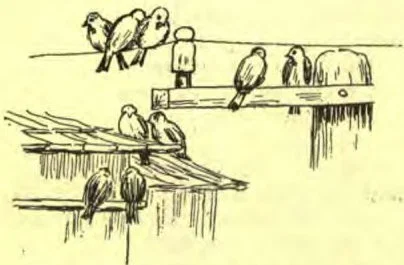
They had great fun after dinner, nailing a board on the window-sill, upon which a branch from an evergreen tree was fastened. Deaconess Grey had brought some grain with her, and this they scattered on the board, with some crumbs. Then they fastened little strips of meat and pieces of bread and potato to the evergreen, and all three sat down to watch the result. It didn’t take the sparrows long to find it out, and what a scolding, fussing, twittering, chirping bunch they were. Bud had to fill up the board and tree three or four times before the hungry crowd got374enough, and then one fat, saucy fellow insisted that he was yet starving, and chirped for more.
“THE DEAR LITTLE SPARROWS”
That night Meenie added to her evening petitions, “Please, God, I’m very glad you let us have such a nice Thanksgiving. Thank you for letting Bud find that dime—and please let him find some more.” ANNA CLIFF WHITE.
Truly Thankful
Poor little Honora Mullaly At the close of the Thanksgiving day, Was standing in front of her alley, A watching some children at play.
Her dress was a wonderful garment, All patches from shoulder to hem; And her hat and her shoes,—well, I beg you'll excuse Any further remarks about them.
But little Honora Mullaly Had a face just as bright as could be, And no flower in meadow or valley Was ever so pretty as she.
So thought an old woman, who, passing, Stopped a moment to smilingly say, “Why, bless your dear heart! I am sure you have had A very good dinner to-day.”
“Yis, indade,” said Honora Mullaly, “I did; for my friend, Mrs. Brown, Had a hape of sweet taters that Sally, Her daughter, baked lovely and brown, “Wid—O ma’am! if you could but have seen it!— The fattest and foinest of hins! And they give me the gizzard and neck of that hin, And all of the sweet tater skins!”
—Selected.
First Lessons in Geography
By Floyd Bralliar
Lesson XII
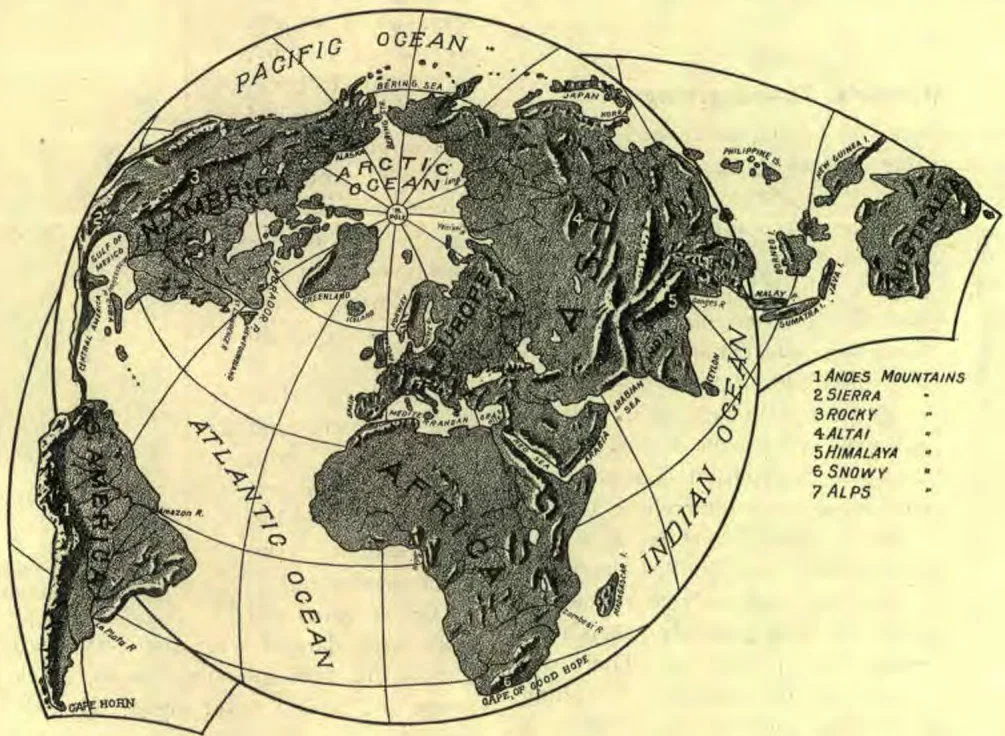
The map on this page shows the earth as it was after the flood, and as it is now. There were some lakes and rivers then that have since been filled up, or have dried away; and some islands have sunk into the sea, and others have been built up; but those are about all the important changes that have taken place in the earth’s surface since the flood.
Notice that there is one long chain of mountains, which extends from the southern point of South America to the northern part of North America. It has a small break in the northwestern part of North America. You will see on the map a chain of islands extending from the northwestern part of North America in a circular direction around the Bering Sea to Asia. These are the Aleutian (a-leu’-shan) Islands. They are simply mountains sunken in the sea, so that only their tops are above the water. The chain then begins as a range of mountains in Asia.
The ridge is again broken in Asia, part of it running to the southeast point, and the other branch running into the southern part of Europe, and crossing the Mediterranean Sea at the Straits of Gibraltar. It there passes with wide breaks through the west coast of Africa, down to the southern cape. The other branch of the great fold passes to the southeastern part of Asia, then crosses to Arabia, and then into Africa, passing down the east coast to the southern cape. The highest mountains in the world are in Asia, where the World Ridge makes its turn toward Arabia.
The mountain chains give shape to the bodies of land and direction to the rivers. As you will notice, most of the land of the world lies in three large bodies. Two of these are very large; the other is much smaller.
The land lying on the western side of the Atlantic Ocean is called the Western Continent, or the New World. The land lying on the eastern side of the Atlantic Ocean is called the Eastern Continent, or the Old World. Each continent contains large bodies of land, which we call Grand Divisions. Sometimes these grand divisions are also called continents. Is it not wonderful that the flood made such great changes in the earth?
Review.—How many grand divisions on the western continent? Name them. How many on the eastern continent? What are they? What water is north of the western continent? What water lies between the two parts of this continent? What water lies west of this continent? What sea is between Europe and Africa? Between Asia and Africa? For what is it noted in the history of the children of Israel? Name the six continents. Which is the smallest? Name all the oceans, and tell where they are.
Lesson XIII
The mountains forming the world system are not in one long, high ridge. They lie in many ridges, or folds, near one another, and run in the same direction. We call the whole ridge of mountains from the southern part of South America to the northern part of North America the Cordilleras. This ridge is divided into two great divisions. These divisions are the Andes of South America and the Cascades, Sierra Nevada, and Rocky Mountains of North America. There are smaller ridges and systems that we will study later.
Does it not seem strange that so much of the earth is covered with water, or with mountains, so that it is not fitted for man to live in? This is so there can not be so many wicked people living in the earth at once. God saw that the more he gave to men, the more wicked they became. At the time of the flood he changed the earth, so that the wicked might be shaken out of it. Job 38: 13. When the earth is made new, it will be changed again, so the whole earth can be inhabited, for there shall be no more sea.
Review.—What large peninsula on the northeastern coast of North America? On the northwestern coast? On the southwestern coast? On the southeastern coast? What large rivers in North America? What rivers in South America? What rivers in Asia? In Europe? In Africa? What large peninsula on the southeastern coast of Asia? On the southern coast? On the southwestern coast? What peninsula on the southwestern coast of Europe? On the northwestern coast? On the southern coast? On the southeastern coast?
FLOYD BRALLIAR.
Betty’s Way
By Annie H. Donnell
It helps Betty. You might try it some time, unless, of course, you don’t need any help — perhaps you like to wipe dishes! Betty — dear me, how Betty doesn’t like to! Although now it isn’t nearly as bad, since she made a play of it. It’s almost fun now.
When you are ten years old, you can make a play out of almost anything. That is the advantage of being ten years old. You will be surprised how much it helps — ask Betty.
“Come, girls — dishes!” mama calls, after tea. In the mornings and at noons there are the lessons, and mama washes them herself.
“Dishes! Dish-es! Call for volunteers!” and two volunteers appear. Glory is the older, and washes; Betty wipes. She waits until the drainer is full of glasses and spoons. Then she begins.
“Oh, dear,” she says, “how many debts I owe! I must begin right off, and pay ’em up. It will never do to let this go on any longer! There, there’s one debt paid a’ready. I begin to feel a little relieved. And that one’s paid, and that one, and that one! I’ll work ve-ry hard, and p’r’aps some day,” sighing, “I’ll be out of debt!”
She wipes away busily, a little scowl between her eyes. The tumbler debts, the spoon debts, the cup debts, are all paid. The plate and saucer ones come next, and she settles them.
“Why, I’m getting along beautifully!” she murmurs, presently, and the scowl is certainly smoothing out. There is a breathless last minute or two, and then a shout of triumph,—“Done!”
The towel waves, Betty dances on her toes, the Gray Princess wakes up and purrs her congratulations. Great times!
“Oh,” breathes Betty, “it feels so good to be out of debt!”—Annie H. Donnell.
November Days
By Lucy Larcom
Who said November's face was grim?
Who said her voice was harsh and sad?
I heard her sing in wood-paths dim,
I met her on the shore so glad,
So smiling, I could kiss her feet;
There never was a month so sweet.
October's splendid robes, that hid
The beauty of the white-limbed trees,
Have dropped in tatters; yet amid
Their perfect forms the gazer sees
A proud wood monarch here and there,
Garments of wine-dipped crimson wear.
In precious flakes the autumn gold
Is clinging to the forest's fringe;
Yon bare twig to the sun will hold
Each separate leaf, to show the tinge
Of glorious rose-light reddening through
Its jewels, beautiful as few.
Where short-lived wild flowers bloomed and died,
The slanting sunbeams fall across
Vine-broideries, woven from side to side,
Above mosaics of tinted moss.
So does the eternal Artist's skill
Hide beauty under beauty still.
And if no note of bee or bird
Through the rapt stillness of the woods
Or the sea's murmurous trance be heard,
A presence in these solitudes
Upon the spirit seems to press
The dew of God's dear silences.
And if, out of some inner heaven,
With soft relenting, comes a day
Whereto the heart of June is given,
All subtle scents and spicery
Through forest crypts and arches steal
With power unnumbered hurts to heal.
— Lucy Larcom.
Sailing Toward Heaven: Direction Over Position
By Oliver Wendell Holmes
I FIND the great thing in this world is not so much where we stand, as in what direction we are moving; to reach the port of heaven, we must sail sometimes with the wind and sometimes against it,—but we must sail, and not drift, nor lie at anchor.—Oliver Wendell Holmes.
THE YOUTH’S LESSON
X—The Continual Service
(December 6)
LESSON SCRIPTURES: In Synopsis.
MEMORY VERSE: “Wherefore he is able also to save them to the uttermost that come unto God by him, seeing he ever liveth to make intercession for them.” Heb. 7:25.
Synopsis
God’s gift of his Son to save man, and man’s acceptance of that gift by faith, is the essence of the gospel. John 3:16. Everything is embraced in this,—the forgiveness of sins (Gal. 1:3, 4), abundant life (John 10:10), and complete victory over Satan (Heb. 2:14), who will finally be destroyed through the power of Christ.
All this was included in the promise of a Saviour, which was given to our first parents in the garden of Eden. Gen. 3:15. Jesus not only made himself one with humanity, by taking upon himself sinful flesh, but through his life of righteousness he made provision for us, that we may live the same life that he lived. Rom. 8:3, 4; Gal. 2:20.
This complete gospel was preached in Israel’s time (Heb. 4:2), through the service of the sanctuary, the central idea of which was the indwelling presence of God: “Let them make me a sanctuary; that I may dwell among them.” Ex. 25:8. The divine presence was manifested in the holy of holies, over the mercy-seat, and between the cherubim. Ex. 25:21, 22.
Nothing but sin can make a separation between God and his people. Isa. 59:1. If man had not sinned, God would have walked and talked with him as in the beginning. This separation was overcome in the typical services by the offerings of gifts and sacrifices; and so a continual fellowship was established between God and man.
This is made very plain in “Patriarchs and Prophets,” pages 352–354: “The daily service consisted of the morning and evening burnt-offering [Ex. 29:38–42], the offering of sweet incense on the golden altar [Ex. 30:7, 8], and the special offerings for individual sins . . . Every morning and evening a lamb of a year old was burned upon the altar, with its appropriate meat-offering, thus symbolizing the daily consecration of the nation to Jehovah, and their constant dependence upon the atoning blood of Christ. . . . In the offering of incense the priest was brought more directly into the presence of God than in any other act of the daily ministration. . . . The incense, ascending with the prayers of Israel, represents the merits and intercession of Christ, his perfect righteousness, which through faith is imputed to his people, and which can alone make the worship of sinful beings acceptable to God. Before the veil of the most holy place was an altar of perpetual intercession, before the holy an altar of continual atonement. By blood and by incense God was to be approached,—[these were] symbols pointing to the great Mediator, through whom sinners may approach Jehovah [Heb. 10:19–22], and through whom alone mercy and salvation can be granted to the repentant, believing soul. . . . The showbread was kept ever before the Lord [Num. 4:7], as a perpetual offering. Thus it was a part of the daily sacrifice. . . . It was an acknowledgment of man’s dependence upon God for both temporal and spiritual food, and that it is received only through the mediation of Christ.”
These offerings were continual offerings,—there was no intermission,—just as the breast-plate of judgment was a continual memorial (Ex. 28:29, 30), and the light of the lamps was a continual light. Lev. 24:2. Thus the service performed was a continual service, representing the continual intercession of our High Priest in the sanctuary above (Heb. 7:24, 25), and the continual, or abiding, presence of this Saviour in every heart that will open the door and permit him to enter. John 15:4, 5; Rev. 3:20.
Questions
What is the essence of the gospel?
How much is embraced in this?
What relation does the gift of Christ sustain to forgiveness of sin?
MEMORY VERSE: “Come out from among them, and be ye separate, saith the Lord, and touch not the unclean thing; and I will receive you, and will be a Father unto you, and ye shall be my sons and daughters, saith the Lord Almighty.” 2 Cor. 6:17, 18.
(The chapter given as the Lesson Scripture is the lesson to be studied. Read this every day, and think over it until you know just what it teaches. Then the following notes, which should be read several times, will help to a fuller understanding of the lesson. Lastly, go over the questions carefully, and be sure that you can answer each in the words of Scripture.)
Before the birth of Isaac, God had told Abraham that his seed should be a stranger in a land not their own. But he also made the promise that after they had been there a certain time, he would bring them out again.
When Jacob, on the way to Egypt, came to Beersheba, one of the places where Abraham had built an altar, and proclaimed the name of the Lord, he stopped there to offer sacrifices. And God met him there, and told him that his children should be greatly multiplied in Egypt, and that he would bring them out again when his time came.
You will remember that Abraham was anxious that as God had called him out, so his seed should first be kept separate and distinct from all the nations of earth. This is why Joseph chose for them the land of Goshen, that they might not be mingled among the heathen Egyptians, and in time become a part of that nation. He wanted them to be kept a separate people who should worship the true God, and be his witnesses to the heathen around them.
Shepherds were disliked by the Egyptians, because in that land they were a low and ignorant class, who kept the cattle of the rich, and did not own their own flocks and herds, as the children of Israel did. Joseph gave this as the reason for keeping his brothers apart from the Egyptians, and giving them the rich and beautiful land of Goshen for pastures for their flocks.
Jacob saw Joseph in great honor (as his boyhood’s dreams foretold), and all his children well provided for, before he died at the age of one hundred and forty-seven years, after being seventeen years in Egypt. In making Joseph swear that he should not be buried in Egypt, but with his fathers in the cave of Machpelah, in the promised land, Jacob was showing his faith that God would fulfill his promise to give them that land for an everlasting possession.
Joseph lived ninety-three years in the land of Egypt. He was in great favor with Pharaoh and all the Egyptians, and had riches and honor. But he did not care anything for the treasures of Egypt; he desired only to be counted among the people of God. His two sons, Ephraim and Manasseh, were counted among the tribes of Israel.
Joseph’s hope, like Jacob’s, was in the promise made to his fathers. He knew that God would bring his people out of Egypt, as he had promised, and he made them promise to take with them the coffin containing his bones, that he might go with them into the promised land, and share in the inheritance.
“By faith Joseph, when he died, made mention of the departing of the children of Israel, and gave commandment concerning his bones.” Through all the years of Israel’s stay in Egypt, the bones of Joseph were with them as a reminder of God’s promise to deliver them, and a witness that “he is faithful that promised.”
Questions
1. How did God tell Abraham that his seed should go down into Egypt? Gen. 15:13. What promise did he then make about them? Verse 14.
2. To whom did God repeat this promise, and at what time? Gen. 46:1-4.
3. Who went with Jacob into Egypt? How many of the children of Israel were there all together? Verse 27.
4. Where did Joseph go to meet his father? Why had he chosen the land of Goshen for them? Verse 29.
5. What did he tell his brothers to say to Pharaoh? Verses 33, 34. Why did he not want them to mix with the Egyptians?
6. How long did Jacob live in Egypt? How old was he when he died? Gen. 47:28.
7. What did Jacob make Joseph swear before he died? Verses 29-31. Why was he so anxious to be buried in Canaan with his fathers?
8. When Joseph was dying, what did he tell the children of Israel? Gen. 50:24. What were they to do with his bones? Verse 25. What did he show by this?
9. How many years did Joseph live? Gen. 50:22. How much of this time was spent in Egypt? What token did the children of Israel always have with them that God would visit them, and bring them out of Egypt?
A String of Pearls
My days fall silent as the falling flowers
One after one forgotten, slipping past,
Yet God shall ask the record of their hours
Before his throne at last.
As pearls drop downward from a broken cord,
They slip asunder, aimless, heedless—lost.
What reckoning shall I give thee, O my Lord!
Of their uncounted cost?
What cord shall hold them safe in shining band?
How shall I link them firmly, one to one,
A circlet to be given to thy hand
When all their tale is done?
Joy can not keep them on its glittering,
Gossamer thread, snapt in the lightest breeze;
Hope and desire grow weak, and loose the string:
I can not trust to these.
One only thread is strong, and sure to last
Till thou shalt ask their reckoning there above;
Weave thou the threefold strand, and hold them fast
With faith and work and love.
— Selected.
Bringing Life Under the Supreme Desire to Do the Father's Will
LET each one who stands facing the future with the radiant brow of youth, bring his life under the power of the supreme desire to do the Father’s will.—John Henry Barrows.
SOLID THROUGH TRAINS OF
WIDE VESTIBULE COACHES and PULLMAN SLEEPING CARS BETWEEN Battle Creek and Chicago, Buffalo, New York, Philadelphia, Toronto, Montreal, Boston
For time-tables, descriptive matter, and information, apply to any representative of the company.
Thanksgiving — Thanksliving
If one should ask the boys and girls of the United States to-day,—and perhaps some of their elders,—“What is Thanksgiving?” the answers would no doubt vary widely, according to the teaching, memory, and observation of those questioned. Most of them, however, would agree that the “Pilgrim fathers” and “good things to eat” were closely associated with Thanksgiving. Even those whose ideas of the former were hazy and ill-defined in the extreme would still have a very decided opinion as to the proper way of observing the day. For it has come to be that too often the real object of our national Thanksgiving is lost sight of in the festivities that have become a part of its celebration.
But Thanksgiving is more than a word; it is more than an occasion; it is vastly more than reviewing the year’s bounties and blessings, and returning words of thanks to the Giver thereof. Thanksgiving, as some one has said, is Thanks-living,—not a day, but a life; not a feeling for one day, but a rule of conduct for all days. As God fed Israel in the wilderness, sending them “corn of heaven” with each new day, so to us his mercies are “new every morning.” Day by day he gives our daily bread; to each the word of promise is, “As thy days, so shall thy strength be.” And as we have received, so should we give—daily praise for daily blessing; continual thanksgiving for continual receiving.
We need to be careful that we make no mistakes about the quality of our giving of thanks. You remember the story that Jesus himself told—how two men went up to the temple to pray, the one a Pharisee, and the other a publican. Steeped in self-satisfaction, the Pharisee lifted up his hands, and prayed “with himself,” offering self-righteous thanks that he was “not as other men.” But the publican, trembling, abased, not daring even to lift his eyes to heaven, had grasped the thought that God’s love saves, and by praying for mercy he showed true gratitude for the gift of salvation.
And this cup of salvation, provided by God the Father and Christ the Son, is the supreme gift to every man, woman, and child who breathes on this Thanksgiving day. It stands of right at the head of every list of blessings—this gift with which and in which are freely given to us all things. One who sets out to “count his mercies” usually finds himself in the plight of the little girl who tried to count the stars—they are numberless; but whatever else is added or omitted, the contemplation of the salvation provided at so great cost for the children of men, should awaken in every heart the grateful response that inspired the psalmist as he sang:—
“What shall I render unto the Lord
For all his benefits toward me?
I will take the cup of salvation,
And call upon the name of the Lord.
I will pay my vows unto the Lord,
Yea, in the presence of all his people. . . .
I will offer to thee the sacrifice of thanksgiving,
And will call upon the name of the Lord.”
The Practical Side
Notice that David’s ideas of thanksgiving are very practical—he takes the cup of salvation, in the first place. He honors the gift that has been provided by thankfully accepting it. Is it not the height of unthankfulness to neglect the cup of salvation?
But David did not stop with simply taking the gift. No one does who accepts it truly. He called upon the name of the Lord. He paid his vows to God in the presence of all his people. He offered the sacrifices of thanksgiving. And he who makes his Thanksgiving a matter of Thanks-living will do the same thing. He will take the cup of salvation himself—but he will not keep it to himself. If he has received anything, he will realize that because he has received, therefore he has something to give—praise to God, help and tenderness and love to all who have not taken the cup of life, or who for any reason are in sorrow or need. His faith will be shown by his works. The “pure religion” of which James writes will be seen in his life. The fatherless and widows, the destitute, the naked, the hungry—these have a claim upon him that he hastens to fulfill.
In short, Thanksgiving is ministry—it is the Christ-life lived again, even the life of him who came not to be ministered unto but to minister. It has been well said that the enthusiasm that does not reach the finger-tips amounts to little. So with the Thanksgiving that does not find expression in deeds. The question is a practical and a personal one for us to answer—to-day and all the days. Let us, as did David, “take the cup of salvation,” and then, by Thanksgiving, make our lives a constant song of praise to the bountiful Giver of every good and perfect gift!
“O give thanks unto the Lord; for he is good:
For his mercy endureth forever.”