The Youth’s Instructor, Vol. 50, No. 47.

Thanksgiving Thoughts

The Youth’s Instructor

Nov 27, 1902

Review and Herald Publishing Company · Battle Creek, Michigan · Nov 27, 1902

Thanksgiving Thoughts

THERE can be no condition of life such that we can afford to be unthankful. And as this is the time of year when all the world professes to make thanksgiving, the Christian can hardly afford to be outdone in appreciating the good things that have come to him. It has been a good summer to most of us; and now, as we are about to settle down to a snug winter, we ought to have in our hearts a strong tide of appreciation flowing out toward the great Giver.
It is true that Thanksgiving comes at a time when all the world wears an aspect of melancholy; but it is only an aspect. True, the leaves are gone; but as they went, under the stem of the old leaf grew the bud that will open in leaf next spring. To be sure, the flowers are gone; but before they went, they gave birth to seeds that will bring the flowers that will appear next season; and, hidden away in the earth, there are multitudes of roots and tubers and bulbs that will reveal new life when the warm days come again.
As I meditate upon these things, my thoughts go to a favorite retreat just a little way out of the city,—The Willows, as I have named it. It is one of nature's quiet nooks, untouched by the evils of the world. Most of us can find such a spot somewhere near by,—a place where nature seems in happier mood than in other places,—a spot where she has had her way more fully than in others. Here one can find the first birds in the spring; and in this spot the spring flowers are a week ahead of the season. Here there is more sunshine than in any other place. A brook runs near by on its way to the lake, and along its bank grows a great clump of willows.
I have found strange birds here that I could not find anywhere else. And here, in their time, grew countless masses of asters and goldenrod and ironweed. Of course the butterflies came. I have sat in the fall sunshine, and watched them hours at a time, flitting hither and thither, their lustrous wings changing color in the brilliant sunlight; while others rested on the aster blooms, their great orange and black wings, spotted with silver, slowly opening and shutting while they drank the nectar of the flowers.
And the bumblebees, how they bumbled! Here, too, were digger-wasps and blue-flies and spotted flying beetles—a large variety of nature's beautiful and curious children.
But they are about all gone now. And if I should take you there with me this Thanksgiving day, and you should look at the naked trees, and the dry, dead weed-stalks; if you should hear the ice cracking on the lake, and feel the cold wind sweep down the frozen bed of the brook, doubtless you would ask me to come away from the cheerless place.
And it would be a dreary place indeed to you, but it could never be quite that to me. Yonder in the bare branches is a deserted bird's nest, the very sight of which brings to mind, with a rush of grateful thanks, the happy times we had here, the birds and I, all last summer. I know they will return next season—even now on warm days a few of them may still be seen. And the old, brown relics of weeds remind me of the asters and goldenrods and blue ironweed blossoms; and these, in turn, make me think of the butterflies and the bumblebees, and, in short, of all the blessed things I have enjoyed here through many a blessed day.
It is much this way in our lives. There may come cheerless times for him who does not enjoy life and God's blessings as they are given. But though Thanksgiving comes at a comparatively dreary time of the year, it is so only in a relative sense. If the good things are not flowing into our hands in such a steady stream now, it is nevertheless a good season for memories. Let the day be a sort of reminder of the things that have been, and of others yet to come. If we have not appreciated the blessings as they were bestowed, let us now “catch up” by giving thanks for all that has been, and all that we hope may be.
Although the melancholy days have come, as the poet has sung, and though they be the saddest of the year, they can never be wholly sad to us, or very melancholy, while our hearts are full to bursting with memories of the goodness and blessings that have followed, are following, and shall, please God, follow us to the end of the days.
For such let us make a glad Thanksgiving. L. A. REED.

Good Words of Counsel — III

“Let thine eyes look right on, and let thine eyelids look straight before thee.” Prov. 4:23–27.
It is perfectly natural for the feet to follow the eyes. One of the principal offices of the eyes is to direct our course. Bicycle riders know how difficult it is to avoid colliding with an object upon which they fasten their eyes. Almost invariably our feet will take us to the object at which we look. It is, therefore, very essential that our eyes look at the object which we wish to reach, or take the direction we wish to pursue.
The Saviour illustrates the importance of this by saying, “If therefore thine eye be single, thy whole body shall be full of light.” While it is true that we have two eyes, it is also true that they both see the same object, both are naturally focused at the same point, and the same image is received by both. If it were otherwise, if one eye saw the footpath and the other the street, we would fall into the ditch. By the united testimony of two eyes, the feet are safely guided. But if there were continually two paths and two sets of objects presented, our feet would suffer great entanglement.
So in every kind of pursuit, success depends upon our having but one object in view, and keeping that object always before us. Pausing in our course to gaze on this, that, and the other thing, will only fill the body with darkness, and insure our defeat in any worthy pursuit. The object upon which the Christian’s eyes are to be fixed is Jesus. Thus the heart becomes fixed in the contemplation of a perfect life, and almost irresistibly we are drawn toward him.
“Ponder the path of thy feet, and let all thy ways be established.”
We have frequent occasion to recall the remark that our “hindsight is better than our foresight.” The reason we are reminded of this impertinent observation is because we do not exercise our foresight as much as we do our backward view. But how can we anticipate our future steps?—“By taking heed thereto according to thy word.” The Christian need not walk in darkness. Here is a promise: “In all thy ways acknowledge him, and he shall direct thy paths.” Prov. 3:6. We read that “the way of man is not in himself: it is not in man that walketh to direct his steps;” but, “The steps of a good man are ordered by the Lord.”
The marginal reading of the text is: “Ponder the path of thy feet, and all thy ways shall be ordered aright.” When about to take a certain course, we should stop to ponder sufficiently to ascertain what the word of God says about it. We should know how it will affect our relation to him. If we lack wisdom, it will be given if we ask. James 1:5. Too often worldly prospects and appearances lead young people, and older ones too, to jump hastily at chances that present themselves, without stopping to consider what the result will be in their spiritual and eternal interests. Wisdom is thoughtful, and God has a chance to speak to the one who has the patience and good sense to wait to hear his voice.
G. C. TENNEY.

Diamond Diggers

DURING the June vacation I paid a visit to the alluvial diamond fields some forty miles from Kimberly. The country is flat and uninteresting, yet many people live there in the hope of some day making a fortune.
The life of the average “digger” is not one to be envied. Many of them have large families to support, and digging is a very precarious way of earning a living. There is little or no comfort in his home. Most of the houses are built of corrugated iron, and lined with canvas. They generally contain two or three rooms, with a mud “lean-to” for a kitchen.
There is no occupation whose results are more uncertain than that of the diamond-digger. To-day, fortune may favor him, and everything will look bright. In a week or two he will not know where the next loaf of bread is to come from. He spends his time in digging, washing, or sorting, with the help of native boys. For a while all may go well. Perhaps he finds a small stone or two every week, and the future looks bright. But one day luck turns, and for weeks and months he will not find enough to pay his boys. “But does he not stop digging?” you may ask. By no means; for the diamond-digger has wonderful hope and perseverance. “You never know your luck,” is his favorite expression. Hope predominates, although he may sometimes get discouraged. Men will live from year’s end to year’s end hoping and working for a fortune that never comes.
My intercourse with many of the diggers set me thinking of some of the lessons we might learn from their life,—lessons which, taken to heart, would make many of us turn to diamond-digging, but of a different kind.
The world is a vast diamond-field, and we may all be diggers in it. A great deal of soil is sometimes turned over and washed before a diamond is found, and the same thing may happen in our experience. The blood of Christ will wash these diamonds; and how bright they will shine among the surrounding débris! Many will be rough and dirty stones, but just as the acid cleanses and brightens the earthly diamond, so will trials and temptations, overcome through the blood of the Lamb, cleanse and brighten these precious jewels.
Many are unwilling to leave their pleasant homes to become diamond-diggers for the Lord. They do not care to bear inconvenience. I wonder how many would leave home if they were sure of finding a “Koh-i-noor” in some desolate place? But there are not enough “Koh-i-noors” in the world to buy a man’s soul. It took the life of God’s Son to purchase that,—and shall we be too indifferent to mine for souls bought at such a price?
Many of the Lord’s diggers get weary. They are sometimes heard to say that they feel like “giving up.” Day after day they work, yet see no results, and their faith grows weak. O, do not give up! Hope on, and, like the diamond-digger, have faith that some day, perhaps to-day, you will find a diamond. Maybe you will have to turn over a lot of soil, but God’s word will not return unto him void.
Digging for God is a wonderful privilege. The ones who found the Koh-i-noor probably felt proud to think that it adorned the crown of the sovereign of one of the greatest nations of the day; but we all have the privilege of finding diamonds for the King of kings, who will some day make up his jewels from among those who love him on the earth. May each reader of the INSTRUCTOR have a part in finding them for him. AMY INGLE.

The Charm of Self-Control

WHEN Bessie went from her city home to her Aunt Margaret’s place in the country, she carried the pleasing conviction that she was a model young woman. Such conceit seems odious in the telling, and Bessie would not have owned that she held it—but she did. Perhaps it may be counted in her favor that she expected and hoped to make her “ladylike accomplishments” useful, and was willing to impart any of her gifts and graces to any one who seemed qualified to receive them.
But on the first evening of her visit her self-satisfaction was threatened. She had flung herself over, rather than into, a chair, and Aunt Margaret glanced at her, and drew herself up. “Don’t sprawl, dear,” she said, with gentle decision.
This to a girl who had been complimented more than once on the “unstudied charm” of her attitudes! Bessie flushed, but she only said: “I’m afraid it’s natural, aunty.”
“It’s natural to be graceful, too, if one schools herself to have it so,” Aunt Margaret answered.
There the matter dropped. Probably Bessie forgot the reproof; but it was recalled to her twenty-four hours later, when Aunt Margaret brought to an unexpected conclusion a story of her own girlhood.
“Bessie,” she said, abruptly, almost in the instant when she finished the tale, “has any one ever called you ill-bred?”
“Certainly not!” the girl blazed out.
“But doesn’t it show ill breeding to be inconsiderate, as you are, of other people’s nerves? You have dandled your foot and twisted that trinket, and even drummed with your fingers while I have been talking. If I had been a nervous person, which happily I am not, your fidgeting would have driven me frantic. Setting aside any question of discourtesy to me, why don’t you cultivate repose? It’s more attractive—and more restful—than this perpetual motion.”
“Cultivate repose? I never thought about it.”
“I suspected as much,” rejoined Aunt Margaret, grimly.
Then she went on to say that very few persons know how to sit, much less how to sit still; that this deficiency argues ill-breeding or “slackness” or want of self-control; that if one permits one’s self to shuffle or lounge or fidget, one is in danger of losing the mastery over one’s body, and of falling into “a slovenly habit of mind.”
It seemed to Bessie that Aunt Margaret’s conclusions carried her a little too far; but the girl perceived, too, that in days when “liberty” is the general watchword, restraint may be all the more an individual duty. Therefore she dropped a few of the habits and mannerisms she had taken into the country, and began to practise certain other modes of behavior. It is not recorded that society or her own family finds her less charming because of the change.—Companion.

In the Laboratory

ONE autumn morning, when I entered the laboratory, I saw on the table, amid flasks, beakers, and test-tubes, a branch of blazing maple leaves and a round, red apple, with broad, rosy streaks upon its underlying ivory surface.
“A bit of plain nature among your scientific tools,” I said.
“Yes,” the chemist answered, “the apple is a work of nature,—that is, of the great Master-chemist, whose ways we are slowly finding out; yet some man had learned one of those ways so that he helped bring it to perfection.
“This beautiful, choice fruit never would have grown upon a wild apple-tree, had not some man, long ago, pruned away the branches of the young tree which bore a wealth of pink-flushed blossoms and red-cheeked fruit, fair to the eye but of bitter flavor, and grafted the bare stump with a bough from a chosen tree.
“It seems to me a great miracle, that by which the bitter juice of a common wild apple is transformed into the delicious flavor of a Gravenstein or a Red Astrachan, and the humble material is raised up and redeemed. But God knows how to work the miracle, and he can work greater. He can lay his hand upon a lowly life and raise it up; he can make a shepherd boy into a king, and a fisherman into an apostle. He can touch a youth splitting rails, and make of him the leader of his people.
“To our lives, also, God can do great things, if we will let him. If we will bear the loss, the pruning, the cutting away of the worthless, he will graft into us the higher life, that our little existence may be redeemed and lifted up into a beautiful, living thing, which shall bring forth much fruit.”—S. Alice Ranlett, in Well Spring.

Why a Baseball Curves

No doubt every boy would like to be able to explain the reason for the unbattable curved balls that he has seen shot from the pitcher’s hand. The pitcher simply holds back one side of the ball with his fingers as it leaves his hand. This gives it a whirling motion. As it whirls through the air, it packs the air in front of it more closely than the air at either side, or above or below. It is easier for the ball to go to the right or left, or upward or downward, because there is less friction from the air. So the ball gradually edges away from the point where the air pressure is greatest, and by giving it a rotary motion upward or downward, or to the right or left, as it leaves his hand, the pitcher can curve it in any direction he wishes, and the curve deceives the batter as to where the ball is going to pass him, so that he strikes in the wrong place.
One thing the curved ball teaches us is that things are not always as they seem, and we need to keep our eyes open as we go through life. There are “curved balls” in other places than on the baseball field. The little cigarette that looks so innocent, the lottery ticket or prize package, and the sparkling “tonic” that some one tells you is a harmless drink, are all curved balls that deceive in the end.—Junior Christian Endeavor World.

My Thanksgiving

Too great the sum of my year's good to reckon, So many memories sweet and tender beckon:— Of glad white days when hills and fields of clover With tiny crystal stars were covered over; Of young, new days, when maples swung their tassels, And feathered things in tree-tops built their castles; When gold and purple flags the iris flaunted, And all the whole, wide outdoor world was haunted— With sweet expectancy; then June—bright comer— And all the gold fulfillment of the summer; The mellow peace and hush of autumn's reigning, Those days before she went, of tender feigning That summer had returned, and joy must follow,— When opal haze she left on hill and hollow. O, this, dear Christ, to-day, is my Thanksgiving— I thank thee for this whole sweet year of living!
— Bertha Gerneaux Woods.

Our Brothers in Darkest Africa

AFRICA as a continent has seemed to have more of the curse, caused by the fall of man, resting upon it than almost any other portion of the globe. Disease, plagues, and war have been prevalent in the land ever since it has been known to civilized man. From the time when the Lord sent the plagues upon the Egyptians, because the wicked Pharaoh would not obey his command, Africa has seemed to abound in trouble; and we can not look for peace until the “King of Salem, which is, King of peace,” shall come again. Our duty is to do all in our power to prepare the inhabitants of this darkened land for the coming of our King.
Let us take a glimpse of the field. In the north there is Egypt, with Tripoli, Algeria, Tunis, and Morocco. Their population is made up of Arabs, Greeks, Jews, Syrians, Armenians, and negroes, and save for one or two workers in Egypt, we have no one upholding the truth of God there. Then there are the West Coast, and the Sudan in the interior, with no one proclaiming the message of Christ’s coming. The Hausas (inhabitants of the Sudan) are an intelligent people, who have written and preserved the history of their country. They weave strong and beautiful fabrics for their clothing, and are lovers of peace, but they are followers of the Mohammedan religion, and very superstitious. They live in walled cities, some of which are of considerable size.
Besides these countries, there are East Africa and much more of Central Africa. These we will not consider at present, but will take a brief glance at the needs of the South African field. This is generally regarded as not very large; but when we consider what it includes, we see something of the vastness of the territory comprised in the name “South Africa.” First of all, there is Cape Colony, with Natal, Basutoland, the Orange River Colony, the Transvaal, Zululand, Pondoland, Griqual, and Rhodesia, including Matabeleland, Mashonaland, and Khama’s country, and numerous others of less importance. In all these colonies we have only eight white laborers who are working for the natives. In addition to the millions of natives in South Africa, there are thousands of Dutch people with scarcely a worker, besides the English. With a field so needy as this before us, can we remain unmoved?
In the native work, our white workers can not expect to do it all; but we need central mission stations, where the natives can be trained, educated, and then sent out to the kraals (native villages), there to teach their own people the truth. It is next to impossible for the older natives to receive such a training, but the children and young men and women are glad to learn, and it is much easier to reach them than their fathers and mothers. You know we often find it so with those in our own home country; that is, after people are brought up to believe one thing, it is hard for them to change their views. This characteristic is much more marked in the African than in their white brothers and sisters. But while the young Africans are much more easily influenced in the right way than their elders, it is also true that they are especially susceptible to evil influences. They are generally taught that the white man is above them, and therefore they must respect him. As a result, they think that everything he does is desirable, and seek to follow him, and in that way have learned many evil habits, such as smoking and drinking and others even worse. Not long ago, when speaking to one of the native boys, he said to me, in his broken English, “I want learn read English. Zulu no good; English ways better.” This was a boy who had lived in the English cities for years, and had learned a little of the language. I taught him for several months; and as he wished to learn to read English, we used the “Gospel Primer” as our text-book. He came regularly at the appointed hour, although the only time that he could come was after the day’s work was done, and I know that he was often tired. He asked a great many questions, and in that way I could tell him many things about the Saviour, his love, and the plan of salvation. It always seemed to do him good, although he could not understand all that I said, as I could speak to him only in English.
The natives live in villages, or native settlements, and it is here, or near them, that we should have our mission stations, so the children can go to a suitable school. Often their parents are not willing for them to come, but after they once have a taste of better things, it is hard to influence them to stay away. Some will run away from home, and come to our school; but others remain with their parents, and endure real persecution, thus upholding the standard of truth by their lives.
Our first native workers have just lately been sent out. They go and hold schools in the kraals for a few months, and then return to the home station. In this way they gain an experience of their own, and still keep in touch with the white workers. If we only had more of these workers, we would be very thankful; but we must first have more training-stations where they can be educated.
Besides the African natives, there are thousands of East Indians and Arabs in South Africa who come here to find employment. As yet nothing whatever has been done for them by our people.
With these thousands of souls dying in darkness and sin, sinking into Christless graves, can we remain silent and unconcerned? There is a far greater work to be done than many of us realize. Where there is now one worker in the field, there should be one hundred. God calls upon young men and women to give their lives to this work; calls them to leave home and loved ones, and devote their whole energies to saving souls in this benighted land. And not only in this country; for this is only one of the many very needy fields. Look also at India, Japan, China, South America, and the islands of the sea. From all these countries comes one great cry for salvation; but where are the workers and money with which to carry on the work? “The harvest truly is great, but the laborers are few: pray ye therefore the Lord of the harvest, that he would send forth laborers into his harvest.” And let us answer our prayers by giving our lives to this work.
Besides the great need of more workers, and of money with which to carry forward what has already been begun, we who are in the field need the prayers of our brothers and sisters in America. Let us all come up to the help of the Lord; let us lay our lives, our means, all that we have, upon the altar of God, and thus hasten our Saviour’s coming. If God’s people as individuals and as Sabbath-schools and churches will do this, we shall see the message go with much greater rapidity than it is now going, and we shall enjoy much more of the blessing of the Lord.
“Can we, whose souls are lighted With wisdom from on high,— Can we, to men benighted, The lamp of truth deny? Salvation, O salvation! The joyful sound proclaim Till earth’s remotest nation Has heard Messiah’s name.”
EDNA L. REASER.
Cape Town, South Africa.
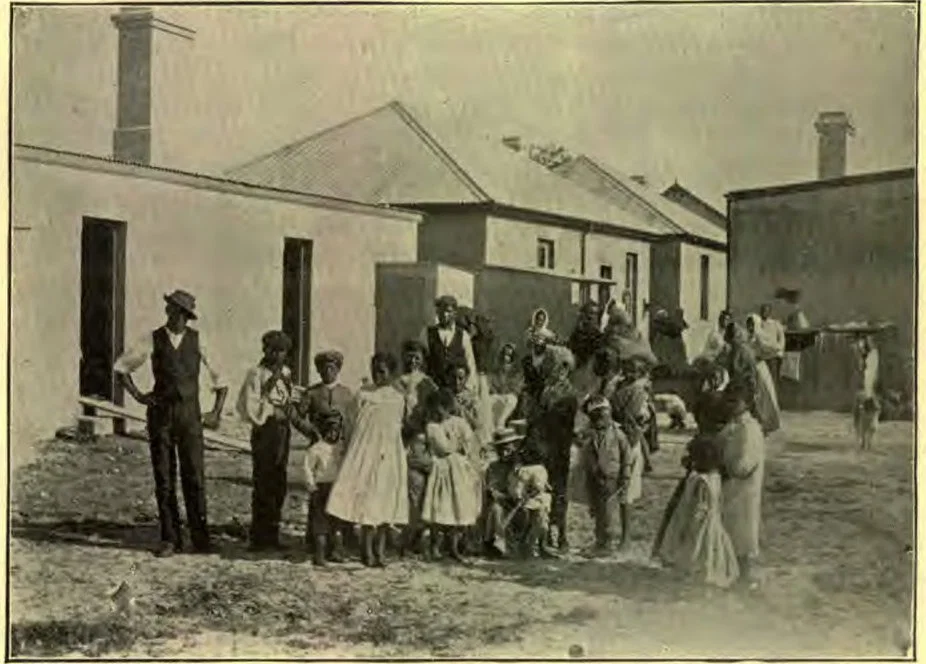
NATIVE CHILDREN IN CAPE TOWN

Christian Endeavor Society Committees in Fen-cho-fu, China

THERE is a society of Christian Endeavorers in Fen-cho-fu, China, where so many missionaries were martyred two years ago, consisting of sixteen members. The society has seven committees. Their names show the practical outgrowth of true organization for service: (1) On preaching the gospel; (2) on cheerful giving; (3) anti-foot binding; (4) anti-opium; (5) on temperance; (6) on Bible study; (7) on charity. Is there not food for reflection in this list, drawn up by young people who have been rescued from heathenism?

A Thanksgiving

BECAUSE our Pilot is the Lord who spareth The eager soul that dareth; Because the waves have not engulfed forever The sailors’ bold endeavor; Preserved from shoal and reef and harbor bar, Thanks to the Hand that guideth us thus far.
Thanks for the ruling calm the Father sendeth, Whatever fear attendeth; Thanks for the Strength unseen that never faileth, And in the storm availeth. Thanks for the rift of stars, the gleam of light, The cheering message spoken in the night.
So sail we on — upborne and yet upbearing, Across the waters faring; Glad that o’er all delight and all disaster Our Lord is ever master; Glad that all things are his — the restless sea With all its grief and joy, no less than we.
—Frank Walcott Hutt.

In Everything Give Thanks

THE young people who are privileged to live in this generation are blessed above all young people of previous generations; for to them will be granted the opportunity of witnessing the final triumph of God’s truth in the earth.
We love this work, our hearts are knit to it, and yet how frequently we find ourselves bemoaning our lot, discontented, because circumstances in our lives have been such that we must be separated from this work, or anxiously looking forward to a time when we may have an active part in the work for the Master.
But how few of us realize the influence of the things which we term “little” in life, upon the development of that very character which will fit us for usefulness. When Joseph was ruthlessly torn from his father, and sold by his brethren to the caravan of Ishmaelites on their way to Egypt, the future looked dark and forbidding. What could he do, alone and friendless, a despised and helpless slave in a strange land? But note his words of cheer and hope when, years later, he made himself known to those same brethren: “Be not grieved, nor angry with yourselves, that ye sold me hither; for God did send me before you to preserve life.” Who sent him into that strange land?—Not his brothers, but God, who knows the end from the beginning, had permitted this experience to come upon Joseph, bitter as it seemed to that beloved and tenderly cherished son of Jacob, because he had a great work for him to do in the plan of salvation. He was to be the saviour of his people.
There can scarcely be one young man or young woman to-day who is placed in a less promising position, one less conducive to preparation for the Master’s work, than was Joseph as he took that lonely ride to Egypt, or languished in the darkness of the prison’s dungeon. But in all these things God was preparing him for the great work before him.
Study the experience of Moses. The decree condemning the Hebrew children to death brought sadness and sorrow into many homes in Egypt, and yet that very decree was used by God for the training and education of the future leader and deliverer of his people. Moses did not understand why, when yet a mere boy, he must be separated from parents whom he loved, and take his place in the palace of the king, surrounded by heathenism and superstition. But God was preparing him for service. “At the court of Pharaoh, Moses received the highest civil and military training.” Angels revealed to Moses the great work to which God had called him. But after his call he was to spend forty years of preparation in the mountains. Naturally “man would have dispensed with that long period of toil and obscurity, deeming it a great loss of time. But infinite Wisdom called him who was to become the leader of his people, to spend forty years in the humble work of a shepherd. . . . Shut in by the bulwarks of the mountains, Moses was alone with God. . . . Here his pride and self-sufficiency were swept away. . . . He became patient, reverent, and humble, ‘very meek, above all the men which were upon the face of the earth,’ yet strong in faith in the mighty God of Jacob.”
We follow him further. God’s people are delivered. At Hazeroth in the wilderness a bitter experience awaited him, caused by the disloyalty and murmurings of Miriam and Aaron. But the experience in Midian, “the spirit of humility and long-suffering there developed,” prepared him for these trying times. Had those forty years of solitude in the wilderness been left out of his life, Moses’ usefulness would have been crippled, if not destroyed.
Little did William Carey know, as he roamed among the lanes and haunts of Whittlebury Forest, gathering specimens of plants and animals, that he was gaining an education that he would need in far-away India. Much less, as he copied the first Greek characters that fell into his hands, and carried them nine miles to one who could teach him what they meant, did he know that he was laying the foundation for the acquisition of the many Oriental languages and dialects with the use of which he became so wonderful an adept. And even his early struggles with poverty, teaching school by day, cobbling or making shoes at night, and preaching on Sunday, were the very experiences that fitted him to stand stanchly at his post in India when all his sources of income seemed entirely cut off.
David Livingstone, who by “plain living” and “high thinking,” working as a spinner in the summer, and studying in Glasgow in the winter, meanwhile picking up as much of carpentry and other useful trades as possible, was being prepared for a far greater place in the great harvest-field than his own heart ever conceived.
And so the lives of many noble missionaries who went to the front in the early days of missions, when heroic character stood out so prominently, reveal the fact that the home training, frequently the poverty, the struggle for education, and the unswerving purpose manifested through it all, revealed the character that was later able to prevail with God and man in some of the darkest and most difficult places in the earth.
As we take this view of our circumstances, we can rejoice in every new experience, whether it be in the most simple home duties, in business to which we seemed clearly called, or in some humble place in the Master’s work, knowing that a loving Heavenly Father is fitting us to occupy that place in the living temple that will glorify him. Truly “all things work together for good to them that love God.” Then “in everything give thanks: for this is the will of God in Christ Jesus concerning you.” ESTELLA HOUSER.

Three Workers for Fields Abroad

In the early part of the present year, the Battle Creek Young People's Society gave some study to the support of our mission work, and as a result, a large portion of the Society agreed to undertake systematic part in the work by giving at least ten cents a week for this purpose.
At the first it was expected that whatever was raised would be given to the general fund of the Mission Board. The executive committee, however, felt that it would give definiteness to our effort, and add greatly to the interest in the plan, if we should undertake to support one of our own number in a foreign field. The suggestion was passed on to the Society itself, and was very cordially approved. It soon came to pass that one of our number, Dr. J. M. Keichline, a graduate of the medical college here, class of 1902, had opportunity to go to the Syrian field, to which his heart turned with eager desire. Accordingly, we set apart our weekly mission offerings for the purpose of helping our fellow-member into his distant field.
It is now expected that Dr. Keichline will take his long journey in the near future. Our fund has grown to about $240 at this writing. We hope not only to send this worker to the Syrian field, but to provide for his support till his work shall care for itself. We shall then hope to assist some other soul, fired with missionary zeal, into the great, needy fields afar.
Dr. Keichline will probably be accompanied on his journey by Dr. Vohan Pampaian, a native Armenian who completed his medical course in the same class. This brother hopes to return to his own people.
On Sabbath, the 15th instant, Miss Marcelia Walker sailed from New York on her way to Sumatra, East Indies, where she will join Elder R. W. Munson and his family. Miss Walker was a Sanitarium nurse, and her presence will be missed from our Sabbath afternoon Young People's meetings. But how encouraging will be her presence with that one family in far-off Sumatra! H. E. OSBORNE.

Lines on Christ's Life Lived in Me

I ENVY not the twelve; near to me is He; The life he once lived here on earth he lives again in me. — Maltbie D. Babcock.

The Weekly Study

Timothy, a Youthful Disciple

(November 30 to December 6)
One interesting topic for the weekly study will be found in the life of Timothy, a youth of New Testament days, and in the instruction which, through him, Inspiration has given for the youth of all time. There is little direct material for the study outside of the epistles to Timothy.
The following outline is suggested:—
Introduction to Work.—2 Tim. 3:10 (margin), 11; Acts 14:1–22; 16:1–5.
There are so many lessons for youth especially in the two epistles to Timothy, that the study may be made most profitable.
In 2 Tim. 1:3, 4, the apostle Paul, a veteran of the army of the Lord Jesus, shows how great an interest the Lord takes in the youth; for it was the Spirit of Christ in the apostle that led him to have so great a burden for the young worker. And, too, as the apostle longed to see his son in the gospel, so Christ longs for the time when he shall see those for whom he died within the city of God.
“Stir up the gift of God,” or as the Revised Version suggests, Stir into flame the gift. 2 Tim. 1:6. Just stir into flame that spark of love and devotion. Pray, study, do something for somebody, and in the very exercise and expression of love the flame will glow and rise higher.
It was a time of confusion, when many were departing from the faith. Subtle heresies were being introduced. In these days that false philosophy began to creep in which led to the papacy in full. Verse 19 gives the secret of the clear vision to know the right way amidst perils and difficulties: “Let every one that nameth the name of Christ depart from iniquity.” The man ignorant of many things that the educated may know, if sin is but put away, can see truth more clearly than the learned man who hides sin in his heart. Not with the head, but “with the heart man believeth unto righteousness.”
Are the young people remembering that they have a work to do in helping to prepare for the week of prayer, to make it a time of spiritual refreshing by winning any wandering youth to God? And prepare also for the missionary offering, which ought to be larger than ever before.
W. A. S.

Love Makes the Neighborhood

It is not place, but love, which makes neighborhood.—Christopher Wordsworth.
Continue reading: Meenie’s Thanksgiving