CORA GRANT, of Jeff. Co., Ill., says: “I am a little girl six years old. I can’t write, so I got papa to write. I can read in the INSTRUCTOR, and love to read the letters. I keep the Sabbath with my papa and little brothers. I want to be a good girl, so I can be saved.”
From Jeff. Co., Kan., ELIZA E. GARRETT writes: “I have two sisters and one brother. My little brother Grant died. I learn my lessons well at Sabbath-school. I go to day school too. My sister and I were baptized the third of January. I want to be a good girl, and do all I can to help in the Lord’s work, and then have a place in the new earth.”
DORA MIDGELY, writing from Lyon Co., Nevada, says: “Eld. Colcord brought the truth here last summer. There were seven baptized, and mamma was one of them. There is no organized church here, but we have Sabbath-school in the court-house every Sabbath. I am twelve years old and have four sisters younger than myself. I hope to be among the saved.”
MINNIE JOHNSON sends a letter from Clay Co., Iowa. She says: “We attend Sabbath-school at Trimello, five miles from our home. Our school consists of twenty-seven members, divided into three classes. My father is my teacher. I learn my lesson in the INSTRUCTOR, and always try to have a good lesson. I like the papers very much. I give some of them to my school-mates, who like them too. I shall try to get some subscribers. I am thirteen years old, and have one sister and three brothers. We go to day school and every two weeks speak pieces, which we learn in the INSTRUCTOR. I am trying to be a good girl, that I may have a home in the new earth.”
ALICE SUCH, a little girl twelve years old, writes from Jeff. Co., Wash. Territory. She says: “I was baptized with my mother and sister last June, and we are the only Sabbath-keepers in this place; but we hope there are others who will keep the Lord’s commandments. I have two brothers older than I am, who, I hope, will obey the Lord soon. A friend has been sending me the INSTRUCTOR, but I am now taking it myself. I like to read the Budget much. I hope to see the INSTRUCTOR family in the earth made new.”
JULIA SHEA, of St. Lawrence Co., N. Y., says: “As I have never seen a letter from this place, I thought I would write one. I am staying at Mr. H. H. Wilcox’s. They have meetings and Sabbath-school held at their house. I get lessons every week in Book No. 3. I do not go to school, as the nearest school is two miles away. I have two sisters, and one brother. I had a little brother and sister die of scarlet fever two years ago, and I am trying to be a good girl so I can meet them in the resurrection. I am ten years old.”
WALTER LOOP, of Jackson Co., Mich., says: “I am a little boy nine years old. I do not live at home. My papa was killed by the cars last spring. He was deaf, and while walking on the railroad track, was struck by the cars. My mamma could not take care of so many, and so I came to live with my uncle and aunt. They keep the Sabbath, and so I keep it with them. I go to Sabbath-school and study Book No. 2. I want you all to pray that my four brothers and sister may keep the Sabbath and be saved. I am trying to be a good boy.”
The next letter was written by DANIE MILLER, of Osborn Co., Kan. He says: “This is my first letter to the Budget, which I like to read. I am eight years old. I go to Sabbath-school, and study Book No. 2. My parents keep the Sabbath. I want to be a good boy. I had a dear little sister, but she died. I want to meet her at the resurrection. She was all the sister I had. I have no brothers to play with. I am all alone. I go to school every day. I read in the third reader and have other studies. I would like to see this in print.”
Next we have a letter from CARRIE STILSON, a little girl ten years old. She writes: “I go to Sabbath-school when I can, but we have eight miles to go, and since it has been so cold, we cannot go every time. I have two brothers and one sister, all younger than myself. Except my brother, we are all in the same class at Sabbath-school, and study Book No. 1. We have kept the Sabbath about five years, but had no Sabbath-school or meetings to attend until last fall, when a series of tent meetings were held at Sextonville, where they have since built a church. I have a grandma, two aunts, and four cousins living in Battle Creek, and I would like to go and see them. I hope you will pray for us.”
Here is a letter from Washington, D. C. It is written by IRENE S. WATERS, who says: “I would like to tell you about our Sabbath-school. We began about eleven months ago with three children,—myself, and little brother aged ten, and my little sister aged seven. We have grown very fast, now numbering thirty-eight. My mamma and auntie began keeping the Sabbath the first Sabbath in June, 1886. My papa now keeps it, so we are united on it. My little sister is in Book No. 1; brother and I in Book No. 2. All our family except my two oldest brothers keep the Sabbath. I pray for them day and night that they may soon learn to keep it. I ask you to pray for them too. I hope to meet you all when Jesus comes.”
MOVING PLANTS.
By W. E. L.
WHEN night comes, many plants go to sleep, just as much as you do. If you look at the wood sorrel, or oxalis as it is called when set out in pots for house plants, you will see that about sunset the leaves all fold up and settle themselves for a comfortable night’s rest. They move very slowly, as if they did not want to go to bed. Indeed, you can hardly see them move, but by and by they are fast asleep. The locust trees shut up their leaves, too, some of them folding their leaflets back, and some standing them stiffly upright.
The sensitive plant goes to sleep more quickly than others,—so quickly that you can see the plant send each of its little leaflets off to bed. They go early, and are up in the morning before sunrise.
But not alone at night does the sensitive plant move. If its leaflets are touched in the day-time, they fold up suddenly, and the leaf droops down on to the plant stalk just as if in a fit of sulks.
THE FLY-TRAP.
Many of our common garden plants move during the day. The sunflower turns its great yellow face from the east to the west in the course of the day, and many other flowers do the same; but they do this so slowly that you cannot see them move.
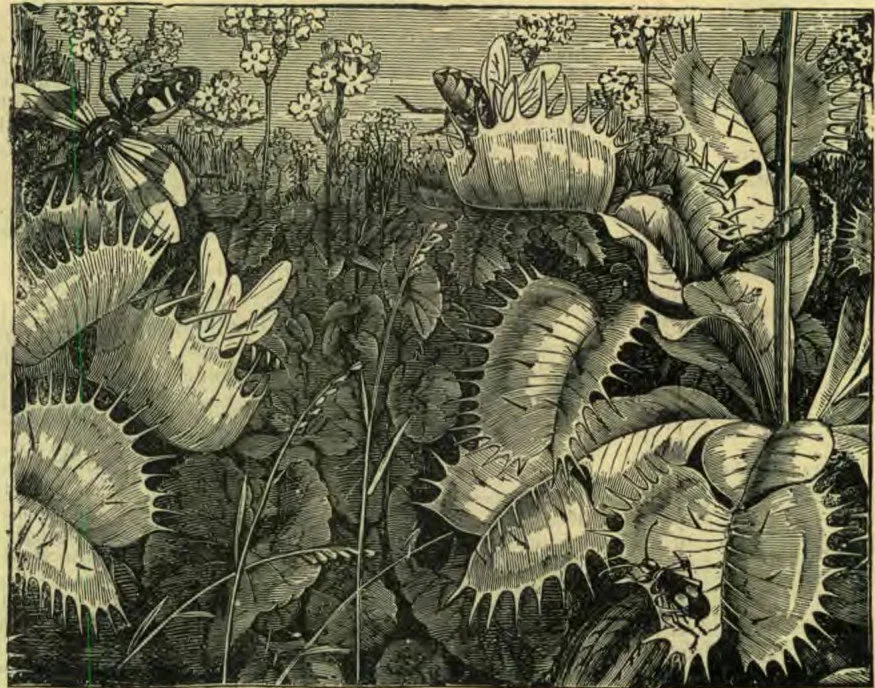
But there is one plant that acts almost as if it could think. At the end of the leaf is a curious little affair, looking almost like another leaf growing out of the end of the larger one. Long bristles cover its surface. When a fly brushes against one of these long hairs, the leaf shuts up suddenly, and holds the surprised fly a prisoner. It will do him no good to struggle to get away; for the more he tries, the tighter the leaf will close, until the poor fly is really crushed to death.
Then what do you suppose the leaf does? Instead of opening, and dropping the fly, it eats him! At any rate, when the leaf opens again, there is no fly to be seen. Sometimes the fly only brushes the hairs of this fly-trap, but does not get caught; then the leaf slowly opens again, ready for another victim.
It does not seem as if the plant really needed these flies for food, because it grows only in the rich bogs of North Carolina. It seems as if it must catch them for fun. Is it not wonderful that plants can move in this way? W. E. L.
WILLINGNESS AND GOOD FIGURES.
“CAN you give me any work, please, sir?” said a neat but poorly clad boy of twelve years of age to a New York merchant.
“Got all the help I need,” was the short and sharp reply of the busy city merchant.
“It’s hard,” replied the disappointed lad, “that a boy that is willing to work can’t get a job in this large city.”
“Why did you come to this city, my boy?” asked the merchant, glancing at the despondent lad.
“Because I want to earn enough to help support my mother and sister.”
This reply, with the peculiar manner of the boy, somewhat moved the harsh merchant, and he asked:—
“What are you willing to do?”
“Anything, sir. Anything in the world that I can do well.”
“Well, go and take hold, and pile up the empty boxes and pick up the loose papers, etc., down in the cellar.”
In less time than it takes to tell it, the boy was hard at work picking up the loose papers and cleaning up in general. During the day the merchant asked the foreman,—
“How is that strange lad working?”
“Like a beaver, sir. He is killing himself with work.”
When night came, the work-worn lad was offered one whole dollar for that day’s wages.
“No, sir!” said the boy: “give me one-half a dollar. It’s all I think I’ve earned, and will buy a supper and a lodging.”
This the merchant thought was uncommon honesty, and it pleased him so much that he told the lad to come next morning. He was there long before any one else was, and in that way showed his promptness. During the day, when the foreman was out, he marked the weight on some bundles that he had been weighing. The head of the firm happened to notice the figures, and as they were so well made, and in a strange hand, he inquired as to who made them. When he learned that the new boy had made them, he sent for him to come down to the office. When he came into the office, he was asked to show a specimen of his writing by copying an article. His writing was so beautiful that he decided to hire him for an office clerk. So this boy, that was once very poor, obtained a good situation and good pay by his willingness to do any work that was given him to do; also, by taking pains with the figures and writing.
All boys that read this can take a lesson from it, by taking pains with everything they do. No matter whether the thing that you do is of much importance or not, do it as well as possible.—Methodist Protestant.
THE BIRD THAT SINGS.
Oh, dear little birdie, who taught you to sing
Among the green branches and blossoms of spring?
I wish you would tell me; for then, don't you see,
I'd ask the same person to try to teach me.
“I wonder, whenever I hear you, if you
Have to sit in a tree for an hour or two
And practice your dear little twitter and trill,
When it is so dreadfully hard to keep still?”
“When you want to play in the sunshine all day,
Does somebody hold up a finger and say,
As solemnly: ‘Now, little blue-bird, stay so,
And carefully practice your do, re, mi, do’?”
“Do you have to learn about octaves and thirds,
And chords and arpeggios and other hard words?
And those terrible scales! Why, of all that I do,
I think them the hardest to practice. Do you?”
“Well, however you do, I am sure of one thing,
That I have to practice before I can sing,
And with all I may learn, and the best I can do,
I never shall sing, little birdie, like you.”