Your ShelfYour Projects

Review and Herald, Vol. 85, No. 9.

WHEN THE SNOW COMES DOWN

Review and Herald

Feb 27, 1908

Review and Herald Publishing Association · Tacoma Park Station, Washington, D. C. · Feb 27, 1908

WHEN THE SNOW COMES DOWN

When the snow comes down, There’s a silence as of prayer; There’s a blessing in the air; There’s a stillness everywhere— Over landscapes brown, Over woodlands bleak and sere, Over orchards dull and drear, Over valleys far and near— When the snow comes down,
When the snow comes down, There’s a hint of heaven’s own; There’s a purity outblown; There’s a hush as of the throne— Of the palm and crown, Of the home we yet shall know; Of the joys that overflow; Of the hopes that upward go— When the snow comes down.
When the snow comes down, There’s the beauty of our God On the thorn and hazelrod, On the pine-tree and the sod, On the field and town; And we know that while the air Throbs with whiteness everywhere, God reveals His mercy there— When the snow comes down.
— Selected.

LIBERTY

THE OFFICIAL ORGAN OF THE RELIGIOUS LIBERTY BUREAU

A 48-page quarterly magazine of religious freedom, set as an exponent and advocate of true religious liberty, the natural heritage of man,—the liberty that is in harmony with the laws of heaven and the just statutes of man; defending Christianity and the rights of conscience, and upholding the Bible as the infallible Word of God; recognizing the church and state as ordained of heaven for specific and distinct purposes, but protesting against any alliance of the church with the state in an attempt to advance the gospel—a wide-awake journal, loyally proclaiming and defending the true principles of liberty. Of Liberty a Methodist minister recently said: “It is a nice, orderly, logical exponent for a good cause,—separation of things civil and religious.”

LIBERTY, VOL. III, NO. 1

First Quarter’s Issue, 1908
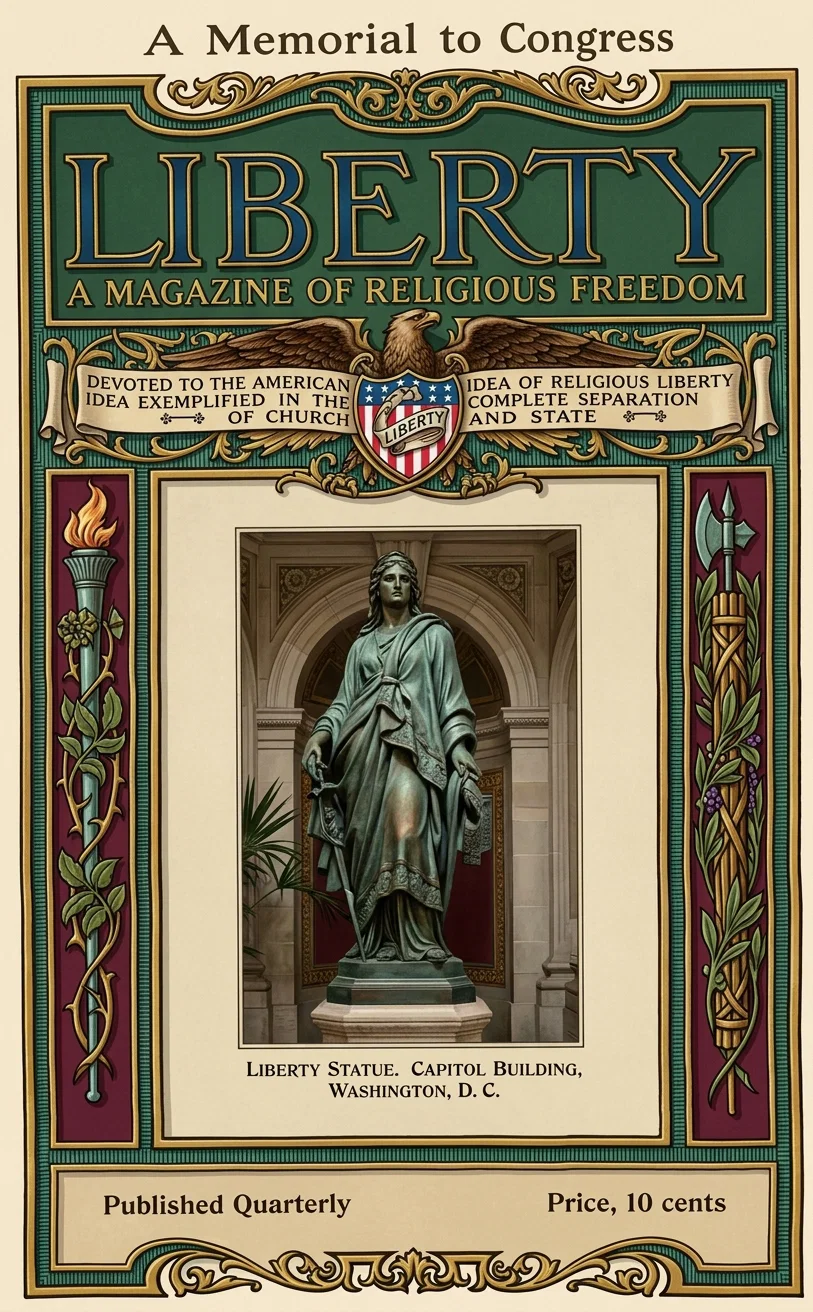
This number comes out with a new cover design, rare illustrations, and thrilling contents, three essentials to quick sales and a large circulation.
FACSIMILE OF NEW DESIGN OF "LIBERTY" COVER

A Memorial to Congress

It contains the memorial which the General Conference recently presented to the Sixtieth Congress, embodying a concise statement of the faith and the teachings of the memorialists, historical records of the disastrous results of the union of the church and the state, and the present organized effort to secure from Congress such legislation as will commit the national government to a violation of its principles of religious liberty and the enforcement of a religious institution. Of this memorial congressmen have spoken highly, and those who presented it in the House and Senate said it was a masterly production, and they would be proud to have the honor of presenting it.
The New York Times gave this memorial the following editorial:—

A Noteworthy Memorial

“A memorial to Congress of the Seventh-day Adventists, printed in the Congressional Record of January 29, is a document of interesting literary, religious, and political significance. It is an adroit argument against the passage of certain bills providing for a stricter observance of Sunday in the District of Columbia. It is rich in its citations of historical precedent, clear and strong in its argument against the union of church and state, and apt in its quotations of authorities from Neander to Bancroft. . . . Their present position is interesting, and their memorial is a noteworthy document.”

Other Important Matter

It also contains the Religious Liberty Bureau’s twenty-two-point protest against Sunday laws,—one of the most masterly documents upon religious legislation ever published. Besides these two principal documents, this number is full of the best things that can be written upon the proper relation of church and state; including the present Sunday-law campaign; things said about reinstating the motto, “In God We Trust,” upon the coins of the United States; the state religion advocated by some; the position some Baptists have taken on federation; the position of the great Catholic leaders on the union of church and state; etc.

Illustrations

While this number is not profusely illustrated, it contains some striking full-page photographs. The full-page photograph of three kings and five queens, taken Nov. 17, 1907, at Windsor, showing the rulers of the principal foreign countries, and the full-page photograph of the heads of the members of the President’s cabinet, make two illustrations that will be especially attractive to all classes. They alone are worth the price of the journal, and many will buy it for these photographs. The full-page photograph of the opening of the first session of the Sixtieth Congress, Dec. 2, 1907, showing the interior of the House, with Speaker Cannon in the act of taking the oath of office, will also be appreciated by all, and no doubt preserved by many, as it affords the individual citizen who has never been to the nation’s Capitol an opportunity to have a view of the nation’s lawmakers in session.

The Very Best Issue

It is quite common for the friends of Liberty to declare every succeeding number the best, and in the case of the last issue, there is a decided expression of preference in its favor. It not only commends itself to its friends, but it is attracting the attention of some of the best daily papers in the country, and many prominent people are speaking highly of it. Our workers are assuring us that it is a good seller, and will be the means of accomplishing much good. Their strongest testimonials are in the form of large orders. It is very common for us to receive orders from one individual for a thousand copies. Several orders of this size have just reached us. With one of these orders the worker said:
“It is a good number, and ought to be read by every citizen of the United States.”
Elder W. H. Thurston writes: “Number One of Liberty, 1908, has been received, and is a splendid number. . . . I believe Liberty is doing a good work.”
Another worker, who has sold more copies than any other individual in the denomination, says of this number: “It is a fine issue, being full of the principles of the message. Send me 500 copies at once.”

Prices

Single copy, 10 cents; 2 to 25 copies, one address, one order, 5 cents a copy; 25 to 500 copies, 4 cents; 500 to 1,000, 3½ cents; 1,000 or more, 3 cents. Annual subscription price, 25 cents. Forty per cent discount to agents on annual subscriptions when 10 or more names are sent in at one time, cash accompanying the order. Address LIBERTY, Takoma Park, D. C.

Editorial

The Platform

The following view given many years ago through the spirit of prophecy, always good, seems to be especially applicable just now:—
I saw a company who stood well-guarded and firm, giving no countenance to those who would unsettle the established faith of the body. God looked upon them with approbation. I was shown three steps,—the first, second, and third angels’ messages. Said my accompanying angel, “Woe to him who shall move a block or stir a pin of these messages. The true understanding of these messages is of vital importance. The destiny of souls hangs upon the manner in which they are received.” I was again brought down through these messages, and saw how dearly the people of God had purchased their experience. It had been obtained through much suffering and severe conflict. God had led them along step by step until he had placed them upon a solid, immovable platform. I saw individuals approach the platform and examine the foundation. Some with rejoicing immediately stepped upon it. Others commenced to find fault with the foundation. They wished improvements made, and then the platform would be more perfect, and the people much happier. Some stepped off the platform to examine it, and declared it to be laid wrong. But I saw that nearly all stood firm upon the platform, and exhorted those who had stepped off to cease their complaints; for God was the master builder, and they were fighting against him. They recounted the wonderful work of God, which had led them to the firm platform, and in union raised their eyes to heaven, and with a loud voice glorified God. This affected some of those who had complained and left the platform, and they with humble look again stepped upon it.—“Early Writings,” page 121.
There are some things which are settled for all time. There are some fundamental positions in this advent movement which are not subject to revision. There are some doctrines which have made this people what they are; and having been wrought into history, they can not be lightly questioned or flippantly insinuated against without impugning this whole movement. These doctrines constitute the platform of this third angel’s message. “Woe to him who shall move a block or stir a pin of these messages.”
There are two ways of examining the foundations of truth. One is to stand firmly on the platform of truth, to maintain confidently that it is the true platform, and to show by a thoughtful investigation and an impartial weighing of the evidence that the foundations stand sure. The other way is to step off the platform, and, under the specious plea of taking an unbiased position, to regard everything as unsettled, and then to investigate carefully all the arguments against the truth to see whether there can thus be found any solid foundations for the truth. Such seekers after truth give the enemy of truth all the advantage, and may count themselves happy if they are not inextricably involved in the slough of despond before they find solid ground.
He who opens his mind to all the plausible theories and the fanciful interpretations of visionary expounders of the Scriptures, who like the Athenians of old spend their time “in nothing else, but either to tell, or to hear some new thing,” will soon become so confused himself that he can give the trumpet no certain sound, and will have no firm platform upon which to stand. He who listens to and harbors all the innuendoes and the false charges against organization and leadership made by those whose chiefest difficulty is that they have not been able to organize and lead things according to their own unyielding will, will soon become a mere echo of the resounding shouts of the mixed multitude whose hearts are still in Egypt. He may deceive himself with the idea that he wishes to give every man a fair chance, and that he must therefore himself occupy a neutral position; but the one who voluntarily places himself on a prominent position between the firing lines of two armies in the time of battle, professing friendliness to both sides, need not be surprised if he is cut down by the storm of leaden hail from both directions. There are times when it is both criminal and fatal to be neutral. The man who stands courageously upon almost any platform is in a more hopeful situation than he who simply raises questions about the true platform, and is always hunting for a platform.
Doubt and suspicion are easily aroused. In every unsanctified heart there is a ready response to insinuations, surmisings, and suggestions of evil, even though they may be wholly groundless. It requires no special research and no marked scholarly attainments to undo the fastenings and open the flood-gates of evil, and all this may be done with the strongest protestations of a single-hearted purpose to search for truth. The truth seeker who is always “seeking after truth,” on the basis that there is nothing positively settled, and that every position, from the existence of God to the interpretation of the number of the beast, is equally open to question and readjustment, is simply a chronic doubter or an agnostic under a misleading name. He is certainly not a safe leader in a campaign against the New Theology and in behalf of “the old paths.” He already stands with one foot off the platform of truth, and is evidently leaning the most of his weight upon the wrong foot at that.
We are thankful that there is “a solid, immovable platform” upon which the people of God may stand firmly and confidently. This does not preclude study and investigation, not to settle the question whether there is such a thing as a firm platform in this advent movement, but to show how firm is the platform upon which we stand. There is a wide difference between these two attitudes. There is much more light for us upon the Scriptures, but not light which will lead us to abandon the fundamental positions in this third angel’s message. In “the everlasting gospel” to be proclaimed to all the world in this generation there is a fulness of meaning and blessing which we have not yet appreciated, but it will not be found by stepping off the solid, immovable platform, and following the will-o’-the-wisps of a speculative imagination. Let us stand together on the “solid, immovable platform,” seeking the things which make for peace.

Answering the Calls

A BROTHER who has deep interest in missions makes the following suggestion:—
Allow me to suggest that you devise some way of letting the REVIEW family know whether the many calls for help from the missions are answered, in part or in full. We read these stirring appeals, and do not know when they are answered. Could a tabulated showing be kept before us? For instance, in the REVIEW of Dec. 26, 1907, Brother F. W. Spies lays before us “A Needy Field in Brazil.” We would like to read of progress in answering such calls, or know that they are still appealing.
The record of the answering of the calls will be found from time to time on the last page of the REVIEW. The departure of every missionary is noted on the last page, with a statement of the field to which he is proceeding. To wait for these notes of departure may seem tedious to the reader who is anxious to see the fields supplied with help; but to the reader watching at home the time of waiting does not seem as long as to the worker in the mission fields who is looking for reinforcements. However, all the time the procession is moving toward the fields. For that we thank God.
For instance, in a few weeks we hope to announce the departure of at least one family for Brazil. Whether the first recruits for Brazil will answer this call which Brother Spies has sounded in behalf of the State of Bahia will depend upon the decision of the brethren in South America. From month to month the calls change, and the needs multiply. Decision as to these details must be left to the responsible committees in the fields.
One thing is sure, we ought to pray the Lord of the harvest to send forth laborers into these fields. Here is Brazil, for instance, one of whose needs is mentioned by the brother. It is a country as large as the United States, claiming twenty-two million people, with the statistics ever growing; and in all that wide land we have four ordained ministers engaged in the work, and but a little band of associates. Help has been voted, and not many weeks must pass until more than the worker and his wife already under appointment shall go forward. And Brazil is but one division of South America, and South America is only one of the great continents.
The General Conference Committee council held nearly a year ago at Gland, listed imperative, specific calls for fifty workers and their wives. The fifty-eight workers sent out last year answered some of these calls, though a large proportion went forward in response to demands made previous to the Gland council. The African missions must be reinforced. One family has recently landed, passage for another has been engaged, and it is hoped that still others will go forward at an early sailing date.
One family is just now about landing in Shanghai, the first answer to China’s call for ten families for specific points. Soon those who read the last page of the REVIEW, as all must do week by week, will see with glad eyes the notice that a party will soon be sailing for the most populous mission field. Others must follow on to this and other lands from which the calls continue to come.
Our missionaries in their reports by no means attempt to list the calls of need that meet them on every side. Did they do so, their reports would be one continual call. The special openings and the need of continual expansion and extension are kept before us week by week.
The few who go seem but a pitiful response; and yet, remembering that old-time question of the apostles, “What are these among so many?” we may remember with grateful hearts that the results are with the Lord when we have yielded to him all that he enables us to do. It is evident that every believer and every church and every home conference must stand squarely under the burden of carrying the message through these vast unworked fields. This is the work our people are laying hold of with courage. Watch for the departure notes on the last page, and pray for reapers for the harvest.
W. A. S.

God's Wonderful Gift

What good thing is there for us that is not in the gift of Christ? It is wonderful in its comprehensiveness. When we stop to consider what there is in it, we are lost in wonder and admiration. The whole gospel is in the gift itself, and grew out of the gift.
In that gift we see first the loyalty and love of Christ, as he arose to the great emergency. The universe, because of Satan's defection, must learn through pain and sorrow the lesson of sin. The gift was made when the revolt occurred, and there began the struggle of loyalty against disobedience, love against hate, life against death.
In that gift there is everything given that is necessary for the salvation of man and the triumph of righteousness over iniquity. The apostle asks this question: “He that spared not his own Son, but delivered him up for us all, how shall he not with him also freely give us all things?” Rom. 8: 32. “How shall he not?” is the question, as if it would be an impossibility for him not to do it—and it would, for all is included in the gift. God could not give Christ to us and for us, and then withhold from us the lesser things that are for our good.
In that gift we find that the gift of everlasting life is included and involved; for we read: “God so loved the world, that he gave his only begotten Son, that whosoever believeth on him should not perish, but have eternal life.” He “became poor” that we might have unfailing riches; he submitted to death that we might not be holden of it. In that giving he took what we merited—death—that we might take what he merited—life; he submitted to be bound by the shackles of death, that he might burst those shackles from every soul willing to be free. In the triumph of life there is involved the victory over death, the death of Death itself; so that we can say, “Death is swallowed up in victory.”
God is the fountain of life and love. Death is not in his purpose. He has no pleasure in it. We read: “I have no pleasure in the death of him that dieth, saith the Lord God: wherefore turn yourselves, and live ye.” Eze. 18: 32. Life, endless, sinless life—that is his purpose and pleasure. It is not his purpose of a day or of a thousand years, but for all eternity. That is why Christ was given to bring back to liberty and life that which had sold itself into bondage and death to the opposer of God's purpose. All his works are to that one end, the triumph of life and love, and that triumph is in the gift of Christ.
In that gift is included and involved the forgiveness of our sins. The prophet Isaiah declares: “He was wounded for our transgressions, he was bruised for our iniquities; the chastisement of our peace was upon him; and with his stripes we are healed. . . . And Jehovah hath laid on him the iniquity of us all. . . . He was cut off out of the land of the living for the transgression of my people to whom the stroke was due. . . . He poured out his soul unto death, and was numbered with the transgressors.” Isaiah 53. We read in Heb. 9: 28 that Christ was “once offered to bear the sins of many.” And he declares of himself, “I came not to judge the world, but to save the world.” John 12: 47. All that was done that God's purpose should not be thwarted, and all that was included in the gift of Christ.
Man, through sin, has been estranged from God. Christ gave himself that he might “draw all men” unto himself, and so unto God, out of whose arms man had flung himself. There needed to be a reconciliation—on man's part; and the bringing of that about is also in the gift of Christ; for we read: “All things are of God, who reconciled us to himself through Christ, and gave unto us the ministry of reconciliation; to wit, that God was in Christ reconciling the world unto himself.” 2 Cor. 5: 18, 19.
We were in darkness. Christ came as the light of the world, and not only to be a light himself, but to give us light for our darkness, and make us lights to bring his light and joy and life to others, so bringing them also out of darkness and unto him, making us one with him, and so at one again with the Father. All this he has done—all this he has given in the one gift of himself. There is love in the place of hate; joy in the place of sorrow; hope in the place of fear; peace in the place of turmoil; loyalty in the place of disobedience; forgiveness in the place of judgment; righteousness in the place of sinfulness; liberty in the place of bondage; reconciliation in the place of estrangement; an everlasting habitation with the Father in the place of an everlasting tomb in the earth; eternal life in the place of unending death. All this is in the gift of Christ, and it is there for every son and daughter of Adam who wills to have it so. Wonderful Saviour! Wonderful gift!
C. M. S.

On the Pacific Coast

After a comfortable journey direct from Washington via New Orleans I arrived in San Francisco Tuesday noon, January 21, my first visit to this city since the great earthquake of April 18, 1906. On all sides were the evidences of the terrible visitation, and also of the wonderful work of restoration which has already been accomplished. I especially desired to see one ruin,—that of the city hall,—and so I wended my way thitherward at the first opportunity. I lingered for some time, looking at the great piles of débris which have not yet been removed, and at the lofty dome, much of which is a mere skeleton, and seemed to hear anew the voice which spoke in rebuke of the high carnival of crime, and for a time thwarted all plans for heaping up wealth. As if in its grip upon the city hall it held in its grasp the city personified, the earthquake seemed to do its worst, apparently determined, by revealing the sham and the fraud of the builders through the naked framework, to make conspicuous the inevitable result of all disregard of righteousness in the passion for wealth. I did not wish to stay in the city. It was not a feeling of fear which took hold upon me, but a vivid sense of the awfulness of the iniquity which calls for such a manifestation of divine judgment, and of the unawed and unrepentant spirit of rebellion against God which prompts the effort to hide as quickly as possible the evidences of the destructive protest against wickedness. And so I departed, depressed with a foreboding of the evil yet to come upon other places where the same sins will provoke the same outbreak of divine indignation.
I received a hearty welcome from the delegates and friends in attendance upon the Pacific Union conference, which was held in the chapel of the St. Helena Sanitarium. It was a privilege to me to meet many fellow workers whom I had not seen for some years, and to join them in the meetings. I spoke once on Wednesday, the next day after my arrival, once on Thursday, and twice on Friday, besides joining in the other meetings. Thursday was an especially good day. Brother Daniells presented quite fully the work in the mission fields, and the plans proposed for raising the funds necessary for the more rapid extension of the message in the waiting lands. I joined with him, and tried to present a vivid picture of actual conditions in heathen lands and of what heathenism really means when observed on its own soil. An enthusiastic interest was aroused, and the meeting continued from half-past two until after six o'clock. The delegates responded with earnest remarks, and pledged themselves to renewed efforts in behalf of the missionary program. It was really a refreshing occasion, and another assurance that the Lord approves the determination to press the line of action forward.
The hospitality of the sanitarium was extended to the delegates, who greatly enjoyed the privileges afforded. It was a cause of satisfaction to me to find that the work of the institution is being greatly prospered under the management of Dr. H. F. Rand and his faithful co-workers. A pleasant feature of our stay was a social evening when we had the opportunity of meeting personally the members of the medical faculty, the nurses, and other workers connected with the institution.
For the first time since the Pacific Press Publishing Association removed from Oakland to Mountain View, I had an opportunity to visit them in their new home. In the meantime they have lost their first building by earthquake and fire, and have erected the buildings which they now occupy. The present quarters are plain, but well adapted to the work; and I was glad to find the brethren there of good courage, and much gratified at the financial results of their last year's operations, which show a gain of over twenty-one thousand dollars. We rejoiced together over this measure of prosperity, especially in view of the fact that only denominational work had been done during this time. I especially enjoyed the opportunity of meeting Brethren M. C. Wilcox and A. O. Tait, the editors of the Signs of the Times, and of spending some time with them in Bible study and conference. As we reviewed together the evidences of the truths of this message, we were mutually encouraged and helped. While at Mountain View we held three meetings of the General Conference Committee, considering various matters which needed attention.
I afterward spent several days at St. Helena with Brother W. C. White and his associates in the study of the different features of their work, and spoke twice at the sanitarium chapel. I was glad to find Sister White enjoying a reasonable degree of health and able to continue her work. The hospitality of her home was appreciated by me.
Thursday morning, February 6, I left St. Helena for southern California, arriving in Los Angeles the next morning. I was made welcome by Elder G. W. Reaser and his associates, who had already arranged plenty of work for me during my short stay. Early in the afternoon I went out to Glendale, about seven miles from Los Angeles and reached by trolley-car, to meet with the workers at our sanitarium there. Drs. M. M. Kay and Etta Gray are the physicians in charge, and Brother J. J. Wessels is acting as business manager. I had sufficient time before the Sabbath to look over the institution and grounds, under the guidance of Brother Wessels. In the evening I spoke to the patients, helpers, and members of the local church in the gymnasium of the sanitarium, dwelling upon the real meaning of this advent movement, and the place which it occupies in the development of the gospel in the earth.
The next forenoon I had the privilege of speaking to a large audience in the Carr Street church in Los Angeles. As the Sabbath-school lesson was upon the coming of the Lord, I made that subject my theme, and the old truths seemed to shine out with new luster. The usual appointments for the afternoon were taken up, and another large audience listened to a presentation of the subject of our mission work in the far East. Some strangers who had been studying the truth were in attendance, and were very favorably impressed by the evidences concerning the worldwide character of this advent movement, and were strongly drawn to unite with us.
After the Sabbath I went to Fernando, about twenty miles distant, where I had an appointment to speak to the faculty and students of our school the next morning. In the absence of Brother H. G. Lucas, the principal of the school, the hospitality of the institution was extended to me by Brother and Sister J. L. Kay, formerly of the Walla Walla College. A goodly number gathered at the appointed hour the next morning, and I talked with them concerning the nature of our message and the work of giving it to the world. There is an earnest missionary spirit at Fernando, and at the close of our meeting two or three conferred with me concerning their intention to go to definite fields at the close of the school year.
By returning to Los Angeles on a freight-train I was able to make connections for Loma Linda, where I was scheduled for the evening. This was the closing hour of a local council concerning the educational work, and afforded another opportunity to lay before the workers assembled the conditions and needs in the great mission fields. Monday noon I met the students in the Loma Linda College of Evangelists, and found about eighty in preparation for the work at home and abroad. They gave earnest attention to a study of the problem of giving this message to the world in this generation, taking with me a survey of the work already accomplished in the many countries of the world, and of what remains to be done. The conclusions reached seemed helpful and inspiring to all. In the evening I spoke in the large parlor to the patients, nurses, helpers, and students, considering this advent movement from the standpoint of the place which it occupies in prophecy. The position which we occupy and the message which we have to proclaim never seemed clearer to me than as we studied them both that evening. I feel sure that the Lord blessed the words spoken. This closed my public work, and I started for the East the next noon.
Our institutions in southern California comprise the café and treatment rooms in Los Angeles, the sanitarium at Glendale, the training-school at Fernando, the sanitarium at Paradise Valley (which I was unable to visit), and the sanitarium at Loma Linda. All the workers in these institutions whom I met were of good courage and devoted to the work. Unity now prevails, and the outlook is hopeful. These several institutions ought to be a powerful agency under the blessing of God for the advancement of the truth in southern California.
The long ride across the continent has no attractions for me, and although I tried to make the best use of the time in reading and study, yet I was thankful to arrive in Washington again, and to join the workers here at the headquarters. It is only a pressing sense of the needs of the work and of our personal duty which induces any of us to undertake heavy field work in addition to the burdens which press upon us here. The results have justified both the effort and the expense. W. W. P.

Wills and Legacies

NEARLY every one to whom God has entrusted means has often thought of making a “will,” disposing of his property at death. Many, however, neglect to make this will, from lack of knowledge, or from fear that they may change their minds before they die.
The latter should remember that one can make as many wills as he may see fit, and the last authentic will invalidates all preceding wills.
To those who do not know how properly to draw up a will, we would say, Write to the General Conference of Seventh-day Adventists, and the Treasury Department of the General Conference will take pleasure in supplying you with proper blank forms, together with other information to make you intelligent concerning this matter.
It is a pity to let these highly important matters drift, and, if death comes to us unexpectedly, to leave our business matters unsettled, and to entail upon our families much needless expense and worry.
The spirit of prophecy has said much on this subject. I quote a few extracts from Vol. IV, pages 476 to 485:—
It often happens that an active business man is cut down without a moment’s warning, and on examination his business is found to be in a most perplexing condition. In the effort to settle his estate, the lawyers’ fees eat up a large share, if not all, of the property, while his wife and children and the cause of Christ are robbed. Those who are faithful stewards of the Lord’s means will know just how their business stands, and, like wise men, they will be prepared for any emergency. Should their probation close suddenly, they would not leave such great perplexity upon those who are called to settle their estate.
Many are not exercised upon the subject of making their wills while they are in apparent health. But this precaution should be taken by our brethren. They should know their financial standing, and should not allow their business to become entangled. They should arrange their property in such a manner that they may leave it at any time.
Wills should be made in a manner to stand the test of law. After they are drawn, they may remain for years, and do no harm, if donations continue to be made from time to time as the cause has need. Death will not come one day sooner, brethren, because you have made your will. In disposing of your property by will to your relatives, be sure that you do not forget God’s cause. You are his agents, holding his property; and his claims should have your first consideration. Your wife and children, of course, should not be left destitute; provision should be made for them if they are needy. But do not, simply because it is customary, bring into your will a long line of relatives who are not needy.
Let it ever be kept in mind that the present selfish system of disposing of property is not God’s plan, but man’s device. Christians should be reformers, and break up this present system, giving an entirely new aspect to the formation of wills. Let the idea be ever present that it is the Lord’s property which you are handling. The will of God in this matter is law. If man had made you the executor of his property, would you not closely study the will of the testator, that the smallest amount might not be misapplied? Your heavenly Friend has entrusted you with property, and given you his will as to how it should be used. If this will is studied with an unselfish heart, that which belongs to God will not be misapplied. The Lord’s cause has been shamefully neglected, when he has provided men with sufficient means to meet every emergency, if they only had grateful, obedient hearts.
Those who make their wills should not feel that when this is done, they have no further duty; but they should be constantly at work, using the talents entrusted to them, for the upbuilding of the Lord’s cause. God has devised plans that all may work intelligently in the distribution of their means. He does not propose to sustain his work by miracles. He has a few faithful stewards, who are economizing and using their means to advance his cause. Instead of self-denial and benevolence being an exception, they should be the rule. The growing necessities of the cause of God require means. Calls are constantly coming in from men in our own and foreign countries for messengers to come to them with light and truth. This will necessitate more laborers and more means to support them. . . .
In determining the proportion to be given to the cause of God, be sure to exceed, rather than fall short of, the requirements of duty. Consider for whom the offering is to be made. This recollection will put covetousness to flight. Only consider the great love wherewith Christ has loved us, and our richest offerings will seem unworthy of his acceptance. When Christ is the object of our affections, those who have received his pardoning love will not stop to calculate the value of the alabaster box of precious ointment. Covetous Judas could do this; but the receiver of the gift of salvation will only regret that the offering has not a richer perfume and greater value. Christians must look upon themselves only as channels through which mercies and blessings are to flow from the Fountain of all goodness to their fellow men, by whose conversion they may send to heaven waves of glory in praise and offerings from those who thus become partakers with them of the heavenly gift.
The cause of God is always in need of funds for carrying on its work. We invite correspondence.
I. H. EVANS, Treas. Gen. Conf.

Catholic Claims in America

A CATHOLIC clergyman in a sermon recently delivered in Boston, sets forth two of the pretensions of the Roman Church in America that will be of interest to our readers. The priest declared that the representatives of the Catholic Church—bishops, archbishops, and cardinals—were, in this country, as much superior to secular rulers in majesty and in claims upon the affection and reverence of the people as the eternal life infinitely transcends the temporal in importance and dignity. His second statement was to the effect that outside of the Catholic Church the whole world of American life is under the influence of Satan, and that “men and women of apparent natural goodness and eminent respectability before the world are really enemies of Christ and opposed to the kingdom which he founded.” These claims to all the goodness there is in the land and to an exaltation infinitely above all the rest of mankind are in perfect keeping with the well-known characteristics of the papacy. In view of the prophetic utterance concerning this power, namely, that it would oppose and exalt itself “against all that is called God or that is worshiped; so that he sitteth in the temple of God, setting himself forth as ‘God,’” it should not surprise us to see this power exalting itself above all that is called man.
Speaking of this public utterance of the Boston priest, the Christian Register (Unitarian) says:—
Happily the Catholic preacher, and those who agree with him, will never have an opportunity to put their theories into practise in America.
The Register, like many another religious publication, puts forth its wish and hope as a prophecy of what is to be.
Continue reading: One Hundred and Fifty Thousand Dollar Fund