Historical quotations and extracts from various writers which may assist the thoughtful student of the Scriptures.
The Starting-Point of the Seventy Weeks
I ASSUME, then, that in the first year of Darius, or about 538 B. C., Daniel was told that seventy weeks were determined upon his people and his holy city for a particular purpose afterward explained in the remainder of the verse; and I make this further assumption, which will hardly be denied me, that the seventy weeks so determined are afterward split up into seven weeks, and threescore and two weeks, and one week; but I do so merely because, if this is the case, then it becomes no longer a matter of doubt as to when the seventy weeks began, or at least only so far as it depends upon the going forth of the commandment to restore and to build Jerusalem. That is to say, we are apparently intended to count them, not from the time when the angel was speaking, as we might have thought most natural, but from the time of which he subsequently spoke. The first subdivision of seven weeks manifestly began from the going forth of the commandment to restore and to build Jerusalem—if, that is, the seven weeks and threescore and two weeks and one week are identical (as being equivalent to them, none can doubt they are) with the seventy weeks. It is entirely gratuitous to suppose that these seventy weeks are to be counted from the year of Jeremiah’s prophecy; and though we might at first suppose the present moment was the one referred to, yet when a definite terminus a quo is afterward given for an equivalent period to commence from, it is at least reasonable to suppose that that is the terminus meant in both cases.
But now arises a much greater difficulty. What was the commandment which went forth to restore and to build Jerusalem? and when did it go forth? We must not forget that the angel was speaking before the issue of the edict of Cyrus. If, therefore, the narrative is authentic, everything was as yet unknown and unaccomplished. Daniel himself was perplexed and anxious as to the termination of that captivity, which he believed was limited to seventy years. He thought the end of those years could not be far off. He is told that there is still a future in store for his people and city of seventy weeks of years—supposing, that is, that by the weeks were meant years. He is not told anything as to the termination of the captivity, which was his chief subject of anxiety. But we know that he lived to see the cause of that anxiety removed. Its removal came in the natural course of events. And this being so, the spirit of prophecy did not concern itself with that immediate source of anxiety, but reached on into the far-distant future, and spoke of the ultimate destiny of the people and city, which was, after all, at the bottom of the prophet’s thoughts, aspirations, and anxieties, however legitimately they were interested likewise in the immediate fortunes of his nation.
And here we may pause for a moment to notice a mark of reality in the narrative on the supposition of its genuineness and authenticity. The last date given in Daniel is the third year of Cyrus. We know that he was alive then: he could not have lived long afterward. As, therefore, he witnessed the promulgation of the edict of Cyrus, he witnessed at all events an issue and answer to his prayer which received no elucidation from the communication of the angel, however much it may have served to elucidate the prophecy of Jeremiah, and yet the record of that communication remained. It was far too precious to be cancelled. Events had made it even more obscure; but it was the message of an angel, and therefore of inestimable value. The present distress and problem of the national fortunes had been relieved and solved by the development of circumstances; but a pledge of vast magnitude and importance had been given to the future, which embraced five centuries to come. This is at all events consistent with the ordinary dealings of Providence, which leaves our perplexities to be solved by the process of events, however much it may be fraught with principles of far wider import concerning even the distant future. What was uppermost in Daniel’s mind was virtually passed over by the angel, but a communication was made to him which involved not only the solution of the immediate present, but bore the promise also of centuries to come. . . .
The angel, however, spoke of a decree to restore and to build Jerusalem. But it is to be observed that the edict of Cyrus, gladly as Daniel must have hailed it, in no degree fulfilled the conditions of this decree as here given. The terms of that edict, as it is preserved to us in Chronicles and Ezra, have reference only to the house of God at Jerusalem. It was in no sense a decree to restore and to build Jerusalem. And the same likewise applies to the decree of Darius, which confirmed in similar terms the suspended decree of Cyrus. The only decree which was capable of any wider application than the temple merely, and the text of which is preserved to us in the historic records of Scripture, is the edict which was given to Ezra in the seventh year of Artaxerxes, or B. C. 457. This decree in its express terms provided not only for the embellishment of the temple, which had been completed since the sixth year of Darius, but also for the political organization and government of the nation. It was by far the most important act of recognition performed by any foreign monarch in relation to the Jews, and the most complete and comprehensive in its nature of which we have any record in Scripture; and to it are to be referred not only all the reconstructive operations of Ezra, but those also of Nehemiah, who was furnished with subsequent authority by the same king in the spirit of his former decree. As far, therefore, as the sacred history of the Jews enables us to determine when the commandment went forth to restore and to build Jerusalem, there seems little doubt that we must refer it to the decree of the seventh year of Artaxerxes, of which the original Aramaic text is preserved to us in the book of Ezra. It is unquestionably a wider and fuller decree than that either of Darius or of Cyrus, important as those decrees, and more especially the former of them, undoubtedly were. . . .
If, therefore, the going forth of the commandment to restore and to build Jerusalem may fairly be referred to the decree of Artaxerxes, then it is plain that that decree becomes the starting-point of the seventy weeks, or four hundred ninety years.—“Old Testament Prophecy,” by Stanley Leathes, D. D., London, Hodder and Stoughton, 1880, pages 216-220.
The Day-Year Principle
ANOTHER objection to the accuracy of Scripture raised by opponents of precision is what they call “The Year-Day Theory.” They object to “days” mentioned in prophecies being used as years, which they say is “a shameful perversion of Scripture.” But it would be uncommon to find in the Bible a prophecy where the days do not mean years. The seventy weeks of Daniel form the most important prophecy in Scripture; but if the seventy weeks, which are 490 days, do not mean years, the prophecy has no meaning. Our Lord was not manifested to Israel after 483 days, which are “69 weeks,” following the command to build and restore Jerusalem. When the voice from heaven declared, “This is my beloved Son,” it was after 483 years; and when he cried on the cross, “It is finished,” it was not after 486½ days, but years. . . . Did not Almighty God give us this example also in appointing a year for a day to the unbelieving Israelites?—“After the number of the days in which ye searched the land, even forty days, each day for a year, shall ye bear your iniquities, even forty years, and ye shall know my breach of promise.” To the prophet Ezekiel (4:6) God also said, “I have appointed thee each day for a year.”
But it is a scientific fact that a day is also a year. If some men can not see this in Scripture, let them lift up their eyes to the heavens above them, and they will see that as the sun proceeds through the twelve signs of the zodiac in a day, so also (if they still keep their eyes open) they will find that the sun passes through the same twelve signs in the course of a year. Therefore, a year-day fulfilment of time is a fact both of Scripture and of astronomy. It is no “theory.”—“The Appointed Time,” by J. B. Dimbleby, London, E. Nister, 1897, pages 36-38.
The Mother's Burdens
By MRS. N. A. JOHNSON
MRS. N. A. JOHNSON
“THE work of the mother is an important one.” This no one will doubt, for on her largely rests the care and training of the children. A mother’s work consists not alone in properly clothing the children and caring for them while they are growing, but their physical and moral well-being depends to a great degree on her. Her work should begin with the babe in her arms, by teaching it self-control and regularity. Regularity should be the rule in all the habits of children. By properly training the child while it is still a babe, much of the mother’s future burdens are lessened.
When there are several children, the work is more difficult, as no two can be treated exactly alike, and tact must be used to make things move smoothly. If the mother would succeed in this work, she must not allow fashions and customs of the world to hold her in bondage.
She should understand how to clothe her children for comfort, health, and freedom, and at the same time becomingly.
The preparation of healthful food is no small task for the mother. Much peevishness and irritability among children is caused by wrong habits of diet, irregular meals, and the habit of “piecing.”
Many mothers deplore the intemperance everywhere, but do not stop to think that by placing rich, highly seasoned food before their children and allowing them to indulge the appetite, they are opening the way for greater evils. It is every mother’s duty to provide good, plain, wholesome food for her family, for “children reared in a healthful way are much more easily controlled than those who are allowed to eat everything their appetites crave, and at all times.”
How earnestly the mother of Moses must have worked to instil in her boy the true meaning of life! Though she had but twelve years, she did a work that developed a mighty man to deliver Israel.
We also find the story of Hannah and her child Samuel. How early she must have taught him obedience; for when but a child in the home of Eli, he was by his master’s side at the first call. It was surely a grand thing to the child to have the Lord speak to him. Those who have been taught obedience when young are much more likely to hear and heed the voice of the Lord than those are who have not been thus taught, and it is the duty of the parents to expect obedience. This is sometimes easier for the father than for the mother, but still it is the mother’s work to command obedience.
During the first six or seven years of a child’s life the parents, especially the mother, should be the only teachers. This will make it necessary that she make “continual advancement in her own life, that she may lead her children to higher and still higher attainments.” Children will ask questions about the things they see and hear, and should be instructed patiently in the things of nature.
Even before the children can go to school, they can be learning to help with the duties at home. The mother must give this instruction. Small children may be taught to do many things to lighten the mother’s burdens. These small duties, faithfully done in the home in early life, help to develop a sense of responsibility.
The mother is responsible for the morals of her children. She should know the children with whom she allows them to associate, and should teach her children to confide in her. She must not repulse them when they tell her things they hear, but listen patiently, and then tell the true side of it, and if it is mere gossip, discourage their participation in it.
A mother’s burden is no light task, as she is called upon to give up many ambitions and pleasures; but it should be a stimulus to mothers to know that “the position of a woman in her family is more sacred than that of the king upon his throne.” Hers is not a work of time alone, but it is her privilege to enjoy through eternity the work and sacrifice of time here.
Grand Junction, Colo.
Protection
By Eliza H. Morton
ELIZA H. MORTON
BEFORE us is the mighty God,
Behind us is his voice,
And just beside us all the way
He makes our hearts rejoice.
Above us are his blessed wings,
And underneath, his arms;
While in our hearts his Spirit dwells
To keep us from all harms.
North Deering, Maine.
A Mother’s Heart
The following beautiful invocation was written by Carmen Sylva, queen of Rumania: “Keep with me always a mother’s heart. Take not from me a mother’s tenderness, and let my forgiveness of injustice be equal to hers. Have with me her power of defense. Let my intuitions be as keen as her divination. Take from me much if it be Thy will, but spare me the mother’s heart.”
Do You Know?
Do you know that according to the most conservative estimates, over fifty per cent of the crimes and a large per cent of the insanity and poverty are due to the use of alcoholic liquors?
Few judges, officials of penitentiaries, prison inspectors, etc., place the proportion at less than seventy-five per cent, while most place it between eighty and ninety per cent.
Do you know that saloons not only do not decrease our taxes, but greatly increase them?
Do you know that the testimony of business men in prohibition towns and cities is almost universally that the closing of the saloons has helped business?
Do you know that prohibition increases real estate values?
“Instead of being a detriment as some persons thought, prohibition has proved a help to real estate values in Kansas City, Kan.”—Report of Committee to Oklahoma City Real Estate Exchange after personal investigations of conditions in Kansas City, Kan.
Do you know that almost two thirds of our territory is now (December, 1907) under prohibitory law either through State prohibition or local option?
Do you know that California has almost two hundred towns and cities under prohibition?
Do you know that according to the official statistics of the Census Bureau given out on Oct. 25, 1900, the average gain in population of our whole State was not twenty-three per cent, but that the average gain of prohibition cities was over ninety per cent?
Do you know that the United States Supreme Court has declared “that the statistics of every State show a greater amount of crime and misery attributable to the use of ardent spirits obtained at these liquor saloons than to any other source”? and that “no legislature can bargain away the public health or the public morals; the people themselves can not do it, much less their representatives”?
Do you know that the curse of God rests upon the legalization of the liquor traffic?
“Woe unto them . . . which justify the wicked for a reward.” Isa. 5: 22, 23. “Woe to him that buildeth a town with blood, and stablisheth a city by iniquity!” Hab. 2: 12.
In view of these facts, is it right, is it sensible, is it businesslike, to legalize the liquor traffic?—Golden Gate Temperance League, San Francisco, Cal.
Spiritual Exercises in Home Life
By Edward Everett Hale
Home and home life must never become commonplace. The little surprises, the remembrance of the birthday, the unexpected treat, the pleasure earned for one by the sacrifice of another—all these belong under the head of spiritual exercises. Nor is there any scene of our life which so demands such exercise as this familiar scene of home, which was to be reset every day.—Edward Everett Hale.
A Visit to the Kingdom of Greece
By L. R. CONRADI
L. R. CONRADI
Of all the countries of Europe, Greece was the only one that I had not visited until recently. Several times I passed along its rugged shores, and among the many islands surrounding it; but as it is the only country on the Continent that is cut off from the general railway connections of Europe, and as most of the steamers going to Egypt and Constantinople do not call here, I had never had occasion to land at any Grecian port.
The route giving the best idea of Greece is that which takes one from Brindisi by boat, touching at Corfu, and landing at Patras, whence the tourist goes on to Athens by rail.
It requires fifty-two hours by fast train from Hamburg to Brindisi, via St. Gothard's Pass—the most direct route. After waiting about an hour in Brindisi, our steamer left, and carried us out onto the Ionian Sea that night. One could scarcely believe that the season was so far advanced, for it seemed to us more like a midsummer night in the north. The starry heavens shone in all their brightness. The sea was quiet and calm.
By sunrise, the rocky shores of Albania came into sight. Albania is the western province of Turkey. We learned that our boat was to call at a station known as Santa Quaranda (The Holy Forty), for a little while, and as we could see only the mountains, with now and then the ruins of an ancient castle, we wondered where the harbor could be, but we finally turned around a point of land, and a few houses appeared. This town was almost entirely destroyed by the Greeks in the war of 1897. Mountain paths lead from here to Janina, the capital of Albania, which is away up in the hills, cut off from the rest of the world, as there is neither railway nor a good wagon road connecting it with other parts of Europe.
From here we passed through a channel formed by the islands of Corfu on the one side, and Albania on the other. Corfu is the largest of the Ionian Islands, of which there are several, with a population of two hundred sixty thousand, mostly Greeks. These islands are quite mountainous, and contain many minerals. They have a fine climate. Their sixteen ports are all free ports. From 1809 until 1863 the islands were under British protection; and during that time schools were founded in every small village, and good roads were constructed. Yet, in spite of the favorable government, the people so often rebelled that England finally, in 1863, ceded them to Greece, after destroying the strongest fortress of Corfu, the main city. The island of Corfu is the largest of this group. It contains four hundred thirty square miles, and is about forty miles long by twenty wide. Its population is one hundred thousand. Its mountains rise about three thousand feet. There are here many fruit-trees—olive, orange, etc. Before the Greeks took the country, the higher classes spoke Italian, but now Greek, more or less mixed with Italian, is the leading language of the island. Our steamer stopped four hours at Corfu, a city of about twenty thousand people. It has an excellent harbor. Here there are several old forts, and a royal palace. Ten miles out from the city is the beautiful Villa Achilleion, built for the Austrian empress in 1890. It is noted not only because of its beautiful and healthful location, but also for its artistic decorations. It has been recently purchased by the German emperor. On account of their healthful location, the Ionian Islands are visited quite frequently by tourists. All considered, it would seem that this ought to prove a promising field for some of our laborers.
MODERN ATHENS
Early next morning, our steamer pulled into the Bay of Patras, which is really the entrance to the Gulf of Corinth. Here the most noted naval battle of Lepanto was fought, Oct. 7, 1571, in which the Turkish fleet was almost totally destroyed. In this neighborhood is also the fortress of Missolonghi, which was so heroically defended by the Greeks in their struggle for liberty in 1825.
After Athens, and Piræus its port, comes the city of Patras, in point of size. It has nearly fifty thousand inhabitants. A railway goes from there to Athens. At first the route is along the Gulf of Corinth, then it crosses the isthmus, and leads into Athens, making a journey of about one hundred forty miles. That I might travel cheaper, and that I might have more opportunity to view the country as we passed along, I took the slow train; I was ten hours in making the trip from Patras to Athens. During the first eighty miles, the plain and the hillsides along the railway were covered with the famous currant vineyards. With their wine and bread, the people also use a great deal of mutton. This is cut into small pieces, a number of which are strung onto a stick, when they are roasted over the fire, and then sold at so much a stick. Meat thus prepared has rather a peculiar, smoky taste.
As we rode along, we could see, on the other side of the Gulf of Corinth, the snow-clad Parnes, 4,640 feet high. Nearing modern Corinth, we saw a small town, of about four thousand inhabitants, at the end of the gulf, while five miles in the distance one sees the Acro-Corinth (the Castle of Corinth), an isolated peak rising abruptly from the plain, two thousand feet high, crowned on its top with the ruins of an old fort, which was the strongest fortress of antiquity—the key to the Peloponnesus. But to-day only a miserable little port is left in the place of the great commercial center where Paul so laboriously worked to raise up one of the apostolic churches. But I noticed one thing which indicated to me that God's Spirit is still striving with the men and women of this town—a British Bible Society colporteur, who was selling Greek Bibles and other Christian publications at the station.
Just behind the town, our train ascended about two hundred feet, and then crossed the bridge over the isthmus canal. This canal is only four miles long, and about seventy feet wide. We could see the whole length of the canal, which, as we crossed the bridge, lay two hundred feet below us. Because it is so narrow, it has been used only by smaller vessels, so it does not pay any too well.15
We now came to the beautiful Bay of Athens, and soon sighted the noted Isle of Salamis, and we passed the town of Eleusis, which used to be the seat of the temple of the Grecian mysteries. The train then made a great bend, entered the Attic Plain, and Athens lay before us. As there were but few tourists in the city, I was able to secure a nice room in a modern hotel, with lift, electric-light, etc., at the modest price of forty cents a day.
The greatest difference between ancient and modern Greek is really in the pronunciation, and one who is versed in ancient Greek can read a modern Greek newspaper, and be able to understand its contents. The same holds true of the conversation.
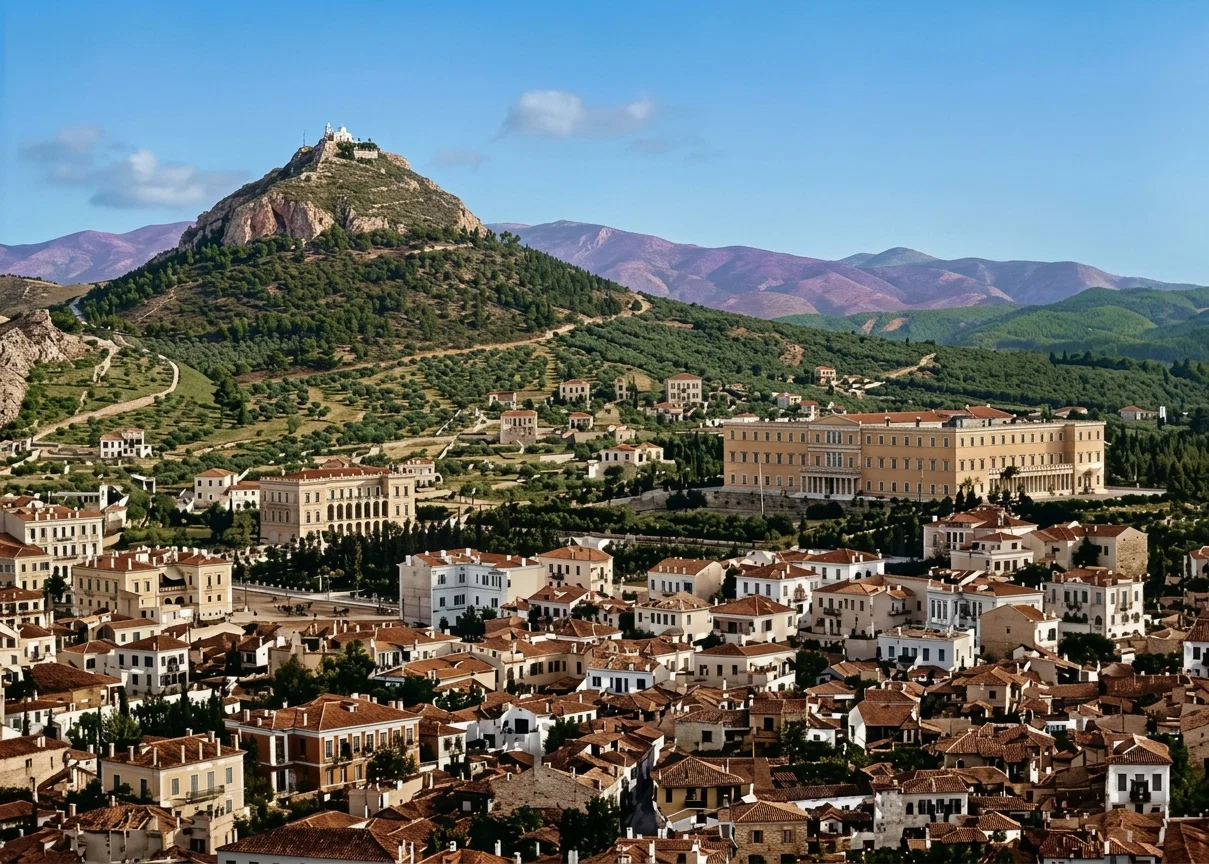
Athens has a population of about one hundred thirty thousand. It contains some nice modern streets. I was rather surprised to see the good stores and business houses here. It shows up very favorably, if compared with other cities of the Levant. If with its population we were to include the inhabitants of its port, Piræus, with which it is connected by electric railways, it would contain 200,000 people. In 1832, the town of Athens scarcely had 2,000 inhabitants; ten years later, it had 22,000; in 1870, 48,000. When one views Athens from the top of the famous Acropolis, he is struck with the vast number of houses, the large extent of the city, and its many nice public buildings. It has more than sixty churches.
MARS HILL
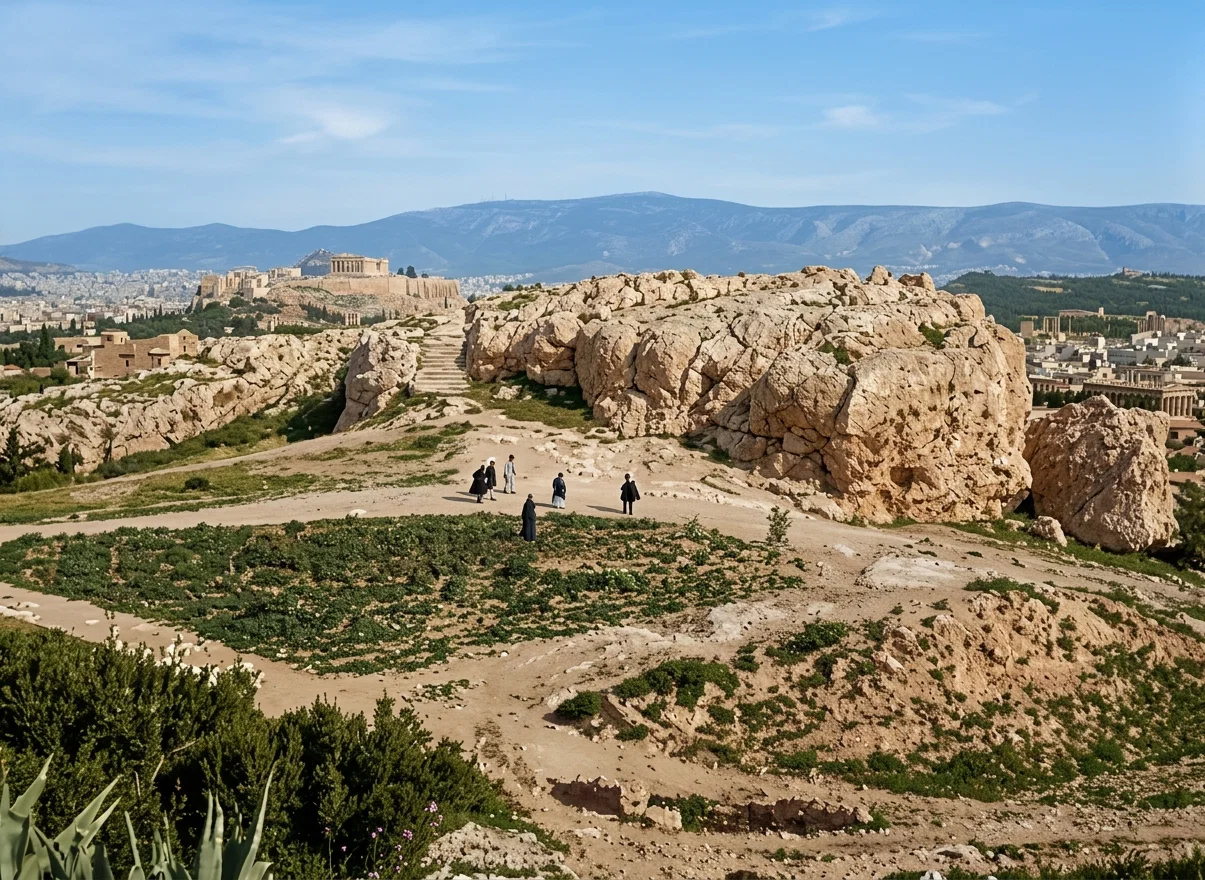
Early the morning after I reached Athens, Prof. W. E. Howell met me, and while we visited the ruins on Mars Hill, where Paul addressed the philosophers of ancient Greece, and while we were going to look at the imposing ruins of the Acropolis, we talked over the prospects of the work in this city to-day.
The kingdom of Greece contains only two and a half million people. Professor Howell has taken a dwelling about twelve miles from Athens, at a place called Kephisia, which is one of the few summer resorts that offer shade. We spent Sabbath together in talking of the circumstances in which the work in the various European countries began.
There are about four hundred Germans in the town. Some of them are prominent business men. On Monday I spent a few hours with a German printer, who expressed deep regret that I had not been able to call on him Sunday, and with him visit the Protestant church. I was very sorry that my steamer was to leave Monday evening, and thus I was unable to visit the old Protestant minister who has suffered so much for the spread of the gospel in that country.
Professor Howell is giving diligent study to the mastery of the language, and we hope that he will be of good cheer, and soon be able to converse fluently with the native Greeks, and bring to them the truth as it is for this time, in their own tongue, and to assist in preparing literature for them. Thus far we have only a few small tracts in the modern Greek. We trust our people in all lands will remember to pray for the work in this recently entered mission.
Hamburg, Germany.
Labors in Japan
By H. KUNIYA
H. KUNIYA
Last summer I again went to my home country to visit those who were interested in the truth. For two months I preached the simple gospel to these country people; and several families started to keep the Sabbath, including several young men. One man of considerable means became much interested, and began to obey; but before fully deciding to become a Seventh-day Adventist, he went to Tokyo to see a famous preacher of his acquaintance. He heard this man preach, but the sermon did not please him. Then he went around to several other churches, hoping to find a large gate by which to enter the kingdom of God. This man loved money more than eternal life, and gave up the truth he once willingly accepted. Now he opposes, and others have followed his example. One woman and her daughter are still loyal to the truth.
I went to another town, and was invited to stay with a certain family. All welcomed me heartily. I stayed two weeks, and gave Bible lessons every night. As I was about to leave, one of the women of the family wished to be baptized. I advised her to tell her husband, which she did. He did not oppose her, but advised her to consider well before going forward in baptism. I baptized her in the river near the town, and she remains firm in the truth. Her husband has given up tobacco and strong drink, and is always glad to listen to the truth. His mother has also become interested in studying the Bible; and when I left, she sent money by a servant to the station to buy my ticket to Tokyo.
October 25 we began tent-meetings at Maebashi, where Brethren Suzuki and Okado have been canvassing for some months. The meetings continued two weeks, and we had a good attendance. We sowed the seeds of truth in that city, and pray that some fruit may soon appear.
From Maebashi I went to the northern coast to see a pastor of the Friends Church, with whom I have been corresponding. I preached in his church, and met a number of the people; and they asked me to come again.
The prophet says: “Arise, shine; for thy light has come, and the glory of the Lord is risen upon thee. For, behold, the darkness shall cover the earth, and gross darkness the people: but the Lord shall arise upon thee, and his glory shall be seen upon thee. And the Gentiles shall come to thy light, and kings to the brightness of thy rising.” In common with other nations, the glory of the Lord is shining in Japan; and though Satan is trying to keep the people in darkness, there are many who are seeking for the light. But how can we satisfy 46,950,000 Japanese with four foreign missionaries and seven native workers? There are many pastors and evangelists who preach the gospel with the mouth, but the real gospel of Christ is not presented in their lives, in acts, for the relief of those in suffering and distress. As a result of departing from the Lord and from his law, hundreds and thousands are dying without hope. Though we present the gospel to these souls by mouth, many will not hear; but if we can relieve their sorrow and distress, they will listen willingly16listened. I preached in her house several times. Since I left, many of the neighbors have come for treatment, so my nephew has been quite busy with this work. We hope to start small medical institutions here and there, as openings for gospel work. If we can not do so now, we must do this work ourselves the best we are able.
Tokyo.
The Hawaiian Islands
By C. D. M. WILLIAMS
C. D. M. WILLIAMS
There are only two of us here — my wife and myself — to do the work on the eight islands. Of course five of the islands contain nearly all the people, so that we scarcely need to reckon on more. We have only one church, but some of the members are located on three of the other islands, so that we can say that the truth has found a lodgment on four of the five, but we do not know how faithful these isolated members may be; for we have not yet visited them all. We have been to see those on two of the other islands, and find that they need help.
HAWAIIAN GIRLS
This year we have been occupied a considerable portion of the time in erecting a church building here in the city. It is a frame building, twenty-eight by forty feet, and is now nearly finished. All that is lacking is the lumber to ceil the sides, the top being already ceiled. We also need a rostrum. We have succeeded in paying for everything so far except to the amount of about forty-five dollars. We have done all we can for the present, and are compelled to wait till more money comes in before we can finish. The lumber company will trust us to any amount we desire, but we have decided not to be in debt; and, although it will take but about one hundred dollars to complete the building, we think it best to wait.
Everything is very high here in price.
We have to add to the coast prices a high freight bill and a large margin for the dealers here. These three things make it almost too expensive to live. For instance: sometimes if we bought, we would have to pay three dollars a bushel for potatoes, and seven dollars for apples. Eggs are much of the time from forty to sixty cents a dozen. Wood and fuel are very expensive.
We have many languages to contend with here — Hawaiian, Spanish, Portuguese, Japanese, Chinese, Korean, and a few others. The white population becomes smaller each year, and the others, especially the Japanese, are increasing. It is very hard to reach the people, as the few whites have, many of them, already rejected the message; and the others are plantation laborers, who have to work when the boss says work. There are no farms, nor kinds of small work in which individuals can engage for the support of their families, as there are in the States; so it is a larger undertaking here to take a stand to obey the law of God.
We are very much in need of more laborers, so that work can be taken up on the other islands more extensively than we can do it. Also, other places on this island should receive more attention. In our visit to the other islands, we have been able to do but little besides distributing reading-matter. There should be more literature in the Hawaiian language. While many are able to read the English, I am told that they understand but little they read. I believe that the message should be made plain, so that it may be thoroughly understood.
The Chinese are quite ready to listen to the truth when there is not too much opposition. But we are not without opposition here, by any means; for I never saw a place where the ministers were so jealous of their members as they are here, or where they put forth a more decided effort to keep them from hearing and receiving the truth. One denomination called one of their members before the council five times, to see if they could not convince him that he ought to stay with them. They are now struggling to convince another that it is not a matter of so great importance whether or not we keep the commandments. Her minister told her that Christ broke all the commandments, so it was not necessary for us to be so very particular about just one. He said it made no difference what day she kept; she could keep any, and still belong to the church.
It would be well if some laborer could come who could be a help in some foreign language. The Japanese and Portuguese are the most numerous. There are also many Koreans and Chinese. Our ship work should also receive more attention.