“Of all the things that God has made,
In this fair world of ours,
Of all the things to me most dear,
Are flowers, lovely flowers.”
FLOWERS! sweet flowers! how they spring up around our pathway, sprinkling the fields and adorning the garden! They are not confined to any place or country, but lift up their bright heads all over our land from the Atlantic to the Pacific—“on the rugged rocky Eastern shore, on the fertile prairies, among the mountains and canyons of the Pacific slope—throughout the sunny South, on every continent and the isles of the sea.”
And they are welcomed by all, from the little child who finds delight in the simple dandelion and buttercup of the field, to the learned botanist who makes them a study and recreation. Indeed, God has planted within us a strong love for these bright and beautiful creatures of his hand.
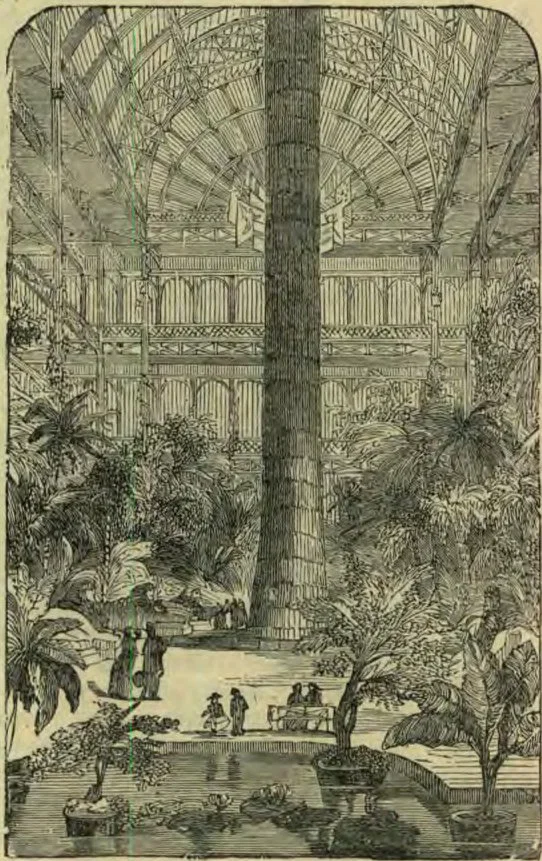
But in our Northern clime, as summer wanes, Jack Frost comes and nips our flowers and they sink down into their winter sleep, guarded and protected by kind dame Nature. Though this is the natural course, yet the florist is able to create such a scene as is represented in our picture, such a pleasing sight, even in winter. Though the snow without may lie many feet deep, the ice cover the rivers and ponds, and the winds come from their home in the frozen region of the North, yet by means of light and artificial heat, the shrubs, plants and flowers are cheated into the belief that it is summer, and they continue to grow, lifting up their heads, and nodding and smiling to each other.
Like all God’s blessings, flowers are free. They grow alike for rich and poor. So sweet, so fresh, so fair are they, they bring comfort to the sick, showing, as they do, a tender Father’s care.
Said a little girl, “Mamma, do you think there will be flowers in Heaven?” “There will be, I am sure,” was the reply; “but they will be more beautiful than they are here, and they will be unfading.” Yes; there will be flowers there; for Heaven is associated in our minds with everything that is beautiful, and surely there will be flowers.
Look again at the picture, and see the different kinds of plants represented here; and yet these are but a small portion of the many kinds with which God has clothed and beautified the earth. Well might Linnaeus, the Swedish botanist, when beholding for the first time a beautiful flower, fall on his knees and thank God for thus adorning the earth for man’s use. And would it not be well for us, when we see so much beauty, to render to God a tribute of thanks for all his benefits? V. A. M.
BUSINESS FIRST, AND THEN PLEASURE.
A MAN who is now very rich, was very poor when he was a boy. When asked how he got riches, he replied, “My father taught me never to play till all my work for the day was finished, and never to spend money till I had earned it. If I had but half an hour’s work to do in a day, I must do that the first thing, and in half an hour. After this was done, I was allowed to play; and I could then play with much more pleasure than if I had the thought of an unfinished task before my mind. I early formed the habit of doing everything in its time, and it soon became perfectly easy to do so. It is to this habit that I now owe my prosperity.” Let every boy who reads this go and do likewise, and he will meet a similar reward.
MANY persons are puzzled to understand what the terms “fourpenny,” “sixpenny,” and “tenpenny” mean, as applied to nails. “Fourpenny” means four pounds to the thousand nails, “sixpenny” means six pounds to the thousand, and so on. It is an English term, and meant at first “ten-pound” nails (the thousand being understood), but the English clipped it to “tenpun,” and from that it degenerated, until “penny” was substituted for “pounds.” When a thousand nails weigh less than a pound they are called tacks, brads, etc., and reckoned by ounces.
LETTER BUDGET.
Bettie Smith, of Osage City, Kansas, writes us of her brothers and herself, that they all keep the Sabbath, and are trying to be good. They take the INSTRUCTOR, and like it very much.
Jessie May Myers, of New London, Indiana, writes: “I am a little girl eight years old. I keep the Sabbath with father and mother. I go to Sabbath-school every Sabbath, where I get the INSTRUCTOR. I like to read the pieces in it. Pray for me.”
George A. Brunson writes from Keenville, Illinois. He says: “I keep the Sabbath with my parents, and sometimes go to Sabbath-school at the Anderson school-house about three miles distant. I hope to be a good boy, to live right and obey my parents. I am about ten years old, and can read and write a little. I hope to be a good scholar some day.”
Eddie Maupin, of Kansas Center, Kansas, says that he has been keeping the Sabbath since last March. His mother belongs to the church, but his father has not yet been baptized. He likes to read the INSTRUCTOR, especially the “Budget,” and hopes that he will see his letter in it. He is trying to so live that he may meet the INSTRUCTOR family in Heaven.
Dora Devereaux writes from Parker, Dakota. She says: “I have been thinking about writing, but have not got at it till now. I am thirteen years old. I keep the Sabbath with my father and mother. I attend Sabbath-school. There are six in my class. We study Lessons for Children, in the INSTRUCTOR. I have taken the INSTRUCTOR two years, and like it very much. Yours truly.”
Sarah B. Walker, of Longmont, Colorado, sends seventy-five cents for the INSTRUCTOR, and says: “I am a little girl twelve years old. I have never taken your paper, but one of my playmates, Alice Sosey, takes it, and I like it so well that I send the money for it a year. I worked for the money to pay for it. I live in the Rocky Mountains, twenty-two miles from the post-office. I do not attend school, but I will read your paper, and that will teach me.”
GOOD COUNSEL.
If health you would keep,
This counsel you'll take:
Be early asleep and
Be early awake.
'Tis good for your health,
'Tis good for your purse;
No doctor you'll need, and
But seldom a nurse.