The Establishment of Our Work in the Southwestern Union Conference
By E. W. Crawford
IN 1875 Elders J. N. Loughborough and M. E. Cornell went West, from Battle Creek, Mich., and after giving a course of lectures in San Francisco and Oakland, Cal., separated, and in October Elder Cornell came to Dallas, Tex., at which place I was running a store. There he made arrangements for the holding of a course of lectures in the — church, about three blocks from my store. Of course I attended, as I was always interested in anything new, and really I had become disgusted with the popular religion of the day. The handbills advertising such subjects as “The Origin, History, and Destiny of Satan,” “The Earth Made New,” “The Dream of Nebuchadnezzar,” appealed to me in a very personal way.
As the meetings continued, five of us became deeply interested. However, Elder Cornell was soon denied the use of the church. Leaving one of our company to tell the people where he had gone, we walked to the courthouse, eight or ten blocks away. I introduced Brother Cornell to the sheriff, and in consultation with the judge, it was decided to let us hold our services there. But the next night the sheriff told us that no religious services could be held in the courthouse, but he gave Brother Cornell permission to speak a few words to the people assembled. He told them he was determined to give them a series of Bible studies, and that he would let them know where he would hold the studies as soon as he could secure a place.
The next morning he found a hall 80 by 30 feet, which he could rent for $20. In talking it over with the five of us, he said, “I will pay ten dollars, for I want to bring my wife here, and we will make our home in the hall. I am a carpenter, and if we can get the lumber I will make the seats, and curtain off the back end for our rooms.” We made up the rest between us, each paying two dollars. Then we went across the street to a lumberyard and told the proprietor what we wanted. He donated some lumber, which we carried to the hall. Then with some borrowed tools we all turned in and helped what we could in making the seats.
In the meantime Brother Cornell got out some handbills giving the time and place of the next meeting, and stating that services would be continued for at least a month, and longer if there was sufficient interest. As a result of these meetings eight or ten of us were established in present truth, and covenanted together to “keep the commandments of God, and the faith of Jesus.” Our little company continued to meet from Sabbath to Sabbath, though Elder Cornell had to go away at the end of the month. Several Adventist families moving in from the North joined us.
We made a strong appeal to the General Conference for help, and Elder James White, then president, sent a minister to organize us into a church. He came, and we built an arbor. After a few sermons on baptism and organization, eleven were baptized, myself included, and a church of seventeen members was organized. Then the minister left us.
We set about to secure a regular minister, and it was arranged for Elder R. M. Kilgore to make Texas his field of labor. He came the following spring, and the General Conference sent a large tent and a family tent with him. We pitched the large tent about two hundred yards from the arbor where our church was organized. Brother Kilgore gave us some good instruction on church government and how to carry forward our work, and then went to Cleburne, near which the Keene Academy is situated, to hold meetings.
We bought two lumber wagons and suitable material for seats, and putting tents, feed for our teams, and provisions for a week’s outing into Brother Alfred Rust’s wagon, we started. I took Brother Kilgore and his family in my carriage. We left Dallas on Sunday morning, and reached our destination Wednesday. All took hold, and soon we had the tents up and the seats placed. Brother Kilgore and I went to the printing office and ordered handbills stating that meetings would begin Friday night. Brother Rust and I distributed these through the town, and I never have seen people more interested. They came in crowds, and the tent was filled to overflowing the first night. The attendance continued good throughout the entire series of lectures. When Brother Kilgore went to hold meetings in Peoria, he left an organized church of fourteen members in Cleburne.
He took a short rest, and then began lectures in Terrell, thirty miles east of Dallas, having organized a church of about twenty members in Peoria. Thirteen embraced the truth in Terrell, and Elder Kilgore moved on to hold meetings in Rockwall, sending word to all the churches in Texas that he would organize a conference at the close of his lectures in that place. After organizing a small company at Rockwall, he appointed a date for the conference to convene, and requested the members of the churches to attend in person as far as possible. I well remember my journey to that meeting, for I walked the twenty-eight miles from Dallas, as my wife wished to use the team to go on a visit.
I have forgotten the dates on which sister conferences united with the union, but I know that Texas was the first, and Oklahoma, Mexico, and Arkansas came in later. E. W. CRAWFORD.
In Virginia’s Mountains
By R. F. FARLEY
Much has been said about the needs of the mountaineers of the South. The writer had the privilege of attending the closing exercises of our church school in Rileyville, Va., and seeing the transformation that the gospel has wrought there.
The exercises were held on the night of April 5. The entertainment at Thanksgiving time had made such a favorable impression that the people for miles in every direction said they were coming to the final exercises. They were as good as their word. In spite of threatening skies and muddy roads, the hall was crowded long before the time came to begin the program. In opening, prayer was offered by Elder W. H. Armstrong; and the succeeding parts of the program were of a uniformly religious character, quite a noticeable contrast to that given at the public school just a few days previously.
A PIONEER SCHOOL
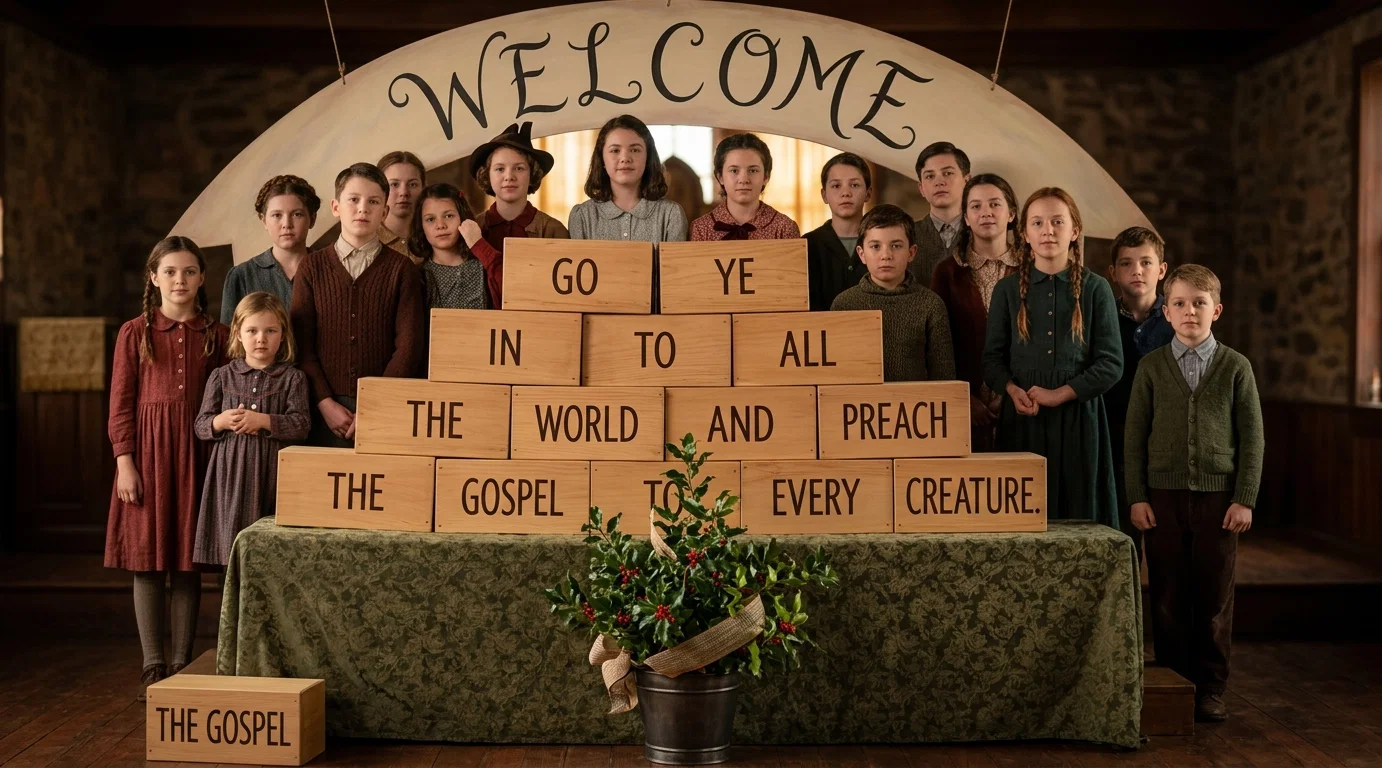
The accompanying picture represents the drill with which the exercises closed. The children, each with a box, marched in an orderly manner, then took their places on the platform. They came forward in turn, each reciting something embodying the word on the box, as he put the box into its proper place. When all had finished, the words “Go ye into all the world, and preach the gospel to every creature,” were before the audience.
An offering amounting to more than five dollars was taken. Besides this, more than $25 had been raised at the Thanksgiving season, and $27 at another time. Thus, thanks to the many friends who sent quilt patches, to the self-sacrificing efforts of the women of the church, and the energy and devotion of the teacher, Miss Alice Gray, nearly $60 was raised toward the liquidation of the school debt. Very soon this little school also will be singing the jubilee song. All are thankful for the good work done. R. F. FARLEY.
A Personal Experience
By Willard H. Saxby
SEVERAL years ago, while attending the Ohio camp meeting as a conference laborer, I received a Testimony from the servant of the Lord. It had been sent to one of our leading brethren, to be read to me. At the close of an evening meeting we retired to his tent. Elder A (for so I shall call him) said, “You believe in the Testimonies?” I replied, “Certainly I do.” We united in prayer, after which he slowly read the manuscript (it was in Sister White’s own handwriting). The first five pages pertained to me personally; the next six were counsels more general in character, applying specially to any one in charge of a city mission, etc.
After Elder A had read a few paragraphs, he read a personal statement to which I objected, saying with emphasis, “That is not so!” He stopped, and said, “Brother Saxby, you say it is so, and the Lord will help you to see that it is so.” “But how can I say a thing is so when I know it is not so?” He repeated, slowly, substantially what he had said, and continued reading. After a page or more, I said again, concerning another statement, “That is not so!” He repeated what he had said before.17talked awhile, and then resumed his reading.
I objected four times in all; but it was on the first point that I was especially positive.
At my request, Elder A lent me the Testimony until the next day. I returned rather late to my room, and Mrs. Saxby was anxious to know why I was so late. When I told her my experience, she asked me to read the Testimony. I said, “No, it will take too much time tonight; but here is one paragraph I will read. I told Elder A it was not so.” It was a matter between my wife and me; and I shall never forget how, after I had read this paragraph, she rose up in bed and said, with all the earnestness of her being, pointing to me with her index finger, “Willard, that is so!”
I began to reason very seriously, like this: My wife says it is so; and Elder A., because of his confidence in the Spirit of prophecy, says it is so; and, above all, the Lord through his servant says it is so: it must be so—three against one. As I sought the Lord by fasting and prayer, I soon saw things in the true light. The Testimony was a photograph of my inner life, and I could see that it was.
It is comparatively easy to believe a Testimony in reproof of some one else; but to one’s own self it is altogether a different proposition, at least I found it so.
This scripture came with force to my mind: “Wherefore let him that thinketh he standeth take heed lest he fall.” 1 Cor. 10:12. When we are sure that we are all right we may be all wrong. In our shortsightedness it is very becoming to us to walk in all humility before the Lord. “Believe his prophets, so shall ye prosper.” 2 Chron. 20:20. I praise God for the gift of the Spirit of prophecy. WILLARD H. SAXBY.
May 21: The source of true wisdom.
May 22: Importance of giving heed to instruction.
May 23: Have I in my life “the beginning of wisdom”?
May 24: The value of sincerity.
May 25: Do my ways please God?
May 26: Temperance and talebearing. May 27: How does my life measure up to the standard of these chapters?
The Book of Proverbs
This book “was written chiefly by Solomon, probably in the early part of his reign. It comprises a collection of wise sayings, poetic in style, gathered from the three thousand spoken by him. Some of the proverbs were written by Hezekiah and Agur. Jehovah is set forth as the creator and governor of the universe, and the disposer of human destinies, rewarding piety and punishing evil. The proverbs themselves relate to almost every part of moral and religious duty, forming a storehouse of practical wisdom, a summary of life’s experience and wise counsels, and a faithful exhibition of the moral philosophy of the Bible. The book of Proverbs is in fact a manual of practical rules of life, as the book of Psalms is a manual of daily devotion. Notice especially the invitations and counsels to mankind by Christ in the character of Wisdom, and study each maxim in the light of Scripture examples.”
As a whole, the book of Proverbs is a collection of sayings relating to the common experiences of everyday life. It deals with our duties to our families, our neighbors, our friends, and the faithful performance of our service to God. Modesty, chastity, temperance, forbearance, gentleness, industry, and other virtues are placed before us in vivid language. Praise and flattery are sweet to the human heart, but it is loath to accept reproof. The necessity of submission to correction is one of the most prominent lessons set forth in the Proverbs. The woes of intemperance are clearly portrayed, and the warnings against this sin are appropriate to all time.
How to Read the Bible
George Müller was one of the greatest Bible readers who read it reverently and with profit every day, and his directions for reading it may well be adopted:—
“Read the Scriptures regularly through. Read alternately portions from the Old and New Testaments. Begin at the beginning of each. Mark where you leave off, and begin there next time. When you have finished each Testament, begin it again.”
“Read with prayer. You cannot by your own wisdom understand the Word of God. In all your reading of the Scriptures, seek carefully the help of the Holy Spirit. Ask, for Jesus’ sake, that he will enlighten you.”
“Read with meditation. Ponder over what you read; the truth is thus applied to your heart. You see new and deeper meanings. It is better to think over a little than merely to read a great deal.”
“Read with reference to yourself. Never read only with a view to instructing others, but for your own teaching. Receive blessing yourself first, and you will communicate it to others. Always ask yourself, ‘How does this affect me?’”
“Read with faith—not as statements which you may believe or not, but as the revealed word of God. Receive every word as true, with simple, childlike trust. Rest upon the promises. Read them as made for you.”
“Read in order to carry into practice. We must accept his word as being the revelation of his will. In it he tells us what to be and what to do. He expects us to be ‘obedient children.’”
The Book of Books
“OUR globe floats in an ocean of air, and that ocean descends to the bottom of the deepest mine, and also rises to the summit of the highest mountain; it covers continents and seas alike, and as an element of universal life is found in all dwellings, and is fitted for men in all variety of conditions. So it is with the Word of God. Thus, whether they dwell in a palace or a prison, whether they celebrate a feast or observe a fast, whether they are prosperous or unfortunate in business, whether they hang rejoicing over a cradle or sit weeping by a coffin, whether they enjoy health or lie pining on a bed of sickness, whether they are occupied with the things of this world or of the next, whatever be the relation in which they stand to others, that of sovereign or subject, parent or child, brother or sister, companion or neighbor, bosom friend or deadly foe, there is none but will find something in the Bible written for him.”—Thomas Guthrie, D. D.
Power of the Word
As a Swede landed in this country, a worker of the New York Bible Society stepped up to him, offering him a Swedish New Testament. The Swede stopped, apparently startled, and stared at the worker, saying, “Weren’t you here twenty-six years ago? I think you are the same man—yes, you are the same man.” The worker told him he had been engaged for twenty-eight years distributing the Scriptures to the immigrants, giving to each one a book in his mother tongue. “Well,” said the Swede, “twenty-six years ago I landed here a stranger, and you gave me a New Testament in the Swedish language, just as you offered me one now. I read it, and through reading it I became a Christian. After a few years I made up my mind to become a preacher, and for twenty years I have been preaching the gospel in Colorado.” The word of God is still “quick and powerful.”—Selected.
Doing Good Where We Are
How often we flatter ourselves with the delusion that we would be much better if we were only somewhere else, and that we would do much better if some other tasks were ours. The place some one else is filling, the work that some one else is doing, looks easy and comfortable compared with our own. But if we would only stop to think one minute, we would know that it is distance that makes the difference. If I am not doing good and being good where I am, there isn't one chance in a hundred that I will ever be good or do good anywhere, unless I get to be a different man from what I am now; and that change that will set me at doing my task well may be made now just as well as any time.—The Christian Guardian.
Go to the Ant, Thou Sluggard
“Go to the ant, thou sluggard; consider her ways, and be wise: which having no guide, overseer, or ruler, provideth her meat in the summer, and gathereth her food in the harvest. How long wilt thou sleep, O sluggard? when wilt thou arise out of thy sleep? Yet a little sleep, a little slumber, a little folding of the hands to sleep: so shall thy poverty come as one that traveleth, and thy want as an armed man.”
Giving to the Poor
“He that hath pity upon the poor lendeth unto the Lord; and that which he hath given will he pay him again.”
Missionary Volunteer Department
M. E. KERN — SecretaryMATILDA ERICKSON — Assistant SecretaryMRS. I. H. EVANS — Office SecretaryMEADE MACGUIREC. L. BENSONJ. F. SIMON — Field Secretaries
A Great Missionary Congress
By Milton E. Kern
The national missionary congress, held in Washington, D. C., April 26-30, by the Laymen's Missionary Movement, was, in some respects, a remarkable meeting. This congress marked the close of the first decade of this organization of the laymen of the Protestant churches, and was preceded by a series of great missionary conventions throughout the United States. This congress had for its slogan,—
“A Survey of Achievement;
“A Council of War;
“A Summons to Advance.”
There were present 1,245 delegates, from practically every State in the Union, and from several foreign countries, representing twenty-two Protestant denominations. The first session was attended by the President of the United States, and the list of speakers for the congress included John R. Mott, Robert E. Speer, George Sherwood Eddy, S. D. Gordon, J. Campbell White, Shailer Mathews, and many other well-known leaders in religious work. Mr. James M. Speers, who is president of a large mercantile firm in New York, is the chairman of the movement; and many other laymen, prominent in business and professional life, are identified with it. Although many ministers were present at the congress, the leadership and delegation seemed to be largely from the laity.
Purpose of the Laymen's Missionary Movement
It is not the plan of the movement to send out missionaries or to administer mission funds, but to stimulate missionary activity on the part of all laymen, and to cooperate with the various church missionary organizations. The purpose, as given by the secretary, is as follows:—
“To stimulate initiative and activity among the men of the church.
“To inspire men to take their full share in the work of the kingdom.
“To promote improved methods of missionary education and finance.
“To impress upon men the vital importance of deepened spiritual life and Christian activity naturally following upon this.
“To stress right standards of the stewardship of life and money.
“To suggest plans for the speedy completion of the missionary task.”
The appeal of the congress was for a broader vision, a deeper consecration of life and means to the task of the church in carrying out our Lord's great commission, and for businesslike methods in the great missionary propaganda. As I heard the stirring addresses that were given, and became acquainted with the results of the movement, I could not help but feel that this is one of the agencies being used of God to carry the knowledge of Christ to the heathen, and prepare the way for the advent message.
There were present in the congress men who had left lucrative business positions in order to give their time without salary to work in the mission field or in behalf of foreign missions at home. There were others who are giving a part or the whole of the proceeds of their business to the cause of missions. When, in this money-loving age, men of great earning capacity will thus dedicate their money and talents to the work of the gospel, surely those who know that the day of the Lord is near should give their all to his work.
Origin and Work of the Movement
The movement had its beginning at a prayer meeting of laymen in New York, Nov. 15, 1906, on the anniversary of that other prayer meeting held under the shelter of a haystack at Williamstown, Mass., by five students a century before, which led to the development of the American foreign missionary enterprise. In 1907 a commission of sixty-six laymen visited various mission fields at their own expense, to investigate the religious conditions, results of missionary activity, and the needs of the fields. Many of these men have since been actively engaged in giving their testimony to the churches, and have greatly stimulated interest in missionary work.
During the season of 1909-10 a national missionary campaign was conducted throughout the United States. Seventy conventions were held, which aggregated an attendance of 7,408 registered delegates, and the campaign was closed by a national missionary congress in Chicago.
From 1913 to 1915 a great interdenominational campaign was conducted, during which 695 conferences were held. This effort was followed by the second national missionary campaign, which has just closed. Sixty-nine conventions were held, with a total registration of 101,927. Of these meetings, the secretary said:—
“The attendance and the interest in nearly every one of the conventions this year have been unusual. Seriousness of thought has been a characteristic feature. The delegates have seemed to realize the tremendous importance of the situation and the burning needs of the world today. World problems have been frankly discussed, and the solution sought in a prayerful spirit. Those attending have felt that a new call to world service had been sounded, and that the conditions demand a hearty response on the part of every Christian layman. As the appeal has been urged for a larger devotion of life and application of effort to the solving of the many problems connected with the missionary enterprise at home and abroad, there have come a depth of purpose and a new surrender of life to the call of God.”
In the work of the movement much emphasis has been given to prayer, sacrifice, education, and finance. Much literature adapted to the needs of men has been circulated, and a periodical, Men and Missions, is published.
In regard to financial methods the secretary said:—
“To change the financial methods of the churches, containing a membership of over twenty million people, is no slight task. The old methods already referred to had such a firm hold that at first it seemed almost hopeless to think of supplanting them. But when laymen began to study the conditions that were prevalent and realized how unbusinesslike churches had been in conducting their affairs, and when they saw the absurdity of trying to finance a great world enterprise by means of the methods then in vogue, they responded heartily to the proposed simple yet practical plan.
“This new plan in briefest outline is as follows: A live missionary committee in every church; an annual organized every-member canvass, preceded by at least a month of intensive educational and spiritual preparation, to secure from every member of the church and congregation a pledge for a weekly offering for the church and missionary budgets, together with the use of a duplex envelope or other collecting device, and a thorough follow-up system. This simple, business proposition appeals strongly to business men, and it is with gratitude that we are able to report its wide adoption.”
While these leaders feel very keenly that “the church is still playing with its great task,” they are gratified with the results already obtained. According to statistics from fourteen leading denominations, foreign mission offerings have increased 87.5 per cent, but the weekly average per member will seem startlingly small to Seventh-day Adventists. The weekly average per member to missionary and benevolent work is $ .037, against $ .028 ten years ago.
Impressions
Very naturally, in such a congress, the present world conditions received considerable attention. Strong appeals were made to the men of America to shoulder the added responsibilities that must necessarily fall upon the Christian people of the United States, because of the terrible sufferings of the people of Europe, the hatred resulting from the conflict, and the serious economic conditions which will surely follow. A new responsibility rests upon the people of this favored land to take up the work of bringing Christ to the entire world, with a depth of conviction and a strength of purpose never witnessed before.
While the whole spirit of the convention was one of optimism and courage, it seemed to me that I could detect an element of deep disappointment in the minds of these men, and that some readjustment of their processes of thinking has taken place. One speaker referred to the fact that people do not believe today as they did two years ago in regard to the possibilities of God's kingdom on earth, and that whereas we said at first that this would be the last war, we are now preparing for other wars. He said that we must gird ourselves to the task of making the world believe that love will rule.
Seventh-day Adventists ought to realize that the people are now more ready than ever before to believe that the kingdom of God can come to this world only through the destruction of earthly kingdoms and the coming of Jesus, and gird themselves to the task of giving the advent message. Dr. Mathews, after speaking of the impressions made by this war among Christian nations upon the minds of non-Christian peoples, suggested that we must now learn to distinguish between civilization and Christianity.
The message of Mr. Eddy, telling of the great transition taking place in the Far East, which he declared to be greater than the Renaissance, in extent, rapidity, and importance, brought a deep conviction that now of all times is our day and opportunity. He told of a district in Korea where twenty years ago there were seven Christians, and now there are thirty thousand. One church with an attendance of 1,500 has 800 at prayer meeting, and is a center from which forty-two other churches have developed. Mr. Eddy's testimony is that among the19educated classes in the Far East interest to hear the gospel has been increased rather than decreased by the war.
Seventh-day Adventists are not identified with the Laymen's Missionary Movement, but we surely should welcome any effort to arouse the churches from their lethargy and get the people to thinking of, praying for, and giving in behalf of the millions who do not yet know of Jesus and his love.
Surely in these momentous days, Seventh-day Adventists should get a new vision of God's call to service. And while life and material wealth are being so lavishly sacrificed, we should surely be willing to give our children, our means, and our service to herald the dawn of the new day to the ends of the earth.
M. E. KERN.
The Rural Schools of the South — A Symposium
By Arthur G. Daniells
A Mission Problem at Home
There is a strange problem in a section of the United States. In a country with widespread educational facilities, with compulsory educational laws which are supposed to be of universal application, is found a large number of people, living in practical isolation, with almost no opportunities for gaining an education or for learning anything about the gospel. Their land is poor, their methods are primitive, and they have no market for their produce, so they are poor as well as ignorant.
These people are, nevertheless, equal in physical and mental ability to any others in the United States. They are the descendants of the pioneer settlers of the country,—English, Scotch, Scotch-Irish, Germans, and French Huguenots,—pure European stock of stable quality.
The isolation in which they have lived has made them a difficult class to help. They need to learn how to cultivate their land, how to care for their bodies, how to train their children, how to read and write. They need above all to be taught the gospel. But they do not realize that they need to learn anything, and are suspicious of efforts that are made in a direct way to help them.
Experience has proved that the best way to help them is for those who wish to do so to live among them, and gain their confidence by lives of kindly ministry and by efficient work on the land. Devout Seventh-day Adventists have bought land, built simple, healthful homes, and when friendly relations have been established, have started schools for the youth and children, free of charge for tuition. That the need for such schools is great is shown by one case, where there are eighty families within two miles of the school, of whom seventy-five per cent cannot read or write.
These schools are practical. The children are taught the regular school subjects, and with these are given lessons on the cultivation of the soil, cooking, sewing, the care of the body, and other things that will build them up physically and mentally, and that will improve their financial condition. With these things they are taught the gospel message.
These schools are having an excellent influence, are raising the surrounding communities to higher standards of life, and gaining souls for the Lord. But there are not enough of them, and those that have been started are poorly supplied with necessary facilities. They are worthy of encouragement and assistance, for they are doing an important part in the giving of the last warning message in a difficult yet fruitful field.
A. G. DANIELLS.
Qualifications and Training of Teachers and Leaders for the Rural Schools of the South
By E. A. Sutherland
The educational situation in the South is peculiar. Before the war a large part of the educational work was done by various religious denominations and by private individuals. The Southern States are just beginning to see the necessity of devoting large sums of public money for operating schools, especially schools in rural districts.
Again, the Southern States are compelled to manage and support two systems of schools, one for white pupils, and the other for colored. This means extra expense not only in wages for teachers, but in erecting school buildings and in equipping and caring for them.
The educational problem presents another very serious difficulty. Extending from northern Virginia, through North Carolina, South Carolina, Georgia, Alabama, and Mississippi, there is a large stretch of country known as the Mountain District. If the rich agricultural lowlands find it difficult to raise by taxation sufficient money to build, equip, and conduct strong schools, it is much more difficult for the scattered population in these mountain districts, with their poor roads and meager income. And yet the rural school is the need of the hour because the population of the Southern States is still largely rural.
There is, however, a very bright side to our educational situation. The Southern people everywhere are awakening to the necessity of good schools, and educators tell us that more interest is being manifested here today than in any other section of the United States. The South is in a position to develop its educational work in harmony with the most advanced20ideas of education. Southern educators are anxious to make their schools practical; they desire to fit the youth better to meet the problems of life. In other words, no section of the United States affords a better opportunity than the South to plant the vital principles of Christian education which we as a people have known so well. We do not have first to reform a well-organized system. We are on virgin soil, and the people are waiting for practical, true education.
It must be evident, therefore, that teachers and leaders in our rural schools must be men and women who are thoroughly in harmony with the principles of Christian education as outlined in the Spirit of prophecy. The United States Commissioner of Education has said that if he had public-school teachers possessed of the consecration and devotion, and with the educational qualifications of some of our rural school-teachers, he could revolutionize the educational work of the United States, and even of the world.
We have been told through the Spirit of prophecy that people of good character, even though they have but a limited education in books, who can do practical things, such as farming, carpentry, cooking, and sewing, will find room for themselves in the South, and that they can do missionary work at much less expense than those who are not thus qualified.
What an opportunity is presenting itself to thousands of our Northern Sabbath keepers who are standing spiritually idle in the market place. It is a field that is inviting them to come, whose people are friendly, who are in a responsive state of mind, and who welcome a school managed by teachers who give the truth not by loud-mouthed oratory, but by well-kept farms, good crops, good stock, model homes with hygienic cooking, etc.
Our rural schools should be operated by a group of workers with varied qualifications. At least two or three families should unite. They should have sufficient means to purchase small farms and equip them in a plain, neat manner.
There should be among these people one or two persons who have ability to conduct a school in harmony with the teaching of the Testimonies. This means that they should have at least a good common school education with some working knowledge of practical subjects. Some of the company may have only a limited education in books, but may be able to teach carpentry, blacksmithing, farming, cooking, dressmaking, and kindred subjects.
There should be people connected with the school who are qualified to do some medical missionary work, and who have an interest in such work. A small treatment-room, with some simple bedrooms, is a great advantage to any rural school. The workers will find sick people everywhere. Some hydrotherapy treatments, together with hygienic diet, fresh air, outdoor life, and rest, can be provided for sick people, who are greatly benefited by contact with such conditions as the school presents. It also gives an opportunity for the workers to live the truth before their neighbors and to present it in the best manner to sick people. Read Isa. 58: 6-12 and Matt. 25: 31-40.
Naturally the question comes to you, Who is qualified to enter this work? Let us consider some essential qualifications. Some members of each company should be mature in age and character. Much depends, of course, on the development of character, one's practical experience, the state of his finances, and his obligations to others. I do not advise people to attempt this self-sacrificing, splendid missionary work who are burdened with financial obligations or debts, for there is no opportunity to make money in this work. A good living, however, can be made if the school is properly equipped.
People should not enter this work who have a large family of little children and are struggling to maintain them, without at least first carefully investigating conditions. No one should come here who will be a burden to the community. All must be able to lift.
I do not advise people to enter this work who have poor health. The Southern field has a healthful climate, yet the burdens that rest upon the active laborers in the rural school demand a strenuous life. The workers need vigor and vitality, and should be an inspiration physically, as well as spiritually and mentally, to their associates and to the people in the community.
I never advise any one to enter this work who is not thoroughly rooted and grounded in the truths of the third angel's message. To make a success of this work one must know God and have great faith in the promises of the Bible. His religion should be practical. He must be a leader.
Those who enter this work should be thoroughly in love with the great reforms in which Adventists as a people have been called to lead out. They should be intensely interested in agriculture, health reform, medical missionary work, the distribution of literature, cottage meetings, and in preparing people to accept the third angel's message, which will make them loyal Seventh-day Adventists, eager to help carry the truth to the utmost parts of the earth. Without doubt among these mountain people will yet be found some who may develop into leaders in this last great movement. Are they not the people from the highways, the byways, and the hedges?
To those who do this work there come untold blessings. In the development of character, the strong faith, the courage, we get a greater blessing than do those to whom we go. In other words, more than the South needs us, we, Seventh-day Adventists, need the South just now to prepare us for what is coming on the earth. Let us take courage and give ourselves and our means to promote this phase of the work allotted to us by the Master of the vineyard. Those interested in the preparation necessary to conduct rural schools in the South should get in touch with the training school at Madison.