While still rolling over the waves of the briny deep the word was flashed to our party of forty-two on the steamship “China,” that a royal welcome awaited us on our stop at the Hawaiian Islands. As we were waiting outside the harbor for the boat’s pilot and inspection officer, we noticed a little launch beside our boat containing a little man with the word “Aloha” pinned across his coat. It meant but little to us then, but before the day was over we learned to appreciate the word almost as much as the word “home.” It is the Hawaiian word of greeting, and means “my love to you.” We discovered that all the members of our little company at Hawaii had adopted this pretty word for our welcome. And to further show their love to us we each were decked with orange-colored garlands.
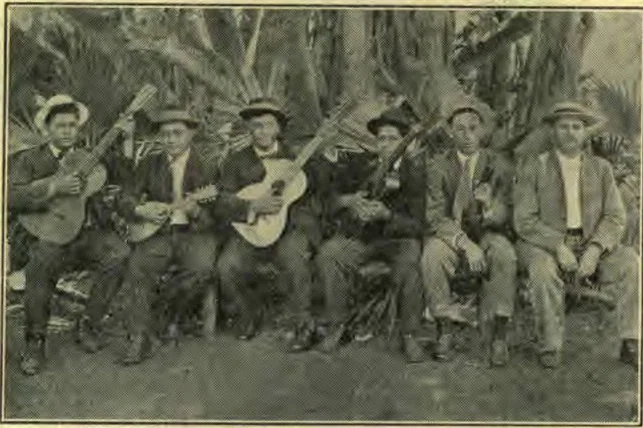
HAWAIIAN MUSICIANS
A special car was waiting to take us through the streets of the beautiful city of Honolulu—and beautiful is but a weak word to tell of the beauties of this city of the deep. The streets on either side are shaded with palms and banyan trees, the foliage of which is luxuriant and dense.
Everything was so interesting that we felt as if the English language were bankrupt, and when we got through with adjectives we should have to start all over again. Our trip took us through the beautiful Manoa Valley and along Waikiki Beach. This is a beautiful beach, and many of us could not resist the call of the waves. We were interested here to see the surf riders. These are little narrow boats with a pole fastened on one side, which keeps the boat balanced on the waves. Long ago the Hawaiian people invented them.
We were told to come to Kapiolani Park for lunch after our cooling recreation. Somebody said “baked beans would be served,” so no need to invite the Bostonians the second time. A bounteous lunch was served, and there were many delicacies which we had never before tasted. During lunch we were favored with beautiful music furnished by the Ukulele Sextet. We understand these musicians won the gold medal at the World’s Fair. Although we were not Hawaiians, we could appreciate the native songs, for they were beautifully rendered.
After lunch we listened to an inspiring address of welcome by Pastor F. H. Conway and a response by Elder R. C. Porter, after which all our party joined in the Chinese “pingan (peace), pingan.”
For the afternoon we were given our choice of many different trips, each party being furnished with a guide. Some chose to visit the famous aquarium containing the different species of sea life in the Pacific. Others went to visit the Bishop Museum, which contains a wonderful collection of island antiquities, feather cloaks, and the early weapons and utensils of the islanders. Another trip was planned for the executive building, which was formerly the queen’s palace. This building contains the throne room and many interesting relics. The shopping district proved to be an interesting place, for here one could see the Oriental markets and curio stores. No matter which trip was taken, each thought the one he had taken the most wonderful. Our “home on the water” left for Yokohama at four-thirty, and on their return to the boat the different groups had many interesting stories to tell.
Our boat sent a hurry call to tardy comers, and soon we were leaving the most beautiful place in the Pacific. As we weighed anchor, our Hawaiian friends bade us farewell with the new “Aloha” song, “Till Jesus Comes,” sung to the tune of their national hymn.
As one looked down into the water, a few bright-green looking forms could be distinguished. These were sharks. Farther out of the harbor porpoises were seen turning somersaults in the water around the boat. As we left Diamond Head in the distance, all felt satisfied that the day had been well spent, and appreciated land more than ever.
ELLA MAE BOWERS.
Shanghai, China.
HANKOW, CHINA, Oct. 6, 1916.
DEAR FRIENDS: While we were traveling from San Francisco to Shanghai it was our privilege to stop at Japan. When our ship cast anchor in the harbor of Yokohama, Elder De Vinney and others came out to meet us, and we gladly accepted their invitation to visit the mission, although the mission compound was thirty miles away. To reach it we had to ride on a street car and train. The electric car station was about a half mile from the wharf. Those of our party who did not care to walk rode in jinrikishas.8
The streets are narrow, with narrow sidewalks on both sides. On each side of the street are Japanese shops. Such articles as wooden shoes, lacquer wares, sandals, parasols, kimonas, beautiful embroidery, dishes, and pictures are sold at these shops.
The youngest member of our party was a baby girl of three months. Her father carried her in a basket on his arm. This greatly interested the Japanese. Many would come up quietly, look at her, then go away smiling. It was evident that they thought this an odd way of carrying a baby; for they carry theirs on their backs.
After eating our lunch in the school chapel, we were shown through the building. Besides the chapel there were two classrooms. In the rear part of the building we found a kitchen, dining-room, and bathroom. These are used by the boys who attend the school. Their sleeping apartment is in the part over the school. The girls’ dormitory is a building across the street.
Another thing of interest which we visited was the printing office. The workmen, including the editor, are Japanese.
The Japanese roofs are thatched, made of grass, and are several inches thick. The house which we noticed in particular had one side open with the exception of a mat curtain, which can be raised or lowered as desired. The Japanese leave their sandals at the door.
The principal furniture in the dining-room was a round table. The Japanese sit on the floor. In the parlor was an organ, bookcase, desk, two chairs, and a few pictures.
The Japanese always have pleasant faces, are very polite, and the parents are fond of their children.
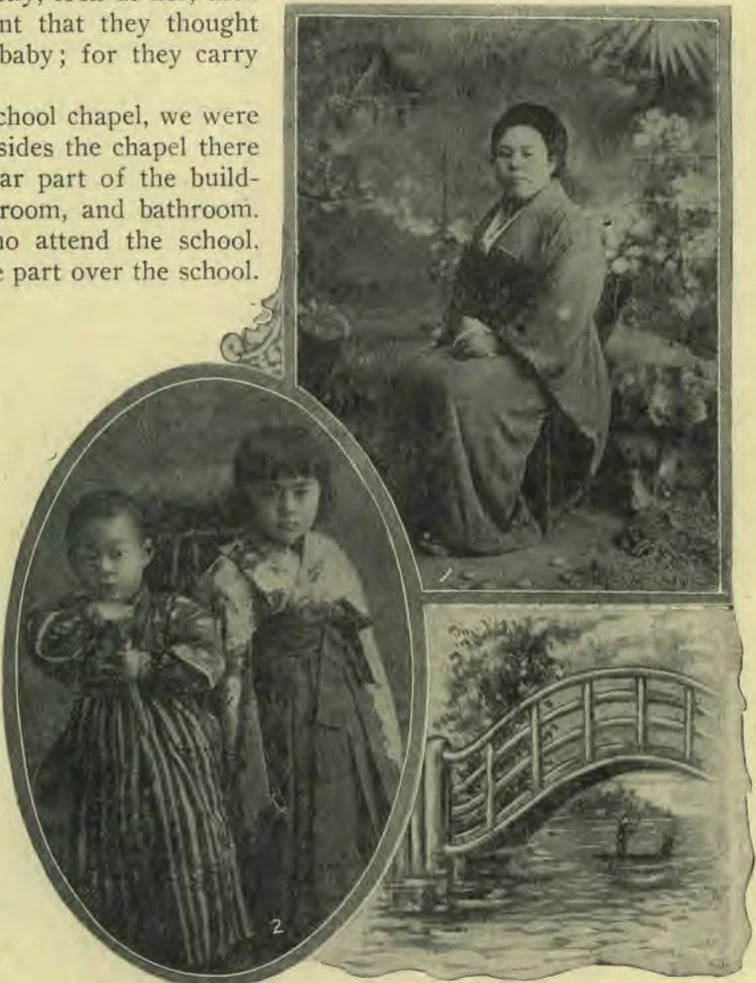
The Japanese dress interested us very much. The girls’ and women’s dresses are much like our kimonas, and a wide girdle is worn around the waist. The sleeves are long and have a long pocket in them. If a woman wears her hair in two coils in the back, it shows she is a maiden lady. If she wears her hair in one coil it shows she is married, and is subject to her husband. The men dress according to the class to which they belong.
All too soon the time passed, and we returned to our ship, the “China.” I trust you will remember this needy field in your prayers.
RACHEL PAYNE WHITE.
The Sacred Ganges
By R. L. Kimble
THE Ganges has its origin in the great Himalaya Mountains, and from there it starts on its course of nearly two thousand miles, finally to be emptied into the Bay of Bengal. There is no river in the world which has such an interesting history, and yet I must add, such a sad one, as the Ganges. This large stream is not only a great waterway for commerce, but it is looked upon as “holy water” by more than two hundred million people of India. And daily, on the banks of this stream, are thousands of Hindus, both men and women, who fully believe that by bathing in it they are washing away their sins and preparing themselves for final absorption and eternal rest in Brahma. The river is not only deified, but is regarded as one of the most potent deities of India.
To the tourist visiting India, if it be Hinduism he would know about, let him visit Benares, or Kasi as it is known to Hindus. Benares is built on the left bank of the Ganges, four hundred and twenty-one miles above Calcutta, and is regarded by devout Hindus as the most sacred spot in the world. What Mecca is to the Mohammedan, and more than what Jerusalem is to the Jew, is Benares to devout Hindus. To die within a radius of ten miles from its center is certain and eternal bliss, even to the outcast.
There is a river frontage of three miles given up to bathing, ghats, and temples. Many thousands are brought here annually from all parts of India to die at this sacred place, and have their ashes scattered upon the waters of the “holy” river.
The saddest and most gruesome of all objects which impress one in this center of Hinduism is its burning ghats. To the banks of the river many bodies are brought daily, each wrapped in a white cloth, and are laid just where they are half covered by water. Within ten feet of this place can be seen parties of pilgrims bathing in, and drinking of, the sacred water of the river, utterly regardless of the dead bodies along the stream. From time to time corpses are picked out of the water and placed upon the piles of wood. Each pile is ignited and the body reduced to ashes. The banks are thick with bathers of every description and age. There is no laughter or play; it is as serious a matter as any church service, and on the correct performance of the right number of dips with the right Sanskrit phrases depends the spiritual blessing of the ceremony. It matters not that the waters are turbid with mud, or fetid with decaying garlands, or black with cinders from the burning ghats, their power to cleanse the sinful soul suffers no taint.
Think of the millions here in India who are bound to such a religion, and spend their lives seeking the lost treasure, but in vain. Will you not pray for these people, that the message of love from our Saviour will win itself to their hearts? R. L. KIMBLE.
Kamakura Dai-futsu
By Lottie Lucas Conger
DURING our brief stay in Japan some of our missionary party visited Dai-futsu of Kamakura.
“In the year 737 A. D., the emperor Shomu, being a sincere devotee to Buddhism, caused numerous monasteries to be erected throughout Japan, and among the other churches thus built and endowed by His Majesty, is that known as the ‘Ko-toku-in’ at Kamakura.”
THE WIFE AND CHILDREN OF ONE OF OUR JAPANESE PHYSICIANS, JAPAN
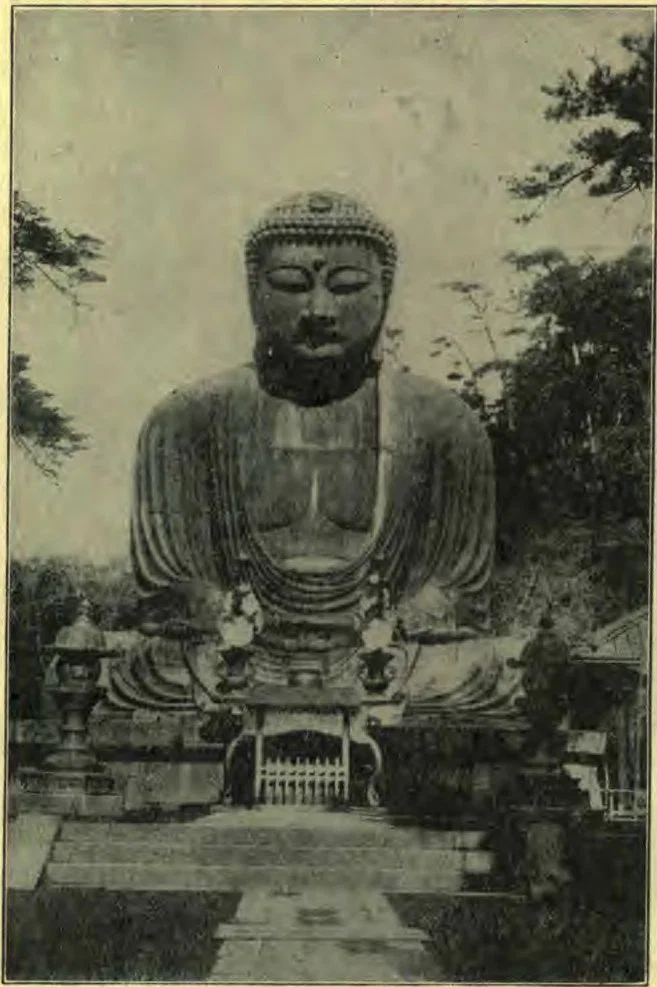
It is here that the famous colossal bronze image of the great Buddha stands. It was cast in 1252 A. D., by a command of the shogun, the prince. This image was much injured by a tidal wave which swept over the site of the monastery in 1495 A. D., yet, notwithstanding the ravages of time and the fury of the elements, it is in a state of excellent preservation and repair. It is about fifty feet in height and ninety-eight feet in circumference. The length of the face is eight and a half feet; of the eye, four feet; of the ear, six and a half feet; and of the nose, three feet two and one-half inches. The length from knee to knee (sitting) is thirty-six feet, and the circumference of the thumb more than three feet.
This is the greatest of the many idols still worshiped in Japan. It caused us to realize more intensely the need of this people.
LOTTIE LUCAS CONGER.
Open Doors in South India
By Minnie S. James
THE GREAT BUDDHA NEAR YOKOHAMA
We find in this country that God works in much the same way as in other parts of the world. For more than eight months evangelistic work has been carried on in the city of Madras, and a number of persons have begun to observe the Sabbath. Among these is a man who was employed by a large English firm. His employers gave him until a certain time to give up these ideas or forfeit his position. In this country the question of employment is a serious one, for there are ten men waiting for every vacancy, and our brother knew that if he should leave his work it would be well-nigh impossible for him to find any place where he could keep the Sabbath; but he decided that he could not longer disobey God, and he left the whole matter in his hands. The way was opened for him to take up a line of work of an independent nature, and in this he was prospered beyond his expectations.
One morning, as this man handed me his tithe, I remarked how God had blessed him, and how in my own experience he had always helped me when I trusted in him. He said that he also had found it so in his experience. Not only that, but he was able to make a better living than he had before. At first his wife was bitterly opposed to his new views, but now she is becoming reconciled and is studying the truth with much interest.
Never in all the ten years that we have been in India have we seen so many openings as are now presenting themselves. People are accepting the truth in different places and calling for some one to come and give them further instruction, but we have no one to send to them. Are there not some who are willing to leave home and friends and come out here to teach this people the way of salvation? They will find here souls for their hire. So often when we make appeals for workers to come out to these foreign fields, some who hear of our needs, question in their hearts whether they would be able to give up relatives, friends, and native land to cast their lot with a foreign race in a distant country; but it would not be difficult for them to make this country as dear to them as their own. India is the dearest place in the world to me. America has lost its attraction except as it holds our two children who are receiving their preparation for the work in the fields beyond. When they are ready, we shall give them gladly and willingly for the work in the mission field. It has been no small sacrifice to be separated from our two boys at a time when they need the guiding hand of their parents, but we know that they are in the hands of those who are deeply interested in the work of foreign missions, but who are unable to work in a foreign land. Are there not young men and women who will be willing to leave home and friends to take this message of salvation to those who are waiting for it?
MINNIE S. JAMES.
Madras, India.
Dispensary Work in Burma
By Carolyn Votaw
SEVEN years ago last August, Miss Mary Gibbs went to Burma, and lived in our home for four years. She took up the medical practice that I had to give up on account of ill health. Finding it necessary to have something more along medical lines, she took some work in a hospital in Calcutta. From there she went into the jungle one hundred miles from civilization and started a dispensary among the Karen people. In the place where she is she gets bread only once a month. Her chief food is rice, leaves from trees, and anything wild she can get from the jungle. She is often called as far as fifty and sixty miles to see patients. Patients are brought to her from ninety miles away, being carried upon the shoulders of natives. She has been called to undertake the most difficult operations because there is no physician near to perform them. She leaves everything to the Lord.10and has never lost a case. She came into mission work when she was twenty-three, probably up to that time the youngest missionary to be sent out alone. She has been called to nurse all the different workers in the mission field that have been sick, and has been remarkably blessed, never having had a sick spell herself, although she is very delicate.
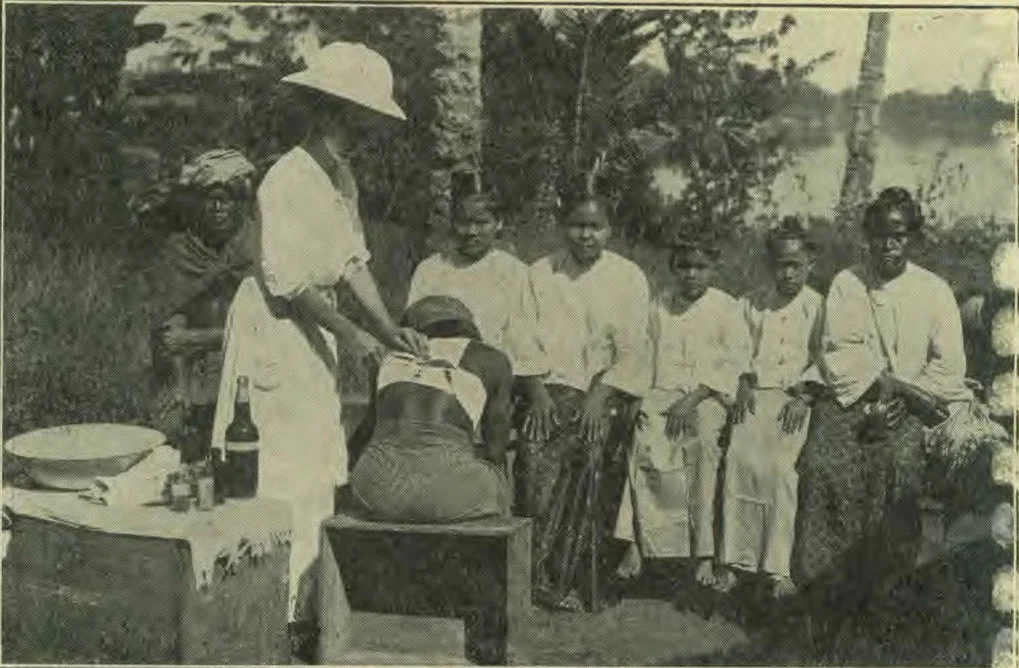
With only rude implements, a treatment-room with nothing but a kerosene tin set upon bricks for a fomentation tank and sterilizing outfit, and two empty packing cases, she has conducted a successful work. She treats almost every ailment.
The following extracts from a recent letter from her shows the work she is doing for the suffering people of Burma:—
“MY DEAR CAROLYN: Your letter of September fourth came last Friday, and it seemed good to hear from you again.
MISS GIBBS AT WORK IN HER OPEN-AIR DISPENSARY, BURMA
“I have already warned the powers that be that I hope to go home next June, but unless my change helps me greatly I am likely to come sooner than that, as for the last few weeks I have been feeling very much under the weather; but now the —’s are off, and everything has quieted down. I am eating and sleeping better, and do not feel so tired all the time. As you said, my nerves are simply worn out.
“A Karen girl, Leh Kiu, and I are all alone in the house. It is delightful during the day, but just a little uncanny sometimes in the evening and night. Leh Kiu is not very brave, so I do not say anything when there are strange sounds.
“I have been having a lively time in dispensary practice lately. I have one case coming now, a little boy about eight years old with sores on his leg. He had an abscess which had been treated after the heathen fashion. This caused the sore to enlarge, and then another formed, and the two were big punched-out ulcers, with a third abscess forming when they brought him here, just a little bag of bones. He is very brave about having his leg dressed, and on the whole it is doing well; one ulcer is half healed over. He came from forty miles away, and this evening a man from the same village came with a finger looking like a sausage. I persuaded them to go to Moulmein to the hospital, and began writing a letter for them, but while I was writing it, they decided they would rather die here than go to the city and be healed. No one from their village had ever gone to the hospital, but several had come here, and had been benefited, so here they are. The finger ought to be taken off, so I do not know what the result will be.
“Monday of this week I was called to a village three miles down the river to see a child suffering from acute indigestion; rather a simple case, but it took a long time to get there and back, the river being so swift.
“The next morning we went to Shwegun by the little steamer that runs from the village a mile above us. We had to answer a call to see a woman who had lost her mind grieving over the loss of her only baby boy. She was really insane, no hysteria. They had called an Indian enchanter of some kind, and he had poked two holes into her neck at the base of her skull, and had run strings into them. Abscesses were forming as fast as they could. That was enough to send any ordinary person to the asylum.
“The friends cooked rice and duck eggs for me, and had plantains, but I was dieting, so did not care to eat much. My girl tells me they were worried because I did not eat more, fearing I would faint on the way home. It was an interesting family. There is an old couple there, with whom, if you could see them, I am sure you would fall in love, the same as I did. The patient got hold of my hand and nearly wrung two fingers off before I caught her wrist. Then she played the game of mimic, doing everything I did, with added flourishes thrown in. She danced and sang and made poetry. It was difficult to get her to take the needed medicine.
“For the two trips I cleared seven rupees for the dispensary, above the boat hire. It is not a great deal, but every little helps, and I would rather visit six villages and only clear a rupee each than visit one and clear six, as means coming in contact with many more people. And money is a small item compared to what we are here for.
“Mr. — brought the launch up before he went away. It is in dry dock now awaiting his return. It runs well, and is conveniently arranged and roomy for its size. It is so tiny it is about like riding in a peanut shell.
“I am making clothes now for my stay in Darjeeling this winter, and for my trip home. I am anxious to go, principally because I am fast losing ground healthwise. If I do not pick up a great deal before the meeting, you may hear of my coming soon.”
CAROLYN VOTAW.
Do the Best You Can
“LIFE holds for most, my comrades.
More happiness than pain.
God gives a week of sunshine
For every day of rain.
So, trusting in the wisdom
Of his eternal plan,
Let’s face the rain or sunshine,
And do the best we can.”
Only the True Can Teach the Truth
By M. J. Sheahan
ONLY the true can teach the truth
So that all who listen believe;
Only the heart that is full of its task
Can the greatest good achieve.
M. J. SHEAHAN.