Your ShelfYour Projects

Signs of the Times, Vol. 24, No. 3.

SOME THOUGHTS ON EPHESIANS 5:1-10

Signs of the Times

Jan 20, 1898

Pacific Press Publishing Company · Oakland, California · Jan 20, 1898

SOME THOUGHTS ON EPHESIANS 5:1-10.
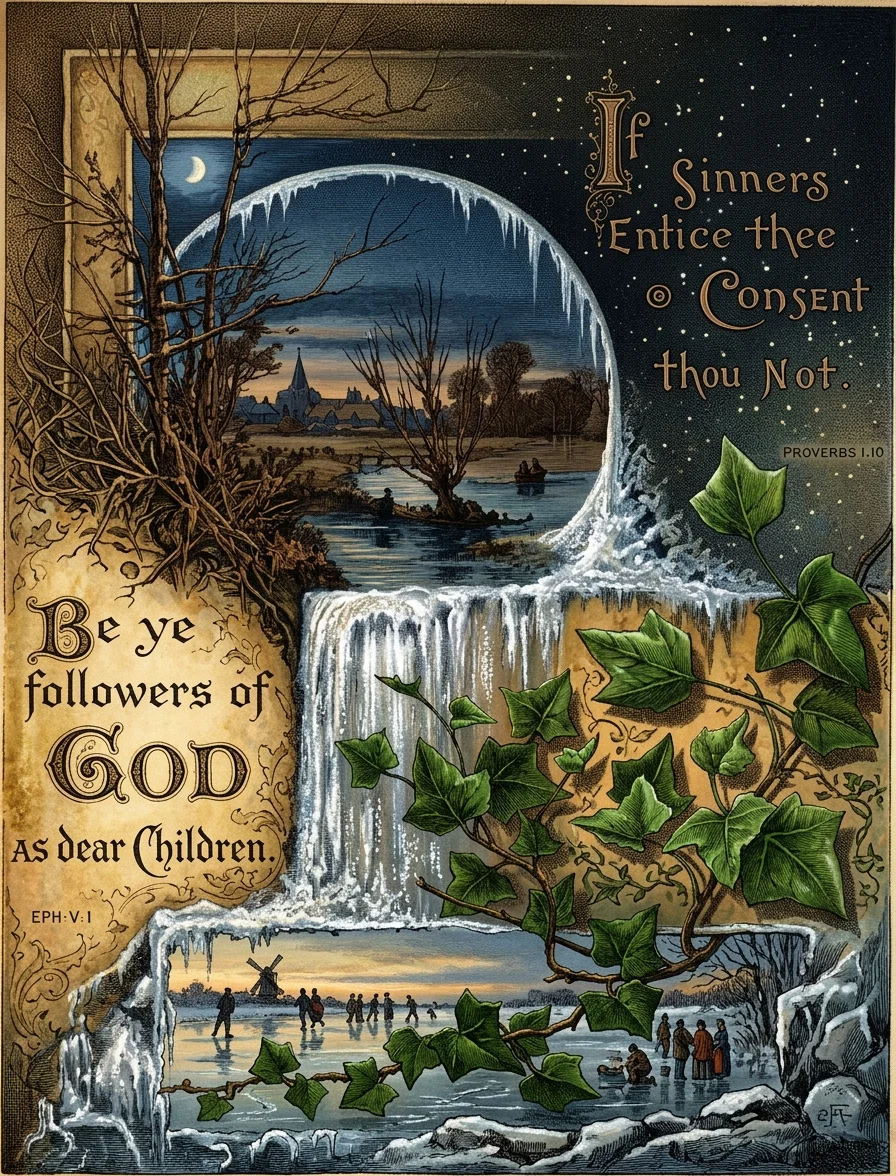
It is difficult indeed to take a few verses from the context in the Epistle to the Ephesians, and make of them a complete whole. It is like taking a beautiful cluster of gems from its setting amid a galaxy of a thousand others. It is beautiful and precious by itself, but with its fellows it is beautified by their luster, while by its own brilliance it adds beauty to theirs. But we can not take all these gems; let us consider a cluster found in Eph. 5: 1-10, containing most precious light, warning, and instruction for seven-days-in-the-week religion, and every moment of each day. The passage reads as follows:—
“Be ye therefore followers of God, as dear children; and walk in love, as Christ also hath loved us, and hath given Himself for us an offering and a sacrifice to God for a sweet-smelling savor. But fornication, and all uncleanness, or covetousness, let it not be once named among you, as becometh saints; neither filthiness, nor foolish talking, nor jesting, which are not convenient; but rather giving of thanks. For this ye know, that no whoremonger, nor unclean person, nor covetous man, who is an idolater, hath any inheritance in the kingdom of Christ and of God. Let no man deceive you with vain words; for because of these things cometh the wrath of God upon the children of disobedience. Be not ye therefore partakers with them. For ye were sometimes darkness, but now are ye light in the Lord; walk as children of light (for the fruit of the Spirit is in all goodness and righteousness and truth); proving what is acceptable unto the Lord.”

“Be Ye Therefore.”

—Literally, “become ye therefore,” in view of what God has done. Aim at the highest mark. God in the beginning elected that His children “should be holy and without blame before Him” (Eph. 1:4), and He has pledged the hoarded love of eternity in the cleansing blood of Jesus Christ, the power that raised Christ from the dead and created the worlds, and all the exceeding riches of His grace, that He may take every child of earth who will trust Him and make them that for which He chose them, “to the praise of the glory of His grace.” Therefore by God’s grace become that to which He called you. If you wish to do it, if you are willing it shall be done in God’s way, He will do the work. It may seem impossible to you so to “become,” but He “is able to do exceeding abundantly above all that we ask or think.”

What Shall We Become?

“Become ye therefore followers of God as dear children,” or, better, as the Revised Version has it, “Be ye therefore imitators of God, as beloved children.” Not followers in the sense of walking after, or with; tho it is true that God goes with His children, and His children with Him. The injunction is more striking. Connect it with chapter 2:17, 18: “This I say therefore, and testify in the Lord, that ye no longer walk as the Gentiles also walk, in the vanity of their mind, being darkened in their understanding, alienated from the life of God because of the ignorance that is in them, because of the hardening of their heart;” but be ye “imitators of God, as beloved children.” He is your pattern, your copy, your model. We are not to look to humanity for a copy to imitate, for we shall find imperfection, and excuse ourselves by that imperfection. Yet we are not to take a stranger. The son loves to follow his father’s example. So God would have His children imitate Him, copy from the perfect Pattern.

How May We Do It?

—Not by a formal life. Not by wearing a seamless robe as did Jesus, letting the hair grow long, and aping a “sanctified” look. It is not by working in human strength or wisdom that we become imitators of God. God wants living disciples, not lay figures or automatons. Those who walk as the Gentiles walk are “alienated from the life of God.” Those who walk as God walks must therefore have His life. And this is revealed in the next sentence: “Be ye therefore imitators of God as beloved children, and walk in love.” “God is love; and he that abideth in love abideth in God, and God abideth in him.” 1 John 4:16. “The love of God is shed abroad in our hearts by the Holy Ghost which is given unto us.” Rom. 5:5. How then shall we imitate God?—By having His life and His love in our hearts. O soul, “receive ye the Holy Ghost!” God is more willing to give His Spirit than are earthly parents to give good gifts to their children. Luke 11:9-13. Then will your life bear the same fruit manifest in the life of Jesus Christ; then will you indeed “walk in love as Christ also hath loved us, and hath given Himself for us an offering and a sacrifice to God for a sweet-smelling savor.” As Christ gave Himself that the life and love of God might be manifest unto the world, so will we yield ourselves thatthe life of God may be in us even as in Jesus, an odor of sweet things, a goodness, not our own, but God’s in us.

Leave the Old Life.

—There are many who think an outward profession of Christianity sufficient. It is enough, they seem to think, to go through certain forms, while the life, the disposition, the passions, the lusts, are the same. He who would become a child of God, who would in love be an imitator of God, must forever leave the old life. He must “resist the devil” if he would conquer. If sinners entice him, he should never consent to sin. The old course of life, even to its thoughts and words, is to be forsaken forever. “But fornication [the newspapers teem with reports of it], and all uncleanness, or covetousness, let it not once be named among you as becometh saints.” God would have the characters of His people look becomingly. He who dwells on fornication and uncleanness, who is coveting the things of the world, is not a follower of God.
“Neither filthiness, nor foolish talking, nor jesting [“lewd terms,” Doddridge], which are not convenient,” “not befitting,” R. V. These are the things that should not, must not, be among the children of God. And yet how much there is of it. Newspapers are oftentimes vile cesspools, or sewers for the same. The evil creeps into the social circle, around the fireside. The foolish talking opens the way for the “lewd turns.” No evil word may be actually said, but the look, the leer, the intonation, the gesture, all bespeak the lurking devil of unsubdued, lustful passion which finds a home in many a heart and a place in many a social circle, corrupting the minds and hearts of youth. If some true, brave soul indignantly protests we hear the sneer of “prudery or puritanism.” Nevertheless, such talk should be condemned; for God condemns it; because that in it is death to the soul that indulges it. “For this ye know of a surety, that no fornicator, nor unclean person, nor covetous man, which is an idolater, hath any inheritance in the kingdom of Christ and God.” And the apostle makes it more emphatic. He anticipated that men would say that we need not be particular; and therefore He continues: “Let no man deceive you with empty words; for because of these things cometh the wrath of God upon the sons of disobedience.” Surely the child of God should heed the warning. The professed Christian who has indulged in these things, should, in the light of this scripture, bow in abject humiliation, and repent of his sins. O, how many are confirmed in evil and led in the downward path, because of the utterly unbefitted and inconsistent course of some light-minded or lustful professor!

What Shall We Do?

—“Be not therefore partakers with them. For ye were sometimes darkness, but are now light in the Lord; walk as children of light (for the fruit of the light is in all goodness and righteousness and truth), proving what is well-pleasing to the Lord.” R. V. “Arise, and shine.” He who will yield to God to shine will have the light of God to shine with. What a blessed life, walking in the light, leading souls from darkness to light, ever a friend to the lost and a light to those in darkness! O Christian, light your lamps at the great Central Light! Dear soul, live no longer in darkness. What you sow you shall reap. You may call darkness light and light darkness, but they that do evil shall not enter the kingdom of God. They who yield to God will be channels of life and light to the world. Which will you choose, the blackness of darkness forever, or a place in the family of God? X.

THE WAY, THE TRUTH, AND THE LIFE

No. 2.
In answer to Christ’s words, “I am the way, the truth, and the life,” Philip said, “Lord, show us the Father, and it sufficeth us.” “Have I been so long time with you, and yet hast thou not known Me, Philip?” Christ said, “He that hath seen Me hath seen the Father; and how sayest thou then, Show us the Father?”
Christ came to our world to reveal the Father. Whatever attractions He possessed, He manifested only those that dwell in the character of God. His words revealed the goodness, mercy, and love of the Father. His excellence was the perfection of the Father. In His every word and work may be seen the manifestation of the attributes of His Father.
In Christ dwelt all the fulness of the Godhead. But the only way in which He could reach men was to vail His glory by a garb of humanity. The angels beheld the hiding of His glory, that divinity might touch humanity. Christ ever retained the utmost hatred for sin, but He loved the purchase of His blood. He suffered in the place of sinful men, taking them into union with Himself. This is the mystery into which angels desire to look. They desire to know how Christ could live and work in a fallen world, how He could mingle with sinful humanity. It was a mystery to them that He who hated sin with intense hatred felt the most tender, compassionate sympathy for the beings that committed sin.
Satan had worked long to efface the true impression of God, and to represent Him as a God having no love. This is Satan’s character. He is destitute of mercy and compassion. Overbearing and revengeful, he delights in the misery that he brings on the human family. With these attributes he attempted to clothe the God of heaven.
Christ came to remove these unjust impressions. He came to assure men that they need not fear to approach God because of His greatness and majesty. He constantly sought to carry the attention of His hearers to God. He presented the greatness of the Father’s love, declaring that He had so great a care for His children that even the hairs of their head are numbered. Not a sparrow falls to the ground without the notice of the heavenly Father. He sympathizes with all the creatures He has made, and if the heart is given into His hands, and attuned by His power, it will respond by strains of melody and thanksgiving.
In His wisdom the Saviour teaches us to approach God with the confidence of a child. He instructs us to call Jehovah by the endearing name of “Father,” that we may not separate from Him in awe and coldness. Constantly He points us to the emblems of fatherly love, seeking to encourage faith and confidence in God. He pleads with us to have a correct idea of the Father. He throws back the accusation of the enemy, declaring, “Like as a father pitieth his children, so the Lord pitieth them that fear Him.” He would have the memorials of redeeming grace arrest our attention, that we may know that all the goodness, mercy, patience, forbearance, seen in Him, belong to God.
But notwithstanding the fact that the disciples were privileged to be with Christ, and were greatly blessed by His instruction, they were slow to appropriate His words to themselves, and many times they remained in ignorance of the true meaning of the precious utterances that fell from His lips. He pleaded with them to have faith in Him. “Believe Me that I am in the Father, and the Father in Me; or else believe Me for the very works’ sake.” “By their fruits ye shall know them.” Is not the fruit I bear sufficient evidence?
“Verily, verily, I say unto you, He that believeth on Me [not with a fluctuating faith, but as the only-begotten Son of God, and a personal Saviour], the works that I do shall he do also; and greater works than these shall he do; because I go unto My Father. And whatsoever ye shall ask in My name, that will I do, that the Father may be glorified in the Son.” This promise the disciples held fast by faith, and on the day of Pentecost it was graciously fulfilled by the Lord. They were bidden not to leave Jerusalem till they had been endued with power from on high. They therefore remained in Jerusalem, fasting and praying. They emptied from their hearts all bitterness, all estrangement, all differences; for this would have prevented their prayers being as one. And when they were emptied of self, Christ filled the vacancy. The Holy Spirit came upon them, and filled all the house where they were sitting. Then was the promise fulfilled: “If ye love Me, keep My commandments. And I will pray the Father, and He shall give you another Comforter, that He may abide with you forever.”
The Holy Spirit leads men to co-operate with God. This is the design in divine help. And in our turn we are to lead others to Christ, the Way, the Truth, and the Life. As we engage in this work with heart and soul, we are blessed and strengthened. God stands ready to co-operate with us, but this He can not do till we do our duty. If ministers and teachers would learn the lessons given here so clearly and explicitly, a great change would take place in the ministry of the Word. They would realize their entire dependence upon God, andwould work for Him with whole-hearted earnestness. The Holy Spirit would work in and through them, and the unconverted would be rescued from their insensibility.
The great reason why the church has not more efficiency and power is that its members love the world. They reject the Spirit of God, and fill their hearts with idols. They love the world, and the things of the world, and of all such the words of inspiration declare, “If any man love the world, the love of the Father is not in him.” They are not, as was Christ, in the world but not of the world. The Lord can not manifest Himself to professed Christians who love the world; for spiritual things are spiritually discerned.
The Holy Spirit is given to bring to our remembrance the words and works of Christ, spoken for the salvation of the soul; and if this Spirit were recognized and appreciated, spiritual life would increase one hundred-fold. But many do not choose to remember. They seek rather to forget the good impression made on mind and heart. They do not desire to yield their way for God’s way. God bears long with them, and his Spirit is constantly employed to bring spiritual things to their remembrance, that subjects of vital importance may find a lodgment in their hearts. The Spirit takes of the things of God, and presents them to mind. Constantly the mind is given glimpses of God. If men listen for the voice of God, these spiritual impressions become more and more frequent, and extend from one to another till the leaven seems to go through the whole church. A divine presence hovers over the people, and a revival is the result. Souls are converted. The sympathies and energies of the people are enlisted on the side of the truth. God works in them, to will and to do of his good-pleasure, breaking the spell of the world, and engrossing the thoughts with subjects of eternal interest.
The most powerful motives and attractions that can be imagined are offered to reclaim man, and win him from the path of transgression to the path of humble obedience. “He that spared not His own Son, but delivered Him up for us all, how shall he not with Him also freely give us all things?” No stronger inducement could be offered. Nothing is withheld. In Christ God gave Himself. He has enriched the world with a gift beyond all parallel. This gift is the source of all patience, forbearance, and mercy. In it is love sufficient to fill the whole world. It is of infinite value; for with it was given all that heaven could bestow.
Our great peril is in regarding the Lord’s plans with cool indifference. All heaven is actively engaged in working out the plans of God for the salvation of an unbelieving world. How then do finite men dare to put aside God’s plans for their own? By doing this, they place their souls in great peril. Shall we not respond to God’s love by giving ourselves to Him without reservation, by walking in His way, by determining to do His will? Angels are enlisted in this work. They do the bidding of God by co-operating with human endeavor. They are filled with amazement; for they are unable to measure the greatness of God’s love. The chosen instruments of righteousness join in the testimony, saying, “Herein is love, not that we loved God, but that He loved us, and sent His Son to be the propitiation for our sins.” As the followers of Christ see Him, the Way, the Truth, and the Life, they exclaim, “God forbid that I should glory, save in the cross of our Lord Jesus Christ.” Charged with a special message, they proclaim Christ, and Him crucified. MRS. E. G. WHITE.

SUBMISSION

Tho dark and drear the way, O Lord, I can not see, And threatening clouds and bitter storms o'ershadow me, Calm in Thy promises I can securely rest, Come toil or danger, want or wo, God knoweth best!
What matters it if friends are false and sweeter ties are riven, Hath not He a pitying eye that looketh down from heaven? There's not a falling tear, a passing sigh, a prayer scarce spoken, But reaches God's white throne and angels see life's mournful token.
So, tho the mountain's high, and weary grows the climbing, Past yonder brilliant sun I hear the hope bells chiming; And, strengthened and refreshed, my burdened heart grown lighter, All fears are gone, a blessing comes, and everything is brighter.
Thus as the bud becomes a rose and bursts in glad fruition, So God can use us most when we but understand submission. And every testing hardship, tho fraught with pain and sorrow, Is but an index of our hopes to behold the new earth's morrow.
So let us then accept the rod, for God looks on with pity; For high above our home awaits within the glorious city, And angels fair are waiting before heaven's congregation, With crowns for all when earth has reached its final consummation.
Mary S. Young.
Benedict Avenue, Wood Haven, S. L. I.

THE PROPHETIC SYMBOLS OF DANIEL 7.

The Lord has said, “If there be a prophet among you, I the Lord will make Myself known unto him in a vision, and will speak unto him in a dream.” Num. 12:6. He does not say that every dreamer is a prophet, but that He will speak to His prophets through that means. Now the Lord recognized Daniel as a prophet (Matt. 24:15), and gave him “understanding in all visions and dreams” (Dan. 1:17). Therefore the visions and dreams of Daniel, as well as his interpretations of the dreams and visions of others, are to be received as prophetic revelations. In the second chapter of Daniel we have found in his interpretation of Nebuchadnezzar’s dream, an outline history of this world’s government from Babylon to the setting up of the kingdom of Christ.
In the seventh chapter we come to visions given to the prophet himself. The date is given as the first year of Belshazzar, who was the last king of Babylon.
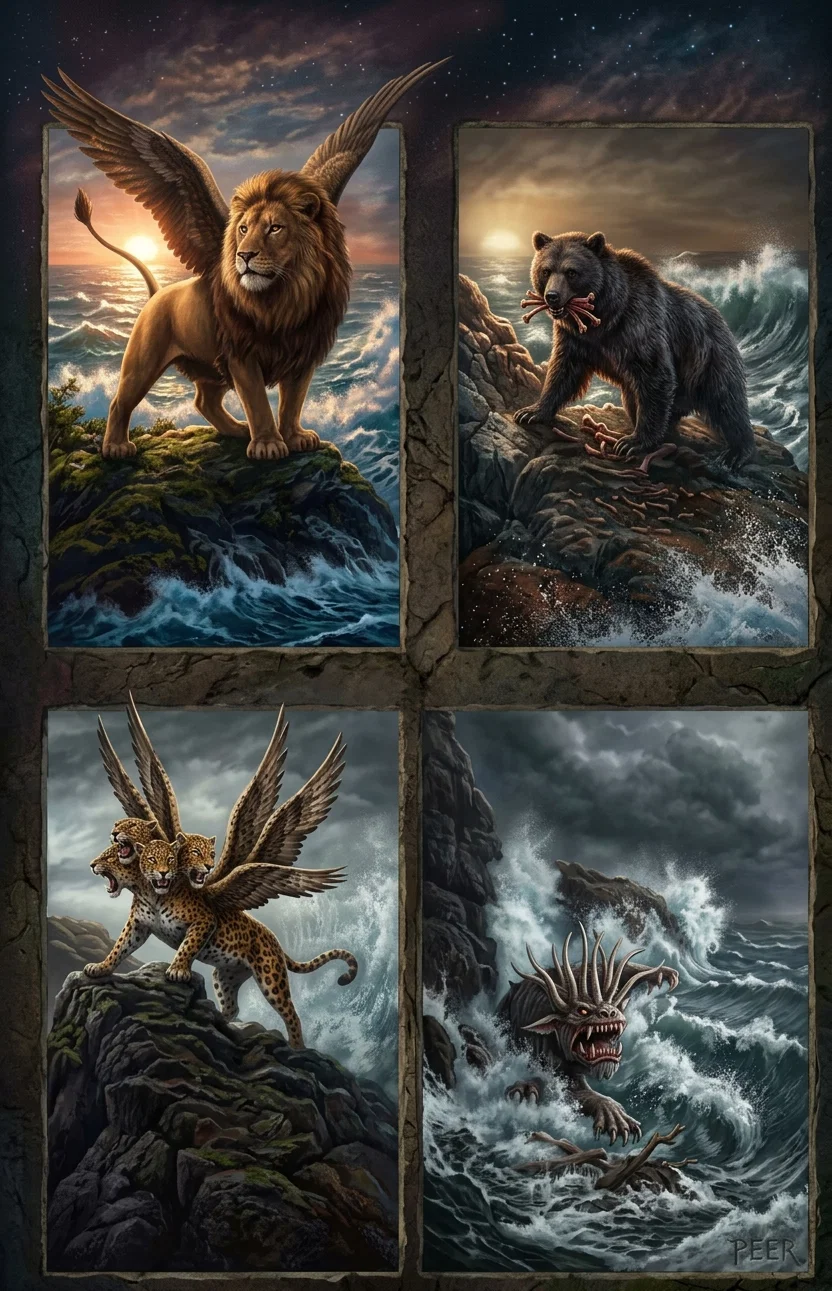
“Daniel spake and said, I saw in my vision by night, and, behold, the four winds of the heaven strove upon the great sea. And four great beasts came up from the sea, diverse one from another. The first was like a lion, and had eagle’s wings: I beheld till the wings thereof were plucked, and it was lifted up from the earth, and made stand upon the feet as a man, and a man’s heart was given to it. And behold another beast, a second, like to a bear, and it raised up itself on one side, and it had three ribs in the mouth of it between the teeth of it; and they said thus unto it, Arise, devour much flesh. After this I beheld, and lo another, like a leopard, which had upon the back of it four wings of a fowl; the beast had also four heads; and dominion was given to it. After this I saw in the night visions, and behold a fourth beast, dreadful and terrible, and strong exceedingly; and it had great iron teeth: it devoured and brake in pieces, and stamped the residue with the feet of it; and it was diverse from all the beasts that were before it; and it had ten horns.” Verses 2–7.
Space will not permit elaborate exposition; the object of this article is merely to give a general idea of the meaning of the symbols used, hoping that the reader will be sufficiently interested to pursue the study more at length. By reference to Jer. 25:31–33, it will be seen that the wind is a symbol of tumult, strife, war. And in Rev. 17:15 it is stated that the sea, or waters, refer to “multitudes, and nations, and tongues.” See also Isa. 8:7. Thus the four winds striving upon the sea would indicate wars affecting all quarters of the earth, and consequently working great national changes.
But what about the “beasts” which “came up from the sea,” or people of the earth? Verse 17 of this seventh chapter of Daniel states plainly that they stand for kings; and verses 18 and 23, as well as chapter 2:37–40, show that the words “kings” and “kingdoms” are used interchangeably. The conclusion is therefore inevitable that the “four great beasts” of Daniel’s vision, coming up in succession, indicate four successive kingdoms. We are also forced to the conclusion that they mean the same four kingdoms that are outlined in Nebuchadnezzar’s dream of the great image given and interpreted in Daniel 2. We are shut up to this latter conclusion by the fact that in both instances the series of four kingdoms reaches to and closes with the everlasting kingdom of God, which shall fill the whole earth. See chapter 2:44 and chapter 7:27. The lesson is the same in both instances, namely, that human government is a temporary arrangement, and sooner or later will come to an end, giving place to a kingdom of righteousness with Christ Himself as king. As everything at all opposed to the righteous rule of the Most High is to be consumed and destroyed, it follows that all wickedness and every dependence of man of a human character will be utterly annihilated.” “For all they that take the sword shall perish with the sword.” Matt. 26:52. “For, behold, the day cometh that shall burn as an oven; and all the proud, yea, and all that do wickedly, shall be stubble; and the day that cometh shall burn them up, saith the Lord of hosts, that it shall leave them neither root nor branch.” Mal. 4:1.
Nebuchadnezzar was an idolater, a worshiper of images; therefore an image would be the most striking form in which a vision of the future could be presented to his mind. He was anxious to know concerning the future of his kingdom, or his dynasty, and was shown by this image in a dream that it would come to an end; and that not only Babylon, but all other human governments, would likewise perish. Now the Lord shows the same thing to Daniel in a vision of beasts, in which the characteristics of these kingdoms while in existence are manifested. Thus the Lord shows to His prophet, and through him to His believing people, more than was shown to the heathen king. This principle is set forth in the words of our Saviour, “Unto you it is given to know the mystery of the kingdom of God; but unto them that are without, all these things are done in parables.” Mark 4:11.
“The first beast was like a lion, and had eagle’s wings.” This beast represented the kingdom of Babylon. In the image, Babylon was symbolized by the head of gold. But gold could only indicate wealth, grandeur, and the power that such attributes could command. The innate characteristics of the kingdom, the manifest means by which it obtained this wealth and glorious dominion, are shown in the character of the lion with wings. The lion is bold, strong, alert; and the addition of wings indicates unusual rapidity of motion. Such was Babylon in the many military conquests in which Nebuchadnezzar figured. But after he passed away, the kingdom degenerated through the profligate inactivity and indulgence that characterized the later kings, especially Belshazzar. For some years there were no strong foes to encounter, and the head of the kingdom gave himself up to easy luxury and debauchery. The consequence was the downfall of the kingdom.
The second beast was like a bear. As Medo-Persia succeeded Babylon in universal empire, the bear was the symbol of that kingdom. In the image this kingdom was represented by the breast and arms of silver. But silver would only indicate a measure of wealth inferior to the head of gold. The bear reveals the character of the kingdom. By this the kingdom is shown to have been not only strong but cruel and rapacious. It was a devourer. “They said thus unto it, Arise, devour much flesh,” and it did. It had three ribs in its mouth, denoting that they had been stripped of the flesh. It was a despoiler, and these three ribs, no doubt, symbolize the three provinces that were especially robbed and oppressed, namely, Babylon, Lydia, and Egypt. It raised itself up on one side. Media and Persia were combined in the conquest of Babylon, but eventually the Persian element in the kingdom became the more prominent, thus fulfilling the symbol. This is further shown by the fact that in the time of Ahasuerus the two names Media and Persia were transposed, and the kingdom was known as Persia and Media. See Esther 1:3, 14, 18, 19.
The third beast was like a leopard. In the image the third kingdom was represented by the belly and sides of brass. This symbol could show only an inferiority in point of wealth—a further deterioration from the glory of Babylon. But the leopard denoted the characteristics of cruelty, cunning, and celerity of motion. The kingdom that overcame and succeeded Persia, was Grecia, and it fulfilled the symbol in every particular. The leopard is naturally very fleet-footed, but the leopard of Daniel’s vision had also four wings, showing extraordinary fleetness. Alexander the Great led his conquering hosts over five thousand miles in less than eight years, including many battles and sieges. In all this there were no steamboat or railroad facilities, and the mode of fighting was hand-to-hand conflict. The leopard of the vision had four heads, which specification was also fulfilled in the history of Grecia. Within fifteen years after the full conquest of Persia, which took place in the year B.C. 331, Alexander had died and the kingdom was governed by four of his leading generals, each having jurisdiction over a specific territory; yet the empire was reckoned as one.
The fourth beast could not be symbolized by any beast in nature. No animal could compare with its diabolical character. It was different from all the others; was exceeding dreadful; had teeth of iron and nails of brass; it “devoured, brake in pieces, and stamped the residue with his feet.” In the image of Daniel 2 the fourth kingdom was symbolized by the legs of iron and feet and toes of iron and clay. That denoted strength at first, but division afterward. It was also said of it, that it should “break in pieces and bruise.” Evidently the iron part of the image, which was “the fourth kingdom,” is the same as “the fourth beast” or kingdom of Daniel’s vision. This fourth kingdom, succeeding Grecia in universal empire, was Rome, as no other kingdom fulfils the specifications. Rome, and Rome only, held world-wide jurisdiction after Grecia.
This fourth beast had ten horns, three of which were plucked up by a “little horn;” but these points must be left for another article.
W. N. G.

THE SURETY OF GOD’S PROMISES.

Since God is the maker of all things (Heb. 3:4), all energy has its source in Him. All creation must therefore receive life and activity from the first great cause. In view of this, inspired writers have greatly enlarged upon the thought of God being before and above all. One writer expresses it: “God hath spoken once, twice have I heard this; that power belongeth unto God.” Ps. 62:11
Another writer speaks of the exercise of this infinite energy on this wise: “He stretcheth out the north over the empty place, and hangeth the earth upon nothing. He bindeth up the waters in His thick clouds; and the cloud is not rent under them. He holdeth back the face of His throne, and spreadeth His cloud upon it. He hath compassed the waters with bounds, until the day and night come to an end. The pillars of heaven tremble and are astonished at His reproof. He divideth the sea with His power, and by His understanding He smiteth through the proud.” Job 26:7–12.
After thus graphically describing the wonderful display of almighty force in regulating the operations of nature, and apparently feeling unable to express the fulness of it, tho having at command inspired language, the patriarch rests the matter by saying: “Lo, these are parts of His ways; but how little a portion is heard of Him? But the thunder of His power who can understand?” With all the wondrous display of what is seen of infinite power in the movements of distant planets, and the changing conditions of our own, only a small part of His ways are known; the thunder of His power is not revealed in these. How utterly impossible, therefore, for a finite mind to grasp the extent of God’s ability to perform whatsoever He will.
Yet when the divine Son appeared on earth to represent His Father, He said, “All power is given unto Me in heaven and in earth.” Matt. 28:18. On the strength of this statement, and what was involved in it, He based the Gospel commission, and all its attending promises. When He further said, “Lo, I am with you alway,” He meant to say that all the power which had been given to Him, was to be freely given to those who accepted the offered commission.
As to when this gift of power was bestowed upon Christ we are not able to determine, but we may safely say that it was not a transient endowment, accorded alone as an accompaniment of His earthly mission; for we find Him using it from the very beginning: “For by Him were all things created, that are in heaven, and that are in earth, visible and invisible, whether they be thrones, or dominions, or principalities, or powers; all things were created by Him, and for Him.” Col. 1:16. True, we are told that “in the beginning God created the heaven and the earth.” Gen. 1:1. But it has been explained that God did this by His Son, who having had the power bestowed, called the worlds into being. Heb. 1:1, 2.
It was this same creative power that the Lord Jesus constantly manifested while here on earth. One reference is sufficient to illustrate this statement: “For they were about five thousand men. And He said to His disciples, Make them sit down by fifties in a company. . . . Then He took the five loaves and the two fishes, and looking up to heaven, He blessed them, and brake, and gave to the disciples to set before the multitude. And they did eat, and were all filled; and there was taken up of the fragments that remained to them twelve baskets.” Luke 9:14–17. Here, as related by Matthew, were five thousand men, besides women and children, who were all fed from so small an original amount of food. But the striking part of the whole affair is that more was left after they had all eaten than was furnished by the disciples. This was the exercise of creative power indeed.
All of Christ’s miracles were performed to attest His oneness with God in creative power, and so prove Him to be the Son of God. Of His wondrous words and works the evangelist says: “These are written, that ye might believe that Jesus is the Christ, the Son of God; and that believing ye might have life through His name.” John 20:31. It was a knowledge of these things that caused Nicodemus to testify: “Rabbi, we know that Thou art a teacher come from God; for no man can do these miracles that Thou doest except God be with him.” John 3:2. The moment creative power was recognized in Christ’s miracles, the Jewish ruler no longer hesitated to own His Sonship of God, and commit himself to His teachings.
Creative power is the only basis of absolute confidence. When trouble assails which human energy has failed to avert, the next and only thing to which one can commit himself implicitly, is a power that it is known can not possibly be thwarted. The power which is before every other one,—that which can create and uphold worlds in their courses,—is the only one that can bring relief in the face of certain ruin. It is this thought which gives force to the apostolic exhortation: “Let them that suffer according to the will of God commit the keeping of their souls to Him in well-doing, as unto a faithful Creator.” 1 Peter 4:19. Nothing short of such faith should ever satisfy. God should not only be counted able, but willing to create ways of deliverance, when none appear at hand. Manna was created for Israel when threatened with starvation on the burning sands of Arabia. Ex. 16:15; 1 Cor. 10:3. In time of famine, Elijah was fed with meal and oil, which were created day by day as needed. 1 Kings 17:15. As there is no variableness nor shadow of turning with the Lord, He is the same yesterday, to-day, and forever, and so makes His power available now as fully as then. “He that spared not His own Son, but deliveredHim up for us all, how shall He not with Him also freely give us all things?” Rom. 8:32. The question is not, how shall God give us all things with Christ; but “how shall He not” do it? In other words, how can He be kept from doing so much, after having given Christ?
Said the Saviour, “All things are delivered unto Me of my Father.” Matt. 11:21. This being true, the gift of Christ to man includes all that was given Him. So then, with Christ, everything is ours; whatever is His, we may claim as the gift of God to us. “Therefore let no man glory in men; for all things are yours; whether Paul, or Apollos, or Cephas, or the world, or life, or death, or things present, or things to come; all are yours; and ye are Christ’s; and Christ is God’s.” 1 Cor. 3:21–23. Here is rebuked any spirit of contention over preferred gifts in the ministry, because such glorying robs God of the praise which belongs to Him. As every gift is from God, everything possessed by His servants, whether time, talent, or means, is His; therefore no one should glory in the man, but in God, whose He is; for as every gift in the world is ours, what they have is ours also, because we belong to Christ, who in turn belongs to God. So all things are God’s which He expects us to render to Him in our service.
The design has ever been for all creation to honor its Creator. Man was given dominion over all the earth that he might render homage to God for every inanimate thing placed under his control, and thus through man,—God’s representative on the earth,—all creation would, directly or indirectly, give glory to the Creator. This thought is brought out in the statement of the apostle: “All things are for your sakes, that the abundant grace might through the thanksgiving of many redound to the glory of God.” 2 Cor. 4:15. For man’s sake, everything was made for him from the first, that he might have cause to constantly pour out gratitude of heart to God, and thus be saved from wandering into wrong.
But through sin, the use of many of these “all things” has been perverted, and made the means of leading away from God. Yet for all this, a loving Father grants us still “all things that pertain unto life and godliness.” 2 Peter 1:3. The only question is as to how we may appropriate them. When a distressed father brought his afflicted son to Christ for His healing touch, he pleaded in anguish of spirit, “If Thou canst do anything, have compassion on us, and help us.” The quick reply of Jesus was, “If thou canst believe, all things are possible to him that believeth.” Mark 9:22, 23. In these words Christ threw back upon the man the responsibility of his implied doubt, requiring of him implicit faith in infinite power, as the condition of help being given.
Christ’s promises are sure because they are those of an infinite Creator through Him. “For the promises of God in Him are yea, and in Him Amen, unto the glory of God by us.” 2 Cor. 1:20. God holds His glory above everything, as that which must be maintained. This could not be done were one of His promises to fail; hence, not a single one has been put upon a sliding scale, that it may be varied according to circumstances, but every one is a positive yea, fortified by the great Amen, which is Christ the Lord. This makes them all as sure as the throne of heaven, and just as abiding. JOHN ORR.
Continue reading: WHERE IS CHRIST?