On the evening of January 4 an express train was boarded in Kansas City by two young highwaymen and robbed while it was yet in the suburbs of that great city. It has been fondly hoped and talked that civilization would stamp out all such desperate criminals. But instead we see them increasing both in numbers and daring. The Bible very plainly says “that in the last days perilous times shall come.” And one of the things causing this “peril” is that “evil men and seducers shall wax worse and worse, deceiving, and being deceived.” 2 Tim. 3:1, 13. The reader’s better judgment, as he reflects on the condition of the world to-day, must at least awaken in his mind the thought that we are certainly in the “perilous times” of the “last days.”
The Sanctity of Law
By Rev. Cortlandt Myers
We need a revolution in the kingdom of God and in human society regarding the sanctity of law. We have had too little preaching and too little practise of Sinai in these last days. Jesus Christ never repealed the Ten Commandments. The Sermon on the Mount was one great red line of emphasis underneath the tables of stone.—Rev. Cortlandt Myers, Baptist, Brooklyn, N. Y.
This was on Thursday. I did not meet him again until Saturday morning, as he had many things to call him outside the range in which my work constantly led me. But as I was sitting on the piazza of the hotel for a few moments on Saturday, he passed with one of the other temperance workers. He glanced my way and dropped the arm of the gentleman with whom he was walking, came toward me, and greeted me. I was struck by his appearance. His face was haggard, his eyes heavy, his whole expression troubled.
“Are you ill?” was my startled inquiry.
He hesitated a moment and then said, “I have not slept,” and turned hastily away.
That day he was obliged to go down to the city near which the assembly was held, as he was to speak on Sunday in several of the churches. Consequently we did not meet again until Monday night, when he was announced to speak on prohibition in the great pavilion on the assembly ground. But when he began to speak, he seemed to have forgotten himself and his subject, and instead of prohibition he gave us the most eloquent and beautiful address on the Gospel of our Lord Jesus Christ as manifested in the temperance reform, to which I have ever listened. My heart was thrilled; yet I did not understand it; for his face was haggard and wan, as tho he had just arisen from a long illness. His manner was very earnest, but there was something peculiar in it which impressed me and many others painfully.
At the close he came directly to me, and said, “Do you think I spoke the truth to-night?”
“That depends,” was my reply.
“Well, I must see you before I leave,” he said. I leave in the morning on the 9:15 train. Can you meet me at the same place at 8 o’clock. I have many things to say to you.”
At the hour mentioned I found him waiting, in the same rustic seat on the lawn. He began at once, saying:—
“The time is short for all I have to say. I kept the promise which I made to you. I intended to keep it when I made it. I got my answer I know, and now if I do not become a Christian, it will not be because I have any doubts to fall back upon.”
“If you do not become a Christian! Is it, then, an open question, after that?”
“Yes, it is still a question to be settled. I must tell you all about it. It has been very strange. I went up to my room that first night, and knelt as I promised. I could not form any words of prayer. I tried to think a prayer. I tried to say the words which you gave me, but I could not seem to get hold of them, and I remained silent on my knees. The suggestion came to me: T. B. Z., you are a fool! I knew that, judged by any standard which I recognized, I was a fool; but I repudiated the suggestion, and said, I am not a fool; I am a sincere inquirer after truth. Then how, I can not tell, it was very strange, but I found my whole heart drawn out in a most earnest cry after a revelation of that God of whom you had told me as your Father and my Father, and for the message which He had for me. I did not utter any vocal prayer; it was just an inward cry. “How long I remained on my knees I do not know, but until away into the night. When I arose, I was no longer in doubt. I had received a demonstration of the being and authority of God, which I could not controvert. And, as I told you in the beginning—granted that there is a God, the only way out is the Christian scheme; and this came back to me with new force. Therefore I had to accept the authority of the Bible and the doctrine concerning Christ—there was no help for it, and the doubts under which I used to hide were swept away. I have no such refuge any longer. The only question now is, What shall I do with the truth as it has been revealed to me?”
“I would like to know what kind of a man you are,” I said, with a feeling of indignant amazement. “You threw down a challenge to Jehovah. He accepted it, because you are His child, and revealed Himself to you in the greatness of His truth. And now are you the man to say, ‘You have satisfied my curiosity; You have made me acquainted with You; now go Your way, and I will go mine; we part company at this cross-roads?’ I want you to understand that truth, once seen, and rejected, becomes an enemy, the angel with a drawn sword, who will follow you through all the days and years of your conscious existence. As long as you live you will know that you are pursued by truth, whom you have made your enemy. Can you afford it?”
Again he settled himself back into the arm of his seat; and there began a struggle which was written upon every feature of his expressive face. Once he roused himself, and, turning to me, said: “But I must tell you more about it. You must be able to understand. I must tell you things which I could not let the world know.” He then revealed the difficulties which surrounded him on every hand, if he should become a Christian. He had determined to leave the temperance platform and go into other lines of activity. He had already taken steps which to retrace would not only bring him embarrassment financially, but as regarded his good name. His reputation would suffer. He would make bitter enemies, who would be capable of pursuing him, with disastrous results. He said, “How can I, in the face of these things, become a Christian?”
“How can you,” I asked, “in the face of the revelation which has come to you, refuse to accept the truth which has been made known. Remember that it is a question of enmity on one side or the other. Which will you have for your enemy, TRUTH, God’s truth, or the world, the flesh, and the devil?”
The Spirit of God make him realize the situation in all its solemnity, but he was not ready yet to yield. And again the controversy began. It was a bitter struggle. During the time that it was going on, as he sat with closed eyes, the carriage came to take him to the train; the hotel proprietor came with his grip and traveling coat upon his arm; friends gathered to see him off; but, checked by his evident absorption, some of them comprehending the situation, they stood off and waited. At last he, straightening himself, lifted his head, spread his shoulders, and exclaimed, “No, I am not that kind of a man; I surrender!”
A flash of light came into his face, and tears like rain flowed down his cheeks. He noticed the carriage, the waiting porter, and friends, looked at his watch, and saw that he had no time to lose. He reached out and took my10hand, and led me along with him to the carriage, talking all the way, bowing occasionally and giving his hand to friends who came up to greet him; but the one burden which was on his mind, and which he expressed, was the desire that he should pass safely through the trial which was before him. He said: “I do not know what is before me—but it will not be easy. In a few days you will hear from me. The question is settled. Do not have any anxiety; but remember that I shall need your prayers.”
It was not long until I received a letter, in which he told me that he had made known the whole situation to those with whom he was to have been associated in the new enterprise that would have taken him out of the temperance reform; that by this act he had made bitter enemies; he saw nothing before him but conflict; but he was determined by the grace of God to fight it out, and stand true.
It would be another story to tell how he went on grandly to the end: how he met contumely and contempt—suffice it to say that he became a greater power than ever before, going from strength to strength, until one day in the heat of the battle, he fell by the way, and was gathered to his fathers, in the hope of a blessed resurrection.
MRS. S. M. I. HENRY.
Battle Creek, Mich.
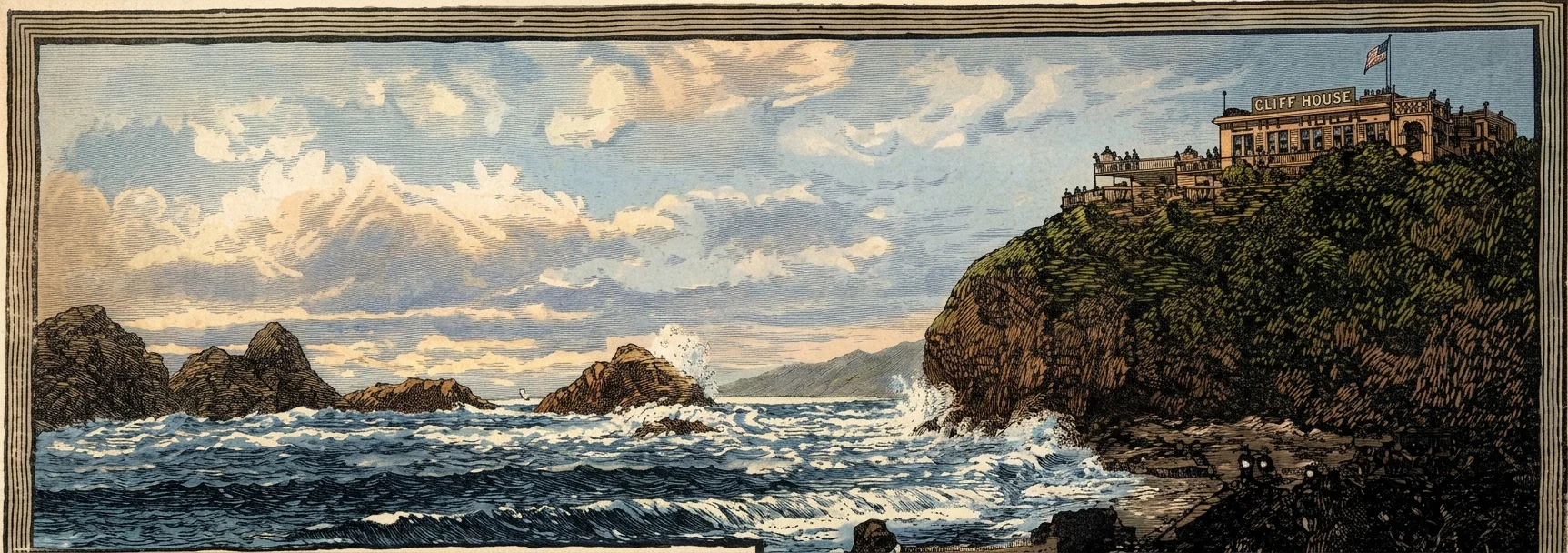
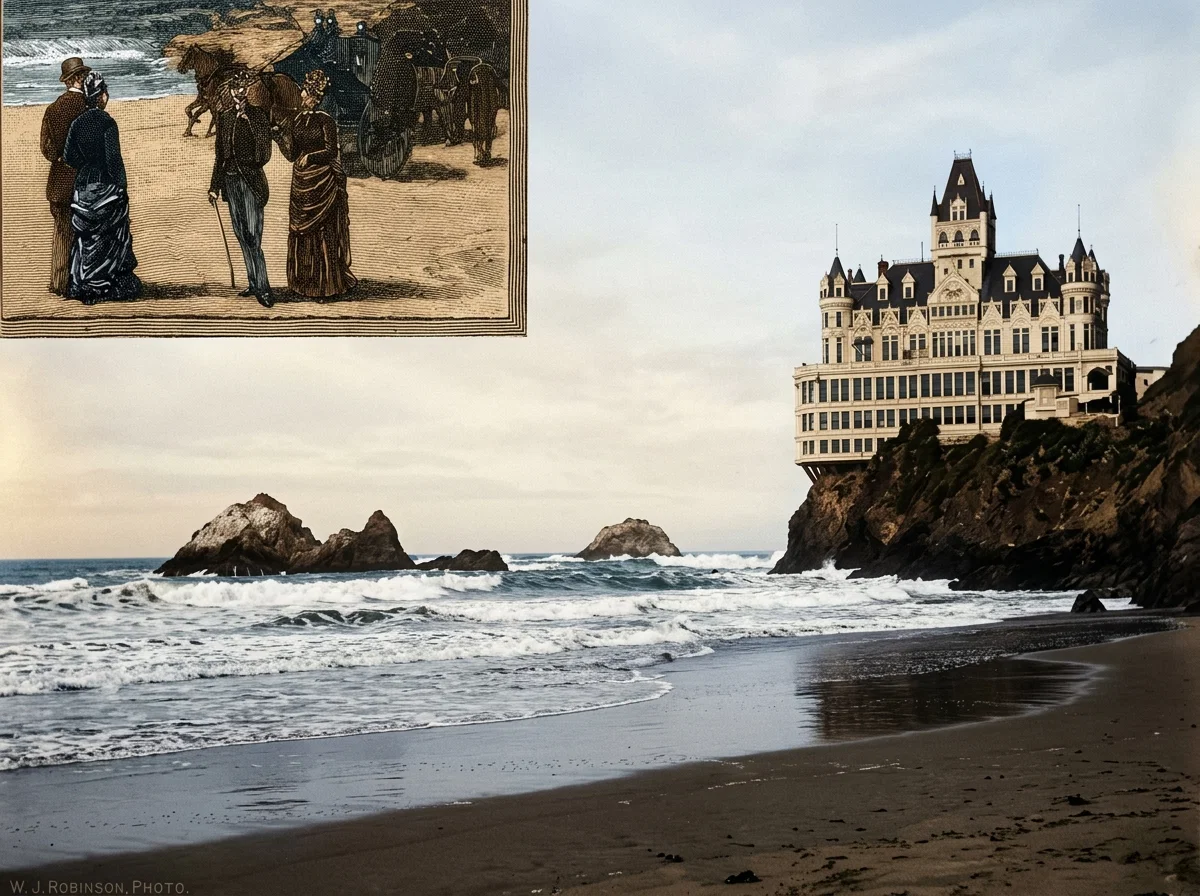
THE “CLIFF HOUSE,” OLD AND NEW.
GOD'S LOVE.
I WONDER if He really shares
In all my little human cares—
This mighty King of kings!
If He who guides through boundless space
Each blazing planet in its place
Can have the condescending grace
To mind these petty things!
Blent with each ill would come such bliss,
That I might covet pain!
Dear Lord, my heart hath not a doubt
That Thou dost compass me about
With sympathy divine.
Thy love for me—once crucified—
Is not the love to leave my side,
But waiteth ever to divide
Each smallest care of mine.
—Anon.
JOTTINGS FROM THE ORIENT.
By H. P. H.
On closing my work in Russia, at Sebastopol, I took a Russian steamer for Constantinople, making the transit of the Black Sea in twenty-four hours. When the weather is at all favorable, the trip down the Bosporus is a delightful one. Through this channel flow all the waters drained into the Black Sea from Asia Minor, a large portion of Russia, Roumania, Bulgaria, Hungary, Austria, and through the Danube a portion of the waters of Germany and the Alps. The Bosporus is about as wide as the Detroit River, and in places several hundred feet deep.
As one nears the Bosporus from the Black Sea, the first objects in sight are the ports on both the European, and Asiatic shores; and from these are villages on both sides till Constantinople, which is situated where the Bosporus empties into the Sea of Marmora, or ancient Propontis. In these villages and on the slopes above them are many villas and summer residences of the wealthy of Constantinople.
About half way down, where the stream is the narrowest, on the European bank, stand the huge towers of the fortress erected by the Mohammedans in 1453, just prior to the taking of Constantinople; and just above these towers are the buildings of Robert College, an American, non-sectarian institution of high educational merit. It is believed that near this point Darius crossed the Bosporus with his army. Among other objects of interest are several palaces of the sultan and ruins of castles dating from the Genoese supremacy.
Approaching the Ottoman capital, the varied domes and slender minarets of the numerous mosques present a most picturesque sight; but on landing, the scene is reversed. The streets are narrow, crooked, illy-paved, and filthy, usually crowded, and often blocked by wretched dogs, some wounded, some half-starved, and others partly eaten by vermin. As most merchandise is moved by Armenian carriers, some parts of the city are crowded by men with huge11boxes, baskets, or bundles on their backs. The heavier objects, as liquor casks, are suspended from poles and carried by two, four, six, or eight men. These usually keep up almost constant shouting to clear the way. Besides this, all kinds of wares are carried open on the arm and sold in the streets, each petit merchant rivaling the rest shouting out his wares. The interest of the scene is heightened not a little by the peculiar and varied dress of the Asiatics.
On landing, it was very noticeable that there had been a thinning out in the city. A few years ago, the streets were more crowded with people and traffic. The Armenian troubles so decreased work in the city that many were obliged to go elsewhere to make a living; and in addition to this, Armenians are quite rigidly excluded from the city. I thought that the war with Greece might lead the government to partly lose sight of the Armenians; but this is by no means the case. The police surveillance is rigid as ever, specially at this time, as it was the anniversary of former outbreaks.
After spending a few days with our church in Constantinople, in company with Brother Baharian, I visited five groups of believers in Nicomedia (Bithynia of the Bible), and had encouraging meetings with them. Chief products of these regions are wine and tobacco, and the people being themselves their best customers, they are much debased by these powerful agents of the enemy. But those embracing the truth have forsaken these evil habits and have completely overcome them, and are become living witnesses of the power of the Gospel to save from the most debasing sins.
A VIEW OF MODERN CONSTANTINOPLE.
While visiting these villages I read the epistles of Paul and was struck with the fact that the evils which he most frequently reproved among the heathen are the prevailing sins to-day. But as then, so to-day the Gospel has power to deliver all who receive it.
Our first meetings were held south of the bay of Nicomedia, in an Armenian village, not far from ancient Nicea, where the memorable church council was held under Constantine, A.D. 325. The creed there adopted is still adhered to by the Armenian church. And as a memorial of those days of sun-worship, all Armenian churches are still built with the altar at the east end, so that in worshiping, the people bow towards the rising sun. It is an interesting fact that even when holding services in private houses, the priests always stand facing the east. The Greeks also follow the same custom. When attending the service of some of our laborers in private rooms, in prayer they were careful to turn towards the east. Thus, like Sunday, this custom is a reminder of the time when in hoary antiquity the pagans worshiped the sun towards the east and dedicated the first day of the week to the sun; and also of the time when, under Constantine, Sunday with other pagan institutions entered the Christian church, opening the gates to the flood of superstition and error which led to the Dark Ages.
But the light of the Gospel which in the great Reformation began to dispel the darkness must increase in brilliancy till Pentecostal days are again experienced and every vestige of darkness is dispersed. We are glad that the light of the Word is shining in consecrated lives in these regions where Constantine and the bishops, the world and the church, began their unscriptural courtships and laid the foundation of the Papacy.
In one of these villages, a Protestant pastor labored in vain many years to turn the people from the excessive use of wine, alcohol, and tobacco; but when preachers of the present truth entered the place, many believed and became total abstainers from all stimulants. This irritated the pastor, who chided those converted, saying: “All these years I have told you not to use wine and you would not obey; but now when preachers of the Sabbath come, you at once obey and forsake all. Why do you listen to them, and not to me?” He saw nothing more than the word of man, and did not recognize the fact that while he was still adhering to pagan errors, the preachers of the Sabbath, having forsaken all human doctrines, had had the power of the “everlasting Gospel,” which saves from sin.
We are glad to be able to close these jottings with the remark that to the praise of the Lord the truth is constantly spreading in these interesting regions. H. P. H.
A FREE MAN.
My father, whose name is Donald Fraser, and his neighbor, William Fraser, were very intimate, and as much together as was consistent with their occupation, they being both industrious farmers. My father was nearly seventy years of age, and his friend William was several years his senior. Both were Highland Scotchmen from Invernesshire, and both were devotees of the pipe and the tobacco quid from their youth up. A quarter of a century before, they had both, from conscientious motives, given up their dram, as they called it, my father leading in that movement and persuading his friend to follow
One night at my father's house, during their chatting, they commenced filling their pipes, and William Fraser, turning thoughtfully to my father and tapping the bowl of his pipe with the handle of his tobacco knife, exclaimed, “Donald, what do you think of this smoking and chewing business?”
My father shrewdly answered by asking another question, and said, “What do you think of it yourself, William?”
William replied: “Donald, we say we are Christians; and if we are Christians, we are ‘free men in Christ Jesus.’ Now, Donald, when we are doing this thing, and can nae leave it off, are we free?”
“Do you think yourself we are?” replied my father.
“I am nae sure of it,” said William, who retained much more of the Scotch dialect than my father.
“And see here,” said my father, “what we spit and burn into smoke, of this nasty stuff, costs us nearly as much money as we give to the Master’s cause. Is this right?”
“Do you think, Donald, that if we should stop it we could do more for Christ?”
Both then, with one impulse, suiting the action to the words, said, “Let us put the things up then;” and both rising to their feet, laid the pipes and tobacco on the mantel-piece, where they lay for many a long day.
These two men never smoked or chewed again. William Fraser has gone to his rest; my father still lives, in his eighty-sixth year, a free man.—Selected.
SPEAK GENTLY.
A YOUNG lady had gone for a walk, but forgot to take her purse with her. Presently she met a little girl with a basket on her arm.
“Please, miss, will you buy something from my basket?” said the girl, showing a variety of book-marks, watch-cases, needle-books, etc.
“I am sorry I can’t buy something to-day,” said the young lady. “I haven’t any money with me. Your things look very pretty.” She stopped a minute and spoke a few kind words to the girl, and then, as she passed, she said again, “I am very sorry I can’t buy anything from you to-day.”
“O miss,” said the little girl, “you’ve done me as much good as if you had! Most persons that I meet say, ‘Get away with you!’ But you have spoken kindly to me, and I feel a heap better.”
This was “considering the poor.” How little it costs to speak kind words, and how much they are worth! If we have nothing else to give, let us at least give love and sympathy.—Selected.
FEVER IN PLANTS.
WHEN plants are wounded their respiration increases, and at the same time their temperature perceptibly rises, as if a kind of fever had been produced by the wound. Mr. H. M. Richards, who has been experimenting with a thermo-electric apparatus capable of registering a change of one one-hundredth of a degree, states that when a potato was wounded a fever manifested itself by an elevation of temperature, which was greatest at the end of twenty-four hours, when it began slowly to decline. An onion similarly treated acquired an increase of temperature many times greater than that shown by the potato, and the fever, instead of being confined to the neighborhood of the wound, affected the entire onion. In fact, the onion proved to be more readily affected in this way than any other vegetable experimented with. The rise of temperature is caused by increased absorption of oxygen.
Thrice-a-Week World.
A GOOD INVENTION.
A FRENCH inventor converts grain into dough at one operation without milling. The grain is soaked, and entering one end of the machine is crushed and disintegrated, the paste passing on to the kneading machine at the other end of the apparatus, where it is aerated and kneaded into dough which can be preserved indefinitely without injury. The nutritive qualities of the grain, bran included, are kept.
The Sacred Fire of Beheram
In a temple in the secluded village of Ocdwada, India, there burns a fire which was kindled about one thousand two hundred years ago, and has been burning continuously ever since. It is the sacred fire of Beheram, consecrated by the ancient Parsees in commemoration of the voyage they had just safely completed in their migration from Persia to India. The fire is kept going in fulfilment of a vow. It is fed at five stated times during the day. The fuel is composed of sandal-wood, benzine, and other odorous material, each of which is first subjected to a peculiar form of religious ceremony. During certain months of the year, especially allotted to the worship of the genius of fire, the little village of Ocdwada is the Mecca of thousands of pilgrims.—Savannah News.
The Value of Knowledge
THE acquisition of knowledge is so solid a good in itself that it can never be lost.—Epicurus.
PASS IT ON.
Have you had a kindness shown?
’Twas not given for thee alone;
Let it travel down the years,
Let it wipe another’s tears;
Till in heaven the deed appears.
Pass it on.
Did you hear the loving word,
Like the singing of a bird?
Let its music live and grow,
Let it cheer another’s woe;
You have reaped what others sow.
Pass it on.
Have you found the heavenly light?
Souls are groping in the night;
Hold your lighted lamp on high,
Be a star in some one’s sky;
He may live who else would die.
Pass it on.
Pass it on, pass it on.
Cheerful words or living deeds,
Live for self, you live in vain;
Live for Christ, you live again,
Live for Him, you live to reign.
Pass it on.
—Anon.
Our Work and Workers.
The brethren in Iowa are responding liberally to a call for donations to assist in establishing a Rescue Mission at Clinton, in that State.
The superintendent of our central publishing house at Battle Creek, Mich., writes us that “for the last few days we have not shut down our power, either night or day, and the indicator still stands at ‘full steam ahead.’”
A new house of worship at Libertyville, Iowa, is to be dedicated on the 23d inst., meetings to begin on the evening of the 21st. Brother C. Santee will officiate, and the matter of a church organization will be considered at the same time.
The brethren in Toronto, Ont., are making a special effort to assist the poor and needy of that city. In that cold northern climate the poor suffer hardships in the winter season which those in more temperate regions do not experience.
On New Year’s day the church at Battle Creek, Mich., was increased by the addition of one hundred and sixty members, many of whom were children, who have been gathered in by the revival work that had been in progress there for some time.
Brother W. A. Ebert, who is working with the Signs at Elwood, Ind., writes: “We have many rich testimonies in behalf of the good paper, if we had space and time to give them. Sufficient to say that we have been made to realize that God is with it.”
The brethren at Saginaw, Mich., have secured the use of a room in the central part of the city, in which they are now holding mission services. Through the kindness of a business man of the city, they get the hall free of rent. How many other churches might do likewise!
There is to be a general meeting at some point in the province of Santa Fe, Argentina, South America, March 8 to 13, for the benefit of the French, German, and Spanish-speaking brethren and others who love the truth. It is designed to have services in all these languages each day.
Throughout the General Conference District No. 1, a collection will be taken on the 22d inst. for the purpose of erecting an addition to the church at South Lancaster, Mass. This is necessary for the accommodation of the students of the academy of that place, who come from all parts of the district.
Brother William Simpson reports to Field Echoes from Brantford, Ont., as follows: “My work is in this city of 15,000 inhabitants. Brother Spear remains on the Reserve about eight miles out in the country, to carry on the work that has started among the Indians. The openings to present the truth in this part of the field are more than we can fill.”
Brother D. P. Gaede, an Iowa laborer, is now on a visit to his old home in Russia. He reports to the Bulletin that “one of our brethren has received license to canvass for our books through the whole of Russia.” He notes having met Brother L. R. Conradi in Germany, who told him of wonderful openings in Petersburg and Riga. In both these places churches have been organized.
Field Echoes says, “One of the Michigan workers who attended the recent conference in Chicago was impressed with the importance of holding cottage meetings; and since returning to his field of labor, writes that he has held one such meeting, in which three souls were converted.” There are so many ways of working for the Lord that every one may find something to do,—“if there be first a willing mind.” Even a cup of cold water in His name does not lose its reward.
The Danish Conference has sent Brother David Ostlund on a mission to Iceland. He started from Copenhagen in November via Leith, Scotland. After leaving the latter place he discovered that a fellow-passenger, an Icelander returning with his family from America, was also a Seventh-day Adventist. He had become an Adventist in America, had heard of the action of the Danish Conference, and thought the missionary would need assistance; so he sold out his property, and was on his way to his old home, when he thus providentially, and to the great joy of both, met the missionary whom he was going to assist. It takes the God of heaven to bring things around when men place themselves in his hand. “Commit thy way unto the Lord; trust also in Him; and He shall bring it to pass.” Ps. 37: 5.12
Brother W. H. Goodwin, of Santa Cruz, Cal., reports that himself and wife have been engaged in Christian help work in that city since November 1, and find all that they can do. The same might be said in any city, if there were laborers willing to do the work. It is an employment which, if faithfully followed, will never know what is meant in ordinary business a “dull season.” The Saviour says, “Ye have the poor with you alway, and whensoever ye will ye may do them good.”
The Review of the 4th inst. contains a striking report from Brother E. L. Sanford. He held meetings two weeks at New Light, N. C., when seventeen adults and nine children took their stand on the truth as presented by him. This success stirred up the opposition to such an extent that threats were made against him, and when he returned to the place again, two shots were fired through the window into the room where he was sleeping. The excitement created in the neighborhood by this occurrence brought many out to hear him preach who would not come before.
The attention of true Christians is being more and more attracted to the work of helping the needy. Brother A. E. Place, president of New York Conference, in a report of his rounds in the Indicator, incidentally mentions that in Newburgh “the missionary spirit is taking possession of our good sisters to an encouraging degree, and as they go among the sick and afflicted, bearing evidence that the ‘love of Christ constraineth’ them, they report that a new joy lights up their life. This is so because they have been a means of lighting other lives, which, perhaps, were almost gone out in spiritual darkness. This line of work proves in every case to be a potent germicide to all microbes of selfishness.”
Avoid What You Blame in Others
ESTEEM is best merited by avoiding to do ourselves what we would blame in others. —Isocrates.
Faith Comes by Hearing
“TRYING to believe makes it impossible to believe; faith cometh by hearing.”
35 “But when it was day, the magistrates sent the sergeants, 36 saying, Let those men go. And the jailer reported the words to Paul, saying, The magistrates have sent to let you go; now therefore come forth, and go in peace. But Paul said unto them, They have beaten us publicly, uncondemned, men that are Romans, and have cast us into prison; and do they now cast us out privily? nay verily; but let them come themselves and bring us out. And the sergeants reported these words unto the magistrates; and they feared, when they heard that they were Romans; and they came and besought them; and when they had brought them out, they asked them to go away from the city. And they went out of the prison, and entered into the house of Lydia; and when they had seen the brethren, they comforted them, and departed.
1 “Now when they had passed through Amphipolis and Apollonia, they came to Thessalonica, where was a synagogue of the Jews: and Paul, as his custom was, went in unto them, and for three Sabbath days reasoned with them from the Scriptures, 3 opening and alleging, that it behoved the Christ to suffer, and to rise again from the dead; and that this Jesus, whom, said he, I proclaim unto you, is the Christ. 4 And some of them were persuaded, and consorted with Paul and Silas; and of the devout Greeks a great multitude, and of the chief women not a few. 5 But the Jews, being moved with jealousy, took unto them certain vile fellows of the rabble, and gathering a crowd, set the city on an uproar; and assaulting the house of Jason, they sought to bring them forth to the people. 6 And when they found them not, they dragged Jason and certain brethren before the rulers of the city, crying, These that have turned the world upside down are come hither also; 7 whom Jason hath received: and these all act contrary to the decrees of Cæsar, saying that there is another king, one Jesus. 8 And they troubled the multitude and the rulers of the city, when they heard these things. 9 And when they had taken security from Jason and the rest, they let them go.
10 “And the brethren immediately sent away Paul and Silas by night unto Beroea; who when they were come thither went into the synagogue of the Jews. 11 Now these were more noble than those in Thessalonica, in that they received the Word with all readiness of mind, examining the Scriptures daily, whether these things were so. 12 Many of them therefore believed; also of the Greek women of honorable estate, and of men, not a few. 13 But when the Jews of Thessalonica had knowledge that the Word of God was proclaimed of Paul at Beroea also, they came thither likewise, stirring up and troubling the multitudes. 14 And then immediately the brethren sent forth Paul to go as far as to the sea; and Silas and Timothy abode there still. 15 But they that conducted Paul brought him as far as Athens; and receiving a commandment unto Silas and Timothy that they should come to him with all speed, they departed.”
QUESTIONS.
1. Give an account of Paul’s imprisonment at Philippi.
2. Give a detailed account of the occurrences in the night.
4. Who brought the message to Paul and Silas? Verse 36.
5. What did Paul reply? Verse 37.
6. How did this reply affect the magistrates? Verse 38.
7. What did they do? Verse 39.
8. What did Paul and Silas first do when they left the prison? Verse 40.
9. On departing from Philippi, where did they go? To what place did they come? What did they find there? Chapter 17:1.
10. What custom had Paul which he here followed? Out of what did he reason with the people? Verse 2.
11. What did he affirm from the Scriptures? V. 3.
12. What was the effect of his teaching? Verse 4.
13. How were the unbelieving Jews affected? With whom did they associate themselves? How much disturbance did they make? Verse 5.
14. When they did not find Paul and Silas, what did they do? What did the mob say that the newcomers had done? Verse 6.
15. What charge did they lay against them before the magistrates? Verse 7.
16. What did the rulers do with the brethren? Verse 9.
17. What did the brethren do with Paul and Silas? To what place did they send them? What did Paul and Silas do on arriving at Beroea? Verse 10.
18. How did the Jews in this place compare with those in Thessalonica? In what way did they show their nobility? Verse 11.
19. What was the result of this investigation? Verse 12.
20. How was the work interrupted at Beroea? Verse 13.13
21. What precautions did the brethren take against the persecution of Paul? Who remained behind in Beroea? Verse 14.
22. To what place did the brethren bring Paul? What message did Paul send back by them, as they left him alone at Athens? Verse 15.
NOTES AND QUESTIONS.
1. Who received the stripes and imprisonment at Philippi? Had any of the other brethren been assaulted by the mob? Yet what did Paul and Silas do as soon as they got out of prison? What words written by Paul did he thus experience? 2 Cor. 1:3–6.
2. “Saying that there is another king, one Jesus.” See how they tried to fasten the charge of treason upon the disciples. Show how those who are loyal to Jesus may in these days be accused of treason to the state.
3. Compare Acts 17:14, 15 with 1 Thess. 2:17, 18; 3:1–6. From this it will be seen that Paul desired to go back to Thessalonica, and that such was his interest for the brethren in that place, that, much as he needed the help and company of Timothy, he sent him back to Thessalonica, and he remained for a time in Athens alone.