Your ShelfYour Projects

Signs of the Times, Vol. 37, No. 39.

Christ Our High Priest
Earlier text: The Lord's Preparation Day

The War-Mad Nations

NOTWITHSTANDING the constant talk of peace, peace councils, peace conferences, peace congresses, appointed by religious, political, and governmental bodies, still the mad preparation for war goes on apace, increasing with every year. Each of the nations talks peace, each of the nations prepares for war. Not a nation upon earth scarcely but what is apprehensive of danger from some other nation or is looking with jealousy upon some other nation. Sometimes it is the eager hunger, the greed, for more territory, which causes the jealousy, and stirs up the spirit of animosity. Sometimes it is commerce, and commercial war is bound sooner or later to awaken the spirit of civil war.
Admiral R. D. Evans remarked in the San Francisco "Examiner" of July 8, 1910:
"We [the United States] have everything needed to control a fair share of the commerce of the Pacific Ocean except the ships. As these increase in number, as surely they must, the chances of friction with other nations will multiply rapidly and war may come at an hour's notice."
This will probably be the result of increased commerce. It arouses more or less bitterness always. We read in despatches from Europe that Germany is looking upon her old rival, Austria, with a great deal of anxiety. Austria has caught the war fever, and Germany does not know but her next war may involve Austria. Turkey and Greece are at enmity, and nothing but the interference of the great powers would prevent war at almost any time for the possession of various provinces.
The fear of breaking the peace is all that restrains Russia from taking possession of the whole Balkan Peninsula if it were in her power. The same condition of affairs exists between England and Germany, between Japan and the United States. Some recent reports contend that while everything is outwardly smooth in the utterances of Japan and her professed friendliness toward this country, she is preparing for war a few years hence with tremendous rapidity, and expects to become mistress of the Pacific Ocean.
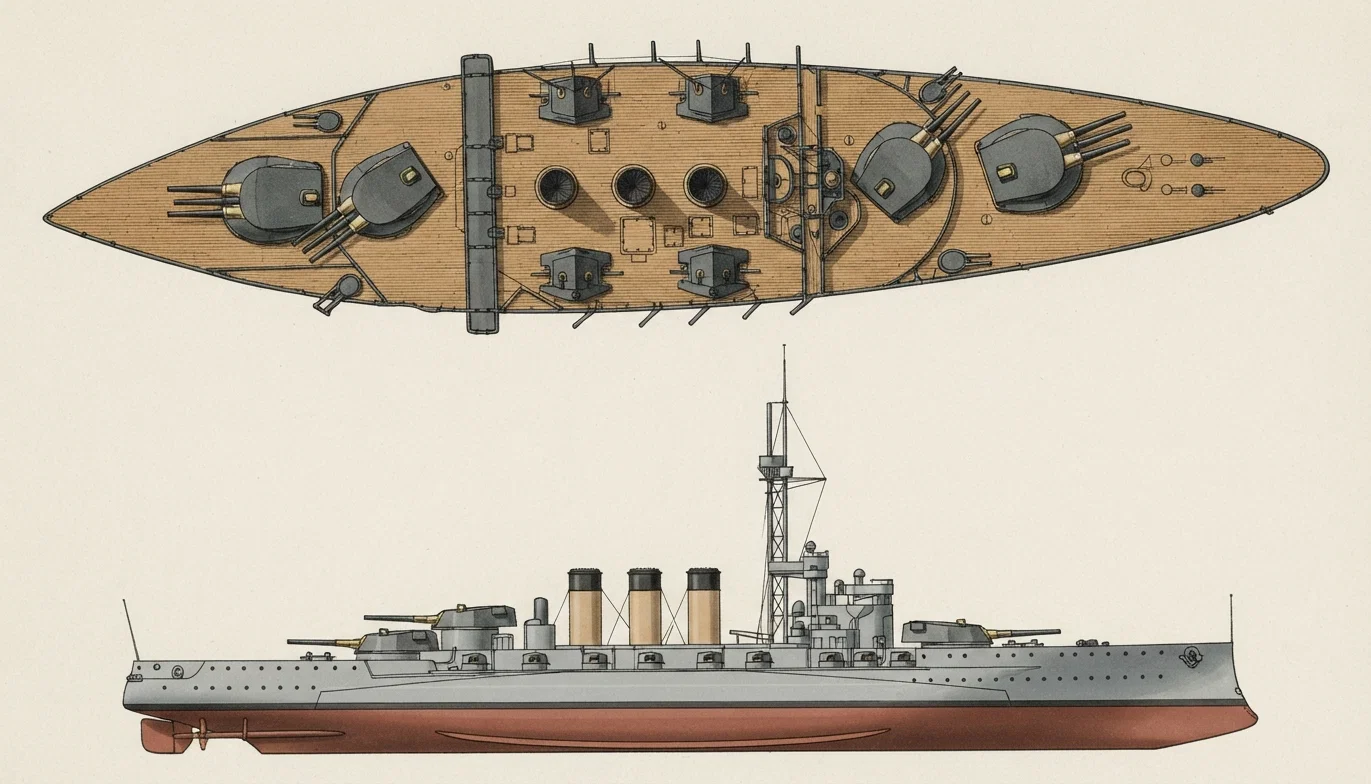
Plan of first Italian Dreadnought, the first vessel to be armed with three-gun turrets

The Fearful Cost of War

The fearful cost of war rests like a horrible incubus upon the breasts of the nations. It is a nightmare, under the influence of which they can scarcely move or breathe, with the vital difference that from the nightmare one awakes as from a fearful dream to relief, but the fearful war expenditures are a reality.
It is but a little while ago that battle-ships in the United States alone were relegated to the junk pile which cost about $50,000,000 when they were built. That is the case with all the various nations. Ships that a few years ago were considered first-class battle-ships or cruisers, like the Oregon and the New York, are now entirely out of class, and would be considered utterly worthless in an up-to-date squadron or fleet. Every advance stirs up the same ambition in some other nation.
Not long ago we noted the launching of the British battle-ship Orion, considered at the time that she was laid down the first battle-ship of the world, one which stood entirely alone. Her tonnage was about 23,000; but last week we noted four others, two American battle-ships of over 27,000 tons each, and two Brazilian battle-ships of over 30,000 tons; and Secretary of the Navy Meyer, of the United States, is advocating the 32,000 ton battle-ship, one of which at least Brazil is also planning.
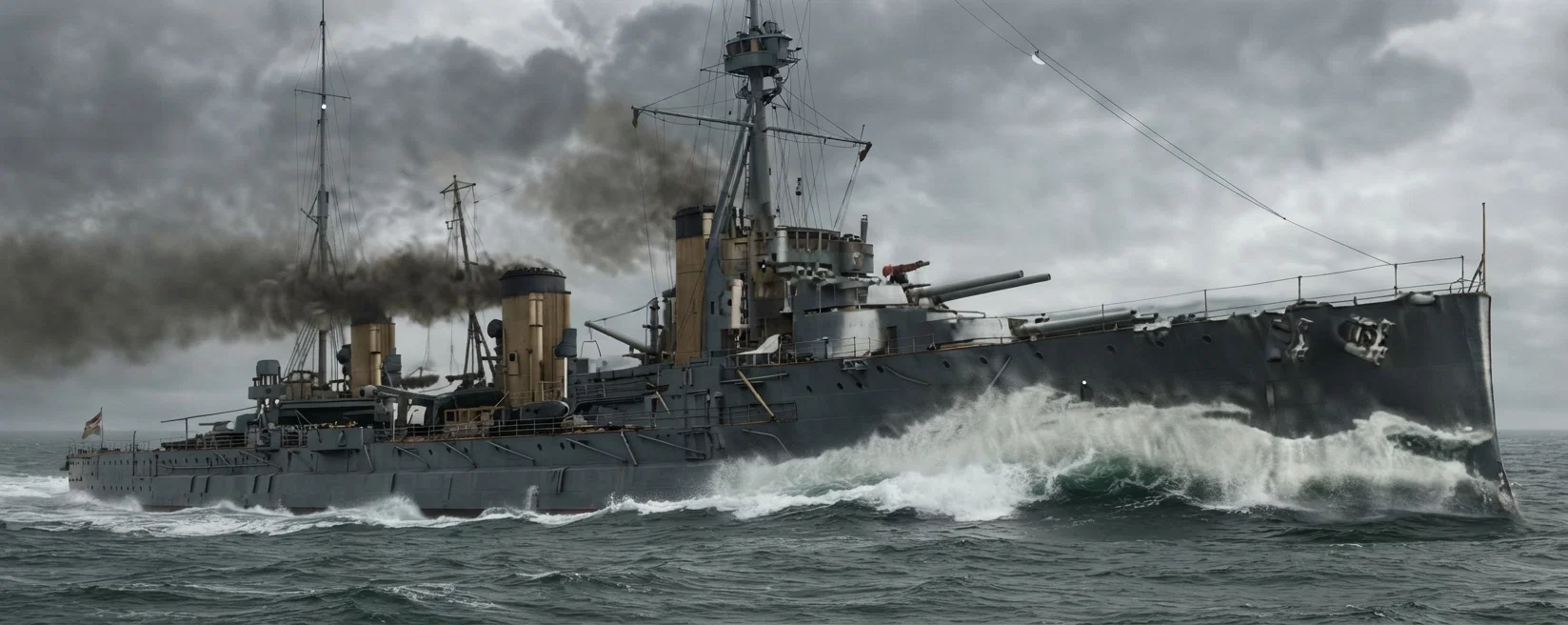
THE BRITISH CRUISER LION She combines the speed of a scout with the fighting qualities of a Dreadnought. Her length is 700 feet, and displacement 20,000 tons. She will mount eight 13.5-inch guns and steam thirty knots.
It was considered an immense price when four million dollars was paid for a battle-ship; but the 32,000 ton battle-ship could not be built for less than eighteen million dollars.
It is not peace advocates or religious newspapers that are pointing out this war-mad spirit, but men of standing, men who are out in civil and political life, whose talents, ability, and powers are given for their respective countries. They see the worship of the war god and wonder where it will end. For instance, in the San Jose "Mercury" of August 31, 1910, is a stirring editorial entitled "The Contest for the Sovereignty of the Sea." After referring to the last of the British Dreadnoughts launched (really a battle-ship cruiser), the Lion, 26,000 tons, that it was built in the wonderfully brief time of eight months, at a cost of eleven million dollars, that it was hardly in the water before Germany had begun to build a bigger, faster, more powerful ship, that Brazil had entered the race for a ship larger still, one of 32,000 tons, such as had been recommended by the Secretary of the Navy of the United States, the editor says:
Deck plan of the British cruiser Lion, showing the sweep of her eight guns from beam to beam
"When the hour comes that engines so mighty and so terrible as those ships crash together on the ocean, a new chapter of horrors will have to be opened in the history of mankind. And in this fierce competition for supremacy on the sea it is not simply that England, Germany, and Brazil are contending; nearly every other leading nation is engaged in the like struggle. . . . Now where and when is all this to stop? We live in a time of profound peace, a time too when all the leading nations are making most profuse protestations of their peaceful desires and purposes, and yet there are preparations for war going on everywhere on a scale never before known in the history of our race."
Referring again to the strong professions of peace, the writer uses this illustration:
"Suppose for instance that in this community the authorities, the newspapers, and the people in general were loudly professing their love for one another, their devotion to peace, and their hatred of strife, while at the same time every man was busy turning his house into an arsenal and going about armed to the teeth, should we not all have the feeling of insecurity and danger? It is precisely so in the great community of nations. If everybody is friendly to everybody and all sincerely want peace, why is everybody so intent on getting ready to fight? The truth is nobody believes in the sincerity of anybody and feels safe in going unarmed. Everybody is afraid of everybody else and thinks that the only security for peace is in being ready to fight. But where and when, we ask again, is this to stop?"
Then he refers to the awful burden which this war expenditure imposes upon the people, even now almost intolerable, but with no end in sight. Magnificent ships which we knew as such ten years ago are already on their way to the scrap heap. Naval commanders would not dare take them into the battle with the new Dreadnoughts; not one of them would last a minute. The United States is spending seventy per cent of its entire revenue in paying the cost of past wars and in preparing for war to come — and more to the same effect.
The New York "World" in a recent issue said, after referring to the eighteen million dollar battle-ship, the price of a 32,000 ton monster:
"When the British government built the original Dreadnought, it not only rendered obsolete a large fleet of its own battle-ships, but it started the other nations of Europe in a mad race of naval construction that threatens to bankrupt them." "The whole Dreadnought policy, ever since Great Britain first adopted it, worked harm wherever tried. It has led constantly to fresher excesses of militarism, burdensome taxation, and bloated armaments that in themselves are a menace to the peace of the world."
The Boston "Herald," referring to the eighteen million dollar battle-ship, asks:
"Is there to be no limit? Are the great nations of the earth to continue dumping millions on the table in the form of battle-ships and other military expenditure, each in turn raising the bet of his next neighbor, and taxing the people almost to the breaking point to provide the funds for this game of bluff? The American people are crying out against the burdens of the increased cost of living. It is practically impossible for the head of the average American family to make both ends meet and provide a decent living for his dependents. . . . No small part of this increased cost of living is due to the increase in the cost of government. . . . And facing this situation an appeal is made to national pride to sustain the extension of our naval policy on an infinite scale. It might be termed the reductio ad absurdum, were it not that it is put forward with a plea for national defense, backed up by semiofficial hints that rival nations are planning ships and laying keels along a similar policy, a plea that never has failed to appeal to the patriotic American people. . . . In the last eight years the appropriations for the navy were in the aggregate $600,000,000 in excess of the aggregate for the previous eight years. A similar comparison of army expenditures showed an increase of $472,000,000. Yet we are at peace with the world, professing a policy of international peace."
Former Vice-President Fairbanks last March, in reviewing the situation, said:
"The world presents no condition demanding war. . . . Both war and the preparation for war unhappily weigh most heavily on the people, and not on those whose policy or intrigue is responsible for the burden. The increase in armies and navies must stop. It can not go on forever. How shall it be stopped? By the use of sense or an international cataclysm. Wherever I have been I have seen ships building and troops drilling for war, and yet I have seen no cause for war. The effects of this madness are visible in the squalor and distress of mankind. Persons calling themselves statesmen are taking their war machinery out of the mouths and off the backs of the men, women, and children who labor. Their wickedness is appalling. The theory that without war nations would become degenerate and that virility would go out of the masses, is unworthy of any mind outside of madhouse. Degeneracy is coming about because the people are so oppressed that they can not be properly clothed, housed, and fed."
In a recent despatch Mr. Lloyd-George, the chancellor of the British exchequer, referring to competition in armaments among the various nations, said:
"The countries of the world are spending annually 450 million pounds [$2,250,000,000] upon this machinery of destruction. In twenty years there has been an increase of two hundred million pounds [one thousand million dollars] per annum. All nations seem to be affected with an epidemic of prodigality which is sweeping over the land and sweeping to destruction. We take the lead. But, after all, we have got the greatest empire to defend; we have got that excuse. But if the nations increasingly spend their money upon matters that give neither sustenance nor support to their people on the road that leads to a higher civilization, we will suffer. . . . I think it is a great and growing misfortune."
Take three nations for instance: Germany's naval estimates for the last year were $38,597,500, an increase of more than $3,600,000 over the previous year. England's estimates for the navy were $203,018,500, an increase of more than $27,000,000 over the year previous. America in eight years has increased its war expenditures $1,072,000,000; from $51,000,000 in 1890 to $185,000,000 in 1902. No wonder that Mr. Stead calls the idea of peace a "fatuous dream."
The aggregate increase in the nations of Germany and England in one year amounts to the vast sum of $30,917,500. At $200 a year,—and there are many schools which young men and women could attend at that price,—it would maintain in school for one year 154,587 boys and girls; at $300 cost it would maintain 103,058 young men and women in school for a year. At one thousand dollars a year it would support 30,917 ministers. It would build 520 miles of railway at $60,000 a mile. It would erect 10,300 homes at $3,000 each. And we certainly know that there are thousands upon thousands in the teeming populations of Germany and England that need the houses, and the young men and women who need the education.
All this sounds remarkable, and yet it should not. It is utterly inconsistent, the professions which the nations and the world are making; but he who reads that Book of all books, the only always up-to-date book in the whole world, the Bible, should expect just what we see now. But by the ancient prophets, Isaiah and Micah, we are told that in the last days many peoples and nations will make great professions of peace, will go up to their great assemblies and say, Let us beat our swords into plowshares and our spears into pruning-hooks; and the same prophets declare that they are soothsayers, they are speaking the things that are not in harmony with God's will. On the other hand we are told, as is set forth in the scriptures in the center of the last page, that in the last days, just previous to the time when Jehovah will reap the harvest, all the nations of earth will be stirred to war, and all nations strong and weak will prepare for the great battle of Armageddon.
We are told in the 25th chapter of Jeremiah that all the nations will drink of the wine of wrath, will drink and be mad, and come up to that great battle that will leave the slain from one end of the earth to the other. We are told in the 16th chapter of Revelation of the agencies that stir up this spirit of strife, and which will gather the nations to that great war. They are the demons that go forth from the bottomless pit. And this article is but a faint echo of the work that is being wrought by them. At the very basis of it all lie selfish pride, selfish aggrandizement, greed, love of glory; and taking advantage of them all, dominant in the human heart, Satan by his demons of darkness infuses in the hearts of men the great struggle for supremacy, the spirit of war. The outcome will be just what is stated in Holy Writ; but beyond all that, all the strife and turmoil that will obliterate nations, in which vast wealth will go down to utter ruin, and in which millions will sink to rise no more, God will take to Himself His great power and reign. Then the universe shall know peace, and in that kingdom the work of righteousness shall be peace, and the effect of righteousness quietness and assurance forever.
The Cost of War.—We quote from the last publication of the American Association for International Conciliation: "Fifteen billions of lives have been destroyed within the historic period by a process that selects the more vigorous for destruction and the weaker for survival. Who can measure that effect? Forty billions of dollars have been expended, and as much more lost by checks on production. Three billions of dollars have been spent in our own country for pensions, and two more still to be spent as a result of wars now past." On the American army and navy two hundred million are expended each year. "Such figures, when quickly sighted, make no adequate impression on the mind, but if pondered at leisure, reveal the dimensions of an evil which it would not seem possible that civilization should knowingly tolerate."
The following table, a little out of date now, shows the comparative strength of the leading navies of the world (including ships now building). It shows plainly just how the whole world is slowly arming for the great battle of the Lord.
Nation War-ships Men Tonnage
Great Britain 510 125,000 2,005,873
Germany 248 60,000 820,692
United States 129 48,000 785,945
France 536 32,500 766,906
Japan 236 40,000 495,704
Russia 160 50,000 412,250
Italy 224 30,000 259,378
Ten Chicago millionaires, the real heads of the beef industry, were indicted September 12 by a federal grand jury in the United States District Court on the charge of several criminal violations of the Sherman anti-trust act. The report says, "In naming individuals, who may be imprisoned as a punishment on conviction, instead of corporations, which could only be fined and dissolved, the Government in these indictments struck the most severe blow that monopolists have yet felt."
The first Democratic governor the state of Maine has known for thirty years was elected in the person of Frederick W. Plaisted. By a singular coincidence his father, Horace M. Plaisted, was the last Democratic governor, who was elected in 1880. The Democratic victory will probably mean the choice of a Democrat to the United States senate to succeed Eugene Hale, who has served continuously since March 4, 1881.
The annual report of Inspector Darlington criticizes the army by saying that the army is wholly unprepared for field service because of the absence of field officers. He says that regulations are almost entirely theoretical or dependent on the experience of European armies, and that transportation facilities are no better than those used in the Civil War. The report mentions a whole battalion of artillery starting for the Philippines without a field officer.
According to reports said to be reliable, a reign of terror more wide-spread than anything of the kind ever before experienced in Nicaragua now prevails in that republic. Women are murdered on the streets, trains are bombarded, and men are hunted and shot down in the streets of Managua, the capital.
An Italian scientist asserts that pellagra is now traceable to the sand-fly, just as malaria is carried by mosquitoes, and insists that he is able to establish conclusively the truth of his surmise.
As the result of hazing in the local high school at York, Pennsylvania, ten young persons are likely to be disfigured for life. Hazing is a senseless, barbarous practise.
The cholera epidemic in Russia is abating. According to the reports of the sanitary bureau, the plague has numbered 170,363 victims and 77,466 deaths during the season.
Thirty lives were lost on Lake Michigan, September 9, when Pere Marquette car ferry No. 18 went to the bottom of the lake half way across. Thirty-five survive.
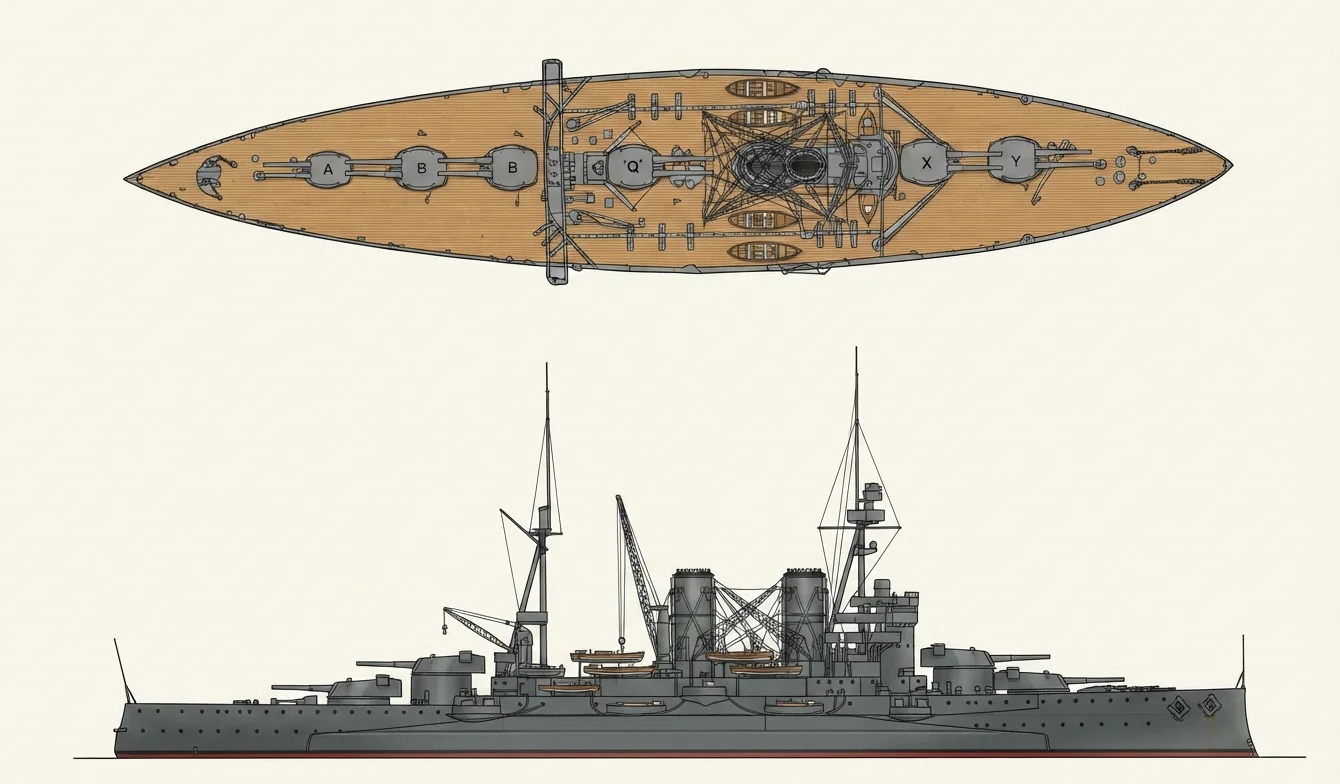
Plan of latest English Dreadnought, the Orion. All the turrets are on the center line. All can be used in a broadside. This is the first battle-ship so equipped.

Books and Bibles

An electrician in Paris has constructed an electric motor which can be put inside an ordinary thimble. It is driven by 3½ volts and runs quite smoothly.
Thoughts from the Mount of Blessing.—An exposition of Christ's Sermon on the Mount. It has 218 pages and six chapters: On the Mountainside, The Beatitudes, The Spirituality of the Law, The True Motive in Service, The Lord's Prayer, Not Judging but Doing. A new edition just printed on fine enameled paper, new type, and reillustrated with 27 beautiful half-tone engravings specially prepared for the book by eminent New York artists. It will be found full of comfort and blessing by all fortunate enough to obtain and read it. A beautiful gift book. Fine cloth cover, 75 cents. Address this office.
Education.—The object of true education and how it may be realized by the youth, the parent, the teacher, the writer, the tiller of the soil, and the business man, is the great theme of this book.
Its first chapter is devoted to First Principles; following that are illustrations taken from the history of Israel. Master Teacher, Nature Teaching, the Bible as an Educator, Physical Culture, Character Building, the Under Teacher, and the Higher Course, are titles of other chapters. 321 pages. Cloth, $1.25. Address this office.
Bibles.—Remember that we are headquarters for anything in the Bible line. We shall be pleased to send you our catalog of Bible selections on application. Pacific Press, Mountain View, Cal.

Shiloh: the Man of Sorrows

Copyright 1910, Pacific Press Publishing Association

Chapter XXXI.—The Beginning of the Traitor

"Thou hast said," replied the other; "and of a truth I remember, even now, the words of the Miracle-Worker as He answered me: 'The foxes have holes, and the birds of the air have nests; but the Son of Man hath not where to lay His head!'—a strange response, indeed," continued the stranger, with a light laugh, which struck Matthias unpleasantly, "a strange response from One who hath power even over devils and evil spirits," he continued almost sneeringly, "One whom even the wind and the sea obey, and to whose command the ear of Death pays heed!"
"But yet," objected Matthias, gravely turning his kindly brown eyes upon his companion, "yet men say the Man is poor, and indeed, His clothing is not such as is worn by kings."
"True; but thou art still a young man, and surely thou art short-sighted. Thinkest thou that such a man as I, a scribe of the school of Gamaliel, would be at all discouraged at this reply of the Nazarene, and return to mine house? Why should a few ignorant Galilean fishermen receive all the positions of honor in the new kingdom? Verily, thy brother-in-law, Bar-jona, seemeth as well born as any of them who follow the Master,—he and Andrew, his brother,—and—I mean no offense, young man, but thou understandest as well as I that the fishermen on the banks of the Galilee are not learned men. John, the son of one Zebedee, hath already taken to himself the honor of the place nearest the Master, and, professing greater love for Him than have the others, leaneth upon His breast! Verily his foolish conduct seemeth to me to be insincere and unmanly—and his actions are only equaled by those of his brother James. The man Philip, also of Bethsaida of Galilee, tho it may hap not a fisherman, hath in his youth, I am told, driven a chariot for some nobleman. Bartholomew seemeth at times to be as sincere and pious as any of our company, but even he appeareth not to appreciate my ability and especial talent. Thomas is too filled with unbelief and unmanly fears to be of much account in our company, and I—"
"Why then did the Master choose him?" questioned Matthias timidly, wondering and uneasy at the discourse of his companion.
"I know not, young man. I have often questioned the same myself. James and Thaddeus do no better than the others; while Simon, being a Zealot,—well, young man, thou mayest readily imagine that he is entirely too aggressive to be agreeable to a man of my fine temperament. But Matthew, the publican! I have often expressed surprise to my friends, that he should have been chosen! A publican! Canst thou think of it, young man? A tax-gatherer for the Romans, the oppressors of Israel!"
"The Nazarene doeth many miracles," continued the man from Kerioth, "but surely He lacketh sound judgment and wisdom, in that He chose Matthew, the publican. And yet, that which the Master lacketh, I strive in every manner possible to make up. But of a truth the Nazarene showed some trace of wisdom in that He hath appointed me, Judas Iscariot, a scribe, and a man of wisdom and discernment, to bear the purse, thus to overbalance in some degree the folly of the others!" and the speaker pressed his hand to his heart in gratified vanity, while he jingled the leathern bag of coins which hung at his side, ostentatiously.
"What thinkest thou, Iscariot?" questioned Matthias; "what thinkest thou truly? Will this mighty Teacher set up His kingdom in Jerusalem?"
For a moment, the man did not reply, but continued jingling the bag of coins absently, until the other repeated his question.
"Will He?—Without doubt, without doubt, and that very soon; and ha!" with a sudden burst of enthusiasm, "He can scarcely offer me anything less than the position of treasurer in chief over the whole kingdom. This, young man, He is bound in honor to do by me,—in honor, I say; for I am only telling the truth when I declare to thee that many a time I have saved our company from actual want, by my sagacity."
"Ah, brother," began Matthias, when his companion paused for a moment, "we would indeed rejoice to see the day when the Roman banners no longer flaunt themselves over the holy city of Zion; but from that which I have heard the Master declare,—and I have been already somewhat in His company,—I can not remember that He has ever so much as promised that He will set up His kingdom either in Jerusalem or in any of the other cities of Israel."
"If the Nazarene Miracle-Worker be indeed the Shiloh of Jacob, and if He set not up His kingdom in Jerusalem," interrupted Iscariot impatiently, while a dark frown gathered upon his brow, "how then can Zion, the holy city, the beautiful for situation, be called the joy of the whole earth, so saith the prophet?"
"I have heard the Man speak strange things," replied Matthias, ignoring the words of his companion, "some things which to me seem hard to be understood,—things which favor not the idea of the glory and swift dominion of Israel. Neither my father Sylvanus nor my brother-in-law Bar-jona are able to explain the meaning of some of His strange words,—and I, at least, have feared to ask Him,—feared lest my dream of Israel's glory be shattered by His answer;" and Matthias sighed deeply.
"I wonder not that Bar-jona be not able to understand,—an ignorant Galilean,—and yet (I mean no offense to thee, young man) but thy brother-in-law aspireth to greater honors than I, in the coming kingdom; aye, this impulsive fellow babbleth like unto a foolish child. Verily I am weary with him! But I tell thee, Matthias, son of Sylvanus, the time is fulfilled, and the Messiah of the prophets must be already come. And if this be true, the time when Israel shall smite the Gentiles, and ride over them victoriously, is at hand. Then shall I, Judas of Kerioth, rise to honor and might and riches—riches! Ah, the gleam of the yellow gold is beautiful, young man, beautiful!" and again the scribe of Kerioth shook the leathern bag eagerly.
For a few moments the two walked rapidly on in silence, save for their heavy footfalls along the rocky road, and the occasional tinkling of the coin. It was Matthias who resumed the conversation:
"Thinkest thou that it is well to carry this bag of coins thus publicly? Fearest thou not—"
"I have with me but a few paltry pieces of silver," interrupted the other, with a touch of scorn in his tones. "This purse belonged unto me, but verily, the bag which I carry for the company would be heavier, did not the heart of the Master go out toward the poor,—the poor,—bah! Let men toil with their hands, if they can not work with their brains. Verily, now, Matthias, if there were none more prudent than this Miracle-Worker, there would scarcely be a single gerah left in the bag for our needs. Philip of Bethsaida hath been chosen to fill my place and to carry the bag while I be for a short time absent. It would have been better to appoint the publican Matthew, but neither the one nor the other understandeth the value of a gerah."
"But of a truth, tell me, when thinkest thou that the kingdom of the Master will be set up?"
"That I can not tell, young man; but were it not for the strange conduct of the Master,—thou mayest term it modesty if thou wilt,—were it not for this, the kingdom might indeed be set up to-morrow, and the Nazarene crowned as king, for the common people would at once rally to His standard, and an army be raised which might well defy the power of Antipas or even of Cæsar himself. I have often thought of attempting to force the Man to do this, but the time seemeth not yet fully ripe. But it is possible for Him to resist the wishes of His fellows too long," and the voice of the man of Kerioth sank to a deep whisper. "Young man, Israel groaneth for deliverance, and the time is fulfilled,—the time spoken of by the prophets, when Shiloh must appear for her salvation,—and the words of the prophets must be fulfilled; and if this Man refuseth to do this work, then will deliverance arise from another quarter. Hast thou not heard," he continued suavely, as Matthias gave him a look of astonishment, "hath no man told thee of the wonderful works of one Barabbas—"
"Barabbas, the robber! Surely thou dost not speak of Barabbas the robber!"
"The outlaw, as men call him," corrected Iscariot, "the outlaw as men call him,—but opinions differ, young man. This man doeth great miracles, as I have heard; but this I know: he desireth the restoration of Israel, and he worketh to this end. Men say he is the son of a rabbi. And if this man lieth in wait for none but the Romans,—the sons of the oppressors of Israel,—and taketh their gold, he but taketh that which rightfully belonged to our nation; and doth it become an Israelite to name him a robber? Was Moses, the servant of God, a robber when he allowed the people to despoil the Egyptians on the night of the first Passover?"
Matthias was silent with astonishment; and a sense of uneasiness, and distrust toward the man beside him, filled his soul. Was this man speaking lightly of the crime of one of the boldest outlaws in all Judea? While he thus mused, his companion continued:
"Would that I had this day, in mine own hands, all the gold and the silver of every Roman dog in all Judea and Benjamin,—yes, and of the land of Zebulon, and the fair city of Tiberias, which Herod Antipas, the crafty Edomite, hath builded for himself. Aye, more; my soul burneth for the gold of Cæsar,—the prince of oppressors—the emperor of Rome. Now, this Barabbas," he continued glibly, "hath already many followers, and he doeth miracles also; and, young man, knowest thou that he also calleth HIMSELF THE MESSIAH?"
"Impossible!" gasped Matthias. "The Lord worketh not the redemption of Israel through robbers and assassins!"
"Believe as thou wilt, young man; but this Barabbas showeth himself more wise than—yes—than Jesus of Nazareth, inasmuch as he hath placed himself at the head of an armed band, and feareth not to despoil the oppressors of Israel. Yet, verily, I am a follower of the Nazarene, my Master, for indeed He doeth many miracles; but unless He prove His claim to the Messiahship by setting up His kingdom very soon in Jerusalem, who shall—" and the speaker continued stammeringly—"why should we forget, young man, that this Barabbas is the lawful son of a rabbi of Israel? Yet, if my Master but give to me the position which my soul longeth after,—that of chief treasurer of the new kingdom, so that my hands may handle the yellow gold—ah! the golden treasure of kings—then will I be content. But see; the sun sinketh, and, should, we be at the city's gate."
"It is well!" exclaimed Matthias, with a sigh of relief, for he was glad to escape further companionship with this man. "It is well; now will I call the disciples of the Baptizer, and we will return and give him burial, and seek the Master."
"And his disciples came, and took up the body, and buried it, and went and told Jesus."
(To be continued)

THE MAN OF VALOR

The latest book from the press. By A. W. Spaulding. Equally interesting to young and old. Telling in a most pleasing way of the triumphs of Israel, under the leadership of Jonathan (The Man of Valor), through faith in the power of their God. A most inspiring book, and should be in every home. 247 pages. Price, 75 cents, post-paid. Address this office.

Christian Science

In the Light of Reason and Revelation

By R. A. Underwood
THE AUTHOR OF THIS PAMPHLET HAS GIVEN US A CAREFUL ANALYSIS OF THE CLAIMS OF CHRISTIAN SCIENCE. IS IT IN HARMONY WITH THE BIBLE? AND IS IT A REASONABLE FAITH? WAS MAN CREATED, AND IS THERE A MATERIAL UNIVERSE? SHOULD WE ADMIT THAT SICKNESS AND SUFFERING ACTUALLY EXIST? IS THERE SUCH A THING AS SIN? DID CHRIST DIE AS AN ATONEMENT FOR SIN? THESE QUESTIONS ARE ANSWERED IN A MOST SATISFACTORY MANNER BY MR. UNDERWOOD.
The rapid progress made by this new faith in the world shows there is "something to it." Read this entertaining pamphlet and KNOW FOR YOURSELF.
Price, post-paid, 10 cents
From your Tract Society, or
Pacific Press Publishing Association
Mountain View, Cal.
Portland, Ore. Calgary, Alberta Kansas City, Mo.
Early Writings. By Mrs. E. G. White. A new edition of this popular work, rearranged and reprinted from new plates. This book is a compilation of the first published writings of the author, and contains many encouraging words for those who are looking for the soon return of our Lord. Cloth, 75c; limp leather, $1.25. Address this office.

Science in the Bible

"Science in the Bible," the A B C of teaching the Bible in Nature and Nature in the Bible. In this little book the Scripture references are alphabetically arranged so that the student of nature may readily find any text bearing on true science as founded in the Word of God. 113 pages. Cloth bound. Price, post-paid, 30 cents. Address this office.

Steps to Christ

Steps to Christ.—This little work, by Mrs. E. G. White, presents in a simple and attractive manner the steps by which the sinner may be made complete in Christ. While the book is an excellent guide for inquirers and young converts, it also contains a wealth of counsel and encouragement for those who are laboring with the difficulties that beset a growing experience. Paper covers, 30 cents; cloth, plain edges, 60 cents; cloth, gilt edges, $1.00. Address this office.

The Ten Commandments

The Ten Commandments.—We have a beautiful four-page folder, tastily printed in blue and gold on tinted cardboard, giving the Commandments as found in the Authorized Version. This attractive little folder makes a very desirable gift for birthday or Sabbath-school class. Price, post-paid, 5 cents. Address this office.
Continue reading: Mrs. Stuttle's HOME SERIES