Your ShelfYour Projects

The American Sentinel, Vol. 13, No. 11.

The Peace of God and Sabbath Observance
Earlier text: The Peace of God and Sabbath Observance

News Notes and Comment

Never in the history of civilization, probably, was there a time when the sound of war so reverberated throughout the world as it does to-day. No great war is actually in progress; but everywhere there are hurried preparations for a war which, when it does come, will be greater than any which has darkened the pages of human history.
There is war in Cuba, and war in prospect between Spain and the United States. The great powers of Europe are growling at each other over the division of Chinese spoils. Japan has addressed a warlike note to Russia, and the latter government is straining every nerve to hurry troops to her Pacific Coast. England is fighting the Mahdi in Central Africa and the rebellious tribes in Northern India. In South America, Argentina is getting ready for a conflict with Chile. In Crete, affairs between the Moslems and the “Christians” are anything but quiet; and the spirit of apprehension and preparation for impending strife has invaded every civilized country on the globe.
The world is rapidly approaching a condition of things in which the only people in it who will retain the blessings of peace, will be Christians. The Christian is, above all others, a man of peace; he is a follower of the Prince of Peace, and a partaker of the divine nature, which is peace-loving. The Christian—and he alone—always has peace; not a figurative, imaginary peace either, but a literal peace. He knows that he has it, because he realizes its presence in his soul. And never does he realize it more fully than when in the midst of external strife and commotion.
In the case of the Christian—and of him alone—there is an impenetrable barrier between the spirit of that without him, and the spirit within him. The spirit without him is the spirit of the world; but he is “not of this world.” If he were of this world, then the spirit of the world—the spirit of strife and unrest—would find a responsive chord in his heart, and he would feel and be actuated by the same spirit. He who is of the world must partake of the spirit of the world; and at a time like the present he cannot but be moved by the spirit of unrest, of strife, of covetousness, of revenge, which is creating universal turmoil throughout the earth.
It is a time to call to mind the words of the psalmist: “He that dwelleth in the secret place of the Most High shall abide under the shadow of the Almighty.” Ps. 91:1. In the time of confusion and conflict to which everything earthly is now tending, it will be of inestimable value to dwell in the “secret place,” shut out from the world, where is the abiding presence of peace. But first there must be in the heart a repetition of that miracle upon the Galileean Lake where the voice of the Son of God said to the tempest, “Peace! be still!” And these are always the first words spoken by Him when the heart is opened for his admission.
It would be useless to think of engaging in war without partaking of the spirit of war. And the spirit of Christianity is not the spirit of war, when the war is to be fought with carnal weapons. Not that Christianity does not stand for justice and the relief of the oppressed. It does this, and to the very fullest extent. But it operates not through the agency of carnal weapons, but by the power and the sword of the Spirit. The giving of supplies of food to the starving Cubans is the expression of the spirit of Christianity; but as much could not be said for the killing of Spanish soldiers, in which work many “Christians” are now expecting to engage. “The Son of man is not come to destroy men’s lives, but to save them.”
It cannot be said that justice and mercy have been more promoted in this world by the sword than by the spirit of Christ. All history testifies to the contrary. “The pen is mightier than the sword;” the voice of truth mightier than the roar of the cannon. The “still small voice” heard by the listening prophet upon Horeb, was the expression of a mightier power than was represented in whirlwind and earthquake and fire. Christianity stands to-day, as it has ever stood, for the promotion of justice and of judgment, of prosperity and of peace, in the earth, by the use of the most powerful and effective agency that has ever promoted these blessings since the world began.
We have not a word to say against civil government or politics, as regards their necessity for this world, or against the propriety of one who is of this world engaging in them. Civil government must be in this world, and there can be no possible way of administering its affairs better than by officials chosen by popular ballot. We only say that a Christian—one who has been called out from the world—cannot consistently engage in politics. He cannot be of the world and not of the world at the same time. For he is under a different government than any on the earth—a government of God, which is the kingdom of God within him. As Jesus said to his disciples, “The kingdom of heaven is within you.” This is a literal fact; this kingdom and government are literal, just as much so as an earthly government is literal. “The Lord is our judge, the Lord is our lawgiver, the Lord is our king.” Isa. 33:22. And if all people on the earth were Christians, then there would be here a government of God, just as there will be when all on the earth who are not Christians shall have been blotted from its face. The conduct of the Christian—in business as well as in religion—is controlled by the kingdom of God within him and not by any earthly government under which he lives. He is subject to the rules of earthly government for “conscience’ sake” (Rom. 13:5), or because he is under God’s government. He is the most useful of all men on the earth because his citizenship is in heaven.

Religious Liberty in the South.

A RELIGIOUS POST-OFFICE WAR.

ACCORDING to the Bristol (Tenn.) Courier of recent date, a petition numerously signed has been sent to Washington from New Market, Tenn., praying that the postmaster at that place be instructed to open the post-office for an hour on Sunday. The postmaster is an elder in the Presbyterian Church, and the sending of the petition has stirred up no little strife. The Courier remarks that the town “is in the midst of a religious post-office war, and the community is embroiled from center to circumference.”
Several of the ministers of the place have delivered sermons on the subject, and one of them is reported to have said:—
“If I knew there was a letter from my dying mother in the post-office on Sunday, I would not go after it until Monday.”
The opinion is expressed that the office will be opened regardless of the conscientious scruples of those “who do not have to get their mail unless they want to.”
But it may be asked, What about the conscience of the Presbyterian postmaster? The answer is easy. If the department orders the office opened on Sunday and the postmaster cannot conscientiously obey the order, he can resign. Matthew was required to leave “the receipt of custom”—abandon his business as tax-gatherer—to follow Christ, and his disciples should one and all stand ready to-day to deny themselves in like manner for his sake. The man who sustains loss for what he believes to be fidelity to his Saviour, should rejoice that he is accounted worthy to suffer for his sake.
But how can any man thus rejoice when called to suffer for refusal to do business on Sunday? Where is the Scripture that even so much as intimates that it is a sacred day, or that Christ would have his followers observe it? It cannot be found; and since this is now very generally known to be so; those who sustain loss for keeping it have small consolation; they cannot claim the blessing pronounced upon those who suffer for righteousness’ sake, hence they turn instinctively to the civil law to protect them against being “compelled” on the one hand to work on Sunday, or on the other to suffer the loss of position or custom by remaining true to their profession of faith in the Sunday institution. It is to supply the lack of divine law that civil statutes are enacted for the “protection” of Sunday.

MORMON ELDERS AND PROTESTANT PREACHERS.

Chattanooga is the headquarters of the Mormon propaganda for the South. Hundreds of Salt Lake missionaries arrive and depart for that place every year, and many tons of Mormon publications are mailed there in the course of twelve months. But large as is the regular business done by this denomination in the South, the present season has been one of increased activity. The number of Mormon missionaries now in the Southern field is said to be two thousand, and their activity is annoying the regular ministers not a little. A recent despatch from Tampa, Fla., says:—
“This section of the State is alive over the advent of a number of Mormon elders, and the people in the different towns have openly expressed their intentions of driving the Utah proselyters from their midst. Already from some small country settlements trouble has arisen over the work of the Mormons, and in two cases the preachers were driven out of the place under threats of whipping if they remained.”
Now the writer has not the least sympathy with the distinctive doctrines of Mormonism; he believes that they are a deluded people and that their elders are “deceiving and being deceived;” but nobody is compelled even to listen to them, much less to believe and embrace their doctrines, unless he wants to do so. Under the laws of the several states, these men have the same right to make proselytes to their faith, to teach their doctrines publicly and privately, that other ministers have; and to deny them this legal right, to invoke against them white-cap methods, to mob them and drive them from the community by force or by threats of personal violence, is unworthy of a free people. Every man who loves liberty for himself should insist that every other man be permitted to enjoy an equal measure of it. Any community can a thousand times better afford to tolerate even the teaching of Mormonism rather than to encourage the spirit of bigotry, intolerance, and lawlessness that necessarily accompanies whitecap methods.
But what has incited the people to mob violence against those emissaries of the Mormon Church? According to the reports published in the secular papers, the preachers of the various denominations are responsible in large measure for this outburst of unchristian and un-American conduct on the part of the people. The Chattanooga News, of February 10, publishes a portion of an address of warning which certain Florida ministers have put forth, and in which occurs the following incendiary language:—
“They are making an earnest effort to establish Mormonism in Florida, and their representatives have reached Tampa and are busy among our people. . . . They have no claims upon us and deserve no recognition at the hands of a Christian public. They are enemies of our political institutions, of our homes, of all social order, as well as of our common Christianity. Their presence in a community is an impeachment of its intelligence and an insult to its morality.”
Such a “warning” could result in nothing else than exhibitions of intolerance and lawlessness ten times more hurtful to genuine religion, to sound morals, and to “our political institutions” than the teaching of Mormonism. Mormonism being opposed to the fundamental principles of Christianity is dangerous only to those who have no well-grounded religious faith and who know but little of the truths of divine revelation. The safeguard against its errors is not violence, but truth; not whipping, but teaching; not black gum or hickory rods, but the sword of the Spirit. Oh, that Christians one and all might speedily learn that, “The weapons of our warfare are not carnal, but mighty through God to the pulling down of strongholds.” “All they that take the sword shall perish with the sword. Let us, then, not appeal to physical force, but to spiritual power, that we may live and not die in that great day when only God’s truth and those who have built upon it shall stand. C. P. B.
Springville, Tenn.

Senate Bill for Sectarian Appropriations.

THE District Appropriations Bill, which provides for the maintenance of various charitable institutions in the District of Columbia, and was reported to the Senate of the United States, March 3, contains the following specifications (pp. 53, 54):—
“For the Church Orphanage Association of St. John’s Parish, maintenance, one thousand eight hundred dollars.
“For Saint Ann’s Infant Asylum, maintenance, five thousand four hundred dollars.
“For Association for Works of Mercy, maintenance, one thousand eight hundred dollars.
“For House of the Good Shepherd, maintenance, two thousand seven hundred dollars.
“For the Saint Rose Industrial School, maintenance, four thousand five hundred dollars.
“For Saint Joseph’s Asylum, maintenance, one thousand eight hundred dollars.
“For Young Woman’s Christian Home, one thousand dollars.”
The first-named of these institutions belongs to the Episcopal Church. The rest, excepting the last, are the property of the Roman Catholic Church.
This bill proposes the repeal of the Act of March 3, 1897, which provided that no contract for appropriations to private institutions “shall extend beyond the thirtieth day of June, 1899, and that no payment shall be made under any such contract except for service actually rendered.” This provision is crossed out in the bill now under the Senate’s consideration.
This, therefore, is nothing else than a deliberate attempt to reinstate the principle of sectarian appropriations, which by the Act of March 3, 1897, had been practically discarded.
The influence behind this part of the Appropriations Bill is of course that of the churches whose institutions receive the benefit of the proposed grants. It is said by one who has an inside view of affairs at the Capitol that the Methodist and Catholic churches are in league to secure the passage of this sectarian measure by Congress; that the Methodists will help the Catholics in the Senate, and the Catholics the Methodists in the House.
The money appropriated by the Government to sectarian institutions is raised by taxation. The people therefore are taxed to support an institution of the church; and this is contrary to free government. For the people never proposed to establish a church; the people are adherents of various churches or of no church. They could not possibly be united in support of any one church, or any two. What they did propose, and what they accomplished, was the establishment of a civil, Republican, government; and all money raised by taxation from the people is to maintain that government and for nothing else. To appropriate it for other purposes is to misappropriate it, and incur the guilt of dishonesty.
These sectarian institutions are wholly under the control of the churches to which they belong. The people who are taxed to support them have, in many cases at least, no voice whatever in their management. To tax the people for their support is therefore a direct violation of the principle, “no taxation without representation,” for which our forefathers fought the Revolutionary War.
But we have reached a day when, in the affairs of government, principle seems to be largely outweighed by policy. But this Government must stand upon principle, and not policy, if it stands at all.

Decision on the Flag Salute in Colorado.

The following from the Denver (Col.) News, of March 1, gives the latest information that has come to us regarding the situation raised by the flag salute in Boulder:—
“Boulder, Colo., Feb. 28.—The flag salute controversy was heard before County Superintendent Harding this afternoon. Dr. Reed represented the Seventh-day Adventists and Chairman E. J. Temple the school board. After reviewing the case Superintendent Harding decided that the flag salute, as it now stands, is a religious test and ordered that all students expelled for non-compliance with the salute order be reinstated at once. As Chairman Temple left the office he announced that the school board would have a flag salute enforced in the schools next Monday morning so modified from the present form that it could not be disqualified on religious principles.”

Sunday as the Barometer of Christian Nations

The Bishop of Liverpool is quoted as saying that “Sunday is the barometer of every so-called Christian nation.” That being true, what is the use of legislating to try to prevent a fall of the barometer?

Studies in French History. -13.

“It seems indeed a relief,” began the professor, when the little audience was again seated, “to find such a character among the kings of France as Louis IX. You will remember that in the last study we learned that he remained at home after his return from the disastrous crusade for about fifteen years. But he felt as if he had not kept the vow which he had made while on his bed of sickness; so he began once more the agitation which led to another crusade.
“You know that after any one had once donned the red cross, it was considered dishonorable unless he went to fight the Turk. So one Christmas the king made each of his courtiers a present of a new robe, as was the custom. This was put on in the dark, on the outside of the church, and when they all went in, behold, every one noticed that his neighbor wore the red cross. Each one was quite inclined to smile at this as a good joke, until he noticed the same mark on his own clothes; then he began to look pretty sober, I tell you.”
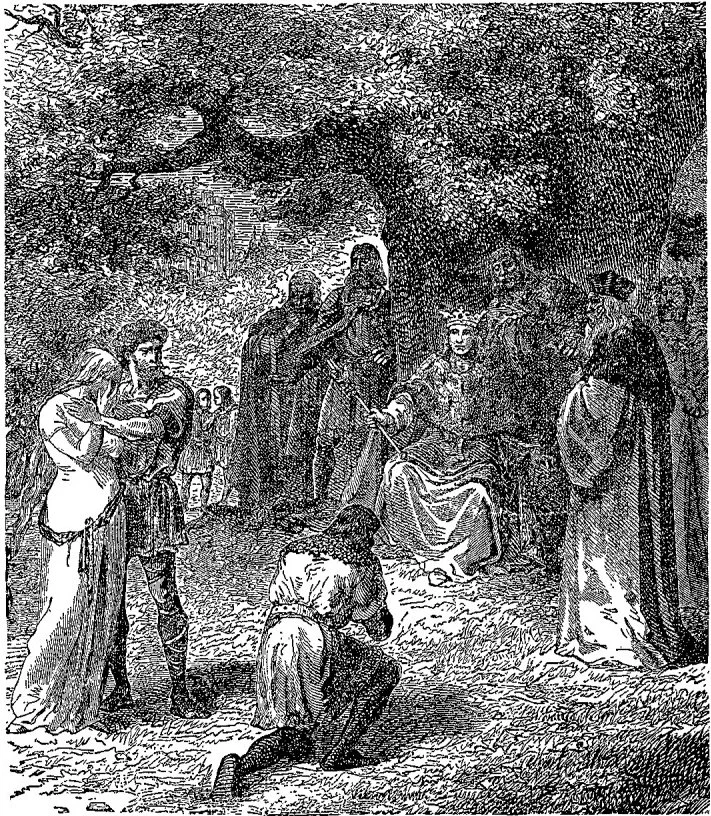
SAINT LOUIS SITTING IN JUDGMENT.
“I should have thought they would!” exclaimed Milly Brown. “It was ever so much nicer to stay at home with their families than to rush off to a far-away country to roast under a foreign sun and be killed by barbarous Turks.”
“Yes; and this second of his crusades was still more disastrous than the first. He did not go at once to Palestine, but sailed for Tunis, Africa, where he was taken very ill from the dreadful effects of the climate and died.”
“Aunt Eunice said she believed Saint Louis died in a bed of ashes, but she had forgotten the circumstances,” said Julia March.
“She was correct. When he died in Tunis, he ordered his servants to strew ashes on the floor, so that he might breathe his last while lying among them.”
“I wonder what he did that for,” said Maggie Palmeter, with a smile. “I should have thought a bed of feathers would have been ever so much softer and nicer.”
“I think Julia March can tell you why he did it. She is quite a student of the oldest, best written and most exact history in the world.”
“I presume you mean the Bible,” said Julia, blushing; “and I dare say that the reason Saint Louis chose ashes as his dying bed was only to symbolize his sorrow for sin. I remember that it was a very ancient custom for people to sit among the ashes in token of humility and sorrow, and sometimes they sprinkled them on their heads.”
“Yes, it was this sorrow for what was really his inability to keep his vow, though he had done the best he could, which caused him to manifest such great grief; he died with the word ‘Jerusalem’ upon his lips.”
“It was said of him that he was never heard to utter an oath. In fact, he punished the sin of blasphemy very severely.”
“I wonder if he was the French king whom I used to hear father tell about,” said Max Smith. “He used to put profane men on a ladder, with nothing on them but their underclothes, and with the entrails of a hog around their neck, would make two men carry them; sometimes he would have them branded on the face.”
Joe Palmeter’s face had begun to get very red during this recital, and his eyes sparkled like diamonds:—
“It was wrong! I’m sure it was not right. There is not the spirit of liberty of conscience in it. It is not Christ’s way of doing!” he exclaimed, earnestly.
“Why, Professor Carman,” said Florence Ray, “you don’t think it was right to blaspheme, do you?”
“I do not, most certainly. But the question is not whether it is wrong to do the act, but whether it would be right to punish men by law for so doing. I am sure Joseph would not approve of swearing, any more than any of us,” said Professor Carman, smiling,
“Indeed I would not,” said Joseph, grateful that his teacher could see the point he had meant to make, “but I believe in perfect liberty of conscience. I would not wonder if the best thing to do with a profane man would be to educate his conscience.”
“Very good, Joseph. The apostle says that he persuades men to repent, and that is the Master’s way. But King Louis said, in excusing his severity, that he would be willing to have the same thing done to him, and he would gladly bear the reproach, if by so doing he could purge France of so heinous a sin.”
“I believe that the blood of Christ alone can purge from sin,” said Julia March, reverently.
“Yes, that is so. No matter how much Saint Louis suffered on account of the sin of his country, it could not pay the debt or cancel the sin.”
“Then don’t you believe it’s right to legislate about such matters? Seems to me Saint Louis did just right,” said Charlie White, with a very sober face.
“I should think Charlie could see,” said Joe Palmeter, earnestly, “that this would make no end of trouble in the government; infidels and unbelievers wouldn’t stand much show, and I guess we’d have to use all the churches for jails after a little.”
“Well,” replied Charlie, “I’m sure it’s very wrong to blaspheme, and I believe I’ll ask my father to-night what he thinks of Saint Louis’ way of putting a stop to it.”
“That’s right,” said Professor Carman. “This is a subject which will bear much thinking about; for it involves a moral principle.”
“Philip the Bold,” he continued, “succeeded his father, Saint Louis, and brought the body of the misguided king back to France, and also those of his own wife and child, his brother-in-law, and John Tristan, his own brother,—five coffins in all—and a sorrowful procession it was.”
“Next week we will ask Charlie White to tell us what his father thinks of the action of King Louis, regarding the punishment of blasphemers.”
MRS. L. D. AVERY-STUTTLE.

“Time, Times, and Dividing of Time.”

“MAMA, this Sabbath question bothers one ever so much. Sometimes I feel provoked to think the pope has cheated one into Sunday keeping, and then again I feel almost mad at God to think he let me go on in darkness, and do tell me, mama, why it was. There are just thousands and thousands of people who are serving God who never heard that Sunday wasn’t the Sabbath. What will become of them? Yes, and of all the good people who died without knowing it?”
“Well, Charlie, you’ve asked me question upon question, which shall I answer first? The last I think, and that by a story I heard a minister tell a few nights ago when I asked him the same questions.
“He said, ‘Suppose a man has a counterfeit bill; but has no idea it is counterfeit. He goes to a store and offers it in payment for goods. The store-keeper detects its spurious character and returns it, saying, “I know you did not know it was counterfeit, and therefore I cannot justly charge you with dishonesty.”’ This is the way many offer Sunday to God. They think it genuine. He knows their honesty and accepts their sincerity. But suppose the man after fully knowing the character of his bill goes to offer it to another store-keeper. Ah, then, Charlie, he cannot stand as an upright man. And as to this Sunday worship, God alone can tell when people know it to be a spurious day of rest. The reason we have so long been ignorant of this matter, I will try to tell you. The varying feelings you experience will soon pass away like troubled waters from a fountain of peace. The Sabbath truth is one of the most profound rest, and when it gets in, you will find Jesus more fully than ever before. What does the word Sabbath mean?”
“Rest,” said Charlie.
“To whom are we invited to come to find rest?”
“Come unto me, all ye that labor and are heavy laden and I will give you rest, . . . and ye shall find rest unto your souls,” repeated Charlie.
“Now, why is it possible for Jesus to give us rest?”
“Because he has it to give.”
“Where did he get it?”
“From his father, I suppose.”
“Why can the Father give rest?”
“O mama, you do ask the queerest questions. Because—why because—”
“That won’t do, Charlie. ‘Because’ is a woman’s reason, they say. I’ll ask you another question, What is God?”
“God is love.”
“Do you have a sense of rest when you are in the presence of those who love you?”
“Yes, mama.”
“Then if God is love, and love gives rest, the reason why God can give rest is very plain. Now, when God had finished the heavens and the earth, what did he do?”
“He rested and was refreshed.”
“Does God get weary?”
“Fainteth not, neither is weary,” said Charlie.
“No; it was not physical weakness that called for this rest. What is expressed in God’s works? Please read Rom. 1:20.”
“‘The invisible things of him from the creation of the world are clearly seen, being understood by the things that are made, even his eternal power and Godhead.’”
“Then God’s works in nature tell us of his character, his love. The psalmist says, ‘The heavens declare the glory of God.’ When God looked upon nature he looked on the expression of his love and rested in love. He gave us the Sabbath as a sign of our rest in his love. Resting in his love we have an anchor both sure and steadfast entering into that which is within the vail, that is fastened unto the throne of God himself. In keeping the seventh day holy, we acknowledge God as our Creator, and as it will take nothing short of creative power to redeem us, we also acknowledge him as our Redeemer, and so, Charlie, what a glorious rest we experience in more fully comprehending the power of him who has loved us and washed us from our sins in his own blood and hath made us kings and priests unto God!”
“O, mama, it is really beautiful. There is plenty of power behind the true Sabbath, and I can see it would never be necessary for the state to back it up with its puny force.”
“That is so, my boy. It is the utter weakness of Sunday, for which there can be found no ‘Thus saith the Lord’ that sends men to the state for its enforcement.”
“Now for your first question. Why have we not found the Sabbath before? Please turn to Dan. 7:25, once more. How long were the saints, the law, and the times to be given into the hands of the papacy?”
“‘Until a time, times, and the dividing of times,’” read Charlie.
“Yes; but, mama, that’s all Greek to me.”
“It was to me until I patiently studied the Scriptures. Please keep your place in Daniel and turn to Rev. 12:14. Here the symbol of a pure woman is taken to represent the pure church. How long was she to flee from the force of persecution?”
Charlie read, “‘And to the woman were given two wings of a great eagle that she might fly into the wilderness into her place where she is nourished for a time, times and half a time from the face of the serpent.’”
“How long was she to flee?”
“For a time, times, and a half a time.”
“Very well, that is exactly the time spoken of in Daniel when the papacy was to wear out the saints, and to think to change God’s law and Sabbath. Now read the sixth verse, and see what this time, times, and half a time is equivalent to.”
“‘And the woman fled into the wilderness where she hath a place prepared of God, that they should feed her there, a thousand two hundred and threescore days.’”
“Now do you see, Charlie, how a time, times, and dividing of time is interpreted?”
“Yes it is clear enough. But I can’t see yet how it explains the fact that we are ignorant to-day. Why, 1,260 days wouldn’t be very long for the papacy to keep us ignorant.”
“That’s so, Charlie. I forgot that you did not know that each day represents a year. You may find this for yourself after we are through with our study by comparing Eze. 4:6 and Num. 14:34.”
“So really then this period of time, times and dividing of time covers 1,260 years?”
“Yes, dear. This is not a new interpretation. Adam Clark and other accepted commentators take the same position. But we need nothing but the Bible truth.”
“Well now, mama, when did this time begin?”
“Do you not remember when the tiara was given to the bishop of the church of Rome?”
“Yes; in 538 A. D.”
“Now, reckoning from that time 1,260 years, we are brought down to 1798, when the pope was taken prisoner by Berthier, a French general sent to overthrow the papal power. The pope was brought to France and died in exile. Since then the pope has been called the ‘prisoner of the Vatican,’ and these great truths have been coming to light. Persecution has not generally troubled the world since then. The law and the Sabbath are coming out of his hand, and we are receiving advance light. O Charlie, let us no longer look on the Dark Ages side of this question. The Light of the world seems walking just before us, saying, ‘If any man will come after me, let him deny himself (self), and take up his cross and follow me.’”
“Yes, mama. How sweet it seems to think we are getting rays of light from Jesus, and there is another verse that does me good; for if we follow him then this will come true, too, ‘That where I am, there ye may be also.’” F. B.

A Card.

To all interested in carrying the gospel of Jesus Christ to the inhabitants of other lands and who desire to assist in supporting missionaries already placed and others who may engage in the work, the opportunity is given to make an offering to the Foreign Mission Board of the Seventh-day Adventist denomination.
Such donations should be sent to W. H. Edwards, the Treasurer of the Board, 1730 North Fifteenth Street, Philadelphia, Pa.

TO OUR PATRONS:

  1. Write names plainly.
  2. Remit by P. O. Money Order, or Express Order, or by Bank Draft on New York. Personal checks are not desired.
  3. Make all Orders and Drafts payable to Pacific Press Publishing Co., not to the editor or any other individual.
  4. We will receive Postage Stamps in small quantities and any kind of good money. Defaced coins will not be taken. If paper money or coin is sent, register the letter.

The Gospel Primer.

A Book for the Children.

Contains 160 pages of matter, which will interest the old as well as the young. There are thirty-three full-page illustrations, which, in themselves, teach many gospel truths.
PRICE - - - - .25
Address this Office.

SEND FOR LIST OF EXCELLENT BOOKS

slightly damaged, offered at half price.
Address, PACIFIC PRESS PUBLISHING CO., 39 Bond St., New York.

Imported German Bibles.

Dr. Martin Luther’s Translation.

WE have imported direct from Germany a select line of fine-minion Reference German Bibles which we offer at the following prices postpaid:—
No. Description Price
60 Cloth, plain edges, heavy boards, Hamburg print $ .75
62 Russia, gilt edges, heavy boards, Hamburg print 1.50
64 Arctic Seal, Orient paper lined, divinity circuit, gold edges, Stuttgart print, size 4½x6¾x1¼ inches, thin paper, 10 pages of Helps and eight maps 2.50
66 German Morocco, gold edges, divinity circuit, leather lined to edge, Elberfeld print, size 5x8x1½ inches. Five pages extra matter and six maps 3.50
Address, PACIFIC PRESS PUB. CO., 39 Bond St., New York. Oakland, Cal.  Kansas City, Mo.

THAT DIFFICULT WORD!

How do you spell it?
What is the area of Cuba?—Spain?—Hawaii?—and the population of each?
To answer the above questions, and for much other valuable information, you should procure THE WEST-POCKET EDITION of the

NEW WEBSTER DICTIONARY,

Containing:—45,800 Words—A Gazetteer of the World—A Parliamentary Manual—Expert Calculator—Literary Guide, etc., etc.

PRICES:

Cloth, red edges, indexed, 25c
Morocco, Gold edges, 50c
Extra Morocco, 60c
PACIFIC PRESS PUBLISHING COMPANY,
39 Bond Street, New York City, N. Y.

A NEW TRACT CATALOGUE.

“Descriptive Catalogue of the Bible Students’, Apples of Gold, and Religious Liberty Libraries” is the title of this 36 page catalogue.
It gives a pithy description of each tract and pamphlet in the above Libraries, together with their size and price. It will greatly assist the reader to select such numbers as he may desire to read and circulate; and may be obtained FREE by addressing the Pacific Press Publishing Company, Oakland, Cal.; 39 Bond St., New York City, N.Y.; 18 W. 5th St., Kansas City, Mo.; or Review and Herald, Battle Creek, Mich.; Atlanta, Ga.
Continue reading: TRADE MARK REGISTERED