The Youth’s Instructor, Vol. 65, No. 48.

Red Cross Funding Needs in France and Belgium

The Youth’s Instructor

Nov 27, 1917

Review and Herald Publishing Assn. · Takoma Park Station, Washington, D. C. · Nov 27, 1917

Red Cross Funding Needs in France and Belgium

At least $30,000,000 in addition to $10,000,000 already appropriated will be required to keep in full operation Red Cross activities in France and Belgium during the coming six months.
Baroness de Rousart nursed the wounded with Florence Nightingale in the Crimean War sixty-three years ago. She is now eighty-five, lives in Cairo, and wears five medals given her by the French government.
Germany, it is said, offers to restore the Danish-speaking portions of Schleswig to Denmark for the cash consideration of gold received by Denmark from the United States in payment for the Danish West Indies.
Do you know why a tablecloth hangs over the edge of a table? Because the Anglo-Saxons, who invented the tablecloth, used to wipe their mouths with the edges that hang over. Later came the napkin, but we still retain the overhanging edges.
At midnight on October 31, the Sheppard prohibition law became effective in the District of Columbia, and all saloons within its boundary closed their doors. This “dry” law interrupts Washington’s drinking program of more than one hundred years’ duration.
In a speech made to the Reichstag, Socialist Ledebour said: “We have had 1,500,000 dead, 3,000,000 or 4,000,000 wounded, of whom 500,000 are crippled for life, and 2,000,000 absolutely invalided. That makes it altogether 6,000,000 men lost during three years.”
The vast store of German scientific information in this country, was opened to American manufactures recently by regulations passed by the Federal Trade Commission, under which enemy-owned patents and copyrights will be licensed for manufacture by citizens in the United States. Approximately twenty thousand patented and copyrighted articles are said to be thus affected.
Treasury statistics estimate that the government is now spending money at the rate of about $42,600,000 a day, which amounts to about $30,000 a minute. Expenditures for October exceed $1,000,000,000, and from the manner in which expenses have steadily mounted it is predicted that they will continue to grow until they reach possibly $2,000,000,000 a month. During the current fiscal year to date expenditures have been about 900 per cent greater than they were for the same period last year.
The goat is the most useful of domesticated animals. His use is fivefold: as producer of meat, milk, skins, and hair, and as the best assistant of the farmer in clearing new land for agricultural purposes. A cow can live where the horse cannot; the sheep where the cow cannot; but the goat will live and grow fat where a sheep would starve. There are about three million goats in the United States, but there is room and need for ten times and maybe twenty times that many. Goatskin leather, what we know as morocco or kid, is the most valuable of all leathers because of the toughness and tightness of the grain and the beautiful finish it takes. Few Americans realize that the beautiful shawls of Kashmir, the finest Persian and Bokharan rugs, the carpets and hangings of India, are all made of goats’ hair.
On the apex of the crown worn by the Prince of Wales on special occasions is a curious feather, or, rather, tuft of feathers, the top of which is adorned with a gold thread. The value of this feather is estimated at $50,000, and it has the distinction of being the only one of its kind in human possession. Twenty years passed after the first hunters set out to procure the feather before it was attained, and during that period more than a dozen hunters had lost their lives in the quest. The costly tuft is of periwak feathers, and the extraordinary danger incurred in procuring it was due to the fact that the periwak, for some unknown reason, is to be found only in dense jungles in which tigers make their lair.
Beginning December 1 all parcel-post packages requiring postage of twenty-five cents or more must bear an internal revenue stamp, as provided in the war-tax bill. The Post-office Department announced recently that regular postage stamps will not be valid for this payment. Special internal revenue stamps will be furnished. The rate will be one cent for each twenty-five cents postage, or part thereof above twenty-five cents.
Mr. William Staples, seventy-three years of age, was graduated last June from Marshall College, West Virginia. Bismarck, “who died at eighty-three, did the greatest work of his career after seventy. Commodore Vanderbilt increased the mileage of his roads from 120 to more than 10,000 between his seventieth birthday and his death. Gladstone took up a new language at seventy.”
As Germany does not provide sufficient food nor clothing to keep her prisoners of war in good health, the United States government is preparing, in conjunction with the American Red Cross, to feed all American soldiers and sailors who may be taken prisoners. The War and Navy Departments are coöperating with the Red Cross in working out plans to this effect.
America has just made a loan to Italy of $230,000,000. With this money Italy will pay for vast quantities of coal and other supplies purchased here for her armies and industries. To carry the supplies the shipping board has already agreed to turn over twenty-five merchant ships.
Cavalry has played a minor part in the great war, but a detachment of Belgian cavalry nevertheless provided a picturesque incident recently when it captured a stranded submarine and its crew on the French coast near Calais.

He Waketh Me Morning by Morning

He waketh me morning by morning. He draws the dream curtains apart; When sunbeams the hills are adorning, And he whispers sweet peace to my heart. I wake to the day and its duty; How precious each moment should be, Believing the King in his beauty Thus thinketh each morning of me.
He waketh me, stooping so lowly; My first conscious thought is a prayer. Such love is so high and so holy, I thank him today for a share. My heart aches with shame when I grieve him, And think, I alone am to blame; I read his kind words and believe him, His love is forever the same.
I hear not his voice in my slumber, I waken sometimes and forget; With sins in my heart without number I worry and wonder and fret; But when in the quiet of evening I ask for forgiveness with tears, He giveth a song for my grieving, My humble petition he hears.
He wakes me, while nature reposes; Such care is so far beyond words. I smell the sweet breath of the roses, I hear the glad song of the birds. The hills are all gilded and gleaming, I waken refreshed and am strong; He opened my eyelids from dreaming, And parted my lips with a song.
MRS. J. W. PURVIS.

Does It Pay?

J. D. MONTGOMERY
THIS seems to be the paramount question of the day. Everybody is asking it. The business man undertakes no new venture unless he first attempts to ascertain if there is any profit to be expected. The professional man does not lose sight of this query. The clerk inquires about the salary, and the laborer concerning the wage. Even the minister is not unmindful of the presence of this question in the air of our times. The spirit of commercialism has invaded the most sacred places and permeated the lives of all classes. It seems to be necessary. Everybody is inquiring if it will pay; if there is anything in it. Efforts put forth without hope of compensation are becoming more rare as the years go by. Does it pay? What is the graft? What does he get out of it? These are the inquiries so often asked or implied. And yet there lingers in the deeper recesses of the minds of many, another question—the same words with a better meaning: Does it pay? Does it pay always to ask the question? Should one count the cost in considering eternal things? If a young man enters the solemn valley of decision, should he sit down and canvass the situation and count the cost of the next move? I say, Yes; of course he should. There are several questions to consider: Does it pay to serve God? Does it pay to serve Satan? Who is the better employer and paymaster? Who requires the more? Who returns the more?

Does It Pay to Serve God?

Many, many have decided this phase of the question in the negative. They say, No, it does not! They feel that God requires too much and returns too little; that what they have to give up is real and what God returns is unreal. Is this your trouble, young man, young woman? Or do you acknowledge the fairness of God in his returns, but are easily led away and tempted? Are you susceptible to the enticements and allurements of the world? Maybe you are just careless and indifferent, and intend later to make the right choice; or perhaps you have not taken time to analyze your attitude.

Peter’s Question

Peter was concerned about this matter after the rich young man had gone away very sorrowful because he could not carry his riches into heaven with him. Peter said to Jesus, “We have forsaken all, and followed thee; what shall we have therefore?” The answer of Christ shows that he is not impatient with us for inquiring into the profits of a life of faith. He said: “Every one that hath forsaken houses, or brethren, or sisters, or father, or mother, or wife, or children, or lands, for my name’s sake, shall receive an hundredfold, and shall inherit everlasting life.” This statement is a searching question as well as a revealing answer. It told Peter, and us, what he wanted to know, and it also said to him, and to us, Have you forsaken all? Have you left this world for my sake? If you have, you will receive in this present time much more than you left, and in another time beyond this you will be entitled to everlasting life. Does it pay?—Yes, it pays! It pays in this present life to leave your flimsy possessions to follow Jesus. Enter into his service, and accept his wage. He is a liberal paymaster. His checks are frequent and adequate, and are payable at sight at the bank of heaven. There are no discounts on his vouchers; no rebates, nor graft. This is in this present time. In the world to come, what we get is extra. It is offered as a heavenly bonus, altogether extra and above what we deserve for our service. Does it pay? Really now, what do you think? Does it pay to decide for God?

Does It Pay to Reject the Offer?

Both sides of a question need be weighed before we decide. What shall we have therefore, Satan, for we have left All and followed thee? Satan isn’t saying just what he will do for those who follow him. He is careful about that. We may only judge what he will do for us by what he has done for others. Some he makes his pets, as it were, and under satanic patronage they seem to flourish like the green bay tree; while others shrivel up and land in the gutter very promptly. In other words, those who select Satan as the master are at his caprice, and the gains are uncertain. He is a good paymaster, but his coin is spurious and his gifts curses. He dwarfs the soul and shrivels the best in man till he destroys the image in which man was made. “Because thou hast rejected knowledge, I will also reject thee.” When we reject knowledge, we accept ignorance; we reject God and accept Satan. When we reject peace, we accept trouble and unrest. When we reject growth and development, we accept the lack of these things. Does it pay? I say, No, it does not pay! For there is no neutral ground. If we refuse to accept the truth, we identify ourselves with those who reject the truth. We cannot “serve God and mammon” for we will hate one and love the other. “He that is not with me is against me; and he that gathereth not with me scattereth abroad.” Matt. 12: 30. “There is no peace, saith my God, to the wicked,” so do not expect any if you decide to reject God. If you think it will pay to reject the God of heaven and all he offers, and accept Satan who offers nothing of benefit, do not expect anything. If the pleasures of the world leave ashes of Sodom in your mouth, do not be disappointed. If the sting of remorse follows self-gratification, do not be surprised. If Satan makes a poor paymaster, it is all he ever promised to be. Either make the best of your choice, or do the manly thing and break with such an employer, and enter the easy service of One who not only promises well, but performs more than he offers and more than we could ask or think. Does it pay?

In the Days of Youth

Does it pay to leave all and follow Him? In the days of youth, when the evil days come not when thou shalt say, I have no pleasure in them,—does it pay at this time of life? I say, Yes, it pays! It pays from the cradle to the grave—any time—to enter the service of the Husbandman of the universe. “Why stand ye here all the day idle?” “Go ye also into the vineyard; and whatsoever is right, that shall ye receive.” Do not be afraid you will be cheated; there will be no close figuring with God. He has promised so much; so much will we receive. The wage will not be lowered nor the cost of living raised in this service. The profit and loss column of our ledger account with God, will show all increase under gains. The loss column will not be used, and present worth will increase daily. Will it pay? Think it over. Make your decision now. Make it right.

In the Power of the Spirit

“I will pray the Father, and he shall give you another Comforter, that he may abide with you forever.” John 14: 16. “Being assembled together with them, [Jesus] commanded them that they should not depart from Jerusalem, but wait for the promise of the Father, which, saith he, ye have heard of me.” Acts 1: 4.
WHAT the Spirit was to the church in apostolic days, it may be to the church in the closing days of the world’s history. This promise of the Spirit was not for that time alone; it belongs to us as well. “Then Peter said unto them, Repent, and be baptized every one of you in the name of Jesus Christ for the remission of sins, and ye shall receive the gift of the Holy Ghost. For the promise is unto you, and to your children, and to all that are afar off, even as many as the Lord our God shall call.” Acts 2: 38, 39.
“To us today, as verily as to the first disciples, the promise of the Spirit belongs. God will today endow men and women with power from above, as he endowed those who on the day of Pentecost heard the word of salvation. At this very hour his Spirit and his grace are for all who need them and will take him at his word. . . .
“Christ declared that the divine influence of the Spirit was to be with his followers unto the end. But the promise is not appreciated as it should be; and therefore its fulfilment is not seen as it might be. The promise of the Spirit is a matter little thought of; and the result is only what might be expected,—spiritual drouth, spiritual darkness, spiritual declension and death. Minor matters occupy the attention, and the divine power which is necessary for the growth and prosperity of the church, and which would bring all other blessings in its train, is lacking, though offered in its infinite plenitude. . . .
“Why do we not hunger and thirst for the gift of the Spirit, since this is the means by which we are to receive power? Why do we not talk of it, pray for it, preach concerning it? The Lord is more willing to give the Holy Spirit to us than parents are to give good gifts to their children. For the baptism of the Spirit every worker should be pleading with God. Companies should be gathered together to ask for special help, for heavenly wisdom, that they may know how to plan and execute wisely. Especially should men pray that God will baptize his missionaries with the Holy Spirit.”—“Testimonies for the Church, Vol. VIII, pp. 20-22.”
What a mighty transformation the outpouring of the Holy Spirit will make in churches and individual experiences! It will change a wilderness into a fruitful field. We are told that when Sir Samuel Baker was exploring in the upper Nile valley, he pitched his tent one night in the bed of a large river long since dry. The heat was stifling, and the country apparently dead. That night the river rose into a torrent. He had scarcely time to escape, with his Arab attendants. When morning broke, the entire scene was transformed. Birds were singing, people were rejoicing, and the large broad river was flowing on to the sea. The natives began immediately to irrigate, and the whole atmosphere of the place was surcharged with life. It was nature’s baptism. With such a baptism does the Holy Spirit fill the soul and change the life.
“Ye shall receive power, after that the Holy Ghost is come upon you: and ye shall be witnesses unto me both in Jerusalem, and in all Judea, and in Samaria, and unto the uttermost part of the earth.” Acts 1: 8.
The disciples had been with Jesus during his ministry, and had listened to his instruction in the temple, as they walked by the way, on the shores of Galilee, and in the upper room. They had seen his wonderful power manifested in healing the sick, cleansing the lepers, and even raising the dead. They saw him after his resurrection, and heard him speak of the things that pertain to the kingdom of God. Finally they saw him ascend from Olivet to the place of glory and power at the right hand of his Father. They talked with the angels concerning his return, and “returned to Jerusalem with great joy: and were continually in the temple, praising and blessing God.” Yet all this did not constitute power. It did not qualify them to carry the gospel to the world; but they were bidden, “Tarry ye in the city of Jerusalem, until ye be indued with power from on high.” Luke 24: 49.
The disciples were to carry the gospel to the world. They were to meet persecution, imprisonment, and death. The Saviour knew that it was impossible for them to accomplish the work before them without this heavenly inducement. On the day of Pentecost the promise that he would send the Spirit was fulfilled, and having received the promised unction, they went forth with power to make known the gospel. They were imprisoned, whipped, stoned, and slain. Their followers were fed to the wild beasts, and the sand of the arena was soaked with their blood; but the word of God triumphed. Old Rome, with her pagan idols and abominations, has passed away. The dynasty of the Cæsars has long since sunk into oblivion. Her oracles are dumb. Her temples have been destroyed and her laws abolished. She can no longer levy a tax on all the world; but the gospel, through the power of the Spirit, has gone to the ends of the earth, and the Word of God has been printed in hundreds of languages and dialects, and scattered to the utmost extremity of the habitable globe.
In his “Quiet Hour Talks,” Dr. S. D. Gordon tells about a little town somewhere in the mountains. The citizens ran a pipe up the hills to a lake. “As the result, the town enjoyed a bountiful supply of water the year round without being dependent upon the rainfall, which is very slight there. The population increased, and the place had a regular Western boom. One morning the housewives turned the water spigots, but no water came. There was some sputtering—there is apt to be a noise when there is nothing else. The men climbed the hill. There was the lake as full as ever. They examined the pipes as thoroughly as possible, but could find no break. Try as they might, they could find no cause for the stoppage. And as days grew into weeks, people began moving away; the grass grew in the streets, and the prosperous town was going back to its old sleepy condition, when one day one of the town officials received a note. It was ungrammatical and poorly written, and the spelling was incorrect; but he never cared less about spelling and grammar than just then. It said, in effect, ‘Ef you’ll jes’ pull the plug out of the pipe about eight inches from the top, you’ll get all the water you want.’ The officials started for the top of the hill, dug into the pipe, and found the plug which some vicious tramp had inserted,—not a very big plug, just big enough to fill the pipe. Out came the plug; down came the water freely; and by and by prosperity came back again.”
The Spirit of God is free. David prayed that he might be upheld by the “free Spirit.” It awaits our demand and reception. In answer to earnest prayer, the promised blessing will come. Now, as in days of old, the Lord will reveal himself to his people. If the blessing is withheld, it is for us to search out the cause and remove the obstacle. Then the water from God’s great reservoir will flow in an abundant stream.
Should we not, like our Master, go forth “in the power of the Spirit”? Pompey is said to have boasted that, with one stamp of his foot, he could arouse all Italy to arms. But with us is the great and mighty God, who, with one word, can summon the inhabitants of heaven and unfallen worlds to his aid, and is able to bring new creatures into being to do his will. There is nothing too hard for him.
When a lecturer wishes to show an example of a human body surcharged with electricity, he places some one on a stool with glass legs, to isolate him from the earth, and then turns on the electric current. You see no fire; you hear no noise. But presently you are asked to come near and hold your hand close to the person on the stool. When you do this, you see sparks of fire shoot out toward you. In like manner, the fire of God’s Spirit should surcharge us, so that those with whom we come in contact will feel a mysterious, invisible power drawing them away from earth to heaven.
Great deeds of valor for the cause of God have been wrought by those clothed with the Spirit. Out of weakness they have been made strong. Irresolution and indecision have vanished, and they have unflinchingly endured privations, calumny, and persecution. Being valiant in fight, they have turned to flight the armies of aliens. They “went forth conquering and to conquer.” With the might of omnipotence God worked through them to make the gospel triumphant.
Shall we not enter into the closet, shut the door, and there, isolated before the throne of God, await the promised baptism of the Spirit, that we may labor and battle against the powers of darkness, not in our own strength, “but in demonstration of the Spirit and of power”? 1 Cor. 2: 4. G. B. THOMPSON.

Courage in the Lord

OFTEN the colporteur is hard pressed by the enemy, and sometimes he gives way to discouragement, seeing not the sun that shines behind the clouds. Concerning this we read from the pen of Mrs. E. G. White the following:
“Hope and courage are essential to perfect service in the work of God. These are the fruit of faith. Despondency is sinful and unreasonable. God is able and willing to more abundantly bestow upon his servants the strength they need for test and trial. The plans of the enemies of his work may seem to be well laid and firmly established; but God can overthrow the strongest of these. And this he does in his own time and way, when he sees that the faith has been sufficiently tested.”— Review and Herald, Oct. 16, 1913.
“All the afflictions and trials that befall us here are permitted, to work out his purposes of love toward us,—‘that we might be partakers of his holiness,’ and thus become participants in the fulness of joy which is found in his presence.”—“Testimonies for the Church,” Vol. V, p. 742.
What comfort is this to the soul who really believes these words and trusts the Lord fully.
“He who is imbued with the Spirit of Christ abides in Christ. Whatever comes to him comes from the Saviour, who surrounds him with his presence. Nothing can touch him except by the Lord’s permission.”—“Ministry of Healing,” p. 489.
“God would never send you the darkness If he thought you could bear the light; But you would not cling to his guiding hand If the way were always bright; And you would not care to walk by faith Could you always walk by sight.
“’Tis true he has many an anguish For the sorrowful heart to bear, And many a cruel thorn crown For your tired head to wear; He knows how few would reach heaven at all If pain did not guide them there.
“So he sends you blinding darkness, And the furnace of sevenfold heat: ’Tis the only way, believe me, To keep you close to his feet; For ’tis always so easy to wander When our lives are glad and sweet.
“Then nestle your hand in your Father’s, And sing if you can, as you go; Your song may cheer some one behind you Whose courage is sinking low, And—well, if your lips do quiver, You will love God better so.”
C. J. TOLF.

Periodicals for San Quentin Prisoners and Navy Boys

Mr. E. B. Hartman writes that it is useless to send papers that have been used to the prison at San Quentin, California, as no papers but those direct from the publishers are given to the prisoners. He suggests that the boys of the navy are hungry for truth-filled periodicals.

Knee Medicine: The Remedy of Prayer

A CHINESE convert, when asked by a missionary what remedy he found most effective in curing his fellow countrymen of the opium habit, idolatry, fear of persecution, and other sins, replied laconically: “Knee medicine.” Is there any other potent remedy for doubts and discouragements, failure and sin, than that found through earnest, persevering prayer?—The Missionary Review of the World.

Among Our Young People in Porto Rico

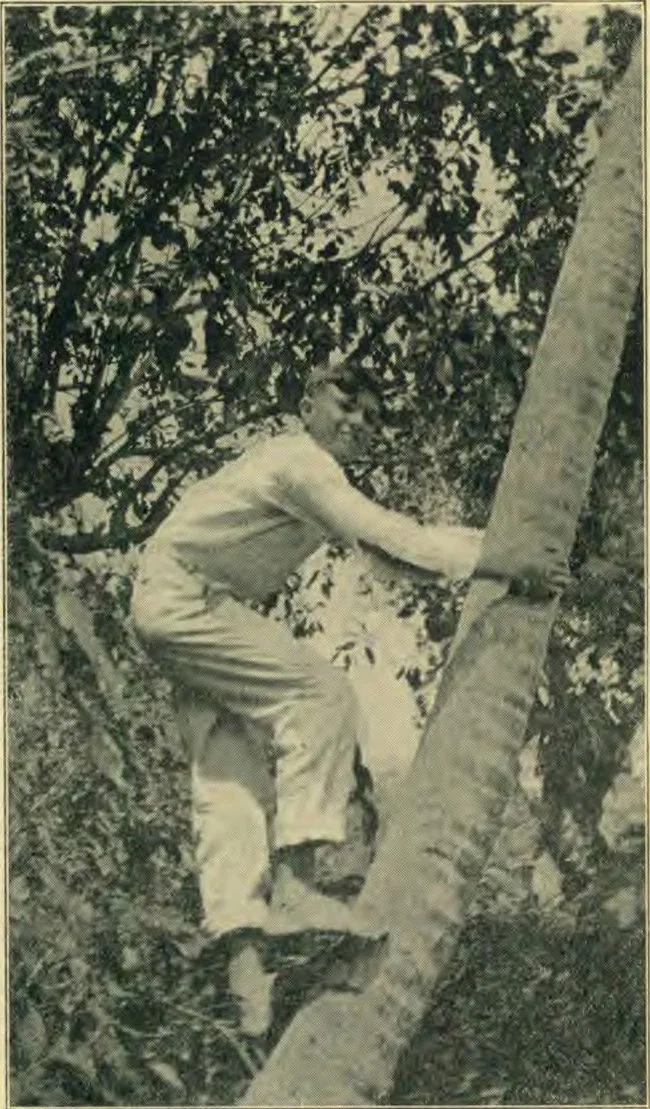
SOME of the truest characters in our Porto Rican young people are found among the “hill people,” called “jibaros.” The young man shown in the accompanying picture, Antonio Marrero, is climbing a coconut tree to give us one of nature’s rarest treats along the beverage line, called “cocoa de aqua.”
Antonio was reared among Roman Catholics of Spiritualistic belief; that is, when they have any belief at all. He began attending meetings at the Moca church, and accepted the gospel. He was baptized by Brother Steele up in the Moca hills. He soon began active work in teaching the “hill people” the truth, and it was not long until he had an audience of some fifty persons who came regularly every week. They gave up their vices and repented of their sins, and many of them are attending the Moca church every Sabbath. This picture gives a good idea of Antonio, who has a happy, open face.
One of the greatest problems at present is how to prepare these young men quickly to go out into the highways of Porto Rico, and tell their own people of a crucified and risen Saviour.
CLARENCE E. MOON.

Burma’s Need

THE present superstition and ignorance of the lands to which our missionaries have been going for half a century is appalling. If our young men had been volunteering for the army of Christian missionaries as they have been volunteering for the armies now engaged in the great European conflict, civilization and righteousness would have penetrated the darkest homes of all lands. The following incident published in a recent number of the Englishman, a Calcutta paper, glimpses the evil that exists even now in Burma, more than one hundred years after the thrilling and pathetic effort of the Judsons to give them the light of the gospel of Jesus Christ.
“Dr. Po Tha and three of his Burmese disciples are in police custody on a charge of murder in Sagaing. An elderly Burmese woman was killed and her daughter was dangerously injured by the Burmese doctor and his three assistants while exorcising ‘nats’ [evil spirits] with which they were said to be possessed. There were two sisters, Ma Sin aged fifty and Ma Kyon aged forty-five. The younger sister had three daughters of whom one, Ma Htae, was suffering from an ulcerous leg. Ma Kyon asked the doctor to treat her daughter. Dr. Po Tha is alleged to have been, when young, a disciple of Hpoungyi [a Burmese priest], from whom he received instructions in the art of casting out devils and evil spirits.
“The physician took a betel leaf in his hand, and after beating it thrice gave it to Ma Htae to eat. When she said it was hot he pronounced her to be possessed of an evil spirit, and spit in her face and slapped her several times. He then passed her on to his disciples, who also assaulted her. The mother of the woman began to cry, and the quack doctor accused her of having an evil spirit too, and he and his men meted out to her the same treatment as to her daughter, only that the mother was beaten for several hours. The disciples threw her on the ground, and declared the evil spirit gone.
“The headman took the doctor and his disciples to his house and sent for the police. The doctor said that he would have caused the ‘nat’ to return to Ma Kyon’s spirit if the government had not prevented him from holding a post-mortem examination. Ma Htae (her daughter) is dangerously ill in the hospital, while the doctor and his three assistants are awaiting trial on a charge of murder.”
Should not the benefits of civilization be considered as worthy to be bestowed upon a people as the blessings of democracy? Compare the expenditure of money, human life, and self-sacrifice now being made by the civilized world in behalf of democracy, with the expenditure for the spread in heathen lands of civilized and humane ideas and modes of living. The latter surely comes far behind the former.

A Wounded Soldier's Regret to Speak of Jesus

An Italian soldier from America was seriously wounded in a recent battle. When speaking to another American of his wound he said: “I am sorry it hit me down there. I was hoping if I were wounded it might be maybe that my legs would be shot off, and then I could lie here and speak of Jesus to others. But this—this will not let me.” He died with this regret upon his heart.

Let Us Not Be Weary in Well-Doing

“LET us not be weary in well-doing.”

The Water of Life

A MIGHTY king fell sick one day, And on his royal couch he lay, Tossing with fever and tortured by thirst, And all of the court physicians versed In science and nature could not allay The terrible thirst of the king that day. (For they did not know, they could not know, That a sin-sick soul had brought him low.)
Then a Jew whose sandal-straps were red With desert dust, stood forth and said: “O king, why with pain wage so weary a strife? I pray you to drink of the Water of Life!”
Then a messenger fleet to Iman Khan, Friend of thirsty souls, right swiftly ran; For a seller of wonderful water was he, And he came to the king as hastily As the horse of an Arab could speed him away, And soon he arrived where the sick man lay.
Then the monarch said: “O Iman Khan, I know you have come from far Ispahan To give me relief from this torturing strife By bringing to me the pure Water of Life.”
Then Iman Khan bowed low, and poured The precious water which he had stored In waterskins for the long, hot ride, And placed it in bowls by the sick king’s side.
Then they held a bowl to his thin, parched lips, And he tasted the water in eager sips;
Then he drank deep drafts; but he longed for more. And his thirst was greater than ever before. And he said, “With the fever I still am at strife; So this cannot be the true Water of Life!”
Then his servants in haste again went forth To the east and the west, to the south and the north, To find in cool springs or where bright fountains break, The Water of Life which his thirst would slake. But they all from the quest unsuccessful returned, And day after day the king’s hot fever burned.
At last he summoned the foot-sore Jew, And said: “Oh, how can your words be true? No water on earth can satisfy; I shall burn with the fever, and thirst till I die.”
Then the Jew bowed low and gently said: “O mighty monarch, have you not read That the water which nature gives to men Can never prevent them from thirsting again? But the water which Christ shall give shall be A well of water eternally. And this, O king, is the Water of Life, Which can bring you relief in your torturing strife. Who searches afar shall his quest not win, For the living water springs forth within.”
“How may I this wonderful water receive?” “O king, you have only to fully believe!” Then a marvelous peace o’er the sick king crept; He drank of the water, and quietly slept.
— A. M. G., in The Christian Herald.

“I’ll Try”

SHE was so tiny a bit of a girl, my younger daughter. It was a rough, cold world in which she was left, when less than three weeks old, by the death of her mother. Her father had tried to provide for her the best care he could, but it had been a struggle for years to keep the little life from going out.
She was now five years old, and growing strong of limb and keen of eye. But she was sadly lacking in confidence. Her father saw it, and wanted to help her. So one day he said to her:
“Bertha May, I wish you would take this basket up to Grandma Binford’s.”
“W’y, papa, I tan’t,” she said, a scared look in her eyes.
“Yes, you can, dear,” her father said.
“I don’t know t’e way,” she said.
“Yes, you do, dearie,” said the father.
But that trip to the corner, then one square east, then straight north into Grandma Binford’s porch, though she had made it with me a score of times, seemed to her like a long journey through a trackless wilderness.
I did not need the basket taken so much as I knew she needed to take it. My older daughter would have been glad to take it. I myself could have taken it on my bicycle, and been home in five minutes. But she needed to learn confidence by doing, and so I insisted.
“I tan’t, papa; I tan’t,” she wailed.
“All right,” I said, presently, “if you will not do what papa says. But I would not ask you to do a thing that I did not know you could do.”
She sat alone for a while, and fought it out. Presently she came to me, and with that courage that is best because it has conquered fear, she said, her lashes still wet, “I’ll t’y, papa.”
She took the basket to Grandma Binford’s, and returned in triumph. What she did not know was that her father had gone through the back gate as she left the front yard, and, looking down the alley, had seen that she turned right on the first street, then made the turn to the north as she ought. She did not know that, as she went north the three or four squares to grandma’s, her father was going on his wheel up the alley, with his eye on her to see that she was safe and that she did not go astray. She did not know that, as she stood on grandma’s porch, her father passed only a few feet from her, happier and prouder over her achievement than she herself.
My Father has often said to me, “Go on this errand; go, speak for me this message.” And I, in my weakness and childish timidity, have said to him, “Father, I can’t.” And he has said to me, “Yes, you can.” And he has had his other messengers whom he could send. But his command was to me.
After I have fought the battle out in my own heart, and have come to him, and said, “Father, I’ll try,” with what fatherly care he has watched over my steps, and how he has hidden me under the shadow of his wing till my work for him has been done! And it is possible that I have pleased my Father as my little child pleased hers.
Even when Job could not see his God, try as he would, his faith triumphed as he said, “He knoweth the way that I take: when he hath tried me, I shall come forth as gold.”—Rev. Levi T. Pennington.

Unsprung Weights

THE unsprung weight of an automobile is the weight of the car below the springs, the weight that goes pounding directly upon the tires and pulling directly upon the engine, unmollified by the relaxation of springing and vibrating steel. A well-known engineer declares that a pound of unsprung weight is nine times as destructive as a pound that is sprung; uses up the gasoline nine times as rapidly, wears out the tires and the engine nine times as fast. So that springs are a matter of economy as well as of easy riding. Nor is it otherwise with the spirit-automobiles in which we travel along the highway of life. The more of our experiences, our habits, our daily toil, our relations with others, we can put upon springs, very much the better. Springs of enthusiasm. Springs of patience. Above all, springs of love. Eliminate unsprung weights.—Æsop Jones.
Continue reading: For the Finding-Out Club