The Youth’s Instructor, Vol. 65, No. 48.

Red Cross Funding Needs in France and Belgium
Earlier text: For the Finding-Out Club

Two Pet Bears

E. J. URQUHART
The beautiful Gallatin valley of Montana was the home of my childhood. Here the days were filled with continual interest. One of the events of these days that gave me much pleasure was the annual return of Mr. Brookins from his spring hunt in the mountains. This meant more to me than Christmas or the Fourth of July. Mr. Brookins was a professional hunter. Each spring he returned from the mountains with a supply of skins of wild animals. He usually brought home from a dozen to a score of bear skins. Now the skins in themselves, beauties though they were, were not the particular interesting feature of the home-coming, only as each skin held its own story of adventure.
While Mr. Brookins hunted with a gun, he also was a great lover of pictures, and took a camera with him on all his trips. His stories were told in a charming manner, and intensified with snapshots of places and things. Once he captured a large grizzly bear in a trap, and was desirous of securing a good picture of him. He stood his gun by a tree and proceeded a few steps farther in order to take the picture. He secured his picture of the old fellow standing there majestically on the snow with one fore foot in the steel trap. But to the mind of the hunter it was too tame. It did not have the snap to it that properly characterized the monarch of the Rockies; and so Mr. Brookins, in order to give the picture the needed interest, took a long pole and poked old Bruin up a little, that he might assume the fierceness in manner and expression that was deemed necessary properly to set off his majesty. The plan worked perfectly so far as demonstrating the fierceness of the captured animal, for he made one mighty bound in the direction of the man, when the steel trap snapped in two and the mammoth bear plunged on toward the gunless hunter. Mr. Brookins ran for his gun with the bear after him. As he ran around the tree, he snatched the gun. By this time the bear was at his heels, and without the formality of sighting, the hunter simply poked his gun in the direction of the animal and fired. Fortunately the bullet penetrated the brain of the bear, and he fell as a log. The coveted picture was lost, but the hunter carried away an experience of the first magnitude.
At one home-coming, Mr. Brookins brought with him two cub bears that he had captured after killing the mother. They were about the size of large tame cats. One of them was brown and the other black. We put collars around their necks and kept them chained like dogs. During the following summer, those bears furnished us boys with hours of amusement. Several times a day we would lead them down to the creek to water, as they were very fond of the water. In the warm days of summer they would wade out into the stream and lie down. If we took them away before they had sufficient water, they became very angry and would run to us, stand on their hind legs and with their fore paws grab us around the legs, and give a terrifying shake.
Several times one or the other of the bears broke loose. These were sorrowful occasions for our household, and for mother in particular. We had a log milk house with a beautiful spring flowing from under it, which was almost as cold as ice. And when a bear got loose, it was a pitiful sight that greeted my mother’s eyes when she appeared on the scene, for milk and cream were a dish that the bears relished quite as much as we children. And beyond a lusty appetite the bear was curious; what he did not drink he had to sample, so that everything in the milk house was a total loss on such occasions.
By the early autumn our pets were too large to trust to a chain, and the watering process became one that was a man’s job instead of a boy’s, because if the bear was cheated of what he deemed his proper time for drinking and bathing, his assault upon his tender was more than a boy could withstand. It finally became necessary to build a strong pen where the bears could be given some liberty, and yet would not require the care that was needed at the stake.
In the late autumn the men-folks went into the pen and dug a large hole in the ground, and covered it over with boards and earth, leaving an opening for the bears to climb down into it. When the air began to grow frosty and the winter snows began to fall, the bears dropped from sight. The days rolled by and still no sign of the bears. We gave them no food; they were taking their winter’s sleep. One day, however, in the latter part of January, they came out and spent an hour or two, and then went back again for a stay of several weeks. They came out in the spring looking not very different from what they did when they went to sleep in the fall, for if they did lose some in flesh it was made up by an extra growth of fur.
By the middle of this second summer they each weighed about two hundred pounds, and as they required much food, Mr. Brookins thought the time had come to give them their liberty, knowing they would not wander far away, and that he could find them in the woods and kill them in the fall after their fur should become fit for market use. So on a summer day we turned them out and they started off for the woods. Afterward we saw them on several occasions not more than a mile from the house. About six weeks later some berry pickers saw one of them and killed him. The other wandered farther and farther away until that fall when Mr. Brookins went out with the dogs to round him up, he located him about six miles away in the mountains. He was summarily executed. Thus closed the career of the two bears.
When the earth is again made new, bears will have lost their fierceness. Cages will not be required to keep them in, for they will be as gentle as the pets of the farm today. Children will play beside them without fear of molestation. God’s great purpose for all the animal creation will then be fulfilled.

Billy’s Lesson

BILLY BROWNE frowned at his book, and told himself over and over: “I never can learn that old lesson! I know that I can’t!”
Every time Billy said this, the lesson seemed to grow harder and more hopeless. It would have been easy in school, but it was tedious work for a boy to make up in vacation lessons he had missed while away on a visit.
The real trouble, you see, was not that the lesson was hard, but that part of the time Billy’s mind was out on the street where Dick and Allen were playing, and the rest of the time it would not work because Billy would not let it. He kept discouraging it.
“What’s the use trying to understand a lesson when you can’t?” he grumbled.
Just then Mr. Beach came down the street with his family of goats — Billy, Nanny, and Kiddie. At once Billy dropped his work and rushed out to see the goats. Dick and Allen joined him, and all began asking eager questions, for none of them knew goats well.
Mr. Beach was leading Billy Goat by a halter. At an order from him, the goat stood proudly on his hind legs.
“He’s like an old man, with a long beard and his sober eyes,” said Billy.
“He’s like a small boy in many ways,” answered Mr. Beach. “He likes to climb, and he’s full of fun and tricks.”
“That’s like a boy,” agreed Dick.
“And he seems always to be hungry,” Mr. Beach added.
“That’s like a boy, too,” laughed Allen.
“If he’s left in the yard,” Mr. Beach went on, “he eats everything green in sight — grass and leaves and shrubs. Even the flowers do not escape him. I shut him and his family up in a pasture with a wire fence around it, which I knew he couldn’t climb. One day I found him outside it, nibbling a young tree. You see, the fence was braced at the corners with long poles, and he climbed the inside one and walked down the outside one.”
“Just like a boy!” again laughed Dick. “Was it hard to train him to do tricks like standing up in this way?”
“No,” answered Mr. Beach. “Goats, as a rule, are easily trained. At first Billy didn’t want to stand on his hind legs, but that was only because he thought he could not. Even a goat can’t do a thing till he gets rid of that notion. He hadn’t found out then how very easy it is.”
Right here Billy Browne might have said: “That’s like a boy, too!”
It was very much like a boy Billy knew. He said nothing, but he was thinking busily, and his thoughts ran like this:
“I’m not going to let Billy Goat beat Billy Browne. I can learn that lesson, and I’ll do it, too!”
And Billy did learn it. He laughed when he was through to think how easy it had been.
The next day, when he passed Mr. Beach’s pasture, Billy Goat looked at him with a wise air, as if he would say: “Didn’t you learn a good lesson from me, Billy Browne?” — Exchange.

Reading That Compels Thought

READ much, but not many works. The only kind of profitable reading is that in which we are compelled to think and think intensely.—William Hamilton.

Missionary Volunteer Society Programs for Week Ending December 8

The programs for this date, with notes, illustrations, and other helpful material, will be found in the Church Officers’ Gazette for December.

The Bible Year

Senior Assignment

December 2. Ephesians 1 to 3: God’s eternal purpose. December 3. Ephesians 4 to 6: Unity; holiness; love, etc. December 4. Philippians: Fruits of righteousness. December 5. Colossians: Divine headship of Christ. December 6. 1 Thessalonians: The second advent. December 7. 2 Thessalonians: Apostasy; the man of sin; consuming destruction. December 8. 1 Timothy: Advice to a young minister.
For notes on this assignment, see Review for November 29.

Junior Assignment

December 2. Acts 25: Paul appeals to Cæsar. December 3. Acts 26: Paul’s defense before Agrippa. December 4. Acts 27: A sea journey; shipwreck. December 5. Acts 28: Paul reaches Rome; preaches the gospel. December 6. Romans 12: Consecration; brotherly love, etc. December 7. 1 Corinthians 13: The greatest gift. December 8. 2 Corinthians 9: The grace of liberality.

Two Letters

“Here’s a letter for you,” called Edna’s mother as her twelve-year-old daughter came in from school.
“A letter!” echoed Edna, joyfully, seizing it from her mother’s hand. “And how ever did it get here, I wonder! It hasn’t any stamp on it, and yet I know it came two hundred miles, for Cousin Sue lives away up in Massachusetts.”
“Look down in the lower left-hand corner of the envelope, and you’ll see how it came,” replied her mother. And sure enough, written across the envelope was “Kindness of Mr. Rogers.” He was a neighbor who had just returned from a trip to the very place where Cousin Sue lived, and he had brought the letter.
“Isn’t it fine to get letters?” remarked Mrs. Walters with a smile of understanding, as Edna finished reading. “Do you know that you have a part of another letter to read today? This is the sixth of December, and the Junior Bible Year assignment is to read Romans twelve. If you’ll come over here near me, I’ll tell you something about the epistle to the Romans, and then we can read the chapter together.”
“You remember Paul wrote at least thirteen letters during his lifetime, which make up a large part of the New Testament. The epistle to the Romans is the greatest of them all. His mighty mind and equally great heart of love live in every page. The letter was written while Paul was at Corinth, and sent “By Kindness of Phebe” to the members of the little mission church at Rome. You see there was no regular postal service in those days. Phebe was a Christian woman living near Corinth, and she was about to make a journey to Rome, so she was given the message to deliver.
Though at this time Paul had never been in Rome, he had many friends there, as you will see from the long list of persons mentioned in the latter part of his letter, to whom he wishes to be remembered. This letter was written in Greek, the “common dialect” of the middle and lower classes at Rome. Paul did not write it with his own hand, but dictated it to his secretary, Tertius, much as people dictate today, no doubt, though of course there were no typewriters and no system of shorthand, and it must have taken a long time to write out such a letter as this.
“Paul’s purpose in writing to the Romans was to answer some of the puzzling questions which he feared might be troubling the church. He also gave them good instruction in the ways of kindness and hospitality, and in all the sweet Christian graces which should be seen in the lives of all who really love Jesus. As we thoughtfully read this twelfth chapter of Romans together, you will see how brimful of good advice it is. The whole chapter is well worth memorizing. Let us learn at least the first verse, and as much more as we can. It is one of the finest chapters in the Bible.”
ELLA IDEN.

God Does Great Things for Us

(Texts for December 2-8)
FRANCIS E. CLARK says that “Dr. Murray, in certain lines of religious authorship and influence, was the most prominent man of his time. What Thomas à Kempis was to the fifteenth century, and Jeremy Taylor to the seventeenth, what David Brainerd and Edward Payson were to the people of their day, Andrew Murray was to our generation, the embodiment of a sane mysticism, of a consuming zeal to know God, the preëminent ‘holy man’ of our time.”
Dr. Murray walked with God for many years. He learned to know his heavenly Father, but he never fathomed his greatness. He learned to appreciate God, and found one of life’s greatest pleasures in meditating upon God’s unsearchable greatness, in thinking of his boundless love for each one of us. That study never lost its fascination for Dr. Murray. On the last evening of his life, while sitting on the sofa in his room, he said to his daughter: “We have such a great and glorious God, and we must rejoice and be happy in him. God is a wonderful and beautiful God. He desires to make our lives just as wonderful and beautiful as his.”
And, truly, our God is great. Just a glance at any one of his marvelous works fills us with amazement. Think how wonderfully he has fitted up the earth for us to live in. Around it is air enough for every one to breathe. Under its surface are coal, iron, gold, silver, and other treasures for man; in the roots, leaves, and barks of trees are remedies for disease. Every year he commands the ground to bring forth a harvest of good things to eat. Still in his great plans for making the earth provide for our many and oft-returning wants, he did not forget to make it a beautiful place in which to live. Surely the God who could plan and make this world is a very great God.
Now turn for a moment to the Bible, that great treasury of reserved blessings, which God has given us. Not one sentence has been added since the amen at the close of Revelation 22; and yet every day men are discovering new and precious truths on its pages. The Great Author put more into that book than appears to the casual reader; yes, more in fact than any reader can comprehend. Every time we look at a verse under the eyepiece of a new experience, we discover a precious promise never seen before in that oft-read passage—just the promise we need.
Yes, God always has more to give—his reserve is inexhaustible; and this is a most comforting fact, for since all his great works are built upon his everlasting love, each one of us can truly say with the psalmist, “I shall not want.” God loves us; and in his great, inexhaustible reserve he has blessings to bestow upon us according to our needs. Not all the natural resources deposited by him in the earth were given to men in the beginning. Some God held in reserve, and from time to time he has led men through paths of discovery and invention and given them some of these reserved resources to pass on to their fellow men. But God still has more to give.
You, too, may make discoveries. God desires to lead you through paths of his own choosing, that he may bring you in touch with his great reserve, and fill your life with blessings for others. The path of the men who have made discoveries has often been dark and lonely, and frequently ended in disappointment and failure. Your path, too, may be dark at times, but success is inevitable if you follow God’s guidance—the expedition cannot fail. God may not give you a new star with which to startle the world; or a great invention to add to the conveniences of modern life, but you may be sure that God will give you just what those about you most need in preparing for the last great reckoning day. And if you follow that path, you will learn that our God truly is a great God, a wonderful God, full of love and mercy. You will learn that life’s greatest need is to know him, that life’s greatest joy is to live with him for others.
“I will extol thee, O my Lord, and praise thee, O my King; Yes, every day and evermore, thy praises I will sing.
“Great is the Lord, our mighty God, and greatly to be praised; His greatness is unsearchable, above all glory raised.
“Upon thy glorious majesty and honor I will dwell, And all thy grand and glorious works and all thy greatness tell.
“The Lord, our God, is good to all, from him all blessing flows; On all his works his tender love and mercy he bestows.”
M. E.

X — Health Reform

  • (December 8) *
MEMORY VERSE: “Whether therefore ye eat, or drink, or whatsoever ye do, do all to the glory of God.” 1 Cor. 10:31.

Questions

1. What wish is expressed concerning the health of a well-beloved servant of God? 3 John 2.
2. Why should the health of the body be preserved? 1 Cor. 6:20.
3. What are our bodies said to be? Verse 19.
4. What will God do to those who defile this temple? 1 Cor. 3:17.
5. For what did David praise the Lord? Ps. 139:14. Note 1.
6. What does the apostle Paul beseech us to do? Rom. 12:1. Note 2.
7. What principle should govern us in eating and drinking? 1 Cor. 10:31. Note 3.
8. For what purpose should we eat food? Eccl. 10:17. Note 4.
9. What food did God give man in the beginning? Gen. 1:29.
10. Under what circumstances was a departure from this diet permitted? Gen. 7:23; 9:3. Note 5.
11. If we take heed to all of God’s words, what will be the blessed result? Prov. 4:20–22.
12. In the description of conditions in the final Home of the saved, what do we learn concerning the inhabitants? Isa. 33:24.

Notes

1. The psalmist, meditating upon the marvelous work of God in the creation of the human body, was led to exclaim: “I will praise thee; for I am fearfully and wonderfully made.” The body with all its parts—the heart, lungs, stomach, brain, nerves, and muscles—is the crowning work of creation.
2. All sacrifices offered to the Lord were to be perfect, and without blemish of any kind. The body should be preserved in as perfect condition as possible, that we may better glorify God. Good health will bring happiness to ourselves and to others.
As a marred and torn picture is not a glory to the artist who painted it, so a human body that has been neglected and through carelessness has become diseased, is not an honor to the One who created it.
3. There are many causes of illness, but eating and drinking that which is not good for the body produces more sickness than any other one cause. Bad food and drink cause disease. Good food and drink build up the body and help overcome disease.
4. “Fruits, grains, and vegetables, prepared in a simple way, free from spice and grease of all kinds, make, with milk and cream, the most healthful diet. They impart nourishment to the body, and give a power of endurance and vigor of intellect that are not produced by a stimulating diet.”—“Healthful Living,” p. 78.
5. When there is scarcity of food, as in the days of Noah, it may be necessary to take the life of the lower animals to save the life of man; but the dangers incurred in a flesh diet are increasing rapidly.
“Flesh was never the best food; but its use is now doubly objectionable since disease in animals is so rapidly increasing. Those who use flesh foods little know what they are eating. Often if they could see the animals when living, and know the quality of the meat they eat, they would turn from it with loathing. People are continually eating flesh that is filled with tuberculosis and cancerous germs. Tuberculosis, cancer, and other fatal diseases are thus communicated.”—“Ministry of Healing,” p. 313.
NATURE'S BEST GIFTS
NATURE'S BEST GIFTS

Keeping the Sabbath

A TEACHER spoke to her Sabbath school class of the necessity of keeping worldly thoughts from the mind during the Sabbath if one would keep the day aright. Then she asked what would aid one in keeping the mind fixed upon proper things. One of her pupils, a young girl not yet in her teens, said she found that reading much in good books during the Sabbath helped her the most of anything.
This is the secret of Sabbath keeping. The Reading Course books are always of interest and profit, and strengthen the Sabbath-keeping spirit. “Patriarchs and Prophets,” “The Desire of Ages,” “The Great Controversy,” are mines of gold to the thoughtful reader. Even the Juniors will greatly enjoy reading these books, and cannot fail to gain much good therefrom.
On next Sabbath prove this statement to be true or untrue by finding the answers to the following questions in chapters 26 and 27 of “Patriarchs and Prophets:”
  1. What was the feeling of the Israelites as they journeyed on after crossing the Red Sea?
  2. What caused Moses anxiety as he watched the guiding cloud near Marah?
  3. What was the difference in the way in which Moses and the children of Israel met difficulties?
  4. How did the children of Israel show that they had wretchedly poor memories?
  5. What lesson against hoarding was given to the Israelites?
  6. Why did the Amalekites attack Israel by the way?
  7. When this wicked nation fell upon Israel, what did they steal? Why?
  8. What two noted events took place at Mt. Sinai?
  9. When on the third day did the Lord appear upon Mt. Sinai to speak the law?
  10. What is the real meaning of each commandment?

The Black Cloud

TWO men in Palestine were watching a black cloud that floated in the sky. While they gazed, it began to grow thin, and in a few minutes it had disappeared. It seemed strange to the men, for clouds did not dissolve in that way in their country. Then one of the men remembered a Bible verse, and quoted it: “I have blotted out, as a thick cloud, thy transgressions.” “I understand that verse now,” he said. “That is what the prophet meant. God took away the people’s sins, made them disappear and be forgotten, as this cloud has gone.” It is true. As the sun and wind dissolved that cloud, so will the Son of God remove our transgressions. When we trust him, they are gone forever, forgiven freely, and forgotten. No matter how black the cloud may be, the sun and wind can dissolve it; and no matter how black sin is, God can take it away.
— Selected.

Where Do You Sit in Church?

EACH Sabbath a father is seen in a certain pew during the church service. He has a son of twelve or thirteen years, who attends Sabbath school, but who is never seen beside his father during the church service. Why not? It seems out of place for the father to occupy his seat regularly, and not to have his son with him. Do not boys need the church service? And if they do, why should they not sit beside their fathers?
There is in the same church a widow. Always there sits beside her in the church pew her twelve- or thirteen-year-old son, together with her three girls. This family has regular habits; the members worship together night and morning at the family altar; they read and improve the Sabbath hours together; they sit together at church; and it is very likely they will travel the straight and narrow path together so long as the providence of God gives them life.
The Lord loved Abraham because he commanded his household after him, and does not the Lord expect every father to do the same by his household? Why should boys be left to sit with other boys during the church service, or to wander around the town during the Sabbath service?
Is the church service not for the youth as well as for the adult? The good gained from the Sabbath school may be lost during the church service by allowing the children to remain away from the service or to sit apart from their parents.
It is expected that children sit with their parents; it is the genteel, the proper thing to do. A failure to do this occasions questioning in the minds of others as to the amiable relationship of parent and child, or at least as to the ability of the parent to “command his household after him.”
There is strength and character to be gained from attendance upon church service. All sermons may not interest the child; but rarely will an attentive child fail to gain good from the service. Children should be encouraged, if not required, to attend the church services regularly, and to sit with their parents.
The house of God may be desecrated by a group of children sitting together; the service may be lost to worshipers because of the irreverent conduct of children; and the children may lose what might have been of untold worth to them.
The church is the place where youth and adult, where parents and children, should worship together in the beauty of holiness. May it be so.

Time Spent in Private Prayer

How much time do we spend in prayer? Billy Sunday tells of an elder who resented the suggestion that he did not spend much time in that way. “Well,” said the evangelist, “time yourself by your watch the next time you pray in private.” The elder did so. And when he reported his experience he said he took out his watch, laid it on the bed, and prayed. When he looked at the watch to see how long he had been on his knees, he exclaimed, “I thought it had stopped!” — Forward.
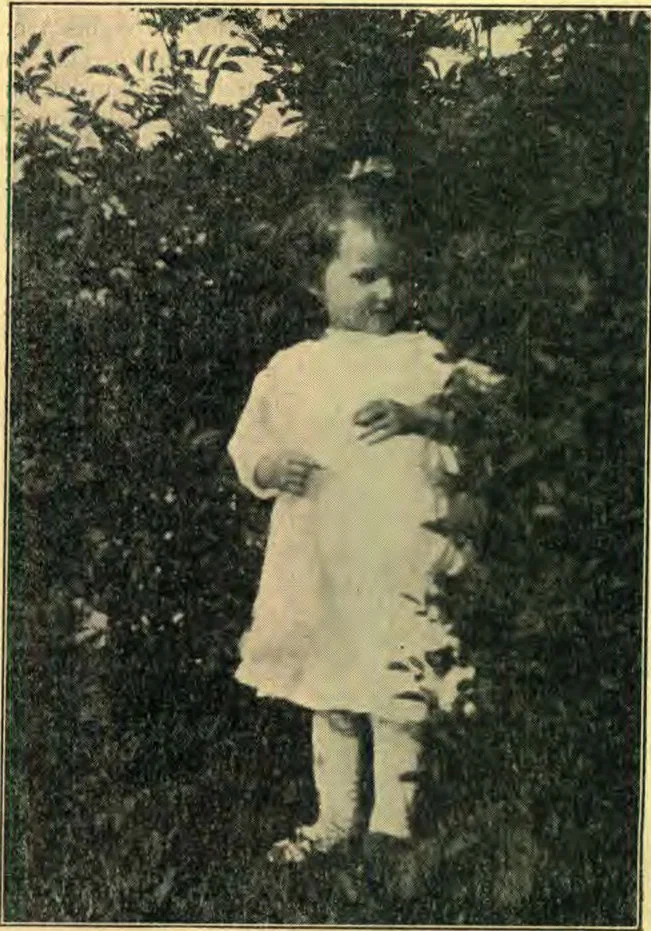
“PLAYING DADDY”
“PLAYING DADDY”

You have reached the end of this edition.

The Youth’s Instructor · Nov 27, 1917