We often hear persons being spoken of as "good moral men," but that "they are not religious." To be strictly correct, however, we should say that such persons are good civil citizens, and this statement includes the type of morality that is generally intended when we speak of the "moral man."
Civility requires that we respect the civil law of the land, and that we have a decent regard for the courtesies and customs of our neighbors and associates. A person may be a good peaceable citizen of the land, giving careful heed to every law of his country, and yet fail to live in harmony with the requirements of the great, perfect, moral law of Jehovah.
Civility, closely analyzed and correctly understood and applied, has to do with our ordinary every day relations with our fellow men, but would not include our higher relations to God and to His moral law. In the field of civility the State may properly legislate, and may rightfully govern all its subjects. But into that higher realm of morality where man communes with his Creator, the laws or restrictions of no legislature, civil ruler, or potentate may ever come.
Morality and Conscience.
Morality has to do in reality with the conscience in its exercise toward God. Man may refrain from committing the overt act of killing a fellow being, and thus he could not be said to violate the law of the land that makes it a crime to commit murder. But God's moral law which says, "Thou shalt not kill," is much broader than the State law against homicides. Hear the words of Him of whom it is said, "It pleased Jehovah, for His righteousness' sake, to magnify the law, and make it honorable." His words are:
"Ye have heard that it was said to them of old time, Thou shalt not kill; and whosoever shall kill shall be in danger of the judgment: but I say unto you, that every one who is angry with his brother shall be in danger of the judgment; and whosoever shall say to his brother, Raca [an expression of contempt], shall be in danger of the council; and whosoever shall say, Thou fool, shall be in danger of the hell of fire. If therefore thou art offering thy gift at the altar, and there rememberest that thy brother hath aught against thee, leave there thy gift before the altar, and go thy way, first be reconciled to thy brother, and then come and offer thy gift. Agree with thine adversary quickly, while thou art with him in the way; lest haply the adversary deliver thee to the judge, and the judge deliver thee to the officer, and thou be cast into prison." Matt. 5: 21-26.
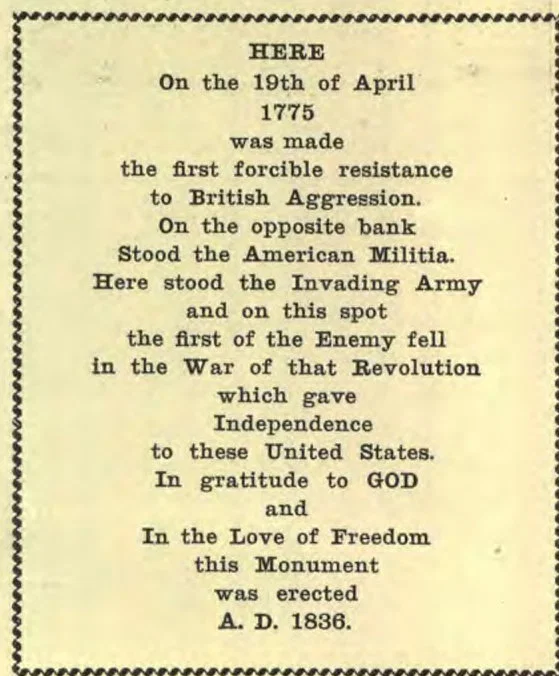
Inscription on the Patriot Monument Above at the Left.
The foregoing scripture is from Christ's sermon on the mount. It has been spoken of as His inaugural address in the which He opened His ministry upon earth and outlined the principles that govern His kingdom. In this text we see the law of Jehovah as He would have us understand it; we see it under the divine magnifying glass and thus get a glimpse of the depth and the breadth of its infinite spirituality. The laws of men can only take cognizance of outward acts that have been really committed. But the law of God meets us long before the evil deed has been actually done by revealing to us that it is wrong to entertain the thought of committing sin or crime. The laws of men seek to deter from crime by the fear of punishment, should the overt act be committed. But the law of God meets us in the secret chamber of the heart and conscience where it is impossible for man to enter, and tells us that if we hold men in contempt and rail at them even in our thoughts we have already entered on the road that leads to actual murder, and so God will call us to account.
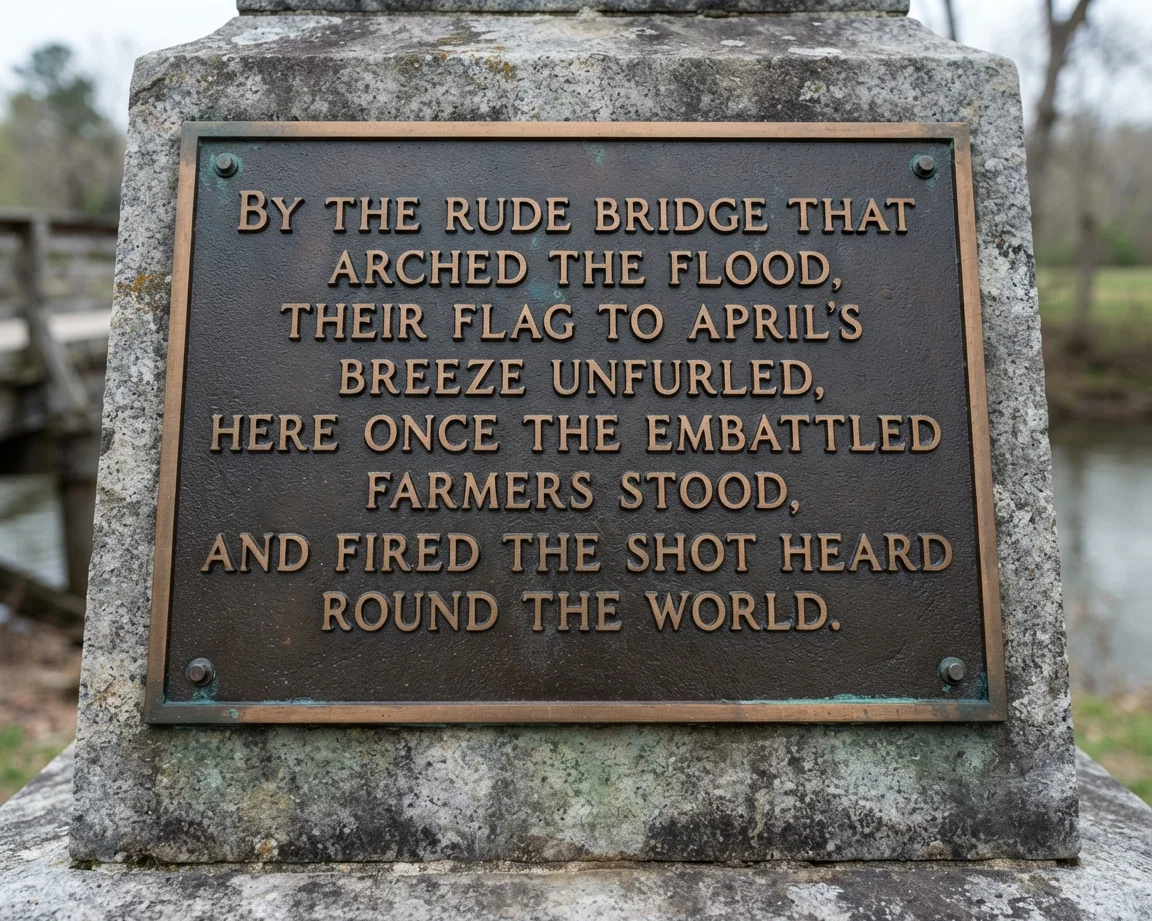
Inscription on the Monument Above at the Right.
Where First British Fell.
His Morality Begins with Mind and Heart.
The spiritual depth and the breadth of meaning of the sixth commandment, as set before us in the words of the Master, are in harmony with His teaching in the same discourse concerning the seventh commandment. His words are:
"Ye have heard that it was said, Thou shalt not commit adultery; but I say unto you, that every one that looketh on a woman to lust after her hath committed adultery with her already in his heart." Matt. 5: 27, 28.
Thus has the Lord shown us by His comments on two of the commandments that His law takes cognizance of sin when it is only in the mind and heart, and long before it is worked out in the actual committing of any evil deed. Then to obey the moral law requires the regulating of the thoughts to bring them into harmony with that law. And when this is done it is perfectly evident that no overt act of wrong-doing will ever be committed by the individual so keeping God's law.
Inspired Poet and Apostle.
The psalmist had this same magnified view of the law of God, for we hear him praying, "Let the words of my mouth and the meditation of my heart be acceptable in Thy sight, O Jehovah, my Rock, and my Redeemer." Ps. 19: 14. He saw by inspiration and also taught that the meditations, the thoughts, must be made acceptable to the Father in heaven if men would have the perfection of character that meets the morality of the law of Jehovah.
And in harmony with this teaching of the psalm are the words of the Apostle Peter upon the same subject:
"Wherefore girding up the loins of your mind, be sober and set your hope perfectly on the grace that is to be brought unto you at the revelation of Jesus Christ; as children of obedience, not fashioning yourselves according to your former lusts in the time of your ignorance; but like as He who called you is holy, be ye yourselves also holy in all manner of living; because it is written, Ye shall be holy; for I am holy." 1 Peter 1: 13-16.
The "girding up of the loins of your mind" is plainly the first and most essential requirement of morality. And such morality as is thus required by the law of God is far beyond the ideals of those who speak of people who are "good moral men," but are not religious. A "good moral man" in the sense which Christ in the Bible teaches5morality is the highest type of manhood, and being the highest it includes all types of true civility that are below it. The person who is truly moral in God's sight is in reality the very best type of citizen for the State. For such a person is so far removed from breaking the law that he will not allow the thought of anything that is wrong to be harbored in his mind to break out in evil deeds. He keeps himself free from the burning fire of crime by always keeping himself clear of all the materials that can be made to blaze forth into sin and iniquity.
The Civil Power and Morality.
It should also be very clear to any one that the civil power of the State can not take cognizance of the morality of the law of God. For the morality of that law has its very essence and substance in the obedience of the mind itself to the divine commandments. And as the civil ruler can not know what men are thinking about he can not try nor punish them for immorality, only as that immorality is represented in overt acts that violate a civil statute.
The civil law, then, can properly only take cognizance of some outward word or act of men. The civil law must confine itself in its operations to the things that have actually been said and done. But the divine law begins its work long before the deed or word is outwardly expressed. The divine law is obeyed by right thinking and by right meditating, and contrariwise it is violated by wrong thoughts and wrong meditations.
The foregoing facts were recognized by the founders of this government and were made a chief corner-stone in the foundations of the new Republic. It was clearly set forth by the men who established the independence of this nation that the civil power could of right have nothing to do with men in matters of religion. As religion was between God and man and not between the State and man, the question of religion must be left for the man to settle with God and not with the State. Such principles are so clear that it would seem that men could never forget or depart from them.
All genuine Christians will be civil because they are obeying the higher law of Jehovah. And all who do not submit themselves to the higher law must be required to be civil by human law. Otherwise anarchy and disorder would soon depopulate the earth. But when the State has gone to the extent of requiring men to be civil one to another, and thus to respect each other's natural rights, it can properly go no further. It can not in reality enter the realm of religion, which is the realm of the secret thoughts and of conscience, and therefore it should not attempt it. Wherever the attempt has been made it has only resulted in the cruelties of persecution.
The man's civility is what we can see and hear in his words and behavior. His outward civility may represent truly what the man is on the inside, or it may be only a sham. But the man's morality represents what he is in reality. It goes down to the very secret purposes of his soul life and is the man in very fact, and not the man as he appears on the outside to other men. To enforce civility is to work in the open where all can see and the rights of none are thus invaded: to attempt to enforce morality is to presume to invade the realm and prerogatives of God, for God alone can read the thoughts and the motives of men. And the legitimate fruit of the effort to regulate not merely the civil relations but also the morals of men is the inquisition and all the attendant tortures and horrors of persecution.
God and Caesar
By J. O. Corliss
THAT is a most significant statement made by the Saviour to those who thought to make Him stultify His teachings regarding the kingdom of God. The incident came about in this way: A delegation of Pharisees and Herodians, the former noted for their strict conformity to Jewish religious traditions, but opposed to the reigning family; and the latter, political Jews who favored the Herodian dynasty for Judea, came to Christ with a question, an answer to which both parties felt sure would involve Him in serious difficulty. In fact it would appear that these parties, tho strongly antagonistic to each other, for the time had buried their differences in order to force Christ to commit Himself to some position which would expose Him to the open attack of one party or the other.
Attempting to Entangle Him.
After attempting to put the Lord at ease thru flattery of His extended knowledge, the spokesman of the party said: Tell us what you think. "Is it lawful to give tribute unto Caesar, or not?" To have answered this studied question by a positive Yes or No would have well served the intended purpose. Then one or the other party would have good reason for compassing His death. Seeing all that was involved in the question, Christ answered it in a way that could not fail to commend His wisdom and discretion. To pave the way for this answer, He said: "Show Me the tribute money." When a coin of the class mentioned had been produced, Jesus asked them to tell whose likeness and inscription it carried. They quickly replied "Caesar's." Very well. "Then saith He unto them, Render therefore unto Caesar the things that are Caesar's; and unto God the things that are God's." Matt. 22: 15-21.
An Eternal Principle.
Concerning the eternal principle enunciated in these words of Christ, it ought not to seem strange to us that those mischief-makers were silenced, and returned whence they came. The only wonder is that men of our own time, holding views as adverse to the spirit of Christianity as were theirs, can not see in the same saying of Christ that which would cause them to lay their hand upon the mouth in mute recognition of the claim of the "higher life."
The Obligation of Christians to the State.
To see more clearly, if possible, our duty in relation to this fundamental declaration, let us consider for a time what it involves. The question at issue was, whether a citizen of God's kingdom, meeting all of his obligations thereto promptly, is bound to recognize the claims of civil government against him, because he is within its jurisdiction. The answer of Christ established for all time the broad principle that any and all who hold and deal in those things, upon which the civil power has a rightful title, must, upon demand of the government, render back to it that which is its own.
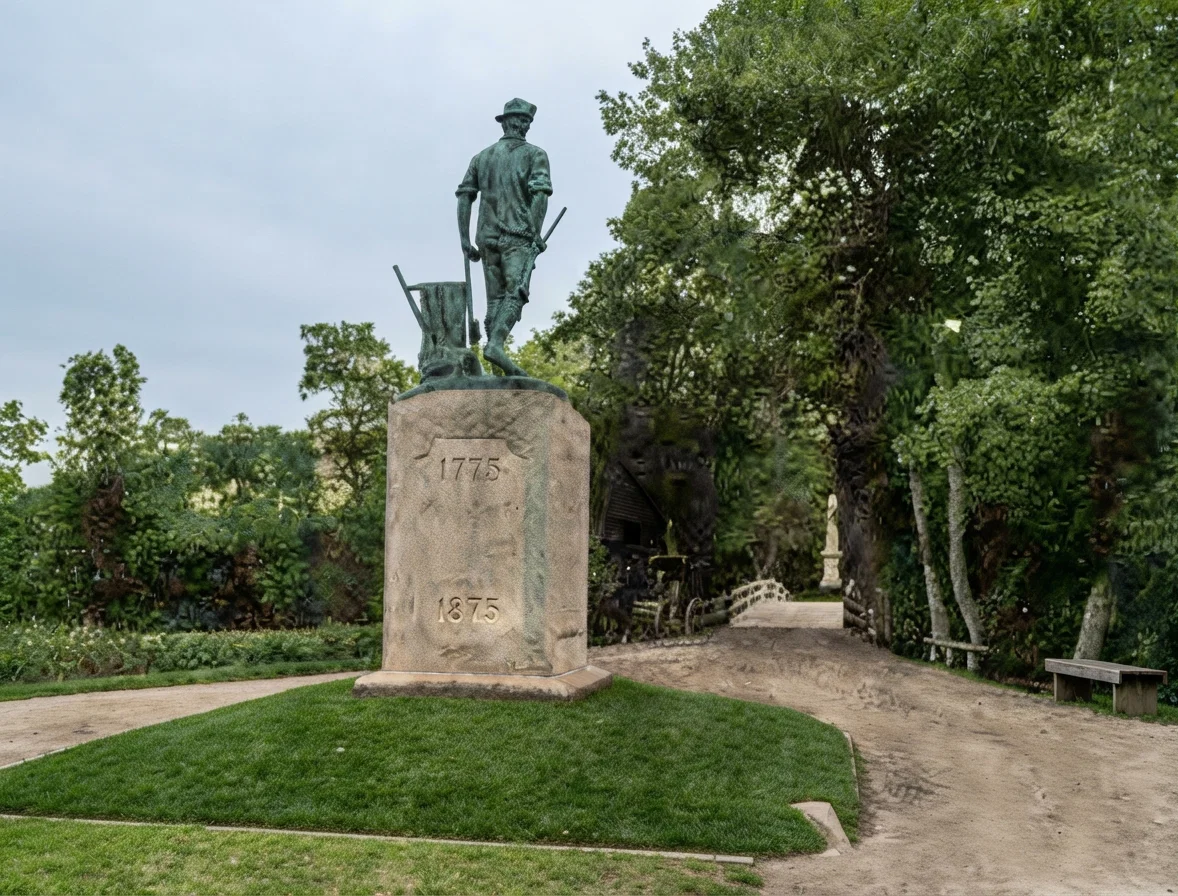
Patriot monument of the "Minute Man," near Concord, Mass., where the first battle of the Revolution was fought. The inscription on the other side of the monument is found on page 4. Just beyond is the "rude bridge," and beyond that the monument where the first British fell. The inscription on this monument is also found on page 4. Thank God the nations here recalled are at peace.
All coin of any realm comes under this head. While claimed as an asset of the civil power, because of the government stamp upon it, which gives it current value, and for which the nation stands surety, this coin is passed into circulation among the government's subjects, that they may with it uphold and sustain the policy of the government, while enjoying prosperity for themselves, under the protection of the government.
It matters not what relation one may sustain to other governments. He may legally be the subject of a foreign power, but so long as he continues in the land of his adoption, under its protection, having possession of visible property, representing a specific part of the coin of his adopted country, he must render to the powers of that country a proportional part of his income for benefits received, just the same as one born in the land.
The Alien's Rights.
Having done this, even an alien is entitled to the same right of protection as native born citizens, simply because he steadily returns to the government from its own, the same as all others, for such protection. So much for one's property rights to civil security. Of course, any government has the right to do what it will with its own. While a government may permit every one of any color or nationality freely to use its coin or property in accordance with its laws, it may, and does, withhold its political franchise from all who have not, by birth or naturalization, been declared citizens of its realm.
All this comes under the head of civil rights, which are granted by every liberal or constitutional government. But no government can rightfully pass the sphere of its own dominion in bestowing or withholding patronage. In other words, it can not give to its subjects that which is not its own; neither can it rightfully withhold from them those privileges which are birthright inheritances. From the foregoing reasoning it is plain that civil rights depend more upon one's use of the State's possessions entrusted to him and his treatment of others similarly situated as he is, than upon any direct claim the State has upon the individual.
The Creator's Claims.
The fact is that the State holds no chattel claim upon any human being. He is the handiwork of God, and bears His "image6and superscription." God's ownership being so indelibly stamped upon man, his first and highest duty is toward the One who gave him existence, and by whose life he is constantly preserved. Every pure impulse in man is therefore prompted by the life that sustains him among men. When that life, however, is prostituted to sordid ambition, its godlike qualities are degraded, and every heavenly attribute is suppressed. But when the native instinct of man's God-given life is permitted to bear sway, his conscience becomes quick to respond to the mysterious promptings of his soul in carrying out the precepts of God's word.
No civil power has any right whatever to interpose any requirement, or to prohibit any privilege, which would in any degree prevent such conduct. In responding to the demands of God, the individual is simply replying agreeably to his acknowledged proprietor who, as his Creator, holds an infinitely higher and therefore stronger right to his services than the State can possibly have.
From this it seems clear that God's moral government is to be administered by Himself thru His mysterious influence over the conscience, after its enlightenment by His inspired word. Thus in moral lines, God administers His own government directly with each individual conscience. With His government, the State can not have any participation, because God's government has to do wholly with heart promptings, of which civil government knows nothing. The mission of human government does not include even that of giving sanction to divine law, much less to enforce its observance upon the people. It can properly concern itself only with public order and social interests.
Laws Touching Religious Rites.
This prerogative of the State does not permit it to make laws touching religious rites on the plea of its own responsibility, for the one great reason that its citizens do not need such laws, since each member of a commonwealth is personally responsible for his standing in such things to another tribunal, infinitely higher than that of the State. Therefore all that the State ought to attempt regarding morals, is to enact laws prohibiting any man, or set of men, from interrupting others in their peculiar form of worship. Any law in violation of this principle has always worked, and will ever work gross injustice, because that which is made by law to interfere with the conscientious discharge of moral duties on the part of one may be, and is likely to be, extended to every other one.
Such a law would be in the nature of a conscience regulator. But religion being a matter between the individual soul and its God, no person, or combination of persons, associated as civil lawmakers, have any right to make their consciences a rule by which to control others in spiritual lines. This, indeed, would be to exceed their own rights of conscience, by trampling on the personal rights of others.
Civil Government and Morals.
Civil government is not, and never was needed to define moral duties, because the knowledge of these was in man's possession before the formation of civil government. Indeed, had man acted in accordance with his knowledge of these things, he would not have sinned, and thus opened the way for another form of government than that given to man in the beginning. The moral law alone was then given for man's entire guidance, and always would have been sufficient for that purpose had its precepts been heeded. That same divine code still exists, and its requirements are infinitely more binding on the conscience than any civil enactment bearing the stamp of its human origin.
The moral law having emanated from Jehovah and being a perfect transcript of His moral mind, no human government may contravene one of its precepts with impunity. In fact the State has no more power against moral law which controls conscience than it has against physical laws which govern matter, because both of these have the same origin, and are alike inexorable, since their Author is above the citizen and the State.
The Attitude of the State to Religion.
All, therefore, that civil law can properly do with reference to religion is to respect every form, and favor none, recognizing all of them as matters outside of its jurisdiction. The reason for this has been set forth so clearly by Dr. Schaff in his work, "Church and State," that this article may well close with his words:
"Freedom of religion is one of the greatest gifts of God to man, without distinction of race or color. He is the Author and Lord of conscience, and no power on earth has a right to stand between God and the conscience. A violation of this divine law written in the heart is an assault upon the majesty of God in man. Granting the freedom of conscience, we must, by logical necessity, also grant the freedom of its manifestation and exercise in public worship. To concede the first and deny the second, after the manner of despotic governments, is to imprison the conscience. To be just, the State must either support all or none of the religions of its citizens."
The Kingdom of Christ Not of This World
By G. W. Rine
THOUSANDS of earnest, sincere Christians have been led into the mischievous delusion that this or any other nation can be transformed, thru the medium of legislation, into the kingdom of Christ. By the enactment and enforcement of certain religious laws, they think, a nation can be made essentially Christian. Many honest people actually go so far as to teach that the kingdom of Christ can and must be ushered into this world "thru the gateway of politics." But this whole theory is radically anti-Christian. It is hopelessly at variance with the explicit teachings of Christ Himself.
When Christ was a prisoner in the custody of the Roman government, He categorically asserted: "My kingdom is not of this world; if My kingdom were of this world, then would My servants fight, that I should not be delivered to the Jews; but now is My kingdom not from hence." John 18:36. This divine declaration is couched in language so simple, so concise, so lucid, that a child should not mistake its meaning. The Master here positively disclaims any direct authority in the political affairs of this world. Why not take our Lord at His word, and believe that He meant exactly what He said? Why is it that millions of those who profess to be the followers and representatives of Christ put themselves in a position directly antagonistic to what He Himself taught regarding His relation to the governments of earth? Is it not a zeal without knowledge that can lead men, otherwise intelligent, thus to stultify themselves? It must, as a rule, be a mistake of the head, and not of the heart.
When They Sought to Forcibly Take Him.
It will be recalled that when His mistaken friends essayed to take Him and place Him upon a throne, He instantly placed Himself beyond their reach by seeking the solitude of the mountains. By so doing He circumvented the foolishly short-sighted scheme of those who posed as His friends.
Inspiration declares respecting our Lord that "He came to His own and His own received Him not." And nothing is more certain than the fact that His own nation rejected Him BECAUSE He refused to assume the honors and powers of royalty. Without an iota of scriptural warrant, the Jews had made up their minds that their expected Messiah must come a king with all the splendor and ostentation incident to the imperial office.
They had become a proud, worldly, ambitious people. They could not brook the thought of a Messiah or King whose office would be a purely spiritual office—One who should be imbued with the power of love instead of the love of power. They must have a Deliverer who would deliver them from the political power of Rome, and thru the medium of the sword attain to universal sovereignty, and thus make the Jewish nation supreme in the politics of the world.
Just as Foretold.
But, as foretold by their own prophets, the Redeemer came "as a tender plant, and as a root out of a dry ground." He came in lowliness, in poverty,—with no ambition but to raise the fallen, succor the perishing, in short, to "go about doing good." Consistently with His pronouncement that His "kingdom is not of this world," He never meddled with politics or interfered in matters distinctly civil. His policy of complete aloofness from all matters that properly lay within the province of the civil courts or of other civil institutions is strikingly illustrated by an incident in His life recorded in Luke 12:13, 14. One of His hearers came to Him with this request: "Master, speak to my brother, that he divide the inheritance with me." Christ promptly answered: "Man, who made Me a judge or a divider over you?" Jesus instantly recognized the question involved in the request as one that must be referred to the courts for adjudication. Hence He refused to touch it. It was a matter that must be rendered to Caesar, and not to God. And it was just because He refused to assume the role of a military conqueror, and by conquest set up His kingdom in this world, that "He was despised and rejected of men" and ultimately condemned to suffer the fate of a malefactor.
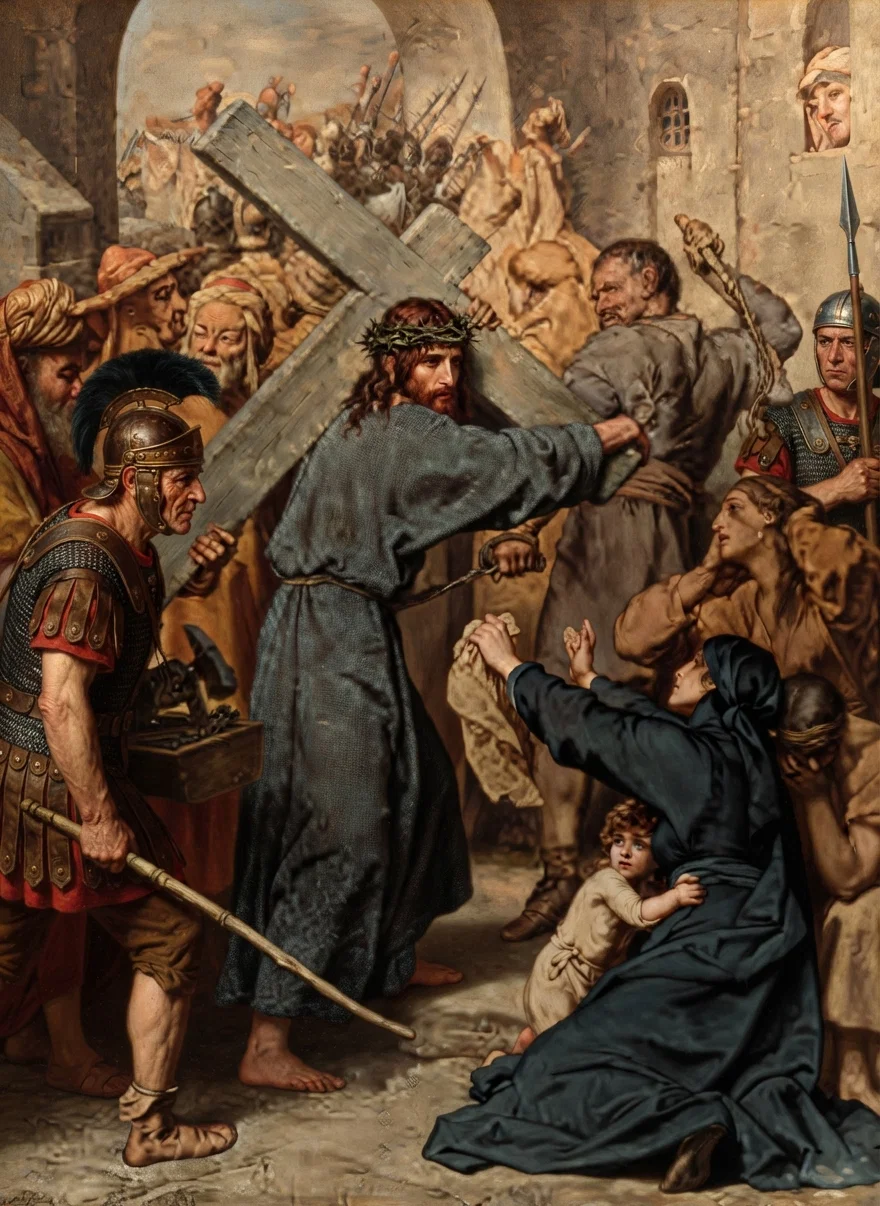
H. Hofmann. Instead of exercising authority over men Christ submitted to authority, even unto death. But in it all He did not compromise righteousness. As He said, "My kingdom is not of this world."
The Kingdom in Reality.
It is true, thank God, that Christ has a kingdom in this world; but it is a subjective, not an objective, kingdom—it is spiritual, not temporal. The subjects of this kingdom are made up of individual human hearts dispersed thruout all nations and tongues. They, like their King, are in the world, but not of the world. They are those who, by the grace of God, have cast down false reasonings and every high thing that exalteth itself against the knowledge of God, and have brought into captivity every thought to the obedience of Christ. This unique kingdom is a kingdom of grace, of the unmerited favor of God. It knows no physical coercion, no police power, no power but the power of love—the power of God who is love.
We who are of this kingdom have a glorious Priest-King who is Touched with a feeling of our infirmities; for, tho sinless, He was tempted in all points just as we are. Hence all are divinely invited—yes, urged—to come boldly unto the throne of grace, and there we shall find abounding grace to help in every time of need. O, how our hearts ought to well up in thankfulness to God for such a kingdom, such a throne—a throne of grace, of favor, of complete salvation, of ENDLESS LIFE!
Weapons of His Kingdom.
True it is that the subjects of this kingdom of character and of life wield weapons of warfare; but their weapons are not carnal, but mighty thru God to the pulling down of strongholds. They are commanded to put on the whole armor of God, not that they may oppose and destroy their fellows, but that they "may be able to stand against the wiles of the devil." They wield a sword, but it is "the sword of the Spirit, which is the word of God." They have enemies, but they are admonished to love their enemies and to do good to them that despitefully use them. Ah! this is the kingdom of God "within you."
But the reader may ask, "Is it not declared in the Scriptures that the kingdoms of this world are become the kingdoms of our Lord and of His Christ, and that He shall reign forever and ever?" True, the Scriptures do so declare. But when? The context clearly shows that this solemn proclamation is made in the time of the sounding of the seventh trumpet,7when the nations are angry, and the wrath of God, unmixed with mercy, is poured upon the unrepentant world, and when the dead shall be judged. Rev. 11:15-18. It is at the time that Christ's kingdom of glory is about to supplant all the kingdoms of earth; when the King of Kings is preparing to break the hopelessly wicked nations with a rod of iron and dash them to pieces like a potter's vessel. No, the kingdom of Christ will never be set up in the nations of the world, but will, in God's own good time, be erected upon the ruins of all earthly nations, in the earth MADE NEW, purified, rejuvenated, and brought back to its pristine perfection and glory.
The Prophetic Symbol Shows It.
This same great truth is strikingly enunciated in the record and interpretation of the King Nebuchadnezzar's marvelous dream found in Daniel 2. The several parts of the great image symbolize the empires and kingdoms of this world to the end of time. Then a "stone" is cut out without hands, which smites the image and dashes it to pieces, and the fragments become "like the chaff of the summer thrashing-floors; and the wind carried them away, that no place was found for them; and the stone [representing the kingdom of Christ] that smote the image became a great mountain, and FILLED THE WHOLE EARTH." It is evident that the kingdom of God, when it is ushered into the earth will be a world-wide kingdom, and must therefore supersede all others. Unlike worldly nations, "the kingdom [of Christ] shall not be left to other people, but it shall break in pieces and consume all these kingdoms, and IT SHALL STAND FOREVER."
The Time When.
We must never forget that it is not until the wicked, by means of the final judgment, are winnowed from among the righteous, that our Lord will issue the glorious invitation, "Come, ye blessed of My Father, inherit the kingdom prepared for you from the foundation of the world." Until that eternal day shall come the people of God are in the world as wheat among tares. They have access to a throne of grace and live in the kingdom of divine favor, but when their Lord shall come in glory, and all the holy angels with Him, then, with Him, they will enter into that timeless kingdom of glory that their Master has gone to prepare. It is THEN that "the ransomed of the Lord shall return and come to Zion with songs and everlasting joy upon their heads." Then the kingdom of Christ will be of this earth (not of this world), but of this earth purged from every taint of sin, and reinstated in its Edenic perfection and glory.
Jefferson's Prophecy.
By Thomas Jefferson
BESIDES, the spirit of the times may alter, will alter. Our rulers will become corrupt, our people careless. A single zealot may commence persecution, and better men be his victims. It can not too often be repeated that the time for fixing every essential right on a legal basis is while our rulers are honest, and ourselves united. From the conclusion of this war we shall be going down hill. It will not then be necessary to resort every moment to the people for support. They will be forgotten, therefore, and their rights disregarded. They will forget themselves in the sole faculty of making money, and will never think of uniting to effect a due respect for their rights. The shackles, therefore, which shall not be knocked off at the conclusion of this war, will remain on us long; will be made heavier and heavier, till our rights shall revive or expire in a convulsion.—Notes on Virginia, Query XVII.
Religious Faith and Accountability
By George Washington
EVERY man is accountable to God alone for his religious faith.—George Washington.