The Youth’s Instructor, Vol. 63, No. 47.

Rock Solidified by Pressure or Cement Injection

The Youth’s Instructor

Nov 23, 1915

Review and Herald Publishing Assn. · Takoma Park Station, Washington, D. C. · Nov 23, 1915

Rock Solidified by Pressure or Cement Injection

DECOMPOSED rock can be solidified again either by applying great pressure or by injecting cement.
IT is estimated that there are at least four thousand times as many invisible stars as those that are visible.
A NEWLY invented lifeboat can be lowered, when full of passengers, by one man in less than two minutes.
IN the Redemption Division of the Treasury at Washington are handled daily an average of eight hundred thousand dollars in bills.
ON July 24 was fought the battle of Nasiriyeh, near the village which occupies the site where Abraham once played as a boy, the true “Ur of the Chaldees.”
THE lowest railroad in the world is that part of the road over the Salton Desert, California. It is two hundred and sixty-three feet below the level of the sea.
A SOAP tree now thriving in Florida came originally from China. The average crop of a full-grown tree is about two hundred pounds of fruit. The annual income from one tree is about twenty dollars.
THE largest steel-arch bridge in the world is being erected over the East River, at Hell Gate, near New York City. Over eighty thousand tons of steel have been used in its construction.
ONE of the late inventions is an electric flatiron with a very small electric light. This light tells whether or not the current is on, and also throws sufficient light on the work to make it valuable to the user.
THIRTY-ONE students in one of our schools earned full scholarships selling our books last summer, and six earned half scholarships. The total number of students from that one school who went out canvassing last summer is fifty-four.
NATURALISTS agree that insects are extremely sensitive to some odors, but opinions differ widely as to the organs of smell. Dr. N. E. McIndoo suggests that certain pores at the bases of the wings and legs serve as noses to insects that have no antennae.
EXPERTS in wood technology have perfected instruments that measure the amount of moisture in wood, and thus have given to lumbermen valuable information, since it has saved them many thousands of dollars in freight charges. According to a writer in the Master Builder, a thousand pounds of green lumber fresh from the saw, contain from four to five hundred pounds of water.
THE United States government maintains a large corps of engineers whose business it is to make maps of little-known portions of the world, and their labor is often performed at the risk of their lives. An expert map maker is Frank C. Shrader, a government geologist. He climbed the Chilkoot Pass, Alaska, to the headwaters of the Yukon. He followed that river, and reached the very heart of the unknown Alaska at the arctic circle. From that point he traveled north, and explored the land to the east of Point Barrow, thus furnishing the government information as to the resources of that part of the country.
THE annual production of coal in the United States is about 600,000,000 tons. Mr. William H. Bowker, of Boston, estimates that this coal contains about 7,500,000 tons of nitrogen, little or none of which is utilized. Mr. Bowker advises us as to two feasible ways of saving this nitrogen,—in the manufacture of coke and illuminating gas, and in the making of producer gas for power by processes that preserve not only the nitrogen in the form of sulphate of ammonia, but also the tar and all the by-products of tar, which are many sweet juices.— Beecher.
It is not work that kills men; it is worry. Work is healthful; you can hardly put more upon a man than he can bear. Worry is rust upon the blade. It is not the revolution that destroys the machinery, but the friction. Fear secretes acid; but love and trust are sweet juices.— Beecher.

“Give Me Work to Do”

“GIVE me work to do,” is now the cry of multitudes of the unemployed, that the remuneration may be theirs with which to supply their needs. The cry is not made so much because the work is a pleasure, but for the enjoyment of the results.
The thrifty housewife enjoys her house cleaning and laundry work, not so much for the work’s sake, but for the results. The manual laborer and the professional man are glad to spend their time earning money with which to supply the needs of their families. Then sometimes the pay is not forthcoming.
We who are engaged in the cause of the blessed Master have no need to cry, “Give me work to do,” for we find it on every hand. And the recompense is sure, for he has promised a rich reward in the kingdom. MRS. D. A. FITCH.

Cloud

THAT cloud was beautiful — was one Among a thousand round the sun; The thousand shared the common lot; They came, they went, they were forgot; This fairy form alone impressed Its perfect image in my breast, And shines as richly blazoned there As in its element of air. — J. Montgomery.

The Bible

A GLORY gilds the sacred page, Majestic like the sun; It gives a light to every age, It gives, but borrows none. — Cowper.

Hymn of Thanksgiving

We thank thee, O Father, for all that is bright— The gleam of the day, and the stars of the night; The flowers of our youth, and the fruits of our prime, And blessings e’er marching the pathway of time.
We thank thee, O Father, for all that is drear— The sob of the tempest, the flow of the tear; For never in blindness, and never in vain, Thy mercy permitted a sorrow or pain.
We thank thee, O Father, for song and for feast— The harvest that glowed, and the wealth that increased; For never a blessing encompassed thy child, But thou in thy mercy looked downward and smiled.
We thank thee, O Father of all, for the power Of aiding each other in life’s darkest hour; The generous heart, and the bountiful hand, And all the soul help that sad souls understand.
We thank thee, O Father, for days yet to be; For hopes that our future will call us to thee; That all our eternity form, through thy love, One Thanksgiving Day in the mansions above.
—Selected.

M. E. KERN

From Darkness to Light

M. E. KERN
The following interesting story of how a poor ignorant girl in Catholic Chile found the light and is preparing to give it to others, was sent to us by Mrs. H. U. Stevens. The young woman finishes the nurses’ course in our sanitarium at Diamante, Entre Rios, Argentina, this year, 1915.
Her early life as she describes it—low ideals, superficial, ignorant, but self-satisfied—is typical of the average South American girl. When we compare that with what she now is, a diligent Bible student, a successful Sabbath-school teacher, a capable nurse, and an earnest Christian worker, it surely shows what this great message can do for the people of all Spanish Catholic fields.
Here is her story. Born in Chile, of Catholic parentage, she began at the age of seven to attend the parochial school, and after three years she had succeeded in learning to recognize the letters of the alphabet, but could neither read nor write. Six months were then spent in a government school, and that ended her school days. But I will continue in her own words:—
“I did not like to study, and was glad to stay at home and work instead. As I grew older, there came the desire to earn money, and the occupation of washerwoman appealed to me strongest, for I reasoned thus: People will always have clothes to wash, so I can always be useful in the world and at the same time earn enough to buy pretty clothes and a few sweets and luxuries. And what more could I want? I had no desire to know more, see more, or be more. My life was complete, and I felt perfectly satisfied.
“In my work I found it necessary to know something about writing and arithmetic, and this I learned by myself, taking various books, and copying the words until I knew what they meant. With effort, I could handle my laundry accounts, and that of course was all that was necessary. Finally I obtained a position in one of the largest laundries in Santiago, and was soon afterwards married, the village priest performing the ceremony, and assuring us that a legal marriage was not necessary. We were happy together, and life went on much in the same way, I still continuing my work.
“But a change came, and in this way: Near us lived a man who was a slave to vice; and, when intoxicated, he abused his family shamefully. Of a sudden, all this ceased, and it began to be whispered in the village that he had left off his bad habits. My curiosity was aroused, and I finally asked our neighbor what had caused him to reform so suddenly. Showing me a book, he said, smiling, ‘That book has done it all. I have been studying it, and it made a change in my life.’ I was more surprised than ever. What sort of book could it be, to make a kind, sober man out of a notorious drunkard? I thought to myself, ‘If I ever get the chance, I shall examine it when no one is looking.’ He evidently divined my purpose, for a few days later, when talking about the matter, he offered me a similar book, which proved to be a Bible. Feeling very guilty, I accepted it, taking care that my husband should know nothing about it.
“Beginning in Genesis, I read about the creation, the very things I had learned about in the Catholic school; and so, feeling assured that it could not be a bad book, I read on and on. In fact, I could not stop. There came into my soul a hunger for that Book, such as I cannot describe to you. In the early hours of the morning, and late at night by the flickering light of a candle, I sat poring over its pages. I understood little of what I read, but nevertheless there seemed to be entering into my darkened soul some rays of light, and I longed for more. I often read on my way to work in the morning; and one day, thinking more of what I was reading than where I was walking, I stumbled and fell. Rescuing my Bible as soon as possible, I looked around to see how many persons had witnessed my embarrassment, but to my surprise that usually crowded street was empty. I thanked the Lord and went on.
“But one thing troubled me. The more I read that book, the less I cared for my church and the priests, and my rosary lay unused upon the dresser. It troubled me at first, for I had always been a devout Catholic. But I continued reading not only the Bible, but religious papers which my Adventist neighbor gave me.
“One Sunday afternoon he invited me to attend preaching service. How I longed to go! But I knew what it would mean to be seen in a meeting of ‘heretics.’ I thought it all over, went to my room, knelt down, and for the first time in my life addressed my Heavenly Father personally, asking if it were his will that I go that my husband should not know that I went. That sermon decided me. Every word uttered by the minister sounded sweet to my ears. The truth seemed so real and beautiful, and I resolved to obey, come what might. Upon returning home that night, I found that my prayer had been answered, my husband not returning home until late at night.
“The great problem was the Sabbath. How could I keep it and continue my work in the laundry? The manager was a bigoted Catholic, a woman who had no sympathy for ‘heretics.’ But I asked the Lord to soften her heart; and when I explained that I could no longer work on the seventh day of the week, she merely smiled, and said, ‘So you have turned “Sabadista,” have you? Well, if you can do six days’ work in five, it will be all right.’ So I came earlier every morning, and worked later than the rest, and thus kept my position.
“But the greatest trials were with my own people. For some time my husband remained ignorant of what I had done. One day, however, upon returning from church, I found him waiting for me. He who had always been kind to me, seemed suddenly turned into a demon. He grabbed my Bible, and tearing it into three parts, threw it down the well. Then he beat me until my eyes were swollen twice their size, and I could hardly move for pain. ‘I’ll teach you to become a heretic!’ he exclaimed between the blows, meanwhile trying to make me promise to give up the new religion. I told him I never would, even though he killed me.
“Seeing the uselessness of force, he then wrote to my people, telling them what I had done, but in such a way as only an enraged man could, entirely misrepresenting my actions. Their response was the hardest blow of all. I was told that they considered me as crazy, worse than dead, and that I should never enter their home again. Imagine my agony of spirit! Oh, it seemed that I should die! But I remembered something in the Bible where it said that when father and mother forsake us, the Lord will take us into his care, and I felt comforted. The truth was dearer to me than father, mother, or husband; yes, dearer than life itself.
“Up to this time I had not fully understood many points of faith, but I soon saw that I could no longer live with my husband unless we were legally married. One of two things I must do: succeed in winning him to my belief and be married by the law, or else leave him. I prayed for him, talked and pleaded with him to go with me, but all in vain. He would hear nothing of it, and, moreover, did not believe I would have the courage to give up my home for a small matter of belief. It was a struggle, for we were fond of each other. At last I had to leave my home and seek shelter with a family of believers.
“Then began a new life. About that time the brethren elected me secretary of the Sabbath school, and never shall I forget that experience. It was then that I awoke to my profound ignorance. With my meager knowledge, you can imagine what sort of secretary’s report I could produce. How I struggled with the words and figures! How I wept and agonized for help! I then and there resolved by God’s help to get an education. Soon the opportunity came, for I was permitted to go to our school at Pua, having charge of the laundry. In addition to the work, which was quite heavy with a large school family, I determined to learn all I could from books, and so carried eight studies, or at least tried to, often ironing or washing with an open book before me. You cannot imagine what a desire I had to learn. It seemed that I had never before realized how much there really was to be known, and I felt keenly my ignorance.
“But I shall never forget how obscure many things appeared to my recently awakened mind. The book ‘Su Gloriosa Venida’ (‘His Glorious Appearing’), simple as it was, was too difficult for me to understand; and after reading it through several times, I gave it away. I remember, too, that I tried to memorize the questions in the Sabbath school lesson pamphlet, not wanting to display my ignorance. (As if I could hide it!)
“But you wonder why I am here. It happened that once while canvassing I had a glimpse of how much suffering and sickness exist in the homes of the people, and I realized the great need of understanding simple treatments. I longed to become a nurse, and the Lord granted that desire also. So here I am, anxious to finish my course and be able to go out to help others to know a better, happier life. I feel that I have received much; I want to impart it to others.”

Getting Paid

THERE is a close relationship in the affairs of this world between work and compensation. Nothing can be done or be left undone unless somehow that act is paid back in coin of its own making.
I know many who, day after day for years, have gone from their homes in the early morning to spend several hours each day in working for others. At the end of the week or the month “pay day” comes, which is simply a day like all the rest, on which the laborer receives his pay, or compensation, for the work done. If the employer would not supply the money, the men would not work; and if the men did not work, they wouldn’t get the money the employer has for them: so then, it is simply a case of give and take for both employer and employees.
Besides these persons, I know others who do much the same thing. These also leave home early in the morning, and come home again late in the day, after having spent a large part of the time in work. But as to pay days, I haven’t seen them bring home a single pay envelope yet. One of them I met a few weeks ago after an absence of several months. She said, “I have just finished my examinations for this term, and have got the highest marks in the class, and the teacher said that I deserved them, so she couldn’t help giving them to me.” And from other things that she said to me I know that besides the good marks and the teacher’s commendation, she received more than this — strength from the work well done, a sense of difficulty nobly overcome, and courage enough to raise her aim higher for the next term. No pay? I believe the pay she received was better than the most generous of envelopes. That girl works, and she gets wages which are equivalent to the work she does — good work, good pay. It is with these as with the former — some do better work than others, and so get better pay.
This principle of being paid for what is done or not done holds good throughout all nature in all the world. Today I plow my fields and plant seed; tomorrow I gather the harvest. If I do not plant, there will be no harvest. Shall I sing? It will make some one happy. Or shall I shirk in order the better to enjoy myself? If I do, double burden must be borne by some one else. The climate disagreeably cold puts nerve and muscle into a man; the hot climate necessitates comparatively little labor, and man within its pale is below the average in ambition and strength. The soil that will grow no plant does not produce fevers, or crocodiles, or tigers. Unto whom much is given, of him much is expected. The more authority, the more responsibility.
In fact there is so very much of this matter of repaying in the world that men put many of their ideas about it into words. We have all heard these adages, and doubtless repeated them, perhaps without realizing just what sage remarks they are and what a great law they are a part of: “Tit for tat;” “Nothing venture, nothing have;” “Who does not work shall not eat;” “Harm watch, harm catch;” “A stitch in time saves nine,” etc.
The universe is full of illustrations of this great law of compensation. I believe it is as much a law of God as is the law which keeps the earth in its orbit around the sun. And well for us that it is: for the knowledge inspires one to make the most of each moment as it comes; it teaches one to look more deeply into everything one meets, and to be very kind and charitable. There is a tree in one of the middle Atlantic States which is so thin and scrawny that strangers sometimes think it is only a large bush of some queer sort. Its branches and leaves are arranged in such a strange fashion that it gives almost no shade from the sun in summer, and but little protection from the wind and rain in winter. In the autumn, when the rest of the trees are russet and golden, this tree is a sickly yellow — not pleasing to look at. Is it really of no use? I am informed that it has the lightest and toughest wood for its size of any tree in the State. Certain articles can be made of it which would be of little use whatever if made of anything else. So the poor tree is really not a nuisance at all, as doubtless many a person ignorant of its better qualities would declare it to be. It serves; it pays for its keep; it obeys the law of give and take.
The Bible recognizes the law of compensation. Jesus would not leave his hearers ignorant of it, and many words he used in telling them about it. Was he not referring to this law when he said: “Give, and it shall be given unto you.” “Ask, and it shall be given you; seek, and ye shall find; knock, and it shall be opened unto you.” “Forgive, and ye shall be forgiven.” “Follow me, and I will make you fishers of men.” “Learn of me: . . . and ye shall find rest unto your souls.” “He that followeth me . . . shall have the light of life.” “Enter ye in at the strait gate: . . . which leadeth unto life.” “If I go . . . the Comforter will . . . come.” The entire Sermon on the Mount is a long expression of the law of give and take, or of cause and effect. Later, Paul echoes it. He said to Timothy, “I have fought a good fight, I have finished my course, I have kept the faith: henceforth there is laid up for me a crown of righteousness.”
It is not only by doing that pay day comes to us. It comes for the stillness of every moment of time. As I think, so am I. My thoughts make me. Noble thoughts, with quiet persistence in thinking them, develop after a while a noble character and disposition. The reverse is also true. Amos R. Wells says of this law: “Whatsoever gallows I erect for another, upon it I shall surely hang myself. I desire poverty for him, and how poor I become in spirit! I wish him to be friendless, and behold I go lonely through the world! I pray for his death, and at the very thought my better nature expires!”
All things that we do or that we do not do, all things that we think or do not think, all things that we say or do not say — these bring us pay days sooner or later. Each person must determine for himself whether the pay day shall be glad or sorrowful; but he cannot determine that there shall be no pay day, for the pay days come unbidden. And at the end of life’s work-day each employee must lay down the tools he has worked with so long, give them into his Employer’s hands, and take to himself the just compensation.
With the measure we mete it is measured to us again. I. C. KILGORE.

Can I Forget?

My Lord! Can I, in thoughtless mood, E'er mingle with the world's gay throng, Or, even for an hour, forget Thy claim, to whom I now belong? Can I forget 'twas blood divine That bought my soul, and made me thine?
Can I forget thy holy love, Poured forth in self-denying deed; Thy days so filled with ministries To those in pain, to those in need; Thy nights so often spent in prayer, On mountain side, or desert bare?
Can I forget thy gracious words Of wise command or loving cheer, Thy counsels and thy kind reproofs, Thy fearless warnings, ringing clear? Strong words, with vital meaning rife; Thy very spirit, and thy life!
Can I forget that last sad night, When met with thee the little band, The faithful few, who ate and drank Death's symbols from thy royal hand; Or that my King could servant be, And say, “In these remember me”?
Can I forget, O love divine, Gethsemane's deep and awful pain, When 'neath the whole world's sin, and mine, Thy tender heart was rent in twain, And anguish-wrung, from each vein flowed, In crimson drops, thy royal blood?
Can I forget the cruel cross, Laid on thee, Lord, by human hate, The thorns that pierced thy sinless brow, The nails that tore thy hands and feet, When jeered by foes, by friends denied, And pierced at last, thy quivering side?
Can I forget that rock-hewn tomb, Where Death a short-lived triumph knew, Or yet that glorious Easter morn, When thou, my life, came forth anew; When thou, o'er whom the Marys wept, First fruits became of those who slept?
O risen Lord! Thou knowest well, How weak is our humanity. Empty of self and sin, and fill So full of tender love to thee, That I may bear, from day to day, Thy life and death in this frail clay.
—M. Carrie Hayward.

The Story of the Rebellion Against the Government of King Jehovah

The Great War—No. 14

The Story of the Rebellion Against the Government of King Jehovah

Heaven’s Great Councils

CARLYLE B. HAYNES
In the government of the great universe of Jehovah all the worlds and planets in space are represented. When God created this earth, he placed Adam at the head of this creation, subjecting everything in this world to his rule. Adam in this position was not only to be the representative of God on this planet, but he was also to represent this planet in the council meetings of heaven.
Undoubtedly this same plan was followed in the creation of the other worlds. The first created being was placed at the head of the government of the first world, and all things in it were under his dominion. He was the representative of God on that planet; and in the councils of heaven it would be his place to represent the world over which he exercised dominion.
When the call is issued for a council meeting in the courts of heaven, the heads of the myriads of worlds in the universe assemble before God, and begin the sessions of their great parliament, or conference. Possibly reports of the work, growth, and progress of the various planets are heard and discussed; and God submits his plans for the prosperity and blessing and welfare of his extensive dominion. These are then carried back to the numerous worlds and put into operation.
Into these wonderful councils of heaven Adam would have been permitted to enter and speak for this world as its representative if sin had not separated him from the Father. When he sinned, not only he, but the world also, revolted against the government of God. One of the parts of God’s great dominion thus wandered away from him. Adam did not retain his position as the head of this creation with all things under subjection to him, but he himself fell under subjection to one who was stronger than he. Satan conquered Adam, and thus took his place as the governor of this world, the head of this creation, with all things in subjection to him, as they had been to Adam. He became “the god of this world.”

The Sons of God

These heads, or governors, of the various worlds are called “the sons of God.” They are sons of God in a more definite way than any of his other creatures, because of the fact that they have never known any other parentage, being created directly by their Heavenly Father, as was Adam.
In the parable of the lost sheep, Jesus described the earth in its wandering away from God. There was but one which left the fold, and that was this earth. Sin has never entered the other worlds. “The host of heaven worshipeth thee.” Neh. 9:6. The ninety and nine were never lost, but remained in the fold. One wandered away, and the great heart of the Father of love could not bear the thought of this separation. So out into the wilderness and darkness and over the mountains of sin he sent “his only begotten Son,” to win this world back to its allegiance to God, and to reunite the entire universe.

Satan at the Gate of Heaven

When sin entered this world, Satan not only overthrew Adam and conquered this part of the territory of the kingdom of God, but he also assumed to appear in the councils of heaven as representative of this planet. Hence we have the record: “Now there was a day when the sons of God came to present themselves before the Lord, and Satan came also among them.” Job 1:6. Here the great archrebel appeared again at the gate of heaven from which he had been driven out, but now he came, not because of the position which he occupied before his fall, but by reason of the fact that he had conquered in warfare one of the worlds of the universe, and had thus by usurpation taken the place of its rightful representative in the councils of heaven, having overthrown that representative.
We can well imagine that must have been a strange scene to the sons of God as they came together for their council, to see Satan walk in among them with such assurance. Undoubtedly the question immediately arose in all minds, “What will the Father do with the rebel?” But the Father recognized the fact that Adam had been overthrown by Satan, and that he had fallen into subjection to the rebel, as well as had the dominion over which he had been placed. After asking Satan for his credentials, in the question “Whence comest thou?” and receiving the boastful reply, “From going to and fro in the earth, and from walking up and down in it,” the Lord permitted him to remain. Job 1:7.
Satan continued, it seems, thus to appear at the gate of heaven until the second Adam overcame him and wrested from him the control of this earth. Since that time he has not been permitted in the councils of God.

“The Accuser of Our Brethren”

It will be asked why Satan desired to appear in heaven when he had nothing in common with any one there, and must have felt very much out of place. He appeared there as “the accuser of our brethren.” Rev. 12:10. He went to charge God’s people with being sinners; to argue that he was their master, and that God should permit him to have complete control over them; to bring reproach against those whom God loved; and to point out to all the representatives of the other worlds that, in spite of all God’s power, he could not keep his people from sinning. A view of his work is given us in the following statement:—
“Satan would invent means to annoy the heavenly angels, and show contempt for his [God’s] authority. As he could not gain admission within the gates of heaven, he would wait just outside at the entrance, to taunt the angels and seek contention with them as they went in and out.”—“Spirit of Prophecy,” Vol. I, page 30.
Undoubtedly he took great delight in recounting how he had caused Moses to sin and thus kept him out of the Promised Land; how David had fallen, through his sin with Uriah’s wife; how he had overthrown Solomon; and how he had won God’s people away from their allegiance to Jehovah. It causes great glee in the camp of Satan when he succeeds in causing any of God’s people to commit sin.
Thus before the first coming of Christ, Satan appeared at the gate of heaven as the representative of the human race and of this earth, and as the “accuser of our brethren.” It is not a pleasing picture, and naturally our thoughts leap forward to the time when his control of this planet will be altogether broken, and the human race will have a better representation in the courts and councils of God.
By what means this was brought about we shall see in the next article.

The First Peep Into the Door of Learning
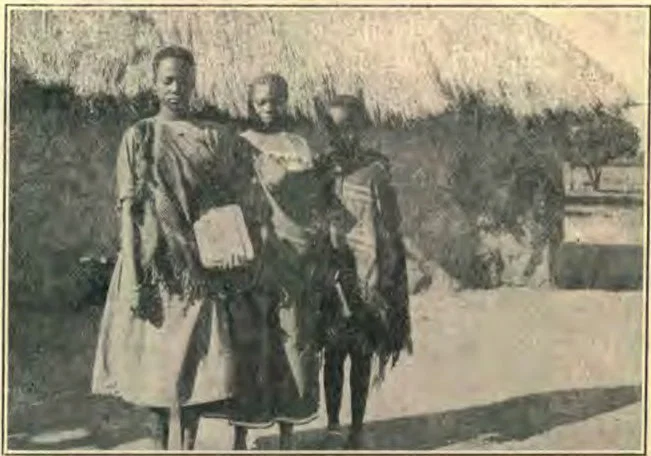
OVER in the chief’s village, near the old Somabula Mission, I think I must have been an eyewitness to the birth of the impulse and enthusiasm for learning in the hearts of three young Matabele girls.
We were waiting for the chief to come from a beer drink in order to greet the visitor whom he had invited. It was late afternoon, and all about, the women and girls were getting ready for the evening meal. Two girls with heavy pounding sticks were “stamping” grain in a mortar to take off the husks. Inyauti was the grain they were preparing for supper, a kind of millet seed.
The pounding sticks are made from the trunk of a young hardwood sapling. The mortar is a section of a tree trunk hollowed out and set perpendicularly. Into this a few pints of the grain are poured, and then the pounding sticks, held perpendicularly, fly up and down, the ends striking heavy blows down into the mortar to thresh the grain. Two or three women may work at one mortar, striking their rapid blows in turn.
Two girls near by were making the chaff fly. A third, the smallest girl, knelt by with a basket, and swept off the chaff and gathered the grain as each portion was finished ready for the winnowing.
THE THREE NEW PUPILS FROM THE CHIEF'S KRAAL
Suddenly the work stopped. The girls were jumping up and down and crying something enthusiastically, clapping their hands, and swinging their arms, as a young boy came toward them.
“What is the excitement?” I said to Brother J. N. de Beer; “what are they saying?” What a blessing it is to know these vernaculars! All the time I found myself wanting to know what people were thinking out loud.
“They are telling him that they have begun to go to school at the mission today,” said Brother de Beer.
“What were their words?” I asked.
“They were,” he said: “‘We went to school! we went to school today! You are falling behind! We went to school! We are learning to write! They gave us some slates! You are getting behind us; we are getting ahead!’”
And while they shouted, they were jumping for joy and clapping their hands. Poor girls! evidently at the general meeting, where the villagers gathered in, they had caught the inspiration of the educational movement. So this day they had come over to the school. For the first time in their lives they had held a slate pencil, and had tried to master the intricacies of the A B C. It was good to see their enthusiasm, and that very night toward dusk I saw the young boy whom they had greeted, coming in to the mission by bicycle in order to talk with Brother de Beer about getting to school.
Next day these three young girls who had just entered the door of learning stood for their portraits before the camera. W. A. SPICER.

Questions and Answers

(Continued)
20. WHAT servant of a high priest had his ear cut off by an apostle? — Malchus.
21. What young shepherd slew a famous giant? — David.
22. What taxgatherer did the Lord Jesus call to be an apostle? — Matthew.
23. What coppersmith was an opposer of Paul? — Alexander.
24. What butler and baker were fellow prisoners of Joseph? — The chief butler and the chief baker of the king of Egypt.
25. What musician was “the father of all such as handle the harp and organ”? — Jubal.
26. What great lawyer was Paul’s teacher? — Gamaliel.
27. What cupbearer to a king rebuilt the walls of Jerusalem? — Nehemiah.
28. In the home of what carpenter did the Lord Jesus spend his early days? — Joseph.
29. What fisherman wrote five books of the Bible? — John.
30. What orator made accusation against Paul before Felix? — Tertullus.
31. What runaway slave was converted under Paul’s labor and sent back to his master? — Onesimus.
32. What blind beggar was restored to his sight by Jesus near Jericho? — Bartimeus.
33. Who was Rebekah’s nurse? — Deborah.
34. What tentmakers went to Ephesus with Paul? — Aquila and Priscilla.
35. What lady’s maid was the mother of Ishmael? — Hagar.
36. What Roman centurion was sent to Peter at Joppa? — Cornelius.
37. What robber was released at the Passover instead of the Lord Jesus? — Barabbas.
38. What fisherman brought Peter to Jesus? — Andrew.
39. What famous shepherd had twelve sons who were also shepherds? — Jacob.
40. What metal worker was “an instructor of every artificer in brass and iron”? — Tubal-cain.
41. What judge was the strongest man in the world? — Samson.
42. What three singers did David appoint to lead the service of song? — Asaph, Heman, and Jeduthun.
43. What sorcerer was stricken with blindness for interfering with Paul’s work? — Elymas.
44. What housekeeper was “troubled about many things”? — Martha.
45. What Roman officer rescued Paul from a mob? — Claudius Lysias. — Belle M. Brain.

A Boy's Rights

Of others' rights, let others tell, I think a boy has rights, as well, Such rights as cannot fail to make A nobleman for honor's sake, A hero of the boy that tries The long, hard way to any prize. Well for the lad, then, that agrees To claim his share in rights like these: The right to stand in line with those Who conquer honor's sordid foes; The right throughout the livelong year To keep the path of honor clear; To speed the causes that shall bring The day when honor's crowned the king. May any champion demand A nobler right in all the land, Or less than all for honor dare, And honor's guard of honor share? — Frank Walcott Hutt.
Continue reading: Hints to Girls