SOME one writing to a Catholic magazine asks the question, “Is it a sin to play kissing games at a party?” The editor, a priest, in answering the question, said:— “No modest, well-bred Catholic young man or woman will join in such games. They indicate a reprehensible spirit of levity and frivolity in the young people who take part in them. It is a vulgar parody on what should be held as a sacred privilege of the dearest relationship. How much of a sin there is in such loose behavior depends on the person. Your confessor can decide that better than an outsider. An innocent young person may be inveigled into such a game, but it will not be without reproach of conscience, and a sense of outraged modesty.”
And yet some of our own girls engage in this questionable conduct. Dr. Orison Swett Marden, in his excellent book “The Crime of Silence,” expresses his strong disapproval of the kiss, in these words:—
“The fact that our girls go out into the world with very little training and few suggestions regarding the risks they run in mingling with men in business life of whom they know practically nothing, the mother’s fatal failure to instruct her daughter regarding the possible curse of the first kiss or the slightest familiarity, has often led to sorrow and shame.”
Dr. Marden further wisely comments on the dangers to which girls sometimes carelessly and sometimes ignorantly expose themselves. He says:—
“Most mothers trust their daughters too implicitly even to think they could ever be led astray, no matter what company they are thrown in. It is true that a pure heart and the power of self-control, backed by wise training, will protect any girl under almost any circumstances anywhere in the world. But how many girls are so protected? And how many mothers have any idea of the perils which their daughters are constantly encountering, and what narrow escapes many of them have? How often do we hear ignorant, well-meaning girls who have been unfortunately entangled, weeping bitter tears of anguish that their mothers never told them of the risks of unchaperoned association with men.”
“Another danger of the new girl’s greater freedom is that it tends to make her too independent of other people’s opinions. She is apt to think that she is just as free as her brother, and can do the same things that he does with the same impunity, which is practically not the case.”
“It may be a false standard of ethics, but it is unfortunately true that, if a girl is indiscreet and happens to make a mistake, if she appears at some questionable place, no matter how innocent she may be of wrongdoing, if she is seen with a man who has a bad reputation, she is quickly gossiped about and her character assailed.”
The Wrong Use of the Telephone
“Again, many girls call up men over the telephone during business hours and talk to them as freely as their brothers talk to their men friends. After a while they acquire the telephone habit, the habit of calling up male acquaintances and saying things to them just because they are at a distance which they would not think of saying in a letter or if they were speaking face to face. We all have more or less what we might call long-distance courage; it is so easy to say things over the telephone, when one is far away, which modesty and sensitiveness would restrain one from saying at close range. While the telephone has proved an untold blessing to millions, it has been the undoing of a great many modest, good-intentioned girls; and this is especially true of girls who were brought up in very strict homes, where the parents would not allow them any liberties, nor tell them why they considered it necessary to be so strict in their surveillance.”
“Most girls know that they should not do indiscreet things, but they do not begin to know how fatally, how tragically wrong these things may be. Heedless of public opinion in doing foolish or imprudent things, many of them say that they don’t care what people think or say of them. ‘She did not care what people said,’ would make a fitting epitaph for many a girl who has gone wrong. It is not always enough to be conscious that we are innocent, not enough to know that we do what is right; we must not put ourselves in questionable positions. Girls should avoid the appearance of evil, avoid questionable situations, avoid the company of men of known bad character. Nor should they carry on silly conversations over the telephone with men whom they barely know.”
“No one is independent of the opinions of others any more than a drop of water in the ocean is independent of the other drops.”
The Rubber Industry
By F. A. Detamore
We have all seen rubber in many forms, but there are many who do not know how it is grown and made into automobile tires, overshoes, and many other useful things. The changes rubber undergoes from the time it leaves the tree till it comes from the factory are very interesting.
The Malay Archipelago is one of the most important rubber-producing districts of the world. Rubber does not grow here naturally. South America is the native home of the rubber tree. As a great deal of money is made in wild rubber,—that is, rubber taken from wild trees,—the idea that rubber could be raised was put forward, and experimental gardens were established in India, and later in the Malay Peninsula, to find out whether rubber raising would be profitable. The results of the experimental gardens were highly satisfactory, and rubber plantations were speedily started. Plantation rubber rapidly made its way to the front, and now rubber raising ranks among the world's great industries.
Rubber is obtained from the sap of a tree, much in the same way that maple sugar is prepared from the sap of the maple tree. The trees are set out in the same way and about the same distance apart as those of an apple orchard. The rubber tree grows to a much greater size than apple trees; so, when the trees become larger, the weaker and poorer ones are cut down to make room for the others.
Tapping is the process of extracting the rubber from the tree. This is usually done by making a slanting cut in the bark of the tree. The rubber sap, or latex as it is called, slowly oozes out and runs down the gash and into the latex cup.
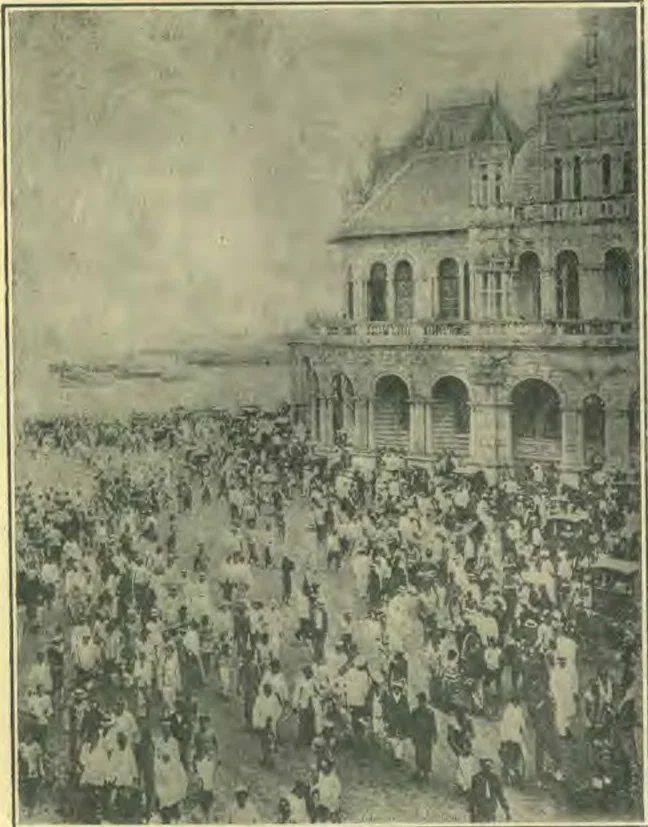
A STREET SCENE IN SINGAPORE, MALAY PENINSULA
Unless tapping is done with great care, much injury will result to the trees. All horticulturists will tell you that to cut into the bark entirely around the tree will kill it, as the sap channels are just under the bark, and they are the arteries of the tree. Tapping is done two or three times a week, so a carefully laid plan must be followed to avoid injury to the trees. A line is usually drawn around the tree close to the ground and another about the height of six feet. Perpendicular lines are drawn from the top circular line to the one near the ground, dividing the bark of the tree into four quarters. A tap is made in one of these quarters; the next time, a tap is made just above or below the first tap, until all that quarter has been tapped. Then the opposite quarter is tapped. In this way three quarters of the tree trunk is recovering from its wounds while the other quarter is being tapped.
As the latex comes out, it looks like cream. The first that flows is of the highest quality, and is collected at once. The rubber prepared from this always brings the highest price. The trees are tapped early in the morning, and the rubber is collected during the day. A man goes from tree to tree and empties the latex cups into a receptacle that he has, and then the latex is taken to the factory. The last latex is scraped from the cut in the bark where it has congealed, and is even scraped up from the ground if any has run down.
Rubber has the same relation to latex that butter has to cream, but it cannot be removed from the latex by churning. A small amount of acetic acid is added to the latex, and this coagulates the rubber and separates it from the water and other constituents of the latex. The amount of rubber in latex varies from thirty to forty-five per cent.
When the rubber has coagulated, it is run through the mangles or washing machines. These mangles are much like the mangles used in laundries for ironing clothes, except that the rollers are usually covered with ridges instead of being smooth. In the mangles the rubber has water poured over it continually, and dust, insects, and bits of bark are all washed out.
The rubber comes from the mangles in a thin, flat sheet not unlike a strip of cloth. It is then hung up to dry. The drying is the most delicate part of the process, for it is in this stage that rubber is easily spoiled. On many large estates the rubber is dried in a vacuum, heated by steam. This process of drying calls for a great deal of machinery, and is costly. It is undoubtedly the best method. But on small estates drying in a vacuum would cut the profits materially, so the drying is generally done by hanging the sheets up in a dark shed.
Often the rubber while drying becomes sticky and even melts down to a liquid. It sometimes becomes infected with bacteria or mold, and is spoiled in this way. All through the preparation extreme care must be taken or hundreds of dollars' worth of rubber may be spoiled.
The rubber is roughly divided into three classes: fine crape, so called from the appearance of the sheet rubber; medium, or ordinary rubber; and scrap, or the rubber that has been scraped from the cut in the bark of the tree. The best rubber sells for about fifty-five cents a pound in the raw condition, and the value of the other grades is lower. An acre of trees nine years old will produce about four hundred pounds of rubber a year. Roughly, the gross earnings of an acre of rubber is two hundred dollars.10
Because of the remarkable growth of the automobile industry and the increased use of electricity, the demand for rubber is steady, and it is doubtful whether the supply of rubber will be sufficient in the future. Shares in a properly conducted estate are a paying investment. Dividends of fifteen and twenty per cent a year are not uncommon.
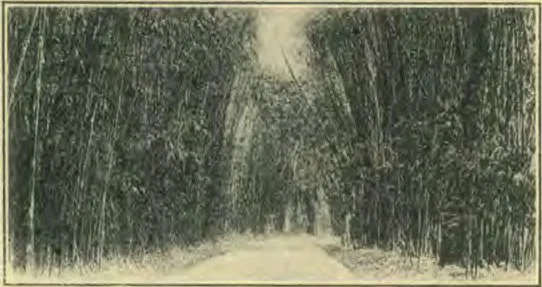
BAMBOO ALLEY, SINGAPORE.
Strange as it may seem, with all the modern machinery for the production of rubber, the wild rubber exported from South America, made by the natives by dipping a pole into the latex and holding it over the smoke of an open fire until it hardens, and repeating the process till a great ball is formed, is the best grade of rubber in the market, and commands the highest price. The name of that kind is Pará rubber, and to say that an article is made of Pará rubber is to establish its quality. The process is too slow to be profitably used on plantations.
The process that makes rubber useful is called vulcanization. In the raw state rubber will freeze in cold weather and become soft in hot. Mr. Goodyear was an inventor who was interested in rubber, and he spent many years trying to treat it so that it could be used in all kinds of weather. One day as he was experimenting with some rubber, he accidentally spilled some sulphur into it. He thought the rubber was spoiled, so threw it outside. On going out later he happened to notice that the rubber was not frozen, although the day was very cold. He brought it into the house and exposed it to heat, but it was not affected. This gave him the start, and he perfected his discovery, and lived to see rubber used in hundreds of ways.
Most of the rubber goods we buy are made of cloth and rubber united. All the raincoats and overshoes are made of cloth with a layer of rubber over it. Automobile tires are made by building up the structure, first a layer of cloth, then a layer of rubber, till the tire is completed. The rubber unites firmly with the canvas cloth and makes a strong fabric.
Many of the poorer grades of rubber articles are made of rejuvenated rubber. The worn-out boots and bicycle tires that the old-clothes man buys at the back door, are sent to a factory where the rubber is extracted from the canvas, and is used again.
Chemists know very little about rubber. It has been studied, analyzed, and experimented upon almost without limit, yet its chemical structure is unknown. They do know that it is composed of carbon and hydrogen, but beyond that point, differences of opinion begin. Specialists have tried to make rubber in the laboratory. They have almost done so, but not quite. A fortune awaits the man who discovers a way of making rubber below the present price.
The next time you use a rubber eraser, or take down the rubber telephone receiver, pause for a moment and imagine a forest of rubber trees, then remember that this most useful substance, together with every other useful preparation of nature, has been given to us by God, and silently offer a prayer to him in thankfulness for his love.
F. A. DETAMORE.
Down to Sleep
By Helen Hunt Jackson
NOVEMBER woods are bare and still;
November days are clear and bright;
Each noon burns up the morning’s chill;
The morning’s snow is gone by night.
Each day my steps grow slow, grow light,
As through the woods I reverent creep,
Watching all things lie “down to sleep.”
I never knew before that beds,
Fragrant to smell and soft to touch,
The forest sifts and shapes and spreads;
I never knew before how much
Of human sound there is in such
Low tones as through the forest sweep,
When all wild things lie “down to sleep.”
Each day I find new coverlids
Tucked in, and more sweet eyes shut tight;
Sometimes the viewless mother bids
Her ferns kneel down, full in my sight;
I hear their chorus of “good night,”
And half I smile and half I weep,
Listening while they lie “down to sleep.”
November woods are bare and still;
November days are bright and good;
Life’s noon burns up life’s morning chill;
Life’s night rests feet that long have stood;
Some warm soft bed, in field or wood,
The mother will not fail to keep,
Where we can “lay us down to sleep.”
— Helen Hunt Jackson.
Seen at a Wayside Pump
By C. P. Bollman
THE August sun was high in heaven,
The earth was dry and parched,
While to a rural wayside pump
A motley procession marched.
First came a preacher with solemn mien,
And from the pump he drank;
And then a woman with jet-black face,
Expressionless and blank.
Two water boys from a railroad camp,
With wooden buckets came;
And anon a man of eighty-two,
All wrinkled, and bowed, and lame.
A clucking hen with her cheeping brood
Drank from the overflow;
A long, slim wasp from her house of mud
Was seen to come and go.
A honeybee with her fussy way,
And store of nectar sweet,
Stopped awhile at the busy pump
And drank at a poet's feet.
A saucy bird, too, drank at the pump,
Where the grass grows fresh and green.
And these are a few of the many things
At this wayside pump to be seen.
C. P. BOLLMAN.
The Scriptures as a Matchless Temple
By Boyle
I USE the Scriptures, not as an arsenal, to be resorted to only for arms and weapons, but as a matchless temple, where I delight to contemplate the beauty, the symmetry, and the magnificence of the structure, and to increase my awe and excite my devotion to the Deity there preached and adored.—Boyle.
Owning a Fault: Wisdom Gained by Confession
“To own a fault is but to say, ‘I’m wiser now than yesterday.’”
The Missionary Barrel
“I CAN never tell you what the Woman’s Home Missionary Society has been to us since we came here,” said the wife of a Methodist missionary on the Western prairie. “We had trouble from the very first to find anything to feed our baby that would agree with her. We had tried everything the physician suggested, and she grew steadily weaker and thinner, until at last we found a particular brand of condensed milk which, when prepared in a certain way, she would retain and seemed to thrive on. What a relief it was to have her rest at night, and to see that she was gaining week by week.
“One day when my husband started to the store,12I asked him to bring me another can of the milk, for the one I was using was nearly empty. When he returned, he said they were out of condensed milk at the store, but that he had found a freighter which was going up to the railroad for a load of lumber, and that he had sent for it by the owner, that he would be back the next day, and I must not worry. I used sparingly the milk I had, and the next evening waited anxiously for the return of the freighter. It came, only to report that the supply in that small town was exhausted; but the man said he was going the next day to a larger town on the railroad, and he thought he surely could get it there.
“Two more days and I had just used the last I had for the baby. All I could do was to wait and trust God. I tried to feed her on other things, but she refused them all. Finally, before the two days were passed, she would take the food offered, only to throw it up and cry constantly.
“When my husband came home after the second time and told me he could not secure the milk, I burst into tears, and could not be comforted. He tried to cheer me up, and said the man had found a barrel of freight there for us and had brought it down, and would soon bring it over to the house. We supposed it was home missionary supplies, for we had received a letter saying it had been sent.
“When it came, I could take no interest in it whatever, for my baby was hungry—starving! What cared I for clothing when my precious one was lying dying! But the other children were eager, and my husband rolled the large barrel down the steps and got the hammer. When he had removed the lid and lifted the paper from the top of the barrel, the first thing the eager eyes of husband and children saw was twelve cans of the particular brand of condensed milk we had tried so hard to get.
“I snatched a can from that blessed barrel, and with tears of gratitude rolling down our faces, we told the children to wait until we fixed the milk for little sister, and then we would see what else was in the barrel.
“That night as I held my quiet, sleeping child in my arms, I longed to kiss the hands of those precious women who had saved my baby’s life.”— Selected.
Ordered to the Stock Room
By J. G. Wright
As Leon Marshall came in from lunch, he met Tom Lester just going out.
“I have a message for you,” the latter paused to say. “Mr. Crane asked me to tell you as soon as you came in that you were to report to Stevens in the stock room.”
“To Stevens?” Leon echoed incredulously. “For what? I’m a bookkeeper, not a packer or a shipping clerk.”
“One of the fellows in the stock room, Jerry, I believe, has hurt his hand on a rusty nail and will have to be at home for a few days. It’s a bad time to have it happen, for they’re rushed to death just now. When Stevens came in with the news, Mr. Crane said that he could spare you from the books for a week or so, and that it would be better to put you into the stock room than to try to get an outsider who knew nothing about our books, and so would be likely to make serious mistakes.”
“A very fine program!” Leon exclaimed resentfully. “I suppose my feelings in the matter don’t count. I might as well be a pawn on a chessboard if I’m to be moved about from the office to the stock room without any say-so in the matter. I think I’ll wait till Mr. Crane comes back and have a talk with him myself.”
“I think he expected you to get to work in the stock room as soon as you got back,” Tom said hesitatingly.
“Perhaps he did. But perhaps I have some views of my own on that subject,” Leon retorted. “The idea of sending me to the stock room to do the work that any dolt could do who had strong muscles! I’m going to point out to Mr. Crane that that’s not the kind of work I’m looking for. I want the sort of work that has some future ahead, and if Mr. Crane or anybody else thinks I’m going to step down from what I’m doing now to pack or unpack cases in the stock room, he’s making a great mistake.”
Just then the door of Mr. Thornton’s private office, which had been standing ajar, swung open, and the department manager stepped into the main office. His appearance startled Leon, who supposed that he was at lunch, but the junior assistant bookkeeper quickly regained his composure. He had heard that Mr. Thornton was a “self-made man.” If so, he would sympathize with the determination to do only the work that offered him a chance of promotion.
Very mild indeed the department manager looked as he stood a moment just outside the door of his office. Tom Lester departed hurriedly, feeling that perhaps it would be as well to be somewhere else when the explosion took place. Apparently, however, there was not going to be an explosion.
“Did I understand Lester to say that they are short of help in the stock room?” Mr. Thornton asked. “I didn’t come in till a few minutes ago, so hadn’t heard of Jerry’s accident.”
“I didn’t know of it myself till Lester told me just now,” Leon answered in some embarrassment, and waited to see what would happen. What should he do? Hold his ground, or back down from the position which he had announced so emphatically only a moment before? With amazement he saw Mr. Thornton remove his coat and his linen cuffs.
“I think I shall have to go out and help Stevens myself,” he said cheerfully. “We can’t let the shipments get behind at this season, and, I’ll have to own it, Marshall, the truth is that I still have a sort of secret liking for the work of the stock room. You see, that is where I began; that is the school from which I was graduated into the office.”
With these words he swung upon his heel and stalked away to the stock room, leaving Leon to do some rapid and vigorous thinking. If Mr. Thornton had begun in the stock room; if Mr. Thornton, the department manager, was willing to take off his coat and pack cases in order that the work of the office might not be delayed, what ground had he, the junior assistant bookkeeper, to stand upon? Leon did not spend long upon that question, but pulling off his coat and cuffs, promptly followed Mr. Thornton.
“You heard me make a fool of myself a few minutes ago,” he said in manful apology, “but one lesson of this kind is enough. I’ve come out to show you that the junior assistant bookkeeper isn’t above doing what the department manager is willing to do.”
The glance which the department manager bent upon the junior assistant bookkeeper was a shrewd but kindly one. He held out his hand, and the two shook hands in silence, but with a new understanding and friendship.— J. G. Wright, in Young People’s Weekly.
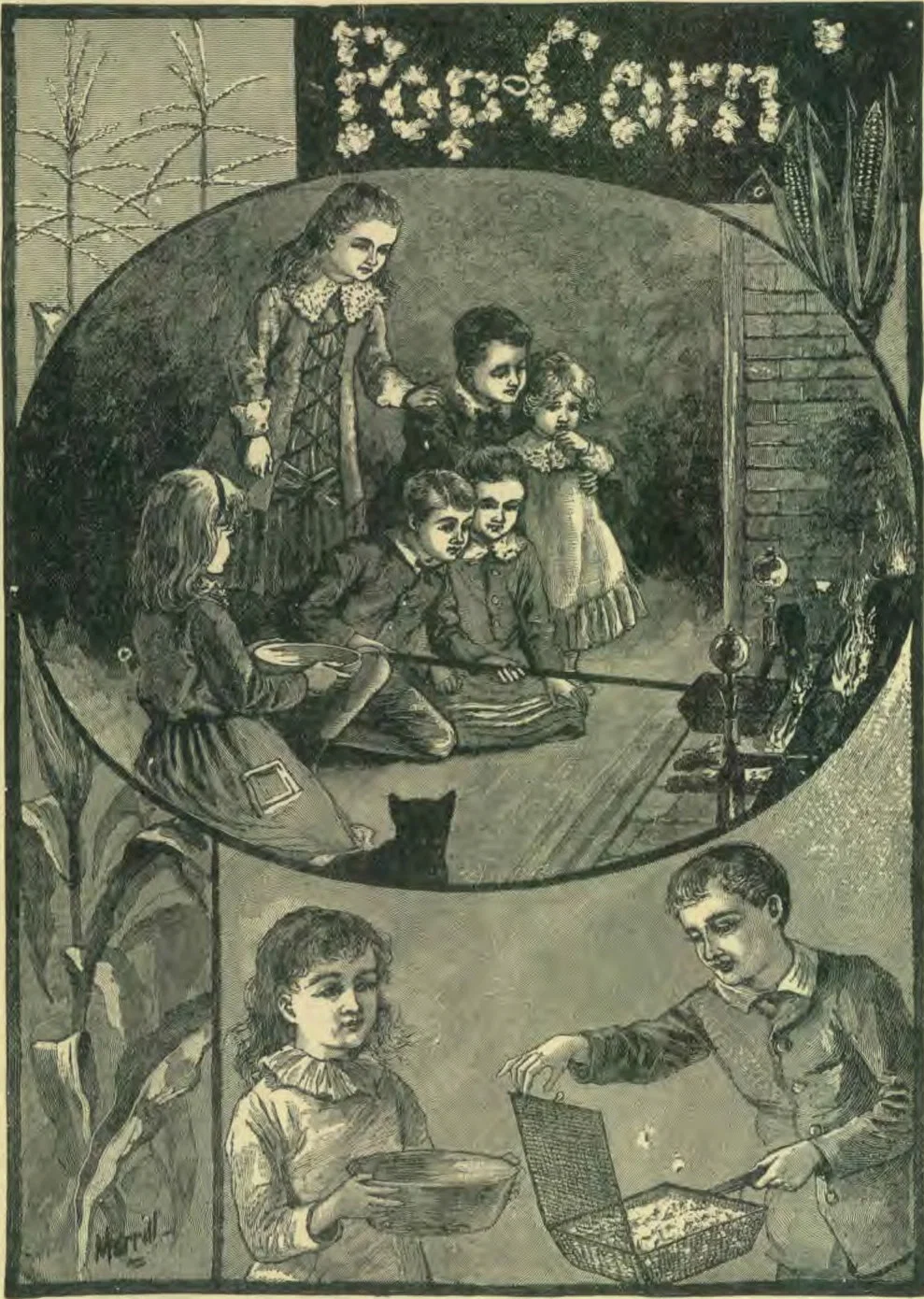
In Corn Time
By Dora Dee
It is nice, nice, nice, in the summer,
To watch the pretty corn grow,
With the long, slender stalks shooting upward,
All standing straight in the row;
To see the broad blades and the tassels,
The silks and the husks of green,
And the plumes in the rows nodding gayly,
With pumpkin vines growing between.
It is nice, nice, nice, in the autumn;
To sit by the kitchen fire,
And watch the blaze in the chimney,
And the sparks flying higher and higher;
To shell the corn from the white cobs;
To send to the mill to grind;
Or to feed to the chicks, or for popping,
If it happens to be the right kind.
It is nice, nice, nice, to build houses
Out of the cobs likewise —
Some of them very little,
But some of considerable size;
Then to put kitty inside one,
When the cob houses are done,
And see her tumble them over,
Is also very good fun.
— Dora Dee.
Man's Impossibilities Are God's Easies
MAN'S impossibilities are God's easies.— T. DeWitt Talmage.
Compass: Happiness Alone Is Victory
COMPASS happiness, since happiness alone is victory.
Missionary Volunteer Society Programs for Week Ending December 4
1. REVIEW the Morning Watch texts. Have a short paper on “Daniel.”
2. Reports of working bands.
3. Bible Study: “The Morning Watch.” See Gazette.
4. Reading: “Lord, what a change within us,” etc. See Gazette.
5. Have a talk on “Our Work in West China.” See articles “Entering Szechuan” and “Literature Work in Szechuan” in Gazette. Use your map.
6. Juniors: Seven children might divide the little story (in Gazette) “How They Ate Their Dinners,” into as many parts. Let one boy read Peter Player’s paragraph; a girl, Lucy Languid’s; and so on. An older girl or the teacher may read the two closing paragraphs.
Recitation: “A Moment in the Morning.” See Gazette.
Mission Reading: “China’s Capital City.” See Gazette.
Missionary Volunteer Reading Courses
Senior No. 9 — Lesson 9: “History of the Sabbath,” Pages 406-478
1. How had Gnostic theology helped to spiritualize away the Sabbath?
2. How did the canons of the Laodicean council affect the observance of the true Sabbath?
3. How did the Sunday laws of earlier dates compare with those of 368? of 386? of 389? of 401? of 425?
4. What does Neander say of the condition of the church in the fifth century? Why did she need help from the state?
5. How did some of the church Fathers try to add luster to Sunday? How do their reasons for Sunday observance compare with those of earlier church Fathers?
6. What shows that a great deal of paganism existed in the church? How did Pope Leo express himself about it? How had the foundation for this apostate church been laid? From what did the Papacy grow?
7. Give two reasons for Sabbath keeping in the Christian era. What was Christ's attitude toward and relation to the Sabbath? What command touching the Sabbath did he leave with the people?
8. What do Dr. Th. Zahn, Guericke, and Gieseler say of Sabbath keeping in the first centuries?
9. Define the word Nazarenes. Why was the council at Jerusalem called?
10. What two great causes led to the setting aside of the Sabbath? How had the Jews corrupted Sabbath observance?
11. In how many countries can you trace Sabbath observance as late as the fifth century? From what sources must the Sabbath history of these early ages be obtained?14
1. WHERE did Mary and Joseph live? Where is Nazareth? Who was the Roman emperor at that time? Why did Mary and Joseph go to Bethlehem? In what kind of place did they probably stop the night Jesus was born?
2. How did the shepherds learn about the birth of Jesus? What did they do after they found the infant Saviour?
3. When was Jesus presented at the temple? What was the “ceremony of redemption”? How is it practiced by the Jews today?
4. What did Simeon and Anna do and say when they saw the infant Saviour?
5. What have you learned in this week's assignment about the Babylonian captivity? What led Cyrus to cause Jerusalem to be rebuilt?
6. Who were the wise men? How did they learn about the birth of Jesus? What disappointment met them in Jerusalem? Who told them to seek the new king in Bethlehem?
7. Why was Herod angry with the wise men? What cruel thing did he do? How was Jesus protected?
8. Why did Joseph and Mary move to Nazareth? What do you know of the flowers and birds that Jesus probably saw when a boy? What trade did he learn? Why did the people love the child Jesus?
9. Why do Jewish children know so much about the Bible? What is the first verse they learn?
10. What three things did Jewish children do each morning? What three special things did Jewish boys learn in school? What else were boys taught? What did the girls learn?
Our Example
By Frank F. Mills
DURING my short stay in Korea a very practical lesson was forced home to my mind, which I have tried not to forget. It was my practice, while in the city of Seoul on business, to become acquainted with as many of the young men as I possibly could, and endeavor to interest them in religion. The temperance question offered a favorable opportunity in many instances; and often when I was asked for a match to light a cigarette, I spoke of the deadly effects of the smoking habit.
One day I went to a Japanese grocery store to do some purchasing, and among other things ordered a dime’s worth of chocolates, of which I was very fond. While my Japanese friend was putting up the candy, I improved the opportunity to speak about the cigarette he was smoking. He listened attentively, and when I had finished, looked me straight in the face, and said in a most friendly way, “Mr. Mills, do you think it any worse for me to spend my money for cigarettes than it is for you to spend yours for chocolate candy?” He then went on to show the evil effects of chocolates and other sweets upon the system, besides the unnecessary expenditure of money involved, even as I had done about the cigarette.
While it must be acknowledged that the nicotine of the cigarette is more disastrous in its results than the sweet of the chocolates, yet his question had a point which I knew was right. Suffice it to say we both shook hands, he throwing away his cigarette, and I allowing him to return the candy to its place in the show case. And as I boarded a street car for our mission station, these thoughts came to my mind: “And every man that striveth for the mastery is temperate in all things. Now they do it to obtain a corruptible crown; but we an incorruptible. I therefore so run, not as uncertainly; so fight I, not as one that beateth the air: but I keep under my body, and bring it into subjection: lest that by any means, when I have preached to others, I myself should be a castaway.” 1 Cor. 9:25-27. “Many will say to me in that day, Lord, Lord, have we not prophesied in thy name? and in thy name have cast out devils? and in thy name done many wonderful works? And then will I profess unto them, I never knew you: depart from me, ye that work iniquity.” Matt. 7:22, 23.
Often when I have related this incident for the benefit of others, a few have been free to consider my position fanatical, saying I ought not to allow myself to be carried to extremes. But after two years of careful consideration of this matter, I am still of the opinion that I can more readily ask God’s blessing upon every dime of mine that is placed in the treasury of my God, to be used in the promulgation of the gospel message, than I could if it were spent for sweets or any other unnecessary thing, and lost to the cause we all love.
In “Early Writings,” pages 266, 267, we are told that Satan and his angels especially hate Sabbath keepers. He says: “We must keep in our ranks all the means of which we can gain control. The more means the followers of Christ devote to his service, the more will they injure our kingdom by getting our subjects. . . . Control the money matters if you can, and drive their ministers to want and distress. This will weaken their courage and zeal. Battle every inch of ground. Make covetousness and love of earthly treasures the ruling traits of their character. As long as these traits rule, salvation and grace stand back. Crowd every attraction around them, and they will be surely ours. And not only are we sure of them, but their hateful influence will not be exercised to lead others to heaven. When any shall attempt to give, put within them a grudging disposition, that it may be sparingly.”
Dear young people, the people of this world are not the only ones who are watching us, to see how we spend our money. God above and the enemy of our souls below are both making note of every item in our lives, and very soon our accounts will be written up. Let us be faithful in rendering to the Lord his own, and by giving up the unnecessary things of life, help to swell the mission fund, that the work may be finished in this generation, and our Lord can come and take us home. FRANK F. MILLS.