The Youth’s Instructor, Vol. 63, No. 47.

Rock Solidified by Pressure or Cement Injection
Earlier text: Hints to Girls

Forty-Eighth Week

November 28. Galatians 1 to 3: Living by faith; heirs according to the promise. Read the introduction to Galatians.
November 29. Galatians 4 to 6: The liberty of Christ; works of the flesh and fruits of the Spirit contrasted.
November 30. Ephesians 1 to 3: Saved by grace through faith; God’s eternal purpose. Read the introduction to Ephesians.
December 1. Ephesians 4 to 6: Unity, holiness, love, etc.
December 2. Philippians: The mind of Christ; the peace of God, etc. Read the introduction.
December 3. Colossians: Exhortation to constancy, charity, humility, long-suffering, etc. Read the introduction.
December 4. 1 Thessalonians: A faithful church; the day of the Lord; etc. Read the introduction.

If You Have Time

Reread, in Acts, the story of Paul’s stay in Ephesus.
Locate the different provinces and cities mentioned.
Make a list, from Paul’s writings, of the principal temptations that had to be guarded against by the Gentile converts.
Read again, in Acts 16, the interesting story of the establishment of the church in Philippi.

Galatians

On his second missionary journey, while detained by sickness in the Roman province of Galatia, Paul had raised up a number of churches. About 280 B. C. this territory was settled by fugitive Gauls, driven out of Italy and Greece; and their descendants, with a mingling of Greeks, Romans, and Jews, formed the population in Paul’s day. The people, perhaps owing to the influence of their Gallic ancestry, are described as “susceptible of quick impressions and sudden changes, with a fickleness equal to their courage and enthusiasm, and a constant liability to that disunion which is the fruit of excessive vanity.”
A few years after Paul’s visit certain Jewish teachers who professed Christianity visited the Galatian churches, and introduced false doctrines among them. They ignored the decisions of the church council held a few years before in Jerusalem, and urged the Galatian Christians to enforce certain ceremonies that they held as essential. Not being thoroughly grounded in the truth, and having little tenacity of purpose, a critical situation arose among the believers, which threatened to disrupt the churches.
It was this situation, word of which reached Paul, probably while in Corinth, that led him to write with his own hand the earnest letter to the Galatians. “He indignantly rebukes his children in Christ for their sudden alienation from him and from the truth; vindicates his authority and his teachings as an apostle; by showing that he received them from Christ himself; and forcibly presents the great doctrine of Christianity—justification by faith—with its relations to the law on the one hand and to holy living on the other.”
“The apostle’s earnest words of entreaty were not fruitless. The Holy Spirit wrought with mighty power, and many whose feet had wandered into strange paths returned to their former faith in the gospel.” For nine hundred years the churches of Galatia were mentioned in ecclesiastical history.
“Since the days of Luther,” says Meyer, “the epistle to the Galatians has always been held in high esteem as the gospel’s banner of freedom. To it and the epistle to the Romans we owe most directly the springing up and development of the ideas and energies of the Reformation.”

Ephesians

The city of Ephesus, situated about forty miles from Smyrna, was chiefly celebrated for its splendid temple to the goddess Diana, regarded as one of the seven wonders of the world, and its immense theater, said to be the largest ever built by the Greeks. A thriving business in the manufacture of small portable shrines to the goddess had been built up, as well as the preparation and sale of books of magic. During Paul’s labors in Ephesus at one time, the believers brought to him their supply of these books, and burned them in a public place. “And they counted the price of them, and found it fifty thousand pieces of silver,” or thirty thousand dollars.
Paul’s letter to the Ephesians was written during the time of his first imprisonment at Rome, about A. D. 63. “There are no personal greetings in the letter, and so it is believed to have been a circular one, intended to be passed around among several churches. It is an epistle of general exhortation and counsel, especially fitted to those that had lately come from heathenism, and were still exposed to its temptations.”

Philippians

Philippi, the chief city of eastern Macedonia, was named for Philip II, of Macedon, who wrested it from Thrace about 358 B. C., and made of it a fortified garrison. In 42 B. C. it came under the control of Rome. The emperor Augustus “transported Roman citizens to Philippi, and made it a ‘colony,’—a miniature Rome, where Roman laws, customs, and language prevailed.”
In answer to a divine call, Paul, in company with Silas, visited Philippi about A. D. 51 or 52, and through their ministry the first church in Europe was established there. In later years Paul twice visited this church. It is thought the second letter to the believers at Corinth was written at Philippi.
Paul’s letter to the Philippians, like that to the Ephesians and the Colossians, was written at Rome during his first imprisonment, A. D. 62 or 63. It was especially called forth by the thoughtful love of the Philippian brethren, who had sent Epaphroditus to Rome with gifts for the apostle’s support. The epistle is “remarkable for its Christian joy and for the warm affection shown by Paul for the Philippian converts. The Philippian Christians are reminded that as believers in Christ they partake of a dignity and of privileges far more exalted than those belonging to them as Roman citizens, and are exhorted to live worthy of their heavenly citizenship.”

Colossians

The church at Colosse, a city of Phrygia, not far from Laodicea, appears to have been raised up by Epaphras. Philemon and Onesimus lived there. Paul’s letter to these believers, written from Rome during his first imprisonment, was especially to warn them against certain errors that were creeping into the organization.
“The letter to the Colossians is filled with lessons of highest value to all who are engaged in the service of Christ, lessons which show the singleness of purpose and the loftiness of aim which will be seen in the life of him who rightly represents the Saviour.”

First Thessalonians

Thessalonica, a prosperous and populous seaport city of Macedonia, was anciently called Therma, from the hot springs in its vicinity. Cassander, who rebuilt the city about 315 B. C., renamed it Thessalonica, in honor of his wife, the sister of Alexander the Great. It is now known as Saloniki.
In Paul’s day the population was made up of Jews, Greeks, and Romans. Because of its favorable location, “on the sea margin of a vast plain, watered by numerous rivers, halfway between the Adriatic and the Hellespont, at the entrance of the pass into the Macedonian plains, with a constant tide of traffic ebbing and flowing,—abroad by sea and inland by the two arms of Roman road,—it was a fit center of evangelization, as from thence ‘sounded out the word of the Lord not only in Macedonia and Achaia, but also in every place.’”
With Silas and Timothy, Paul visited Thessalonica on his second missionary journey; and a flourishing church, noted for its ardent hope in the soon return of the Lord Jesus, was raised up. Obliged to flee from the city because of the persecution of the unbelieving Jews, Paul went to Corinth, where he stayed a year and a half. Here, a few months after leaving the new church in Thessalonica, the apostle addressed to them his earliest letter, in A. D. 52. In it he recounted the circumstances of his stay among them, expressed his joy in the good report that had been brought to him by Timothy concerning the believers, and took occasion to clear up in their minds certain truths concerning the state of the dead and the second advent.

X — Hosanna to the Son of David

  • (December 4)
LESSON SCRIPTURE: Matt. 21: 1-16.

Questions

1. Where did Jesus and the disciples next go? Matt. 21:1.
2. What did Jesus tell two of his disciples to do? Verse 2.
3. What should they say in case any one questioned their taking the animals? What would be the result? Verse 3.
4. Why was all this done? Verse 4.
5. What had the prophet Zechariah said? Verse 5.
6. How did the disciples respond to Jesus’ directions? Verse 6.
7. What did they do when the animals were brought? Verse 7.
8. What did the multitude then do? Verse 8.
9. What did all the people cry? Verse 9.
10. When he came into Jerusalem, what did all the city ask? Verse 10.
11. What did the multitude answer? Verse 11.
12. Where did Jesus go next? What did he do there? Verse 12.
13. What did Jesus say to the buyers and the sellers? Verse 13.
14. Who came to Jesus in the temple? What did he do for them? Verse 14.
15. How did the priests and the scribes feel about the day’s events? Verse 15.
16. What did they say to Jesus? Verse 16, first part.
17. What answer did Jesus give? Verse 16, last part.

Notes

X — Hosanna to the Son of David

(December 4)
LESSON SCRIPTURE: Matt. 21: 1-16.
MEMORY VERSE: “Hosanna to the Son of David: Blessed is he that cometh in the name of the Lord.” Matt. 21: 9.

Questions

1. On the way to Jerusalem, to what place did Jesus and his disciples finally come? Matt. 21: 1. Note 1.
2. What did Jesus tell two of his disciples to do? Verse 2.
3. What were they to say if questioned by any one as to their action? What permission would the man at once give? Verse 3.
4. What had been foretold concerning this event? Verses 4, 5. Note 2.
5. How did the disciples respond to the command of Jesus? Verses 6, 7.
6. What did the multitude spread in the way? Verse 8.
7. What did they cry? Verse 9. Note 3.
8. How greatly was Jerusalem stirred at this demonstration? What question was asked? Verse 10.
9. How did the multitudes answer it? Verse 11.
10. What did Jesus do when he went into the temple? Verse 12.
11. What did he say had been written? Verse 13. Note 4.
12. Taking the place of the buyers and sellers, who quickly filled the temple? Verse 14.
13. What sounds were heard in place of the rattle of money and the loud voices of the money changers? How did the chief priests and scribes regard this? Verse 15.
14. What did they say to Jesus? In what beautiful manner did Jesus again in effect say, “Suffer little children, and forbid them not”? Verse 16.

Notes

1. For notes 1, 3, 4, see notes 1, 2, 5, of the following lesson.
2. “Five hundred years before the birth of Christ, the prophet Zechariah thus foretold the coming of the King to Israel. This prophecy is now to be fulfilled. He who has so long refused royal honors, now comes to Jerusalem as the promised heir to David’s throne.”—“The Desire of ages,” page 569. See Zech. 9: 9.

An Experience in the Mission Field

BROTHER and Sister R. P. Robinson went to Africa just after the last General Conference. They are now located at the old Solusi Mission, in Rhodesia. The following incident, told by Brother Robinson, will give the readers of the INSTRUCTOR a glimpse of life on an African mission station. This is all the more interesting when we understand that the extent of Brother Robinson’s medical knowledge is what he obtained in the elementary medical studies given at the Foreign Mission Seminary.
“During one week in the early part of last March it became necessary for Mrs. Robinson and me to carry the responsibility of the mission by ourselves five or six days. One of our native church members came and said his little girl was very sick. We gave him some medicine, but that did not satisfy him; he wanted me to see the child. I told him I had much work that afternoon and could not go; but I could see he was desperate. I knew the child must be very ill.
“He stayed around and would not go home. I saw there was nothing for me to do but to go to his home, which was about a mile away. I took some fomentation cloths, and one of our mission boys to interpret. When we reached the kraal, or huts, I found one of our native teachers there. The man’s brother and his wife, who were members of the Solusi Mission church, were also present, besides several heathen relatives. They were all outside, sitting behind the huts in the shade, where the mother was holding the sick child.
“The moment I looked at the child I saw it had a very short time to live unless something could be done soon to relieve it. There were tears in the mother’s eyes, and when I saw that anxious look in the faces of both parents and of the other relatives, I fully realized that those black people love their children as truly as white people do theirs.
“I questioned the father and mother closely concerning the child’s sickness, and decided it was dying of dysentery or cholera morbus. The little one had been unconscious four days, and had had convulsions often during that time. I was very much perplexed to know what to do. And when I realized that its life or death might depend on me, I felt a terrible weight of responsibility. Never before had I so fully realized my own human weakness as at that moment. Every native was anxiously looking at me, waiting for me to do something. The natives have implicit confidence in what the white man does for their sick.
“I then told these people there was almost nothing I could do, but that we could call on God, the great Doctor, in whom we believed. I told them we would pray, then I would give some treatment, and I asked every one who prayed to ask God to bless the treatment. I told the native teacher to pray first, then the mission boy I had brought with me, then the child’s uncle, I said I would pray next, and the father should pray last. So we gathered around the child, and I have never heard more earnest prayers than those. They prayed in their language, and I in mine. No prayer was finished without weeping.
“We arose, and with the help of the father and the uncle, I lifted the little wasted body into a warm bath, where we kept it for several minutes, pouring warm water over it. We then lifted it out, and I put several hot fomentations on the abdomen. Just before leaving to come home, I told the people to call me at any time, day or night, if they needed me, and I would do what I could.
“At half past two in the morning they came, saying the child was worse. I dressed, and went with the uncle, who had come for me; but instead of finding the child worse, I found it much better. It was conscious, and much more lively. It was having some pain in the bowels, and because it made more fuss, they thought it worse. I put hot and cold on its abdomen till daylight, and left it sleeping quietly. In five days it was running around again with the other children.
“To me this was a direct answer to prayer. Such experiences bring to the missionary real joy in service with Christ. It is such manifestations of God’s love and care that cause the missionary to love his work, regardless of all its perplexities and discouragements.”
This is one of the stations our young people are giving money for this year. Have you done your part to sustain this work? M. E. KERN.

On Human Vanity and Self-Regard

DRAWN by conceit from reason’s plan, How vain is that poor creature—man! How pleased is every paltry elf To prate about that thing—himself! —Churchill.

Greatness in Humble Service to Others

W. E. Gladstone, England’s greatest statesman, was never greater than when, sitting on a stool in a miserable attic, he read the Bible to an old street sweeper who lay ill. Moody was never greater than when he preached his first sermon to a colored boy, in a bare cabin, by the light of a candle, with a barrel for a pulpit.—Selected.

The Criterion of True Beauty

THE criterion of true beauty is that it increases on examination; of false, that it lessens. There is something, therefore, in true beauty that corresponds with the right reason, and it is not merely the creature of fancy.—Greville.

Thanksgiving

“THANKS for the strong, free wind of life, However it change or veer; For the love of mother and sister and wife; Clear stars that to haven steer; For the quenchless lamps of changeless love That burn in the night of the dead; For the life that is, for the hope above, Be thanksgiving by all hearts said.”
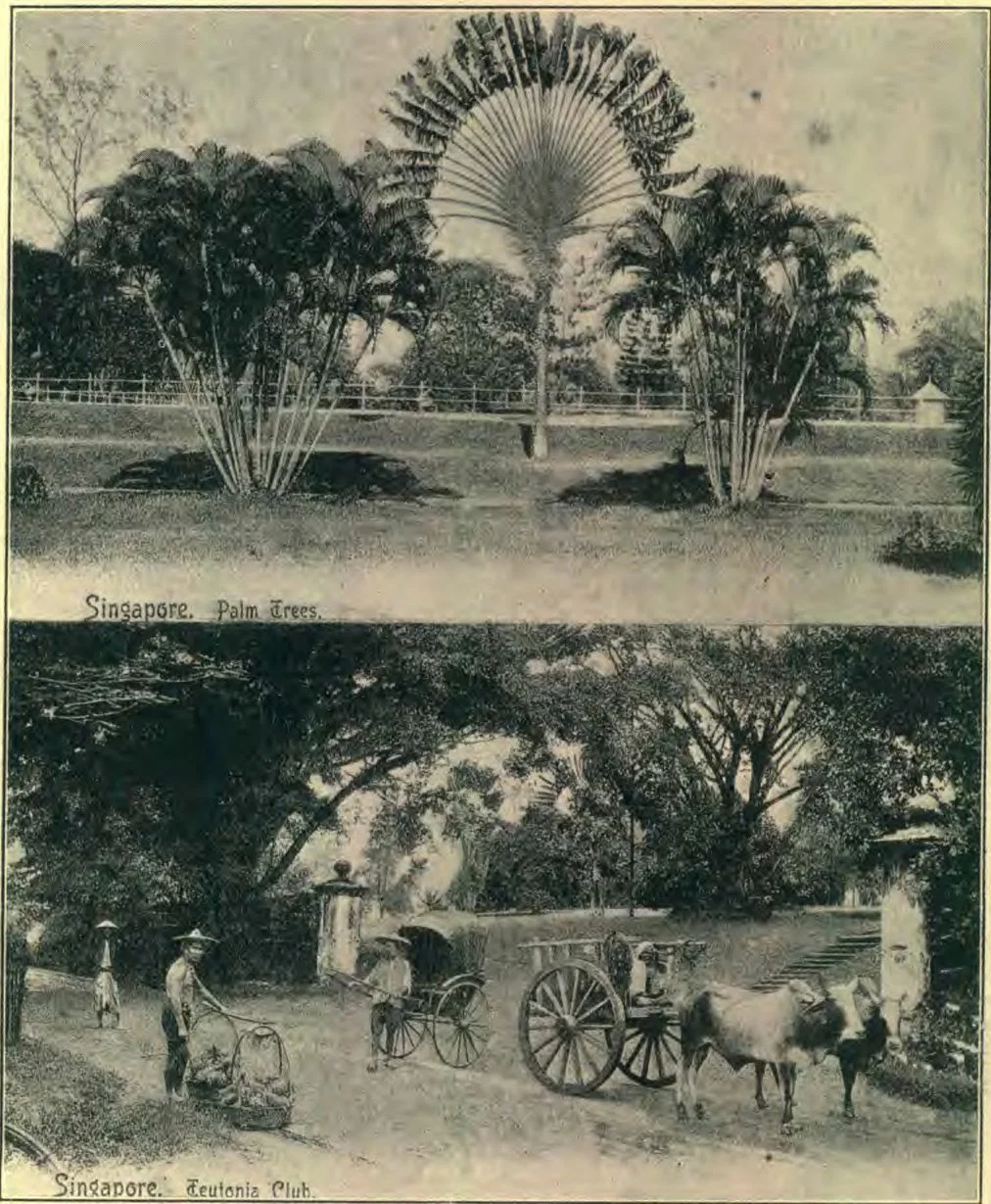
VIEWS IN SINGAPORE, MALAY PENINSULA.

You have reached the end of this edition.

The Youth’s Instructor · Nov 23, 1915