4. “Lion.”—The king of beasts, or head of the beast creation, occupies the same position as the head of gold (Dan. 2: 38), and represents the first kingdom,—Babylon,—established in prophecy B. C. 677 by the capture of Manasseh, king of Judah.
5. “Eagle’s wings.”—Power and rapidity of conquest and soaring pride of Babylon under Nebuchadnezzar.
6. “A man’s heart was given to it.”—The change in Babylon under Belshazzar, compared with Babylon under Nebuchadnezzar.
7. “Bear.”—Cruel and rapacious. This beast represented the second kingdom, Medo-Persia, established B. C. 538, at the overthrow of Babylon by Cyrus.
8. “Three ribs.”—Three provinces,—Babylon, Lydia, and Egypt,—which were especially oppressed by Medo-Persia.
9. “Leopard.”—A fleet beast—the third kingdom, Grecia, established B. C. 331 by Alexander the Great, when Medo-Persia was overthrown by the decisive battle of Arbela.
10. “Wings of a fowl.”—Grecia’s rapid conquest of the world.
11. “Four heads.”—Four divisions of the Grecian kingdom made soon after the death of Alexander, in which the territory was divided between his four leading generals,—Cassander (west), Lysimachus (north), Ptolemy (south), Seleucus (east).
12. “A fourth beast, dreadful and terrible.”—The fourth kingdom (verse 23) represented Rome, established in prophecy by the league with the Jews, B. C. 161.
13. “Iron teeth.”—An iron monarchy (Dan. 2: 40. See also extract from Gibbon in note on lesson 3.)—cold, lacerating, persecuting character of kingdom.
14. “Residue.”—The people of God left from Grecian rule.
15. “Ten horns.”—Ten kings (verse 24)—ten divisions of western Rome.
IMPORTANT LESSONS.
1. God continues to reveal “his secrets unto his servants the prophets.” Amos 3: 7. 2. The symbolic language of the Bible is explained by its literal language. Dan. 7: 17, 23, 24. Hence the importance of comparing scripture with scripture, instead of taking any one scripture as the basis of a theory. 3. This lesson covers the same ground chronologically as does the third lesson, but the Lord gives us “line upon line.” (See Isa. 28: 10.) The true character of nations is represented by ravenous beasts. 4. The history of this world of sin is made up largely of strife, division, overthrow, and destruction. 5. Those who become “saints of the Most High” will soon take the kingdom, forever freed from all these sad consequences which now surround us. We have none too much time to get ready.
19. What kingdom is to follow these earthly kingdoms? Verses 13, 14.
20. Who will then possess the kingdom? Verses 18, 27.
NOTES.
The same general field of prophetic history is surveyed in this chapter as in the second of Daniel. To Nebuchadnezzar the four great kingdoms of the world, their degeneracy and the transfer of power from one to the other until the time of the establishment of the kingdom of God, were shown under the figure of a gigantic image composed of various metals. Nothing of their character was presented to him. It was enough for him to know that earthly kingdoms were transitory, and must give place, at last, to the kingdom of God. To Daniel, as the servant of God, and a representative of God’s people, these same kingdoms were shown under another series of symbols, which express their character as oppressors of the people of God.
The lion, the king of beasts, stands at the head of the line,—a fitting symbol of the empire under the aggressive and warlike Nebuchadnezzar. But the Babylonians abused the power God gave them. “The children of Israel and the children of Judah were oppressed together: and all that took them captive held them fast; they refused to let them go. Their Redeemer is strong; The Lord of hosts is his name.” Jer. 50: 33, 34. So Babylon passed away (538 B. C.) by the power of the Medes and Persians, and a great milestone toward the kingdom of God was passed.
The division of the fourth kingdom, Rome, is plainly indicated by the ten horns. The special work of these horns is not referred to here. This is more particularly done in the book of Revelation. They seem to be introduced here so that the “little horn,” which was “diverse” from them, could be located and described. These ten kingdoms were formed by the breaking up of the Roman empire between the middle of the fourth and the latter part of the fifth century. These kingdoms were all political, or civil powers. The little horn was “diverse” from them; it was an ecclesiastical power,—the papacy.
The little horn is a symbol of a last-day power, for it continues until the judgment. In verses 9–11 the judgment is described; and the eleventh verse shows that at the very time of the judgment, this power is still uttering blasphemous words. It also meets a different fate from the others. Thus we read: “I beheld even till the beast was slain, and his body destroyed, and given to the burning flame. As concerning the rest of the beasts, they had their dominion taken away; yet their lives were prolonged for a season and time.” This is a very important statement. The great and terrible beast, in its last, or little-horn, phase is not merged into another power, as were those powers preceding it, but it goes direct into the “burning flame.” Paul’s reference to the same event in 2 Thess. 2: 8 makes the final ending of the papacy very clear. It is to be destroyed at Christ’s coming.
The persecuting power which the papacy has manifested in the past, and which she now manifests where it is possible for her to do so, is too well known to need extended comment. Rome has literally “made war with the saints, and prevailed against them.” In the explanation of the symbol it is said that he “shall wear out the saints of the Most High, and think to change times and laws.” A more complete description of the general conduct and work of the papacy could not be given. It has warred against God’s people; millions of martyrs’ graves attest this fact. It has fought against God’s law; the mutilated second commandment, the divided tenth, and the expunged fourth, as they are found in Catholic books, and as they are held by that church and taught to her people and to the world, all evidence that the prophet spoke truthfully upon this point also.
Every chain of true Bible prophecy, however dark the shadows through which we may be conducted, has a glorious ending. Cruel kingdoms will not last forever. As one earthly kingdom succeeded another, marking successive steps down the stream of time, so the last earthly power will finally pass away, and the benign kingdom of God will be ushered in. All the other kingdoms were transitory, because there was evil in them, and the permanent continuance of evil cannot be harmonized with the perfect reign of a just God. The kingdom of God will stand forever. The stone will smite the image, and dash it to pieces; the papacy, and all other evil works of darkness, will be destroyed at and by the coming of Christ, and “the saints of the Most High shall take the kingdom, and possess the kingdom forever, even forever and ever.”
"IT IS MEAN AND CRUEL."
The Arabians have a quaint old story that has a noble lesson in it: A haughty favorite of an Oriental monarch, who was passing along the highway—so runs the story—threw a stone at a poor dervish, or priest. The dervish did not dare to throw it back at the man who had assaulted him, for he knew the favorite was very powerful. So he picked up the stone and put it carefully in his pocket, saying to himself: “The time for revenge will come by and by, and then I will repay him for it.” Not long afterward, this same dervish, in walking through the city, saw a great crowd coming toward him. He hastened to see what was the matter, and found, to his astonishment, that his enemy, the favorite, who had fallen into disgrace with the king, was being paraded through the principal streets on a camel, exposed to the jests and insults of the populace. The dervish, seeing all this, hastily grasped at the stone which he carried in his pocket, saying to himself: “The time for my revenge has now come, and I will repay him for his insulting conduct.” But after considering a moment, he threw the stone away, saying: “The time for revenge never comes; for if our enemy is powerful, revenge is dangerous as well as foolish; and if he is weak and wretched, then revenge is worse than foolish, it is mean and cruel. And in all cases it is forbidden and wicked.”—Exchange.
Meditations Acceptable in Thy Sight
“LET the words of my mouth, and the meditation of my heart, be acceptable in thy sight, O Lord, my strength, and my redeemer.”
Every Follower of Christ a Leader of Souls
EVERY true follower of Christ will be a leader of souls to him.
ANDORRA
By August Kunz
THE ROAD TO ANDORRA.
This is the name of a mountain basin in the eastern half of the Pyrenees. It is watered by the Balira, beautifully situated between the French departments, Ariége and Catalonia. Its natural position between France and Spain favors its independence and neutrality, which are recognized by the governments of both countries. The valley is a very singularly constituted, genuinely democratic, farmers’ and herders’ republic, covering one hundred and fifty square miles, and numbering some twelve thousand inhabitants, distributed over six civil communities. The dense bushes furnish an abundance of wood; there are also good pasture lands and rich iron mines. The soil is adapted to grape and fruit culture, but grains are very much raised, so that the people are under treaty with France for annual grain exports to that country. Since 805, during the reign of Louis the Pious, Andorra has been neutral territory, although it has to pay a small sum annually both to France and to the bishop of Urgel,—to the latter for exercising the right of nominating the clergy, etc. The republic received its first judge, or provost, from France, the second from the bishop of Urgel. These “men of authority” are intrusted with the administration of justice. The taxes, however, are imposed by a supreme council of twenty-four persons, who are chosen by a free ballot.
Every male citizen between sixteen and sixty years of age is liable to military service. The Andorrans are a kind, moral, peace-loving, and hospitable people. Their speech is the same as that of the Catalonians and Castilians; their mode of living is extremely simple. The customs and habits of over one thousand years ago are still in vogue here. The chief place in the republic is the village of Andorra.
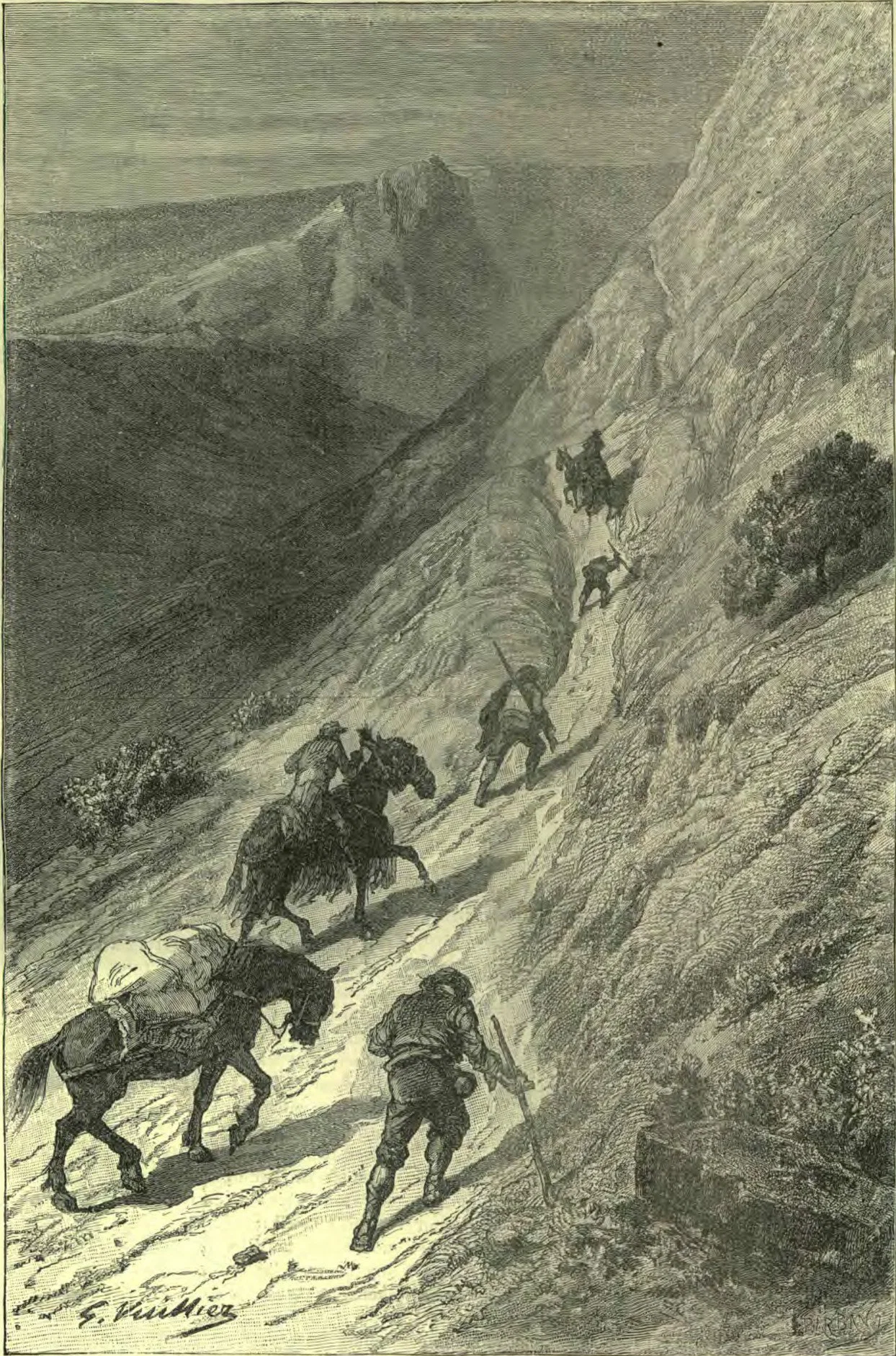
With these few general preliminaries, I will quote M. Gaston Vuillier, a native of Perpignon, who describes a visit to this very small republic:—
“In the beautiful month of July we started from Perpignon, in south-eastern France, and went by rail to Prades, and the foot of Canigon. Here we found the regular diligence from Mt. Louis in waiting, which took us through the magnificent gorge from Villefranche to Mt. Louis. Part of our journey had to be made at night, and as the moon cast its silver light over the mountains, and these on their part threw gigantic silhouettes of their contour across our track, we found the charm so pleasing that no thought of sleep entered our mind, nor did the eyes refuse to serve us with their best, as we tried to discern what we were passing. For a moment Fontpédrouse loomed up through the night, in the gorge, and its roofs cast a faint bluish reflection through the darkness of the night. About midnight, chilled by the freshness which prevails at all seasons on these heights, we reached Mt. Louis. Spending the rest of the night in comfortable quarters, we set out the next day in a private berlin, the regular conveyance being overcrowded. A storm overtook us on the way, and it seemed as if all the winds were let loose at once. Lightning followed lightning, revealing in its garish glare the outlines of this sad-looking piece of mother earth, where the thunder reëchoes with frightful crashes. The horse, seized with fright, seemed to vie with the wind in speed, and the vehicle creaked like an ancient vessel in the tempest.
“Finally we reached Bourg-Madame, in a drenching rain. We were wetted pretty thoroughly, in consequence of the jolting and tossing of the coach to and fro, which splashed the gathered waters from the top of the conveyance onto us. Never did we appreciate the luxuries of a tight roof and a comfortable hotel more than then, and the refreshments served revived our ardor. After a splendid night’s rest we had the great pleasure of looking out from the morning window to see the country flooded with bright sunlight, which the golden orb of day scattered most lavishly everywhere, a brilliantly blue sky crowning all from above. In an ornate conveyance we soon left for Porté, through the valley of Carol. Puigcerdà lies on the boundary line between France and Spain, a bridge connecting the two countries. On the one side are French ‘douaniers’ (revenue-collectors), and on the other the Spanish carabineros. After we have traveled for some distance on Spanish ground, the roads again wind onto French151territory at the entrance of the valley of Carol.
“This is a wild gorge of a grand and beautiful character, bristling with a perfect chaos of rocks bearing many traces of glaciers that must have covered them in former ages, enhanced at present by a noisy torrent that foams at a great rate of speed along its dashing way. From the lofty rock-heights of the mountains, with sparkling sprays the waters descend in rainbow colors, forming themselves into long, silvery bands. Before us are the towers of Carollie, remains of the castle of a feudal knight who was afterward conquered by Charlemagne.”
“We passed, without stopping, through the little hamlet of Porta and the village of Porté, the last of France in this region, and came in sight of the Puymorens, at the foot of which we stopped till the next day.”
“The next morning, before daybreak, we heard the beasts of burden made ready for the continuance of our journey. The muleteers led the beasts by the bridle as we rode them along a rocky footpath up the steep mountainside. This route, though quite rough, is very much nearer,—yet plenty long for all that, even when riding mule-back, before we reach Solden, the first village of Andorra. The sun darts forth for some time before we leave the rocky declivity; and now, behold, we are on the summit of Puymorens!”
“We then traversed a waving plateau covered with short grass. Soon we saw the Andorran muleteers. They arrived clad in short leggings, with red girdles and hats and velvet vests. The beasts of burden, caparisoned in metal plated and trimmed leather trappings and fly-nets of many colors, made a dazzling display in the bright sunlight. There was before us a very enjoyable treat, fond as we are of looking upon bare mountains, abrupt crests, and general outlines of landscapes. Below was the mountain peak of steep Andorra, to the right the valley of Ariége, and much higher up, to the left, the source of the Ariége River,—a blue lake reflecting the sun’s rays like a brightly polished surface of glittering steel.”
“Having drunk in at the full the varied scenes presenting themselves as we turned our gaze hither and thither in warm admiration, we descended toward the course of Balira, our downward trip having nothing of note to chronicle beyond the appearance of a humble flower-girl, offering her pretty wild flowers,—a sort of white pinks,—that she had gathered on these mountain slopes round about.”
AUGUST KUNZ.
SYSTEMS OF HANDLING THE MAILS IN LARGE CITIES.
By E. G. Burdick
2.— MAILING DIVISION.
In all large cities, the high business blocks are supplied with long flat tubes with glass fronts extending from top to bottom, with slots for each floor, in which to deposit letters, small papers, etc. At the bottom of this tube is a large iron box, which catches all the mail placed in the tube. This tube, or “chute,” as it is called, is supplied by the Cutlers Mailing Chute Company, who have the sole right to make them. In one large building here (Minneapolis) where chutes are placed, I have stood where I could see the letters fall ten floors, and they fall with almost the rapidity with which a shot comes out of a gun.
On the corners of all streets in the business portion of the city, there are iron boxes painted red, and fastened to lamp-posts or posts set for them, in which to place mail for collection. Papers are usually placed on top of the box, as they are too large to go in it. These boxes used to be painted red, green, blue, or yellow; but recently they are being repainted all one color—red. The number of collections a day was formerly told by the color of the box, but that information is now usually placed on the front.
Over the whole city these boxes are scattered at the most convenient points for the people. In the resident portion they are placed from three to five blocks apart, and in the suburbs much farther apart.
Then there are sub-stations, at which one can get stamps, cards, wrappers, and envelopes, and register mail, as well as deposit mail for collection, to save coming down to the main office. There are ten sub-stations here in Minneapolis, which are numbered from one to ten, and located where most convenient.
Again: in the main office there are also large boxes to receive mail. These boxes are marked “north,” “east,” “south,” “west,” and “city,” so as to hasten the dispatch of the mail.
Collections are made as follows: 1. In the business portion, where the mail has been deposited, as we have noticed, the collection is made by carriers on foot, making collections every half hour or hourly, as the case may be, where mail is most heavily deposited.
2. In the resident portion foot carriers and carriers with horses and carts make the collections from two to four times a day, and in the suburbs mail is collected only once by horse collectors only.
As the mail comes in, the letters and papers are dumped onto large tables, and the papers put by themselves, and the letters are “faced” up by carriers and clerks. When this is done, the mail is ready for cancellation, which I will tell you about next time.
E. G. BURDICK.
LIQUID SILVER.
By Mrs. S. E. Kennedy
Ancient alchemists gave to the metal mercury the name of quick, or liquid, silver, because of its power to flow, or move quickly, at common temperature, and also because they supposed that it really contained some silver,—a mistake easily made, as it is often found in combination with this metal. In this state it forms a native amalgam, called cinnabar, a brilliant red ore found in California and Mexico, and also in Austria, Spain, and several other European countries.
Pure mercury is often found in fluid globules, disseminated throughout the rock within which it is inclosed; but it is sometimes discovered in cavities in such quantities that it may be dipped up by the pailful.
It was first discovered in the Mexican mines by a slave, who, in attempting to climb a steep ascent, caught hold of a shrub to help himself up. The shrub gave away, and from the cavity made by the pulling up of the roots, a tiny stream of what seemed like liquid silver trickled down upon him.
One of the most singular properties of mercury is its affinity for gold or silver. J. R. Nichols, in Fireside Science, speaks of a case, which, though clearly understood by the initiated, remained forever an unexplained mystery to the unscientific victim: “Several years ago, while lecturing upon chemistry before a class of ladies, we had occasion to purify some quicksilver by forcing it through chamois-skin. The scrap of leather remained upon the table after the lecture, and an old lady, thinking it would be very nice to wrap her gold spectacles in, accordingly appropriated it to this purpose. The next morning she came to me in great alarm, stating that the gold had mysteriously disappeared, and nothing was left in the parcel but the glasses. Sure enough, the quicksilver remaining in the pores of the leather had amalgamated with the gold, and, entering, destroyed the spectacles.” It is said that gold leaf dropped upon mercury disappears like a snow-flake dropped upon water. One who has watched a magnet gather together the tiny particles of iron from the quartz and other material in a quantity of sand, will understand how mercury has the power to draw to itself the tiniest particles of gold or silver.
The uses of mercury are various. Mercurous chlorid, or calomel, is a tasteless white powder used in medicine. The writer has a vivid recollection of such a remedial agency made use of in her youth, which produced what doctors call “salivation.” The blackened tongue and loosened teeth, to say nothing of the excruciating soreness of the mouth, have left an impression upon her mind which time can never efface. The attending physician declared that it saved her life; she is therefore bound to say a good word for the harsh medicine, which later remedies have largely superseded.
Chemists, by different processes, produce from this metal many articles differing materially. One of the most useful purposes to which mercury is put is in the manufacture of mirrors. The process is thus described:— “Tin-foil is first spread upon a marble table, and the mercury is carefully poured over it. The two metals combine, forming a bright amalgam. A clean, dry plate of glass is then carefully pushed forward over the table, so as to carry the superfluous mercury before it, and also prevent the air from getting between the glass and the amalgam. Weights are afterward added to cause the film to cling more closely. In twenty-four hours the plate is removed, and in three or four weeks is dry enough to be framed.” When we look in a mirror, we rarely realize what it has cost others to minister to our comfort. The workmen at this kind of work are short-lived. A paralysis sometimes attacks them within a few weeks after they enter the manufactory, and it is thought remarkable if a man escapes a year or two without serious sickness.
MRS. S. E. KENNEDY.
ACCURACY AND GREATNESS.
THE wonder of Professor Agassiz's knowledge was the completeness of it. That is the secret of the power of all great naturalists. They see what escapes the observation of others, and are able to discover the meaning of slight differences that ordinary men have not noticed at all. A young artist once called upon Audubon, the great student of birds, to show him drawings and paintings. Audubon, after examining his work, said, “I like it very much, but it is deficient. You have painted the legs of this bird nicely, except in one respect. The scales are exact in shape and color, but you have not arranged them correctly as to number.” “I never thought of that,” said the artist. “Quite likely,” said Audubon. “Now upon this upper ridge of the partridge’s leg there are just so many scales. You have too many. Examine the legs of a thousand partridges, and you will find the scales the same in number.” The lesson shows how Audubon became great—by patient study of small things.—Selected.
LEARNING WAR.
WE read of a time when men shall not “learn war any more,” but it evidently has not yet come, nor will it come so long as the churches cultivate military drill, and train their boys in military science.
There is, however, one important part of military training and instruction which seems to be greatly neglected, even in church circles, and that is the financial aspect of the military question. There is nothing more important to men who seek to learn the art of war than the question of finance; and the “military chest” is one of the most important adjuncts of successful warfare. The longest purse wins in many a conflict. He who can command unlimited wealth is likely to succeed in the contest. The Michigan Christian Advocate says:—
“When organizing the boys into military companies for instruction and drill, it would be well to teach them that war is expensive as well as horrible. The armies of Europe cost the people of those countries one hour’s extra work every day to sustain the soldiery. A single shell, without the powder, costs more than the average farm laborer can earn in five months. One iron-clad ship of war represents the equivalent of a week’s wages of a million men, and perhaps more. Why not also teach the boys that military exercise is neither essential to health nor a protection to virtue? Why not impress them with the fact that the worst use to which deadly weapons can be subjected is to use them in killing people? Why not encourage moral war, and discourage the worldly military spirit? The Lord’s battles are always worth fighting, and he is the best soldier who allows his sympathies and energies to be enlisted only in a righteous cause.”
Mimic warfare is expensive, but the genuine article costs tremendously; and the less that Christians have to do with learning war and making war, the more fit they will be for that kingdom where the Prince of peace shall reign, where there shall be “abundance of peace so long as the moon endureth,” and where “nation shall not lift up sword against nation, neither shall they learn war any more.” Ps. 72:7; Isa. 2:4.—The Christian.
THE JOY OF MAY.
By Helen Everton Smith
Gay the orchards full in bloom,
Flowing o'er with rich perfume;
Green the turf, and pink the trees,
Noisy with the hum of bees;
Purple lilacs' heavy scent,
With breath of fragrant lilies blent—
Essence these of merry May?
“Nay,” cry robins, “nay, nay, nay!
Wooing is the joy of May!”
Full from orchards, groves, and yards,
Answer fluttering, feathered bards—
Chorus buoyant, light, and free,
Led by merry songsters three,—
Bluebird, robin, mellow thrush,
Lilting forth with joyous rush,—
“Ours the song of brightest May;
Sweet the secret we betray;
Mating is the joy of May!”
Hang-birds swinging high their nest,
Safe from squirrel’s cruel quest;
Finches hiding ’mid the leaves;
Martins nesting ’neath the eaves;
Russet wrens by sheltering doors,
Each his very heart outpours,—
“Ours the wisdom sweet of May;
Life is work, and work is play;
Loving is the joy of May!”
— Helen Everton Smith, in Harper’s Bazaar.
DEATH FROM TIGHT-LACING.
A SHORT time ago an English actress fell dead, from the effect of tight-lacing, while dancing. She called her husband as she fell, and in an agony of pain begged him to loosen her dress. It was too late, and she was dead before a doctor could be found. Such a remarkable case of death from tight-lacing is of course noticed; but there are thousands of cases of lingering death from the same cause that are never mentioned. A few years ago a young woman poisoned herself to death in New York City. The doctor who examined her after death stated that “her internal organs were good, except her liver, which was half cut in two by tight-lacing;” but he added: “That is nothing remarkable!”
FEARS A REVOLUTION.
THE emperor of Germany appears to be haunted with a fear of a revolution, and perhaps the rapid increase of what is known as “socialism” in Germany is an evidence that his fears are not unfounded. Under his direction an anti-revolution bill has been drawn up and presented to the Reichstag, which is intended to give the government the authority to check anything looking like a revolution, in its incipient stages. But the Reichstag has shown a good deal of independence lately, even refusing a vote in honor of Bismarck, and the emperor and those who are with him in this proposed legislation are meeting a strong resistance. The bill cannot be passed without the support of the Centrist, or Catholic, party, and the Catholics will not vote for this measure unless great concessions are made to them. Between the fear of a social revolution and a dread of seeing the pope once more dictating the policy of Germany, Emperor William’s path cannot be very rosy.
NEGRO SLAVERY IN MEXICO.
SEVERAL months ago the newspapers reported an exodus of negroes from the Southern States to Mexico, where a colony was to be formed, and where land was to be obtained at remarkably easy rates. Tempted by these alluring promises, about thirteen hundred men, women, and children left their homes for Mexico. Now it appears that the whole movement is a crafty scheme of a few wealthy capitalists to get the negroes into Mexico, get them into debt to a company, and then keep them there in practical slavery. Two negroes have escaped, and after walking nine hundred miles, they have arrived in Texas. They tell harrowing tales of the privations and sufferings of the would-be emigrants. They are worked under guard, with insufficient food and clothing, and with no prospect of improving their condition. The attention of the United States government will be called to their condition, but governmental matters always move slowly, and these deluded people of color, who have been so unwise as to leave their own country, will undoubtedly suffer many more months of involuntary servitude before they will once more be able to return to home and friends.
MAN-WORSHIP
A recent writer in a Chicago paper gives an interesting description of the entrance of the pope of Rome, Leo XIII, into the cathedral of St. Peter’s at Rome. The great church was crowded, and when the pope reached the center, where all could see him, there was a deafening shout of, “Long live the pope-king! long live the king of Rome!” All this adulation was received very easily and naturally by the pope, as though he were made to be honored and worshiped. Reading this description, one is reminded of the worship paid to the former emperors of pagan Rome by the people, and the difference does not seem to be very great. The whole system of the papacy is placing man before God,—worshiping the creature instead of the Creator,—and that is heathenism.
The Last Pensioner of the Revolution.
UNTIL very lately the United States government has carried upon its pension rolls the names of pensioners from every war that she has fought. The last Revolutionary soldier died in 1867; but widows of soldiers of the Revolution still received money from the government. Quite a good many young women married soldiers of advanced age, and some of these women have lived to be very old. Now it is reported that Mary Brown, of Knoxville, Tenn., widow of a soldier of the Revolution, and the last pensioner of that war, has lately died at the age of ninety-one years. At the age of twenty, in the year 1824, she was married to a soldier, and the government has continued her husband's pension of twelve dollars a month to her ever since he died.