Natal, in the southeastern part of South Africa, became an independent colony last year, although it has been under the control of the English 52 years. The colony is 919 miles from Cape of Good Hope, 390 from Algoa Bay, on the east coast, and 233 from East London. Its area is but 20,460 square miles, less than one-tenth the size of Cape Colony. It was first discovered Christmas day, 1497, by Vasco de Gama, the celebrated Portuguese explorer, whilst visiting the coasts of South Africa with a squadron of three small vessels on his way to India, and he gave to it the name it has since borne, in honor of the nativity of the Saviour. It was finally taken by the Boers, but in 1893 there was a formal submission of the Boers and assumption by Great Britain. At first it was under Cape Colony, but this did not give satisfaction, and it became a separate government in 1848. The population, according to census of 1891, was 555,947. Of these 42,759 were whites. There were 43,070 East Indians, of whom 30,000 were free, and the others were indentured, being imported as laborers. The aboriginal tribes are now given as 469,747 souls. The whites engaged in agricultural pursuits number 3,325, and those following various trades, 6,628.
The city of Durban is the only seaport of Natal, and a place of great commercial importance. The entrance to the harbor is called the Bluff Channel, which has a shifting bar of sand. The largest vessels do not venture to cross this bar, although great efforts have been put forth to make it safe. The town of Durban spreads over the flats around the bay, a distance of three or four miles, and then stretches up a wooded height called “The Berea,” which rises three or four hundred feet above the sea level. Berea is the residence part of Durban, and is delightfully situated. The town itself is one of the brightest and prettiest in South Africa. The population numbers 27,492, including the10Asiatic and native servants. To the American visitor this colony presents greater attractions than Cape Colony.
Pietermaritzburg is the capital and seat of government. It lies 54 miles from Durban. Its population in 1892 was 17,286, comprising 9,986 Europeans. The country being comparatively new, the European population are few in proportion to the natives. The people are social and more hospitable than in the larger cities of Cape Colony. The other towns are small, but the English are numerous enough in every place to have a government. As there is protection given to the natives in this colony, and surrounding tribes often oppress one another, Natal becomes an asylum for the oppressed by other tribes. The educational advantages are as good as in any of the colonies, and each government makes especial efforts to give all an opportunity in this line, although it is not compulsory. The growth of this colony has been slow but gradual. There is no portion of South Africa where the English are not found.
Natal had the honor of first introducing the iron horse, which was prior to 1860, but not until 1880 was there a railway to the capital. The remarkable development of the gold fields in the South African republic drew from this colony largely the European element. The climate is not to be relied upon to give assurance to crop raisers. The lands are usually classed as coast lands, midlands, and uplands. The first does not extend more than eight or ten miles from the sea. Here it is from seven to eight hundred feet above the sea level. This is the semi-tropical belt, where the air is humid and warm, debilitating to the invalid in the summer, but invigorating in the winter. The products are sugar, tea, coffee, arrowroot, and fruits, such as mangoes, pineapples in abundance, bananas, oranges, and lemons, which grow in rich profusion. Sugar manufacturing is carried on to quite an extent. There are 36 sugar mills now in active operation, which yield from two to five hundred tons per annum each, and about half a dozen have a much larger capacity. The aggregate output of sugar in 1891–92 was 18,000 tons. The Indian corn furnishes two crops a year; one is harvested in August, and the other in January.
The midlands extend back 25 miles farther, and have an altitude of nine hundred to three thousand feet. This is not very productive; on the highest portions, corn, hay, and potatoes are usually good. In the summer season hailstorms are an unpleasant feature in the midland and upland districts. The uplands are still farther back, with an altitude of three to five thousand feet. The country presents inducements for those who would put up fruits in cans, and furnish them to other portions of South Africa, where now they are imported from England and other countries.
Schools for children and high schools are encouraged by the government, as also mission schools for the natives in different parts of the colony. Industrial training is also provided for, and defined as “teaching of grades of agriculture, or some productive labor that would enable the student to earn a living.” In a country like this, with missionaries and educators from all parts of the world, with such a variety of people to deal with, every system of education finds place in some way. There is quite a difference in the dispositions of the natives to be instructed. The Kaffirs are considered superior to the Hottentots and the Bushmen. The Zulu is a fine specimen of humanity physically, but not as attractive as some others. The Basutos are more steady and plodding in their educational pursuits than either of the other tribes.
Among themselves they have a government, although simple. There is a regular gradation of authority from the head of the family to the head of the kraal, or village, who is responsible for the collective families therein, and up to the chief, who, with his counselors, adjudicates all matters between individuals and tribes. Their system of law takes cognizance of crimes, enforces civil rights and obligations, provides for the validity of marriages, and secures property to the rightful owner, according to well-defined rules. Superstition, however, enters into all the affairs of life, and forms part of their laws and religious customs. Families settling in these countries, and manifesting the Spirit of Christ, could have a wonderful influence over the people. There are open doors in every land and community whereby to reach every class of individuals with the truth.
PREDICTION AND FULFILLMENT.
Our Lord declared that just before his coming to earth again, the following condition of things would exist in the world and church:—
“And many false prophets shall rise, and shall deceive many. And because iniquity shall abound, the love of many shall wax cold. But he that shall endure unto the end, the same shall be saved.” Matt. 24:11-13.
We have the false prophets manifest in those who are crying, “Peace and safety,” who predict the coming of the kingdom of God through other than Gospel means.
We have the abounding iniquity in the amazing carnival of crime and evil, which has become so common as no longer to amaze.
We have the waxing, or growing, cold of those who once were warm—the members of the church of God. Upon this point we present a few extracts from a sermon by Rev. F. F. Passmore (M. E.), of Denver, published in the Seattle (Wash.) Call of July 11, 1895. His text was Eze. 33:7 and John 21:15-17. Among other things he said:—
“Watchmen are men who are appointed to look out for danger, and when they see it to give the alarm and warn the people.
“Shepherds are men who are to look after sheep, all the sheep, and all the interests of the sheep.
“The time has come when every true minister of the Methodist Episcopal Church, from our bishops down, must take a stand squarely on God’s word for justice, purity, and truth. It is enough to make night and sin themselves blush to see how the ministry, including our bishops, are pandering to the world, and uphold crime and criminals.”
“From the sermons coming from our pulpits to-day it would seem as if our leading preachers had not the faintest idea of the nature of the divine mission to which they claim to have been called. The prophets, Christ, and the apostles, were the true ministers of Bible history, and they are to be our patterns in subjects, manner, and methods.”
“If the Bible teaches anything on the subject of the ministry, it teaches that those who go to the world with this message of salvation are to give up the world, its wealth, its honor, its care, its glory, and be wholly consecrated to the welfare of mankind.
“When the history of the ministry of to-day is written, it will read strangely, and sound more like the doings of pagan priests than of the Methodist ministry. There is nothing in the world so powerful and effective as a consecrated, sanctified, spiritual, live, and courageous pulpit. On the other hand, there is nothing so pale, so cumbersome, so weak, so lifeless, so contemptible, so useless, and so cowardly, as a man-serving, time-serving, money-seeking ministry. A ministry that is so far lost to the Spirit of the Master that it can preach to please the rich and corrupt who are violating every law of God and desecrating every sacred right of man, is in a condition that should arouse a sleeping church and slumbering age. The trouble with our age is that Christ is not being preached in our great churches by our great preachers. I mean just what I say: Christ is not being preached in one of the great Methodist Churches from the Atlantic to the Pacific.”
“Great churches in whose pulpits stand men sending forth peals of impassioned oratory for the pleasure of a few rich and favored, and never a word for the thousands of poor, hungry, and cold of humanity, who have been brought to this distress by the very men who are sitting enraptured by such eloquence, is about as far from being the true Spirit of Christ as heaven is from hell. Some women and children are picking up coal in the great city of Denver to keep from freezing, while other women and children are worshiping (?) God in a $250,000 Methodist Church only a few blocks away, with the added luxury of soul-enravishing music from a $30,000 organ. Does any sane man, saint or sinner, believe for a moment that either of these pictures—the one on the river or the one on Capitol Hill—are the products of Christianity? If the people in the bottoms were not so poor, the people on the hill would not be so rich. If the people on the hill were not so rich, the people on the bottoms would not be so poor. Yet we have D.D.’s and schools of theology that are teaching that both these conditions are the result of Christianity. Can we hope to change these conditions while Bishop Warren and the other chief watchmen and shepherds are living in fine mansions in Denver and University Park, are clothed in purple and fine linen, and are faring sumptuously every day?”
This is the condition of things at the present time. God calls upon his people to heed his word, be loyal to him whatever others may do, watch for his coming, and endure hardness, affliction, reproach, and persecutions if need be even to the end. And does not this very condition of things demand the message given in Rev. 14:6-12 and 18:1-4?
THE TWO ARMIES.
By Editor
[The following beautiful little poem was recently reprinted in our Dumb Animals for our “armed Sunday schools.” There is point in Mr. Angell’s suggestion. Just now, when almost everything has “Christian” or Christianity” connected with it in some sort of way, we have in the churches of our land, dedicated to the Prince of Peace, the marshaling of “Boys’ Brigades” and other semi-military organizations. When Holmes’ little poem on the “Two Armies” is read, let the reader think of the condition of things noted above. Christianity is responsible for the poem, but it is safe to say that it did not inspire the “Boys’ Brigades” or “Armed Sunday schools.”]
As LIFE’s unending column pours,
Two marshaled hosts are seen,—
Two armies on the trampled shores
That death flows dark between.
One marches to the drumbeat’s roll,
The wide-mouthed clarion’s bray,
And bears upon a crimson scroll,
“Our glory is to slay.”
One moves in silence by the stream,
With sad, yet watchful eyes,
Calm as the patient planet’s gleam
That walks the clouded skies.
Along its front no sabers shine,
No blood-red pennons wave;
Its banner bears the single line,
“Our duty is to save.”
For those the sculptor’s laureled bust,
The builder’s marble piles,
The anthems pealing o’er their dust
Through long cathedral aisles.
For these the blossom-sprinkled turf
That floods the lonely graves
When Spring rolls in her sea-green surf
In flowery-foaming waves.
Two paths lead upward from below,
And angels wait above,
And count each burning life-drop’s flow,
Each falling tear of Love.
While Valor’s haughty champions wait
Till all their scars are shown,
Love walks unchallenged through the gate,
To sit beside the throne.
—Oliver Wendell Holmes.
CHRIST, OUR ADVOCATE
His Ministry in the True Tabernacle
An up-to-date pamphlet on the work of Christ in the sanctuary in Heaven. Bible Students' Library No. 128. Fully illustrated. Paper covers. Price, 10 cents.
Address,
PACIFIC PRESS PUBLISHING CO.
OAKLAND, CAL.
Kansas City, Mo. New York City, N.Y.
_CHRIST AND THE SABBATH:_ Or Christ in the Old Testament and the Sabbath in the New, by Elder James White. Paper covers, fifty-six pages, sent post-paid for ten cents.
Address,
PACIFIC PRESS, Oakland, Cal.
THE CONSECRATED WILL.
LAID on thine altar, O my Lord divine,
Accept my gift this day for Jesus' sake;
I have no jewels to adorn thy shrine,
Nor any world-famed sacrifice to make;
But here I bring within my trembling hand
This will of mine—a thing that seemeth small,
And only thou, sweet Lord, canst understand
How, when I yield thee this, I yield mine all.
Hidden therein, thy searching eye can see
Struggles of passion, visions of delight,
All that I love, or am, or hope to be—
Deep loves, fond hopes, and longings infinite.
It hath been wet with tears and dimmed with sighs,
Clenched in my grasp till beauty it hath none.
Now from thy footstool, where it vanquished lies,
The prayer ascendeth, “May thy will be done.”
Take it, O Father, ere my courage fail,
And merge it so in thine own will that e'en
If in some desperate hour my cries prevail,
And thou give back my gift, it may have been
So changed, so purified, so fair have grown,
So one with thee, so filled with peace divine,
I may not know or feel it as my own,
But gaining back my will, may find it thine.
—Anon.
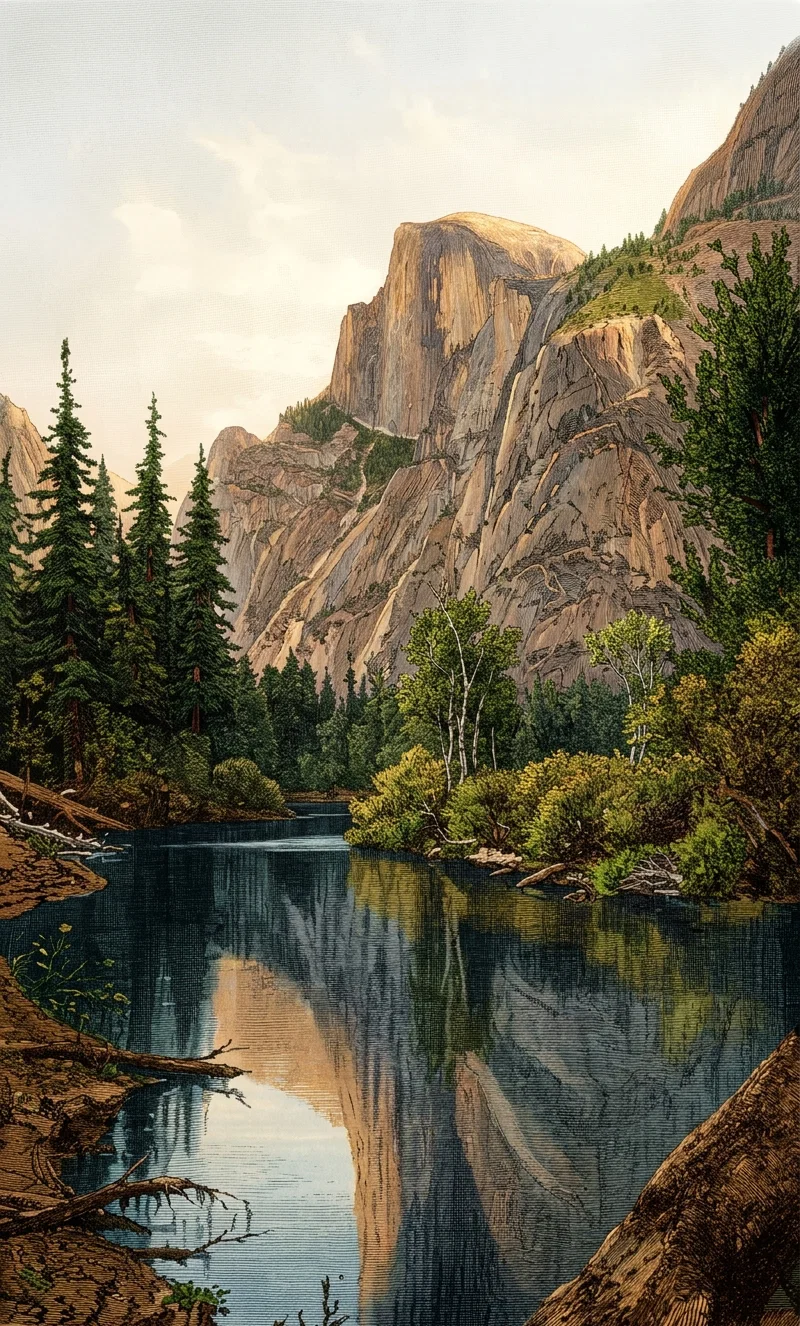
MIRROR LAKE.
By L. A. Phippeny
BY L. A. PHIPPENY.
“All aboard for Mirror Lake.” It was not a summons to mount a wagon or stage—only the conventional phrase one of us shouted to the rest one early morning in June in our camp almost under the booming Yo Semite Falls, in the world-renowned Yo Semite Valley. There were three of us, Elliot, Edward, and self, and we were out this morning, if on no other, some time before day, and tramping across the valley to see the sun rise in Mirror Lake, for the guidebooks said that was the time above all others to peep in on the world upside down.
This little sheet of water, which the Indians called Ke-ko-too-yem, Sleeping Water, nestles like a fallen star in the deep rock cleft known as Ten-ie-ya cañon, in the northeastern part of the valley, which, by the way, is only about seven miles long by one-half a mile to three miles in width. It were impossible to adequately describe in cold words the stupendous and majestic guardians and settings of this watery gem. Like many another wonder of nature, surpassing art of man, they must be seen to be appreciated.
To the right, as one ascends the cañon, towers the cloud-crested Half Dome, its lofty head lifted over five thousand feet above the bed of the valley. This rock is, as its name indicates, in appearance half of a dome, one part rising in steep curves from the surrounding mountains and from the valley on one side, the other part a sheer precipice with a clear drop of a mile, with the exception of a low abutment or talus of rock débris extending in a sharp slide to the waters of the little lake.
On the left stand the noble North Dome and Mt. Watkins, whose huge fronts, forming the abrupt wall of the high Sierras to the west and north, present a spectacle only a degree less imposing and awe-inspiring than their incomparable neighbor. The approach to the lake up Ten-ie-ya cañon between these herculean pillars is a half mile of easy ascent over a rocky deposit, which appears to have been hurled to this narrow resting place at some remote age from the mountain above. At any rate, it acted as a dam to the11waters of Ten-ie-ya Creek, which spread out in a convenient but shallow hollow and formed Ke-ko-too-yem. To give variety to the scene, and serve as a softening finish to the rocky environment, from the scant soil has sprung a rather dense growth of fir, willow, and other varieties of vegetation, fringing the lake to the water’s edge, filling the cañon, and extending along the north side of the valley in a park of good-sized oak.
MIRROR LAKE.
Into the mouth of this gorge, three miles from our camp, the three of us found our way, while as yet the shadows lay thick and heavy in its depths. The morning was cool, the place was ominously still, and, in spite of admiration and anticipation of a pleasurable sight soon to be beheld, a sense of gloom stole over us, and involuntarily we shuddered as we looked up at the beetling and threatening crags, which seemed ready to topple over and crush us.
A well-defined road wound in and out amongst the trees and rocks, and it was not long before a glimmer through the leaves told us that we had arrived at the center of attraction. A few steps to one side, and we emerged onto the rock-strewn margin of the Mirror. And a remarkable mirror it was, too, though we were sadly disappointed at first in its size. Indeed, we were disposed to ridicule this much-talked-of point of interest. But we could not change it, so we set ourselves to admiring it, as became dutiful sight-seers. And we succeeded admirably. Wonderful and marvelous changes swept over the sensitive face of the little body of water as the shadows slunk back to their hiding places in the crannies and caverns of the rocks, and our respect increased apace.
As the mist lifted and fled before the approach of the natural enemy of darkness, and the lights and shadows in the serene depth took on the beauteous contour and distinct features of nature above, our thoughts were instinctively turned to that wonderful mirror of nature’s God,—his word,—into which if a man look steadfastly he shall behold in ever-increasing splendor, in ever-unfolding beauty, the glory of the Lord. But in that mirror, as the mists of sin darkness are dispelled from the soul by the entry of the Sun of Righteousness, will the man himself, by beholding, be changed from glory to glory, assimilated as a part of the picture itself, retouched by the great Master, showing forth the beauties of his handiwork.
We were the first at the lake, and evidently early, and for nearly two hours we feasted our senses on the remarkably distinct and beautiful inverted picture, ere others came to enjoy it with us. And we shouted, and startled the echoes, and were startled in return, for this is a veritable lurking place of these mockers. Quick and loud they answer back, or roll away up the cañon and return with a snap, until one can well imagine a whole regiment in hiding. It is said nine distinct echoes can be counted. Perhaps we still felt like giving a covert fling at the small size of this mirror, so we concluded to toss stones to the opposite shore. Here came a real surprise, for, with our utmost efforts, the rocks fell away this side of the middle. Surely we are as strong as ever. But then we remember we are in mountain altitudes, and things are not always what they seem!
But the straggling crowd of tourists from the valley hotels came at last, in time to see the sun rise in the lake. As the morning had advanced, and the line of sunlight slid down over the brow of Mt. Watkins, another line, its exact counterpart, crept up and up from the depths below, bringing out with startling distinctness each prominence, cross-hatch, and indentation on the face of the mountain in duplicate. Opposed to this brightening and enchanting picture, hangs the bold, dark shoulder of the Half Dome, this side yet in the shadow. Below it—in the reflection of course—the sky is all rosy, and now in the hollow of the shoulder an intensely bright rim shows where the lord of day will shortly break forth. Every one is stationed at the best view point, and in breathless interest gazes down into the depths. We three were standing huddled together on a small rock, barely large enough to hold us, a dozen feet from shore, from which an excellent view was obtained. Suddenly the almost painful silence was rent by a loud, harsh, “Haw! haw! haw! Now! Look at them guides!”
We looked. Everybody turned and looked. There on the shore behind us stood a rotund, florid party with a monocle screwed in his eye, pointing directly at our reflection and our rock. Well, perhaps we did present a striking picture—we and our antipodal selves. But guides! Yes, we were roughing it, and were clad in roughing clothing, and in our hands were our home-manufactured alpenstocks. But to be called guides we resented, that is, silently! It is said there is only a step from the sublime to the ridiculous. Here it was only a tone, and as the full measure of the fall burst upon us, we shouted with the rest. The episode was hardly at an end, and the shattered reveries and soul inspirations were scarcely collected, when a brilliant burst of light from below and above proclaimed the climax of the scene. A shout of admiration greeted the two light bearers, and the party dispersed.
A few minutes later a faint puff of wind rustled the leaves near by and darted out across the water, shimmering the surface into a million tiny wavelets. The fairy picture vanished, and in its place lay an ordinary dull sheet of water. We turned with a sigh of delight and regret, and remembered suddenly that we had come away from camp before breakfast. We had been partaking of a feast, but even such a banquet will not suffice for hungry bodies.
OUR WORK AND WORKERS.
ELDER W. S. CRUZAN reports the baptism of five persons at Willow Springs, Mo.
FROM a report of Elder W. A. McCutchen we learn that he is about to organize a church in Richmond, Va.
ELDER H. E. RICKARD, reporting tent labor at Bethel, P. Q., states that thirty-three have decided to walk in all the commandments of God.
As a result of meetings held at Sisson, Cal., Elder G. A. Snyder reports a company of fourteen Sabbath-keepers and a Sabbath school of eighteen members.
THE northern part of Wyoming has been segregated from Colorado Conference, and made a mission field under the direct supervision of the General Conference.
AT the recent meeting of West Virginia conference the following officers were elected: President, D. C. Babcock; Secretary, T. E. Bowen; Treasurer, B. B. Johnson.
NEW YORK CONFERENCE has chosen officers as follows: President, A. E. Place; Vice President, J. W. Raymond; Secretary, W. A. Westworth; Treasurer, W. A. Wilcox.
OUR London paper, Present Truth, of September 26, says that two workers had just left that city for Calcutta, and others were soon to follow. The same paper also noted the shipment of books to Burma.
ELDER WM. INGS reports that at the last quarterly meeting at Vacaville, Cal., a man came eighteen miles to be baptized, who never had heard a sermon preached by an Adventist minister. He is an Italian, and was brought up in the Catholic faith.
ALTHOUGH the recent local camp meeting at Missoula, Mont., was a numerically small affair as compared with many of the meetings in other localities, it is reported to have been an encouraging and profitable occasion. Ten were baptized, and a good interest was left in the place, to be followed up by further labor.
(Continued on page 12.)11
(Continued from page 10.)
AN excellent suggestion is found in the report of Brother M. S. Babcock, Montgomery, Ala., in a recent issue of the Review: “The boys who attended were very bad at first, and tried our patience severely, but we took the matter to the Lord instead of to the authorities, and now good order and excellent attention prevail.”
BROTHER CHAS. F. PARMELE reports encouragingly of the canvassing work in the Bahama Islands. Four Baptist ministers have taken “Great Controversy.” Of this book one reader, who is a magistrate and postmaster, says: “The book seems to have met with a quite favorable reception around here; it is spoken of quite highly. It lives on its merit. I have read it with much interest.”
As an offset to the tent labors of Elder G. E. Langdon and company at Cape de Moiselle Creek, N. B., some ministers and others announced that they would prosecute the first person who joined the Adventists and was found working on Sunday. Yet it is commonly maintained that seventh-day observers are not prosecuted because they keep that day, but for the violation of the Sunday laws.
THE factory inspector of London continues his Sunday visits to the International Tract Society’s publishing house, and there is a probability of further prosecution for Sunday labor. The Church of To-day, a Church of England paper, says: “The Adventists, let it be remembered, are not Sabbath-breakers, and pay the greatest regard to Saturday, but decline, on conscientious grounds, to be bullied into keeping Sunday.”
A LABORER at Red Rock, Mont., tells this incident: “A Methodist minister and the presiding elder came here and stopped overnight at my sister’s house. She gave them some papers and tracts, which they took freely; but the minister told a lady near Red Rock that the elder requested him to get all the Adventist literature he could and burn it, so others could not read it.” This statement, coming to the ears of the people, has been the means of stirring up quite an interest to read that which was to be so arbitrarily kept from them. Thus the wrath of man is made to praise God.
IT is seldom that we have all the ordinances of the Lord’s house celebrated on one occasion. But this was the experience of the Oakland church at the last quarterly meeting. Just after the roll call the baptistry was opened, and a sister was baptized by Elder H. F. Courter. This was immediately followed by the ordinances of humility and the Lord’s supper, under direction of Elder M. H. Brown. Such an event was no doubt of frequent occurrence in the early days of the church at Jerusalem immediately succeeding the day of Pentecost, when they, “continuing daily with one accord in the temple, and breaking bread from house to house, did eat their meat with gladness and singleness of heart. . . . And the Lord added to the church daily such as should be saved.” Acts 2:46, 47.
THE FOURTH SABBATH IN OCTOBER.
The fourth Sabbath in October is the time for the regular annual collection for the benefit of the International Tract Society. It is important that there be a liberal donation, as the work of the society is continually increasing. As missionaries are sent to foreign fields, it is necessary that they have literature in the languages of the people to whom they are sent. The translation and publication of this matter requires large sums of money, for the lack of which the message is often retarded. There is also considerable territory in the United States not yet occupied by state societies, which must needs be supplied by the International Society. These pressing needs call for self-denying effort on the part of all our brethren to assist the society in its important work.
THE CHRISTIAN'S ENJOYMENT OF THE WORKS OF NATURE.
By William Cowper
He looks abroad into the varied field
Of nature, and, though poor, perhaps, compared
With those whose mansions glitter in his sight,
Calls the delightful scenery all his own.
His are the mountains and the valleys his,
And the resplendent rivers. His t' enjoy
With a propriety that none can feel,
But who, with filial confidence inspired,
Can lift to heaven an unpresumptuous eye,
And smiling say, “My Father made them all!”
Are they not his by a peculiar right,
And by an emphasis of int'rest his,
Whose eyes they fill with tears of holy joy,
Whose heart with praise, and whose exalted mind
With worthy thoughts of that unwearied love
That plann'd, and built, and still upholds, a world
So clothed with beauty for rebellious man?
—William Cowper.
REASONS FOR A DAILY BATH.
MANY persons do not consider a daily bath necessary, but take one perhaps once a week. They like to begin the week clean and with clean clothes. This is certainly better than not to bathe, but is it sufficient?—It is not. Except in those few cases of idiosyncrasy where bathing seems to do harm, a bath should be taken every day, and it should be short, but thorough. The reason will be seen at the close.
The skin is an excrementitious organ, the same as the kidneys are. That it has other work to do is also true. It is an organ of touch; to a slight extent it is an organ of respiration, and it also acts as a protection to the tissues below it; but it is chiefly a gland spread over the whole surface of the body, and as a gland, or a multitude of small ones, it separates from the blood that broken-down waste matter, which, if retained, would quickly poison us to death. If the surface of the body be covered with an impermeable coating to prevent perspiration, life becomes extinct in a very short time.
Krause, an eminent authority, estimated the number of these glands on the entire skin, and found on the forehead 1,258 to the square inch; on the cheeks, 548; on the front and sides of the neck, 1,303; on the breast and abdomen, 1,136; on the back of the neck and nates, 417; on the forearm, inner surface, 1,123; outer surface, 1,093; palm of hand, 2,736; back of hand, 1,490; upper part of thigh, inner surface, 576; outer surface, 2,685; dorsal12surface, 924; bottom of foot, 2,685; upper surface of foot, 924. Taking the surface of an average-sized man as a basis for calculation, he estimated that there were in the skin of the whole body 2,381,248 sweat glands. These glands are situated in the deep layer of the skin, and each one empties onto the surface by a little coiled tube.
The sweat is secreted by them just as other glands secrete other substances, in a liquid form, but as it passes through the coiled tube that ends on the surface of the body, it becomes, in ordinary conditions, a vapor, and if the body were naked, it would fly away in the air at once. We call this vapor “insensible perspiration.” Much of it passes into our clothing and goes through it into the air. Some of the solids in it condense, and remain in our garments, and if worn even a few hours in hot weather, they smell foul and bad from the condensed sweat. It is the watery part, the least poisonous, that passes entirely off. Some of it condenses on the skin and blocks up, more or less, the mouths of the sweat ducts. In warm weather and during hard work the perspiration comes out, not as a vapor, but as a fluid, and collects on the skin in the form of sweat drops, often running down in streams. The amount of the sweat daily poured out on the skin varies with the food, temperature, and exercise, and ranges from two pounds to several pounds. In men who work as firemen for furnaces it will be perhaps eight or ten pounds daily. In a Turkish bath it sometimes amounts to as much.
When the air is moist, it does not take up this perspiration so quickly as when dry, and we feel oppressed by it. For this reason a dry atmosphere is most healthful for many diseases. It enables the perspiration to escape quickly, which is a great relief to the body.
The nature of the perspiration varies with the food, the health, and other conditions. In a gross feeder it is gross. In one who eats pure food it is less gross. About 995 parts in 1,000, are water; the remaining 5 parts are urea, fatty matter, volatile oils, alkaline salts, chloride of sodium, alkaline sulphates, phosphates, acids, ptomaines, etc.
In addition we have glands in the armpits that secrete oily matter of a more or less offensive nature.
From this it may be seen that the perspiration is an excretion the same as that from the kidneys, though not quite so richly loaded with broken-down tissues, but it is constantly poured out on the surface of our bodies, and makes this organ unclean. It is for this reason, the purification of the skin, that a daily bath is necessary. There are other reasons for bathing, but this is the chief one. The others will be considered in future articles.—Journal of Hygiene.
DON'T SNUB HIM.
Don’t snub a boy because he wears shabby clothes. When Edison, the inventor, first entered Boston, he wore a pair of yellow linen breeches in the depth of winter.
Don’t snub a boy because of the ignorance of his parents. Shakespeare, the world’s poet, was the son of a man who was unable to write his own name.
Don’t snub a boy because his home is plain and unpretending. Abraham Lincoln’s early home was a log cabin.
Don’t snub a boy because he chooses a humble trade. The author of “Pilgrim’s Progress” was a tinker.
Don’t snub a boy because of dullness in his lessons. Hogarth, the celebrated painter and engraver, was a stupid boy at his books.
Don’t snub a boy because he stutters. Demosthenes, the great orator of Greece, overcame a harsh and stammering voice.
Don’t snub a boy for any reason—not only because he may some day outstrip you in the race of life, but because it is neither kind nor right.—Good Housekeeping.
A SPIDER’S BRIDGE.
THERE is a great deal of clever thought in the head of a spider. A naturalist once caught one in his garden, and brought it into the house to put its cleverness to the test.
First he took a basin and fixed a tall stick in it, so as to stand upright steadily. Then he filled the basin with water. On the top of this tiny flagstaff he put the spider—a regular Robinson Crusoe stranded on a desert island. Then the naturalist watched to see if the insect would hit upon a plan for getting away.
The spider was very much perplexed. He scampered down the pole to the water, stuck out a foot, got it wet, shook it as a cat does, and ran back up to the top. A second time he went down and made sure that the water lay all round the stick. Having satisfied himself that no way of escape lay there, he returned to the masthead. A sudden thought seemed to strike him. He held up one foot, then another, and fidgeted about for a bit. What was he doing?—He was feeling whether there was enough wind moving in the room to float one of his silken clues as far as the edge of the basin. There evidently was. So he began, in true spider fashion, to spin the web out of his own body, and let every breath of air float it out further and further toward the mainland.
At last the end of the sticky thread caught. He drew it tight, and then, like a clever gymnast, ran down it safely ashore.—Selected.
SPEAK GOOD.
THERE is a rendering of Ps. 100:4, in the English prayer book, which has always seemed to us very personal and fresh, “Be thankful unto Him and speak good of His name.” The gladdest praise, the purest blessing, the most acceptable sacrifice, anywhere and at any time, is to speak good of His name. To speak a good word of Him is to speak a good word for Him; it will be as the fragrance of flowers, as the song of birds, as the beauty of the sky. What a cloud of incense may go up to the throne of God and the Lamb through his people just speaking of him as they have tasted of his love, and as they have seen his glory in the face of Jesus Christ!—London Christian.
Acceptable Service
What kind of service God accepts and how we may render it. Order Apples of Gold Library, No. 21. Price 50 cents per hundred or one cent each in small quantities. Address PACIFIC PRESS PUBLISHING CO., Oakland, Cal.; Kansas City, Mo.; or New York City, N. Y.
BIBLE SANCTIFICATION: A CONTRAST OF TRUE AND FALSE THEORIES.
By Mrs. E. G. White.
This is a pamphlet of only 84 pages, but its value is not to be judged by its size. It is just what its title indicates: a faithful presentation of Bible truth on this important subject, and an exposure of the false theories prevailing in regard to it. Every believer in Bible truth should read it. Buy it, read it, and lend it to your neighbor. Price, 10 cents.