God has chosen to make known his will by means of his word, and has endowed all his intelligent and morally-responsible creatures with the faculty of understanding and making themselves understood by means of language. God's will is the law of the universe; and when he speaks, everything, animate and inanimate, understands and obeys, except man, who is in rebellion against him. Paul says in his letter to the Romans, “For the invisible things of him from the creation of the world are clearly seen, being understood by the things that are made, even his eternal power and Godhead; so that they are without excuse.” Rom. 1:20. Here our minds are directed to the “things that are made”—his creative works—that they may teach us of the invisible things of God. Let us turn to the work of creation and see what lessons it has for us: “In the beginning God created the heavens and the earth.” David tells us how he did it: “He spake and it was done, he commanded and it stood fast.” And again he says, “By the word of the Lord were the heavens made, and all the host of them by the breath of his mouth.” Each advance step in the work of creation was marked by a definite command from the mouth of the Creator. On the first day God said, “Let there be light; and there was light.” On the second day he said: “Let there be a firmament in the midst of the waters, and let it divide the waters from the waters. . . . And it was so.” On the fourth day God said, “Let there be lights in the firmament of the heaven to divide the day from the night; . . . and it was so.” In the work of creation the concept was first in the mind of the Lord; then the word went forth, “Let there be,” and “it was so.”
Unchangeable.
God being all wise, he never makes mistakes; therefore his word is immutable. This is true whether it be in his creative work or in the laws which he has made to govern animate and inanimate nature, whether those laws be natural or moral. His purpose once expressed is his “eternal purpose.” Hear his own words on this point: “My covenant will I not break, nor alter the thing that is gone out of my lips.” Ps. 89:34. “All his commandments are sure. They stand fast forever and ever.” Ps. 111:7, 8. “Think not that I am come to destroy the law, or the prophets; I am not come to destroy, but to fulfill. For verily I say unto you, Till heaven and earth pass, one jot or one tittle shall in nowise pass from the law, till all be fulfilled.” Matt. 5:17, 18.
The Word Incarnate.
In the days of man's innocence God talked with him. Gen. 3:8. And after his fall God's love prompted him to reopen communications with him and offer terms on which he might be redeemed from sin and restored to the favor of God. This he did by making his word incarnate in his Son, and sending it into the world to accomplish his will. As the world and all things which it contains, including man, were created by the word of God, so are the world and all things which it contains, including man, to be regenerated by his word. The inspired apostle, in introducing this work of regeneration and redemption, says: “In the beginning was the Word, and the Word was with God, and the Word was God. The same was in the beginning with God. All things were made by him; and without him was not anything made that was made. In him was life; and the life was the light of men.” John 1:1–4. Christ is the medium, and the only medium, that God has provided through which to communicate with man; therefore Christ is to man the Word of God. Every word that is spoken by God to man comes through Christ; and Christ, with all the power of a Godhead, is behind every word that God speaks, to guarantee its fulfillment. When Christ was in the world, he was the word of God incarnate. His daily life, his miracles, his teachings, were equally a revelation of God's will to man; and whether the word be spoken directly by Christ or by him through another, it is equally the word of God, and has equal power to accomplish that for which it is given. When Christ was in the little ship on the Sea of Galilee, tossed by the storm, the three words, “Peace, be still,” produced a great calm. The winds and the sea obeyed him. When Peter said to the lame man who was laid at the beautiful gate of the temple: “In the name of Jesus Christ of Nazareth rise up and walk, . . . immediately his feet and ankle bones received strength. . . . And he entered with them into the temple, walking, and leaping, and praising God.” Acts 3:6–8. When Elisha, sitting in his house, sent his servant to tell Naaman the Syrian, who had come to inquire what he should do to be healed of his leprosy, to dip himself seven times in the river Jordan, the power of God went with that word to heal Naaman as soon as he had obeyed it.
The Written Word.
The written word is as full of life and power as the words spoken by Christ and the apostles and prophets. “For the prophecy came not in old time by the will of man; but holy men of God spake as they were moved by the Holy Ghost.” 2 Peter 1:21. In giving the promise of the Spirit to his disciples, Christ said, “But the Comforter, which is the Holy Ghost, whom the Father will send in my name, he shall teach you all things, and bring all things to your remembrance, whatsoever I have said unto you.” John 14:26. And to the Jews he said, “Search the Scriptures; for in them ye think ye have eternal life; and they are they which testify of me.” John 5:39.
The Word a Detector.
There are two spiritual powers in the world—truth and falsehood. One proceeds from the “God of truth;” the other, from the “father of lies.” The first works through the Word, which is called “truth” (John 17:17), through the law, which is called “the truth” (Ps. 119:142), and through the Holy Spirit, which is called the “Spirit of truth” (John 16:13), to lead men into the truth and through the truth to salvation. The second works through “all deceivableness of unrighteousness” (2 Thess. 2:10), through the “spirits of devils” (Rev. 16:14), through “all power and signs and lying wonders” (2 Thess. 2:9), to deceive men and lead them to destruction. In his prophetic discourse given in answer to the question, “What shall be the sign of thy coming, and of the end of the world?” the Saviour says, “There shall arise false christs, and false prophets, and shall show great signs and wonders; insomuch that, if it were possible, they shall deceive the very elect.” Matt. 24:24. John in speaking of the workings of this power in the last days, under the symbol of a beast, says, “And all that dwell upon the earth shall worship him, whose names are not written in the book of life of the Lamb slain from the foundation of the world.” “And he doeth great wonders, so that he maketh fire come down from heaven on the earth in the sight of men, and deceiveth them that dwell on the earth by the means of those miracles which he had power to do in the sight of the beast.” Rev. 13:8, 13, 14. When these great deceptions come, how are men to determine between them and the genuine workings of the Spirit of truth? The word of God will be the only detection and the only refuge open to men. That word, which is “quick, and powerful, and sharper than any two-edged sword, piercing even to the dividing asunder of soul and spirit, and of the joints and marrow, and is a discerner of the thoughts and intents of the heart,” will, if it is treasured in the mind and heart, enable men to make the closest distinctions between the workings of the word of truth and the counterfeits which Satan will invent to deceive men. The word of God, which admits of no changes or substitutions, will be the only refuge which men will have. It is in anticipation of such deceptions that the apostle says in writing to the Galatians, “But though we, or an angel from heaven, preach any other gospel unto you than that which we have preached unto you, let him be accursed.” Gal. 1:8.
The Word Triumphant.
In the view which John had of the closing scenes of the world's history, he says: “And I saw heaven opened, and behold a white6horse; and he that sat upon him was called Faithful and True, and in righteousness he doth judge and make war. His eyes were as a flame of fire, and on his head were many crowns; and he had a name written, that no man knew, but he himself. And he was clothed with a vesture dipped in blood; . . . and the armies which were in heaven followed him upon white horses, clothed in fine linen, white and clean. And out of his mouth goeth a sharp sword, that with it he should smite the nations; and he shall rule them with a rod of iron; and he treadeth the wine-press of the fierceness and wrath of Almighty God. And he hath on his vesture and on his thigh a name written, KING OF KINGS, AND LORD OF LORDS.” And in the midst of this description the revelator says, “And his name is called THE WORD OF GOD.”
I LIST AWHILE.
By Harry Armstrong
BY HARRY ARMSTRONG.
I List awhile when earthly songs are ending,
As loud the echo rings through heaven aglow,
While angels bright, with harps and voices blending,
Repeat the strains their ears have heard below;
In gentler notes ’tis rendered more completely,
With one accord aloud through heaven ’tis rung:
It fills my heart with joy to hear so sweetly
Our earthly songs by heavenly choirs sung.
I list awhile when I my weak petition
Present before my Father’s throne above.
I know it meets his smiling recognition,
I hear a voice in tenderest tones of love—
The Saviour’s voice, like richest music falling,
Presents my plea amid a seraph throng,
And from his throne I hear so sweetly calling
An answer sweet to cheer my soul along.
I list awhile amid the great commotion,
Where souls are daily sold for worldly gain,
Where groaning earth alike with wailing ocean
Is burdened with the blight of sin’s long reign;
Far from the voice of thunder, loud repeating,
I walk beneath my Saviour’s loving smile;
And when I hear his still, small voice entreating
’Tis only when I stay and list awhile.
OTHER INTELLIGENCES.
By Roderick S. Owen
BY RODERICK S. OWEN.
“For thus saith the Lord that created the heavens; God himself that formed the earth and made it; he hath established it, he created it not in vain, he formed it to be inhabited.” Isa. 45:18.
A world, then, without inhabitants would be a vain expenditure of creative power. Again, in Rev. 4:11, we read, “Thou art worthy, O Lord, to receive glory and honor and power; for thou hast created all things, and for thy pleasure they are and were created.”
From these two texts we must conclude that the presence of intelligent inhabitants contributes somewhat to the pleasure of God, compared with which the pleasure derived from all the rest of creation is as nothing. Let us inquire, In what does this pleasure consist?
1. In Companionship.—Could an intelligent Creator find companionship in the vast systems of worlds wheeling so silently through space? Could he find it in any one of them—in its beautiful valleys, its broad plains, its lofty mountains, its rolling hills, its babbling brooks, its mighty rivers, its dense forests, its beautiful lakes, or its broad, extended oceans?
Place an intelligent creature in the midst of the most beautiful surroundings, where the Creator has lavished his wisdom and creative power, where the eye would be greeted in every direction with scenes of beauty, where the ear would be enraptured by sweet and melodious sounds, where every sense of our being would be filled for a time with ecstatic joy, yet soon he would tire of all this, and intelligence would feel alone. The soul would long for that companionship which could be found in none of these. In fact, a great deal of the pleasure which we now derive from the things of nature is due to the thought that sometime we will describe them to others. Yes, intelligence can find lasting pleasure and real companionship only in other intelligence. But the degree of each will depend upon, (1) the degree of intelligence, none being found with an idiot; (2) the degree of harmony that exists, none being found when there is complete variance.
Perchance you have taken great pains to prepare something for your child, friend, or associate, yet when you have presented it to them, they have shown no appreciation of it. O, how disappointed you are! How your pleasure is marred! So in the creation there must be intelligence sufficient to lead them to appreciate the wonderful works of God. Then, brother, if you find no pleasure in any one of the various manifestations of the handiwork of God, begin at once to cultivate a taste and a love which will lead you to have feelings of gratitude for it, so that your Creator may not be disappointed in you; and this taste will draw you more and more toward the Author of all these things, even as says the psalmist: “I meditate on all thy works; I muse on the work of thy hands. I stretch forth my hands unto thee; my soul thirsteth after thee, as a thirsty land.” Ps. 143:5, 6.
Again you plan a great sacrifice, which will be a witness of your love, but, lo, when you have exhausted your store, you find no response! You have squandered it upon an inappreciative and lifeless heart. Instead of the pleasure you anticipated, your heart is saddened by disappointment. Thus we see that the intelligence of the creature must include a sensibility which will be moved by every manifestation of the Creator’s love.
As we look at the material universe about us, we find it everywhere controlled by fixed laws. A course of action is prescribed for every part, and from this course it has no power to deviate. It is obedient to the Creator’s will. But this is not the service which yields the most pleasure to the Creator. In all this there is no intelligence. There is no power to choose, and consequently no willing heart service. That obedience to his will is the design of God concerning the inhabitants of this world is taught by the Saviour in the Lord’s prayer: “Thy kingdom come. Thy will be done in earth, as it is in heaven.” But the obedience of the intelligent creature must be voluntary. It must spring from the heart. God is not pleased with a forced service. The true parent is only pained by that obedience which is extorted by the uplifted rod, while that obedience which springs from a heart delighting to do the parent’s bidding, creates in each one a fountain of joy which yields a sweet peace.
“In earth as it is in heaven.” Of the angels it is said, they “do His commandments, hearkening unto the voice of His word.” Ps. 103:20. Yes, leaning forward to catch the first word, that they may hasten to obey. O, what pleasure such obedience must yield to the Father! Far too often are earthly parents pained by being compelled to repeat, perhaps again and again, their commands, because they fall on inattentive ears, controlled by hearts in which there is no real desire to obey. So Paul says, “Not with eyeservice, as men-pleasers; but as the servants of Christ, doing the will of God from the heart.” Eph. 6:6.
“Eyeservice!” Ah, the world is full of it! The laborer who is industrious when the foreman is by and dilatory in his absence, the man who tries to appear to be what he is not, the Pharisaical Christian who does his good deeds to be seen of men, the man who attends church, who performs his Christian duties, who refrains from this or that simply because it will affect the opinion of others concerning him, are eyeservants. What an abomination such must be to an all-seeing and holy God!
Thus we find that God must desire his universe inhabited with creatures possessed with intelligence sufficient to afford him companionship, to appreciate what he has created for them, with a sensibility to be moved by his love, and with hearts to render him a willing service.
CONTROVERSY AWAKENED BY TRUTH.
By Ellen G. White
BY MRS. E. G. WHITE.
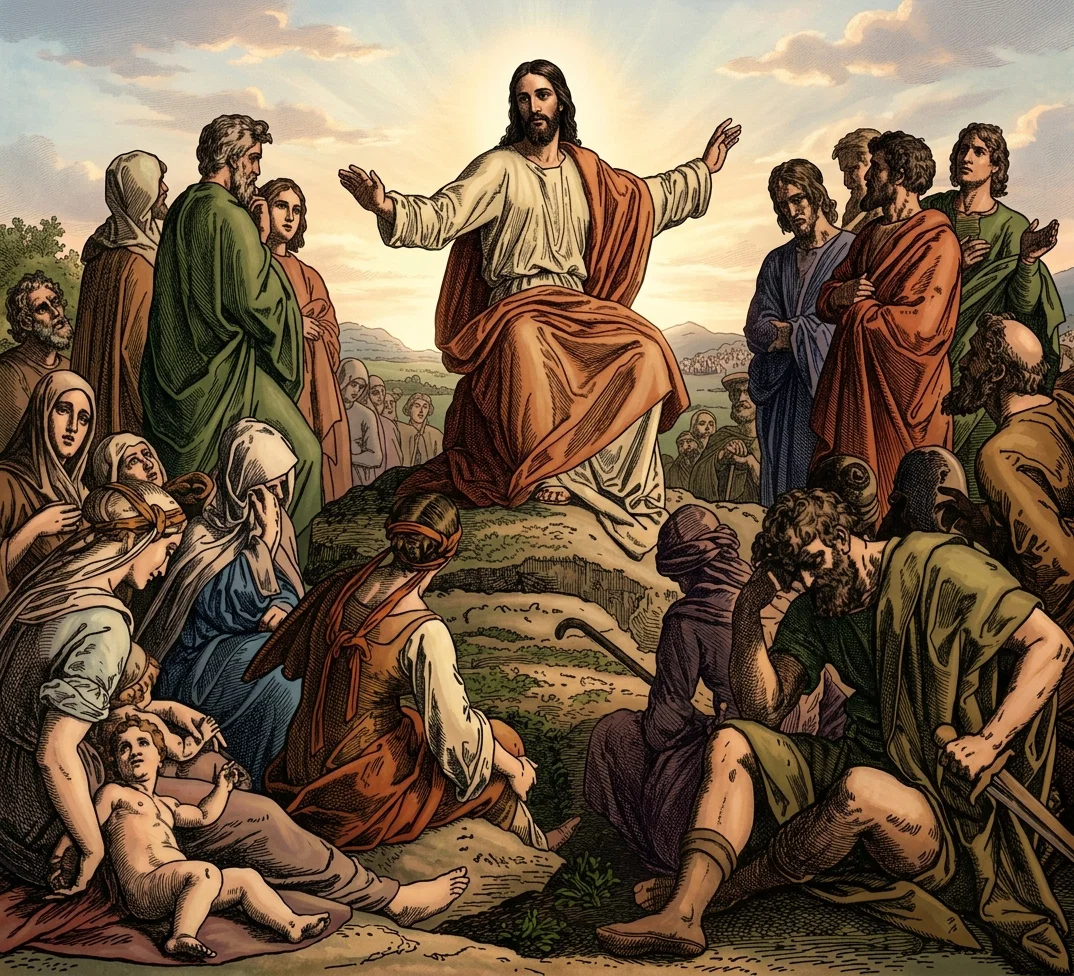
The congregation that assembled to hear Christ’s sermon on the mount was a mixed multitude. Christ’s heart yearned over them with pitying tenderness; for he knew how great were their needs. He used illustrations from the things of nature and from their daily practices to make clear to their minds matters of eternal importance. His utterances were full of tender love as he spoke to the weary and the oppressed. He was often interrupted by appeals from the sick and the afflicted, and while he healed their physical maladies, he administered comfort to their hungry souls. His words, “Thy sins be forgiven thee,” fell like a refreshing shower upon some thirsting souls, who knew not what to do to obtain salvation. And he began to teach them many things. He spoke unto them of the kingdom of God, presenting righteousness as of the first consideration. He laid open before them the claims of the law of God. The commandments of God had been buried up under a mass of human sayings, and it was necessary that as a detector he should separate the sacred from the common.
His discourses created discussion among the people, and though discussion is not the most desirable thing, yet it is preferable to cold, dead apathy. Christ’s interpretations of the Scriptures were as new to those who claimed to be expositors of the law as they were to the multitudes that thronged his steps; for truth had been mutilated in the hands of the scribes and rabbis. Christ came to remove the rubbish, and to let the jewels of truth shine out in their priceless beauty. He knew that his discourses would create controversy, and excite the passions of the scribes and Pharisees; but he knew also that controversy would be better than calm, when no one inquired, “What is truth?” Calm comes after storm, and inquiry must be roused in order that advanced truth may be discovered. When controversy is awakened, the advocates of truth are accredited with causing disturbance. Those who are engrossed with business, who are seeking for gratification of the carnal senses in following after pleasure, care nothing for eternal realities; but should not eternal matters be presented to those who are, as it were, sleeping the sleep of death? Let earnestness be awakened even amid contention, and many will search for truth as for hidden treasure. In every audience where Christ presented the truth in clear lines, there were angry interruptions on the part of the priests and rulers, and their protests led to sharp contention, but in these audiences there were many who said, “This is the Christ of God.”
The Scriptures were sufficiently clear to prove that Christ was the Son of God, the Messiah, the “light to lighten the gentiles,” and “the glory of thy people Israel;” but the minds of men were so darkened by the misapplication of Scripture, that, although prophecy was fulfilling before their very eyes, in the teachings and miracles of Christ, yet they failed to recognize the fulfillment of prophecy and remained in darkness. At times they were convinced of the truth, but the humiliation of acknowledging the truth was greater than they would endure.
Why did not the Jewish nation accept of the evidences that were so clear and convincing?7The Holy Spirit bore witness in the miracles that Christ did. All the divine attributes were revealed in him, and though he bore the sufferings of humanity, he was the Majesty of heaven. He did not find a select few to whom to teach the great eternal truths, but he set these matters before the multitude; for the world was his field. He set forth the law of his kingdom before both saint and sinner, before the great men of the world and before the common people. The truth he taught was sent home to the hearts of those who heard by the power of the Holy Spirit, to search their hearts as with a lighted candle. God was in Christ reconciling the world unto himself. Christ taught the mysteries of the kingdom of God by presenting truth to the minds of men through some natural object that unfolded its spiritual nature. His was not a subtle, man-invented theory that but few could perceive; it was the presentation of that which met the needs of the suffering and oppressed. However prejudiced men were, they yet realized that his words met their want. His words were simplicity itself, and the most unlearned could comprehend their import as he promised rest to the weary, and blessing upon the poor and mournful. He did not present truth in ambiguous language. There was too much at stake to do this; for the ignorant are many, and the life of peace and rest is obtained by the reception of truth. It was necessary that it should be made so plain that no one of his hearers should be misled.
THE SERMON ON THE MOUNT.
Priests and rulers had interposed themselves between the people and God, and they sought to interpose between them and the great Teacher, even as they do in this day. How great will be the responsibility of men who seek to hinder souls from entering into the kingdom of heaven! The whole tenor of Christ’s teaching was contrary to that of the rabbis. In his sermon on the mount he tore away the middle wall of partition that separated men one from another through national prejudices, and taught the exercise of a love that was to embrace the human race. He said to the people: “Ye have heard that it hath been said, Thou shalt love thy neighbor, and hate thine enemy. But I say unto you, Love your enemies, bless them that curse you, do good to them that hate you, and pray for them which despitefully use you, and persecute you; that ye may be the children of your Father which is in heaven; for he maketh his sun to rise on the evil and on the good, and sendeth rain on the just and on the unjust. For if ye love them which love you, what reward have ye? do not even the publicans the same? And if ye salute your brethren only, what do ye more than others? do not even the publicans so? Be ye therefore perfect, even as your Father which is in heaven is perfect.”
Christ teaches that we are to recognize our neighbor in every race and condition of men. No distinction is to be made as to who is our neighbor, on the ground of poverty, or wealth, or position. The followers of Christ are to see their neighbor in any one who needs their help. “All ye are brethren.” The Lord has not established a kingdom merely for the rich, and the one essential thing for an entrance into his kingdom is Christlikeness of character. The Lawgiver explained the meaning of the divine precepts, and showed that they were not arbitrary requirements, but that in the doing of them there is life; for Christ from the pillar of cloud had distinctly told them that those who did them should live in them. The Ten Commandments are called in the New Testament the royal law of liberty. In obeying the divine precepts, men will assimilate to the divine character; for the character of God is expressed in his holy law. In substituting their own ideas, in erecting their own standard, they will come to misrepresent the Father and Jesus Christ, whom he has sent, coming far short of Christlikeness of character. In erecting a standard for themselves, they will cling to their own deficiencies, practice their former habits, and fall far below the perfection of Christ’s character. But through the grace of Christ, we should ever strive to reach the perfect standard.
We are in a world of imperfection, and on every hand is the image of false Christs,—Christians who are Christians only in name; for they are retaining rejectional attributes of character, that mark them as subjects of the enemy, rather than subjects of the Prince Emanuel. Were they under the control of Christ, they would bear his image and superscription; but they are false christs, misrepresenting Jesus, denying him every day in character, although professing to believe on his name. Christ expounded the precepts of the law in his sermon on the mount; for he knew that some who were departing from it, would return to allegiance, and become representatives of the Son and the Father.
“WE WOULD SEE JESUS.”
By W. N. Glenn
BY W. N. GLENN.
Among the throng of Jews who gathered at Jerusalem to attend the Passover feast, the last of these occasions in which our Lord participated, were some Grecians. The record says: “And there were certain Greeks among them that came up to worship at the feast; the same came therefore to Philip, which was of Bethsaida of Galilee, and desired him, saying, Sir, we would see Jesus.” John 12:20, 21.
We are not told the object of this request, whether it was prompted by the characteristic Greek desire “to tell or to hear something new” (Acts 17:21), or to learn of Jesus some lesson of truth. It is a fact, however, that during his ministry, and especially after the resurrection of Lazarus, and during the few days from his triumphal entry into Jerusalem until his crucifixion, there was a general desire on the part of all classes to see Jesus. The purposes of this general desire were varied. On the part of many the motive was mere curiosity; of this class was Herod, governor of Galilee. Luke 23:8. Many others were prompted by the thought that perhaps he was the Messiah for whom they were looking, who would give them victory over their Roman masters, and they wanted to be in position to secure special favors. Others desired relief from physical suffering; others sought to entrap him by questions, and break his influence with the people; and still others were anxious to find occasion to accuse him before the authorities and have him put to death (John 11:47–57), while a few believed that he was really the Son of God.
However, to see Jesus literally, and to be with him, are prominent among the precious promises of the Gospel: “Beloved, now are we the sons of God, and it doth not yet appear what we shall be; but we know that, when he shall appear, we shall be like him; for we shall see him as he is.” 1 John 3:2. So much to be desired is the fulfillment of this promise that “every man that hath this hope in him purifieth himself, even as He is pure.” Verse 3.
In that comprehensive sermon on the mount we have these words: “Blessed are the pure in heart; for they shall see God.” Matt. 5:8. And just at the close of his ministry the Lord added this comforting assurance: “I go to prepare a place for you. And if I go and prepare a place for you, I will come again, and receive you unto myself; that where I am, there ye may be also.” John 14:2, 3. Paul also gives an important testimony on this point: “For the Lord himself shall descend from heaven with a shout, with the voice of the Archangel, and with the trump of God; and the dead in Christ shall rise first; then we which are alive and remain shall be caught up together with them in the clouds, to meet the Lord in the air; and so shall we8ever be with the Lord.” 1 Thess. 4:16, 17. The importance of this promise is emphasized in the next verse: “Wherefore comfort one another with these words.” From the foregoing scriptures we learn that the promise to see Christ and be with him is not only an incentive to purity of life, but is also a special source of comfort in the sorrows and trials and afflictions incident to the Christian’s sojourn in this sinful world. This is not by any means all there is in this connection, but it will suffice for the present purpose.
Another prominent thought is that the fact of their having seen Christ in the flesh was a source of great faith and courage to the first apostles in proclaiming the Gospel. “That which was from the beginning, which we have heard, which we have seen with our own eyes, which we have looked upon, and which our hands have handled, of the word of life (for the life was manifested, and we have seen it, and bear witness, and show unto you that eternal life, which was with the Father, and was manifested unto us); that which we have seen and heard declare we unto you, that ye also may have fellowship with us; and truly our fellowship is with the Father, and with his Son Jesus Christ. And these things write we unto you, that your joy may be full.” 1 John 1:1–4.
In chapter 4:14 the apostle adds, “We have seen and do testify that the Father sent the Son to be the Saviour of the world.” Also in his Gospel record (chap. 1:14,) the same witness says, “We beheld his glory, the glory as of the only begotten of the Father.”
The apostle Peter shows how his confidence in proclaiming the word was strengthened by having seen the Lord in person: “For we have not followed cunningly devised fables, when we made known unto you the power and coming of our Lord Jesus Christ, but were eyewitnesses of his majesty . . . when we were with him in the holy mount.” 2 Peter 1:16–18.
The apostle Paul bases his call to the apostleship upon the Lord’s having appeared to him, and his having received his ministry direct from Heaven. In the ninth chapter of Acts is the record of this man’s conversion while on the road to Damascus with a commission authorizing him to arrest the disciples of Christ and bring them to Jerusalem. He related this experience to an excited mob in Jerusalem (chapter 22), and again before Festus and Agrippa at Cæsarea (chapter 26). In writing to the Corinthians he asks, “Am I not an apostle? . . . have I not seen Jesus Christ our Lord?” 1 Cor. 9:1. And in the fifteenth chapter, after citing various persons to whom the Lord had appeared after his resurrection, the apostle adds, “And last of all he was seen of me also, as of one born out of due time.”
But we would see Jesus. We are far this side of his personal advent to the earth, and away past the apostolic age. His appearing again is yet in the future. Is it possible for us to see Jesus now?—Yes, we may see him by faith; “faith is the substance of things hoped for.” By faith we have a far more comprehensive view of Christ than they had who saw him in person only. If we would see Jesus, we must see him by faith in his word. “Faith cometh by hearing, and hearing by the word of God.” Rom. 10:17. Notwithstanding the personal presence and personal teaching of the Master, which his disciples had enjoyed for over three years, yet after his resurrection, when he would give them a more perfect knowledge of himself and his mission, he “opened their understanding, that they might understand the Scriptures.” Luke 24:45. He had before told the Jews that the Scriptures testified of him.
Then if we would see Jesus, we must turn to the word of God, the Scriptures of truth. In what scriptures shall we seek to see him? It is common amongst the masses of those who profess the Christian name to point to the New Testament as the part of the word that teaches of Christ. But when Christ would have his disciples understand the Gospel by means of the Scriptures, there were no New Testament Scriptures. And when only a portion of the New Testament had been written, the apostle Paul, writing by inspiration of the Spirit, said, “All Scripture is given by inspiration of God, and is profitable for doctrine, for reproof, for correction, for instruction in righteousness.” 2 Tim. 3:16. Then until we have searched all the Scriptures, and brought them within our understanding, we have not exhausted the means at our hands for seeing Jesus.
Christ in All the Scriptures.
For the purpose of magnifying our view of the world’s Redeemer, let us note a few prominent points as seen in the light of Scripture. In the first chapter of John we read: “In the beginning was the Word, and the Word was with God, and the Word was God. The same was in the beginning with God. All things were made by him; and without him was not anything made that was made.” Verses 1–3. That the Word here mentioned was Christ, is shown in verses 10 and 14: “He was in the world, and the world was made by him, and the world knew him not.” “And the Word was made flesh, and dwelt among us.” To this testimony may be added that of Paul in his Epistle to the Colossians (chapter 1:16, 17): “For by him were all things created, that are in heaven, and that are in earth, visible and invisible, whether they be thrones, or dominions, or principalities, or powers; all things were created by him, and for him; and he is before all things, and by him all things consist.”
With the foregoing Scripture statements before us, we turn to the first statement in the Old Testament (Gen. 1:1), and read, “In the beginning God created the heaven and the earth.” In the thirty-third Psalm, sixth verse, we read again: “By the word of the Lord were the heavens made; and all the host of them by the breath of his mouth.”
It seems clear, in the light of all these testimonies of the Spirit, that the very first verse in the Bible refers to Christ; and we see Jesus, “the firstborn of every creature” (Col. 1:15), as the Creator and Upholder of the universe. Being the Creator of the world, it was Christ who rested on the seventh day, after occupying six days in the work of creation. Therefore it was he who “blessed the seventh day, and sanctified it.” Gen. 2:3. Thus in the very beginning Christ became Lord of the Sabbath day, which was made for man. See Mark 2:27, 28.
Nor did his work as redeemer begin with New Testament history, as is shown in the fact that he is “the Lamb slain from the foundation of the world” (Rev. 13:8), and in the further fact that the righteous are to inherit the kingdom prepared for them from the foundation of the world (Matt. 25:34). In the eleventh chapter of Hebrews is a long list (reaching clear back to Abel) of those who saw Jesus by faith and were willing to submit to all manner of trials and persecutions in defense of the faith. These all obtained a good report through faith, and will eventually see their Lord in the everlasting kingdom. Enoch’s faith led him to walk so closely to God that he was translated without seeing death. Elijah’s faith brought to him a like blessing. Noah preached the last message of mercy to the world of his day, and built an ark for the temporal saving of all who would accept rescue, in which structure we see a type of Jesus, the everlasting Redeemer. Abraham saw the Lord in person, when with two other angels he came to the patriarch’s tent and partook of his hospitality, and afterward told him that Sarah should bear him a son. Then, on their leaving his tent, Abraham walked some distance with his guests, when the Lord told him of the impending destruction of Sodom. See Genesis 18. Abraham’s faith looked forward to a “city which hath foundations, whose builder and maker is God” (Heb. 11:10); and Jesus said of him, “Abraham rejoiced to see my day; and he saw it, and was glad” (John 8:56).
By faith we see Christ in the pillar of cloud and of fire, leading his people Israel out of Egypt through the Red Sea, by way of the wilderness, to the promised land. They “were all baptized unto Moses in the cloud and in the sea; and did all eat the same spiritual meat; and did all drink the same spiritual drink; for they drank of that spiritual Rock that followed them [margin, ‘went with them’]; and that Rock was Christ.” 1 Cor. 10:2–4. By faith we see Jesus, the Word of God, the active Agent in all things, standing in the majesty of his power on Mount Sinai, and we hear him rehearse the law in the hearing of the people. By faith we see Jesus, the “Captain of the host of the Lord,” stand in the plain of Jericho and give commandment to Joshua, the leader of Israel. See Joshua 5:13 to 6:5. By faith we read all the scriptures of the prophets and “holy men of old,” as the inspiration of “the Spirit of Christ which was in them.” True faith in Christ does not stop in its effort to see Jesus when it has gone back to the beginning of the New Testament. It sees him in Genesis as verily as in Matthew. Whether we see him speaking a world into place, or guiding his faithful servants over the flood of waters that destroyed the ungodly inhabitants in Noah’s time, or parting the Red Sea for the deliverance of his people from Egyptian bondage, or standing in the grandeur of his majesty on Mount Sinai, or going about in human flesh healing the sick and raising the dead, or giving his own life for sinners and taking it up again, or returning to his former home in heaven, or whether we see his servants doing great works by the power of his name,—it is the same faith, and he is the same Lord. And if we look forward and see him coming again in power and great glory to receive his people unto himself, it is the same faith in the same infallible word. In the light of this word all who will may see Jesus in all his varied capacities—as creator, as redeemer, as father, as friend, as preserver, as prophet, priest, and king, and “very present help in trouble.”
Christ's Presence Banishes Despair
WHERE Christ brings his cross, he brings his presence, and where he is none are desolate, and there is no room for despair.—Mrs. Browning.