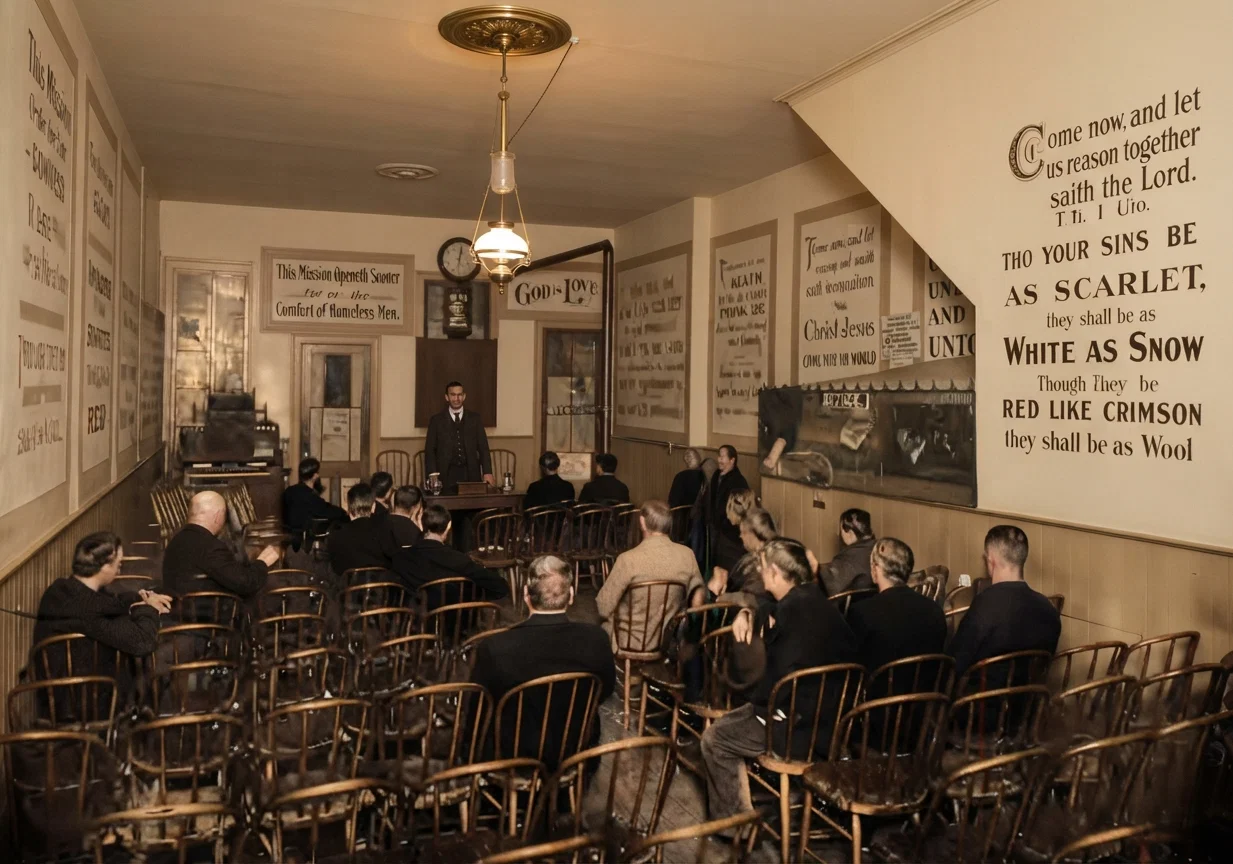
"YES, I have been a very wicked man, a good-for-nothing drunkard, for twenty-nine years, but in that time, You know, I have tried hard to quit. O, it hurts me to think of it, but it's the last time, and I am so weak, won't You help a poor man? I'm down now, clear down, and You tell me in the writing on the wall that You want to reason with me; and, tho my sins be scarlet, or a crimson red, You will make them white as snow. It's no use, I can't do anything; I know it, I have tried it so many times; but, Lord, look at the writing on the wall. You can do it, and I know it."
It was a solemn time; a poor, penitent Scandinavian was on his knees, talking with God; tears were falling thick and fast, and as he wiped them away with the back of his unwashed hand, traces of dirt moistened with the fluid from the heart's fountain were seen in irregular streaks over his face.
A soul was pleading with the Lord for help. The writing on the wall to which he referred was one of the many texts of Scripture seen on the walls of the Helping Hand and Medical Mission of San Francisco, Cal. It was a rainy night, and the mission was filled to the doors.
Just before the time for the services to begin, every worker in the mission came to the small room in the rear of the chapel to pray, and the burden of each heart was that the Lord would take full possession, so that in all the singing, praying, and preaching, Jesus could be seen and heard.
The text chosen for the evening was Isaiah 1:18: "Come now, and let us reason together, saith the Lord: though your sins be as scarlet, they shall be as white as snow; though they be red like crimson, they shall be as wool." This was the "writing on the wall." At the close of the meeting we invited those present who were tired of sin to raise their hand, and, as usual, several hands came up. Among them was the hand of the man with whom we knelt as he made the prayer referred to above.
The winter is on. Fruit-gathering is over for the season, and idle men are coming from every direction. They are homeless, hungry, footsore, and ragged; they range from fourteen to seventy-five years of age. Some of them are on crutches, some almost blind, others, owing to poverty and exposure, are sick in body and mind, while all of them are cripples, made so by man's powerful enemy.
Somebody's boy, brother, husband, or father is here among this increasing crowd of poverty-stricken men. To help him now, while he is down, would it be wrong? would it be a sin? Would it not be the right time to apply the "Golden Rule," "Whatsoever ye would that men should do to you, do ye even so unto them"? Is not the "ox" in "the pit"? and is not this the time to get him out? I am sure this is what Jesus would do if He were here. He says, "The Spirit of the Lord is upon Me, because He hath anointed Me to preach the Gospel to the poor; He hath sent Me to heal the broken-hearted, to preach deliverance to the captives, and recovering of sight to the blind, to set at liberty them that are bruised." Luke 4:18. Then read John 17:18: "As Thou hast sent Me into the world, even so have I also sent them into the world." Also in Isa. 58:7, that man feed the hungry, give shelter to the homeless, and clothe the naked. Read also in Matt. 25:34-40, "Come, ye blessed of My Father, inherit the kingdom prepared for you [you, you, dear one, who will do as He did] from the foundation of the world; for I was an hungered [I, Myself, Jesus], and ye gave Me meat [food.]" Where were You hungry?—On the earth, everywhere, wherever the children of men dwell, along the "hedges," down in the slums, out in "Shanty Town," up in the "tenement loft," below, in the deserted cellar.10We have no room for any more; the mission is full; but the call for help comes thicker and faster. Not since the mission started, ten months since, have the appeals for help been so great as now. Never before have we seen men in such a deplorable condition, loaded down with sin and shame, manacled, soul and body, with every kind of destroying habits, and clothed in garments that are threadbare and loathsome, made so by long use and by covering a body that is filthy with disease.
The Helping Hand and Medical Mission is now ten months old, and during its short life it has been able to do a little work, relieving a portion of the sufferings of its large family; and as we believe the many readers of THE SIGNS OF THE TIMES will be interested in an up-to-date report, we give the following:—
Penny lunches served . . . . . . . . . . 337,000
Men furnished a bath and clean bed . . . . 25,500
Garments fumigated . . . . . . . . . . . . 35,000
Men furnished employment . . . . . . . . . . 6,575
Suits of clothing distributed . . . . . . . 1,073
Medical treatments given . . . . . . . . . . 2,490
Men who have made a start to serve the Lord . 727
Sermons preached . . . . . . . . . . . . . . 308
Bible-readings held . . . . . . . . . . . . . 618
Quite a number who once raised their voice in praise to God for what He had done for them, have died and are numbered with the great majority. We leave them there, for they are in the hands of the faithful Judge, who will do all things well.
Many hearts have been made glad by the return home of a long-lost son or father, who came to the mission a physical wreck; so, taking a look over the busy ten months of the past, we are brought to say, "Bless the Lord, O my soul, and all that is within me bless His holy name." And as the New Year comes to us, finding the mission full of men who need help, we pray the Lord for more wisdom and strength so that we can do better work for Him in 1899 than we have in the past.
B. F. RICHARDS.
An Interior View of Chapel and Reading-room of our Helping Hand Mission. Altho the assistant chaplain, Brother H. H. Dexter, stands at the desk, it is not a time of regular service. At the regular services there is always a good attendance, and frequently the room is crowded.
HASTE ON.
By Frances E. Bolton
CHRIST comes; earth's night is nearly done.
O messengers, haste, haste, speed on;
The harvest wanes, yet gather in
The last few sheaves your zeal may win;
For in brief time the harvest year
Will all be past! Then on with cheer.
There's yet a gleaning left for thee
E'er time shall be eternity.
FRANCES E. BOLTON.
MISSION NOTES.
THE Presbyterian Board has wiped out a debt of $97,454, and received last year $801,773 for regular work.
THE American Baptist Missionary Union, the Presbyterian Board, the Methodist Episcopal Church, all contemplate establishing missions in the Philippine Islands in the near future.
LAST year the Congregationalists gave $1.03 per member for foreign missions; the Presbyterians, 94 cents per member; the Baptists, 80 cents per member; the Methodist Episcopals, 34 cents; the Episcopalians, 44 cents; Seventh-day Adventists, $1.75.
THERE are about 150,000,000 native heathen in Africa yet entirely ignorant of the Gospel. This is about one-tenth of the population of the world.
THE total income of the China Inland Mission for the past year was $226,065, of which more than $185,000 came from England, the balance from America, Australia, and China. The number of missionaries on January 1 was 744, since increased to 773.
DURING the past year the largest amount for foreign missions was given by the Methodist Episcopal Church, $977,491. Next to the Methodist Episcopal comes the Presbyterian, with $899,387; the Baptists gave $782,474; the Congregationalists, $643,283.
THE American Baptist Missionary Union makes an excellent showing in the matter of self-support among its missions. The number of its churches in heathen lands is 855, of which not less than 524 are self-supporting; while of its 1,235 mission schools, 383 receive no help whatever from America. A partial report of benevolent contributions of these churches in pagan lands gives $51,462; and it is believed that, taking into account the gifts that are not reported, the amount would be double that thus named.—Christian Worker.
ON the foreign field some of the leading religious bodies of this country are represented as follows in the number of workers: The Methodist Episcopal have 5,652; the Baptists come next, with 5,001; the Congregationalists, with 2,956; the Presbyterians, 1,776; the Episcopalians, 413. In communicants the Baptists lead with 202,527; and the Methodist Episcopals have 169,629; the Congregationalists, 44,600; the Presbyterians, 34,606, and the Episcopalians, 4,074.
HELPING HAND MISSION.
By S. N. Curtiss
In another column of this department will be found a report of work for ten months, by the chaplain, B. F. Richards.
Certainly the friends of the mission have every reason to be encouraged by this good report. The workers in the mission are of good courage and eager to continue in their labor of love,—"feeding, cleansing, and clothing those who need their help," since "in this way these outcasts are prepared to know that some one cares for their souls."
And what a satisfaction to these workers, and to all who have by their contributions made such a work possible, to know "that many of these poor outcasts from society will, through the ministration of human agencies who co-operate with the divine, seek to restore the moral image of God in others"!
No appeal has of late been made through this paper for contributions. But there is the same need for donations as ever. The winter season is now here, and hundreds of men are out of employment, and homeless, and every night the mission beds are full by half past ten or eleven o'clock, and still we are unable to accommodate all who apply.
We would be especially thankful for contributions of clothing, beans, dried fruit, and other provisions. These should all be sent charges prepaid, and addressed to Helping Hand and Medical Mission, 641 Commercial Street, San Francisco; and a letter should be written stating who are the senders, so that proper acknowledgment may be made when they arrive. The bill of lading should invariably be mailed to the address given above whenever goods are sent by freight; otherwise the goods may lie in the freight office for weeks and storage charges be made.
Cash contributions should be sent to the treasurer, S. N. Curtiss, care SIGNS OF THE TIMES, Oakland, Cal.
S. N. CURTISS,
Secretary and Treasurer.
THE PURPOSE OF THE CHURCH.
THE church of Christ is a missionary enterprise.
It is not intended to stand still, but to "go."
It is not intended to be self-contained, but to "make disciples," and "baptize them in the name of the Father, the Son, and the Holy Ghost."
It is not intended to be silent, but to "teach" the things that Christ has commanded.
This is the very essence of Christianity, that it is an advancing, radiating, conquering religion.
It is born to grow. It lives to spread. It is a centrifugal force, which works from the center toward the circumference.
The church is organized to conserve, increase, direct, and apply that force. It is the body, in which the Spirit of Christ is to live and work. The Spirit of Christ is missions. When that Spirit wanes, the church is sick; when that Spirit dies, the church is a corpse.—Anon.
ONE OF MANY.
By Editor
This is the way a subscriber in Little Rock, Ark., writes:—
“I am happy to note that you are going to print 1,000,000 copies of your good paper, THE SIGNS OF THE TIMES, dated Jan. 5, 1899.
“The SIGNS is an ‘able minister;’ and it ought to be scattered like the leaves of autumn; for it is doing, and can do, a work that the living preacher can not do.
“The SIGNS is surely stepping out in the right direction. It is designed to accomplish a grand mission; and I wish for it a glorious success.
“I would like to circulate one thousand of them myself. Who will help to spread the glad tidings of the glorious Gospel of Christ? J. J. Jobe.”
And there are many who will help and are helping.
OUR WORK AND WORKERS.
By Editor
AT the last quarterly meeting of the church in Newburg, W. Va., seven members were added.
THE addition of three members to the church at Cary, Me., is reported by Brother P. B. Osborne.
THREE converts comprise the report of manifest results of meetings held at Newton, Iowa, by Brother B. L. Dieffenbacher.
BROTHER W. B. EVERHART has the use of the United Brethren Church building, near Darbyville, Iowa, for a series of meetings.
OUR State agent in Nebraska says, in the Reporter, "I am leaving some in every church at work with THE SIGNS OF THE TIMES."
IN a schoolhouse four miles from Volga, Iowa, Brethren C. J. Buhalts and U. P. Long have been holding meetings, and as progress in the work report four adherents.
SABBATH-SCHOOL conventions are coming to the front in several conferences, and all the reports we have seen indicate that the schools concerned in them are the recipients of marked encouragement.
THE first church school under the auspices of Keene (Texas) Industrial Academy was started in December, at Talala, Indian Territory. The brethren erected a neat building, and the school was opened with eighteen pupils.
AT Bettinger, W. Va., President S. M. Cobb recently held a few meetings in connection with Brother Gardner, with the result that six persons accepted the doctrines advanced, and a Sabbath-school of thirteen members was organized.
BROTHER O. O. FARNSWORTH notifies us that the church in Boston, Mass., is located at 36 Bromfield Street. Sabbath-school, at 10 A.M.; other services, at 11:30. Brother Farnsworth is elder of the church, and his residence is 52 Rush Street, East Somerville, Mass. The work there is encouraging.
A SPECIAL week of prayer was held in the Seventh-day Adventist Church of Delta, Colo., from the 1st to the 7th of this month. Brother Isaac D. Rowell writes that "the meetings were well attended both morning and evening during the entire week; and from each meeting every one went home feeling that God had especially blessed him individually, and that the Holy Spirit had rested upon all."
THE brethren at Bern, Kansas, are desirous of opening a helping hand reading-room at Pawnee City, Neb., where literature pertaining to the truths we are giving to the world will be available to the public. They ask for donations or the loan of books and periodicals to enable them to carry out this purpose. Address O. S. Runyan, Bern, Nemaha County, Kansas; or, James C. Nichols, Pawnee City, Pawnee County, Neb.
IN our Oklahoma paper, The Gleaner, of the 4th inst., is a good report of the Bethel Mission, at Guthrie, from Brother A. W. Jenson. At the time of the report the mission was six weeks old, and there had been some interesting experiences. "During this time we have given free 76 meals, 36 lodgings, and 18 baths, besides other treatments. We have many interesting experiences. Three have been converted and quite a few convicted. One man whom we found paralyzed in limbs and left arm from sciatic rheumatism, has been with us four weeks, and we had to erect for his treatment a hot-air cabinet. He is improving steadily but slowly, and we will have to keep him until warm weather at least. He is penniless and friendless. We have gone before the police court and rescued men from the rock quarry. To-day we saw an officer leading a boy from Missouri, fifteen years old, to the lockup, and, finding him guilty only of vagrancy and beer-drinking, we requested him turned over to us. So, in place of being in the lockup, he is now asleep in our apartments while we are writing this."
The Sabbath School International Series
LESSON VI.—SABBATH, FEBRUARY 11, 1899.
BAPTISM OF JESUS.
At the Ford of the Jordan, Near Jericho, Autumn of A.D. 27.
Note.—The texts inclosed in marks of parentheses, while not essential to the lesson study, will be found to throw much light upon the lesson, and are suggested for those who wish to study further.
16 "John answered, saying unto them all, I indeed baptize you with water; but there cometh He that is mightier than I, the latchet of whose shoes I am not worthy to unloose; He shall 17 baptize you with the Holy Ghost and with fire; whose fan is in His hand, thoroughly to cleanse His threshing-floor, and to gather the wheat into His garner; but the chaff He will burn up with unquenchable fire.
18 "With many other exhortations therefore preached he good 19 tidings unto the people; but Herod the tetrarch, being reproved by him for Herodias his brother's wife, and for all the evil 20 things which Herod had done, added yet this above all, that he shut up John in prison.
21 "Now it came to pass, when all the people were baptized, that, Jesus also having been baptized, and praying, the heaven 22 was opened, and the Holy Ghost descended in a bodily form, as a dove, upon Him, and a voice came out of heaven, Thou art My beloved Son; in Thee I am well pleased.
23 "And Jesus Himself, when He began to teach, was about thirty years of age, being the son (as was supposed) of Joseph."
11 "I indeed baptize you with water unto repentance; but He that cometh after me is mightier than I, whose shoes I am not worthy to bear; He shall baptize you with the Holy Ghost 12 and with fire; whose fan is in His hand, and He will thoroughly cleanse His threshing-floor; and He will gather His wheat into His garner, but the chaff He will burn up with unquenchable fire.
13 "Then cometh Jesus from Galilee to the Jordan unto John, 14 to be baptized of him. But John would have hindered Him, saying, I have need to be baptized of Thee, and comest Thou 15 to me? But Jesus answering said unto him, Suffer it now; for thus it becometh us to fulfil all righteousness. Then he 16 suffereth Him. And Jesus, when He was baptized, went up straightway from the water; and lo, the heavens were opened 17 unto Him, and He saw the Spirit of God descending as a dove, and coming upon Him; and lo, a voice out of the heavens, saying, This is My beloved Son, in whom I am well pleased."
28 "These things were done in Bethany beyond Jordan, where John was baptizing."
31 "And I knew Him not; but that He should be made manifest to Israel, for this cause came I baptizing with water."
33 "And I knew Him not; but He that sent me to baptize with water, He said unto me, Upon whomsoever thou shalt see the Spirit descending, and abiding upon Him, the same is He that baptizeth with the Holy Spirit."
SUGGESTIVE QUESTIONS.
While the people hesitated in their decisions as to who the strange prophet was, what did John say of One who was to follow him? Luke 3: 16; Matt. 3: 11. (John 1: 15, 30.)
For what reason did John say he had been sent to baptize? John 1: 31. (Isa. 40: 3.)
How did John come to positively know that the One whom he had baptized was the looked-for Messiah? John 1: 33.
Side Lights.—"Desire of Ages," pp. 109-113; "Spirit of Prophecy," vol. 2, chapter 4.
NOTES.
Bethany.—The common version reads, the house of the ford, or passage. The place "Bethabara," was beyond the Jordan, that is, on the east bank of that river, supposed to be nearly opposite Jericho. It is not positively identified. See "Smith's Bible Dictionary."
Burn up, etc.—Language could not more forcibly express the utter destruction of wicked men. As chaff is burned up, so will they be consumed in the presence of God. The fire will not be quenched till it has done its work.
Then cometh Jesus.—The Saviour's modesty on this occasion is a standing model for every professed Christian. As He was retiring and modest, in this first public act of His life, so may all become the same, and demonstrate their worthiness to be counted His followers.
As a dove.—Never, before had such an answer to prayer been realized. The form taken by the Holy Spirit on this occasion is certainly suggestive. It was in the beautiful form and gentle motion of the dove, the appropriate symbol of gentleness and affection. It identified Him as the meek and lowly One, the kind and loving Saviour. That Spirit is the same to-day, and, when received, points out the receiver as being peaceable and "gentle, and easy to be entreated, full of mercy and good fruits, without partiality, and without hypocrisy." James 3: 17.
THE SUNDAY SCHOOL INTERNATIONAL SERIES
LESSON VII.—SUNDAY, FEBRUARY 12, 1899.
CHRIST'S DIVINE AUTHORITY.
NOTE.—Jesus had healed an impotent man at the pool of Bethesda, in Jerusalem, on the Sabbath day. For this cause "did the Jews persecute Jesus, and sought to slay Him." Following this record comes the reply of Jesus to their accusations, which constitutes the lesson for this week.
17 "But Jesus answered them, My Father worketh even until 18 now, and I work. For this cause therefore the Jews sought the more to kill Him, because He not only brake the Sabbath, but also called God His own Father, making Himself equal with God.
19 "Jesus therefore answered and said unto them,
"Verily, verily, I say unto you, The Son can do nothing of Himself, but what He seeth the Father doing; for what things soever He doeth, these the Son also doeth in like manner.
20 For the Father loveth the Son, and showeth Him all things that Himself doeth; and greater works than these will He 21 show Him, that ye may marvel. For as the Father raiseth the dead and quickeneth them, even so the Son also quicken- 22 eth whom He will. For neither doth the Father judge any 23 man, but He hath given all judgment unto the Son; that all may honor the Son, even as they honor the Father: He that honoreth not the Son honoreth not the Father which sent 24 Him. Verily, verily, I say unto you, He that heareth My word, and believeth Him that sent Me, hath eternal life, and cometh not into judgment, but hath passed out of death into 25 life. Verily, verily, I say unto you, The hour cometh, and 26 now is, when the dead shall hear the voice of the Son of God; 27 and they that hear shall live. For as the Father hath life in Himself, even so gave He to the Son also to have life in Himself, and He gave Him authority to execute judgment, because He is the Son of man."
Golden Text.—"This is indeed the Christ, the Saviour of the world." John 4:42.
SUGGESTIVE QUESTIONS.
(1) What circumstances led up to the words of Christ contained in this lesson? See introductory note. (2) What did Jesus answer them? V. 17. (3) Then what did the Jews seek to do? Why? V. 18. Note 1. (4) What did Jesus then say of the power of the Son? V. 19. (5) What is the Father's regard for the Son? What does the Father show the Son? What would be the effect upon the people? V. 20. Note 2. (6) What further power does the Father give to the Son? V. 21. (7) To whom is judgment committed? V. 22. (8) Why is this authority bestowed upon the Son? What is the effect of not honoring the Son? V. 23. (9) What is the result of hearing and believing the Word? V. 24. (10) What did Jesus say was then coming to pass? V. 25. Note 3. (11) In whom is the source of life? V. 26. (12) Why does the Son have authority to execute judgment? V. 27.
NOTES.
1. "Had broken the Sabbath day."—The accusations against Jesus were always false. He had not broken the Sabbath day. He never broke the Sabbath day, or any other commandment. He was absolutely without sin (Heb. 4:15), which could not have been true if He had broken any one of the commandments (James 2:10; 1 John 3:4). He disregarded the traditions of the Jews concerning the observance of the Sabbath, as in many other things, but He did not disregard the Sabbath day. There never was any controversy between the Jews and Christ, or between them and the apostles, or between them and the church during the first century, as to the day of the Sabbath. The Jews only complained of Jesus and His disciples because of their manner of keeping the Sabbath; and He showed them that their traditions, which were unnecessary burdens, were in violation of true Sabbath-keeping. "It is lawful to do good on the Sabbath day." "Making Himself equal with God."—This was also a false accusation. As a man, Christ never claimed equality with God only in the ordinary sense in which a son is equal with a father—in those things in which He was made equal by the Father. Verse 19 is emphatic on this point: "The Son can do nothing of Himself, but what He seeth the Father do." See also verses 26, 27, and chapter 8:28. Again Jesus said, "My Father is greater than I." Chapter 14:28.
2. The Father's love for the Son.—"To love is expressed by two words in the New Testament. Agapao indicates a reasoning, discriminating attachment (the deliberate choice of one out of a number) founded on the conviction that its object is worthy of esteem, or entitled to it on account of benefits bestowed. Phileo represents a warmer, more instinctive sentiment, more closely allied to feeling, and implying mere passion. Thus phileo represents the affectional element of love, and agapao the intelligent element. Men are bidden to love (agapao) God; never phileo, since love to God implies an intelligent discernment of His attributes, and not merely an affectionate sentiment. Both elements are combined in the Father's love for the Son (agapao in John 3:35; phileo here, 5:20). Agape is used throughout 1 Corinthians 13. Erao, 'love' in which the idea of sensual passion predominates, is never used in the New Testament."—Vincent's Word Studies.
3. "The dead shall hear."—This means the spiritually dead, as is indicated by the expression, "the hour is coming, and now is." The resurrection is future, and is referred to in verses 28, 29.
You Have Been Wanting
By Editor
A College Education
Do You Want One Still?
Then Read Our Offer
We will give you a free scholarship of one year, including board, room, and tuition, in any one of the following colleges or academies:—
Union College, Lincoln, Nebraska
Walla Walla College, College Place, Wash.
Healdsburg College, Healdsburg, Cal.
South Lancaster Academy, S. Lancaster, Mass.
Mt. Vernon Academy, Mt. Vernon, Ohio
Keene Industrial Academy, Keene, Texas
Southern Industrial School, Graysville, Tenn.
Upon the condition that you secure for us a certain number of yearly subscriptions for THE SIGNS OF THE TIMES, at one dollar ($1.00) each.
The number of subscriptions required to entitle you to a scholarship in Union College, Healdsburg College, Walla Walla College, South Lancaster Academy, Mt. Vernon Academy, and Keene Industrial Academy, is 140. One hundred subscriptions will entitle you to a scholarship in the Southern Industrial School, at Graysville, Tennessee. These subscriptions must be accompanied by the cash, $1.00 for each subscription, and must be sent to us direct.
If you are interested in securing an education without financial expense to yourself, write us for particulars and instructions. We are making you an offer of great intrinsic value,—an offer whose acceptance will mean much in your future usefulness, whatever your field of labor. Send for catalogues to the schools named above, and write us at once in order that you may begin work without delay.
Address,
SIGNS OF THE TIMES,
Subscription Dept. Oakland, Cal.
Lessons by Mail on Medical Electricity or How to Use the Battery
By Prof. G. L. Abell
By Prof. G. L. Abell
Member of the Board of Directors of the Electro-Medical Society of San Francisco.
Learn how to use the battery and treat yourself. Many diseases are quickly cured by the proper application of electricity. The course embraces the treatment of every organ and part of the body. The lessons are written in plain language and are illustrated. Course, five dollars. Send for circular. Address,
PROF. G. L. ABELL, School of Chemistry and Electro-Therapeutics. 22 1/2 Geary St., San Francisco, Cal.