Your ShelfYour Projects

Review and Herald, Vol. 31, No. 18.

THE WORDS WE SPEAK
Earlier text: Afore Prepared Unto Glory

THE DRESS REFORM.

AN APPEAL TO THE PEOPLE IN ITS BEHALF.
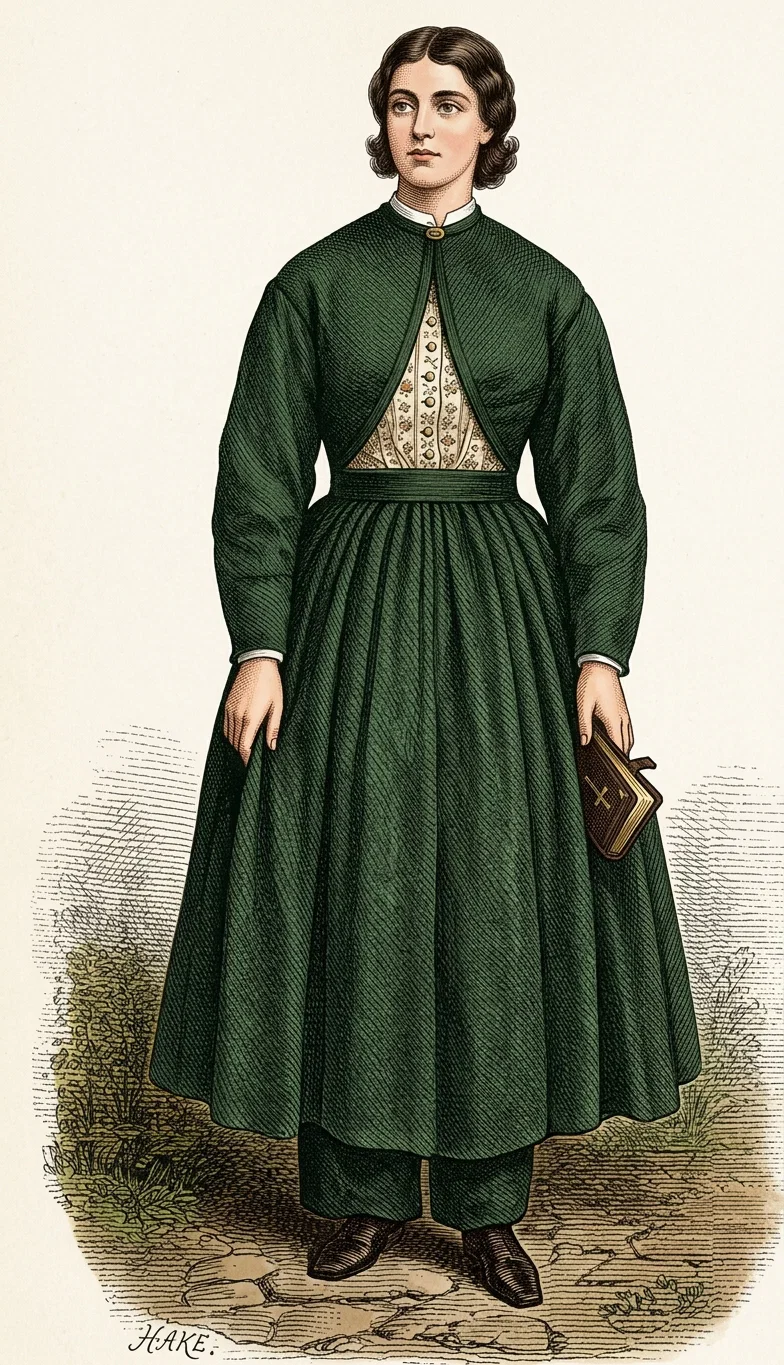
We are not Spiritualists. We are Christian women, believing all the Scriptures say of man's creation, his fall, his sufferings & woes on account of continued transgression, of his hope of redemption thro' Christ, and of his duty to glorify God in his body and spirit which are his, in order to be saved. We do not wear the style of dress here represented to be odd,—that we may attract notice.
We do not differ from the common style of woman's dress for any such object. We choose to agree with others in theory and in practice, if we can do so, and at the same time be in harmony with the law of God, and with the laws of our being. We believe it wrong to differ from others unless it be necessary to differ in order to be right. In bearing the cross of adopting the reform dress we are led by a sense of duty. And although it may appear objectionable to those who are governed by fashion, we claim that it is the most convenient, the most truly modest, and the most healthful style of dress worn by woman.
We have counted the cost of appearing singular in the eyes of those who feel compelled to bow to fashion. And we decide that in the end it will pay to try to do right, though for the present we may appear odd in the eyes of those who will sacrifice convenience, comfort, and health, at the altar of fashion.
We have also looked at the fact that our course in this matter of dress will cost our friends disagreeable feelings, and have taken into the account those things which excited their feelings of prejudice against the reform dress. When among strangers we are supposed to be Spiritualists, from the fact that some of that class adopt what is commonly called “the short dress.” And the question is frequently asked, “Are you Spiritualists?” To answer this question, and to give the reader some of the reasons why we adopt so unfashionable a style of dress, is this little tract given. We are well aware that some of those who espoused the cause of Spiritualism, over the moral worth of whom a shade of uncertainty has been cast, by the extravagances and immoralities among them, have adopted the short dress, and that their zeal in so doing, under the peculiar circumstances, could but disgust the people against anything of the kind.
How could it be otherwise? The people are shut up to fashion. They do not understand the benefits of our style of dress. And it is all the more objectionable to them as it resembles in some respects that worn by some doubtful Spiritualists. We most certainly bid ladies who have embraced Spiritualism a hearty welcome to all the blessings and benefits of a convenient, healthful, and (being of a proper length, and neatly and properly fitted and made,) truly modest dress, and wish they were as consistent and right in other respects.
In the existing state of things the people may regard the adoption of our style of dress as a bold step on our part, showing more independence than good taste. They may censure us. They may deal in wit and sarcasm in reference to our dress. They may even utter bitter speeches on account of our course in this thing. But our work shall be, by the grace of God, to patiently labor to correct their errors, remove their prejudices, and set before them the reasons why we object to the popular style of woman's dress, also some of the reasons why we adopt ours.
We object to the popular style of woman's dress.
1. Because it is not convenient. In doing housework, in passing up and down stairs with both hands full, a third hand is needed to hold up the long skirts. See that lady passing up to her chamber with a child in her arms, and both hands full, stepping upon her long skirts, and stumbling as she goes. She finds the popular style of dress very inconvenient. But it is fashionable, and must be endured.
If she goes into her garden to walk or to work among her flowers, to share the early, refreshing, morning air, unless she holds them up with both hands, her skirts are dragging and drabbling in dirt and dew, until they are wet and muddy. Fashion attaches to her cloth that is, in this case, used as a sort of mop. This is exceedingly inconvenient. But for the sake of fashion it must be endured.
In walking upon the streets, in the country, in the village, or in the crowded city, her long skirts sweep the dirt and mud, and lick up tobacco spittle, and all manner of filth. Careless gentlemen sometimes step on these long dresses, and, as the ladies pass on, tear them. This is trying, and sometimes provoking; and it is not always convenient to mend and cleanse these soiled and torn garments. But they are in harmony with fashion, and all this must be endured.
In traveling in the cars, in the coach and omnibus, fashionable dresses, especially when extended by hoops, are sometimes not only in the way of the wearers, but of others; and we charitably think that were it not for the overruling power of fashion, measures would be taken to do away with their inconvenience.
We object to the popular style of woman's dress.
2. Because it is not healthful. To say nothing of the suicidal practice of compressing the waist, so as to suppress natural respiration, inducing the habit of breathing only from the top of the lungs; and not to dwell particularly upon the custom of suspending unnecessary weight upon the hips, in consequence of too many and too long skirts, there is much that may be said relative to the unhealthfulness of the fashionable style of woman's dress; but we suggest at this time only the following:—
(a) It burdens and obstructs the free use of the lower limbs. This is contrary to the design of God in securing to woman the blessings of activity and health.
(b) It frequently shuts her indoors when her health demands that she should enjoy exercise in the pure, invigorating air of heaven. If she goes out in the light snow, or after a shower, or in the dews of the morning or the evening, she bedrabbles her long skirts, chills the sensitive, unprotected ankles, and takes cold. To prevent this she may remain shut up in the house, and become so delicate and feeble that when she is compelled to go out she is sure to take cold, which may result in cough, consumption, and death.
It may be said that she can reserve her walks till the sun has gathered up all this dampness. True, she may, and feel the languor produced by the scorching heat of a midday's summer sun. The birds go forth with their songs of praise to their Creator, and the beasts of the field enjoy with them the early freshness of the morning; and when the heat of the sun comes pouring down, these creatures of nature and of health retire to the shade. But this is the very time for woman to move out with her fashionable dress! When they go forth to enjoy the invigorating air of the morning, she is deprived of this rich bounty of Heaven. When they seek the cooling shade and rest, she goes forth to suffer from heat, fatigue and languor.
(c) It robs her of that protection from cold and dampness, which the lower extremities must have to secure a healthful condition of the system. In order to enjoy a good state of health, there must be a proper circulation of the blood. And to secure a good circulation of the current of human life, all parts of the body must be suitably clad. Fashion clothes woman's chest bountifully. And in winter loads her with sacks, cloaks, shawls, and furs, until she cannot feel a chill, excepting her limbs and feet, which, from their want of suitable clothing, are chilled, and literally sting with cold. The heart labors to throw the blood to the extremities; but is chilled back from them in consequence of their being exposed to cold for want of being suitably clothed. And the abundance of clothing about the chest, where is the great wheel of life, induces the blood to the lungs and brain, and produces congestion.
The limbs and feet have large veins, to receive a large amount of blood, that warmth, nutrition, elasticity, and strength, may be imparted to them. But when the blood is chilled from these extremities, their blood vessels contract, which makes the circulation of the necessary amount of blood in them still more difficult. A good circulation preserves the blood pure, and secures health. A bad circulation leaves the blood to become impure, and induces congestion of the brain and lungs, and causes diseases of the head, the heart, the liver, and the lungs. The fashionable style of woman's dress is one of the greatest causes of all these terrible diseases.
But the evil does not stop here. These fashionable mothers transmit their diseases to their feeble offspring. And they clothe their feeble little girls as unhealthfully as they clothe themselves, and soon bring them to the condition of invalids, or, which is preferable in many cases, to the grave. Thus fashion fills our cemeteries with many short graves, and the houses of the slaves of fashion with invalids. O God, must this state of things continue?
We object to the fashionable style of woman's dress.
3. Because, under certain circumstances, it is, to say the least, not the most modest, on account of exposures of the female form. This evil is greatly aggravated by the wearing of hoops. Ladies with long dresses, especially if extended with hoops, as they go up and down stairs, as they pass up the narrow door-way of the coach and the omnibus, or as they raise their skirts, to clear the mud of the streets, sometimes expose the form to that degree as to put modesty to the blush.
Having noticed some of the wrongs of the popular style of woman's dress, we now wish to show in reference to the reform dress that—
1. It is convenient. No arguments are needed to prove that our style of dress is most convenient in the kitchen. In passing up and down stairs, the hands are not needed to hold up the skirts of our dresses. Being of a convenient length, they take care of themselves, while our hands are better employed.
We can go out into the untrodden snow, or after a fall of rain, and, if our feet and limbs are entirely protected, all is dry and comfortable. We have no fears of taking cold as we trip along, unburdened by trailing skirts, in our morning walks. We can, in spring and summer, walk and work among our flowers without fear of injury from the dews of early morning. And then, the lower portion of our skirts, not having been used as a mop, are dry, and clean, and comfortable, not compelling us to wash and clean them, which is not always convenient when other important matters demand time and attention.
In getting into, and out of, carriages, in passing old trunks, boxes, and other ragged furniture, and in walking over old, broken sidewalks, where nails have worked up an inch or two above the surface of the plank, our dresses are not exposed to a thousand accidents and rents to which the trailing dresses are fated. To us, this is a matter of great convenience.
2. It is healthful. Our skirts are few and light, not taxing our strength with the burden of many and longer ones. Our limbs being properly clothed, we need comparatively few; and these are suspended from the shoulders. Our dresses are fitted to sit easily, obstructing neither the circulation of the blood, nor natural, free, and full respiration. Our skirts being neither numerous nor fashionably long, do not impede the means of locomotion, but leave us to move about with ease and activity. All these things are necessary to health.
Our limbs and feet are suitably protected from cold and damp, to secure the circulation of the blood to them, with all its blessings. We can take exercise in the open air, in the dews of morning or evening, or after the falling storm of snow or rain, without fears of taking cold. Morning exercise, in walking in the free, invigorating air of heaven, or cultivating flowers, small fruits, and vegetables, is necessary to a healthful circulation of the blood. It is the surest safeguard against colds, coughs, congestions of the brain and lungs, inflammation of the liver, the kidneys, and the lungs, and a hundred other diseases.
If those ladies who are failing in health, suffering in consequence of these diseases, would lay off their fashionable robes, clothe themselves suitably for the enjoyment of such exercise, and move out carefully at first, as they can endure it, and increase the amount of exercise in the open air as it gives them strength to endure, and dismiss their doctors and drugs, most of them might recover health, to bless the world with their example and the work of their hands. If they would dress their daughters properly, they might live to enjoy health, and to bless others.
CHRISTIAN MOTHER: Why not clothe your daughter as comfortably and as properly as you do your son? In the cold and storms of winter, his limbs and feet are clad with lined pants, drawers, woolen socks, and thick boots. This is as it should be; but your daughter is dressed in reference to fashion, not health nor comfort. Her shoes are light, and her stockings thin. True, her skirts are short, but her limbs are nearly naked, covered by only a thin, flannel stocking reaching to her muslin drawers. Her limbs and feet are chilled, while her brother's are warm. His limbs are protected by from three to five thicknesses; hers, by only one. Is she the feeblest? Then she needs the greatest care. Is she indoors the most, and, therefore, the least protected against cold and storm? Then she needs double care. But as she is dressed, there is nothing to hope for the future relative to her health but habitual cold feet, a congested brain, headache, disease of the liver and lungs, and an early grave.
Her dress may be nearly long enough; but let it sit loosely and comfortably. Then clothe her limbs and feet as comfortably, as wisely, and as well as you do those of your boy; and let her go out, and enjoy exercise in the open air, and live to enjoy health and happiness.
3. It is modest. Yes, we think it is the most modest and becoming style of dress worn by woman. If the reader thinks otherwise, will he please turn to the first page, and again examine the figure there represented, and then tell us wherein this style of dress is faulty or unbecoming? True, it is not fashionable. But what of that? Fashions do not always come from Heaven. Neither do they always come from the pure, the virtuous, and the good.
It is true that this style of dress exposes her feet. And why should she be ashamed of her well-clad feet any more than men are of theirs? It is of no use for her to try to conceal the fact that she has feet. This was a settled fact long before the use of trailing skirts extended by hoops, giving her the appearance of a hay stack, or a Dutch churn.
But does the popular style of woman's dress always hide her feet from the public gaze? See that lady passing over the muddy street, holding her skirts nearly twice as far from the ground as ours, exposing, not only her feet, but her nearly-naked limbs. Similar exposures are frequent as she ascends and descends the stairs, and as she is helped into, and out of, carriages. These exposures are disagreeable, if not shameful; and a style of dress which makes their frequent occurrence almost certain, we must regard as a poor safeguard of modesty and virtue. But we did not design an exposure of this false modesty in relation to woman's feet, but simply a defense of the style of dress which we regard, in every way, truly modest.
What style of dress can be neater, more modest, and more becoming girls from the ages of five to fourteen years, than ours? Stand those girls of fashion beside these, and then say which appears most comfortable, most modest, and most becoming. The fashionable style is not as long as ours, yet no one laughs at those who follow that style for wearing a short dress. Their limbs are nearly naked, while modesty and health clothe the limbs of the others. Fashion and false modesty look upon these girls who have their limbs clad in reference to comfort, modesty, and health, with horror, but smile upon those whose dresses are quite as short, and whose limbs are uncomfortably, immodestly, and unhealthfully exposed. Here come the cross and the reproach, for simply doing right, in the face of the tyrant—Fashion. God help us to have the moral courage to do right, and to labor patiently and humbly in the great cause of reform.
In behalf of my sisters who adopt the reform dress, ELLEN G. WHITE. Greenville, Montcalm Co., Mich., April, 1868.

A FEW SUGGESTIONS.

1. We recommend the reform dress to all. We urge it upon none. When Christian women see the wrongs of the fashionable style, and the benefits of ours, and put it on from a sense of duty, and have the moral courage to wear it anywhere and everywhere, then will they feel at home in it, and enjoy a satisfaction and blessing in trying to do right.
2. But those who adopt the reform dress should ever bear in mind the fact that the power of fashion is terrible; and that in meeting this tyrant, they need wisdom, humility, and patience,—wisdom to speak and act so as not to offend the slaves of fashion unnecessarily; and humility and patience to endure their frowns, their slights, and their reproachful speeches.
3. In view of existing prejudices against the reform dress, it becomes our duty in adopting it to avoid all those things which make it unnecessarily objectionable. It should reach to within eight or nine inches from the floor. The skirt of the dress should not be extended as with hoops. It should be as full as the long dress. With a proper amount of light skirts, the dress will fall properly and gracefully about the limbs.
Anything eight or nine inches from the floor is not the reform dress. It should be cut by an approved pattern, and fitted and made by directions from one who has experience in this style of dress.
4. Taste should be manifested as to colors. Uniformity in this respect with those who adopt this style of dress, is desirable so far as convenient. Complexion, however, may be taken into the account. Modest colors should be sought for. When figured colors are used, those that are large and fiery, showing vanity and shallow pride in those who choose them, should be avoided. And a fantastic taste in putting on different colors, is bad, such as white sleeves and pants with a dark dress. Shawls and bonnets are not in as good taste with the reform dress, as sacks and hats, and caps in winter.
5. And be right yourselves. Secure and maintain, in all the duties and walks of life, the heavenly adorning. The apostle speaks to the point:
“Likewise, ye wives, be in subjection to your own husbands; that, if any obey not the word, they also may without the word be won by the conversation of the wives; while they behold your chaste conversation coupled with fear. Whose adorning let it not be that outward adorning of plaiting the hair, and of wearing of gold, or of putting on of apparel; but let it be the hidden man of the heart, in that which is not corruptible, even the ornament of a meek and quiet spirit, which is in the sight of God of great price.” 1 Pet. iii, 1–4.
My dear sisters: Such an ornament, such a course of life and conduct, will give you influence for good on earth, and be prized in Heaven. Unless you can obtain and maintain this, I entreat you to lay off the reform dress. Do not disgrace it with a want, on your part, of neatness, cleanliness, taste, order, sobriety, meekness, propriety, modesty, and devotion to your families and to your God. Be a recommendation and an ornament to the reform dress, and let that be a recommendation and an ornament to you.

DAILY COMMUNION.

Dost thou, my child, an hour allot, On each returning day, In which, to some sequestered spot, You steal away to pray? Oh! if thou hast such hallowed place, Such hallowed hour for prayer, Thy heart hath ever testified That Jesus meets thee there.
A holy calmness spreads around As you approach the place; And objects all, of sight or sound, Are made the means of grace. Angelic strains of spirits sweet Seem trembling all, in the air, And every spirit testifies That Jesus meets thee there.
Is sorrow on thy youthful heart? Is sickness in thy frame? As low you kneel, and claim your part In Him who felt the same, So soft and soothing is the balm That falls on pain and care, Thy grateful spirit testifies That Jesus meets thee there.
That secret place and certain time, To thee, my child, were given, To bear thee up on wings sublime, Away from earth to Heaven, Though memory's page of time or space No mark or token bear, Still true to that, 't will testify That Jesus meets thee there. —Anon.

CAN YOU AFFORD TO LOSE YOUR SOUL?

“What shall a man give in exchange for his soul?” Mark viii, 37. Mankind are very shrewd in their calculations when dollars and cents are concerned. They buy and sell, barter and exchange, all with a view to profit; and when money or profit cannot be obtained, they wisely rest from their toil, and wait a turn in the markets.
But when they have the subject of religion pressed upon them, that is, when they are invited to weigh the value of eternal life, and note the difference between this gift and the loss of all, they turn away with apathy, or disgust. Their attention you can hardly attract for a moment; much less, hold for a length of time sufficient to benefit them; they do not seem to like the theme, unless in a very few instances, few indeed, and these often prove to be the candid, honest children of God.
Alas! alas! that so many should fail to value eternal life! that so many, like Esau, should say in their hearts, “What profit shall this birthright do to me?” Oh! how many, with the light of Heaven upon their path, choose the way of death; choose it openly, willfully, knowingly.
Sinner, we appeal to you. Can you afford to lose Heaven and eternal life? Can you afford to lose a home, an inheritance in the earth made new? Can you lose the friendship and love of God, and his angels, and his beloved people? Can you lose the opportunity now given, to wash in the pure fountain and be cleansed from the stains of sin? Can you accept as the price of eternal life, eternal death? Will you consent to lie down in sorrow and everlasting shame, with vile transgressors, and suffer the pangs of the second death? Will you, as the price of happiness, accept pain? take death for life, shame for honor? Do you not pay dearly for your purchase? Are you not making a bad bargain? Jos. CLARKE.

Enemies

ENEMIES are as necessary to the proper development of the full-grown man as friends. When lived that man that amounted to anything but could count his enemies by the score?

Observed and Secret Duties

OBSERVED duties maintain our credit, but secret duties maintain our life.

SABBATHS AND NEW MOONS IN THE NEW EARTH.

The prophet Isaiah thus plainly speaks: For as the new heavens and the new earth, which I will make, shall remain before me, saith the Lord, so shall your seed and your name remain. And it shall come to pass, that from one new moon to another, and from one Sabbath to another, shall all flesh come to worship before me, saith the Lord. Isa. lxvi, 22, 23.
A zealous no-Sabbath writer has undertaken to show that the Sabbath cannot be in force now, by an attempt to prove that it is not adapted to the future eternal state. With such men God's words are of no account. The most positive statement of Scripture, directly contradicting their position, does not stagger them in the least. They will set themselves to the work of explaining it away, as deliberately as the Devil undertook to make Eve believe that God meant just the opposite of what he said, when he affirmed that she should not surely die, in the day she partook of the forbidden fruit.
The text above quoted from Isaiah is as direct and positive an affirmation, as need be made, that from one Sabbath to another, in the new earth, all flesh shall come up to worship the Lord of hosts. But Mr. W. Sheldon, the great light of the Voice of the West, has a puerile theory to maintain, directly in the way of which stands this declaration of the prophet. So he attempts to parry its force in the following manner:
“If this text carries the observance of Sabbaths into the new earth, it also carries the observance of new moons there; and this is certainly carrying the shadow into the sunshine. But I am told this clause simply means from month to month. Then the other merely signifies from week to week. So this dodge is fatal to the seventh-day theory. They do not wish the text to teach the observance of new moons in the future world, and in attempting to escape this, they destroy their own theory. From month to month, and from week to week, instead of new moon observance and Sabbath-keeping is the evident meaning of the text.”
Although Mr. S. does not deny that the expression “from one new moon to another,” means from month to month, we will offer a word or two in support of this fact. The Hebrew word here translated new moon, is ghodesh, and occurs in the O. T. two hundred and sixty-five times. Two hundred and forty-six times it is rendered month, and only nineteen times, new moon. The second definition of that word by Gesenius is, “a lunar month.” Hence the Septuagint translate it into Greek by the word μὴν, the leading and primary signification of which, according to all lexicographers, is month. Dr. Akers, commenting upon this verse says: “The word rendered ‘new moon’ in this passage, both in the Hebrew and the Greek of the Seventy, signifies month only, without respect to any particular day. By rendering it new moon, our translators have assumed, without authority, that it means the first day of the month.”
This is not, therefore, a “dodge” devised by Seventh-day Adventists to get along with this passage. It is the truth, sustained by competent critical authority, and with it, as with all other Bible truth, their theory is perfectly in harmony.
But, says Mr. S., if this means month, then Sabbath means week. How does he know? Has he given any authority? Not a particle. It is a groundless assumption, characteristic of the man; not only without foundation, but contrary to the express meaning of the word. But does the word, Sabbath, never mean week? Yes, under certain well-defined circumstances. And what are they? Ans.: When it is preceded by a numeral adjective denoting the day of the week. Of this construction we have a few examples in the New Testament, where we read of the first day of the week; but the word Sabbath never means week in any other construction. And this is not the construction in Isa. lxvi, 22. There is no numeral adjective there, and the word Sabbath in that place, means Sabbath, the seventh day of the week, the day which God commands us to devote to rest and religious worship. Thus his effort to shield himself and his pitiable theory behind a false criticism, ends in utter failure.
Yet he exclaims, “Just think of carrying the fourth commandment into the world to come. ‘The seventh day is the Sabbath of the Lord thy God, in it thou shalt not do any work [in the new earth], thou, nor thy son, nor thy daughter, thy MAN-SERVANT [in the new earth], nor thy MAID-SERVANT [in the new earth], nor thy CATTLE [in the new earth], nor the STRANGER that is within thy gates.’ Will the saints have man-servants and maid-servants in the world to come, either hired servants, or bond servants? Will one class be poorer than the other class, and have to hire out in the kingdom? And will God need to keep a standing prohibition against working them on the Sabbath day? And will the poor ‘cattle’ have to ‘work,’ too, in the new earth? And are there to be ‘strangers’ there?”
This childlike sophistry, if we may dignify it with the name, we emphasize just as its author has given it to the world in print. Perhaps he thinks it forcible. If so, he is entitled to pity rather than censure.
As to laboring in the new earth, we sincerely trust that we are not, in that eternal world, to slump down like a mass of jelly into a state of helpless and hopeless inactivity. The prophet informs us that we shall build houses and inhabit them, and plant vineyards and eat the fruit of them. Then there will be something to do, and some labor to cease from. So this point is decided; for from the words of inspiration there is, with us, no appeal.
And as to the man-servant, could we not possibly keep the Sabbath without one? or a maid-servant? or cattle? or a stranger? We have never known before that these appendages were essential to an observance of that institution. We have no man-servant, either hired or bond; and yet we are trying to keep the Sabbath for all that. We have no cattle, nor beasts of burden, neither cow, sheep, horse, nor oxen; yet we never supposed we must procure these animals before we could keep the Sabbath. It is rarely that we have upon the Sabbath, a stranger within our gates; yet we never think of saying, We cannot keep the Sabbath today; for we have no stranger with us. And suppose there should be none of these things in the new earth, we imagine it would be just possible to keep it there without them!
We have now shown that new moon in Isa. lxvi, 23, means month.
We have shown that the expression from one Sabbath to another refers to the weekly day of rest.
And we have a “thus saith the Lord,” that upon this weekly rest-day all flesh [the nations of the saved] shall come up in the glorious new earth to worship before God.
And we may add in the language of the angel to John, “These words are true and faithful;” and neither Mr. S., nor any other man, need for a moment think he can overthrow them, any more than he can pluck down the pillars of Heaven.

THE LATTER RAIN

Is coming—the refreshing from the presence of the Lord. Those will receive it, in the church already gathered by the third angel’s message, who are prepared for it; and honest ones without, will, under its influence, soon be gathered in. But what will be our condition, brethren and sisters, if we, with all our opportunities and privileges, shall be unprepared to receive this blessing? The blessing will not come on us unsought. It will come on those who are earnestly praying for it, and living in harmony with this prayer. And we shall not have to wait a long time, after we have the needed preparation. I believe we shall receive it in degree, as soon as we are prepared to use it to the glory of God, and our own good. It seems to me that it is even now beginning to come upon the servants chosen of God to lead out in the work of the present message, and upon the most devoted in the church.
Let it be our earnest prayer that God will bless us with his people, and give us a part in the great work that lies yet before us. The labor comes before the rest. Give me a part in the labor. Let me go all the way with this people. Let me bear the cross and endure the toil with the people of the Lord; and there is no doubt that the crown and glorious rest will be given in due time. Let me share in the suffering, and I will not fear that the glory will not be given. Let us not be so selfish as to desire the crown, while we shun the cross, to crave the rest, while we refuse the toil, and covet the glory without the suffering. Oh! let us share with God’s people now, and I will trust him for what shall be my lot hereafter. R. F. COTTRELL.
Continue reading: CLERICAL SLANDER