RAILROADS in Africa are approaching the heart of the continent from the Kongo on the west, from Cairo on the north, from Cape Town and Lorenzo Marques on the south, and into Uganda and Abyssinia on the east. Now they propose a line along the southern shore of the Mediterranean littoral. The ground has been inspected, and the conditions are favorable. The engineering difficulties are not such as need hinder a scheme which is otherwise desirable. Over a great part of the route there would be more to fear from the predatory tribes than from natural obstacles. Tracing the new route from England, there would be first, the twenty miles across the channel, then rail through France and Spain, and again a short sea journey from Gibraltar to Tangier, where the new line would begin. Its course would be along the northern borders of Morocco, thence by way of Algeria to Tunis and Tripoli, and onward to Cairo through the Libyan desert and the great tracts of country over which the khedive rules. If a Cape-to-Cairo railway becomes one of the actualities of the future, the new line would make it possible to travel from London to Cape Town overland except when crossing the channel and from Gibraltar to Tangier.—Selected.
Hayti
By W. JAY TANNER
GRANDE RIVIERE, a town of perhaps twenty thousand inhabitants, is situated among the mountains of Hayti, about eighteen miles south of Cape Haitien. This town is celebrated among Haitiens as the birthplace of Dessalines, the founder of Haitien independence, and it is also famous as a place where numerous successful revolutions have been inaugurated. I have been told that because of these facts the Haitien people look with more or less favor upon any movement that, in its beginning, is associated with the place. At any rate it was here that in August, 1905, eighteen members of the local Baptist church, including their native pastor, began to keep the commandments of God and the faith of Jesus. This was the result of the efforts of the young teacher of whom I spoke in my last report.
On the third of November, in company with an interpreter and some others, I started out to pay this little company a few days' visit. We traveled by rail, and were received and entertained with the greatest of hospitality by an ex-commandant of the Haitien navy, who has embraced the message. I was first taken, however, to the headquarters of the general in command of this military district. This visit, which was paid as a matter of respect, he returned the following Sunday, with his staff in full uniform, an honor that, as an Adventist minister, I never expected to receive, even in this “land of generals.” This officer, however, is a warm friend of our cause, and argues in favor of the truth wherever he goes.
The meetings with the little company here were well attended, both by members and by others. We felt the presence of the Holy Spirit in these meetings to a degree that I have seldom realized either in America or in Jamaica. Those who compose this company are mostly men, who, when compared with their fellow citizens, can be rated among the more intelligent members of the community. One has been a judge and also a representative, another a commissioned naval officer, and one is a school-teacher. The others are mostly cultivators of the soil. Altogether the outlook at Grande Riviere, as at Cape Haitien, is favorable for the advancement of the message in this republic.
W. JAY TANNER.
California
By W. T. Knox
THE camp-meeting and tent season for the present year is now in the past. The summer was a busy and fairly successful one to most of the conference laborers, although none of the efforts put forth have been as fruitful as desired.
Five camp-meetings have been held,—at San Jose, Arcata, Cloverdale, Reno, and Hanford. An excellent interest attended all these meetings, and our people attending witnessed to having been greatly benefited. The time occupied in holding them was from the last of June till the last of October, and they were so located that all portions of the conference were given camp-meeting privileges with a minimum expense in traveling. Perhaps the only exception to this was the Sacramento Valley. The attendance at most of the meetings was good, and in all cases the interest manifested by the citizens of the various localities was very encouraging. After meetings were held for the proclamation of the message at San Jose by Elders Hibbard and Rine, at Arcata by Elder Behrens and Brother Albrecht, at Cloverdale by Elders Langdon and Rine, and at Reno and Sparks by Elders Osborne and Leland. With the exception of the last named, all these meetings were profitable in obtaining accessions to the faith.
Meetings have also been held at Oakdale, Orange Blossom, and Ceres by Elders Gardner and Basney; at Oakland by Elders Langdon and Rine; at San Luis Obispo by Elder Dart and Brother C. N. Miller; at Yuba City by Elder Martin; in San Francisco by Elder Hibbard; and in Mountain View by Elder Corliss and the writer.
In some portions of the conference there appear to be excellent opportunities for presenting the truth. This is, perhaps, most noticeable in San Francisco, where new converts are continually being added to the church, and at San Jose, where Brother Sims has, during the summer and fall, found more work than he could possibly attend to.
Quite a number of places are now calling for help, and we are planning for an energetic winter campaign in schoolhouses and halls.
The attendance at our college is small this year, too small to properly support the school. The work being done is, however, of an excellent character, and the results are good.
It is too early to be able to report results from the week of prayer. An effort was made to distribute the conference workers so as to reach as many of our churches as possible. So far as heard from, the meetings have accomplished a great deal of good, and, as far as can be judged, the donations will be liberal. —W. T. Knox, in Pacific Union Recorder.
West Coast Mission Field,
By Frank Henry Westphal
South America
We are sorry to have to announce to our brethren that in the flames that destroyed the Williams' buildings in Valparaiso, November 10, our printing-press, type, and other equipments, with the books of the tract society and furniture of the mission, were all completely destroyed.
We know not why the Lord permitted this, but we do know “that all things work together for good to them that love God.” Rom. 8:28. It is not easy to recognize calamities as blessings in disguise. We need to wait and let the Lord reveal this matter to us.
Jacob, who was robbed of his son Joseph, knew not why such a great calamity should befall him. He passed several years in grief and deep sorrow, but finally the matter was all made plain to him. What an ecstasy thrilled his very being when he found that Joseph16had been sent to Egypt beforehand, to prepare the way for the support of God's cause in the earth during the seven years of famine in all Palestine and Egypt.
It seemed too good to Jacob to be true, but it was true; and when he realized that it was true, and that he would really see Joseph, he was almost overwhelmed with joy and thankfulness. There are many other instances to which we might refer. We are sure that the Lord had his hand in this calamity that befell our printing equipments in Valparaiso.
There are now strikes and disturbances taking place in nearly all the large cities, and to be free from the violence of these storms in the cities, it will, no doubt, be well to have our printing plant established in some rural district. Without doubt the Lord is giving us a gentle hint that the better place for our printing plant is in the country. We are, therefore, very much in favor of having it in connection with the school that we wish to start this year. This will give our students the privilege of getting an education in the art of printing, and save us from the high rent we have to pay in the cities. It will also have a tendency to create in the hearts of the students a desire to engage in missionary work, and thus increase the list of subscribers to our periodicals.
Some who read these lines may desire to help in our present need; such may send their donations to the Mission Board, stating clearly the object of the donation. The Mission Board will faithfully forward such donations to us. May the Lord bless his children in seeking to do his will, and learning from him what he wants them to do with the means he has given them.
A few months before the fire occurred, we insured the mission property for five thousand Chilean dollars, and as there were not many books in the office at the time of the fire, the cost price is nearly covered by the insurance. Our press was a very cheap one, something like the one Benjamin Franklin used many years ago. It served us well for the time we used it, but now we shall need a more modern press so we can print to better advantage. For this purpose we shall need more money. We shall try to raise what we can in this country, but our people here are mostly poor, and can not help us much. With but few exceptions, they live from what they earn daily. Remember us in your prayers.
F. H. WESTPHAL.
Scotland
By W. Dalry Maclay
It is now thirteen months since we left the United States, and in many respects it has been an eventful period.
Upon our arrival in Scotland we went to Kirkcaldy, and began work. The Lord blessed our efforts, and five persons embraced the truth. This was in the winter and spring. When the tent season opened, we began an effort in Falkirk, a town of twenty-nine thousand inhabitants. There was decided opposition on the part of the popular ministers, but notwithstanding all their influence, five persons began the observance of the Sabbath.
In August the general meeting for the mission field was in Paisley. It was the largest gathering of Scotch Sabbath-keepers ever held, and was a source of great encouragement to our people throughout Scotland. At this meeting the brethren recommended that I locate in Edinburgh. In harmony with this, I removed to Edinburgh in September. Since coming to this city, the Lord has blessed my labor by adding three new Sabbath-keepers to the little company here.
I am enjoying my work in Scotland very much, and trust that God will use me to bring the light to many who are in darkness and the shadow of death.
W. DALRY MACLAY.
11 Shandon Place, Edinburgh, Scotland.
Arkansas
By E. L. PICKNEY.
BLACK ROCK.—The week of prayer was a blessing to us. O that we may heed the counsel given! We are trying in the strength of Jesus to follow in his footsteps.
For some time we felt the need of a church-school, for we realized that our children and youth must be trained for Jesus. This fall we completed our little church building, and a teacher was secured, Sister Jessie McConnell, who now has an interesting school of twenty-one. This is the end of the second month. We thank the kind Father for these blessings.
This is an excellent fruit country, and is beautifully situated for a sanitarium as well as a school. The water is good.
There is a tract of land near the church building, containing one hundred acres. This was once known as a health resort. A large hotel was erected on this property, and people came from far and near to enjoy the benefits of a mineral spring. A few years ago the owner died. Since then the building has gone to wreck, and the land is now for sale.
Perhaps there are isolated ones who need the privilege of a school, and others who might like to help start treatment rooms. There is room to work. Let those who have a burden for the work in the South think and pray over this matter. Address the writer, at Black Rock, Ark., for further information.
E. L. PICKNEY.
An Interesting Experience in Mexico
By Geo. M. Brown
SOME time ago a sister from California accompanied her son to Mexico, where he went to work on a plantation, in the hope of regaining his health. Soon after arriving in the country, this sister sent to the office of the mission for some literature, and began to work with the Mexicans employed on the plantation. Although she did not understand the language, she had the missionary spirit, and an interest was aroused in the mind of one of the Mexican boys, and he began to study the Bible and to learn something of the truth.
Finally the sister was obliged, by failing health, to return to California, and she took the Mexican boy with her. He has been converted by the study of the Sabbath-school lessons, being especially impressed by the notes which were taken from Sister White's writings. This sister says, “My heart is in Mexico, and I want to educate this boy, so that if I can not go back, he may return and work for his people.”
I trust that this faithful sister and the boy may be remembered in our prayers. Let us pray that our sister's health may be restored, and that this boy may be especially prepared by the Lord for work in the great, dark, needy Mexican field.
This experience should encourage all to greater faithfulness in the sowing of the seed. The Lord of the harvest is providing us with a little means to increase our stock of literature, and we need wisdom from him in order that we may use this fund in the best possible manner. GEO. M. BROWN.
Algeria
By S. JESPERSSON
We arrived here safely the eighth of August, after spending a very profitable time in France on our way from Switzerland to Algeria.
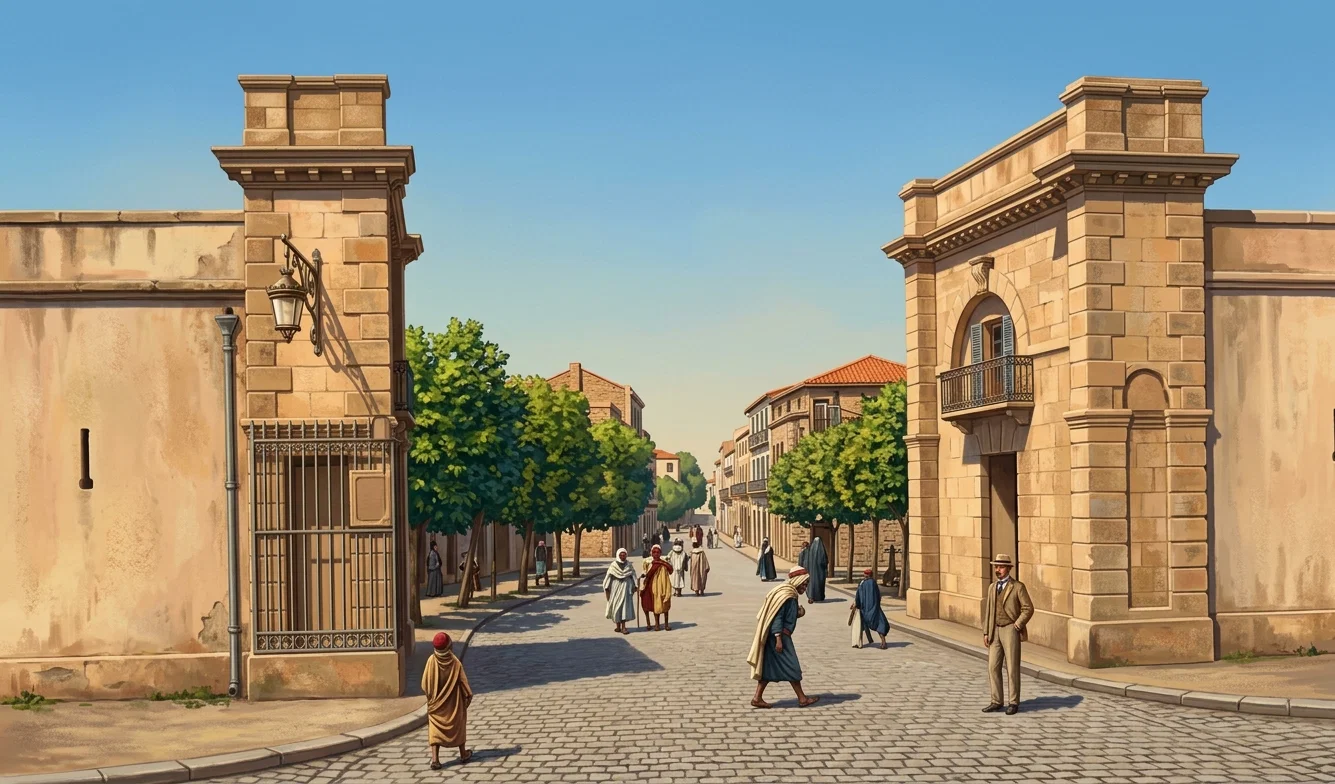
A GATE OF BLIDA
When we arrived in Algiers, the heat seemed rather severe, so the next day we took the train for Blida, a town of from twenty-five thousand to thirty thousand inhabitants, one hundred kilometers from Algiers. This place is said to be somewhat cooler and healthier than the densely populated parts of Algiers. We stayed in Blida about two months, until the hot season was over, and the tourists, as well as those who had gone to Europe and other places to spend the summer, were expected soon to return to their homes.
We have been well ever since coming here; it was quite hot during August and September, but we did not suffer severely from the heat. During the summer months it is very dull here, so we have not been able to do as much as we desired; but it was fortunate that we came here so early in the year, for now we know better what to expect another year, and we have had time to become familiar with the people and their customs. Most of the inhabitants are Arabs, but there are also many Europeans and some of other nationalities. The professed Christians are nearly all Catholics, and as the Europeans are the most powerful here, it is a Catholic place. Thus far every one is free to exercise his religion according to his own conscience, so there is a great deal of business going on on Sunday. A Sunday law, however, has already been spoken of, and will no doubt soon appear on the table again for consideration; so we see it was high time to enter this field.
The Catholics are, of course, held in great darkness here as well as everywhere else, but even among them we find soberly thinking persons. I will just cite one example. Through the recommendation of one of the physicians I gained an entrance into a very good family. The man was suffering from neuralgia, and the doctor asked me to give his patient massage. As I did not come on Sabbath to give him his treatment, he soon learned of our religion, and asked me many questions in regard to our belief; and almost every time I gave him massage, I could also tell him of the truth, and, although he is far from being a pious man, he took great interest in what I said. Many times he said to his wife: “That is right; they have a much better religion than ‘we,’” etc. When I went there one evening after the Sabbath, he asked me in regard to the signs of the times and many other things, and finally he put the straight question to me, “What do you think of the pope?” I said, “I hardly feel free to state just what I think, or rather what the Bible says, of him, as you are one of that faith.” “Yes, yes,” he replied, and his wife also, “just speak out freely; never mind.” “Well,” I said, “the Bible says that he is the man of sin, the son of perdition.” To this he replied, “I believe that that is just what he is.”
Having finished the treatment, I said, “Now I will read you some about the signs of the times if you wish me to do so,” to which he quickly answered in the affirmative. So I sat down and opened to them the Word of God, and held a good Bible reading with them. The Lord blessed in a special manner, and they exclaimed: “What a wonderful book is that! and what knowledge, and so true it is!”
I pray the Lord that this people may some day give their hearts to God, and so learn the truth, not only in theory, but in spirit and love.
Here the medical work was the “entering wedge,” as we have been told that it is to be. May the Lord help us to find the sincere ones, and to do our best for everybody. We are glad to be here, and we praise the Lord for his goodness to us, and it is our earnest desire to serve him faithfully. When the great gathering shall take place, we also expect to be there, bringing precious sheaves from this part of the great harvest field. Remember us and the work here in your prayer. Our address is 7th Rue Michelet, Alger, Algeria.
S. JESPERSSON.
Dec. 7, 1905.
Ecuador
By GEO. W. CASEBEER.
GUAYAQUIL.—After a more or less pleasant trip of thirty days, in company with Brother and Sister F. L. Perry and17their little boy, we arrived in Guayaquil, Ecuador, Nov. 7, 1905. The next day our brother and sister resumed their journey to Peru.
In touching several ports in Mexico and Central America we found many things very interesting in the ways of the Spanish people, but we were somewhat more favorably impressed with the Ecuadorians, because of their industry and energy. Most of the stores and shops of Guayaquil open at half-past five, or thereabouts, and do not close until ten or eleven o'clock at night. It is said that three fourths of the money of Ecuador is handled here.
The climate is very good from May to December, or during the dry season; but when the rains come, the mosquitoes also come and bring the fevers. The sewerage system is very poor; and as the water and mud stand in the streets, there is a chance for the breeding of disease. A refreshing breeze from the sea, which blows here almost constantly, moderates the heat considerably.
Prospects for our work here are quite encouraging. Brother T. H. Davis, who has been here about one year, has faithfully sown the seeds of truth by the printed page, by Bible readings, and in various other ways, and although no one has taken a decided stand to obey the truth, yet a vast amount of prejudice has been broken down, and the cause has many friends. There are two young men, carpenters, who are especially interested, and are convinced on the Sabbath question. They seem willing to endure ridicule, and are able to give good answers for their faith. We hope they will soon take a firm stand.
We have started a series of meetings in one room of our dwelling-house. There seems to be quite an interest, although on account of our limited facilities, no public announcement has been made. At our first meeting there were about thirty in attendance. After the study was finished, and the people were dismissed, they all sat still, as if they wanted something more. We sang several Spanish hymns, which they seemed to enjoy. We find our Bilhorn telescope organ a great help.
After all had gone, the owner of the house came in and asked if we intended having a meeting every night. He seemed troubled over the matter, as he was opposed to having all classes of people in his house, or, as his wife expressed it, “servants, negroes, and white people altogether.” There was, perhaps, some prejudice against us as Protestants. Brother Davis explained that we were to have meeting but once a week. The man was satisfied, and told us he would keep the thieves and bad people out, so now we have only the “good” people to preach to.
We expect in the future to rent a hall where “good” and “bad” alike can come. The people here seem ripe for the message. In Guayaquil the people are very liberal minded, but they seem to be following France in rejecting all religion, and turning to infidelity. But some will surely accept the message of truth.
Brother Davis and I spent one week on a canvassing trip up the railroad line. We visited several small towns on our way, and sold Spanish and English literature. There are many Jamaican negroes in this country, especially along the railroad, who all speak English. As a usual thing we find them much degraded. One must visit them on their pay-day, or find that their money has all gone for drink or in some other way. If they have money, they are very willing to buy religious books, for they all claim to be Christians.
One man I met seemed much interested in “The Coming King,” and wanted me to bring it to his house at five o'clock. The appointment was met, but no man nor money was to be found. The next morning I happened to see him, and he said, “We have to let it pass. If you don't dead afore you gets back, I takes one dem books.” During the four days we were gone, Brother Davis sold about fifty sueres' worth, and I about ten.
All the way along we found people interested in reading the literature they had bought before. “My word . . . shall not return unto me void.”
The farther into the interior one gets, the stronger he will find the prejudice, as the priests have more power there.
In what is called the Orient—that is east of the Andes Mountains—there are vast numbers of Indians. White men do not often enter there, and the priests only to the edge of the country to collect their money. Does not this vast field appeal to some one? Before it is entered by others, we should be giving them the message.
Brethren, pray that the message of truth may have free course, and break the bondage of darkness from many hearts.
GEO. W. CASEBEER.
Greater New York Conference Workers' Convention
By K. C. Russell
This meeting was held at 535 West 110th St., New York City. The attendance consisted of the Greater New York Conference workers. Besides the local workers, there were in attendance a portion of the time Elders W. C. White and A. E. Place, and the writer. The time of the convention was devoted to a study of different phases of the message and methods of labor, and especially in seeking the Lord for a greater consecration and for the Holy Spirit's power, to the end that the workers might go forth prepared to do more effective service for the Master. The studies which were held during the convention were on the following subjects: The Sanctuary and its Service, Health and Temperance; Religious Liberty, Proper Use of Language; much time was also devoted to the study of real Christian experience and practical godliness. Elder C. H. Edwards, the president of the conference, gave some interesting talks on the sanctuary question, and also drew some practical lessons for God's people to-day from the experience of ancient Israel.
The spirit of earnest prayer characterized the services, and the spirit of unity and devotion on the part of the workers was a remarkable feature of the meetings. Thursday evening, December 28, a service was held with the Brooklyn church, in which the presence of the Holy Spirit was manifest. Sabbath, the thirtieth, the churches in Greater New York held two union meetings. One of these was in the Brooklyn church, and was conducted by Elder A. E. Place, and the other was in the church at 535 110th St., New York City. The attendance was large at both of these services, and the Holy Spirit was present in power to convict of sin and righteousness, as was demonstrated by the humble and heartfelt confessions that were made. Sunday there was a goodly number of willing candidates who followed their Lord in baptism.
When we met to plan for actual work, it was demonstrated that the grace of God had not been received in vain; for there was a ready response on the part of both workers and people to enlist in earnest service for the Master. The brethren and sisters in Greater New York are planning to carry on a vigorous campaign with the forthcoming special Signs. There will also be inaugurated a movement in their churches which will consist in the conducting of health studies once a week in each church, in which they will make the “Ministry of Healing” the basis of their lessons. As far as possible a physician or nurse and a minister will be associated in conducting these studies. It was voted also that the conference committee should appoint a religious liberty secretary to have charge of that department of the work in the conference, and also that they select some person to make a specialty of writing for the New York papers; for it is believed that the time has come to improve every agency possible in disseminating this message to the millions who are groping in darkness.
It was a pleasure to meet at this meeting Elder H. E. Robinson, with whom many of the readers of the REVIEW are acquainted. Owing to physical infirmities, he and his wife were unable for a long time to engage in active service for the Master. We are glad to report that they are improving in health, and Elder Robinson is hopeful that he will be able to continue laboring for the Master and improve in health until he regains his old-time vigor. His present address is Matteawan, N. Y.
Our prayer is that the Lord may roll a burden upon his people throughout this country for the unwanted millions of precious souls in Greater New York.
K. C. RUSSELL.
Reorganization of the Boulder-Colorado Sanitarium
By Francis M. Wilcox
DECEMBER 7 articles of incorporation were filed for the formation of a new corporation known as the Colorado Medical Missionary Association. This corporation was organized for the purpose of taking over and operating the Boulder-Colorado Sanitarium. This step has been contemplated for the last two years. Its object was to bring about such a reorganization of the sanitarium enterprise that it should become in every sense a denominational institution.
The membership, or constituency, of the new corporation consists of the following:—
1. The executive committee of the General Conference of Seventh-day Adventists.
2. The executive committee of the Central Union Conference of Seventh-day Adventists.
3. The executive committee of the Colorado Conference of Seventh-day Adventists.18
4. The board of directors of the Colorado Medical Missionary Association.
This brings behind the institution a stronger constituency than ever before in its history, and it is hoped that this reorganization will result in greatly increasing the influence and work of the institution.
The board of directors of the new association was chosen for four years, and consists of the following-named persons: Dr. H. F. Rand, Francis M. Wilcox, Geo. F. Watson, Edward T. Russell, Dr. Ida S. Herr, Jas. G. Weller, Dr. Kate Lindsay, Charles L. Burlingame, and Watson Zeigler. This places upon the board the president of the Colorado Conference, also the president of the Central Union Conference.
In the organization of the board, Dr. H. F. Rand was chosen president, Geo. F. Watson, vice-president, and Francis M. Wilcox, secretary and treasurer.
The last year the institution has been the most successful in its entire experience, and the prospects are for a growing patronage in the future. With the large representative constituency now behind the institution, consisting of representative men of the denomination, we trust a more earnest effort and co-operation than ever before may be put forth in behalf of the sanitarium. We recognize, however, that it is only the Lord that can give success, and that our help must come from him. The patronage of the sanitarium is better at the present time than ever before at this season of the year.
Elder and Mrs. J. L. Shaw have been connected with the institution for the last few weeks, and expect to remain for several months. Their assistance in the religious work is very greatly appreciated.
The recent visit of Elder Spicer to the institution was of inestimable blessing, serving to connect the workers more closely in sympathy with the general cause and with the work in other lands.
FRANCIS M. WILCOX.
Under the Shadow of Our Church
By A. O. Taft
FROM time to time we have reminders showing us that there are persons living very near some of our churches who are thirsting for the knowledge of the truth of the third angel's message, but who do not know where to find the individuals who can give them the knowledge which they seek.
For instance, a recent letter to the Signs office states: “I have just been reading a copy of The Signs of the Times. I find it so interesting that I would like to subscribe; but as it is an old copy, I will write first to see if you are still publishing this paper in Oakland, Cal.”
This lady writes from a small town where we have a large church. There is also residing there one of our ordained ministers. Why has not this woman been made aware of the message through visits of some of our people living in that locality? We have no reason to believe that the brethren and sisters living there are more negligent than our people elsewhere; but it does impress the fact that we are not nearly as wide-awake as we ought to be in visiting among our friends and neighbors, in supplying them with our literature, and in other ways directing their attention to the great message for this time. Let us open our eyes and look around us to see if we can not find living right in our immediate neighborhood some of the very ones for whom God is giving the third angel's message. It is high time that we should awake out of sleep, for our salvation is very much nearer now than when we first believed.
A. O. TAFT.
Our New Mission Station
By W. H. Anderson
Here I am, in Buluwayo again. I left Cape Town May 8, for Kimberley. I stayed five days at Brother Willson's, and we had a pleasant time together. He has a fine bath and treatment room there, and they are prospering well.
I soon found myself on the train again for Buluwayo. As there is not much to be seen on the road, and we had all the room we wanted, I made my bed, and slept most of the two days on the way.
On arriving here, I was met at the station by the mission cart, and taken to the farm that night. All came running out to meet me, and seemed glad to see me again. I found about the usual number in school there. As I had a resolution from the union conference, and also a letter from Elder Hyatt in regard to the boys that I was to have, there was no trouble in getting the help I needed.
Jim had laid his plans, and had gathered all the information he could get from his people, and was prepared to go to them with the gospel. It was a bitter disappointment when I told him that it was better for him to wait, and if the Lord wanted him to go to his own people, he would open the way for him to do so later. And as the Lord had not opened the way, he might better stay where he was. I do not see how he could be spared from the home station now. He is bearing heavy burdens there; and as he is as true as steel, they feel free to lay them on him. When any of the boys are in trouble, they go at once to Jim for counsel and advice; and he is very apt in bringing from the Bible just the illustration that fits the case he has in hand.
It would have done our people good to have heard the testimonies of the boys whom I chose to go with me. I will give some as I remember them now:—
Umlemo, who goes to drive the team, is a slave boy, and was brought to the mission by his master at the time of the famine. He said, “Once I was living in darkness far to the east. The Lord found me there, and brought me here in darkness, that he might show me the light. I now see it, and I praise the Lord for it. Now a voice calls from the north, and says, Go there. I recognize it as the voice of God. What am I that I should refuse to listen when he speaks? As I came from the east to receive a blessing, I now go to the north to be a blessing. Pray for me, that I may be faithful.”
Pahlane is going with me as a native teacher. He is married, and his wife is with him. They accepted the truth when we were living at Kupavula, and we regard them as our own children.
“Once,” he said, “I was in darkness. I worshiped the goat and the snake. I prayed to gods that are not gods. Now I have learned a better way. I am a child of God. Now I see a people who are sitting in darkness as I was; and I heard the Lord say, ‘Who shall I send, and who will go for us?’ Then I said, ‘Here am I, Lord; see me, and make me a light and help them.’ May my lips be touched with the coal from off the altar, that I may speak the words of life to the people in that north country. Pray for me.”
I found so many wanting to go there. I had to spend much time trying to tell them that we could use only a few, and that they would have to wait until another mission was established, and that there would be an opportunity for some of them to go and assist in opening the work. I am so glad to see such a spirit of consecration and willingness among them, and to know that they are so anxious to go and give the light to their own people. It is all they have ever been taught in the mission, and I think that they have learned the lesson.
I came back to Buluwayo on Monday and have been very busy ever since. I am to leave here to-night for the Falls. I have in my company a native teacher and his wife, an ox driver, an interpreter, a farm manager, a house boy, and a hired girl. I have the girl and boy who were with us so long in the house at Buluwayo, so Mrs. Anderson will have excellent help in the housework. As this help is all native, it is not very expensive; and it is better than some of the white help that I have seen in this country. I hope that Mrs. Anderson can come the first of July. I think I shall be ready for her by that time. I expect my wagon in Buluwayo to-night, and that it will go on with me to the Falls.
W. H. ANDERSON.
The Nebraska Sanitarium
By A. T. ROBINSON
SEVERAL years ago one of the three buildings belonging to Union College, College View, Neb., known as North Hall, was leased to the Nebraska Sanitarium for a term of twenty years, at an annual rental of $1,250. In later years the attendance at Union College has increased until there has been a pressing need of more room for the accommodation of students. The patronage at the sanitarium has also increased, making it impossible for any room to be spared in the building occupied by the sanitarium.
At the annual meeting of the Union College board, last February, careful consideration was given to this matter. A proposal was submitted by the college board to the sanitarium management to sell to the sanitarium the property it had formerly held on lease. In view of the fact that the sanitarium is a sister institution, engaged in another line of the same missionary work, the consideration of sale submitted was such as would not have been justified from the standpoint of simply a business transaction. The sanitarium was asked to pay $5,000 down, another $5,000 within two years from date of transfer, and assume a fourth of the present college indebtedness, as such indebtedness shall fall due. This latter item means an obligation of $7,127.76, making a total amount to be paid by the sanitarium of $17,127.76.
The sanitarium management felt somewhat reluctant to assume this obligation, and negotiations proceeded slowly for several months, but were finally consummated19by the formal signing of the legal papers on the evening of November 1. In this transfer the property was deeded by the Central Union Conference to the Nebraska Sanitarium Association.
In addition to the proposal first submitted, the sanitarium in this transfer secures a lease, for an indefinite term of years, of the grove east of the sanitarium, adjoining its grounds. This grove is to be fitted up by the sanitarium and the college conjointly to be used as a park and an outdoor gymnasium, for the benefit of the patients of the sanitarium and the students and teachers of the college.
At the time the transfer was made, the sanitarium found itself in a position to meet the first payment of $5,000, $3,000 of which had been saved from the earnings of the institution during the time negotiations had been pending.
Another reason of the transfer was to place means at the disposal of Union College to provide necessary additional room for students. After a careful investigation of the main college building, it was decided to finish off rooms in the attic story. Nine well-lighted, well-ventilated rooms are now nearing completion, and eight other rooms could be finished if necessary. This provides needed room for students, at small expense, leaving most of the money realized from the sale of property to the sanitarium, to be applied on the indebtedness of Union College. This, in addition to $61,927.90 realized from the sale of “Christ’s Object Lessons,” reduces the indebtedness of the college to a point where it can be handled without embarrassment.
The utmost harmony and good feeling exists between these two institutions, which are now more closely united than ever they have been before. In a recent Testimony from Sister White concerning these two institutions, the following statements are made:—
“The Nebraska Sanitarium is in a good location. It is away from the city with its temptations, and yet it is so situated that people will learn of it and the nature of its work. Its proximity to the college is a decided advantage; for these two institutions, working together, may be a help one to another. We must remember that our sanitariums are established to do the highest work that mortals can undertake. . . . The Lord would have his people in the Central Union Conference arouse, and put forth a united effort to make the sanitarium at College View a praise in the earth, and a continual blessing to many, that from it there may shine forth the light of truth.”
About one year ago the Nebraska Sanitarium Association so changed its articles of incorporation as to sever its connection with the International Medical Missionary and Benevolent Association of Battle Creek. The constituency of the association was so changed as to make it a Nebraska institution closely allied with the evangelical work of the conference.