But at a subsequent period the notes of time given in the word of prophecy became more distinct. That I may not, however, detain you unnecessarily on the point, I will confine my remarks to one remarkable prophecy of this kind—that of Daniel. To this highly favored prophet the angel of God was commissioned to make the following precise revelation of the time when the Messiah was to appear and fulfil his work on earth: “Seventy weeks are determined upon thy people and upon thy holy city, to finish the transgression, and to make an end of sins, and to make reconciliation for iniquity, and to bring in everlasting righteousness, and to seal up the vision and prophecy, and to anoint the Most Holy. Know therefore and understand, that from the going forth of the commandment to restore and to build Jerusalem unto the Messiah the Prince shall be seven weeks, and threescore and two weeks: the street shall be built again, and the wall, even in troublous times. And after threescore and two weeks shall Messiah be cut off, but not for himself: and the people of the prince that shall come shall destroy the city and the sanctuary; and the end thereof shall be with a flood, and unto the end of the war desolations are determined. And he shall confirm the covenant with many for one week: and in the midst of the week he shall cause the sacrifice and the oblation to cease, and for the overspreading of abominations he shall make it desolate, even until the consummation, and that determined shall be poured upon the desolate.”
A more definite and precise prediction could not be conceived; and this prophecy is in fact an accurate description of the time and circumstances of our Lord’s appearance in the world, and the events with which it was accompanied.
The word translated “weeks” literally signifies “septenaries,” and may be referred either to days or to years, as it is used in the Scriptures in both senses. Thus when Laban said to Jacob, respecting Rachel, “Fulfil her week,” the context shows that the word means seven years. And in this case, the reference to the Messiah in the prophecy shows that we must here also understand the word to mean years. So that the seventy weeks of the prophecy embrace a period of 490 years.
The statement of the prophecy, then, as regards the time of the appearance of the Messiah, and of the events that were to mark his course, is this: that from the time of the going forth of a commandment (for so the words should be translated) to restore and to build Jerusalem, unto the appearance of the Messiah, the Prince, should be seven and sixty-two septenaries of years,—that is, 483 years; and after those sixty-nine septenaries, and (as the words seem to imply) before another septenary had elapsed, the Messiah should be cut off; which event should be followed by the destruction of the city and temple. And during the last seven years of the 490, the Messiah was to establish a covenant with many, and in the middle year of the seven was to cause the sacrifice and the oblation to cease. He was also, but at a time not precisely determined, to make the city desolate by a desolation that should last for a certain decreed period.
Now it appears from Scripture that there were four commandments, or edicts, issued by the kings of Persia with reference to the rebuilding of Jerusalem; one by Cyrus, a second by Darius Hystaspes, and a third and a fourth by Artaxerxes Longimanus; and as the prophecy does not state which is referred to, there was, until its fulfilment, a degree of obscurity remaining, sufficient, as might be expected from the usual phraseology of prophecy, to prevent the reader from knowing with certainty beforehand what would be the precise period of its fulfilment; while on its accomplishment, it was sufficiently definite to fulfil all the purposes of prophecy.
In endeavoring to ascertain, therefore, which of these edicts was the one referred to, we at once find that it could not be either of the first two, for the 490 years reckoned from either of them will not bring us even to the birth of Christ.
We proceed, therefore, to the third, which was granted to Ezra in the seventh year of Artaxerxes. Now it is capable of satisfactory proof that the reign of Artaxerxes commenced in the summer or autumn of the year 464 before the vulgar Christian era, and consequently the seventh year of his reign extended from the summer or autumn of 458 to the same period in 457 of the same era. And as it appears, from the account given by Ezra himself, that he started from Babylon, in consequence of this edict, on the first day of the Hebrew month Nisan, occurring about the middle of our March, and after many communications held with the whole body of captive Jews, the edict must have been issued a little before this period, and consequently about the close of 458 B. C., or the beginning of 457 B. C.
The testimony of the prophecy, then, is that the public appearance of the Messiah would take place 483 years from this time.
Now, it is obvious that the event to which we should naturally look as corresponding to that which is here predicted is the first appearance of our Lord as the Messiah, which was at his baptism, when both human and divine testimony was borne to his true character, and he was proclaimed to be the Son of God. This event took place, we are told by St. Luke (3:23), when he “began to be about thirty years of age.” We have, therefore, to determine the precise date of our Lord’s birth, which, though it is not expressly stated by any of the sacred writers, may be fixed sufficiently for our purpose from the historical data they have given us connected with this event. The vulgar Christian era was as is universally admitted, wrongly calculated by those who first introduced it as an epoch for reckoning the period of the events of history; and therefore, when we speak of the year A. D. 1, it is understood that this is not the true year of our Lord’s birth.
Our Lord’s birth must have taken place, according to the evangelists, some little time before the death of Herod. And according to Josephus, Herod’s death took place a few days after an eclipse of the moon, and a few days before a passover. From these data we learn with certainty that this event happened in the latter part of March, B. C. 4 (B. C. being understood to refer to the vulgar Christian era); a date which is confirmed by several historical testimonies. The Messiah was born, therefore, some little time previous to this.
But St. Luke also tells us that our Lord’s baptism, when he began to be about thirty years of age, was in the fifteenth of Tiberius. Luke 3:1. And reckoning the years of Tiberius from the time when he was made by Augustus his colleague in the empire (which St. Luke must have done, for otherwise his words would place the birth of our Lord after the death of Herod), his fifteenth year would extend from the summer of A. D. 26 to the summer of A. D. 27. And thirty years backward from this period would take us to the latter half of B. C. 5, or the former half of B. C. 4. As our Lord’s birth, then, was some little time before March, B. C. 4, we are fixed to some period toward the close of B. C. 5. And consequently our Lord was thirty toward the close of A. D. 26, and was baptized about the close of A. D. 26, or the beginning of A. D. 27; precisely 483 years from the period when, as we have already proved, the edict was issued in the seventh year of Artaxerxes. —“Fulfilled Prophecy,” by W. Goode, D. D., F. S. A., London, James Nisbet and Co., 1891, pages 128–131.
The Picture Post-Card
By Jessie C. Dorsey
JESSIE C. DORSEY
Many of the evils of this world are the perversions of things good in themselves. Satan is busy adulterating the pure, misrepresenting the honest, demoralizing the upright, misleading the innocent, ridiculing the sincere, and in every way possible trying to destroy all that is good in man.
Among his latest efforts to pervert, is the use he is making of the post-card. Some thoughtful person a few years ago conceived the idea of communicating with friends by means of the picture card representing some of the scenes in various parts of the world, specimens of God's handiwork, places of historical interest. These were pleasing to the receiver, and convenient to the sender. After a time the post-card took the form of an innocent rebus. Some sentiment was expressed by picture objects to which the writer need only affix his name. These have now taken on a ruder and coarser form until the post-card has become the means of the lowest suggestions in crime and vice. The many God-given virtues are thus represented in a most degrading light. Parents and home, churches and schools, are held up to the ridicule of the young people and children.
Many of these cards are actually obscene, vulgar, and profane, but instead of receiving the treatment they merit, they are greeted with laughter and applause. Have we not many times felt the blood of shame rise to our faces as we have turned in disgust from the well-filled card-racks of the drug and book stores, news stands, show-windows, and even grocery counters where the post-cards are displayed? Suggestions of the lowest thoughts are to be found on these post-cards. There is a demand, and a growing demand, for them. They are exchanged between men and women, boys and girls, and even the little ones find delight in their gay colors. Thus is springing up an education of the baser sort, that is finding ready pupils among both old and young, and doing its destructive work everywhere.
It may seem to some like a small thing, but I feel alarmed for the children and young people, who are so susceptible to influence silent or otherwise. Pictures can do a great deal in the molding of character, and conditions can be brought about which will result in the eternal loss of souls. Herein is another demand for the earnest vigilance of mothers.
Denmark, S. C.
A Touching Scene
The writer remembers being on a railroad train several years ago, when directly in front of him sat a kindly looking, snowy-haired old man, evidently unaccustomed to traveling, and as manifestly in his “second childhood.” He was very talkative, and he told me all about the journey he was taking.
“I’m going to Iowa to see my son, Jimmy, and my daughter, Nellie. Just think! I ain’t seen either of them children for most six years, and if they ain’t tickled to see me, I’ll be mistaken. An’ the train seems to fairly drag. I get so impatient every time it stops at a station! Wish it’d keep right on an’ never stop until we get to —; that’s where Jimmy and Nellie live.”
He began gathering up his belongings when we were still an hour’s ride from his destination.
“I want to get ready to git right off when we stop,” he said. “Jimmy and Nellie will both be at the depot to meet me, although they live nine miles out in the country, and there ain’t no need o’ them comin’. But they’ll be there—you see if they ain’t.”
When we reached —, the excited old man started to leave the car in eager haste. But the train had not come to a standstill when a great bearded giant of a man, fully fifty years of age, hurried into the car.
“Jimmy!” called out the old man, eagerly. “Here I am, Jimmy.”
“Father!” cried the son, and he took the little old man right into his arms and hugged him, while the tears stood in the eyes of both.
A stout, plainly clad, middle-aged woman appeared at the car door and cried out, “Father!”
Then she turned and called to someone on the platform: “Here he is! Here is father!”
“Nellie, my girl!” said the old man.
The son and daughter both had an arm around the father as he left the car. On the platform were seven or eight grandchildren from five to twenty years of age.
“Here’s your gran’pa!” said Nellie joyfully, and a great hugging and kissing time ensued.
Of course the passengers in the car and the bystanders on the platform smiled; but I think the most of them agreed with a lady on the car who said: “It’s a beautiful sight to see an old man loved and revered by his children and grandchildren, and I only wish such exhibitions of affection were more common.”—Selected.
The Garden
HAVE you “made garden” yet? The garden should be done on paper, at the fireside, before the seeds are ordered; but if you have neglected this, send for the seedsman’s catalogue as soon as possible, and when it comes, hold a family council, study directions for preparing the ground, making the beds and selecting the seeds, giving special heed to instructions for planting and cultivating.
Plan your garden so that most of the work may be done by the horse and plow, or the hand cultivator. Select reliable, tried sorts of vegetables and fruits for the main crop, and plant enough to supply the table, with a goodly surplus for canning and drying. For the winter supply, you can sow later.
Try a few seeds of the novelties; if several neighbors should send for one variety each and exchange seeds, a goodly start might be had for a small amount.
If you have not started a fruit garden, begin now. Look over the advertising pages and see the offers of reliable seedsmen, many of whom offer “collections” of plants, mailing size, which are well worth considering. If given care, nearly all these plants or roots will live, and even if a few do die, you will get your money’s worth. A half loaf is better than no bread, you know, and it is just as easy to raise fruit bushes or vines in the fence corners as to raise sumach, wild brambles, and poison-ivy. Even one at a time is a start. Do not delay, for the seed-time is at your door. If you are a village woman, you can14have many things in the way of flowers that your busy country sister must do without; but the country sister may have much if she sets her head to it. Plant perennials, and set out flowering shrubs where you can see the beauty while at your work. Many hardy shrubs can be grown from the seeds, blooming the second year. Fill your life with beauty; plan for the sunshine, and then work for the plans.—The Commoner.
The Tryst
By Margaret R. Radcliffe
WEARY, you say, and tired, dear,
Weary of time and stress?
The struggle of life has been hard, I fear,
And pleasure grows less and less.
Ah well, then take a little rest;
For you are worn and weak;
In the quiet, dear, is a waiting Guest—
Patiently waiting to speak.
His hands are filled with goodness, dear,
And his heart with holy love;
He looks like the Lord of another sphere,
His voice is the voice of a dove.
What! Can not leave your work, my dear;
Not move from the ruts of life?
Behold, in the eyes of this Friend a tear;
He would help you in the strife.
He would unloose the hands, my dear,
Of time that hold you fast;
Go talk with him in the stillness, dear;
Sure it will rest you at last.
Did you say you could not see him, dear?
Lift up your bended head;
His pitying eyes are above you, dear,
Filled with tears unshed.
Let him unclasp your hands, my dear,
From earth’s persistent hold;
Go rest with him in the quiet, dear,
His peace will you enfold.
Go into the sacred stillness, dear.
For the sake of the love of Christ;
’Tis love divine that is so near—
Go forth and keep your tryst.
—Margaret R. Radcliffe.
W. R. SMITH
By W. R. Smith
Korea
W. R. SMITH
WE are anxious that you should know at all times the true condition of the work here in Korea, so that you may be constrained to pray, and to give of your offerings, that the cause of God may be sustained and built up in this dark corner of the earth.
From time to time we have told you of the rapidly increasing number of Sabbath-keepers. If we had it to do over again, we would be more conservative in reporting this; because, as we are learning the situation and the language better, we think we have been misinformed as to the number of true believers.
From the first, it has seemed to us that the education of workers was the work of chief importance; but of course we could not do anything until we had gotten a fair use of the language.
Soon after we had started upon our second year here in Korea, Miss Mimi Scharffenberg came to the field. She has gotten along well with the language.
Already we have told you something of how the way opened that we might have a little training-school. Now we will tell you just how the means came in, how much the building cost, and how we are carrying on the school work.
You know how we obtained from the government a plot of land and some old buildings. When this was done, we had ground on which to build, and tiles to cover a building, but no money with which to build. It was one morning about the middle of July when the three of us, Mrs. Smith, Miss Scharffenberg, and I talked this matter over. As the Lord had blessed us in securing the land, and in view of the crying need for a school, we decided we would deny ourselves of some things we really needed, and use the money to build. As we look back over the situation, we think that right there, when we in our hearts made the sacrifice, the “sound of a-going” in the mulberry-trees began. We had only a small amount of money among us, but it was sufficient to pay the bargain price on what timber we thought we should need. We began with the small amount we had, and the building is erected, and we have 32.07 yen left, with which to buy an organ; but as she had already purchased an organ, this amount was given to the school fund. Also, a sister living in Pennsylvania sent her fifty yen to be used for school purposes. Altogether, Miss Scharffenberg has put one hundred twenty-three yen into the erection of the building. Mrs. Smith’s parents, who have long been among the number who are looking for their Saviour, sent us one hundred seventy yen. The General Conference gave two hundred yen. In all, we have received six hundred ninety-three yen, and have a neat tile-roof building, which will accommodate from seventy-five to one hundred students. Besides this building, we have two Korean compounds, which are to be used as living quarters by the students. Miss Scharffenberg paid for one of these, and we the other. At a reasonable estimate, the buildings and ground are worth one thousand yen.
We have a partition of swinging doors in the house, and use one end for the boys, and one for the girls. We have sixteen students at present, ranging in age from nine to twenty-eight years. We teach them Bible, arithmetic, physiology, and geography, and are well pleased with the interest they are manifesting in their studies.
We also have another building, which was obtained from an educational society in the government. This is a compound, consisting of one large building and several smaller ones, about four miles from where we live. It was secured in the following manner:—
One day in August, one of our literary helpers was looking over a magazine, and said that there was an announcement in it that a certain class of buildings which this educational society had at its disposal would be given to those who would use them for educational purposes. One of them is the one we have just mentioned, and we went that same day to look at it. The next day we went to Pyeng Yang, to see about getting it. It was arranged that one of the Korean workers should go to Seoul, to be at a general meeting of the society which was to convene in a few days, and there make application for the property. He did so, and secured the place. We think this property is worth at least five thousand yen. This place and the houses and land here by us had first to be deeded by the authorities to individual Koreans, who then transferred them to us. This large building was secured in August. At first there was local opposition to our having the building, but this soon quieted down, and the people were willing that we should take the house. Although we had taken the responsibility of going ahead and securing the property, we thought best now to wait until we had15opportunity to consult with Elder Field, before beginning to make the necessary repairs on the house. When Elder Field, Elder Shultz, and Brother Benson came in October, and thought it best to go ahead and repair the buildings for school purposes, we began to do so, but were forced to stop, on account of cold weather, as well as shortness of funds, after about one hundred yen had been expended. About three hundred yen will be needed to repair the buildings properly. When this is done, we think that the work in northern Korea will be quite well equipped, so far as school buildings are concerned. But we trust that the brethren in more favored lands will remember the crying needs of this people that have not yet been supplied.
Soonan.
The Beans of the Devil
ROWLAND HILL began his sermon one morning by saying: “My friends, the other day I was going down the street, and I saw a drove of pigs following a man. This excited my curiosity so much that I determined to follow. I did so, and to my great surprise I saw them follow him to the slaughter-house. I was anxious to know how this was brought about, and I said to the man, ‘My friend, how did you manage to induce those pigs to follow you here?’
“‘O, did you not see?’ said the man, ‘I had a basket of beans under my arm, and I dropped a few as I came along, and so they followed.’
“‘Yes,’ said the preacher, ‘and I thought, so it is that the devil has his basket of beans under his arm; and he drops them as he goes along, and what multitudes he induces to follow him to an everlasting death! Yes, friends, and all your broad and crowded thoroughfares are strewn with the beans of the devil.’”
The devil is just as busy now with his basket of beans as he was when Rowland Hill preached that sermon, and he is just as successful in enticing silly men and women to the slaughter-house of souls.—Selected.
Death Due to Tea Drinking
No doubt many deaths are indirectly due to the dyspepsia, anemia, and other diseases which result from the habitual use of tea. It is not often, however, that the coroner attaches the blame to the tea, as was done in the case of a man who died in London recently. The Londoner ate a supper of boiled beef, and then had some tea. Early the following morning he was taken ill, and died before a doctor could be summoned. A medical man who made the post-mortem examination said the stomach contained undigested food, and was distended. This, acting on a weak heart, caused heart failure. A verdict of “Death from syncope, weak heart, and indigestion caused by tea drinking” was returned.
Many lessons may be drawn from this report, not the least important of which is the fact that it is dangerous to go to sleep soon after eating, especially when foods difficult of digestion have been taken. The absorption of poisons from undigested food which lies like a lump in the stomach, is an adequate cause for a degree of brain and heart paralysis which sometimes results in death.—Australasian Good Health.
GEO. TEASDALE
By GEO. TEASDALE
Java
GEO. TEASDALE
Java first became known to Europe about four hundred fifty years ago through the Portuguese, who were at that time the most enterprising maritime nation in the world. The Dutch shortly afterward successfully disputed the sea supremacy with them, and in the course of a century became fully possessed of this country, and also of a large number of other islands in these seas, over which they have maintained control until the present time.
Although the area of Java is less than that of the State of Alabama, yet it contains a population of thirty-two million, which is much more than one third the number of the whole population of the United States. Not only does it contain this population, but it also maintains it, for its only resources are agricultural. It is so fertile, however, that each year the value of its exports exceeds sixty million dollars, and this after providing food for its teeming inhabitants. The imports into the country are chiefly machinery, clothing, and a few provisions for the use of Europeans.
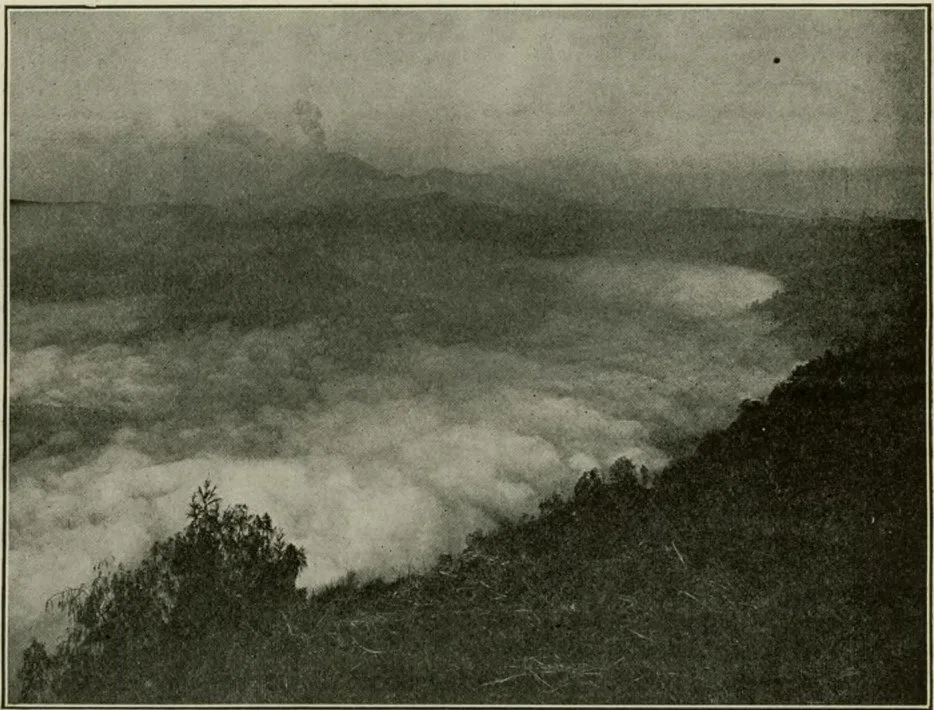
ABOVE THE CLOUDS IN JAVA
Volcano Smeroe in the distance; volcano Bromo nearer, but not ejecting smoke.
The climate of Java is ideal for the man who can adapt himself to constant summer without the stimulative effect of a cold season. Its location in the immediate vicinity of the equator would cause one to suppose that the temperature is so high as to be well-nigh unendurable. A few months’ residence in the country proves the climate to be quite bearable, even in the large cities and on the low-lying plains, while in the mountain districts it is exceedingly pleasant. The climate is not by any means suitable for a European. Even its virtues are detrimental to his well-being, and its evils constantly threaten his existence. It does not kill by cruel blasts of stinging cold, nor by sudden and violent changes of mood; but rather it smothers its hapless victim with a wealth of affection paralleled by the constant cuddling bestowed upon some unfortunate infants by their doting relatives. Both languish under the toxic effects of too much fondling. Java’s insular nature gives to it the advantage of being fanned at both seasons of the year by the monsoons, which causes a mild temperature not unlike that of an Italian summer. The chief scourge of Java is the malarial fever. The victims of this disease number many thousands every year. It either persistently pursues them through a series of years, and ultimately brings them to a premature old age and untimely grave, or it suddenly pounces upon its prey and carries them off after a few days of raging madness. Living in the large cities in the Indies is equal to life on a battle-field in the uncertainties of its continuation. If a person escapes the ravages of the fever, he is almost sure to succumb to the enervating climatic influences, unless he makes frequent pilgrimages to the mountains or to Europe.
The first company of workers for Java bearing the third angel’s message came late in the year 1906. We landed in Sourabaya, a city of two hundred fifty thousand, situated in the eastern part of the island, where one woman and her children were already keeping the Sabbath. A few persons have been attracted to the standard of truth erected here over fourteen months ago. The greatest difficulty in the way of proclaiming the truth is the diversity of languages. Malay must be acquired in order to do business with the Chinese and the coolies. Dutch, being the official language, is also necessary, and the thirty million natives are divided into three tribes, each of which speaks a distinct language, and all are quite difficult to master. We have seen God’s leading in this field in many instances, although as yet but few results of our labor are apparent. There is no doubt but that the proclamation of the closing message to the Mohammedans of Java is the most difficult work for which the Australasian Union Conference is responsible, and it will call for much sacrifice on the part of our people of both men and means.
The past year has been one full of blessings to us, although some of them have come in the form of severe afflictions. While we were enjoying a fair degree of health and strength, the members of our mission family were suddenly attacked by fever, and three of them narrowly escaped death, but the fourth, our oldest child, a fine, healthy boy of twelve, now lies in the cemetery a victim to our last dread foe. Our hearts were almost broken, but we have found comfort in the promises of Him whose Son was attacked by the same cruel enemy. This sacrifice binds our hearts to the country in which he died, and we look forward to the day when he with many others will be won from death to life eternal.
The late union conference council decided that a home in the mountains should be secured for the workers in Java, and when this is accomplished, we shall have a place to which we can go during the fever season to restore our depleted vitality. We hope also to be able sometime to establish a small mission there, in which to train the natives to become workers among their own people. Government restrictions make the acquirement of land quite difficult and expensive, and satisfactory sites are very few. There is a good line of railway from one end of the island to the other, and there is also a system of light railways spread throughout the country. These operate mainly on the lowlands and on the plateaus, while the higher places are reached only by toilsome journeys in bullock wagons, or on small mountain ponies. Our present force of workers, besides Mrs. Teasdale and myself, are Sisters Skadsheim and Nordstrom, and in a few weeks Sister Judge will join us. The last two named are sanitarium nurses from Australia. A young man and his wife with a knowledge16of the Dutch language could be employed to advantage here among the Dutch-speaking portion of the population; also a canvasser who is able to handle books in that language. Already “Coming King” is being printed in the Dutch-Malay, and soon we expect to have a canvasser in the field among the Chinese and the Malay-speaking Javanese. We believe that our books will sell well in this country, and through literature chiefly will the message go to many millions of the people.
Little has been done to evangelize the natives of Java, and the few efforts which have been put forth during the last century have resulted in turning less than twenty thousand to Christianity. Mohammedan countries are not generally fertile fields for missionary enterprise. One encouraging condition among the Javanese is that they are not very ardent adherents of the prophet, and are almost free from that fanaticism which is so predominant a characteristic in most followers of Mohammed.
Our work here is great, but our God is also great, and in his name we traverse these modern Ninevehs, proclaiming the warning committed to our charge. He will supplement our feeble voices with his mighty power, so that the truth can be made known to the millions of people in this land who know not their right hand from their left.
Sourabaya, Java.
The East German Conference
By Guy Dail
GUY DAIL
The seventh session of the East German Conference was held in Berlin, January 22-26. The business meetings were in our Central Berlin chapel, while well-attended lectures for the public were conducted in four other parts of the city—in North Berlin, in South Berlin, in Schoeneberg, and in Charlottenburg. Of all the European fields, none seems to promise more for our work than the land of the Reformation; and of the German territory, none appears more easily accessible than Berlin, with its nearly three million inhabitants. I was astonished to hear how some of our laborers in this city operate: If a Bible worker at the time of his first visit, sees that there is little interest in the subject presented, he does not call on this person again to try to awaken an interest; he has so many addresses of others who really desire to hear, that he takes only such as wish to learn of the message.
The territory of the East German Conference is made up of the provinces of Brandenburg (with the city of Berlin included) and Pomerania. The kingdom of Saxony is to be severed from the East German Conference, and will date its organization into a separate conference from Jan. 1, 1908, and thus the population of the East German Conference, which was 11,765,000 heretofore, will be cut down to about 7,256,000.
As to finance, the East German field has done well. Although it lost Silesia, with more than 375 members, a year ago, yet in 1907 its tithe was 66,148.83 marks, or only 2,409.32 marks less than when Silesia was still a part of its territory. The gifts for 1907 amounted to 11,274.68 marks, against 12,559.73 marks—Sabbath-school, First-day, and annual offerings—in 1906.
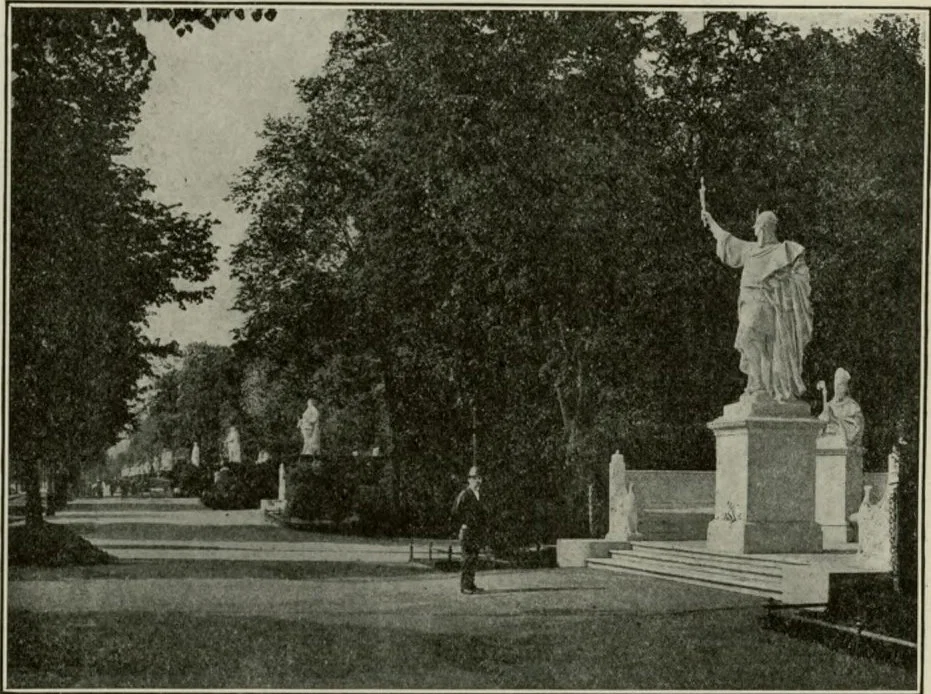
AVENUE OF VICTORY, BERLIN
After Silesia was organized into a separate conference, there remained in the East German field 1,032 members; during 1907, 275 were added by baptism and vote, and there was a net gain of 214, so that its present membership is 1,246.
We are much pleased with the development of the canvassing work here. In 1905, there were twenty-eight to thirty colporteurs, with sales amounting to 30,398.70 marks; in 1906, thirty to thirty-two canvassers sold 33,365.85 marks' worth of publications; and last year, there were thirty-eight to forty agents, whose output was 59,316.96 marks.
About one hundred delegates were at the conference. On Sabbath, six hundred were in attendance, to witness the ordination of Brethren O. Schwenecke, R. Cunitz, and M. H. Wentland, who were set apart to the gospel ministry by prayer and the laying on of hands. Several were baptized, and the day was a good one for all who were able to be present. Brethren L. R. Conradi, H. F. Schuberth, E. Frauchiger, and Dr. Petersohn were glad to assist during the conference.
The business passed off harmoniously. It was voted to give 1,000 marks of the surplus tithe toward the support of the work in the Austrian Mission. This is one of the practical ways in which the delegates expressed their gratitude to God for the rich blessings of the year.
One recommendation suggested that our brethren, when lending money for business enterprises, should require a written agreement about the matter, and the proper security for the payment of the loan.
Another of the encouraging features of this session of the East German Conference was the reception of six new churches and companies. Two churches were cut off from the original Central Berlin church, and were organized into separate congregations; they, too, asked for admission—thus eight, in all, were received.
Last summer the East German tent efforts gave encouraging results; and it is now planned to continue the gospel tent work, and over four hundred marks were raised in cash and pledges toward the tent fund. The conference poor fund was also strengthened by a good collection, and the Sabbath-school donation was liberal.
Brother G. W. Schubert was unanimously chosen president, and he will be assisted in this field by three ordained ministers, two licentiates, sixteen Bible workers, one missionary nurse, and thirty-two canvassers. That God may continue his blessing here is our earnest prayer. We believe our friends everywhere will remember the East German field during the current year.
Hamburg, Germany.
Native Evangelist Comforts Missionary Family at Kongo Funeral
A TOUCHING letter just received from a missionary sent out by another mission board to the Kongo, tells how in the hour of bereavement in his family, one of the native evangelists officiated at the funeral of the little child that had just died. He spoke with such tenderness and power that the missionary is constrained to say, “The comfort, strength, and inspiration which came to our hearts through the message of our own evangelist on this occasion were so truly wonderful that if we had no other fruit from all our years of labor and sorrow on this difficult field than that single moment and that one man, we would feel infinitely repaid.” “Cast thy bread upon the waters: for thou shalt find it after many days.”