THE seventh session of the East German Conference was held in Berlin, January 22-26. The business meetings were in our Central Berlin chapel, while well-attended lectures for the public were conducted in four other parts of the city—in North Berlin, in South Berlin, in Schoeneberg, and in Charlottenburg. Of all the European fields, none seems to promise more for our work than the land of the Reformation; and of the German territory, none appears more easily accessible than Berlin, with its nearly three million inhabitants. I was astonished to hear how some of our laborers in this city operate: If a Bible worker at the time of his first visit, sees that there is little interest in the subject presented, he does not call on this person again to try to awaken an interest; he has so many addresses of others who really desire to hear, that he takes only such as wish to learn of the message.
The territory of the East German Conference is made up of the provinces of Brandenburg (with the city of Berlin included) and Pomerania. The kingdom of Saxony is to be severed from the East German Conference, and will date its organization into a separate conference from Jan. 1, 1908, and thus the population of the East German Conference, which was 11,765,000 heretofore, will be cut down to about 7,256,000.
As to finance, the East German field has done well. Although it lost Silesia, with more than 375 members, a year ago, yet in 1907 its tithe was 66,148.83 marks, or only 2,409.32 marks less than when Silesia was still a part of its territory. The gifts for 1907 amounted to 11,274.68 marks, against 12,559.73 marks—Sabbath-school, First-day, and annual offerings—in 1906. After Silesia was organized into a separate conference, there remained in the East German field 1,032 members; during 1907, 275 were added by baptism and vote, and there was a net gain of 214, so that its present membership is 1,246. We are much pleased with the development of the canvassing work here. In 1905, there were twenty-eight to thirty colporteurs, with sales amounting to 30,398.70 marks; in 1906, thirty to thirty-two canvassers sold 33,365.85 marks’ worth of publications; and last year, there were thirty-eight to forty agents, whose output was 59,316.96 marks.
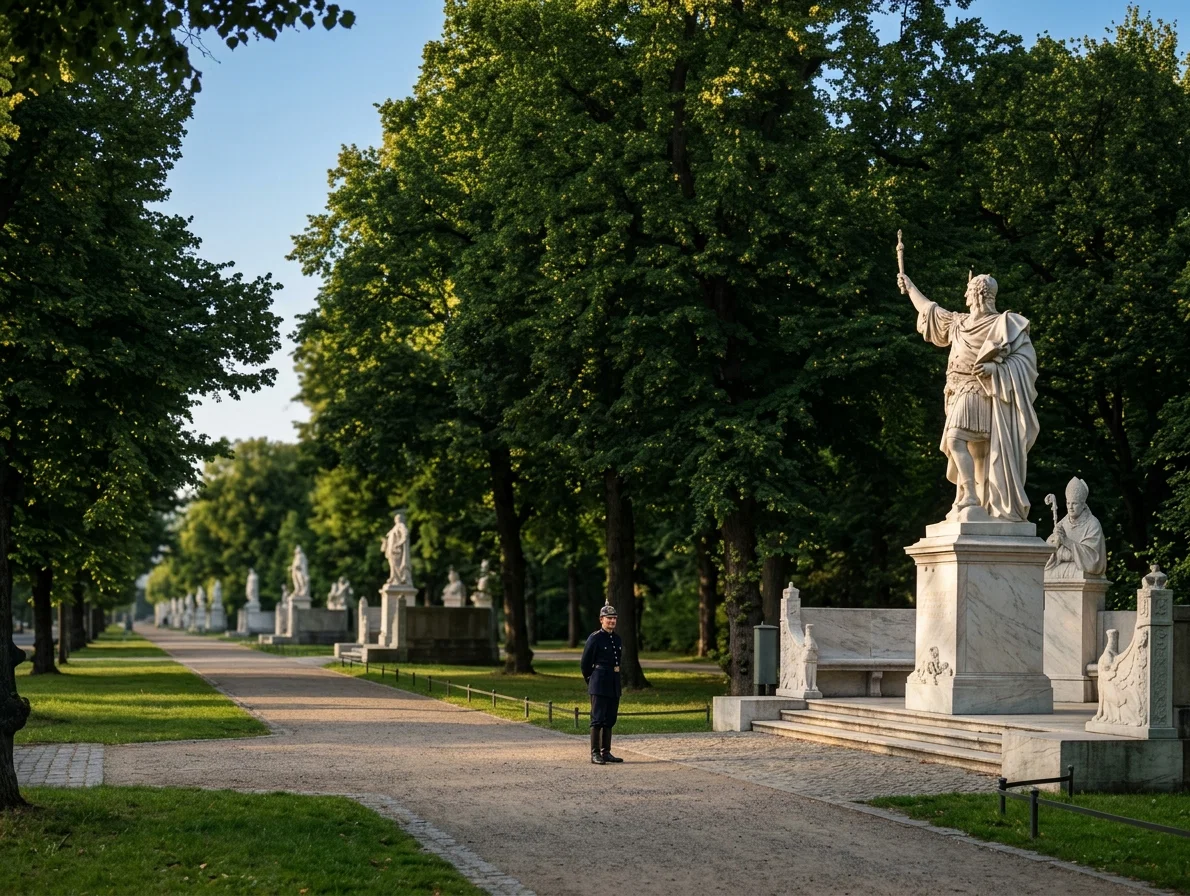
AVENUE OF VICTORY, BERLIN
About one hundred delegates were at the conference. On Sabbath, six hundred were in attendance, to witness the ordination of Brethren O. Schwenecke, R. Cunitz, and M. H. Wentland, who were set apart to the gospel ministry by prayer and the laying on of hands. Several were baptized, and the day was a good one for all who were able to be present. Brethren L. R. Conradi, H. F. Schuberth, E. Frauchiger, and Dr. Petersohn were glad to assist during the conference.
The business passed off harmoniously. It was voted to give 1,000 marks of the surplus tithe toward the support of the work in the Austrian Mission. This is one of the practical ways in which the delegates expressed their gratitude to God for the rich blessings of the year.
One recommendation suggested that our brethren, when lending money for business enterprises, should require a written agreement about the matter, and the proper security for the payment of the loan.
Another of the encouraging features of this session of the East German Conference was the reception of six new churches and companies. Two churches were cut off from the original Central Berlin church, and were organized into separate congregations; they, too, asked for admission—thus eight, in all, were received.
Last summer the East German tent efforts gave encouraging results; and it is now planned to continue the gospel tent work, and over four hundred marks were raised in cash and pledges toward the tent fund. The conference poor fund was also strengthened by a good collection, and the Sabbath-school donation was liberal.
Brother G. W. Schubert was unanimously chosen president, and he will be assisted in this field by three ordained ministers, two licentiates, sixteen Bible workers, one missionary nurse, and thirty-two canvassers. That God may continue his blessing here is our earnest prayer. We believe our friends everywhere will remember the East German field during the current year.
Hamburg, Germany.
Comfort from a Native Evangelist
A TOUCHING letter just received from a missionary sent out by another mission board to the Kongo, tells how in the hour of bereavement in his family, one of the native evangelists officiated at the funeral of the little child that had just died. He spoke with such tenderness and power that the missionary is constrained to say, “The comfort, strength, and inspiration which came to our hearts through the message of our own evangelist on this occasion were so truly wonderful that if we had no other fruit from all our years of labor and sorrow on this difficult field than that single moment and that one man, we would feel infinitely repaid.” “Cast thy bread upon the waters: for thou shalt find it after many days.”
A Visit to Mexico
By A. G. DANIELLS
By request of the General Conference Committee Elder W. C. White and I attended the general meeting in Mexico. This meeting was held in Mexico City December 19-29. Two other important meetings were held in Mexico during our visit—one at Guadalajara and the other at San Luis Potosi. It had been five years since my last visit to Mexico, and I was greatly encouraged by what I saw at this recent visit regarding the work in that difficult field. On my visit five years ago, I found only two or three Mexicans keeping the Sabbath. On this recent visit, I found about one hundred rejoicing in the third angel’s message. The reports presented for 1907 by the superintendent of the field, Elder G. M. Brown, showed that excellent work is now being done in the circulation of our literature.
Our first meeting was held at Guadalajara. Here we had the pleasure of meeting Elder Brown and wife, the Drs. Swayze, Dr. Erkenbeck, and Brother and Sister Placencia, whom we had met on our previous visit. Besides these dear friends, we met quite a number of Mexicans who were much interested in the truth, some of whom had been baptized and united with the church.
We were pleased to find an excellent medical dispensary and treatment rooms in this city. The large sanitarium in which our people were once so deeply interested, and for the erection of which they gave thousands of dollars, is not now used for medical work. About four years ago this institution passed into the hands of the Battle Creek Sanitarium. It has since been sold to the Methodists, and it is now being used as a girls’ college. I was informed that it was sold for about $61,000 gold. The medical mission which we are now operating was donated by the Drs. Swayze. It has been fitted up for giving treatments to first-, second-, and third-class patients. Besides the regular line of medical work and treatments, it has a good dental parlor. Dr. Myers is acting as superintendent of the institution. The place is a model of neatness, and the institution is so conducted that all classes of people can receive accommodation.
In connection with the mission there has been erected by the brethren and sisters in Guadalajara a very neat and appropriate chapel for religious services. This institution is on the corner of a good street, along which an excellent electric car-line runs. We feel very greatly pleased and encouraged regarding the outlook of our medical missionary work in this city. It seemed to us that this was a most appropriate provision for such work.
We greatly enjoyed the services of the Sabbath which we spent in this place. As usual the first hour of the forenoon service was devoted to the Sabbath-school. The chapel was well filled, and the entire program was conducted in Spanish. The sermon that followed was translated into Spanish. As the progress of our cause in all lands was outlined on the missionary map of the world, the congregation seemed to gather new courage to press on with the work. The afternoon sermon was followed by a spirited praise service in Spanish, and at the close two Mexican sisters were baptized by Elder Brown in the baptistery connected with our chapel. In the evening the chapel and mission were dedicated to the worship of God and to the service of love he would have us render to our unfortunate, suffering fellow men. One of the American missionaries of the city, and also one of the resident Mexican ministers, joined us in the service. It was a great pleasure to our brethren in Guadalajara to have this excellent medical mission and chapel completed and dedicated to the good work for which they were provided.
Protestant missionary work is carried forward with great difficulty in Mexico. The men of the upper class of society are very indifferent to everything pertaining to religion. The women of the upper class are devout Catholics, and seem to be afraid of giving any other religion any attention. Both the men and the women of the lower class are very superstitious, and are perfectly satisfied with what they have. But notwithstanding all the difficulties and obstacles that have to be met in Mexico, the Lord has blessed the efforts that have been made during the last five or six years in that field. We are profoundly thankful for the deep interest our brethren who have located in Mexico have manifested in the development of our work in that field. We appreciate the services they have rendered to the cause.
In next week’s REVIEW I shall report our meeting in Mexico City.
A. G. DANIELLS.
South Africa
By E. R. Williams
AFTER a very pleasant voyage, both in crossing from America to England, and also from England to Africa, we arrived at Cape Town, January 28, safe and well.
We met a number of missionaries on the boat coming to Africa. One, a native of Africa, who had been to America to receive an education, was just returning to work among his native tribe in Swaziland. We got very well acquainted with him, and with his wife, whom he married in Alabama. I gave him a copy of the missionary number of the Signs, with which he was much pleased, and said he would send for the Signs when he got settled.
There were also several Swazi chiefs on board, whose acquaintance we formed, and whom we supplied with some of our literature.
I was invited to speak on the last Sunday night of our voyage, and was pleased to have the privilege of presenting some points of the message to more than two hundred very attentive listeners. I spoke on the origin of sin, of God's provision for its destruction with its author, and also the time of its destruction, touching upon some of the signs which show that we are living in the last days and near the time when the Master of the universe should come, and sin have an end. The interest could not have been better, and we felt that God had given an opportunity to turn some hearts toward his truth. Many came and expressed their interest in the subject, and we received a number of invitations to write to missionaries and others, which we expect to do. We feel that we have great reason to thank our Heavenly Father for his care and protection on our journey. We expect to go farther up the country soon, and will then write more about the work here.
Our hearts were made sad to receive word from the sanitarium that Sister W. H. Anderson was dead. Sister Anderson has been ill at the sanitarium for some time. Elder Anderson is up in Barotseland, and the news will come to him as a crushing blow. May God sustain him, and may our dear brethren in the home land not forget to pray for the missionaries who go into these deadly climates to seek for the lost.
E. R. WILLIAMS.
District of Columbia
By H. E. ROGERS
The delegates representing the churches in the District of Columbia held their annual meeting in the church-school building in Takoma Park, March 1. Two new churches were received into the organization, having a present membership of eighty-two. There are now five churches and one company, having a total membership December 31 of four hundred fifty-five. Other Sabbath-keepers living here bring the total number to about six hundred.
The report of the treasurer, I. H. Evans, showed that in 1907 the tithes paid amounted to $10,652.83; contributions to foreign missions from all sources, $1,788.15. There was surplus tithe on hand December 31, amounting to $3,484.88, which amount was voted to the General Conference for foreign missions, making the total contributions to foreign fields from the funds received during 1907, $5,272.03.
The regular staff of laborers at present consists of one minister and six Bible workers; but the general laborers living here, as well as the students at the Foreign Mission Seminary, all take an active part in the work, so that the number engaging in the work is much greater.
The usual committees were appointed, and their reports carefully considered. The resolutions adopted relate to plans for effectively circulating our large subscription books in the city, the carrying forward of systematic efforts in the circulation of Life and Health, Liberty, and the REVIEW AND HERALD. A committee was appointed to consider and formulate plans for securing a place of meeting for the colored brethren and sisters in Washington, and another committee to consider plans for assisting in the erection of a church in Takoma Park.
Resolutions were also adopted favoring the passage of the bills now before Congress looking toward the abolition of the liquor traffic, and remonstrating against the passage of the Sunday bills now before that body.18
Other resolutions were adopted expressing approval of the plan which made the District of Columbia and Takoma Park General Conference territory, and recommending that the same be continued; and that a constituency be selected on the following basis: That each church appoint one delegate for its own organization, and an additional delegate for each fifty members, and that the General Conference be represented by an equal number. An executive committee of seven members was provided for.
It was also arranged that one third of the tithe be used in the work in the District, the remainder to go to the General Conference for work in foreign mission fields. The officers elected for the ensuing year are as follows: Chairman of the constituency, I. H. Evans; Vice-Chairman, the chairman of the executive committee; Treasurer, the General Conference; Secretary, H. E. Rogers; Executive Committee, K. C. Russell, G. B. Thompson, J. H. Neall, B. G. Wilkinson, M. C. Strachan, D. W. Reavis, J. N. Gillis.
The outlook before the work in the District never seemed brighter, and the cause is moving forward encouragingly.
H. E. ROGERS, Secretary.
Chile
By MILLIE E. STEELE
SANTIAGO.—We rejoice in the rapid progress of the work in other foreign fields. We know something of what it means to be a foreign missionary, although in our field we do not have to battle with many of the hardships that our brethren meet with in other fields. Yet we, too, have our ups and downs. Nevertheless we are happy to be counted worthy to have a place in the Lord's vineyard.
If every Seventh-day Adventist in the home land could taste for a few months the joys and sorrows, and feel the cares of those who have gone to less-favored lands, how willingly and eagerly would they give of their means! If they could realize the needs as we do, a call for means would never need to be repeated.
There is so much to be done to educate the people, but, alas, it is the money and workers that are lacking. Why could not many of us with God's help, practise a little more self-denial in the matter of dress, and in many other ways, and resolve to give the surplus into the treasury of the Master? I am confident that by so doing we might add many dollars to the fund for missions. The Lord would abundantly bless our efforts, and we would find that it is indeed more blessed to give than to receive. God is saying to each one of his children, “Make me an offering.” Shall we do it? “There is that scattereth, and increaseth yet more.” Prov. 11:24-26.
There should be no retrogression on our part. We should push forward with all energy, for the night is very near. While we are deliberating what we shall do, the enemy is busy sowing tares, and that which we might reap may be lost.
Here in our field the work grows slowly, for much of the seed falls in the highway. Yet we thank God for the results we see. During the year 1907 the number of converts was nearly double that of 1906.
The headquarters of our work have been moved from Valparaiso to a place called Espejo (mirror), a suburb of Santiago. We find many inconveniences, yet we hope with God's grace to overcome them. A more Catholic place could not have been found; some evidently thought that a Protestant was the evil one himself, and some were even afraid to pass the house without running. If the Lord had not gone before and raised up one or two believers, we should have found it impossible to get any one to do anything for us. Many crosses have been made in the mud wall of the house, and a five-pointed sign, which these poor people believe will cause the devil to depart.
We have been here nearly two months, and already we can see that the people are softening. A few have come to the meetings that are held in our house. God's word will not return unto him void, and we see evidence of this day by day.
MILLIE E. STEELE.
Newfoundland
By C. H. KESLAKE
We are thankful to be able to report that during the year 1907 the work in Newfoundland made some advancement. Besides accessions to the faith, there has been marked improvement in the matter of finances. The tithe was increased more than fifteen per cent over that of the previous year, the same being true also of the annual offering. “Bring ye all the tithes into the storehouse,” is a command filled with the rich promises of Him who says, “The seventh day is the Sabbath.” The church here in St. John’s is seeking to be faithful in all of God’s commands.
Since my last report the truth has obtained a foothold in another of the outports, as all places along the coast, other than St. John’s are called. In July I went north as far as Englee, a small fishing town on what is known as the French Shore. The weather at the time was all that one could desire, making life on the ocean wave one of pleasure. On the way we passed numerous large icebergs, one day passing no less than twenty-two of these ocean giants which are such a menace to navigation.
En route, we stopped off at Twillingate, and visited Brother F. W. Johnston. While there, it was our privilege to speak to the friends on the subject of religious liberty. Some who had thought that Sunday legislation was all right were led to see that, after all, it was fraught with evil. One person thus convinced gave us a small donation toward the printing which we later secured. Brother Johnston has sought to do faithful work in the face of great difficulties. At this writing there are five or six persons in Twillingate who are keeping the Sabbath, although not all of these have as yet been baptized. In recent letters Brother Johnston writes encouragingly of the work, and hopes for souls.
Proceeding to Englee, I reached that place late the following Sunday night, and was welcomed by the friend whom I had met on the steamer “Portia” the year before, formerly a Catholic, but now a Methodist. For the next two weeks I found myself virtually buried from the outside world, as the telegraph system in Newfoundland does not extend so far north, and mail is received in the summer only once in two weeks. During four months in the winter, mail is received but once, being carried overland by a courier with dogs and kometicks.
I soon discovered that my presence in Englee was considered an unwelcome intrusion by the local pastor. However, the people, who soon learned that I was a Seventh-day Adventist, expressed a wish to hear my message, and invited me to speak in their church, much to the displeasure of the pastor. Having heard something of our faith, and feeling that he could not meet the arguments in favor of our position, he decided to leave his flock and go to another place until I should leave there.
Anxious to disarm prejudice and to avoid unjust criticism, I told the friends that, being an Adventist, I did not wish to appear to take undue advantage of the situation, and instead of preaching in the church I preferred to do so in the open air, with a rock for a pulpit. But they would not have it thus, and despite the protests of the pastor, ere he left, insisted upon my using the church.
Unfortunately as man would look upon it, I landed when the fishing season was at its height, when men, women, and children were busy from about three o’clock in the morning until as late as eleven, and sometimes later, in the night, catching and salting their fish. Except on Sundays, two of which I spent with them, I had very little opportunity for public speaking; but in the daytime, as opportunity offered, I visited the homes, sold or gave away literature, and prayed with and read to them out of the Book of life. As for my hostess, I found her hungering for the truth, an appetite for which had been created by our English publication, Present Truth, and tracts that I had previously sent her and her husband. Before I left, she became thoroughly convinced that we had the truth, and has since written me that she and another person have yielded themselves to obey. I thoroughly enjoyed my stay with these dear people, and regretted that I could not remain longer; but, the Lord willing, I shall return there when the ice disappears, to help them still further.
Another minister with greater influence than the local pastor already mentioned, has gone to Englee for the purpose of undoing our work. The shortness of the time made it impossible for us to present even the principal points of our faith at all perfectly. Nevertheless, this pastor has been powerless to shake the faith of the two mentioned, although among other things he was armed with Elder Canright’s “Seventh-day Adventism Renounced.” We earnestly pray that God will keep these dear souls, and make them a means of reaching others, for I am persuaded that there are other honest souls in Englee.
In returning home I visited a lone sister, Mrs. Welshman at Shoe Cove. To go there I had to land at Tilt Cove and be rowed around to Shoe Cove by boat. By this means I discovered what I had not noticed before, that small groups of houses are built apparently in the holes in the rocks. This reminded me quite forcibly of the prophecy in Jer. 16:16. I found Sister Welshman of good courage, and remained with her a few days, held two meetings at her home, and then continued my way homeward. I again called at Twillingate, this time to baptize a young man who recently decided to “keep the commandments of God, and the faith of Jesus.”19
At Pilley’s Island, where the steamer called, a Catholic priest whom I had previously met, came on board. The pleasure of meeting was mutual, and, being together several hours, we freely conversed upon religious topics. He acknowledged that his church had changed the Sabbath, that she had persecuted, and expressed his abhorrence of religious coercion; and when confronted with the fact that his church was seeking temporal power and meant to enforce Sunday by law, he shrugged his shoulders, and frankly said, “Well, I don’t care if it is my church; the whole thing is wrong.” I studied with him the twenty-three hundred days. He followed me very carefully, and finally exclaimed, “Then the end must be very near.” I believe that some day he will see and accept the truth. He agreed to read some of our literature which I promised to send him.
That same week I reached home, after being absent seven weeks, thankful that so many opportunities had been given to declare the truth, and that a “door of utterance” had been opened in Englee.
C. H. KESLAKE.
Fiji
By C. H. PARKER
I HAVE spent a month in Lau since my last report, and I had a nice, quiet time. The brethren there are all of good courage, and seem to be making advancement in the message. One man who had not paid tithe for a long time, came out firm again on the side of truth. Several from the outside are about to take their stand for the Lord. These we labored for while we were located in Lau. A European woman, for whom we also labored while in Lau, is trembling in the balance. I had a number of good readings with her; she seemed to drink the truth in like one who was famishing. All the brethren in Lau pledged themselves to take a number of our partial translation of a portion of "Great Controversy" to sell in the month of December. All seemed to enter heartily into the spirit of getting our publications before the people as quickly as possible. We are thankful for this spirit, for we realize that this is what will help us to publish the truth quickly throughout this field. Pray that our brethren here may be true to their vows.
On returning home to Buresala, I found Brother and Sister Stewart, who have come to take the place of Brother and Sister Carr, as they have been called to open the work in New Guinea. They are taking hold nobly, and give promise of quickly acquiring the language of this people. They like their new surroundings, and best of all, they believe that this is the field to which the Lord has called them.
We were glad to welcome Brother and Sister Steed among us, and to know that now our Samoan field is to have help. They seem of good courage in the work to which they have been called, and like their island environments very much. We pray God's blessing upon them, and the field to which they are going.
Sister Carr leaves us to-day for Sydney. We are sorry to lose her from our number, for she has endeared herself to the work here by the ties of love and self-sacrifice. We are glad, on the other hand, that Fiji is able to give her best to start the work in New Guinea. Our prayers go with her. Brethren, what a glad day it will be when the work is finished, and the workers are gathered home with their sheaves from all lands. Let us be intensely in earnest in our work, that it may be hastened to the finish.
C. H. PARKER.
Two Bookmen’s Conventions
By H. H. Hall
A BOOKMEN’S convention was held in Sioux Falls, S. D., January 10-16, in behalf of the subscription book and missionary work in the Northern and Central Union Conferences. It was attended by the general and field agents; the tract society secretaries; several of the presidents of both unions; Elder R. A. Underwood, president of the Northern Union; James Cochran and W. R. Beatty, of the Kansas City Branch, and Chas. M. Cottrell, of the Canadian Branch; also the writer, from the main office of the Pacific Press.
Home Missionary Work
A paper entitled, “Revival of Missionary Work; How to Organize for It,” was presented early in the convention, and was enthusiastically received. All present appreciated the fact that the success of our work as a whole, and particularly the success of our subscription book work, depends upon active service in the home churches. The recommendation from the General Conference Publishing Department to the effect that union and State Missionary secretaries be appointed was favorably received. All seemed to recognize the fact that the circulation of tracts, periodicals, trade and forty-per-cent books had assumed sufficient importance to demand that one man in every conference take general charge of it, much the same as the canvassing agent directs in the subscription book work.
Book Study
A daily study of the great truths contained in “Daniel and the Revelation” was led by Brother F. L. Limerick, and a similar study on “Controversy” was carried forward by Brother W. L. Manful. These studies were particularly helpful, for they revived in our hearts an appreciation of the value and importance of these volumes.
Round Table Talks
An hour and a half was given each day to a round table discussion of the details of the successful field agent. The various points had been arranged in advance in a logical way; hence these daily studies were very profitable. A blackboard was placed on the wall, and as the different points were developed, they were written on the board. After being revised according to the discussion, they were recorded by the secretary, and embodied in the minutes of the convention. A few extra copies of the minutes may be had by addressing the writer at Mountain View, Cal.
Institute General Instruction
Brother C. G. Bellah gave daily lessons on the detailed instruction that should be given to prospective canvassers in an institute. In anticipation of this study an outline in brief had been printed on paper with wide margins. Each field agent had a copy of this, and made such memoranda on it concerning the points made, the illustrations introduced, etc., as would be of assistance to him in his own institute work. We believe this was a very instructive feature of our program. A few copies of the printed outline are available. Address the writer.
Reminiscences of the Book Work
One entire evening session was given to the relation of incidents and experiences connected with the beginning of the circulation of the printed page by this denomination. Elder Underwood presented an intensely interesting paper on this topic, and was followed by Brother C. M. Everest, who told us of his experiences as State agent in Minnesota. As we compared the facilities we now have for the carrying on of our book work, the preparation which our field agents, as well as the canvassers themselves, now receive, we were led to appreciate our present opportunities, and to determine to make better use of them.
City Work
Another evening was given to the consideration of papers, experiences, and observations on city work. Brother Chas. M. Cottrell led in the presentation of a paper entitled, “Successful Canvassing in Our Cities.” He told of his20experiences with different books in different cities, just how he gained an entrance, presented his book and delivered it. Brother T. D. Gibson followed, presenting some valuable suggestions on the same subject. Brother W. R. Beatty spoke of his experience with well-to-do people in Spokane, Wash., Oakland, Cal., Vancouver and Victoria, British Columbia. Altogether, it was an evening that gave us a new conception of the work to be done in our cities.
The Sale of Foreign Publications
As the conferences in the Northern Union and some in the Central Union have a large German, Swedish, and Danish population, careful attention was given to their needs. Brother Max Trummer told us how the young people speaking these languages, who are now in attendance at Union College, had become interested, and that fifty of them were now preparing themselves to sell books the coming vacation. They are studying their canvasses and their prospectuses in their own language.
Prices
The writer presented a paper on “The Price of a Subscription Book: What It Includes,” in which he showed that the actual cost of material entering into these books had increased 26.5% during the past few years. He also spoke of the improvements that had been made in “Great Controversy” and “Daniel and the Revelation,” and suggested that increased prices would have to be secured in order to place the work upon a proper basis. The prices of $2.75, $3.75, and $4.75 for the marbled, library, and leather bindings respectively for “Great Controversy,” “Daniel and the Revelation,” and “Bible Readings” were enthusiastically adopted.
The Manufacture of a Book
A carefully prepared paper, written by Brother F. H. Gage, of the Pacific Press Publishing Company, was read by Brother F. F. Byington, manager of the International Publishing Association, in which the various processes of book manufacture were presented. These were made clear to all by exhibits which were passed around during the reading of the paper.
The College Place Convention
A somewhat similar program, but varied to suit the needs of the coast conferences, has just been closed at College Place, Wash. Here we were favored by the attendance of the North Pacific Union Conference Committee at our opening meeting, and by as many of their members as could be relieved from their duties during the succeeding sessions. At this convention, as well as at the one held in Sioux Falls, our field and office workers were brought close together, were led to plan for united action, and gained a new sense of the importance of the work to which they had given their lives.
What We Expect During 1908
With a well-organized, united band of field and office workers; with carefully planned, tested, and accepted methods of work; with about fifteen hundred students in our various schools, one third of whom will probably enter the field during vacation; and with a conviction that we are doing the very work the Lord would have us do, we confidently expect a great work to be done during 1908.
H. H. HALL.
Southern California
By F. I. Richardson
SANTA BARBARA.—The message is being carried here by house-to-house work, Bible readings, etc. This was thought to be advisable as the weather at this time of year is liable to be such as to interfere with a revival effort. The Lord is blessing the work. On the twelfth of January eight persons were baptized, seven of whom united with the church. Others are much interested.
The last two weeks of January we spent at the Fernando Academy, assisting in Elder R. S. Owen's place, while he attended the Pacific Union conference. As the days came and went, the condition of the school gradually unfolded to us. The general harmony that prevails among the students and faculty, the interest the students manifest in their studies, and above all, the spiritual condition, are truly a cause for rejoicing. More than one hundred of the one hundred fifty students have started in the service of the Master, and still others are following their example. We feel that this school should be encouraged by our prayers, our influence, and our means.
F. I. RICHARDSON.
In Sunny Tennessee
By C. F. PARMELE
THERE is wonderful satisfaction in laboring in a needy field. How pleasant it is to find thirsty souls, and see them drink in the truth. The moist eye and the fervent “God bless you” seem good pay for a whole day’s search. Such a field is Tennessee. Here we have populous cities and well-filled country districts awaiting the message of truth. From experience gained in various fields, from our largest cities to rural cabins, I can say this is as easy territory in which to gain access to human hearts with our good books as any I have tried. Who will come and help gather in the ripened sheaves? We can use a hundred men and women in this conference. Write me about your convictions in this matter. Do it now. My address is Madison, Tenn.