ACCORDING to plans which had been previously announced, the West Indian Union Conference of Seventh-day Adventists held its first session in conjunction with the Jamaica Conference of Seventh-day Adventists, at Kingston, Jamaica. The time set for the meeting was from January 11 to 26, 1907. The plan embraced not only the transacting of the regular business which would come before the conference, but also the conducting of a Biblical institute for two or three weeks, that the workers in the West Indian Union Conference might have the opportunity of receiving instruction from some of our leading men on the cardinal points of our faith.
Besides the workers of the West Indian field who were gathered together, there were present at the meeting, Prof. C. B. Hughes and his wife, from Keene, Tex.; Elder E. W. Farnsworth, of the Atlantic Union Conference; Elder U. Bender and his wife, from Arkansas; Elder Luther Warren, of Chicago; and the writer.
On arriving at Kingston Sabbath morning, we were at once taken to the Seventh-day Adventist chapel where our brethren had assembled in Sabbath-school. I think that never before in all my experience had I seen a house so packed with humanity as was the Kingston chapel on this occasion. The seating capacity was about three hundred. Every available space was occupied, and scores of people were standing in the aisles, away down to the stairways that lead to the street. It was impossible for all the people to hear, and so it was arranged for an overflow meeting to be held. This was conducted in the basement of the church. Probably a more interested and earnest class of believers never assembled before the opening of a union conference session. In the afternoon it was also necessary that an overflow meeting be held to accommodate the crowds of people.
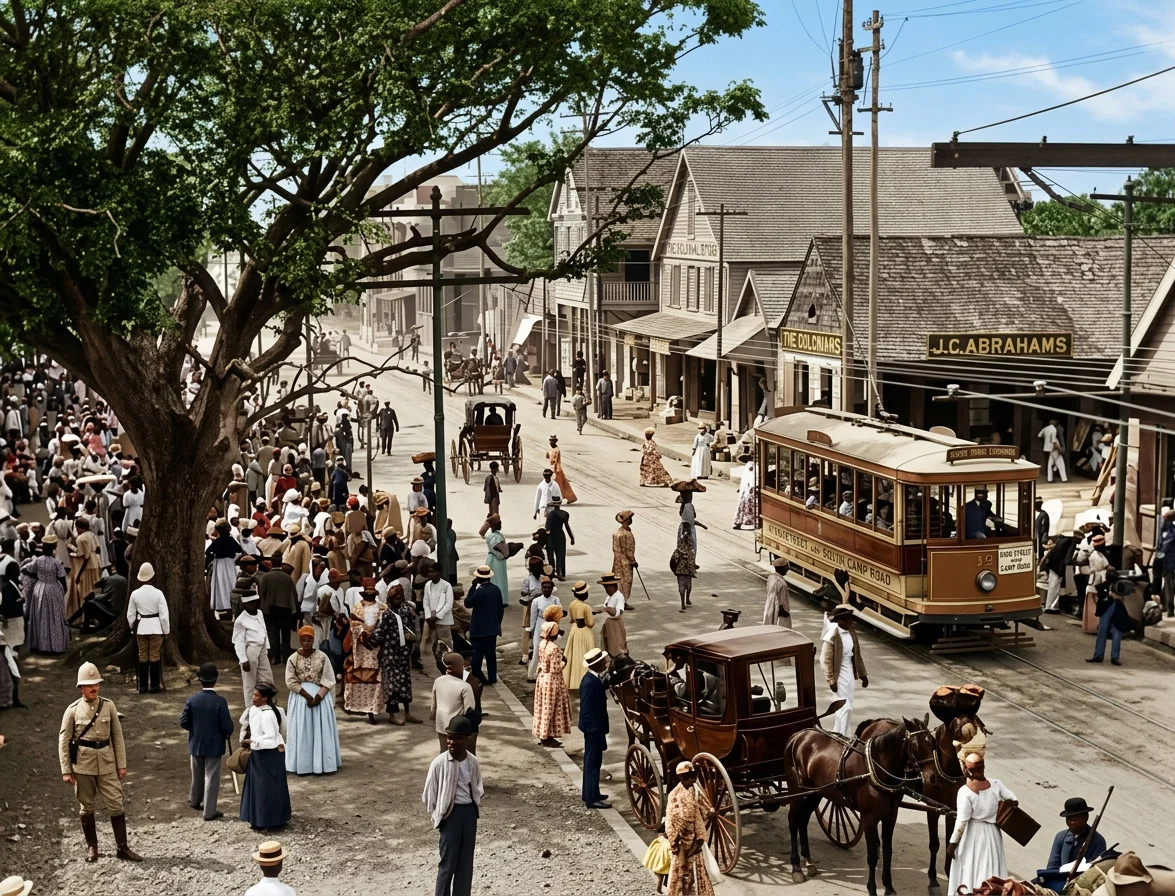
KINGSTON BEFORE THE EARTHQUAKE, NEAR KING STREET
On the morning of January 13, at 9 A. M., the West Indian Union Conference held its first meeting. Elder Geo. F. Enoch, the president, occupied the chair. The conference was organized, seating between forty and fifty delegates, representing five organized conferences and four mission fields. The house was so packed with the brethren that it was almost impossible to seat the delegates and conduct the business. After the organization of the conference, we listened to the president's address, and then the usual committees were appointed, and the business of the conference gotten under way.
It had been arranged that the Jamaica Conference should hold its meetings during the time appointed for the West Indian Union Conference, and they occupied the afternoon in organizing their conference, receiving the president's address, the report of the treasurer, and getting their committees appointed.
The brethren had leased the city hall of Kingston for some evening services during the conference. This hall was centrally located, and would seat about one thousand persons. It had been beautifully decorated with appropriate mottoes, musical instruments, etc.
The meeting on the evening of the thirteenth was to open at 7 P. M., but long before the time arrived for the opening of the services, the hall was so packed with people that it was impossible for any more to find even standing room. The meeting was opened half an hour before the appointed time. It is said that a thousand people stood in the stairways and halls and in the streets who could not find admittance.
Elder Luther Warren spoke on the subject, The Hour of God's Judgment. The hall was almost as still as the chamber of death, save for the speaker's voice, which rang out in clear and thrilling notes, announcing that the hour of God's judgment had come, and that the time had come for men to put away their sins. The whole audience was stirred as they listened to the stirring appeal of the speaker; and seldom, if ever, have the people of Kingston heard a clearer clarion note from heaven to repent and humble themselves before God, than on this occasion.
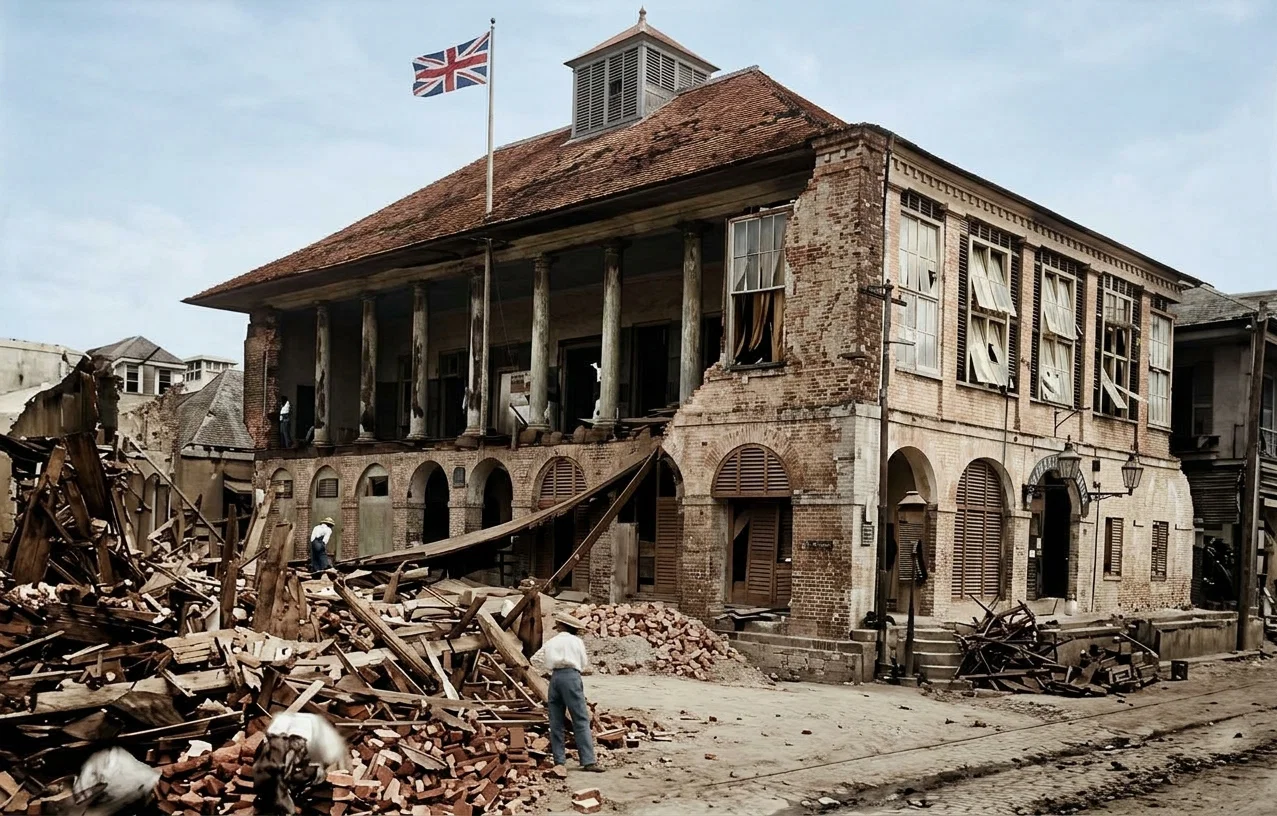
Unfortunately, this was the last meeting that we were able to hold in the city hall. Before the following night, on which Elder Warren was to have spoken on the Time of the Judgment, the great earthquake occurred. The city hall was laid in ruins. How little the people of Kingston realized on the night they listened to the thrilling message from the servant of God, that they would hear the voice of God in such a demonstrative manner on the following day at 3:30 P. M.
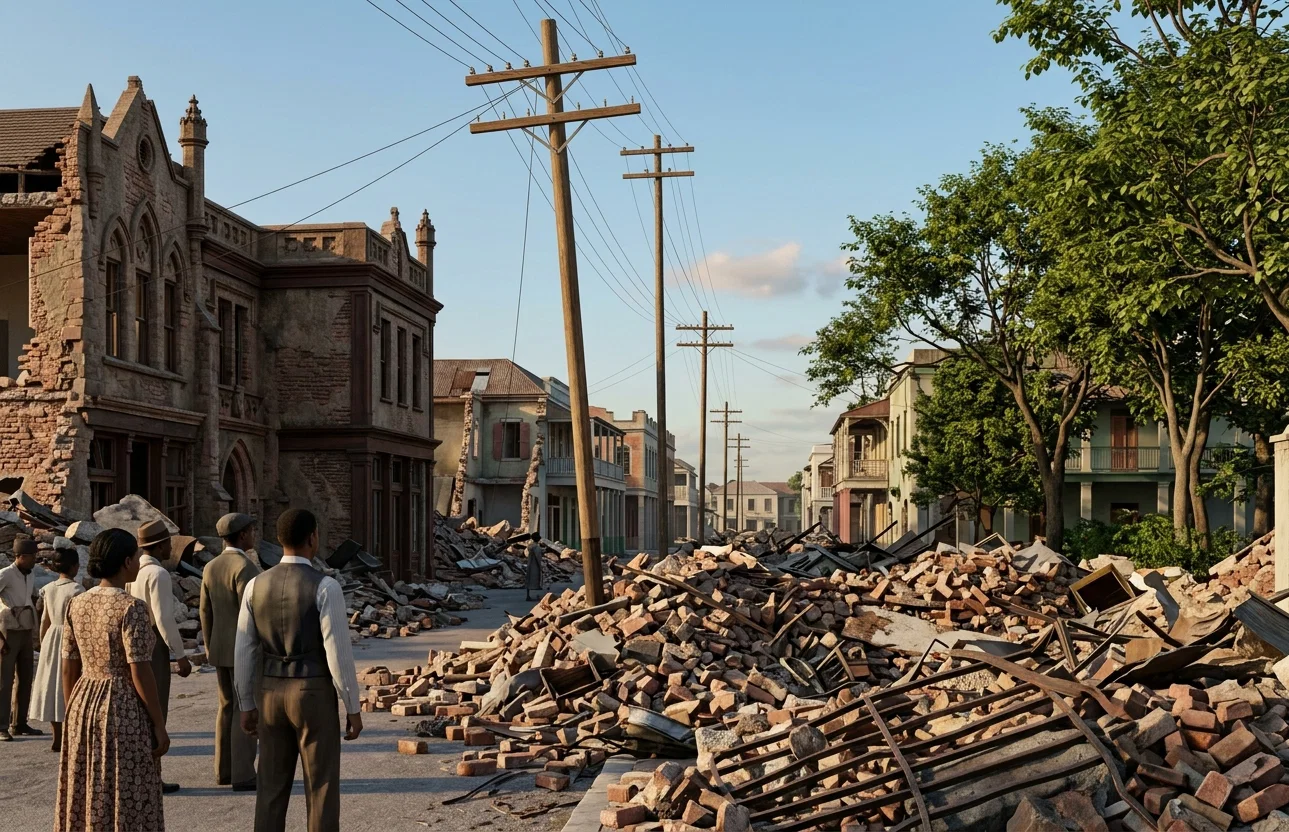
The earthquake laid the city in ruins. Nearly every building constructed of brick or cement, or that had been plastered was rendered uninhabitable. Fire broke out, and as the earthquake itself had tied up all the engines and fire-fighting apparatus in the city, nothing could be done to check the flames. Scarcely a breath of air stirred in the heavens, or the whole city would have been burned. As it was, the fire consumed the entire business portion of the city. The available hose that could be secured was attached to the hydrants in different places, and the flames were gotten under control. Every church building in the city of Kingston of any importance or size was laid in ruins.
Fortunately for our own people, the conference had adjourned over Monday, giving the delegates a chance to visit the school farm at Bog Walk, some twenty-three miles from the city of Kingston. About thirty of the delegates availed themselves of the privilege of visiting the school farm, and were at the farm at the time of the earthquake. On this account there was a limited number of people in the Kingston chapel at the time of the earthquake. Providentially the walls of our church did not fall to the ground.13
Only one of our delegates was killed — Brother Norman Johnston, the treasurer of the West Indian Union Conference. He had gone to the city about thirty minutes before the earthquake shock, to do some banking business. Up to the time the writer left Jamaica, his remains had not been found.
There was no place in which meetings could be held after the earthquake, inasmuch as the tent which had been sent down by the New York Conferences had not been secured from the customs, and a portion of it was under the débris.
Sessions of the conference were held out of doors wherever the delegates could be gotten together. The committees brought in their reports, officers were duly elected, credentials and licenses were granted, and the distribution of laborers was arranged. So that as far as the business part of the conference was concerned, it was completed almost as fully as it would have been had there been no earthquake.
RUINS OF BUSINESS HOUSES, KING STREET
It was thought that it would be impossible to continue the institute work, owing to the lack of accommodations, the prospect of the scarcity of food, and the strong desire that the delegates had to get back to their families, etc. The meeting therefore adjourned on Thursday, January 17, at seven o'clock.
Preceding the adjournment of the conference Brother E. L. Cardey of the Central American Conference, Brother J. H. Matthews of the East Caribbean Conference, and Brother Sterrie A. Wellman of Trinidad were set apart to the work of the gospel ministry. Most of the delegates then proceeded to make arrangements for passage to their various fields of labor.
It was the privilege of Elder Farnsworth and the writer to spend the following Sabbath and Sunday at Kingston. Our hearts were made to rejoice to see over one hundred souls give themselves to God and covenant to obey the truth.
Elder Tanner, of Hayti, led the services in the morning in the large pavilion which had been erected. There were present during these services, Elders Strickland, Tanner, Bender, Beckner, Professor Hughes, and the writer. All hearts were made to rejoice to see such a manifest working of the Spirit of God upon the hearts of the people. It was planned for Elders Strickland, Tanner, and Bender to remain in Kingston and continue the services.
Elders Enoch and Connerly were at Port Antonio over Sabbath and Sunday, and ten precious souls gave themselves to Christ during the meetings at this place.
The delegates returned to their home fields with good hope and courage in the Lord. Many testimonies were offered, expressing gratitude to God for the special manifestation of his power in behalf of ourselves and our people at the time of this great calamity.
We believe the conference was a great benefit to the work in the West Indian Union Conference, and I am sure that none would wish to part with the experience gained at this meeting. It will be necessary to render much help to the people of Jamaica to restore their damaged churches and property.
We left the Jamaican brethren of good courage in the Lord, and determined to press on until the victory is gained.
Gospel Work in Changsha
Hunan was one of the last provinces that held out against the entrance of the foreigner. Within only a very few years has Changsha become a treaty port. It is said the literati here are a very strong body. They have issued an anti-christian tract, the first edition of which was eighty thousand copies. Through its influence there was created a very strong prejudice against the work of Christ, which has served to harden men’s hearts against the entrance of the gospel.
Dense darkness abounds, and superstition, with fear of demons, is prevalent, keeping these poor people bound down by a cruel slavery. It needs to be seen to be realized. Very real are their fears of these demons. Various devices are used to frighten them away, or confuse them so they will not trouble the business or homes of the people. High walls are built around the houses to keep them out; screens are erected in front of the doors, and walls in front of their gates, for a like purpose. Streets and roads are made crooked to bewilder them,—this often necessitates going much farther than needful to reach a certain point,—and there are few roads fit for traveling.
In spite of these drawbacks, China is making some headway. But at the present rate it would be hundreds of years before she could take her place among the nations of the earth. The influence of Christianity is doing something to scatter the darkness—but how much more is needed! In this great city there14are nine missions, with three independent stations. The Chinese who accept Christianity are often persecuted by their countrymen. At Siang-tan, a city thirty miles from here, a dispute is in progress between students and church-members, caused by the refusal of a Christian shopkeeper to pay a temple tax.
It is we who have a special message to give in these last days, who can bring to the Chinese healing for the soul and health for the body, and best lend a helping hand to lift them out of this darkness and gross superstition. A lady physician of the Norwegian mission is the only one who has established a hospital and dispensary in this place, where the poor can go and receive help and treatment for their ailments. But here only women and children are admitted. The dispensary is open for three days each week, from nine till one. A small fee of two and one-half cents gold is charged each patient, if she has it; if she has not, care and medicine are given gratis. It has been my privilege to assist in this work the past month, while awaiting the arrival of our freight, and I can testify that it is a work fraught with great blessing. I am now in full charge for a fortnight, while the doctor is out of the city attending a conference. Last Wednesday was my first day alone, when I had thirty-four cases. Eleven of these were new ones, with history to take, examination and diagnosis to make, and treatments to be given. Five helpers assisted me. Some terrible cases present themselves, which yield very readily to simple treatments and medicines. The medicines (so called) most used are water, soap, bichlorid, condensed milk, and santonin, with a good laxative. It is surprising how very serious maladies disappear as if by magic.
The Chinese come very readily to the foreign doctor in cases of severe illness, as they do not have great confidence in their own medicine-men, whose futile efforts they have so often seen. Often all that is done for a patient is the holding of incantations over him by the priest. O for the consecrated physician, who will show them through his life what the love and compassion of the Saviour are!
A good oculist is sadly needed here. Cases of strabismus and myopia are very frequent, and could be corrected by glasses properly fitted. There is no oculist, to my knowledge, nearer than Shanghai, one thousand miles distant. The Chinese take readily to the wearing of spectacles, thinking it adds to their dignity. Frames made of tortoise-shell, with large circular glasses, seem to be a favorite style.
We visited a glass factory the other day, where lenses for spectacles are made. The process, which was interesting, was as follows: A large mass of melted glass is collected on the end of a pipe or blower, and carried up some steps to a platform, and held downward over a pit. The end is then applied to a bellows, by which a cylinder is formed, ten to twelve feet in length and three to four feet in diameter. That which is used for the spectacles is very thin and fragile. This is cooled, and cut into circles about one and one-half inches in diameter. They are then sent to the “eye man,” who fits them into frames most antique in style. He sells them to his unwary countrymen for ten cents or more.
The blind are very numerous, owing to the ignorance of the people in regard to infection. Smoke from the open fires, with no proper means of egress from the room, is a frequent cause of severe conjunctivitis, especially among the women. For treatment they sometimes go to a quack, who may have a limited amount of foreign drugs, with no knowledge of their use. He often puts carbolic acid in the eye, which finishes it.
POST-OFFICE, KINGSTON, JAMAICA, WITH TOWN HALL ABOVE
A rational school of medicine, where young men and women could receive a practical training under Christian influence, would be a real benefit to the Chinese. It would do more toward breaking down the wall of prejudice than almost anything else. Other Christian organizations are recognizing this principle, and schools of higher learning and universities are being formed to train the young men and women for real, practical work, right in their own country. Yale University has started the nucleus for such a work here at Chang-sha. It, however, is not very popular, on account of the boycott on American institutions and manufactures in general. This kind of work takes time, patience, and a real work of grace in the heart. Of those taking this course of training, some would most likely become Christians. These should make efficient workers for the Lord.
May the needs of this great empire, with its more than four hundred million souls, speak to you; and God grant some may hear the Macedonian call, “Come over, and help us.”
Chang-sha.
In the New Province of Hunan, China
By Emma Perrine-Laird
EMMA PERRINE-LAIRD, M. D.
We have now taken a small house, and are at work. I have begun the language study with a teacher, and am assisting a lady physician of the Moravians. Later I expect to open a little work in our own house, outside the city walls, where there is much need.
My husband conducts a meeting in our front room, next the street, which he has fitted up for that purpose. All he has to do is to open the door and sing a song, and he has a crowd of attentive listeners every evening. The following is a paper which I prepared; it is to be read at the meeting of the Medical Alliance in America, and may be of interest to the readers of the REVIEW:—
Hunan is one of the most central of the eighteen provinces of China. Changsha, the capital city, is enclosed by a wall nine miles in circumference, and has a population estimated at four hundred thousand. The people are said to be very proud; and to have rather more than the average amount of intelligence accorded Chinese.
Carey’s Bible Translations
ONE man — Carey — laid siege to the languages of India, and translated the Bible, in whole or in part, into twenty-four languages and dialects, rendering the Word of God for the first time accessible to more than two hundred millions of mankind. Now that we have reached the last generation, may we not confidently expect God’s Spirit to move men to greater endeavors?
O. A. OLSEN
By Ole Andres Olsen
Australasia
O. A. OLSEN
We are much cheered by the reports that come to us through the good old REVIEW from time to time concerning all parts of the field, showing the rapid progress the message is making, and how quickly it is spreading even in the remote parts of the earth. This, in itself, is one of the most definite signs that the coming of the Lord and the glorious consummation of the gospel is right at the door; for when this gospel of the kingdom shall have finished its work, having been preached in all the world, the end will come.
From the Australasian field, also, we can give a good report. Since the close of our excellent union conference, two local conferences and camp-meetings have been held, the first one being at Sydney, New South Wales. It is becoming somewhat difficult to find suitable locations for these gatherings in or near our large cities. The meeting this year was held October 18-28, at Bondi, a suburb of Sydney, where as yet no labor has been put forth. The ground, while favorably located, was rather limited for space; still it answered the purpose quite well. We were greatly favored with most perfect weather throughout the entire meeting. The Spirit of the Lord was present in a marked manner, and we had, as it were, a fair taste of the blessings of the latter rain.
At this meeting we had with us quite15a representation from our island mission workers. Brother and Sister Cady, from Tahiti, and Brother Christian, of Norfolk Island, were still with us. Brother and Sister Teasdale had arrived from New Zealand, on their way to Java. Brother Joseph Mills, who was about to start for Singapore, Brother G. A. Marriott, who will soon leave for either Fiji or Tonga, and Sister Skadsheim, who leaves for Java as a Bible worker, were all present, and added much to the interest. The meeting took on a missionary character, first in its interest in fields abroad, and second in pushing the missionary campaign with vigor in the home field. It was an occasion that will long be remembered.
The work at this place is now being followed up. Since the camp-meeting, twenty have been baptized, including rebaptisms. We hope the effort in this place may develop a strong church.
November 1 we had another interesting occasion. On that day a party of eight boarded the steamship “Guthrie,” bound for Java and Singapore. Brother Mills, one of the recent teachers of the Avondale school, goes to Singapore to assist in the school work; and Brother W. W. Fletcher, from Victoria, also goes to Singapore to strengthen the corps of workers there. Elder Geo. Teasdale and his wife and two children, Sister Helena Teasdale, Sister Skadsheim—a former Bible worker in New South Wales—go to open up work in Java, where as yet we have done nothing.
This company was reinforced at Brisbane, where Brother and Sister Wantzlick and their child went on board the ship, for work in Sumatra. So the steamer carries workers to three very important fields—Java, Singapore, and Sumatra. We all rejoice greatly in this advance move, and earnestly pray that the signal blessing of God may attend these laborers.
The second camp-meeting since our union conference has just closed, at Masterton, New Zealand. Here also we had a very interesting and profitable meeting. Masterton is located about half way between Wellington and Napier, on the east side of the North Island, in the midst of a prosperous and well-to-do community. It has a population of five thousand.
The weather was not so favorable during this meeting as was that experienced at the camp-meeting in Sydney. This, to some extent, hindered the attendance from the community. On both Sundays the weather was favorable, and we had large and attentive audiences. The two city papers gave very favorable notices of our meeting, and printed quite full reports of the discourses. This was much appreciated.
The interest here will be followed by a tent-meeting, and we have reason to expect that a strong company of believers will be raised up in this place.
A special feature of the meeting was the consideration of the school for New Zealand. This movement was begun at the meeting last year. A considerable sum of money has been raised; but up to the present they have not been able to decide upon a location. This was found to be a more difficult matter than was expected.
This meeting also had its special missionary feature. The union conference drew heavily on New Zealand for our mission field. Not only were Brother and Sister Teasdale taken, as already mentioned, but also Brother and Sister Pascoe, for Rarotonga, who, at this meeting, took their leave of the brethren in New Zealand, and together with Brother and Sister Cady were to sail from Auckland the next week. On the last Sabbath of our camp-meeting Brother Pascoe was set apart by ordination to the gospel ministry. This was a very precious occasion, on account of the gracious presence of the Holy Spirit.
The business of the conference was carefully attended to, and Brother Cobb was again called to bear the burden of the presidency.
Another interesting feature of this meeting, as well as of the one held in New South Wales, was the vote of the conference to support a laborer in the mission field from their conference funds. This assistance is greatly appreciated by the union conference, as we are thus enabled to push the work more rapidly. By the time this report reaches the readers of the REVIEW, twelve additional laborers from the Australasian field will have entered the island mission work, located as follows: Singapore, Sumatra, Java, Rarotonga, Fiji, and Norfolk Island. Brother and Sister Mitchell, of Adelaide, South Australia, will be located in Norfolk Island; and in a short time it is expected that two more will join the work in Fiji.
We are now on the boat from Wellington to Sydney, to meet Elder G. A. Irwin, who has arrived during our absence. We shall indeed be glad to meet him; and may the day hasten when the work shall be completed, and the Lord come and gather his own. What a meeting that will be!
Sydney, Australia.
The “Malaysia Conference”
By R. W. Munson
R. W. MUNSON
One of the special reasons for sorrow of heart over our enforced departure from Padang, Sumatra, was the anxiety we felt concerning the future of the children of Brother Matthew, the first man we baptized in Sumatra. There were seven of these, and the conference had undertaken their support; but they were not under our jurisdiction, and according to Chinese customs and Dutch law, they could not be until their father died. He was rapidly failing before we left, but lived for many months. I had taken the precaution to have a will made, in which he appointed me the executor of his estate and guardian of the children. He specifically stated that he wanted the children reared and educated in the Christian faith. Last June Brother Matthew died, and this left the way open for us to act. Brother Jones went there, on the same trip that took him to Surabaya, and brought the orphans to Singapore. He was providentially directed to the home of Mr. Seng Ahn, son-in-law of Brother Matthew, and a very fine man. His wife, the daughter of Brother Matthew by his first marriage, welcomed Brother Jones cordially, and made him feel at home. He met all the brethren, and did them much good by his visit.
November 1, the day we saw the steamship “Guthrie” leave the harbor of Sydney with a company of eleven, comprising the party who were starting for the East Indies, we rejoiced exceedingly, and took fresh courage. God is working, and we should pray with ever-increasing faith and assurance that every prayer is recorded in heaven, and will eventually be answered.
Another cause for raising a stone of Ebenezer is the miraculous restoration of our son Paul to health. A year ago the first of this month I brought him home from the sanitarium to die, if God did not intervene. Before bringing him home, I called Brother Gates, Brother McElhaney, and Dr. James, who is an elder, and after carefully explaining to the child his condition, and telling him that if God spared his life, I wanted him to devote it to the work of carrying the message to others, we prayed for him, and Brother Gates anointed him with oil, in harmony with the instruction in James 5. I felt that this was the last thing I could do. I then committed him to God’s care, to heal or otherwise, as the Lord willed. As Abraham laid Isaac upon the altar, so we laid him on the altar. We were fully resigned to the Father’s will, but prayed that if he saw that the child could live to honor him and forward the work of the message, he might spare him.
He began to mend from the day he reached home. Within the past year he has lost all the bad symptoms. He suffered from consumption of the bowels, and was a mere skeleton, and apparently bloodless. No one who saw him had any hope for him, humanly speaking. To-day he is plump and ruddy and full of life. Praise God, from whom all blessings flow!
Most of my time the past year has been given either to tent work or to the translation of literature into Malay for use in Singapore. I have translated a Sabbath tract prepared by Brother Gates, one on opium, prepared by Dr. Kress, and am now at work on “Christ Our Saviour.” We hope to get this off by the close of 1906, when a Sabbath tract, one on the seventh of Daniel, one on tobacco, and finally “Coming King,” will be taken up. This book will be put into Dutch Malay—the kind of Malay spoken by the Baba Chinese in the Dutch East Indies. The tracts are first to be put into the Singapore Baba Malay, and then the Dutch Baba Malay. Another work that must soon engage our attention will be a Malay hymn-book, containing hymns suited to the needs16of our work, and dwelling upon the fundamental phases of the message.
This translation work has given me peculiar joy and satisfaction. I can readily see that the demand for literature in that great field is going to tax my strength for some time to come; for there are many millions of people to be reached through the Malay tongue alone in its various forms. The work already mapped out will keep me busy for a year at least.
There is one great field among the East-Indian born (or Baba) Chinese who come of Chinese fathers and Malay mothers. There must be at least a hundred thousand of these. Then there are the Mohammedans, numbering several millions, who can be reached with the pure Malay in the Arabic character. Lastly, but not least, there is the large population of Christian Malays in Sumatra, Celebes, Moluccas, and the Sangir group, who must hear the message. Most of these can be reached through the Malay. In the Celebes and the Moluccas it is a somewhat different Malay, but can be easily acquired by one who knows the pure Malay spoken in the Malay peninsula.
One night some weeks ago, in a waking vision I seemed to see all those hundreds of thousands of Christian Malays reaching out their hands for the pure light of the third angel’s message. We can enter those fields with literature when ordained ministers would be refused permission to labor.
All this will help the reader to realize what a tremendous importance attaches to the plan to establish at Singapore a strong plant for printing the message in all the languages of eastern and southern Asia, and of the East Indies. This plan is receiving serious consideration, and will no doubt crystallize in definite action in the near future.
I can say that while my first impressions of Australia—I do not refer to the people—were unfavorable, I like this country better and better. All my children are attending the Avondale school. Excellent work is being done in this school. I regard it as a singular mark of God’s favor that I am permitted to place my children in this institution.
In conclusion, I wish to say that I am rejoicing in a richer, deeper religious experience than ever before. I bless God for complete victory over sin. Many besetting sins that have hindered me in my Christian race are indeed “laid aside,” by the grace of God, and I am striving with all my heart to run the race set before me. I wish to testify that one secret of this victory lies in a prayerful study of the “Testimonies.” I thank God with all my heart for the spirit of prophecy, and especially for the “Testimonies.” I know they are from God, for they bring conviction to me whenever I read them. Furthermore, they describe my condition as I myself could not do it. As I have read them, I have stood in awe, as if I heard the very voice of God speaking to me.
Cooranbong, N. S. W.
The Light Shineth in Darkness
By F. W. Spies
This wonderful truth is still meeting its fulfilment. Some time ago a brother, who is living in Nictheroy (Brazil), which lies just across the bay from Rio de Janeiro, met a man, a Roman Catholic, and talked with him about the Word of God. This man was one of the eighty-four per cent of Brazil's unfortunate ones who can neither read nor write. But he took home to his wife the Bible offered to him, and asked her to read to him from it. At first she did not feel much disposed to comply with her husband's request; but having once begun to read, she soon found herself interested in that before-unknown book, and the more she read, the more this interest deepened.
To make a long story short, I will say she continued to read, and her husband continued for a time to listen. But soon he, not wishing to obey the teachings of God's Word, returned to the smoke and drink habit, from which he had been for a time delivered; and, naturally enough, he wanted his wife also to renounce the Word. But in her case the precious gospel seed had found a good soil. She turned away from her Romish customs, and began the observance of the Lord's commandments, trusting in Jesus and his promises, instead of in the virgin Mary and a host of saints.
When the husband found that the wife would not give up her faith in the Bible, he ill-treated her, and forbade her to have any intercourse with our brethren, hoping thus to extinguish the spark of love for the truth of God; but a few days ago I met this sister for a few minutes only, and found her happy, and confident in the Lord, manifesting an unwonted interest in, and a love for, the truth. In spite of the persecution she suffers at home, she asked to be baptized, and will, we hope, be one of the four to receive this rite in a short time.
Speaking of her husband, she said: “The Lord can do wonders, and I am hoping he will some day change my husband's heart.” This sister's simple faith and earnest, consistent Christian life show that even to-day that light which lighteth every man that cometh into the world can disperse the darkness and error of Roman superstition, and bring light and liberty and gladness. We believe that this sister's case is simply a sample of many others who are waiting to receive the precious light of the gospel as soon as it shall shine upon their pathway. May the Lord of the harvest send forth reapers into this field that is already ripe for the harvest, in order that none of the precious grain may be lost.
F. W. SPIES.
Personal Experiences in Colporteur Work
By Wm. C. Rahn
SOME time has passed since I last reported, and as the Spirit of the Lord instructs us to write our experiences that they may be a source of encouragement to others, I do not wish to disregard his desires, especially at a time when every soul is tried to the uttermost. The Lord is certainly adding his blessing to those who are working for souls in this long-neglected field. We are told that it is our privilege to know that angels of God are round about us when we visit from house to house. I have realized that more here in South Carolina than in any other State in which I have worked.
The past week I have been conscious of his special guidance in my work. In finishing my territory I had to do a great deal of walking; so, tired and worn out, I found a stopping place at a house previously visited, but where I had taken no order. They gladly received me and kept me overnight, and I had no difficulty in selling them a book in the morning. In the next two houses I sold two more books for cash.
In the forenoon of the next day I came to a well-to-do man who was staking out his cow, and had his mule harnessed ready to plow. He seemed to be in a great hurry. I told him that I had a book which I would like to show him.17But he “had no time this morning to look at a book;” but after a little conversation, we sat down and went through the book “Coming King.” He asked if I did not think the Lord would give a message before he should come. “Yes,” I said, “and this is a special invitation to you this morning.” It had a deep effect upon him, and he wanted me to stay longer. I took his order for the book, and went over the hill praising the Lord.
In the distance I saw a man sitting by the roadside, waiting for the mail-carrier. The Spirit of the Lord impressed me to canvass that man. With full courage I went to him, sat down by his side, and the Lord came very near, but the man would not give his order, so I went on to the end of the road. A man told me that by going through the woods I could find another road. I failed to find the other road, and had to come back to that same road and pass the house of the man whom I had canvassed by the roadside. After I had passed his house, I heard him calling me. He said he wanted one of the books. The Lord had led me back there again. I never saw the Lord work in a more marked way than here.
He gives me new zeal and new courage from day to day, and I shall trust more in him. I often think if we as a people could realize the time in which we are living, and the world's great need of the third angel's message, and would arise as one man, how quickly the work might be finished. If any who read this feel impressed to come here, I hope they come at once; there is room.