The Youth’s Instructor, Vol. 66, No. 4.

Cuba is about the size of New York State

The Youth’s Instructor

Jan 22, 1918

Review and Herald Publishing Assn. · Takoma Park Station, Washington, D. C. · Jan 22, 1918

Cuba is about the size of New York State

Mr. Henry Ford has at least 600 released prisoners in his works at Detroit.
Over one hundred billion dollars is the estimated cost of the war to date.
Four hundred million typhoid germs can be packed into a grain of granulated sugar.
A resident of Baltimore has placed on the lawn of his home a simple but dignified stone memorial to Adam, the first man.
The American Museum of Natural History, New York City, maintains a collection of living bacteria. This is the first time such a collection has been made for the use of scientists.
A half-million persons, ninety per cent of whom are men, are each year committed to correctional institutions in our country. One out of every 200 or 250 persons in the United States gets into jail.
For seventeen years Arthur F. Fuller has lain flat on his back. He has in this time written and published twenty books, including a seventy-two-page book of poems. He is a music composer as well as a writer of books.
The czar of Russia owned two Siberian wolf-hounds, Peter the Great, valued at $5,000, and Catherine the Second. A former secretary of the American embassy at Petrograd bought these and brought them to America.
Ground glass has been found in canned tomatoes that were furnished to one of our cantonments. Also Red Cross bandages were poisoned in transit from Toledo, Ohio, to Cleveland. That there are traitors within our borders is beyond doubt.
On December 28, 1917, President Wilson took over all the steam and electric railways throughout the country, except the street electric passenger railways. Mr. McAdoo, Secretary of the Treasury, was made director of the railways, for the period of the war.
Parcel-post motor truck routes are to be established, totaling between three and four thousand miles. One of these routes will extend from Portland, Maine, to New Orleans, Louisiana. A second route will cover territory in Illinois, Indiana, Ohio, and West Virginia. The third will be in California.
The Standard Publishing Company, Cincinnati, Ohio, publishes a series of “Childhood Bible Stories” in booklet form. Each booklet is beautifully illustrated with twelve attractively colored full-page illustrations, and sells for fifteen cents. These stories are adapted to children from four to six years of age.
January 30 is Tag-Your-Shovel Day. This is the day when the householders of the country will be visited by the school children, who tag each coal shovel whose owner promises to use one less shovel of coal a day for the rest of the year. The boy or girl in each community who tags the most shovels will be given the privilege of tagging the shovel of the highest official of the town or city. The District of Columbia boys and girls will work enthusiastically, each hoping to be the favored one to tag the White House shovel.
Vilhjálmur Stefánsson, the arctic explorer who headed an expedition to the far north in 1913, and who had not been heard from since March, 1916, recently arrived at Fort Yukon, Alaska. His boat, “The Karluk,” was crushed and sunk by the ice, and eight of his party lost their lives in an attempt to reach Herald Island. Mr. Stefánsson was sent out to make geological, botanical, and biological surveys of the Canadian arctic shores, and to study Arctic Ocean conditions. The loss of his boat militated greatly against the success of the expedition; but with dog teams he accomplished much, among other things discovering a large island or continent northwest of Prince Patrick Island.
Dr. Hu King Eng, of Fuchau, who was the first woman of the Chinese race to graduate from a medical school, has been so honored and respected by the authorities that she has been given the right to hold property in her own name, the first woman in that province, if not in all China, to whom such a privilege has been granted. She has decided to exercise the right of disposing of it,—also a new thing in China for a woman,—and has made out a deed of the property, worth about $6,000, as her offering to the Jubilee Fund of the Woman’s Foreign Missionary Society of the Methodist Episcopal Church.
The patent office is full of interesting studies, from the noiseless alarm clock, designed to wake the sleeper by pouring cold water over his feet, to the tornado-proof house, built on a pivot so as to turn before the wind. They leave one with a heightened sense of the ingenuity of one’s fellow creatures, together with a conviction that the percentage of those who win in the patent game must be exceedingly small in comparison with the host who patiently put in their lives and gain nothing.
Gautemala City, Central America, suffered quite a severe earthquake on Christmas Day, and more severe ones during the week following. A large number of the leading buildings were wrecked, including the National Palace which houses the various branches of the government; the general post office; and the railway station. About sixty persons were reported killed and a large number injured. The American Red Cross has been appealed to for aid.
We often hear it said that one is never too old to learn. Personal cases that prove this are always interesting. William S. Hoover, of Los Angeles, started to learn the alphabet at seventy-five, and now at eighty-five he is taking dancing lessons. He claims never to have had childhood and youth, as he began to earn his living at six years of age.

A Parable

“To the queen rose in the rosebud garden of girls.”
MRS. MARION E. CADY
A WAY up at the head of a beautiful valley in sunny California, where it narrows and almost loses its identity in the foothills of the Coast Range, is a young ladies’ boarding school. From its rose-trellised porches, across the rolling hills that rise higher and still higher, can be seen the green and gold of the orange groves on the sloping sides of Litch Mountain. The soft night winds of early spring waft the heavy fragrance of the rich waxy blooms down to the little valley below, and the pale, thin blossoms of the mock orange bow their heads in confusion.
At the rear of the buildings is the fig orchard, where emerald globes hang swelling in the moist warm darkness to the very perfection of melting richness and sweetness.
This is an old, old school. The lawns are covered with rare shrubs from many climes, and grand old trees, the favorite being an old oak that raises its symmetrical and gray-lichened branches even above the stately madrona with its tiny wax bells. It has spread its sheltering branches over the rose hedge, and one night long, long ago, aided by the south wind, gently caressed one shining tendril of the graceful climbing rose, and now its gray-green branches are beautiful with pink and white festoons of the clinging rose vine.
The choicest of roses border the well-kept walks, but near the strong, protecting trunk of the old oak is the most treasured one of all, a beautiful La France. The year before, it was a marvel in size and richness of coloring, and this year it was given extra care, that absolute perfection might be attained. Every morning after the young women had gone to their classrooms, the Woman visited each shrub and flower, but she lingered longest over her cherished rosebud. It seemed to be growing so slowly. Had it been pruned too closely? She called the head gardener. He looked it over carefully, then said, “It’s all right. Just wait.” So she went for her private drive on the boulevard to Canyon Springs, where one always has, as a matter of course, one full cup of the famous soda water. On the way back she noticed growing among the grasses by the roadside a tall, slender rosebush, literally loaded with little tight green buds.
Day after day she watched and tended her Garden Rose, watering it with her own hands, and watching for those little menaces to perfection by which the enemy of all things beautiful seeks to mar God’s handiwork.
The next week when driving on the boulevard, she again noticed the Roadside Bush. This time she could see the pink beginning to show in the swelling buds. When she returned home she examined the buds on the Garden Rose, but no hint of color was seen. Perhaps it was too sheltered? She called the head gardener again. He was a quiet, gruff old man. “No, lady. Just wait,” was all he said. But it was hard to wait, for the very next drive showed the Wayside Rose had burst into bloom, and such a mass of fluffy pink-and-white daintiness the Woman from “back East” had never before seen. They seemed too frail and beautiful for the dusty roadside. But the Wayside Rose seemed all unconscious of that. It even bent a little closer to the road as though desirous of sharing its loveliness with all. Careless hands plucked its flowers, to be worn for an hour. Soon it began to look a little dusty—but then each morning its dew-washed petals were again fresh and beautiful. But it was flaunting itself perilously near the stream of pleasure seekers on the broad way. And then one morning the Woman, who had grown to love the Wayside Rose, gave a cry of dismay at sight of it. Some careless bicyclist had run over it. Perhaps it was dark and he could not see how frail and beautiful it was. Perhaps his brain had been muddled and coarsened by his stop at the last road house. Anyway, he had carelessly crushed it to the earth, and some of its petals lay bruised and fading in the sun. The Woman left the carriage and carefully lifted the tall flower-laden bush. Shaking the dust from it, she placed it back among the tall protecting grasses by the fence. But its fiber was weakened. That night a boisterous wind came, and the rose had no strength to withstand its buffetings. Morning found it again bent low to earth. And there was no hand to lift it. One or two shoved it carelessly aside, but the next day it had been crushed so many times it made no effort to straighten. Prone in the dust it lay. All its dainty pink petals, with their freshness and sweetness, lay bruised and fading under the feet of the pleasure lovers on the popular boulevard. Finally even the green leaves too were browned and powdered in the dust of the road. Nothing remained but the brown stalk with its thorns, now grown long and sharp. One day the selfsame bicyclist was again passing that way. Noticing the needle-like thorns, he jumped off his wheel, and with a sharp knife severed the Wayside Rose. With a toss he landed it on some thistles a careful farmer was burning.
Deep and serious were the thoughts of the Woman who loved all things beautiful, as she drove slowly homeward. How tenderly she watched her sheltered rose! The buds were swelling now, but they still kept their sweetness and loveliness tightly locked in the heart of the coming rose.
One soft dewy morning in May the buds began to open. One by one the fragrant pink petals unfolded until they formed that most beautiful of all flowers,—a half-blown rose. And there in that lovely garden, sheltered from the hot breath of the sun, from the dust of the street, where no rough wind could bruise its fresh, tender petals, it stayed a half-blown rose a long, long time. One night under the stars and the whispering leaves the full soft petals opened wide. In the morning the Woman looked deep into the heart of her rose. By and by she plucked the beautiful flower, and put it in a slender vase in the cool library.
One evening the girls were all gathered around the Woman, as they loved to do in the big old-fashioned library of this fine old-fashioned school. It was the time for one of those quiet, intimate talks when, though often unconsciously, the foundations are laid in the impressionable years of girlhood for those fine womanly traits of character that shine so attractively in the young woman of true worth. The Woman looked at the rose whose rich fragrance filled the room. Again she turned her gentle eyes on her budding girls, soon to blossom into the full flower of womanhood—so like the roses. Her gaze rested longest on fair-haired Gladys. “Glad” the girls lovingly called their favorite, and well did it fit her of the sparkling eyes and full, red lips, brimming over with the electric energy of untiring youth. What anxious hours the Woman had spent over this radiantly attractive girl who chafed restlessly under the careful chaperoning and quiet, sheltered life of the school regulations, which the other young women accepted as a matter of course in their well-bred lives.
Then she told them a story. It was the story of the Wayside Rose and the Garden Rose. It was a very quiet group of girls that filed out of the room that evening, with gentle “good nights” to their beloved preceptress.
A few days after the evening’s story the Woman came in from her drive a little wearied. Slowly she walked to the cool, quiet library, and brushing back her wavy hair with a thin soft hand, lay down on the big sofa. While she lay asleep, one by one the petals of the rose loosened and fell on the polished mahogany of the table. Some one opened the door quickly. It was Gladys. She gave a little start of surprise as she saw the Lady and the flower. A serious thought entered her mind, and gave added charm to the sweet, bright face. With Gladys, to think was to act. Gently she gathered the petals, still soft and pink and beautiful, and wrapping them in the softest of silks, placed them, more fragrant in death than in life, on the pillow by the Woman, with this little stanza of verse:
“May the simple heart of a child be mine, And the grace of a rose in bloom; Let me fill the day with a hope divine, And turn my face to the sun’s glad shine, Away from earth’s dross and gloom.”

The Coming King

B. F. M. SOURS
THE herald angels came to tell The coming of Immanuel; He came to take our stain away, He came to bring eternal May.
The flowers of love and joy and peace Have burst to joy, and will not cease; The bloom of an eternal spring We bring him as our offering.
We know no other way than this, We should be gladly, wholly his; And so, upon time’s blessed ways, Our holy King his scepter sways.
They told him as the coming King, And heaven made earth with gladness ring; But all the years since then have known His glorious reign, his sovereign throne.
Again he comes: the walls will part For thee, O Sovereign of my heart! I wait thy coming, I am thine, O Monarch, Jesus Christ divine!

The Karens

BURMA is populated by three distinct races, Burmese, Karens, and Shans. The Burmese greatly outnumber the Karens and Shans, as the latest census records the population of Burma at about 13,000,000, of whom 1,000,000 are Shans and 1,800,000 are Karens. Our article has to do with the latter of these three races.
There are several tribes of Karens, and these people of the mountains and jungle are much more numerous than was formerly supposed. Besides lesser and more insignificant tribes, there are the Phyos, Sgau, and Red Karens, each having its different dialect. They are widely scattered over Burma as a result of the persecutions of former years which caused them to flee from their cruel enemies, the Burmans. Under English rule their lot has been changed to that of equal liberty with their former oppressors.
As to religion the Karens were, generally speaking, animists, few of them accepting Buddhism, the faith of the Burmans, or any of the other Eastern established religions.
The first missionary work done for this race was undertaken by the Baptists about the year 1828. Great success has attended their efforts, and thousands of these sons of the forest have accepted the gospel of Jesus Christ. Their tradition of the white foreigner who would some day come to the Karen’s relief, bringing the knowledge of a true God in a book, was a most helpful introduction to the missionary in his endeavors.
One of their old sayings in verse, referring to the foreigners, was as follows:
“The sons of God, the white foreigners, Obtained the words of God. The white foreigners, the children of God, Obtained the words of God anciently.”
It is perhaps difficult to trace the origin of the Karens, and their wanderings during the centuries, but their many traditions which coincide with the Bible teaching plainly point to a knowledge of God and his truth handed down through their years of toil and suffering. Perhaps no heathen people have so many traditions which clearly show their former knowledge of the true God. Although without literature, they had carefully preserved these traditions. First they believed in God as the Creator of the heavens and the earth, the sun, moon, and stars, and all things therein. Man was made by God and placed in a garden. From a rib of man God made a woman. He planted seven kinds of fruit-bearing trees in a garden, and of one of these they were commanded not to eat. Once in seven days God promised to visit them in this garden, probably an allusion to the Sabbath. An evil being corresponding to Satan, who was formerly a holy angel of heaven, is set forth in their verse as follows:
“Satan in ancient times was righteous, But he transgressed the commands of God; Satan in ancient times was holy, But he departed from the love of God; And God drove him away. He deceived the daughter and son of God, And God drove you away; For you deceived the daughter and son of God.”
They have a very interesting account of the temptation and fall, which corresponds in many points to the Bible record. It reads as follows:
“Afterward Satan came and said, ‘Why are you here?’ ‘Our father, God, put us here,’ they replied. ‘What do you eat here?’ Satan inquired. ‘Our father, God, created food and drink for us; food without end.’ Satan said, ‘Show me your food.’ And they went, with Satan following behind them, to show him. On arriving at the garden, they showed him the fruits, saying, ‘This is sweet, this is sour, this is bitter, this is astringent, this is savory, this is fiery; but this tree, we know not whether it is sour or sweet. Our father, God, said to us, “Eat not the fruit of this tree; if you eat you will die.” We eat not and do not know whether it is sour or sweet.’ ‘Not so, O my children,’ Satan replied; ‘the heart of your father, God, is not with you; this is the richest and sweetest; it is richer than the others, but not merely richer and sweeter, but if you eat it you will possess miraculous powers: you will ascend into heaven, and descend into the earth; you will be able to fly. The heart of your God is not with you. The desirable thing he has not given you. My heart is not like the heart of your God. He is not honest. He is envious—I am honest. I am not envious. I love you and tell you the whole. If you do not believe me, do not eat it. Let each one eat carefully a single fruit and then you will know.’ The man replied, ‘Our father, God, said to us, “Eat not the fruit of this tree,” and we eat not.’ Thus saying, he rose up and went away. But the woman listened to Satan, and thinking what he said rather proper, remained. Satan deceived her completely; and she said to him, ‘If we eat, shall we be able to fly?’ ‘My son and daughter,’ Satan replied, ‘I persuade you because I love you.’ The woman took of the fruit and ate. And Satan, laughing, said, ‘My daughter, you listen to me well; now go, give the fruit to your husband, and say to him, I have eaten the fruit, it is exceedingly rich. If he does not eat, deceive him, that he may eat.’ The woman doing as Satan told her, went and coaxed her husband, till she won him over to her own mind; and he took the fruit from the hand of his wife and ate. When he had eaten the fruit, she went to Satan, and said, ‘My husband has eaten the fruit.’ On hearing this he laughed exceedingly, and said, ‘Now you have listened to me; very good, my son and daughter.’”
Of the results to our first parents the record is:
“The great dragon took a white fruit, And gave to eat to the children of God, They did not observe all the words of God; They were deceived, deceived unto death. They did not observe all the commands of God; They were deceived, deceived unto sickness. They transgressed the words of God, And God turned his back on them. Having transgressed the commands of God, God turned away from them.”
The Karens had no clearly defined traditions of the deluge, but of the dispersion of man they have the following statement:
“O children and grandchildren! Men had at first one father and one mother; but because they did not love each other, they separated. After their separation they did not know each other, and their language became different; and they became enemies to each other, and fought.”
It is clear that this much-oppressed and otherwise ignorant people had kept among themselves much that indicated that they preserved God’s word in comparative purity even though they had no literature. God remembered them and sent them his words by the “white foreigners.” A few have also accepted the truths as preached by Seventh-day Adventists, and on the Salwin River a mission has been established, with the purpose of presenting in a definite manner this last warning to these people of the forest. To every nation, kindred, tongue, and people is this message to be given, and let us pray that many of these humble ones may listen and obey. J. E. FULTON.

Best Things

The best philosophy — a contented mind. The best law — the Golden Rule. The best education — self-knowledge. The best science — extracting sunshine from a cloudy day. The best music — the laughter of an innocent child. The best journalism — printing the true and beautiful only, on memory’s tablet. — Exchange.

Where the Truth Triumphs

WITH saddlebags across our shoulders, Elder E. L. Maxwell and I bade farewell to our wives the morning of July 29, 1917, and left for the railway station in Callao, Peru. Our train pulled out of the station at six o'clock in the morning, and by four in the afternoon we had passed through sixty-two tunnels. After passing through the last one, we crossed the great divide and began to go down on the east side of the Andes. We crossed the Andes at an altitude of about 16,000 feet above sea level. This is the greatest altitude reached by any standard-gauge railroad in the world with the exception of a branch line of this same road, which reaches up in the eternal snows of the Andes at an equal altitude. In going to the top, by circling around, and switching back and forth to get up the side of the mountain, one station is passed five times. In making the last switch we could look nearly straight down and see the town 1,500 feet below us.
Passing from sea level to so high an altitude in so short a time is physically very trying on one. I suffered with a severe headache. The faces of all on the train became very red and flushed, looking as if the blood were almost ready to burst through the skin. Some were very sick, and bled at eyes, ears, and nose.
We reached Huancayo, which is the station at the end of the line and about one hundred fifty miles over on the east side of the Andes, at eleven o'clock that night. Here we spent two days resting before going to Laraos. I felt as if I were just getting up from a long sick spell, and can assure you the two days' rest was appreciated. On the first of August two Indians with mules and burros arrived to take us over the mountain pass to their Indian village. As we did not leave Huancayo till late in the day, we made only about twelve miles, and that by traveling till nine o'clock at night. During the evening we passed through three Indian villages. We also met several companies of drunken Indians, who were dancing and yelling, thus causing considerable excitement. We spent the night in what would be called a wagon yard in the States, yet it was the best place in the town. An Indian woman made us a bowl of good hot soup. It was my first experience with Indian cooking. I got along well, as a faithful dog was near by to help me get rid of some goat cheese that was well fastened together with goat hair.
Our guide aroused us at four o'clock the next morning, so we might get an early start. It was well we did start early, for if we could have seen the road we were going over, our courage might have failed us. Now and then we came to a big rock which served as a huge stair step. Our mules would simply give a lunge and land on the top. The road was a mountain trail about two feet wide and so straight up that I was afraid my mule might upset. The day passed, and night found us following a little stream that finds its way to the great Amazon. This night we were the guests of an Indian family out in the country. This family let us make our bed in an old adobe hut with a straw roof. At one end of the bed the chickens roosted, and at the other was a large pile of Peruvian wood, “cow chips.” Above our heads were several dead chickens tied up by their feet to poles that served as a ceiling. We were, however, glad for the shelter, as our bedding was scarce and the night was very cold. In the morning, after eating a little cancha, or parched corn, we were off for another day.
At ten o'clock we crossed one of the main ranges of the Andes at an altitude of about 16,000 feet, and very close to the eternal snow line. To our right was a great peak covered with snow. From here we could look out across the mountain tops for many, many miles, viewing now and then a great peak towering six or eight thousand feet above us. It was a beautiful morning, and the scene was impressive. During the afternoon we passed by many copper, gold, and silver mines. We could often pick up a stone filled with one of these metals. I saw an old rock fence, the rocks of which sparkled with gold. At four o'clock in the afternoon we began to descend our last large hill to the town of Laraos.
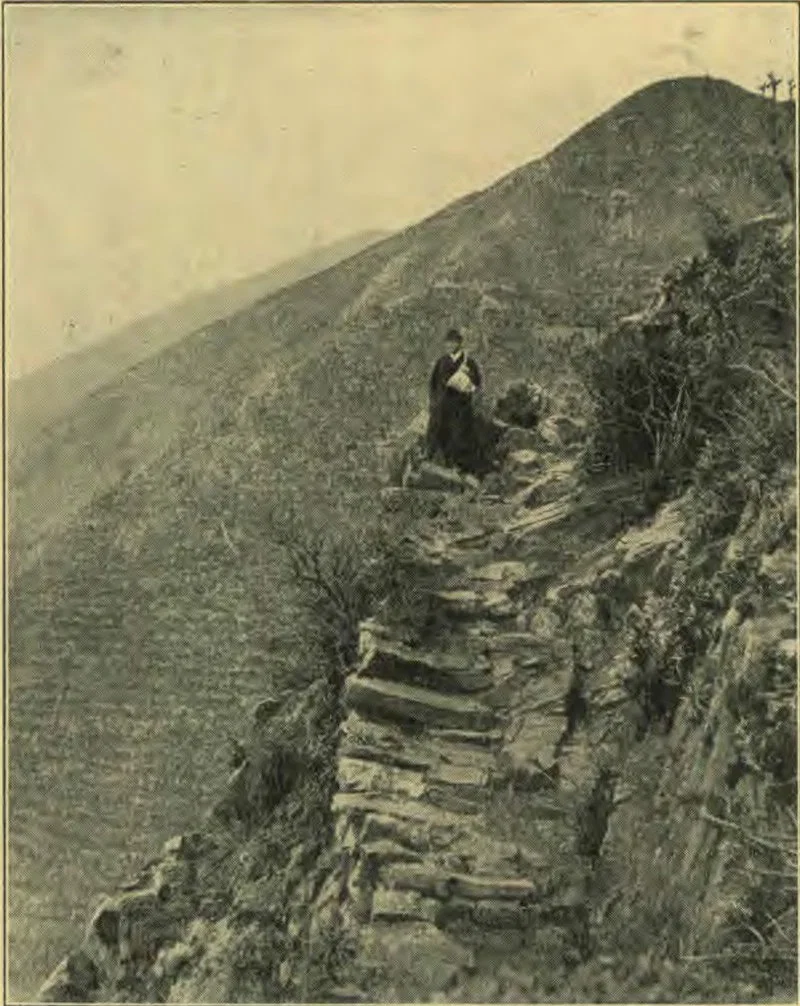
In going down three miles, we lowered ourselves six thousand feet in altitude. Our road was a narrow path ranging from one to three feet wide. To our left was a great rock wall. To our right was an immense gulch two thousand or more feet deep. A stone from under the mule's feet would frequently roll to the bottom and land in the angry waters that roared below. We arrived at Laraos that night at nine o'clock. Friends had prepared a room for us in a house of mud. There were no windows in it, but a door in the center of the side. The floor was of mother earth, which had been swept and well covered with a coat of water. The latter added much to our misery, as we were already cold and very weary from our journey.
A SECTION OF THE MAIN TRAVELED ROAD TO LARAOS
If one's horse should fall from this narrow path, he would land in the river fifteen hundred feet below. Elder Maxwell is shown coming down the steps.
A SECTION OF THE MAIN TRAVELED ROAD TO LARAOS If one's horse should fall from this narrow path, he would land in the river fifteen hundred feet below. Elder Maxwell is shown coming down the steps.
This little town of Laraos is built over a mountain stream on a big mountain slide. One can see up the side of the mountain where the dirt came from that filled the gulch, making a great dam across it, about five hundred feet high. This mountain stream has succeeded in making its way through this dam. While the water sinks from sight on one side with no visible opening for its escape, it comes rushing out on the other side. This region has a wonderful system of irrigation and farming. Up either side of the mountain for two or three thousand feet, are great rows of little fields. These fields are now level, but many times the wall that was formerly erected on the low side, and which now holds the dirt to make them level, is as high as the field is wide. These fields will average about twenty feet wide and fifty to one hundred feet long. Each adult and every child has from three to four of these little fields, and each field is supplied with water for irrigation.
The message first found its way to this place through the printed page, carried by Brother Salazar in June of 1913. In the fall of the same year W. R. Pohle and R. B. Stauffer visited this place and held some meetings in the Catholic church, but trouble arose and they had to leave. In 1915 Brother Salazar again visited this place and held some meetings in the public square. On the night of April 4 a mob attacked him and he had to flee for his life. One of the brethren was crippled in the uproar that followed, and for a time much persecution followed for the believers. The first day that we were there the city authorities visited us, and later the city schoolmaster, who had vowed that a Protestant minister should never again enter the place. The night before, this schoolmaster had, in company with two or three other men, tramped the town all night, shouting “Viva Católica,” thus trying to create a mob to drive us out of the place. With the help of Him who rules above, we were able to make friends with the schoolmaster and the city authorities, and after a stay of one week we left without being molested in any way.
After visiting three other Indian villages and holding meetings in them, Sunday, August 19, people from all four places met in a central place called Tintin, for baptism. Twelve were ready for this ordinance, and twelve or fifteen more wanted to be baptized, but it was necessary that each should first be married to the woman with whom he was living. As are the priests, so are the people. The priests set a low example of morality, and when the message finds these people, they have to make things right before taking part in the ordinances of the church.
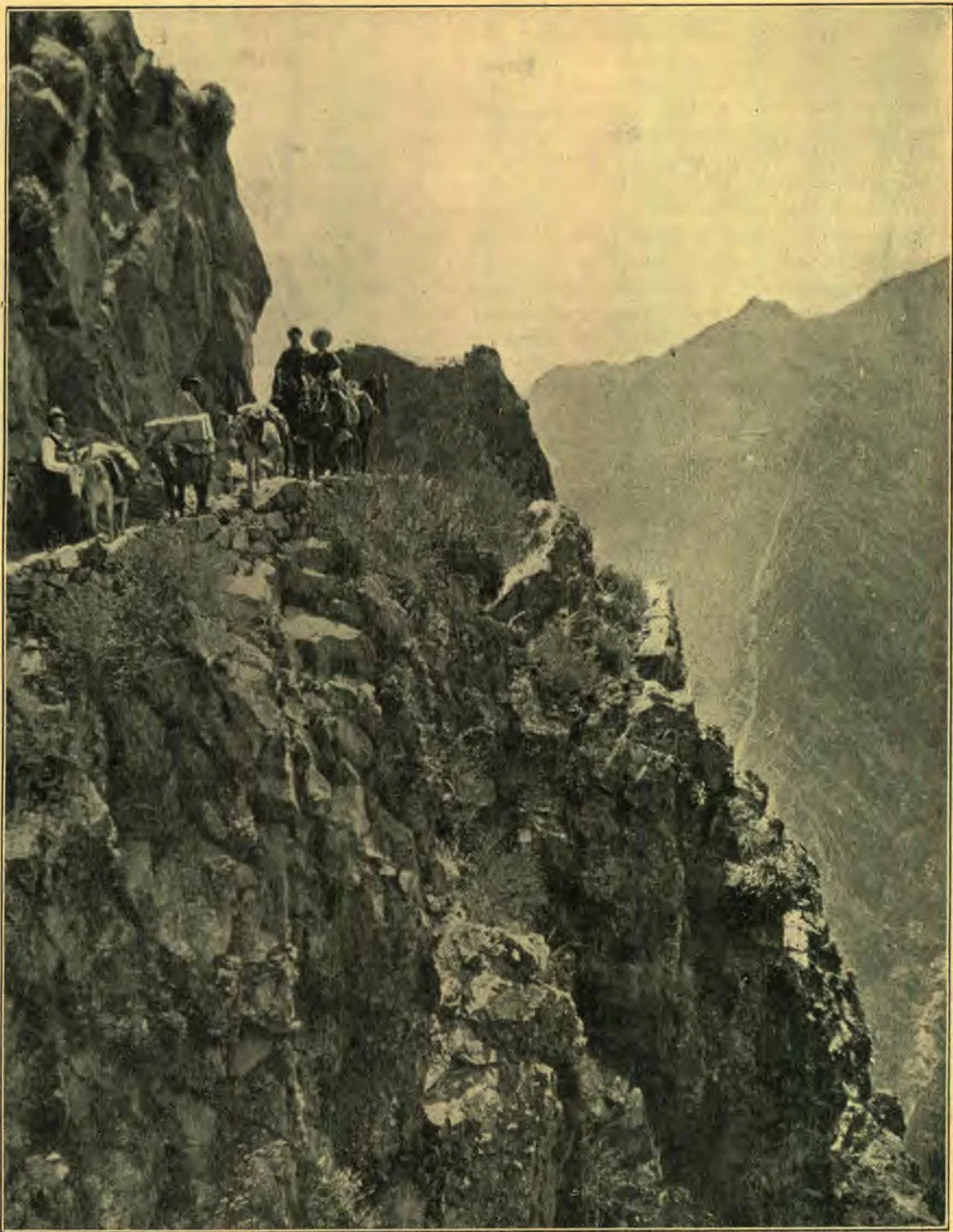
We returned to Huancayo over a different road. Our guide awakened us at three o'clock in the morning on the twentieth of August, and we started on our way over a very difficult path. We were down in a great gulch following along a stream. Our trail was dug out of the side of a great wall. Sometimes we were close to the roaring waters and again we were up so high that we could scarcely hear the roar. It was dark and we could not see the road, so we had to trust our horses and the God who rules above to take us safely over the narrow trail. Now and then we crossed the stream over a bridge made of brush suspended across the water twenty or more feet above it. These bridges look very frail and they do not belie their looks. They are about three feet wide, and are made without banisters. In the center is a path about eighteen inches wide, for the horse to walk on. The great walls on either side of us kept getting closer and closer together all the time, till soon we could see but few stars through the opening above us. At daybreak we came to what looked like the impossible. A great perpendicular wall on either side a thousand or more feet high, and in front arose a wall nearly perpendicular, two hundred or more feet high. The gulch at this place was not more than ten or twelve feet wide.
THE MISSIONARY PARTY ON THEIR WAY TO VISIT THE OUTSTATIONS
It is nearly a thousand feet straight down to the water at this place.
THE MISSIONARY PARTY ON THEIR WAY TO VISIT THE OUTSTATIONS It is nearly a thousand feet straight down to the water at this place.
We began to look for a way out, and found a stairway with steps from one to two feet high up the wall in front of us. This stairway reaches from the wall on one side to the wall on the other side, and back and forth, till finally one may reach the top. At first we wondered how the horses and loaded burros would climb such a stairway, but we dismounted and got in front of our horses to keep out of the way of rolling stones, and our faithful animals followed. It is interesting to watch the burros climb with their loads. This is the main traveled road to market, and all lumber, farm tools, and everything of that kind must be taken over this road. It is no wonder that the people learn to live and do with a meager equipment. We must also remember that books for the colporteur must be taken over this road if delivered to the people of the towns below.
During the day we again crossed the same mountain pass that we crossed in going to Laraos. This time we were in a blizzard and snowstorm. As we went down on the other side, the snow turned to rain. Because the people living along the way are thieves, we were obliged to camp for rest under the shelter of a large rock.
Brother Maxwell and I tried sleeping on one cot, because our bedding was scarce and the rock was not large enough to shelter two cots. At half past twelve our guide awakened us, stating that it was time to be on our way. We were glad to hear the call, for it was little that we had slept, and we were cold and needed some spirited walking to get us warm. We arrived at Huancayo the night of August 21, at seven o'clock. Here we took some much-needed rest. Though the roads are difficult and the altitude and weather trying, we are glad to have a part in the work of soul-saving in Peru. E. H. WILCOX.

Pay of the World's Fighting Men

If, as was reported, the German kaiser offered a prize of $75 to the first man of his forces in France who captured an American soldier, the bonus proved a tempting one to the Teutons, for this sum represents more than three years’ pay for a private in the German army, according to a war bulletin issued by the National Geographic Society.
The American soldier boy abroad will draw a princely wage compared with Tommy Atkins, the French poilu, the Italian Alpini, the German boche, and all the other fighting men of European nations.
Disregarding the “extras” and special allowances of various kinds provided for in all the armies of the world, but taking the lowest wage of the humblest private as the standard, the comfortable rate of pay allowed Uncle Sam’s fighting men affords a remarkable contrast to the lean-pay envelope of the men with whom our soldiers will join forces in France, as well as to the slim compensation of the enemy armies.

Poilu Gets $1.50 a Month

With his quarters, clothing, and rations furnished him, as they are furnished in all armies of the world, the American second-class private, receiving his foreign-service pay of $33 a month, will be a plutocrat compared with the French soldier, who draws the bare pittance of $1.50 every thirty days, scarcely enough to keep the American fighting man in cigarettes.
But the French soldier’s wage is, in its turn, princely compared with the 32 cents a month which the Russian government allows its privates and the 73 cents which Austria-Hungary pays its troops—1 and 2½ cents a day, respectively.
Great Britain is the most generous of the European governments in its pay of privates, who receive $7.60 a month at home and an additional allowance while fighting in France, Mesopotamia, and other foreign lands. Italy ranks second in generosity, with a monthly minimum allowance of $5.83. Spain compensates her soldiers with a $4.42 monthly wage, and Germany has built up her military engine of frightfulness with a wage scale beginning at $1.65 a month,—less than 6 cents a day,—to do the ruthless bidding of ruthless rulers. Japan’s soldiers at home, with $8 a year, fare a little worse than the Austrians. Turkey is an indulgent employer by comparison, granting $11 a year—92 cents a month.
A first-class American private, drawing $36.60 a month in France, gets $41 a year more than a Russian colonel, and $64 a year more than a German lieutenant for the first three years; $31 a year more than a first lieutenant of the Austrian army, and $19 a year more than a junior lieutenant in the service of Italy.

Americans Best Paid

The pay of an American second lieutenant (disregarding all allowances) is $100 a year greater than that of a lieutenant colonel in the British army, $73 more than that of a full colonel in the French army, $62 more than that of a German lieutenant colonel, $260 more than that of a colonel of Austrian troops, and only $100 less than that of a major general of the Italian army, while to a full general of the Russian army the American’s $1,700 would seem a fortune, as the Muscovite of the highest rank gets only $1,272.
The pay of an American captain compares favorably with that of a British colonel, a French brigadier general, a German brigadier general, an Austrian brigadier general, a Japanese lieutenant general, and an Italian lieutenant general.
A brigadier general of the American army, drawing a minimum salary of $6,000, receives nearly $240 more than a marshal of France, $2,000 more than a full general and field marshal in the German army, $2,250 more than a full general of Japan, and nearly five times as much as a Russian general of the highest rank. Italy’s highest army officer at the beginning of this war was a lieutenant general, whose annual compensation was $150 less than that of an American major.
Since the outbreak of the war the French government has revised its scale of pay for the army. The man in the first-line trenches now receives a franc a day ($6 a month), but he is not permitted to draw all of this amount. He is paid partly in cash, and for the balance he receives a certificate of deposit in a reserve fund, which is to be disbursed at the end of the war. All those not in the first-line trenches will receive their 25 centimes (5 cents) a day.—New York Evening Globe, Sept. 22, 1917.
Continue reading: Absolute Monarchs