THERE are just six absolute monarchs left in the world. Their titles run, “Lights of the Earth,” “Sons of the Sun,” “Arbiters of the Tides,” etc. Once they were a mighty brotherhood, but time has cut deep into their ranks.
Sultan Seyyid Taimur bin Turkee rules Oman. Never heard of Oman? It stretches along the south-east coast of Arabia and boasts of 750,000 inhabitants. The sultan has an income of $250,000 a year, plus caravan receipts, plus a percentage of pearls gathered by deep-sea divers. At present the only distinction the sultan enjoys is that of being the least-known monarch of the least-known state in Asia. But a few missionaries have succeeded in passing Oman’s one open port, Muscat.
The sultan of Siam has 1,203 brothers and sisters, and 604 stepmothers. V’fa M’a Vagiravudh has 6,000,000 subjects and an income of $3,000,000, a palace of silver mosaic, and an eight-sided throne. He has accepted the challenge that East must be East, and is9introducing compulsory education, military service, and other modern methods.
Empress Zeodita of Abyssinia, or Ethiopia, sits on the throne once occupied by the Queen of Sheba, and claims to be the lineal descendant of that historic lady and King Solomon. She is said to be unalterably opposed to railroads, and twentieth-century methods in general. Her triple-tiered crown weighs some ten pounds. She expelled all foreigners from her domain.
Muley Yusoef rules Morocco, and is said to be the proudest of the sultans. He wears rubies on his fingers and bracelets on his toes, and rides white elephants with silver howdahs. The Moors have never forgotten that they once conquered Spain.
A short, stout, sallow man, much bewhiskered, sits on the throne of Afghanistan. He is Habibulla Khan, the wisest and shrewdest monarch of the East. He tolerates six Europeans and two Americans among his six million subjects.
From his eight and one-fourth miles on the Riviera the Prince of Monaco draws $1,000,000 a year, aside from all state expenses, and the roulette wheels at Monte Carlo make it all. The prince is justice, law-maker, executive, all in one. His 22,000 subjects pay no taxes; but neither must they go near the gaming tables. The vices of Monte Carlo are strictly for foreigners.— Every Week.
Notes on Alaska
ALASKA has now about 100,000 reindeer, and it will have 13,000,000 within a decade. Reindeer meat is now being shipped to United States markets.
Alaska has over 5,000 glaciers which are giants in comparison with those of the Alps. The Childs Glacier is as tall as the dome of the Capitol at Washington.
Most of the halibut eaten in the United States comes from Alaska. The fish products of this country have already netted us more than $200,000,000.
In the interior of Alaska are grown cabbages weighing as much as a two-year-old baby.
The chief summer entertainments are garden and lawn parties which are held amid the flowers.
Near the arctic circle the children go barefoot in summer.
Alaska’s chief winter sport is dog racing. The great race is across the Seward Peninsula from Nome to Candle City and return, a distance of over 400 miles. Many of the racing dogs have been taken to France to aid in the war.
At Nome, Christmas Day has only four hours of sunlight. The sun rises at ten, skates across the horizon, and sets at two.
The Eskimos do wonderful carving.—Selected.
The Sky Battle
THE self-control and tact manifested by men in every division of the army service are marvelous; but perhaps the aviation work offers more thrilling experiences of real heroism than any other. A British airman, Second Lieut. Malcolm Henderson, “was detailed to fly over the enemy’s lines, carrying with him an observer to photograph their positions. The work involved keeping his machine at low altitude, within range of the German anti-aircraft guns. Suddenly there was a terrific shock. A shell had struck the nacelle of the aëroplane, crashed through the floor, and cut off one of Henderson’s legs below the knee. For an instant the machine hung disabled, then gave a downward lurch. The slip might have ended in a nose-drive, except for the pilot’s tremendous assertion of self-control. Losing blood as he was at a fearful rate, every nerve affected by the shock, he yet succeeded in getting his machine into equilibrium again, and, before the astonished German gunners could return to their guns, had driven it out of range. Holding gamely on through the pursuing shells, he presently volplaned to earth within the British lines, bringing back his companion and the photographs unscathed.
“Sublieutenant Oxley and Flight Lieutenant Dunning, D. S. C., were flying a long way from their own lines when they sighted two enemy machines and decided to attack, Oxley working the machine gun while Dunning steered. During the fiercest part of the fight Dunning felt a burning pain in his left leg, and simultaneously the petrol tank was pierced by bullets.
“They succeeded in beating off the Germans; and then Oxley, who knew that Dunning would probably bleed to death before they could get home, improvised a tourniquet and passed it over to his companion, with a scribbled note telling him to fix it on his leg and relinquish control of the machine, so that he himself might take charge. The two men managed the difficult exchange of seats as the aëroplane whirled through the air. Then Dunning, having tied up his wound, turned his attention to the leaking petrol tank. He succeeded in stopping the leak by keeping his thumb pressed over the hole. In this way they got the riddled and battered machine back to their own lines, and made a successful landing.”
The Tree Choir
By Minnie Leona Upton
I KNOW a vested choir Who sing at early dawn, When dewdrops shine and sparkle On field and wood and lawn; They’re always fresh and spotless, And shine with daintiness, Although they rise so early, With little time to dress.
And then again at twilight, When all the world is still, Their music echoes sweetly From orchard, grove, and hill; A song of true thanksgiving They jubilantly sing, And then each little singer Tucks head ’neath downy wing.
— Minnie Leona Upton.
The Story of the Apple
By Beatrice M. Parker
In olden times the doctors recommended that the children be given plenty of apples in the morning and some during the day for lunch. They did not recommend apples at night unless they were sweet and well baked. There is an old saying, arising evidently from this fact, that apples are gold in the morning, silver at noon, and lead at night.
The apple tree has been cultivated for centuries. It was probably a native of southwestern Asia and the adjacent portions of Europe. It was introduced into the Roman garden nearly five hundred years before the Christian era, being considered a luxury and cultivated by only the wealthiest people. It was, however, considered a profitable crop, and grafting was understood and practiced, so that various kinds were produced which became very popular. Later, in the time of Vergil, apples were quite common among the Romans, and a favorite combination of foods seemed to be that of apples, soft chestnuts, and cheese.
Slicing and drying the fruit in the sun must have been practiced at an early time, because evidences of such art have been found in the prehistoric houses of the lake settlers in Switzerland.
Apples were introduced into England at the time of the Roman occupation and were brought to America by the European colonists.
The history of apple growing in this country is very interesting. Perhaps there is no chapter in it more entertaining than that of Jonathan Chapman, who was considered the pioneer of apple culture in western Pennsylvania, Ohio, and Indiana. This man, who was born in Boston in 1775, had a strong scientific bent. His love of nature was so deep that he thought it wicked to kill any kind of animal for food or to prune a tree. He wandered about gathering apple seeds from the pomace of cider mills, and between 1801 and 1847 he planted these seeds wherever he could find a clearing. At first people laughed at him and allowed him to plant the seeds simply from pure good-natured tolerance. Later, when they realized the value of the fruit, they looked upon him as a wonderful personage. He was popularly known as Johnny Apple Seed, and before he died he saw apple trees bearing fruit throughout an area of over one hundred thousand acres, all planted by him.— Beatrice M. Parker.
The Chess Player
By F. W. Bothem
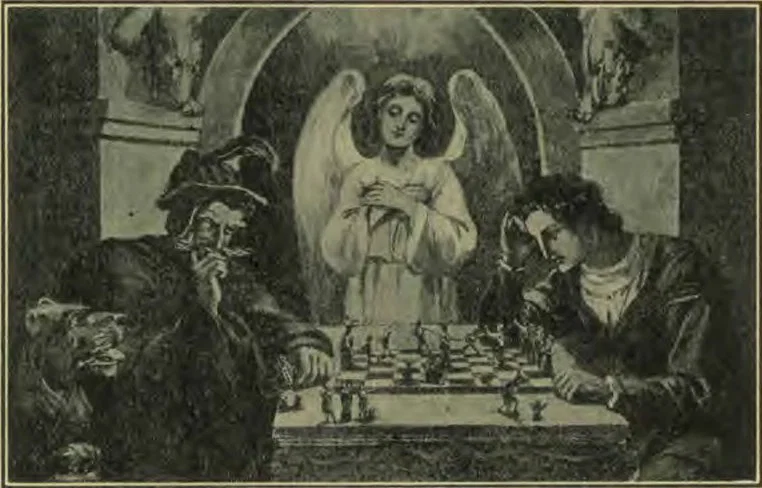
Many years ago Paul Morphy was the champion chess player of the world. A friend one day invited him to come and look at a valuable painting he had just purchased. It is called “The Chess Player,” and presented Satan playing chess with a young man, the stake being the man’s soul. The game had reached the stage where it was the young man’s move; there was no move that he could make that would not mean defeat for him, and the strong feature of the picture was the look of awful despair that was on the man’s face as he realized his soul was lost, and the sneer upon the face of Satan as he saw the victory.
THE CHESS PLAYER
Morphy studied the picture for a time (he knew more about chess than the artist who painted the picture), and then he called for a chessboard and men. Placing them in the same position in which they were in the painting, he said: “I’ll take the young man’s place and make the move.” And he made the move that would have set the young man free.
When I heard this story, I thought it was just like my life. In the game of life I was worsted. It was my move, but Death was in every direction. I was in despair, when I saw One come on the scene who knew all about my life, and I recognized the only One who could help me. I turned to him, and he made the move that set me free.—F. W. Bothem, in “Faith Links.”
Large Building Operations in Washington
By T. E. Bowen
THE past few months have brought to Washington between forty and fifty thousand persons. The providing of homes and offices for this large influx of people into the national capital on account of the war, has been a stupendous proposition. One large contract entered into recently to provide government offices presents figures of interest.
Late in the summer, on vacant blocks just east of the park containing the National Museum, large steam shovels began removing an elevation, converting three city blocks or more into a building site. Upon this site operations on a large scale began for the erection of buildings which will provide 2,168 offices and house 4,500 government officials. In the erection of one of the three sections of buildings, 5,000,000 feet of lumber have been used.
Forty days from the time the building operations began, the offices were practically inclosed, and according to a statement made by Mr. E. G. Marshall, general superintendent of the construction work of one of these large section buildings, the world record for that amount of work in that time has been broken. The first section was ready for occupancy December 15, the second January 5, and the third section will be ready about February 5.
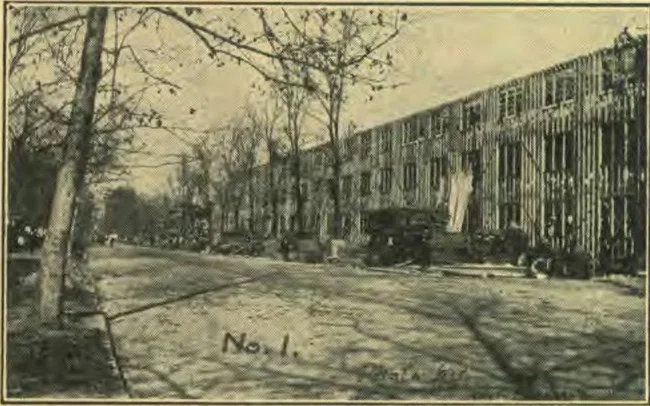
The picture given below shows the street frontage of the first wing building across from the National Museum, looking up Seventh Street, Northwest, toward Pennsylvania Avenue. This is section one of the buildings, and the one nearest completion. Beyond this one wing building shown in the picture, there are five other wings running parallel with this and of the same size.
Altogether about 18,000,000 feet of lumber are required in the erection of this plant, 350,000 feet of flooring being required for one section, and 1,050,000 for the entire plant. Eight hundred carpenters and workmen have been employed in one section, and probably about the same number in each of the other sections. The pay roll amounts to from $60,000 to $70,000 weekly.
This is only one of several building activities the government is carrying forward in the District of Columbia. Extensive additions have been made to the government hospitals, and a large annex, as it were, to the Bureau of Engraving is being provided. The stamps and money are printed in the Bureau of Engraving.
Amid all these increased activities there is earnest work being carried forward by those connected with the institutions here, in placing literature in the hands of these people, and in other ways seeking to enlighten them as to the meaning of these present-day events, when great nations are being drawn into the world war. T. E. BOWEN.
Who Painted the House?
A VIEW OF THE NEW OFFICE BUILDINGS,
WASHINGTON, D. C.
I AM going to paint the house,” said a big can of paint, waiting, already mixed, in the woodshed. “No, I am going to paint it,” the paintbrush asserted, bristling with impatience. “You are, are you?” sneered the ladder, lying against the wall. “How far would either of you go without me?” “Or without me to pay the bill?” said the check book of the owner of the house, in a voice muffled by the pocket of the coat hanging on a nail. Just then the painter, who had overheard these proud remarks, ventured to put in a word. “Perhaps I’d better take a holiday,” said he quietly. “I wonder if the house would be painted by the time I got back.” Even the most efficient of us is only a tool in the hands of the Infinite Worker.— The Christian Age.
A Voice of Bell-like Sweetness
“Is there anything that I can do for you, Hilda?”
The girl in the darkened room, with a bandage over her eyes, flounced angrily on the bed on which she lay, the springs creaking protestingly under her weight. Her sister who had asked the question looked a little startled, but not at all puzzled.
“Do anything for me? I guess if you had to be shut up in the dark with your eyes bandaged, and nobody came near you for hours and hours—”
“Oh, Hilda,” the sister remonstrated, “it is only half an hour since I was here before.”
“Well, if it’s such a sacrifice, you don’t need to come at all! I suppose I shall live through this, though I really don’t see how I’m going to stand it much longer.”
The sister was almost in tears. “Hilda, I was sorry to leave you alone so much this morning. But you know there’s a lot of work to be done.”
“I wouldn’t want you to change your plans on my account,” declared Hilda. “Go off and leave me to myself. Want anything, did you say? O dear, no! I’m perfectly contented lying here in the dark with nothing to do and nobody to talk to.”
Sighing a little, the sister seated herself and made several attempts to talk. But Hilda’s ill humor would not allow her to respond, and conversation languished. Then came a welcome distraction, for from the sidewalk a sweet voice of bell-like clearness was uplifted in song.
For a moment Hilda appeared oblivious to the song. Then curiosity got the better of her mood. “I wonder who that can be!” she exclaimed.
Her sister rose, went to the window, and opened the closed shutters just a crack. “It’s a man that sometimes goes by the house,” she said. “You must remember him, he’s blind.”
“Blind!” Hilda repeated incredulously.
“Yes, surely you must remember him, Hilda. He was blinded in an explosion, I think.”
Hilda spoke eagerly. “I wonder if my pocketbook is on the table now. I’d like to give that man a quarter. Would you mind tossing it out to him?”
“I think I’d better take it down,” said the sister, pleased with Hilda’s air of interest. “If I threw it, he probably wouldn’t be able to find it.” She extracted the coin from Hilda’s pocketbook, and went downstairs. The grateful musician showed his appreciation by singing all his repertoire, and Hilda’s sister thought it safe to finish the task she had interrupted to see if her sister needed her.
She went upstairs again as soon as the singing ceased. Hilda was lying very quiet, and she did not speak as her sister entered.
“Did you enjoy the music, Hilda?” asked the sister, a little doubtfully.
“I—I enjoyed it, but it wasn’t that so much. It made me do some thinking.” The sister looked puzzled. But Hilda did not leave her long in doubt.
“That man is blind all the time, and he goes around the street singing and making everybody happier. And I’m blind for a few days and I’m making everybody miserable.”
“Oh, Hilda,” protested the sister, and then relapsed into silence, realizing that Hilda had spoken but the truth.
“I can’t go around singing,” Hilda continued, “but as long as my blindness is only temporary, it does seem as if I might be moderately pleasant, so it won’t be impossible to live in the house with me and stay happy. Have you finished all your work? Because if you haven’t, don’t feel you’ve got to stay with me.”
The sister dropped into a chair. “But I have finished,” she answered, “and now I feel like having a good talk.”—The Girls’ Companion.
The Old Judge’s Way
By Walter K. Putney
OLD Judge Kingsley was about the most exasperating man in the town. He was slow, easy-going, and was in no hurry to push cases that came before him for judgment. That is what made many folks remark about the judge that he was behind the times and an old fossil.
“I wish that I were the judge of the district court,” angrily remarked John Foss one day. “It is a shame the way he lets off the fellow with a good story! Only yesterday he refused to do anything with the Kelton children. They are neglected and ought to be put in some home!”
“Well,” replied the judge’s neighbor, to whom Mr. Foss was speaking, “perhaps the father will look out for them in the future. He earns good money and ought to be able to support them well. The only trouble is that he cannot get a good housekeeper. It is too bad that his wife died and left such a family.”
“Huh! He drinks — that is what the matter is! But then, it’s no use to say anything to the old judge—he won’t do any different.”
In a ruffled state of mind John Foss went home. As he turned in at his street he saw a team coming down the road. The horse limped badly, and Mr. Foss stopped and frowned.12
“Well,” he exclaimed disgustedly, “it is a shame for a man like Bob Johnson to drive a lame horse! I shall report him at once to the Society for the Prevention of Cruelty to Animals. It is my duty to do so and relieve that poor beast.”
It so happened that Judge Kingsley turned into his street a quarter of a mile distant, when the same horse and driver came down. He too stopped and looked at the poor horse as it slowly limped along. Then he noticed the name on the wagon, “R. Johnson, Teamster.”
When he reached his office the next morning the judge took down the directory and found that “R. Johnson, Teamster” lived about a mile outside of the town. At noon he took a walk over to see him.
At the door of the house the judge was told that he would find Mr. Johnson at the barn. Out to the barn he walked, and as he turned the corner he heard, coming from the open door, “Easy now, old boy, it smarts a little I know, but we’ve got to get that swelling down.”
Stepping inside, Judge Kingsley saw Bob Johnson rubbing the lame leg of his horse, and all the while talking in a soothing way, and occasionally stopping to give him an encouraging pat.
Making some noise, as if he had just stepped in, Judge Kingsley said, “Horse sick? Are you going to do anything this afternoon? I had a little job, but—
“Well, sir,” replied Bob Johnson, “Old Tom is lame. I have to bathe that leg every noon and night after he comes in, and still he gets worse off. I should say it was the hard pavements more than anything else.”
“Can’t you rest him a little?” asked the judge quietly.
“No, I am sorry to say that I can’t,” and Bob Johnson shook his head sadly. “You see, I can’t afford to buy another horse, and I wouldn’t sell Tom, as he is, to any Tom, Dick, or Harry. That would be downright cruelty, for no man would buy a lame horse except to use him up in a short time.”
Just then a little head appeared in the doorway, and a wee voice asked, “How is Old Tom, papa?” Then, not stopping for a reply, a little girl bounced in, ran up to the horse, and threw her arms around his muzzle.
“Ahem!” coughed Judge Kingsley. “It seems to me that such a nice horse has earned a little vacation.”
“I know it, sir,” sighed Bob Johnson, “but what is a man to do? I have favored Tom in many ways this past month, letting hard jobs go—jobs that would have brought me in quite a penny too, simply because I didn’t think I ought to give him such heavy loads. We can’t afford a vacation, and—”
“Oh, yes, you can,” interrupted the judge in a kindly tone, “and let me tell you how to do it. I know of two men who have places out in the country. Their horses are not worked at this time of the year and they need exercise. I’ll send you the name of one who has a horse that could come here, and I am sure that he would let you send Old Tom out into the country with his other horses until he gets well again.”
“But how do you know that he will swap in that way?” asked Bob Johnson. “He may not wish such an old, lame horse in place of a good one.”
“Oh, I’ll see to that,” laughingly remarked Judge Kingsley. He did not tell Bob that the horse was his own, and that the country place was where he went every summer for his own vacation.
Bob Johnson did not delay any time at all when he received directions as to how to get to this place where Old Tom was to have his vacation. The next morning he was up bright and early and hitched Old Tom into the light buggy, driving the ten miles, over soft country roads, in slow time, so as to give his pet horse every favor possible. Then he returned home with a good, chunky bay horse that looked as if the heaviest loads would be play for him.
A couple of days later the agent for the Society for the Prevention of Cruelty to Animals came into the yard. His inquiries were easily answered, and when he learned the full story, he said:
“Well, I guess I am not needed in such a place as this; but I wish there were more men like Judge Kingsley.”
“Yes, that’s right,” replied Bob Johnson, “he may be slow and easy, but his heart’s in the right place.”—Walter K. Putney, in Young People.
New Year Motto
“I ASKED the New Year for some motto sweet,
Some rule of life with which to guide my feet.
I asked and paused; he answered, soft and low,
‘God’s will to know.’
‘Will knowledge, then, suffice, New Year?’ I cried,
And ere the question into silence died,
The answer came, ‘Nay; but remember, too,
God’s will to do.’
Once more I asked, ‘Is there no more to tell?’
And once again the answer softly fell:
‘Yes; this one thing, all other things above,
God’s will to love.’”
A Year Text
By Geo. S. Belleau
Two young men, whom I shall call John Harris and Frank Clark, were leaving college to enter into a tent effort for the summer. Both of them decided to take a year text and in place of calling each other by name, call the text they chose. John Harris chose Romans 6:23 and Frank Clark took 1 John 3:4. In place of calling good morning to each other, they would call out their text.
During the summer John Harris received a call to go to Africa. It was on September 15 that he boarded the steamer which was to carry him to his future field. Frank Clark was at the dock to see his friend off. As the ship began to move away, 1 John 3:4 called from the dock and Romans 6:23 answered from the vessel. They kept this up till they could not hear each other, but when they waved their white handkerchiefs both knew that each wave meant the year text. Perhaps those on the wharf thought that these two men were crazy, calling out texts to each other, but what did it matter, since there was such a happy sequel to this unusual procedure. When they wrote to each other later, they always put the year text on the back of the envelope and on all letters they wrote.
One day a letter arrived in Africa to John Harris from Frank Clark. Frank told him how a man on the wharf was so puzzled over the two texts which they had cried out the morning he left for Africa, that he went straight home and looked up the texts in the Bible. First he found that “the wages of sin is death,” and then that “sin is the transgression of the law.” He studied the Bible to find out which law was meant, and finally decided to keep the ten commandments, and was keeping the true Sabbath.
The postman in Africa noticed the two texts on the back of the envelopes, and one day his curiosity led him to look them up in the Bible. About a month after John Harris received Frank Clark’s letter the postman asked Mr. Harris to explain those two verses to him, as they had been troubling him of late. Mr. Harris showed him that if we do not keep the law of God we will be lost, for “the wages of sin is death,” and “sin is the transgression of the law.” Finally the postman decided to keep God’s ten commandments, and he is now observing the seventh day.
As we are about to begin the new year, why not each one of us take a year text, and put it on our letters when writing to friends? We never know how much good can be done in this way, as a single text will sometimes put an honest searcher for truth on the right track.
Geo. S. Belleau.
How the Pastor Helped
He was thoroughly interested in young people, having once been a young person himself, you see! The young people’s society was composed largely of newly baptized members, who were anxious to understand more fully the precious truths which they had heard at the tent- and hall-meetings.
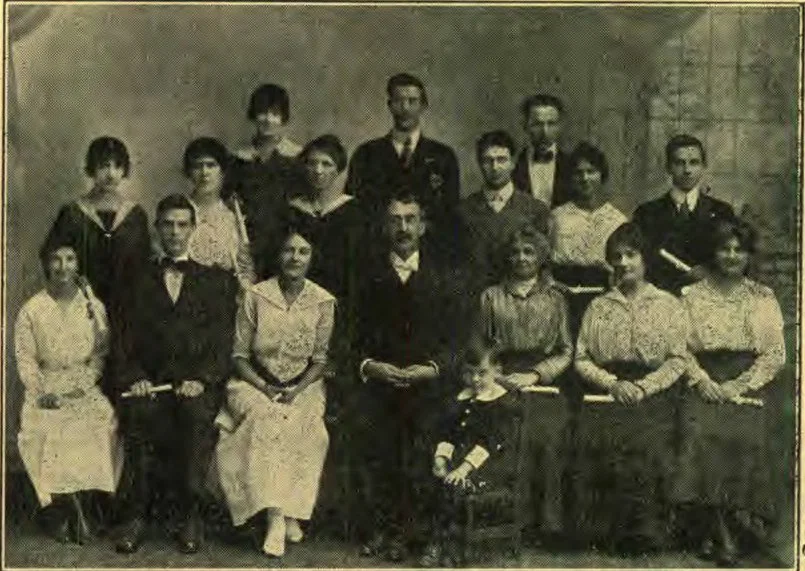
So what should this pastor do but organize a Standard of Attainment Band among the young people. He was a man who knew the Bible, and more than that, knew how to explain it clearly to others. The band met regularly. The members studied not only Bible Doctrines but our Denominational History. Last September they took the Standard of Attainment examinations, and if you wish to know whether or not they passed and received their certificates, just notice the accompanying picture. Those “diplomas” which they are holding show that they finished their course satisfactorily, and are now not only the possessors of Certificates of Attainment, but are also better prepared than ever before to give to others a reason for the hope that is within them. The little fellow in the foreground of the picture has not yet become a member of Attainment, but no doubt before long he will be studying for Junior Attainment membership. God wishes to use the boys and girls as well as the older ones in spreading the good news of his soon coming.
STANDARD OF ATTAINMENT BAND OF THE PATERSON, NEW JERSEY, MISSIONARY VOLUNTEER SOCIETY
Cannot other workers lend a hand in helping our Missionary Volunteers to carry on their Attainment bands? Why don’t you ask their assistance, young people? M. V. DEPT.
“Knee Medicine”
By M. E.
RECENTLY I read of a Chinese convert who was asked what remedy he found most effective in delivering him from the opium habit, from idolatry, and from the fear of persecution. He replied, “Knee medicine.” Finally, he, too, had found the king of medicines—the remedy that has succeeded where all others have failed; the remedy that has proved its efficacy in every clime, to every race, in every kind of trouble.
Scientific research has discovered wonderful remedies, but they all pale into insignificance before the unfailing panacea for human ills. There is absolutely nothing that will take the place of this remedy in the life of an individual, and the sooner we learn this fact the better for us. It is the only remedy that will keep us from succumbing to the malignant epidemics that are raging in the land today.
You who have read “Pilgrim’s Progress” may remember the story of the fire by the wall. Christian tried to put it out, but his attempts were all in vain. Finally he discovered that it was fed by a stream of oil that flowed through a crevice in a wall. This story is a good word-picture of a Christian who uses “knee medicine” faithfully, and by means of it keeps his connection with heaven unbroken and obtains power to live the victorious life.
If “knee medicine” were ever needed, we need it today. Somehow the very seriousness of these times seems to benumb our sensibilities. Catastrophes come so thick and fast that we have sort of readjusted our lives, and begin to look upon this epidemic of disasters as the normal course of events. We still recall how we shuddered when we heard of the sinking of the “Titanic.” We sighed when we thought of the hundreds of happy tourists who had been carried down to a watery grave. Did not some of us again and again lay the heart-rending story aside because we could read no more through our tears? Today, however, we read dry-eyed of big mine explosions and terrible catastrophes by land and sea. Of course, we did not want to read the account of the terrible Halifax disaster before supper the other evening, but are we not beginning to expect just such columns on the front page of the daily paper?
Yes, and we should expect them! But our danger lies in failing to see in these events the signs of the end. They are the handwriting on the walls of time; and as God used Daniel to read the warning message written on the wall of Belshazzar’s palace, so he is looking today for earnest young people to interpret aright, in the light of the sure word of prophecy, the present conditions of the world.
How many of our Missionary Volunteers are prepared to do this? The signs of the times show conclusively that the kingdoms of earth are being weighed in the balance and found wanting; soon “Finis” will be written to their annals, and Christ will come to claim his own. Are you ready for that day? Are you prepared to help others to get ready? Remembering that our last opportunities to save others are rapidly slipping away, shall we not plan definitely to use more “knee medicine” during 1918? M. E.
Our Counsel Corner
A New Department
HAVE you questions which have been puzzling you—questions on Missionary Volunteer work or on other matters of interest to young people? Our14Counsel Corner is for you; a corner where we may talk over our problems, and be of mutual help to one another. This corner will be what our Missionary Volunteers make it. We solicit questions, reports, and letters from the young people; and promise that they shall receive careful attention. Address all communications to the Missionary Volunteer Department, Takoma Park, D. C.
What is the budget plan?
It is a systematic plan of raising money for missions (or doing other things). The conference Missionary Volunteer secretary gives to the society its portion of the offerings to missions to be raised during the year. That is the society’s foreign-mission budget. First the officers and then the society give serious consideration to the work of reaching the goal, and members agree to take a certain share. There is a systematic plan of keeping account of what the society does toward its goal month by month.
This is all explained in a new leaflet just published, “The Missionary Volunteer Goal and How to Reach It.” The price is one cent, and it should be ordered from your tract society. You should secure at least enough copies so that each of your officers may have one. It would be better if every member had a copy. It will help you to success in 1918.
In our goal for 1918 we have a campaign for “INSTRUCTOR subscriptions.” I see no place on the report blanks for this item. How shall we report this work?
On both the individual and society report blanks there are a few blank spaces for extra items. Use one of these for this: “New INSTRUCTOR subscriptions.”
We hope all our young people will enter upon this work of increasing the subscription list of our Missionary Volunteer paper, the YOUTH’S INSTRUCTOR. It ought to be read by all our young people. M. E. K.
What is the Lookout Committee?
Some one has said that it is a committee which looks both outward and inward; “outward, to seek new members of the society; inward, to hold faithful to their duties the members already obtained.” Its duties may be briefly summarized thus: (1) To bring new members; (2) to satisfy yourselves as to the fitness of applicants; (3) to introduce them to others; (4) to introduce them to the work; (5) to reclaim indifferent members; (6) to welcome strangers. Every Missionary Volunteer Society should have a Lookout Committee. E. I.
Will you explain what is meant by the educational secretary of a Missionary Volunteer Society?
The educational secretary of the Missionary Volunteer Society is chosen to lead out in the educational features of the Missionary Volunteer work. It goes without saying that this officer should be a lover of reading; should know how to find spare moments for reading good, helpful books; and should be acquainted with the Missionary Volunteer Reading Courses, the Standard of Attainment, and the Bible Year.
He should try to enroll as many as possible in each of these, and keep written lists of these enrolments in a good substantial notebook. His records should show when each individual in his Reading Course, or his Standard of Attainment, or his Bible Year enrolment completes his work. Reading Course or Standard of Attainment certificates received should also be recorded.
The educational secretary’s office is an important one. It fairly bursts with opportunities for doing good. With items from Reading Course books, the enthusiastic educational secretary will acquaint the society members with the courses; with new items from the mission fields, etc., he will stimulate their interest in the Standard of Attainment plan; by tactful personal effort he will persuade many not only in the society, but in the Sabbath school, in the church, and among his friends to gain the benefit of the educational features promoted through the Missionary Volunteer Department.
He will organize Reading Course and Standard of Attainment classes whenever this seems best. His motto will be, “At it, all at it, always at it.” And in this way he will endeavor to make the educational features of our work the greatest possible blessing to the greatest possible number. M. E.