The Youth’s Instructor, Vol. 43, No. 8.

THE FAROE ISLANDS

The Youth’s Instructor

Feb 21, 1895

S. D. A. Publishing Association · Battle Creek, Mich. · Feb 21, 1895

THE FAROE ISLANDS.
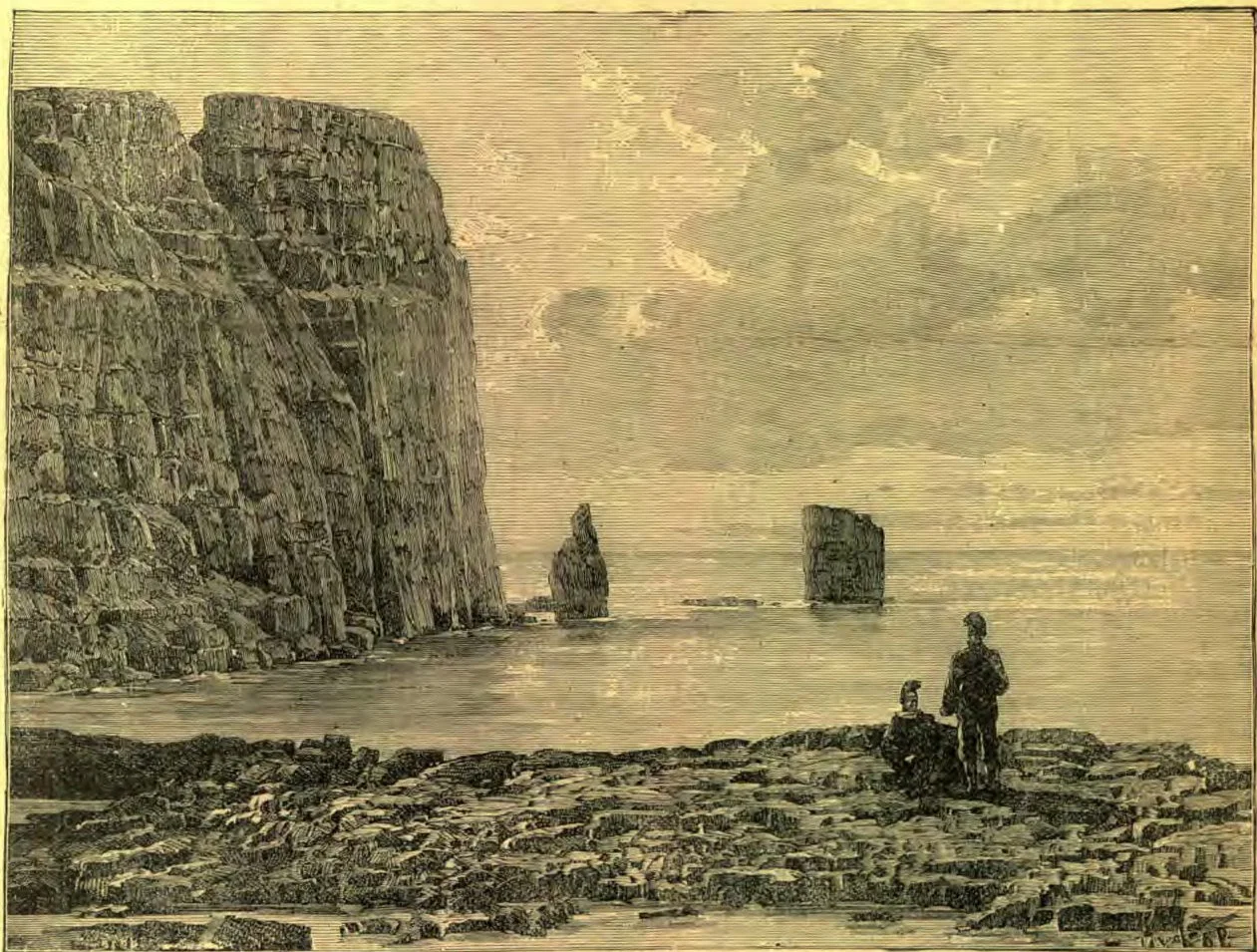
ROCKS OF TROLD-NYPEN.
In the Atlantic Ocean, about two hundred and seventy miles southeast of Iceland and one hundred and ninety miles northwest of Shetland, lies this group of some twenty-two rocky islands, about seventeen of which are inhabited, having in the aggregate a surface of five hundred and fourteen square miles, and, according to the census of 1890, twelve thousand nine hundred and fifty-four inhabitants, who are called Faroese. The uncommonly steep mountains of these islands range all the way from one thousand to two thousand eight hundred feet in height, Slatteretind on Osteröe being the culminating point. The largest isle of the group is Strömöe (six and one-half square miles, with nearly three thousand inhabitants), on which stands the Skalingefield, two thousand two hundred and sixty-seven feet high. Thornshavn is its leading city, and Westmanshavn, a good port for vessels. The islands of Österöe, Syderöe, Vaagöe, Sandöe, and Bordöe deserve special mention. The climate is moderate at all times of the year, taking into consideration that the group lies between sixty-one and sixty-two degrees north latitude; but the breezes from the sea are very damp. The winter is mild; snow remains seldom longer than eight days. The mean temperature for the summer months is about fifty degrees Fahrenheit. Storms are frequent. The soil is rocky, but in spots where a thicker layer of arable ground prevails, is very fertile. Storms hinder altogether the growth of trees, but there is no lack of coal, peat, and some driftwood. Cattle are of small stature, but the horses are exceedingly strong. Thousands of sea-fowl inhabit the cliffs, especially the so-called Vogelberg (Bird Mountain).
The language of the natives is a dialect of the old Norwegian tongue, but at court, in church and school, and in general print, the Danish is used. The chief pursuits are cattle-raising, fishing, and fowling, and the gathering of featherdown (eiderdown, from the feathers of the eiderduck). Their favorite amusement is chess-playing, and in every house one can find a chess-board. Since the laws of 1854 these islands have had their own Lagthing, or law-making body, consisting of eighteen chosen persons, at the head of whom are the Amtman (commandant or governor) and the Probst (rector of the church). In secular matters their last appeal is made to the mayor of Copenhagen, and in church affairs to the bishop of Zealand. Their only city and market is Thornshavn on Strömöe, with little over one thousand inhabitants, possessing a good port with a strand battery; also a school with two teachers, for a more liberal education.
These islands were peopled by the Norwegians in the ninth century, and in 1380 they came into possession of the Danish crown. So much as to their history. Now, what does nature offer here?
“To find a smiling aspect at the Faröe Islands,” said M. Ch. Edmond, a great traveler, “it would be necessary to be tossed ashore there by a tempest! But he who can, under such adverse circumstances, find attractions here, will agree with us when we say, They are there all the year around in all kinds of weather, and surely so, if one comes there from Iceland, for instance, that Ultima Thule of the northern world, leaving it clad in a mantle of snow and ice, whilst the little isles of Faröe seem to be entirely rid of their white sepulchral sheet, and once more attired in their spring vestments. Tourists who have hitherto written about these islands have with very few exceptions given them a character altogether more sad and gloomy than the reality warrants. Often, too, those who have painted such desolate pictures have tarried only a few days in the country, and not seldom at a time when heavy fogs extended over the coasts, intensified by the howling storm, or when the flourishing mountain-slopes were covered by white clouds.” M. H. Labonne, who visited Faröe in the month of June, records the temperature as very agreeable, being forty-five degrees Fahrenheit in the morning, and fifty-nine degrees Fahrenheit at noon; the rain lasted but a little while, and he found constantly that what he had read about the islands did not agree with the reality. He writes:
“Cultivated lands and pasture grass in broad bands of living green contrasted beautifully with the black basalt rocks that formed their borders.
“This lovely temperature is due to the slight elevation of the valleys and to the Gulf Stream, that bathes these islands, and envelops them with its hot vapors. Thus the climate here is the most even of any in Europe, the difference between winter and summer being only fifty-two degrees Fahrenheit. As little as in Iceland does one find trees in the open fields, the hurricanes uprooting them; but in well-protected gardens I have seen beautiful shrubbery with very dense foliage. As to Iceland, it is said, on the contrary, that there are no more than two or three trees on the whole island.
“In certain localities the hills are covered with a species of earth of remarkable fertility. Rye and barley, in years when they ripen, yield more than thirty-fold returns. Turnips and potatoes also do well. The Land of Ice, on the contrary, possesses no grain culture.”
It is said that in the ninth century Flocke, a Norwegian pirate, upon the discovery of these islands found large herds of sheep living in a wild state upon them, whence the name “Faröe,” from Faar (sheep), and öer (islands). Another interesting fact to notice, and that seems to-day well established, is that Christopher Columbus landed here in 1467, and that from this point he made Iceland, where the inhabitants told him of the existence of Vineland, meaning America.
M. Fred. Lacroix has seen a note written in the identical handwriting of the illustrious navigator, stating that after he sailed in the Mediterranean he cruised in the waters of the north. Christopher Columbus adds that he “came to Faeroer, whose inhabitants at the time sustained commercial relations with Iceland, about 1467.” Up to the fifteenth century the Scandinavian peoples were in communication with their American settlements at Greenland and Vineland.
Alexander von Humboldt asserts as an equally certain fact, that it was at Reykjavik where the celebrated Genoesan gleaned from the Icelandic legends that information which put it into his head to search a new commercial water-route to the East Indies. The Faröe group and Iceland, are, therefore, to follow the views of these and other reliable travelers, as it were the hinges upon which turned the gate that opened America to Europe.
From a geographical standpoint, at least, these islands represent certainly one of the parts or links of that consecutive chain which, with the Orkneys, Shetland, and Iceland, join the northern extremity of Scotland to the coasts of Greenland; the archipelago of Faröe which contains as stated before some twenty-two islands, large and small, rising in the midst of this large channel, and occupying at its full length one degree of latitude.
Traveling from place to place, one finds the landscape changing at every turn. Sometimes the steep banks will assume a gentle slope, and we discover, ensconced at the foot of the rocks, charming cabins, emerging here and there from their pretty green inclosures, which are almost always sown to barley, the only staple cereal raised on the island. Farther on, on the contrary, is a grand mass of block and bare rock, hollowed out by dashing cascades, and pierced by deep caverns, shooting upward from a single spur, as it were, above the waves to an altitude of nearly one thousand feet. The pen is unable to describe the effect produced by the spectacle equally grand and extraordinary, of these abrupt, rocky upshoots, which stand forth perpendicularly upon the bosom of the sea; we can therefore do no better than to refer the interested reader direct to the cut taken from a photograph, of Trold-Nypen (meaning “sorcerers’ turnips”).
From a religious point of view, we cannot but believe that in the providence of God some precious souls from these far-away islands will hear and receive the truth into honest hearts, and bring forth its fruits unto life eternal through Christ Jesus, our Lord; for “the isles shall wait for his law” (Isa. 42: 4), and surely these are some of them, and, as we believe, among the more promising. A. K.

SCRAPS OF ASTRONOMY.— NO. 3.

The two lines running parallel to the equator twenty-three and one-half degrees therefrom, are called the Tropics, which is from the Greek, and signifies “turning line”—the sun turning at these two points, alternately, north and south. Because the sun was in Capricornus, when vertical to that Tropic, it was called Capricorn. Aquarius was emblematical of the rainy season, which the sun enters about January 21.
Now the opposite sign, Leo, rises in the evening, and is generally considered to be one of the most beautiful constellations of the zodiac. About February 21 the sun enters Pisces (the fishes), a reminder to the ancients of their fishing month. From February 21 to March 21 we are brought round to the point where we started.
By this we see that the earth has performed a revolution around the sun; but a surer evidence is the annual parallax of the stars.
We have given the signs and constellations as they undoubtedly were when named, making no distinction. The ancient philosophers believed that the stars had much to do with the destiny of the moral and physical world. The science founded upon this belief is called “astrology,” meaning discourse, or language, of the stars.
Anciently the stars were studied largely for purposes of prognostication. It seems that fragments of this ancient astrology have come along through the ages down to the present time; and, like the foolish idea of the dead having knowledge, are believed, against all reason and revelation.
There are those still in almost every community, who think certain stellar signs govern certain portions of the body, and that it is very important to wait for the sign to be just right before doing certain things,—such as weaning colts, calves, lambs, etc., and sometimes even babies.
With people who enjoy the light of true science and philosophy, these and similar notions have gone out of date long ago; so we cannot, like the ancient Grecians, believe the stars “to feed on air, and to be the breathing holes of the universe.” J. M. AVERY.

EARTHQUAKE WAVES.

The pulsations of the great earthquake in Greece last April were perceived in England, and, it is believed, at the Cape of Good Hope, by means of very delicate instruments contrived for the purpose of registering any slight shaking of the earth’s crust. In like manner the shock of the Constantinople earthquake of July last was perceived at various meteorological observatories in Austria, Russia, Germany, Holland, France, and England.
By a comparison of times, combined with the distances from Constantinople of the places where pulsations were observed, a fairly accurate estimate of the velocity with which the earthquake waves traveled was obtained.
The average speed was about two miles a second. This is almost the same velocity as was calculated for the pulsations of the Greek earthquake in April. At this rate, if it were continued without diminution, the wave would pass completely round the earth along a great circle, in about three hours and a half. One of the English instruments which registered these pulsations is at the bottom of a deep mine near Newcastle-on-Tyne, and its delicacy may be judged from the fact that it has recorded the beating of the waves on the sea-coast ten miles away.

FOUR HUNDRED AND TWENTY-FOUR DEGREES BELOW ZERO.

Four hundred and twenty-four degrees Fahrenheit below zero! Just what this means it is almost impossible to imagine; and yet it is one of the temperatures which has been reached and used in laboratory research, and has been made the subject of some highly interesting experiments and explanations by Professor Dewar before the British Royal Institution. Four hundred degrees below zero is not an every-day temperature, nor can it be reached by more every-day means than the expansion of liquid air, which latter Professor Dewar has succeeded in producing in comparatively large quantities, and in storing by novel and ingenious methods, to be used as required in the study of matter at abnormally low temperature, exactly as a spirit lamp or a Bunsen burner is used in studying the properties of different bodies at the higher temperatures.
The tensile strength of iron at four hundred degrees below zero is just twice what it is at sixty degrees above. It will take a strain of sixty instead of thirty tons to the square inch, and equally curious results have come out as to the elongation of metals under these conditions. It was an idea of Faraday that the magnetism in a permanent magnet would be increased at very low temperatures, and experiments with comparatively low temperatures had rather negatived Faraday’s suggestion; but Professor Dewar has completely verified the opinion of the famous savant, having shown that a magnet at the extremely low temperature made possible by the liquid air, had its power increased by fifty per cent.

Is It Possible?

“According to Invention, a building has recently been erected by Herr Wagner, an architect at Limburg, solely of materials formed of ashes, without any admixture of sand. It is claimed that hard natural stones of almost every variety have been successfully imitated with this very cheap material.”
Have you ever seen or read of those who were once poor and ragged boys, and considered as of no account, yet who became men of note? The world has hundreds of them. If a building can be made of ashes, there is no boy so poor that he cannot be turned to some noble purpose if he only has a mind to do it.
Æsop was a slave; Robert Burns, the great Scottish poet, was a shepherd; Homer, king of poets, was once a beggar; Dr. Kitto, editor of the “History of the Bible,” worked at brick and mortar; Linnæus, the greatest of botanists, was a shoemaker; John Prideaux, Vice-Chancellor of Oxford University, was once the boy who swept Exeter College; Sextus V, pope of Rome, herded hogs when a youth; Martin Luther often sang for his bread when a poor school boy; President Garfield was a cabin boy; Governor Toussaint, general and statesman, was born a Haytian slave.
Yes; it is possible. You may look, and really be, so much like the other man that it would be hard to tell which came from the ash-grate and which from the great quarry.
Take courage from the ashes, boys, and plod away! P. Giddings.

GROWTH OF INDUSTRIAL LIFE.

4.— MONEY.

MONEY has two uses. It must have both these uses to some extent, or it is not money; and whatever does have these two uses in any community, is money.
If any one wishes to tell what the value of an article is, he says that it is worth so and so much money. Everything which may be bought and sold has its value measured in this way. Money, therefore, is a measure of value.
If one person wishes to exchange a buggy for a horse belonging to a second person, he finds out what his buggy is worth in money, and what the horse is worth in money, and if the two are worth about the same amount, an even exchange is made.
But if the owner of the buggy could not find a horse for which he could trade, he might sell it to some one who wanted a carriage, and so get money enough to buy himself a horse from another man.
This is the other use of money. Money is a medium of exchange, as well as a measure of values. It is something which every one will give and take in exchange for what he does not wish to keep, because every one who takes money for what he has, knows that he can trade it for what he wants.
In the manorial village, the first use of money was almost its only use. While the value of the labor-dues was often set down in the accounts, real money was rarely used. Direct barter of one thing for another and of commodities for work, was the usual form of exchange. Only the strolling peddlers and the fairs did a money business.
In the time of the guilds, money was used for making sales and purchases; that is, it had come to be a medium of exchange in the everyday life of the English people. But it was only an instrument and a tool. No one who produced tried to get money, for itself, but only for the comforts which money represented. For generations, the prices remained almost uniform, controlled by the guilds, and only so much was produced as the community needed. These goods were sold simply for what they were supposed to be worth.
No goods were ever left on the hands of the maker. There were no panics, no dull times. There could not be; for there was just so large a market, and it was always only even full, and never choked. Nor could there be times of scarcity; for nobody ever held anything back for better prices, simply because prices were always the same.
All persons who live only on a salary are still using money merely as it was used then. It is for them simply a medium of exchange. If a clerk asks for a raise of salary, it is not usually the money in itself that he desires, but the better living which it will insure him. Work is exchanged against money, and that against needed commodities.
With the product of labor it is no longer so. Money is now an end in itself. It is invested in labor, and in machines to make labor more productive, and all in order that the product of labor may be turned again into more money. This new power which money has acquired, of making more money, has changed the whole order of industrial life. Money which is thus used to produce money is called capital. We shall see that capital has altered completely the conditions of labor; has transferred it from the life of the guild to the life of the factory,—and it is no wonder that labor has a collision with it now and then.
The discovery of America had much to do in bringing about the change in the use of money. The opening up of a new world and the discovery of a water passage around the Cape of Good Hope to India, tempted forth those bold merchant-adventurers, of whom Sir Francis Drake is a type—wild buccaneers—merchants at home, pirates abroad. With the gold and silver of the new world they bought their cargoes of European wares, and traded them in India, in Africa, and in America, for silks, for ivory, and for furs; then returned to Europe and reaped princely gains from the sale of their outland merchandise. Thus the idea of seeking profit—of selling commodities for the highest price they can be made to bring, regardless of their cost—was introduced to the business world. Men in every vocation where such a thing could be done, began to seek for some way of giving one shilling to get two; and as a final result, money, from being servant, became master. It was no longer merely a “common drudge ’tween man and man,” but a genius powerful enough to create great factories, to cover the sea with ships and the land with railways, to bless and prosper, or to blast and ruin, with but a change of countenance.
The development of a new relation between money and trade reacted on the coin. Up to about the time of Elizabeth there had been a steady sinking in the real value of the coin. The pieces decreased in size and in purity. Clipping of the coin was very common, and no one seemed to object to it. Indeed, when Elizabeth prohibited clipping the coin with heavy penalties, the law was looked upon as a most uncalled-for injustice. Yet the chief robbers were the kings themselves. When in need of funds, they coined the money of the realm in more pieces than the proper weight of sterling metal would make, making up the shortage with baser metal,—copper, tin, or lead. The pound sterling was originally twelve ounces of silver. Wear of coins reduced this in the course of four centuries so much that the coins which should make a pound were found to weigh but eight ounces. Then came the idea of seigniorage, or royal meddling with the coin, and in twenty years the weight of a pound sterling was only six ounces. Finally Henry VIII reduced it to only two ounces.
But all this depreciation in money did not alter prices at all. For most purposes leather coins would have answered fully as well. Anything which would serve to make exchanges would do; all that was necessary was that men should take it at a certain fixed and uniform value.
When money became an object in itself, the effect of the debasement was felt at once. The prices which were gaged to money of twelve ounces to the pound, would not answer when money was of only one sixth that value. A reform of the coinage was called for, and in the reign of Elizabeth the weight of the pound was fixed at four ounces, and counterfeiting and clipping were prohibited.
C. B. MORRILL.

Choosing Happiness Over Suffering in Daily Life

WHETHER any particular day shall bring to you more of happiness or of suffering is largely beyond your power to determine. Whether each day of your life shall give happiness or suffering, rests with yourself.

THE EASTERN QUESTION.

PART II.—THE OTTOMAN POWER.

From northern Africa the followers of Mohammed went into Spain, where they were called Moors. They built beautiful palaces there, one of which, the Alhambra, is very celebrated. Washington Irving has written a book about it, which you may sometime like to read. You will then learn that they were very wonderful people, when they were not fighting. They lived there hundreds of years. Boabdil, their last king, was conquered by Ferdinand and Isabella, the Catholic sovereigns who sent Columbus off on his voyage of discovery.
But we will go back to Jerusalem; and we find that some fierce Tartar tribes, called the Seljuk Turks, had become so zealous in their religion that they wrested Jerusalem from the Saracen rulers, and began to persecute and kill the Christians who made pilgrimages to the Holy Sepulcher, and threateningly advanced toward Constantinople, the Christian seat of empire.
Then great armies from all over Europe marched or sailed to defend and recover the holy places. These wars are called the Crusades. They began in 1096 A. D. The stories of these wars, of the knights and their deeds of chivalry, are very interesting. The children, even, went on crusades. Longfellow, in allusion to this time, has written a pretty poem, the “Children’s Crusade,” which you will like to find and read.
Well, the Seljuk Turks were prevented from taking Constantinople, but the Christians could not retain Jerusalem, although they did get possession of it for awhile.
After a time the Ottoman Turks, an offshoot of the Seljuk Turks (these are all Mohammedans in religion), gradually established a sovereignty, and seized province after province from the Christians in Asia. They besieged Constantinople, and finally conquered and took it. That was in 1453 A. D. They established their seat of empire there, and have kept it to the present day. Their ruler is called the Sultan. They are not a very highly civilized people,—nothing like the Moors.
There was great dismay in Europe when Constantinople fell; for it seemed as if the conquerors might make the whole world Mohammedan, but that was not to be. The Hungarian warriors and Knights of St. John checked the Turkish advance, so that they had to be content with Turkey and Greece in Europe. But they have several times since tried to conquer the European continent.
About one hundred years after this, Philip II of Spain tried to compel the Moors to give up their native language, to give their children Christian names, and send them to Christian (Catholic) schools. There was a great revolt at this, which he suppressed by depopulating the fairest provinces of Spain. He also sent a fleet into the Mediterranean against the Turks who had captured Cyprus. It was an immense fleet, similar to his “Invincible Armada” which he sent against England a few years later. They met the Turkish squadrons in the Gulf of Lepanto on the western coast of Greece in 1571. The battle which followed was unequaled by anything the Mediterranean had seen since the naval encounters of the Romans and Carthaginians in the first Punic war. The Ottoman fleet was almost totally destroyed. Thus the battle of Lepanto holds an important place in history; for it marks the turning-point of the long struggle between the Mohammedans and Christians, which had now been going on for nearly a thousand years.
The Turks never recovered their former power and prestige. LORETTA REISMAN.

THE SAINTS ARE GOD'S ISRAEL.

“THE Lord hath chosen Zion. . . . I will also clothe her priests with salvation: and her saints shall shout aloud for joy.” Ps. 132: 13, 16.
The apostle wrote “unto the church of God which is at Corinth, to them that are sanctified in Christ Jesus, called to be saints.” 1 Cor. 1: 2. Every one who calls on the name of the Lord Jesus Christ in truth, and loves him, is one of the saints. It is the greatest honor God can bestow on a person to count him among the saints of God.
“Salute every saint in Christ Jesus. The brethren which are with me greet you. All the saints salute you, chiefly they that are of Cæsar’s household.” Phil. 4: 21, 22. “Giving thanks unto the Father, which hath made us meet to be partakers of the inheritance of the saints in light: who hath delivered us from the power of darkness, and hath translated us into the kingdom of his dear Son: in whom we have redemption through his blood, even the forgiveness of sins.” Col. 1: 12–14.
We have no strength, but God can work mightily in the weak. He forgives our sins when we confess them, and he cleanses us from all unrighteousness, thus making us meet to be partakers of the inheritance of the saints in light. Christ says, “Love your enemies, bless them that curse you, do good to them that hate you, and pray for them which despitefully use you, and persecute you; that ye may be the children of your Father which is in heaven: for he maketh his sun to rise on the evil and on the good, and sendeth rain on the just and on the unjust.” Matt. 5: 44, 45.
“And it shall come to pass, that in the place where it was said unto them, Ye are not my people; there shall they be called the children of the living God.” Rom. 9: 26. We were Gentiles and foreigners by birth, but God has in mercy called us in these last days, and placed us in his church, which is “the Israel of God.” Then we glory only in the cross of our Lord Jesus Christ, by which the world is crucified unto us, and we unto the world.
God had anciently a believing people among the Jews. But they were not all Israel, which were of Israel. Rom. 9: 6. The great majority hardened their hearts against God. They walked not in his statutes, but polluted his Sabbaths. Eze. 20: 21. The devil (not Abraham) was their father, and they would do the lusts of their father. John 8: 44. For this reason the Lord rejected them forever as a nation. The Lord spoke very definitively by Moses concerning their fate as a nation if they would not obey his commandments. “The fruit of thy land, and all thy labors, shall a nation which thou knowest not eat up; and thou shalt be only oppressed and crushed always.” Deut. 28: 33. Their land and city were taken and destroyed by the Romans. “Moreover all these curses shall come upon thee, and shall pursue thee, and overtake thee, till thou be destroyed; because thou harkenedst not unto the voice of the Lord thy God, to keep his commandments and his statutes which he commanded thee.” Verse 45. “And they shall be upon thee for a sign and for a wonder, and upon thy seed forever.” Verse 46. For eighteen hundred years the Jews have been a sign and a wonder among the nations of the earth, and this they will continue to be till the Lord comes.

THE TRUE ISRAEL'S FUTURE.

The Lord has given his Israel some very precious promises which are still unfulfilled. They cannot fail, but they do not belong to Israel after the flesh. God’s holy promises do not belong to the children of the devil. God does not any longer recognize the old Israel as a separate people with separate promises and privileges. “For he [Christ] is our peace, who hath made both [Jews and Gentiles] one, and hath broken down the middle wall of partition between us.” Eph. 2 : 14. This middle wall of partition was the law of commandments contained in ordinances. The sacrificial temple service and circumcision distinguished the Jews as a separate people. Christ took away the separating wall “for to make in himself of twain one new man, so making peace; and that he might reconcile both unto God in one body by the cross.” Eph. 2 : 15, 16. Before the death of Christ the Gentiles “were without Christ, being aliens from the commonwealth of Israel, and strangers from the covenants of promise.” Verse 12. But now the believing Gentiles are fellow-citizens with the saints [the believing, that is, the spiritual Jews], and of the household of God.” Verse 19. “For he is not a Jew, which is one outwardly; neither is that circumcision, which is outward in the flesh: but he is a Jew, which is one inwardly; and circumcision is that of the heart, in the spirit, and not in the letter; whose praise is not of men, but of God.” Rom. 2 : 28, 29. Abraham is father of all them that believe, though they be not circumcised, who live by faith in Christ. Chapter 4 : 11, 12. “For if they which are of the law [the unbelieving Jews] be heirs, faith is made void, and the promise made of none effect.” Verse 14. “Therefore it is of faith, that it might be by grace; to the end the promise might be sure to all the seed; not to that only which is of the law, but to that also which is of the faith of Abraham; who is the father of us all (as it is written, I have made thee a father of many nations).” Verses 16, 17. “For they are not all Israel, which are of Israel: neither, because they are the seed of Abraham, are they all children: but, In Isaac shall thy seed be called. That is, They which are the children of the flesh, these are not the children of God: but the children of the promise are counted for the seed.” Chapter 9 : 6-8. Those who believe in Christ, whether Jews or Gentiles, are God’s Israel, Abraham’s children, and to them pertain “the adoption, and the glory, and the covenants, and the giving of the law, and the service of God, and the promises.” Verse 4. Through the fall of the Jews, salvation is come to the Gentiles; and if their fall “be the riches of the world, and the diminishing of them the riches of the Gentiles; how much more their fulness?” Chapter 11 : 12.
What is the fulness of the Jews? The fulness that God gives is an abundance of spiritual blessings. It is “to know the love of Christ, which passeth knowledge, that ye might be filled with all the fulness of God.” Eph. 3 : 19. “And of his fulness have all we received, and grace for grace.” John 1 : 16. The apostle John who wrote this was himself a believing Israelite. He testified that God’s Israel had then received their fulness, and that it was grace for grace, or grace in addition to grace. Christ himself, the heavenly Teacher, taught them the truth of God, and brought the blessings of God to them; and after his resurrection the Holy Spirit was given in rich measure. Thus they received the early rain,—the fulness of the Jews,—while we look for the latter rain,—the fulness of the Gentiles. Rom. 11 : 25. And just as the Gentiles were blessed by the fulness of the Jews, so the Jews will be blessed in the last days through the fulness of the Gentiles. The words shall be in Rom. 11 : 15 are added. If they are left out, the fifteenth verse teaches nothing more or less than the twelfth verse; namely, that the casting away of the Jews brought reconciliation to the world, and that their receiving, or fulness, was life from the dead. So likewise the fulness of the Gentiles will be life from the dead.
“And so all Israel shall be saved.” Rom. 11 : 26. That is, in this manner shall all Israel be saved. The Greek word houtō (which is rendered “so”) always refers to manner, not to time. Israel shall be saved in the manner spoken of so plainly in this chapter; that is, by faith in Christ, whether they come from the Jews or from the Gentiles. There is but one good olive tree, but one true sheepfold; and that is God’s Israel. Verses 16-24; John 10 : 16. Jesus has made one sheepfold of believing Jews and Gentiles, and that is the one olive tree, or the house of Israel with whom the new covenant is made. Heb. 8 : 10-12.
The unbelieving Jews are represented by branches that are broken off from the good olive tree. Rom. 11 : 17. They can be grafted in only by faith. Verse 23. And the believing Gentiles can remain as branches on the same olive tree (the spiritual house of Israel) only by faith. Verse 22. Thus all stand by faith in Christ. And when the Deliverer comes from Zion, the people of God will obtain immortality. In this manner shall all Israel be saved when Christ is revealed in heavenly glory, with all his holy angels. May we then be ready. J. G. MATTESON.

ALONE WITH CHRIST.

Among the many hairbreadth escapes experienced by the venerable missionary to the New Hebrides, Dr. Paton, the following is one of the most inspiring:—
One night, pursued by savages, Dr. Paton was obliged to climb into a tree for safety. He says: “The hours I spent there live all before me, as if it were but yesterday. I heard the frequent discharging of muskets and the yell of the savages. Yet I sat there upon the branches as safe as in the arms of Jesus! Never in all my sorrows did my Lord draw nearer to me, and speak more soothingly to my soul than when the moonlight flickered among those chestnut leaves, and the night air played on my throbbing brow, as I told all my heart to Jesus. Alone, yet not alone! If it be to glorify my God, I will not grudge to spend many nights alone in such a tree, to feel again my Saviour’s spiritual presence, to enjoy his consoling friendship. If thus thrown back upon your own soul alone, all alone in the midnight in the bush, in the very embrace of death itself, have you a Friend that will not fail you then?”

Training Children in the Way They Should Go

TRAINING up a child in the way we would have it go is not necessarily the same as training it up in “the way it should go.” — Ram’s Horn.

Tarry Ye: Waiting Upon the Lord

“TARRY ye.” Many who are Christian workers would do better to be Christian waiters.—Govan.
Continue reading: LESSON 10.—THE TIME OF THE JUDGMENT (CONTINUED)