The first requisite of good manners is self-forgetfulness. I have seen people whose social opportunities had been extremely limited appear to better advantage than those who had been accustomed to the usages of polite society all their lives, simply because they had no desire to outshine or impress other people, were good listeners, and observant enough not to commit a breach of manners.
Politeness in the home should be a matter of course, and equally a matter of course should be appreciation. A pleasant sense of obligation should pervade all the household. If Kate has taken a little of her allowance to purchase flowers for the dining-table or sitting-room, it is well for mama to say, before all the family: “Kate, your flowers are beautiful; it is very sweet of you to give all of us the benefit of some of your pin-money.” This will bring a glow of satisfaction to Kate’s heart, and will be suggestive to the other children.
I recently heard a party of six or seven women commenting on the lack of manners among children. It was the experience of all that their friendly salutations to the children of their acquaintance were either ignored entirely or received but scant recognition. One woman said: “I try to be charitable in my judgments of all children, but I must confess there are some who rather repel than attract me. Many appear so indifferent that my heart always goes out to two little girls whom I frequently meet, and who always give me a smile and bright greeting.”
It is usually a lack of training that makes children habitually negligent in this direction, though we must always bear with the shy, timid child, or the dreamy, absent-minded one, whose thoughts may be far away even while she looks at you.
The shy and self-conscious child is at a serious disadvantage, for he is often too timid to do the thing he knows is proper. Such a child should be frequently praised, and opportunities afforded him to express himself in play and word and action.
One mother secured immediate and happy results in several directions by losing no chance to praise judiciously the manners of those about her. For example, she said to the children:—“Whom do you think I met this morning? Little Thelma —, and what a dear little girl she is; she always gives me such a pleasant smile and bow, I really enjoy meeting her. I hope you always speak to mama’s friends as pleasantly as she does to me.” It is quite true that grown people are very often remiss in the matter of speaking to children. I once heard an old gentleman express enthusiastic admiration for a friend of mine, closing his remarks by saying, “Even when she was a little girl, she never passed me on the street without a pleasant bow.” When I told my friend of this, she laughed heartily, and said her reward had come after many years; she said her bows were received with such indifference that at first it required some courage to continue them. After a time, however, it became such a matter of course to her to bow pleasantly to him that she never stopped to consider his manner of response.
This is the great secret of the best manners. It is the being polite as a matter of course; nowhere does habit stand one in better stead.
Almost all affectation, save that which has its origin in a species of nervousness, arises from a desire to impress people in one way or another, and children should be carefully guarded against this demoralizing tendency. It is one thing to desire the approval and affection of those about us; it is quite another to assume various affected poses in an effort to obtain them.
When children are urged to be polite and thoughtful, the primary motive should be the simple one—because it is right; secondly, because it makes others happy and comfortable as well as themselves, and lastly, because only through the exercise of true courtesy can they win love and friendship.
Parents often do their children serious injustice by criticizing or speaking harshly of their relatives, neighbors, or acquaintances in their presence. Such conversation, though the child may comprehend little of it, prejudices his mind, and unconsciously affects his manner when he is thrown with the objects of his parents’ disapproval. Children can not discriminate, and are likely to confound criticism of trifling faults with serious condemnation.—Mrs. Theodore W. Birney, in Childhood.
Precept and Example
By W. E. Gladstone
PRECEPT freezes, while example warms. Precept addresses us, example lays hold on us. Precept is a marble statue, example glows with life—a thing of flesh and blood.—W. E. Gladstone.
Caring for Baby’s Eyes
American Motherhood says: “Now for the baby’s sore eyes. Boil some old linen handkerchiefs; cut them into small pieces an inch and a half square; dissolve a teaspoonful of boracic acid in a pint of water, put this solution into a bottle and cork it up. Every morning strain some of this water into a teacup, then with one piece of the soft linen wash one eye, throw the linen away, and take a new piece of linen for the other eye; never use the same piece for both eyes, but immediately burn the piece used. Use tepid water, and do not rub the eyes.”
“If you are obliged to use hard water for baby’s baths, soften it with a pinch of borax, or, if there is a breaking out on any part of his body, add boiled starch to his bath, or put two tablespoonfuls of oatmeal in a piece of cheese-cloth, and squeeze that in the bath water until it looks milky. This is one of the best things for eruptions or chafing.”
The baby’s bath towels should be soft and absorptive, and the tender little body should be patted dry, rather than rubbed. Only the purest soap should be used, if any, in the bath. No scented soap should be tolerated. If the baby is kept clean, with close attention to its clothing, it has an aroma of its own that is more agreeable than any perfumery; but if you must use an odor, the scent of lavender is at once refreshing and clean-smelling, and it may be obtained by packing dried lavender blossoms among the baby’s linen.—Selected.
An Industrial School for the West Indies
By Geo. F. Enoch
GEO. F. ENOCH
Nearly two decades ago the light of the third angel's message began to shine into the West Indies, through the printed page. Later, the living preacher came; and as the years passed, the work grew, more and more workers followed, and so richly has the Lord blessed the few scattered laborers, that about three thousand loyal believers are now found in the lands whose shores are washed by the waters of the blue Caribbean Sea.
ROAD TO BOG-WALK STATION, NEAR THE PROPOSED SCHOOL SITE
Among the three thousand believers are hundreds of young people and children, growing up rapidly into the men and women of the future; and what are we doing for them? This army of young folk, if neglected, will become a source of weakness and discouragement to the cause in the days to come, but if properly cared for and trained, will be a tower of strength. Which shall it be?
I am glad to report that the brethren and sisters here are feeling the burden of this question upon their souls, and are lifting as much as they can. During my recent trip through Jamaica, the matter was enthusiastically discussed, and over three hundred pounds was raised toward the establishment of a training-school. These pledges will nearly all be paid, as we insisted on pledges within the means of the donors. The handsome sum promised was not due to any large promises by any one individual, but rather to the fact that everybody gave something. When our people consider the poverty prevailing in the West Indies, they will see that Jamaica, at least, is straining every nerve to raise the money required for the school.
We propose that our school shall be an industrial school in the strictest sense of the word. In fact, we could have no other. Very few of our young people will be able to give a cash equivalent for their education. It is absolutely necessary that we give them the opportunity to work their way through school. In order to do this, we must have sufficient land, of good quality, reasonably near good markets, and, further, every useful and remunerative industry possible must be connected with the school. Otherwise, it can not succeed. We propose to take the Avondale School, as outlined in volume one of the Testimonies, for our model.
But right at the start we are hampered for want of means. Any one who knows Jamaica knows that land answering the above description is hard to find. When Columbus was asked by Queen Isabella to describe Jamaica, he took a good-sized sheet of paper, and crumpled it up in his hand, and dropped it on the table before her, saying, “That is Jamaica.” It is almost all up one side and down the other. Some small plains are found on the south side, but they are dry, and irrigation, where possible, is expensive. It is impossible for us to hang our school on the mountainside, and expect our young people to dig an education out of the rocks with a hoe. We could secure plenty of such land, but to us it would seem folly to do so.
But only twenty-two miles from Kingston, just one and one-half miles from Bog-walk railway station we found two adjoining properties for sale, one of sixty-six acres, the other of forty-one. The land rises gently from the main road to a good height, and can all be put under the plow. The elevations offer ideal sites, and the lower portions have good locations, high and dry, for building soil for cultivation. But it requires twenty-seven hundred dollars cash to purchase them. A good house, worth about six hundred dollars, is on one of the properties, so that work could be begun at once. Alas! we have not the money. The island is small, and Elder Beckner and I have searched almost every parish in the island, and we know of no other favorable spot. Shall we be compelled to fold our hands and see this opportunity slip away from us?
When I think of the recent San Francisco disaster, and of how such scenes will soon be general, I can not see how our people can tie up their money in real estate and buildings in the United States. Brethren, we plead for help. Shall we plead in vain?
It will require five thousand dollars more than we can raise in the West Indies to launch this school. Who will help at this time?
Now, remember we are doing all we can, lifting every pound in our power, and yet we fall short. We only ask for help to purchase land and the bare material for the buildings. Give our young people in the West Indies assistance in getting that, and they will ask no more. They are so anxious for an education that they are willing to dig it out, if they can only get hold of the materials and tools.
And what is given to us will relieve the brethren and sisters of other burdens. Very soon we will offer you good, reliable laborers for tropical Africa and for the Southern States; and we will help to support them, too. In fact, we have at the present time a score of native West Indians doing good, acceptable work in this West Indian field, and that without a training-school. Scores more are only waiting for a training. Shall they wait in vain?
Bridgetown, Barbados.
Rosario, Santa Fe
By Arthur Fulton
ARTHUR FULTON
This is the second largest city in Argentina, and has a population of about one hundred and forty thousand. It is a port on the Parana River, and although about one hundred and fifty miles north of Buenos Ayres, is visited by many large ocean steamers. Extensive work is being done in fixing up the docks. It is also a large railroad center and grain and stock market. It is often called the Chicago of South America.
Most of the Protestant denominations of Europe and America are represented, and have growing congregations. At our annual conference in Rosario Talo last October, a sister came from this city to be baptized, and reported an interest among her friends to hear the truth; and as it was the vacation, I was sent there to follow up the interest.
When I arrived on the first of November, this sister had removed to Cordoba, and every door seemed closed against the message. I began a house-to-house canvass for our Spanish paper La Verdad Presente. In this way I found some who began to take an interest, and meetings were held twice a week in our home. Later, the way opened to hold cottage meetings on the other side of the14city, about six miles distant. The interest was almost wholly among members of the Salvation Army.
We left on the twelfth of March, for the South American Conference, in Parana, nine having begun to keep the Sabbath, although under great persecution. One, an officer in the Salvation Army, came with us to the meeting. There she took her stand fully. Since going home, she writes that two others have begun the observance of the Sabbath of the Lord, and the interest is increasing. So at last the truth has found a foothold in this large city. May the Lord bless our people there, and add to their numbers.
The Danish Conference
By Guy Dail
GUY DAIL
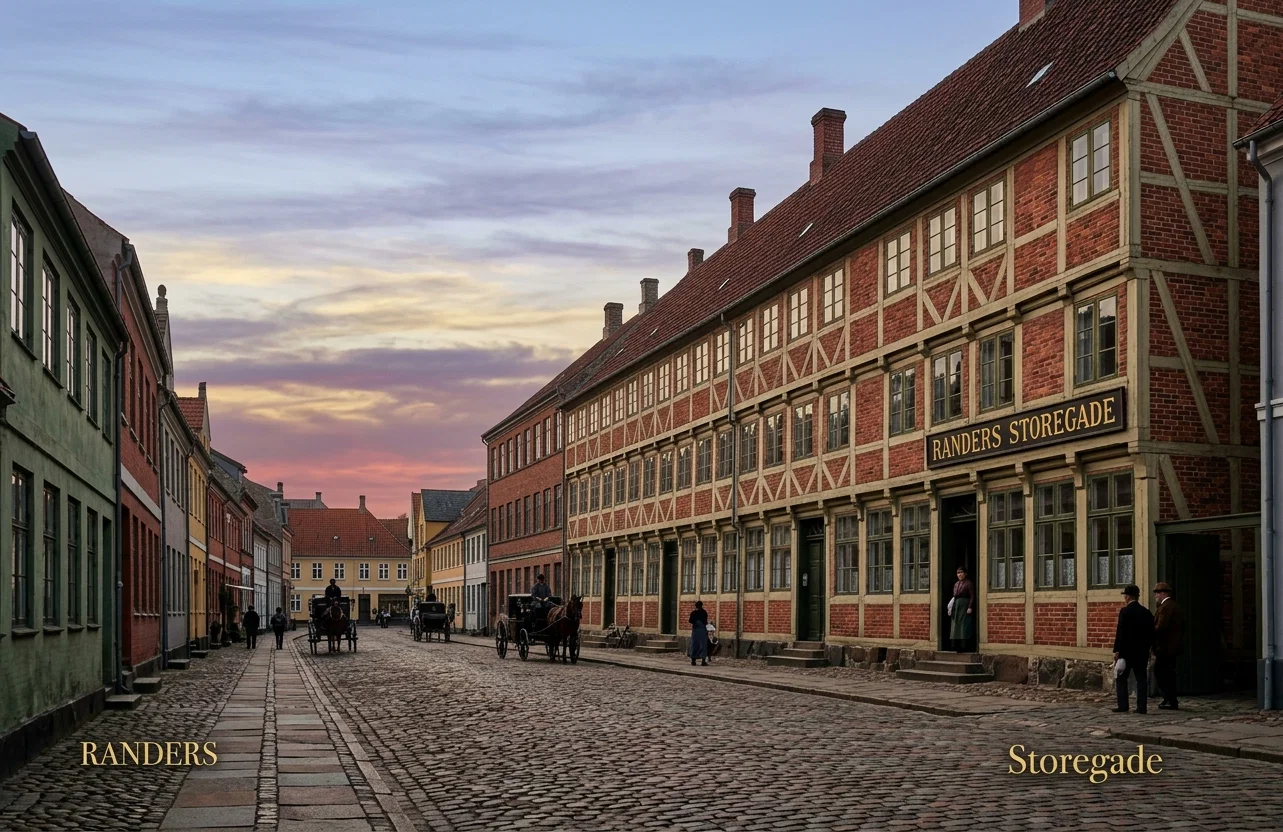
This year the twenty-seventh annual session of the Danish Conference was held in the pleasant city of Randers, a place containing about twenty thousand inhabitants, June 13-18. Sixty-two delegates represented seventeen of the eighteen churches in the field. In all, about three hundred persons attended. We had an excellent and harmonious meeting. The Sabbath day was one of blessing, and revival of God's work in many hearts. The Holy Spirit greatly assisted Elder Conradi as he presented the need of unity in the church. Hearts were touched. Souls were converted.
The reports of the laborers for the past year contained many encouraging items. Through the opposition offered to some of the statements one of our ministers made about the attitude of Romanism to heretics, he was led to investigate authorities referred to by the questioner, and it was found that, contrary to what had been expected, our worker secured only better support for the statements he had made, so that our case was still more clearly seen to be just. We also learned that at the Skodsborg Sanitarium God had remarkably blessed some of the work done. A girl had been unable to walk for seventeen months, because of paralysis; her physicians could do nothing for her, and they told her that if she could not be helped at Skodsborg, she could not be benefited anywhere. She came, has been under treatment, and now is able to walk—a case in which God has especially been pleased to help us. The sanitarium is overcrowded, and will soon have another building, which will have about thirty rooms for patients, besides dining-rooms in the basement for patients and helpers. It will be three stories above basement, will cost about fifty thousand kroner, and will be erected on our own land. We hope to have it finished by this autumn, and it will probably be the best-paying building we have here. At Frydenstrand, they are also having a good run of patients.
The campaign on Danish “Christ's Object Lessons” began last October; about seventeen hundred books have already been disposed of. Some had a very good experience in their work, disposing of as many as seventy, eighty, or even one hundred copies, and being supported in their efforts by some of the popular ministers.
Advanced steps were taken in the resolutions presented at the conference. It was unanimously voted to support the proposed mission to Abyssinia, and the First-day collection, amounting to about thirty-five dollars, will go toward this object, as will all the First-day offerings in the Scandinavian conferences in the future. Since it has been decided to give for a special object, we believe there will be a material increase in the weekly offerings the coming year.
Denmark has taken the initiative among the Scandinavian fields, in adopting the plan followed by most of our European conferences, as expressed in the following preamble and resolution:—
A STREET SCENE IN RANDERS, DENMARK
“Whereas, It is now the practise of most of the local conferences in Europe to give a second tithe to the union conference, and,—
“Whereas, This plan has brought great blessing to the people, and,—
“Whereas, The Scandinavian Union Conference will hereafter need more means, therefore,—
“Resolved, That the Danish Conference pay a second tithe to the Scandinavian Union, beginning with July 1, 1906.”
Co-operation and support were pledged to the proposed union school, to be held at Nyhyttan, Sweden, the coming winter; the publication of local conference reports in connection with the Sabbath-school lesson pamphlets was favored; and the conference sanction was given to the work of the Copenhagen Young People's Society, which is especially interested in seeking to deepen the religious life of our youth in that city, and in working for the cause of missions.
Financially, there has been a wonderful improvement in this field the past five years, each year showing a better report. The tithe for 1905 was $7,066, against $5,700 the previous year; the offerings were $1,053, or $265 increase over 1904; book sales, $8,849, or $1,633 better than the year before. Sixty-four were received into the Danish Conference last year, but the net increase is not large, the membership at the close of 1905 being 724, or six more than twelve months earlier. The large number emigrating to America cuts down our net gain in this field very materially.
The following officers were chosen for the coming year: President, J. C. Raft; Vice-president, P. A. Hansen; other members of the Conference Committee (this committee also acts for Frederikshaven Sanitarium), Dr. N. P. Nelson, Jens Olsen, Peter Hansen, L. Muderspach, H. L. Henriksen; Canvassing Agent, Peter Hansen; Secretary and Treasurer, Jens Olsen; Auditors, R. J. Aagaard and Peter Hansen.
Ministerial credentials were granted to J. C. Raft and P. Christensen; ministerial licenses to L. Muderspach, Z. Sherrig, N. P. Hansen; missionary credentials to O. T. Helleraas, who has been recently invited into the field from Norway.
These workers go forth to another year's labor, among the two and one-half millions in their field, with better courage than before, feeling happy for the instruction they received at the meeting, and determined to press the battle to the front. Among workers and people there is a good spirit, and we think the days before our work in Denmark will be still brighter than they have been in the past.
Hamburg, Germany.
Revival in Madagascar
A MISSIONARY writing from Madagascar states that a great revival is in progress in that island among the natives, similar to that experienced in Wales last year. Many hundreds are deciding for Christ, and there is a marked deepening of the spiritual life among the believers. Visiting different villages, the worker found the same work going on in each. In many places they are giving up their charms, and the natives themselves are doing soul-winning work.
A Letter From California
By E. R. Palmer
Another Account of the Burning of the Pacific Press Printing Plant
[The following is the greater part of a letter from Brother E. R. Palmer, addressed to the officers of the General Conference. It gives a vivid report of the experiences in connection with the recent fire at Mountain View.—ED.]
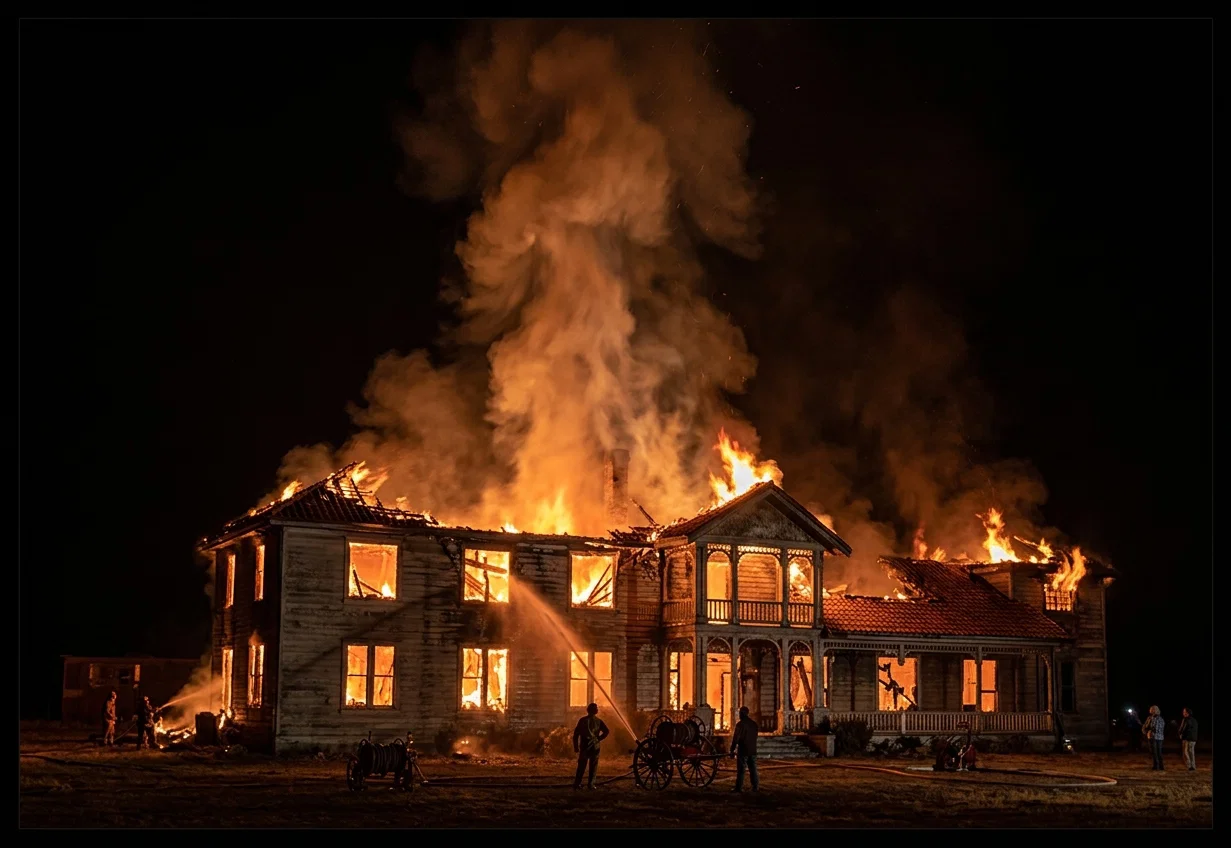
At fifteen minutes of twelve we were aroused by a man's rushing down our street toward the Pacific Press, crying “fire.” As far as known, he was the first person who saw the flames. From our front veranda we saw at a glance that the entire plant was doomed to destruction. The flames already had fast hold upon the photo-engraving department, where they doubtless started, and were mounting through the roof into the heavens. The fire was terrific, and spread rapidly through the entire plant. We rushed back to our room to partially dress, and on returning, perhaps three minutes later, and possibly less, the flames had already spread along the runway to the engine-house, and from the engine-house had caught in the tank-house. In the other directions they had spread through the entire factory, which was stacked high all through with the many large jobs in progress. Although we live only two blocks away, by the time we could reach the building, the flames had nearly destroyed the roof of the front part, which was the last portion of the plant to be reached; and great angry flames were bursting through the doors into the circulating department and into the front hall from the factory.
FRONT VIEW OF THE BURNING BUILDING
Nothing could be done except to save a few articles from the lower floor, and the men did this at the risk of their lives. The typewriters, I think, were all saved from the circulating department, although when Brother Bourdeau's machine was snatched up, the cover of it was on fire.
Brother Gage and several others were in the counting-room and got out the most of the old records. The legal papers, cash, and current account-books were in the safe, and it will probably be several days before we shall know whether they are destroyed.
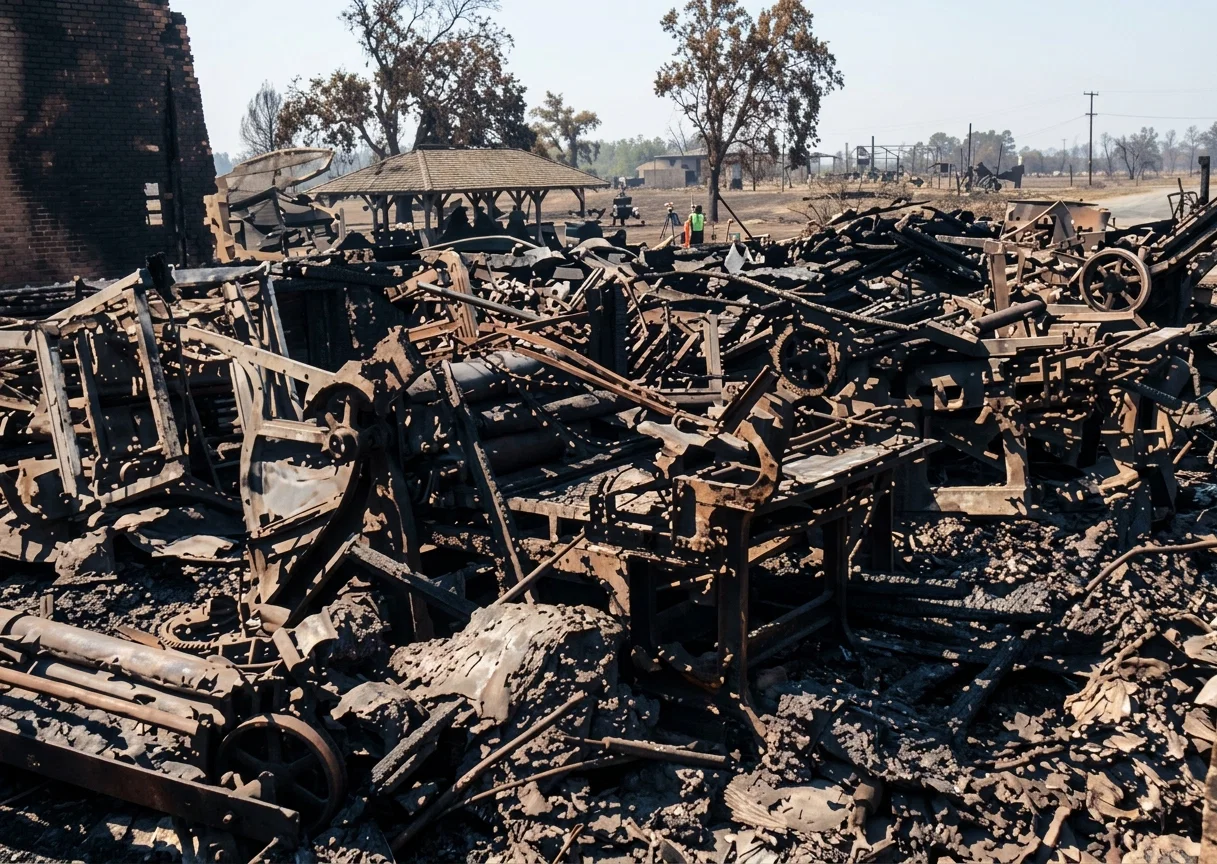
The entire plant was swept clean with the exception of the boarding hall, the horse shed, and the bicycle shed. The brick walls of the power-house are still standing. The lower story of the tank-house and a small piece of the front wall of the main building still stand. I never saw flames sweep through a building so quickly, except in the Review and Herald Office fire. Practically nothing could be saved. The large editorial library,
which Elder Wilcox had been collecting for many years, was entirely destroyed, with the exception of four small books which I had borrowed from him a few days before. Besides this, a large part of his personal library had been transferred from his own house, and went with the rest.
It is unnecessary for me to recount the items of loss. There are thousands of photographs, original drawings, and valuable files of the Signs and other papers which can never be replaced. It is not yet known whether the Signs and Little Friend lists are saved. The copies used in the circulating department were destroyed.
An up-to-date copy was kept in the vault, and a portion of the valuables stored there will be saved. Unfortunately, the vault was somewhat defective, and was probably cracked at the time of the earthquake, though no one was aware of it, and the fire got inside, but burned very little. They tried their best to keep the fire down around it, but it was heated so that it finally gave way and the top fell in. The fire was put out, and kept away from much of the stuff, but considerable has been either damaged or destroyed.
The plant was insured for one hundred thousand dollars. This was held by six or seven good companies, though these companies have been put under such a terrible strain by the disasters in San Francisco that they are likely to cut down the insurance or repudiate it altogether on almost any possible technicality. We earnestly hope that the Lord will overrule in this matter and enable the Press to secure the amount in full.
THE PRESSROOM AFTER THE FIRE
The difficulties of the present situation can hardly be conceived. It is much worse even than in the case of the Review and Herald. Never in the history of the Pacific Press was there a larger amount of work in progress, which made the loss unusually heavy. The great stock of books was entirely destroyed, there being only a conservative stock at Kansas City and Portland to fall back upon, while, on the other hand, the canvassers are having greater success than for many years. Fortunately, nearly all the agents had just made their first delivery. Others can postpone their deliveries, and it is thought that books can be supplied in six weeks. Fortunately efforts have been concentrated upon two books. Nearly all the agents are working for “Great Controversy” and “Heralds of the Morning.” Orders will at once be placed for “Great Controversy” with the Review and Herald at Washington, and a man will be sent East with the responsibility of bringing out a large edition of “Heralds of the Morning” in the shortest possible time.
In the lower room of the tank-house there was stored a large font of small pica type. The employees will set up the Signs and Little Friend, and take them to San Jose or Santa Clara to be printed. Several firms have offered assistance, and by furnishing them with additional help from the Pacific Press force, the most urgent work can be done.16
Sabbath afternoon at three o'clock the members of the church met in front of the boarding hall and enjoyed a very precious meeting. There was a strong spirit of consecration and union. The occasion was a very touching one. There seems to be a universal desire to interpret the meaning of the catastrophe aright and learn well the lessons taught by it. The leading sentiment expressed in the meeting was that the Pacific Press Publishing Company does not consist primarily of buildings or facilities, but rather of faithful, devoted men and women; that the church of God is a temple not made with hands, a spiritual building which can not be destroyed, and that the work of God, although shorn of some of its strongest facilities, will go on still stronger than in the past. From this thought many who feel deeply afflicted and heavily chastised are receiving consolation.
It is too early to forecast what will be done. Much depends upon the ability of the Press to collect the insurance money. It seems probable that a smaller plant for our denominational work only will soon be erected on the old foundation. Among the employees there are many good mechanics, and it is believed that the work can be largely done by the office force, thus giving employment to many now thrown out of work.
It is needless to say that the leading men of the Pacific Press feel greatly afflicted. They suffered great loss from the move from Oakland to Mountain View. Then came the earthquake which shook down the brick walls. They rebuilt with wood, and now the whole is burned, and yet above all, the spirit of these devoted men seems to stand triumphant in the confidence that God has permitted this affliction in love, and that through it he will teach lessons in unity and reliance upon him and in separation from the world with all its commercialism, which will be worth more to the cause of God as a whole than the plant itself could have been.
Our Publishing Department and Relief Bureau have also suffered. Ten days before the fire we had moved into the Pacific Press building. The room where we were was too hot for the summer weather, and the Pacific Press very kindly gave us office room which was very comfortable and commodious. It was the large square room next to the editorial rooms, facing the south. Everything we had was destroyed,—our typewriter, our files, minutes, accounts, everything,—and we have to begin all over again. However, our accounts were with publishing houses and others who kept accurate accounts, and we shall be able from them to receive itemized statements and reports which will enable us to make up our records quite completely. It will take considerable time to get in working order again, and of course our loss will amount to quite a little, though it is trifling compared with the loss of the Press.
We most earnestly desire the prayers of all God's people that wisdom and strength may be given to the men upon whom these almost crushing burdens and sorrows are now resting. At the same time, I am confident that I express the sentiment of the Board when I say that none are wholly discouraged or cast down. Confidence in God in a time like this is proving an anchor to the soul, both sure and steadfast.