The Youth’s Instructor, Vol. 67, No. 20.

Miscellaneous News and Curious Facts Items

The Youth’s Instructor

May 20, 1919

Review and Herald Publishing Assn. · Takoma Park Station, Washington, D. C. · May 20, 1919

Miscellaneous News and Curious Facts Items

On April 17, Capt. E. F. White, an army aviator, made a nonstop flight from Chicago to New York, covering 727 miles in six hours and fifty minutes.
A relief force to Russia left Britain for Murmansk in the early part of April. It is expected that the main force, consisting of volunteers, will be sent in May.
According to “Our Dumb Animals” there are forty-eight kinds of animals, sixty-seven kinds of birds, about ten kinds of fishes, twenty-one kinds of reptiles, and seventeen kinds of insects named in the Bible.
With the Oriental child the knucklebone from a sheep “represents everything from a doll to a sword, from a pasha’s horsetail-ornamented shell tree to a British gunboat, from a mosque to a church.” It is the “eternal, ubiquitous play toy of all the East.”
“Training the Little Home Maker,” by kitchen-garden methods, is the title of an interesting book of songs for the mother and daughter or for teacher and pupils to sing, as they work together at home making. These songs are instructive, and for the younger children make play of home duties.
Can you light a safety match with one hand? If not, according to the men who are in charge of teaching soldiers who have lost an arm, to adapt themselves to the new conditions, you are a cripple; you have not the normal use of your fingers. The one-armed men are taught that feat before they are out of bed.
King George, according to the Washington Post, differs from all other rulers in that neither he nor the members of the reigning house cost the British taxpayers in the United Kingdom and in his oversea dependencies a single cent. On his accession to the throne he followed the example of his father, Edward VII, and of his grandmother, Queen Victoria, voluntarily turning over for the term of his life the crown property to the national treasury in return for a civil list.
Count Greppi, has recently celebrated at Rome the one hundredth anniversary of his birth in a wonderful degree of physical and mental vigor, conveying in his manner and speech the impression of a man at least thirty or forty years younger. He is in every sense of the word the dean of the profession. Just a month before the outbreak of the war, that is to say, in the summer of 1914, he traveled to Paris in order to take part in the congress of the International Society of the History of Diplomacy. His last ambassadorial post was at Petrograd, where he represented King Humbert, and, before him, Victor Emmanuel II, being a most popular figure at the Russian court and in the Muscovite great world. Count Greppi may be said to have commenced his official career at the early age of eleven, when in 1830 he was appointed page of honor to the Empress Marie Louise, the Austrian consort of the first Napoleon, and who, after her husband’s downfall and exile to St. Helena, was invested with the sovereignty of the Duchy of Parma, while retaining her imperial title. Greppi’s memories of her court while in her service are still vivid and most entertaining.
More than a hundred of the leading men of this country issued a call to individuals, institutions, associations, and organizations to send delegates to the National Conference on Lynching, which was held in New York City May 5 and 6. This call was in accordance with the following words of President Wilson concerning the crime that from time to time manifests itself in this country: “There have been lynchings, and every one of them has been a blow at the heart of ordered law and humane justice. No man who loves America, no man who really cares for her fame and honor and character, or who is truly loyal to her institutions, can justify mob action while the courts of justice are open and the governments of the States and the nation are ready and able to do their duty.”
China is looking to the United States for help by way of seed exchange in its work of reforestation. The American Forestry Association is to render assistance to Belgium, France, and Italy in reforesting their devastated areas. Practically all of Belgium’s forests having any timber value was cut down by the Germans and used either in Belgium or sent back to Germany, while fully 450,000 acres of Great Britain’s forests, one half of her total forest area, went for war work.
The creation of a bureau of aeronautical development, which would have charge of inventing and designing aircraft and appliances for all branches of the government rather than a department of military aeronautics, and which would have charge of the operation of aircraft as well, is favored by the Post Office Department as a means of advancing the airplane mail service.
A chorus of two hundred boys are giving concerts in the different churches of Seattle. At each of these a talk is given on the harmfulness of cigarettes, and songs are sung to the same effect by the boys. There is some effort under way greatly to increase this chorus and to tour the country, using the Anti-Tobacco Annual in the campaign work.
Miss Rankin, former member of Congress from Montana, is now in Europe. She crossed the water to attend the International Congress of Women at Berne, to which she was a delegate. Since the Congress she has been traveling in France, Italy, Poland, Czecho-Slavonia, and England.

Think for Yourself

E. F. COLLIER
Some time ago on a railway train, the writer became interested in the way a mother took to soothe and feed her crying child. Assuming that the child was hungry, she took from a bag a cracker, and after chewing it thoroughly, proceeded to insert it in the baby's mouth. The child swallowed it, blissfully ignorant and helpless as he was, and to all appearances liked it.
How many men and women are contented with that method of feeding. After allowing others to chew over their intellectual and heart food, they swallow it without a question, for the mere reason that it is easier to swallow than to chew!

Boasting of Borrowed Opinions

How often we hear people say, “I think so and so!” or, “I believe thus and so!” or, “That is my idea of the matter!” How proudly they voice these expressions, and what conceit they display over their own judgments! But it is usually borrowed opinions that make the most noise.
It is safe to say that nine out of ten who applaud their wonderful opinions have not thought out matters carefully at all, but are merely seconding opinions which they borrowed from some one else. A borrowed opinion is just as good as a homemade one, you know, provided you are comfortable in it and can handle it properly. So they find one that meets their approval, and appropriate it.

Few People Think

Most people consider themselves rational beings, yet few take pains to reason. The Creator has graciously endowed the human animal with machinery for thinking, but he rarely thinks.
Thinking is such a nuisance! It always requires an effort, and how unnecessary in a world where conclusions are to be had ready-made! Others have thought out the facts before us — why bother? Knowledge of things is a heritage left us by our ancestors who did some thinking — be thankful for what they left us, and take it easy! Rules have already been formulated, laws enacted, codes of conduct laid down, society organized, religions established — why should we worry about such things? And so we do not. Outside of a few specialties which most people have, the average person accepts what is told him by others, and is content.

Slaves to Others’ Notions

The result is that the majority of men and women have become slaves to the judgment or notions of others. And because of this, errors in science remain undiscovered and unrebuked for centuries; false dogmas of religion hold sway through succeeding generations; and millions living in the age of progress and enlightenment remain deluded by silly, and oftentimes contemptible superstitions and fables.
Scarcely a day passes that one does not hear foolishness of the following sort:
The groundhog looks for his shadow on the second day of February. Throw ashes upon your cows on Ash Wednesday. Do not break a mirror under any circumstances—it means misfortune. If you drop an article when starting on a journey, always step on it before picking it up. A dog howling outside your window at night is a sure sign of death. Beware the black cat that crosses your path. Never allow the clock to strike twelve while you are eating your midday meal. Plant all root vegetables during the dark of the moon, and all top vegetables during the light phase of the moon. Look out for Friday and the thirteenth!
Enough. Their name is legion. The pathetic part of it is that some people are wholly sincere in their belief of each one of these. So with the predictions of the “weather prophet” of the almanac, no matter how often they are proved to have failed, some one still reads them and believes in them. Somewhere there are individuals who will accept anything that may be told them. Their weakness is that they do not think. They would rather follow the fable foister.

Thinking Begets Wisdom

Of course some one thinks, and thereby is redemption. The energy of thought, seasoned with divine grace, has brought nations from a chaos of stupidity and blind savagery into advanced stages of civilization. What might the world have been if men had been less reliant on others and used their powers of mind which their Creator gave! “Wisdom is the principal thing; therefore get wisdom: and with all thy getting get understanding.” Knowledge may be acquired from others without much thinking, but true wisdom requires activity of mind and the indwelling of Christ. In the exercise of the brain functions,—memory, imagination, and reason,—under the stimulus of the Holy Spirit, that wisdom is acquired which is pure and peaceable and without hypocrisy.

The Conquering River

E. F. COLLIER
I HAVE heard say that life is a battle, A drama, an ocean, a song; A ship on the highway of transit, A star in the firmament’s throng.
I’d rather say life is a river With a destiny more than sublime, Whose waters are ever imprinting Their way on the shore lines of time.
O the value of life’s onward river Is not known by the course that it flows, But its way and its will and endeavor Tell its virtue and worth as it goes!
No stream but is vexed with its turning, Its rocks and its cavernous gloom, But its surge and its murk are forgiven As it hastens to sunlight and bloom.
There are clefts and chasms to cover, There are treacherous shoals that appear, There are sharp reefs and dangerous shallows, And gorges and grottoes of fear.
But the pure, dashing waters avoid them, Or angrily tear them away; Then tranquil, unsullied, bear onward In calm to a happier day.
Every crag in its path hears a protest, Every precipice falling away, Disappointed, beholds the undaunted Arise in a rainbow of spray.
And thus in the face of obstructions It glitters and glides to the sea; But its journey of hope and persistence Bears a message of courage to me.

The Missionary Volunteer Council

WE are sure our young people will be interested in a brief report of the council held by the Missionary Volunteer Department at Takoma Park, April 23-27. The delegates were representative of the North American field, including from the General Department, Prof. M. E. Kern, Matilda Erickson, Ella Iden, and Meade MacGuire.
Union Conference secretaries: W. L. Adams, Southwestern Union; C. L. Benson, Central Union; Mrs. R. D. Quinn, Atlantic Union; C. A. Russell, Lake Union; W. W. Ruble, Pacific Union (elect); J. A. Tucker, Southeastern Union; John C. Thompson, Southern Union; G. R. Fattic, Lake Union; C. W. Flaiz, North Pacific Union; N. H. Saunders, East Canadian Union; J. J. Reiswig, West Canadian Union; A. W. Werline, Columbia Union; J. F. Simon, representing the German Department; Adam Schmidt, Northern Union (elect).
Local conference secretaries: Miss Grace, Evans, Southern Illinois; Miss Marian Brooke, Cumberland; Miss May Bell, Southern Wisconsin.
Special help and counsel was also rendered by Elders A. G. Daniells, W. W. Prescott, Charles Thompson, and J. L. Shaw; J. S. Marshall, principal (elect) Argentine Training School; Walter Murray, secretary (elect) Brazil Missionary Volunteer Department; C. C. Lewis; A. G. Goude; F. M. Wilcox; G. B. Thompson; C. S. Longacre; L. L. Caviness; W. E. Nelson; Sarah E. Peck; and a number of other workers.
One characteristic of this council was that, owing to the extraordinary times, it seemed best that a few most vital subjects be taken up and thoroughly discussed, rather than to spend the time on a multitude of less important details.
This is indicated by the opening topic presented by Professor Kern, “What Shall be the Main Emphasis of Our Message to the Young People at This Time?” Several hours were spent in a discussion of this subject. The need of clear, simple teaching from the Scriptures of the possibility and necessity of living a life of victory over sin was especially emphasized. We ourselves must have this experience in order to be ready for Christ’s coming, and also to fit us for successful soul-winning.
Time was also given to a discussion of the moving picture theater menace, and resolutions passed regarding this terrible peril into which many are drifting. The leading brethren of the General Conference Committee who were present took a deep interest and active part in the discussion of these questions.
Special consideration was given to the Junior Missionary Volunteer work, and plans laid for more aggressive efforts. Methods were discussed and plans laid for more efficient work at camp-meetings, and for revival and soul-winning work in the field.
Consideration was given to the matter of completing our census, so that we shall have a full and accurate record of all our young people throughout the field. We can hardly overestimate the importance of this matter. Various phases of our Missionary Volunteer Goal were taken up, and methods and plans for aggressive work were suggested.
Deep interest was manifested in the topics “Consecration of the Missionary Volunteer Secretary” and “Helping Our Young People to Face the Problems of Sin,” and considerable time was spent in testimony and discussion. This was followed on Friday night by a meeting at which Professor Prescott spoke on the topic, “The Victorious Life in Christ.” On Sabbath Elder Daniells spoke on “Attaining Our Ideal: To Reach Every Boy and Girl, Young Man and Young Woman, in the Denomination.”
Committees were appointed and resolutions prepared and passed affecting the devotional, educational, and administrative phases of our department, and also the Junior work.
It was a profitable council, and we believe and pray that it may result in a new impetus being given our Missionary Volunteer work. MEADE MACGUIRE.

“People are Delighted with It”

THE general secretary of the Michigan W. C. T. U. Loyal Temperance Legion Branch, Grand Rapids, Michigan, Mrs. Lenora H. Holcomb, speaks in the highest terms of the Anti-Tobacco Annual. With her fourth order for this annual, she says:
“DEAR COWORKERS: Once again I am sending to you for copies of your Anti-Tobacco Annual of August, 1917. This makes my third or fourth order, but it is the best publication I can find for my work with the children and their leaders. People are ‘DEE-LIGHTED’ with it, and it presents the truths so plainly and clearly that all may see. This must be our next great objective, now that we are beginning to see the end of the liquor traffic.”
D. W. REAVIS.

Chinese New Year’s Customs

H. O. SWARTOUT
New Year’s is the great national holiday of China. There are other festivals for special purposes, but at New Year’s time every one lays aside work and worry and gives himself up to merrymaking. It is a religious holiday, in that idol worship makes up a large part of the celebration. It is a business holiday, in that all sorts of buying and selling cease. It is a universal birthday anniversary, in that the Chinese count their ages from New Year’s instead of from their real birthdays.
Preparation for New Year’s occupies a large part of the last month of the old year. Everybody rounds up his business and pays his debts. Large supplies of provisions are laid in, especially of meats and other things which the Chinese consider delicacies. Each person fits himself out with as fine a suit of clothes as he can afford. Toys and fancy headdresses are bought for the children. Letters are written to all absent members of the family, urging their presence at the coming festivities.
The last few days before New Year’s are especially important. On the twenty-third day of the twelfth month the kitchen god is escorted to heaven. He is only an image drawn on a sheet of paper, but on this day people pray to him, kotow, burn incense before him, rub sugar on his mouth, then burn him in the kitchen stove. He is supposed to ascend to heaven in the smoke, to report the deeds of the family for the past year. It is hoped that the worship and the sugar will induce him to make a good report.
After the departure of the kitchen god the final preparations for New Year’s are made. As large a quantity of liquor is brewed or bought as the family can afford. Incense, paper money, and firecrackers must be provided. New pictures of the door gods must be pasted up on the front doors. Characters meaning, “May the five blessings descend on this house,” or something similar, are written on strips of red paper, which are pasted above the doors. The last day of the month is spent in cooking all sorts of dainties. All this work must be out of the way before nightfall on New Year’s Eve.
The Chinese consider it imperative for every member of the family to be present at the evening meal the night before New Year’s. The food is first offered as a sacrifice to the new kitchen god, accompanied by much burning of incense and shooting of firecrackers, then it is eaten by the family. After the meal the children kotow to their parents. The parents string cash on a red cord and hang it about the children’s necks.
In most parts of China few sleep during the night before New Year’s. Sometime during the night, usually about midnight, they “seal the door of riches.” This is done by pasting two strips of paper across the door in the form of a diagonal cross, and is supposed to prevent riches from escaping at this important time. After the door is sealed, the family sit around the room in order of rank, and spend their time in mutual congratulations and in repeating the multitudinous phrases which are considered lucky or felicitous.
The most important religious exercises of New Year’s come just before the dawn of the day. As the first indications of light appear, the family, which have been passing the time as indicated, prepare to go out to worship heaven and earth and greet the god of wealth. A little shrine to heaven and earth has already been built outside the house, and a glance at the almanac tells which way to go and how many steps to take to find the god of wealth. Every member of the family must take part in worshiping heaven and earth, for the Chinese have a deep-seated belief in a “heavenly father” and a “mother earth,” who are above all gods which can be represented by images. The family, or some member of it, proceeds to the place where the god of wealth is supposed to be waiting. All this worship is accompanied by the burning of paper and incense and the shooting of firecrackers. As the family re-enter their home, heaven and earth are supposed to be pleased, and the god of wealth is supposed to follow them into the house to take up his abode for the coming year.
Every incident or condition of the weather on New Year’s morning is scrutinized to see what sign of good luck may appear. Whether it is cold or warm, whether it is wet or dry, whether there is snow on the ground or not, whether the sky is clear or cloudy, whether there are any birds to be seen or heard and what kind, what the domestic animals happen to be doing, the number, age, and sex of any persons who may happen to be in sight, and countless other things, on this morning have a lucky or unlucky meaning to the superstitious Chinese.
As might be expected, ancestor worship is not forgotten at New Year’s time. In some parts of China special intercession is made for the presence of the ancestors in the home on New Year’s Day. After the intercessory ceremonies a stick is laid in front of the door, the idea being that the ancestors have arrived and the stick will make it hard for them to get out of the door again. That they may not appear to dishonor their ancestors by having better food than the ancients, many Chinese refrain from eating any of the dainties they have prepared, till New Year’s Day is past.
After breakfast on New Year’s morning the people go out to make New-Year calls. From this time till the middle of the month everybody is expected to give some appropriate greeting the first time he sees a friend. If he fails to do so, it is considered an affront. Among the many greetings heard, perhaps the most common one is: “Congratulations! May you get rich!”
With the worship and ceremonies over, feasting and merrymaking begin. The kitchen fires are kept burning all day for three days, to be ready whenever the housewife wishes to warm food. Dainties, the names of which would convey little meaning to anybody but a Chinese, are consumed in endless variety and prodigious quantity. Drinking, smoking, gambling, dragon procession, and theatricals are the order of the day; and drinking, gambling, smoking, lantern processions, and more theatricals are the order of the night. Those who are well-to-do continue the merrymaking for weeks, but three days ends it for the masses.
The poorer classes in Chinese society also share in the New Year’s joys. Everybody is expected to give alms to every beggar that asks. In some places fishermen and the poorer workmen have beggars’ privileges at this season without losing their standing as tradesmen. Coolies demand large tips. Employers are expected to make a substantial gift to their employees just before the holiday. Thus very few in China are so unfortunate as to be without the means to celebrate New Year’s.
New Year’s must not be considered simply as a holiday interesting to foreigners and dear to the Chinese. Its effects are profound. Because it brings all members of the family together once a year, it prevents emigration and intercourse with people in other parts of the country, thus retarding that broadening of mental horizon and growth of national feeling which are necessary to make China a strong nation. Because of the idol worship connected with the observance of the holiday, it is a hindrance to the spread of Christianity. But because of the yearly settlement of debts, the encouragement of charity, and the tendency to union caused by universal celebration of the same holiday at the same time, Chinese New Year’s is not devoid of good.
523 U. S. Postal Agency, Shanghai.

No Royal Road to Learning

IT was a Zulu king, I believe, who, in the early days of African missions, demanded that he, the king, should be taught to read by a quicker process than his people who were attending the mission school. He came with his chiefs to be taught in royal fashion. He learned the first few letters; and the teacher advised that this was sufficient for the first lesson.
No, he, a king, must take the whole alphabet at one sitting. The result was that at the end of his first day's school he had the letters all confused in his mind, and in disgust gave up the whole plan of acquiring the art of reading.
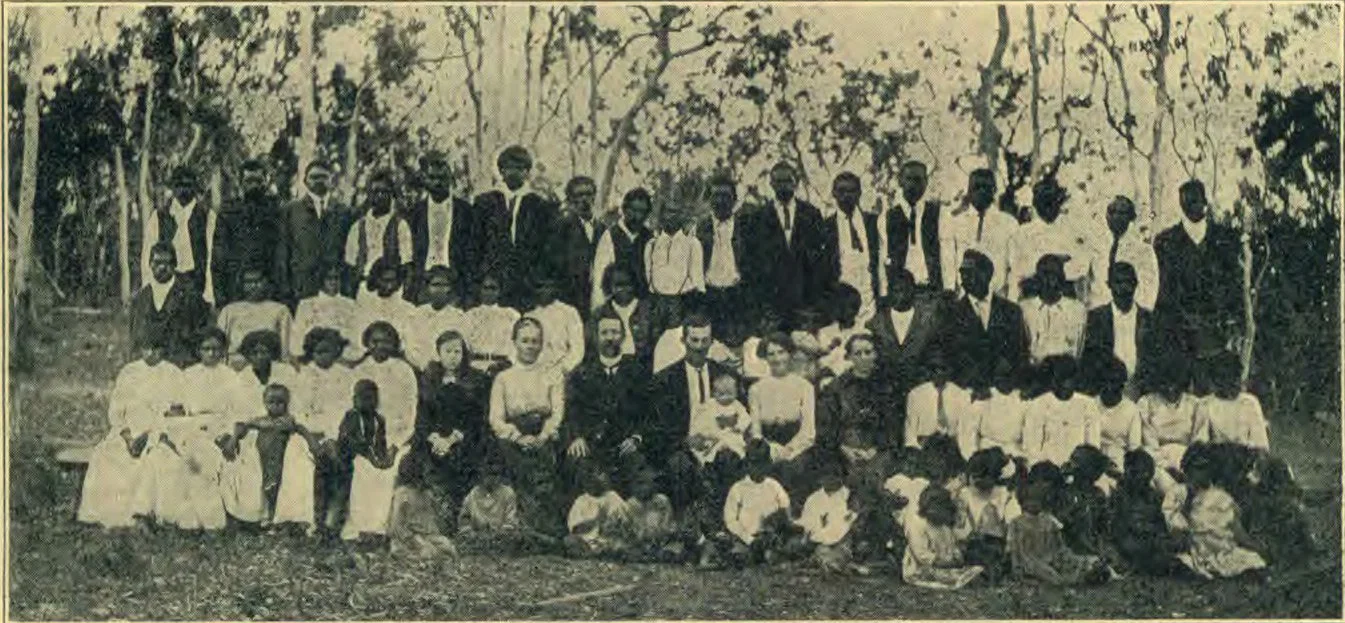
I was reminded of this African king's idea that there ought to be some royal road to learning, by an experience related at the Australasian Union Conference. Brother J. L. Branford, of the Monamona aboriginal mission, in Queensland, told how the natives—the black aborigines—thought at first that the missionaries would be able not only to teach, but to supply the learning as well. He said:
“When we first opened our day school, the natives thought it was a great idea. A large number of men and women wanted to come and learn to read and write; but they seemed to have the idea that their teacher was going to do all the work, and that they need not put forth any effort. They did not seem to expect that they would need to use their brains. We started a night school for the men, but a few weeks convinced them that it was too hard for them, and so they gave up. The women held on a little longer, but with all the encouragement we could give them we could not persuade them to stick to their studies long enough to receive any real benefit. One by one they dropped off. The adults do not like to use their minds other than in the art of hunting and fishing.”
THE MONAMONA MISSION FAMILY, QUEENSLAND, AUSTRALIA
It was good, however, that Brother Branford was able to give a more encouraging report concerning the children:
“With the young people, however, it is quite different. These we have more under our control, and good results have been attained. We have found that they learn some things as quickly as white children. Reading and writing is easy to them, especially writing. But we find that they forget much more quickly. It seems hard for them to retain what they have learned. But, taking our educational work right through, our young people have made good progress, and they are becoming much more intelligent than their parents. They are exceptionally fond of singing. It is a common occurrence to hear in the evenings groups of boys and girls singing our good hymns. Most white children hail with delight the announcement of a holiday from school, but such is not the case with our black children. If anything happens that our teacher cannot hold school, they are quite disappointed. They love their school very much. The girls have made more progress than the boys. The reason for this is that we have the girls in a dormitory and Brother and Sister Mitchell live with them. This has given the girls much greater opportunity of making progress. We need a dormitory for the boys very much, and must have one in the near future.”
Thus, while still no royal road to learning has been discovered, the good old road of hard work and perseverance suffices even these children of the wilds. Many years ago the Australian aboriginals were spoken of by some as so low in the scale of human existence as to be incapable of improvement. All that is now known to be nonsense. Degraded they are in the wild bush land and deserts of the interior, but they have hearts that feel as our own, and minds capable of comprehending not only the common things of the way of salvation. Already eleven of these young knowledge, but chiefest of all, the eternal truths of not devoid of good.
S. S. “Tango Maru,” Banda Sea, East Indies.

God Our Father Is Tender and Near

“ABSOLUTELY tender! Absolutely true! Understanding all things, Understanding you! Infinitely loving! Exquisitely near! — This is God our Father, What have we to fear?”

Character Hints

[The following quotations are from the “Testimonies to the Church,” Volume III, by Mrs. E. G. White.]
“Hearts yearn for sympathy and love, and are as much refreshed and strengthened by them as flowers are by showers and sunshine.”

The Best Shield for Youth

“The Bible should be read every day. A life of religion, of devotion to God, is the best shield for the young who are exposed to temptation in their associations while acquiring an education. The Word of God will give the correct standard of right and wrong, and of moral principle.”

The Only Safeguard

“A fixed principle of truth is the only safeguard for youth. Strong purposes and a resolute will close many an open door to temptation, and to influences that are unfavorable to the maintenance of Christian character. A weak, irresolute spirit indulged in boyhood and youth, will make a life of constant toil and struggle, because decision and firm principle are wanting. Such will ever be trammeled in making a success of this life, and they will be in danger of losing the better life.”

The Two Necessary Considerations

“The first consideration should be to honor God, and the second, to be faithful to humanity, performing the duties which each day brings, meeting its trials and bearing its burdens with firmness and a resolute heart. Earnest and untiring effort, united with strong purpose and entire trust in God, will help in every emergency, will qualify for a useful life in this world, and give a fitness for the immortal life.”

The Books of Record

“You all have an influence for good or for evil on the minds and characters of others. And just the influence which you exert is written in the book of records in heaven. An angel is attending you, and taking record of your words and actions. When you rise in the morning, do you feel your helplessness, and your need of strength from God? and do you humbly, heartily make known your wants to your heavenly Father? If so, angels mark your prayers, and if these prayers have not gone forth out of feigned lips, when you are in danger of unconsciously doing wrong, and exerting an influence which will lead others to do wrong, your guardian angel will be by your side, prompting you to a better course, choosing your words for you, and influencing your actions. If you feel in no danger, and if you offer no prayer for help and strength to resist temptation, you will be sure to go astray; your neglect of duty will be marked in the book of God in heaven, and you will be found wanting in the trying day.”

Vanity in Dress

“Vanity in dress as well as the love of amusement is a great temptation for the youth. God has sacred claims upon us all. He claims the whole heart, the whole soul, the whole affections. The answer which is sometimes made to this statement is, ‘Oh, I do not profess to be a Christian!’ What if you do not? Has not God the same claims upon you that he has upon the one who professes to be his child? Because you are bold in your careless disregard of sacred things, is your sin of neglect and rebellion passed over by the Lord? Every day that you disregard the claims of God, every opportunity of offered mercy that you slight, is charged to your account, and will swell the list of sins against you in the day when the accounts of every soul will be investigated. I address you, young men and women, professors or nonprofessors. God calls for your affections, for your cheerful obedience and devotion to him. You now have a short time of probation, and you may improve this opportunity to make an unconditional surrender to God.”

Signing Petitions

THE right of petitioning is a sacred one; but the right has been so abused that it has come to have an unsavory flavor, at least under certain conditions.
The fact that many people sign a petition as a favor to the one circulating it, without really weighing the contents, has been one factor that has brought the petition into disrepute.
A bright young student, A. G. Oliver, of St. John’s Military School at Salina, Kansas, recently took a unique way to show the real worthlessness of many petitions, since people so frequently sign without full knowledge of the contents.
Mr. Oliver received fifty signatures to his petition, and “would have had more had there been time. In the petition the words ‘Holiday’ and ‘Tuesday, February 4,’ were typewritten in capitals and stood out from the rest of the petition. These were the words that did the work.
“An entertainment was given at the school that night. During an intermission the names of the signers were called out, and the cadets were told to form a line in the center of the floor. After they had done this, the petition was read, to the amusement of the guests and the consternation of the cadets. The signers then, for the first time, discovered what they had signed.”
“Cadet G. K. Harris stood in line without having signed the petition. When the names were being called out, thinking he was going to miss a holiday, he stood anxiously near by. Sergeant Stanley Skilling noticed his agitation, and whispered, ‘Slip in line, they’ll not notice that your name wasn’t called.’ Harris obeyed cheerfully, and stood in line at attention with the rest. The petition follows:
“ ‘St. JOHN’S MILITARY SCHOOL, Salina, Kansas, February 3, 1919.
“ ‘To the Faculty of St. John’s Military School.
“ ‘We, the undersigned, do hereby respectfully submit the following petition:
“ ‘That in view of the fact that the cadet corps has been unusually conscientious in the performance of its duties and obligations, and that the school spirit heretofore displayed has been a great credit to the institution, and since the officers have been very punctilious in the performance of their duties to the great assistance and relief of the faculty,
“ ‘Be it hereby respectfully petitioned that if
A HOLIDAY
be considered on TUESDAY, FEBRUARY 4, the faculty postpone the same indefinitely as an unworthy reward for the above-mentioned excellencies and virtues.
“ ‘As a more fitting recognition of our achievements, we beg that something be granted which will not soon be forgotten. On the date aforementioned, we request that we, the undersigned, be conducted to the rear of the gymnasium and be there noisily decapitated [heads cut off].
“ ‘The formality of notifying our parents can be done away with, as it will not be worth while. All our belongings, such as textbooks, old shoes, pants, jerseys, kite strings, photographs, marbles, shiny clubs, pennants, paper airplanes, and chewing gum, we dedicate to the school, hoping thereby to preserve the memory of otherwise useless lives.
“ ‘All of which we humbly petition.’”
Mr. Oliver carried his joke so far as to have the petition with the names of the signers printed in the school paper. It is safe to say that there are at least fifty persons who will hereafter insist on reading a petition carefully before signing it. F. D. C.
Continue reading: MORRIS LUKENS