The Youth’s Instructor, Vol. 67, No. 20.

Miscellaneous News and Curious Facts Items
Earlier text: MORRIS LUKENS

“Do the Young Women of Washington Need to be Chaperoned?”

DR. JAMES L. GORDON, pastor of the First Congregational Church of Washington, D. C., spoke recently to his church on the subject given as the heading of this article. Among the many good things Dr. Gordon said were the following:
“If girls had the proper fund of knowledge so necessary to them in the business world, there would be no need of chaperons.
“But many mothers, and fathers as well, have been negligent in their parental duties, and girls do need the proper chaperons.
“Remember, you young women who are away from home, that in the business world you will have to fight a strenuous battle. It is no small thing to leave a village of a few hundred and come into a large city like Washington, surrounded by temptations and away from the protection of the home.

Dangers in Association

“Remember, too, that the association of men and women in business brings certain dangers to the girl, not that the woman has not the right to engage in business, for she has as much right as the man.
“The young women of the present generation have a tendency to let down in speech, manner, style, and ethics. If you desire to be looked upon as a woman of quality, do not let down, but stand firm.
“There is a certain limit in the manner of dress, and that limit is decency. The laws of health and decency go hand in hand, and the minute that there is a lack of clothes, in an effort to appear stylish, your health is endangered, and you have overstepped the limits of decency.
“Remember that in every city, community, and even in the churches there are certain men who make a study of systematically destroying the characters of young women. They will also argue that social purity is a dream and a myth. Young women must have the courage to stand firm and give such a fiend the lie.

Warns of Character Gambling

“No man loves you who talks so, and he who does probably is a social leper whose touch is damned.
“Never think that because a man has a family and is a member of some religious body the possibility of his taking advantage of loneliness is removed. Far from it. Such perfidious hounds are encountered in every walk of life, and should be thrown in the very vilest depths of perdition.
“Many girls gamble with their own characters and win, many others gamble and lose, and the girl who loses goes down in degradation. Remember, above all, that there is no protection for young women who will not protect themselves.”

Reading Course Books Wanted

SOME of our mission schools in English-speaking foreign fields and in the South are very anxious to get former Reading Course books, Senior and Junior. If any of our young people have books to donate, will they not write to the Missionary Volunteer Department, Takoma Park, D. C., giving the names of the books? The department will give directions where to send the books.

Missionary Volunteer Society Membership Revision Question

WE have had a society in our church four years. On the day of organization we had an impressive program. Parents and older church members were present. The purpose of the society was made plain, and the pledge dwelt upon. The young people seemed to sense the sacredness of the responsibility they were assuming, and each gave his testimony as to his purpose in joining. No member has ever been taken in since who did not express a desire to help others. The elder assists in instructing new members, and we always have good services at such times.
Here is the puzzling part: We have members who have never reported one item of missionary work. These young persons are not regular attendants at Sabbath school or other church services, though both church officers and young people have urged them to come, and tried to encourage them. They seem good in their intentions, but do not do anything in particular either for their own benefit or for any one else.
We now want to revise our membership list. It has been made plain, both before the society and the church as a whole, that members not reporting missionary work or attending for three months without good reason, according to the Missionary Volunteer organization, should be dropped, not as being “turned out,” but more as attendance records are kept in school. However, even with this explanation, we have hesitated to take the step, fearing to discourage or offend; also because we have kept hoping these young persons might become more interested and active, in which case we should not know how to receive them back into membership without embarrassment. Will you please tell us what to do? L. R. M. S.
Your question is a good one, and depicts a condition that is perhaps not rare. As far as I can see you have not been at all remiss in making full explanations of the ideals of the Missionary Volunteer Society at the time of organization. You have also exercised care in making plain the purpose of the society to new members. In spite of all this, you have the conditions you mentioned.
First of all, if it were possible, I should secure the services of a good minister, and endeavor to have a revival effort in the church. If this is done, or if it is not, I should favor taking steps to drop members who are not interested or active, after most earnest prayer and personal effort for each one concerned, on the part of your executive committee. If nothing avails to awaken their interest, the executive committee should recommend to the society the dropping of the names. This may preferably be done at a business meeting where only the society members are present, rather than in the regular meeting, which is often attended by many who do not belong to the society. This plan will save unnecessary embarrassment. It needs to be understood, however, that dropping names from the society membership list is not the same as dropping individuals from church fellowship. It is not nearly so serious a matter. It is natural that you should fear that this might alienate somebody who would later come back, but I believe that faithfulness, coupled with kindness and a burden for souls, will not often turn any one away from the Lord; and if young people whose names are dropped, later respond to the influence of the Holy Spirit, they will be glad to ask to again become members of the society. M. E. K.

Gaining an Audience

PEOPLE are not overanxious as a rule to go to hear the gospel preached, so various means are taken to attract them to the church. The following experience of a jinrikisha coolie suggests an effective way that without doubt would produce equally good results in this enlightened land. The writer says:
“An uneducated jinrikisha coolie named Ode San, sixty-seven years of age, was converted, and returned from the mainland to his native island village to preach, as he said. Since he could not write, could read the Bible only by spelling out each word, and spoke most crudely, Captain Bickel was somewhat dismayed at having him the first representative of Christianity in his town. But three months after Ode’s conversion, the captain received a card from him, saying ‘Come preach.’ He went, and found an audience of four hundred waiting for him.
“How had Ode aroused this interest? He had gone to a house where a sick man lay, and offered to help the wife in any way he could. He had drawn water and carried wood until the man was well. He had visited all the sick of the town and offered help in the same way, preaching by his kindly acts and simple words. When he announced a meeting, four hundred of his townsmen responded. He has spoken personally to 58,000 individuals, and has opened up four islands since his conversion.”

Important Notice

Much manuscript accumulates on an editor’s desk. It may be good; but the space of the paper is limited. The editor may have accepted the contribution, but later some other article that seemed more opportune at the time came in, and so caused the former to be laid aside; then perhaps changed conditions in the world may have pushed it farther back, until finally it was lost to view. It is difficult for an editor to lay aside fresh matter for that which has been on hand for months and years. This unavoidable accumulation of manuscript necessitates “a clearing-up time.” Spring is here, so the editor of the INSTRUCTOR plans to fall into line with the usual custom, and “clean house,” destroying or returning unused manuscript.
Contributions will be returned to those who make request for articles within one month from date of this paper. Others will be destroyed.

The Child’s Due

THE Red Cross Magazine offers the following suggestion on the way to train children: “When the Creator made man, he was an artist. He wasn’t a mechanic. He didn’t make a lot of men and say, ‘This is man!’ He said, ‘These are men,’ and he made them all different. He gave each one of them a distinct creative impulse. The school must foster and encourage that impulse. If it doesn’t, it makes the child antisocial. If I let him play with music, sculpture, painting, natural things, things that appeal to him, I’m giving him the chance of a full development. But if I put them all in a room, treat them all alike, give them standardized educational food, they become devitalized and depersonalized. First we repress all individuality in the child, and then when he gets out into the world we complain that he hasn’t any individuality.”

Forgiving Others

“George,” began his father one evening, “you are now fourteen years old, and I think you should be sharing more responsibilities in the home. I am going to ask you to conduct family worship once a week.”
“All right, father, I’ll do the best I can.”
George was a bright young Christian who wanted to do the right thing. But he was as full of mischief as you find boys, and often did things that he wished later he had left undone. We all know what that experience is, do we not?
“I wonder when father will expect me to begin,” said George to himself as he curled up in bed. He dreaded it, but he and his father were good chums, and George did not mean to disappoint him. Why, he had already promised to do it!
The next morning, when the little family circle gathered for morning worship, his father gave him a knowing look. George understood. Glancing around the room, he noticed that father, mother, and Marian had all found the morning lesson, so he began to read. He was a good reader, and got along splendidly.
Then they knelt in prayer. That was a harder test, but George started out bravely on the Lord’s Prayer. All went well until he came to “Forgive us our debts, as we forgive our debtors.” Here his voice failed. Somehow that prayer meant more to him than usual this time. Those words were a mirror in which George saw himself as he really was. The story he told just for fun yesterday looked like a real black lie now. He wanted to be forgiven for telling it. But was he ready to forgive Harold for telling the teacher he had copied in the examination when he had not done it?
He did not feel quite sure that he was ready to forgive Harold. He still felt like paying back. But just now he was asking his Father in heaven to forgive him as he forgave others, and he surely did not want God to forgive him as he had forgiven Harold.
The Lord’s Prayer was a new prayer to George that morning. Never before had he seen so clearly what those words meant. In spite of himself, a sob escaped his lips. He could not finish the prayer, so he slipped away quietly to his own room for an all-alone talk with God, while the others finished worship.
Nothing unusual happened that day. George went to school, and that evening he and his father had their usual visit. After a while George said: “Father, I am glad the Bible says, ‘Forgive us our debts, as we forgive our debtors.’ I tell you, a fellow feels a lot better inside when he forgives than when he keeps thinking about how he can pay back.”
“That is right, George,” said his father, “forgiving others does make us happy, and remember this, too, that no one can be really a strong, forceful power for good who does not learn how to forgive others generously. I am so glad you are learning that lesson, George. I want you to grow up to be a man after God’s own heart, and one thing he requires is that we forgive others. Let us learn every day better how to forgive and forget and be kind.”
M. E.

IX — Work of the Holy Spirit

(May 31)
GOLDEN TEXT: Your choice of the following: John 14: 15-18; John 14: 26; Rom. 9: 28.
LESSON STUDY: “The Desire of Ages,” pp. 668-672.

Questions

1. To whom is the gift of the Holy Spirit promised? Acts 2: 38, 39.
2. Through what does one receive the promise of the Spirit? Gal. 3: 14.
3. By what name did Jesus speak of the Holy Spirit? Note 1. Why cannot unbelievers have this comforter? John 14: 15-18.
4. What part does the Spirit perform in our worship? Rom. 8: 26.
5. If we are truly the sons of God, what will the Spirit be to us? Rom. 8: 14.
6. What relation does the Holy Spirit sustain to our future inheritance? Eph. 1: 13, 14. Note 2.
7. Why should we be very careful not to grieve away the Holy Spirit? Eph. 4: 30; Luke 11: 13. Note 3.
8. What experience do those have who walk after the Spirit? Rom. 8: 1.
9. Why are they free from condemnation? Verse 2.
10. What will be fulfilled in those who walk after the Spirit? Verse 4.
11. What assurance does the Spirit impart? Verses 16, 17; 15: 13.
12. Under the direction of the Spirit, what help comes from Bible study? John 14: 26. Note 4.
13. Under what figure is God’s promise of the special outpouring of the Spirit presented? Hosea 6: 3.
14. In that time what are we admonished to do? Zech. 10: 1.
15. What will the Lord do in this time of the latter rain? Rom. 9: 28.

Notes

1. The Holy Spirit is the third person of the Godhead. He has a variety of names, as Holy Ghost, Spirit of God, Spirit of Truth, Spirit of Christ, Comforter. The work of the Holy Spirit is to reprove, guide, teach, comfort, and at last to seal the saints of God. Eph. 1: 13. To Christ at his baptism the Spirit assumed the form of a dove, emblematic of love and peace as revealed in the character of our Saviour. On the day of Pentecost the Spirit appeared as cloven tongues of fire. This symbol indicated the burning zeal of those who receive the Spirit, and the parting of the flame signified that a diversity of gifts was by the Spirit bestowed upon the disciples.
“No man ever saw the wind; yet no sane person doubts that there is wind, for we see the swaying boughs, the quivering leaves, the dust storms in the distance, and tremble before the blast of the hurricane. We feel the might of the wind, we see the results of its power, and because of the effects it produces, we believe there is wind. Upon evidence of the same character, we believe there is a Holy Spirit.”—“Bible Lessons,” McKibbin, Book Four, p. 258.
2. Earnest—“Something of value given by a buyer to a seller, to bind the bargain.” The Holy Spirit is given as an earnest, or token, that heaven is ours.
“In the early times, when land was sold the owner cut a turf from the greensward and cast it into the cap of the purchaser as a token that it was his; or he tore off a branch of a tree and put it into the new owner’s hand to show that he was entitled to all the products of the soil; and when the purchaser of the house received seizin, or possession, the key of the door, or a bundle of thatch plucked from the roof, signified that the building was yielded up to him.
“The God of all grace has given to his people all the perfections of heaven to be their heritage forever, and the earnest of his Spirit is to them the blessed token that all things are theirs. The Spirit’s work of comfort and sanctification is a part of heaven’s covenant blessings, a turf from the soil of Canaan, a twig from the tree of life, the key to mansions in the skies. Possessing the earnest of the Spirit, we have received seizin of heaven.”—Spurgeon.
3. “The Holy Spirit softens the heart, causes us to hate sin and to repent of all our wrong-doing. Without the Spirit, we should never have one good impulse, nor the least sorrow or regret for our sins. Unless we repent, we can never be forgiven. Therefore, if we grieve the Spirit entirely away from us, we are lost, for there is no other power that can cause us even to desire to make our peace with God.”—“Bible Lessons,” McKibbin, Book Four, p. 261.
There is no salvation for one who persistently grieves away the Holy Spirit. Eph. 4: 30; Matt. 12: 31, 32. God is more willing to give the Holy Spirit to them that ask him than earthly parents are to give good gifts to their children. Luke 11: 13.
4. The preaching of the Word will be of no avail without the continual presence and aid of the Holy Spirit. This is the only effectual teacher of divine truth. Only when the truth is accompanied to the heart by the Spirit, will it quicken the conscience or transform the life.
“The Comforter is called ‘the Spirit of truth.’ His work is to define and maintain the truth. He first dwells in the heart as the Spirit of truth, and thus he becomes the Comforter. There is comfort and peace in the truth, but no real peace or comfort can be found in falsehood.”—“The Desire of Ages,” p. 671.

IX — David Made King; the Ark Brought Home

(May 31)
Memory Verse: “Blessed is every one that feareth the Lord; that walketh in his ways.” Ps. 128: 1.
Study Helps: “Patriarchs and Prophets,” pp. 697-708; “Bible Lessons,” McKibbin, Book Two, pp. 82-86.
“Jesus, the real Ark thou art, Set up in every faithful heart.” —Wesley.

Questions

1. How did David hear of the death of Saul and Jonathan? 2 Sam. 1: 1-4.
2. What did this Amalekite boast of having done? What evidence of Saul’s death did he bring? Verses 5-10.
3. How did David and the men that were with him show their grief? How was the messenger who claimed to have killed Saul punished? Verses 13-16. Note 1.
4. What inquiry did David make of the Lord? Where did he then make his home? What did the men of Judah then do? How long did David reign over Judah only? 2 Sam. 2: 1-4, 11. Note 2.
5. Although Saul’s descendants rebelled against David, what change gradually came in? 2 Sam. 3: 1.
6. After all these years of patient waiting for God to fulfil his promise, what came to pass? How old was David when he began to reign? How long was he king over all Israel and Judah? 2 Sam. 5: 1-5.
7. What city did David now take for the capital of his kingdom? Verses 6, 7. Note 3.
8. What sacred treasure did David wish to bring to Jerusalem? In whose house was the ark? 2 Sam. 6: 1, 2. Note 4.
9. How was the ark carried? How did David and those who were with him express their feelings of joy and satisfaction? Verses 3-5.
10. Describe what took place on the way to Jerusalem. Verses 6-8.
11. What did David then fear to do? Where did he have the ark taken? Verses 9-11.
12. What instructions had been disregarded in moving the ark? Note 5.
13. What was told David concerning the blessing of the Lord? What did he then do? How was the ark carried this time? Verses 12, 13. Note 6.
14. What place had been prepared for the ark in Jerusalem? How did David celebrate the completion of his work? Verses 17-19.

How Does This Lesson Teach

The certainty that the Lord’s promises will be fulfilled?
The wickedness of irreverence?
That God’s presence in a home brings a blessing?

Notes

1. “David must have been intensely anxious to learn the result of the battle. The terrible news was brought by an Amalekite, who declared that he had slain Saul, and in proof of his story brought Saul’s crown and arm band. He evidently expected praise and reward from David, and his account of having slain the king was probably entirely false; though it is possible that Saul succeeded only in wounding himself badly, the suicide’s deed being completed by the Amalekite. In any case, David showed his horror of the act by immediately ordering the execution of the Amalekite.”—Peloubet.
2. “David and his followers immediately prepared to obey the instruction which they had received from God. The six hundred armed men, with their wives and children, their flocks and herds, were soon on the way to Hebron. As the caravan entered the city, the men of Judah were waiting to welcome David as the future king of Israel. Arrangements were at once made for his coronation. ‘And there they anointed David king over the house of Judah.’ But no effort was made to establish his authority, by force, over the other tribes.”—Patriarchs and Prophets, p. 697.
3. “As soon as David was established on the throne of Israel, he began to seek a more appropriate location for the capital of his realm. Twenty miles from Hebron, a place was selected as the future metropolis of the kingdom. Before Joshua had led the armies of Israel over Jordan, it had been called Salem. Near this place, Abraham had proved his loyalty to God. Eight hundred years before the coronation of David, it had been the home of Melchizedek, the priest of the most high God. It held a central and elevated position in the country, and was protected by an environment of hills. . . . This stronghold was called Jebus, and its inhabitants were known as Jebusites. For centuries, Jebus had been looked upon as impregnable; but it was besieged and taken by the Hebrews. . . . Jebus now became the national capital, and its heathen name was changed to Jerusalem.”—Id., p. 703.
4. “Now that David was firmly established upon the throne, and free from the invasions of foreign foes, he turned to the accomplishment of a cherished purpose,—to bring up the ark of God to Jerusalem. For many years the ark had remained at Kirjath-jearim [1 Sam. 7: 1, 2], nine miles distant; but it was fitting that the capital of the nation should be honored with the token of the divine presence.”—Id., p. 704.
5. “The fate of Uzzah was a divine judgment upon the violation of a most explicit command. Through Moses the Lord had given special instruction concerning the transportation of the ark. None but the priests, the descendants of Aaron, were to touch it, or even to look upon it uncovered. The divine direction was, ‘The sons of Kohath shall come to bear it; but they shall not touch any holy thing, lest they die.’ The priests were to cover the ark, and then the Kohathites must lift it by the staves, which were placed in rings upon each side the ark, and were never removed. To the Gershonites and Merarites, who had in charge the curtains and boards and pillars of the tabernacle, Moses gave carts and oxen for the transportation of that which was committed to them. ‘But unto the sons of Kohath he gave none; because the service of the sanctuary belonging unto them was that they should bear upon their shoulders.’ Thus in the bringing of the ark from Kirjath-jearim, there had been a direct and inexcusable disregard of the Lord’s directions.”—Id., p. 705.
6. “At the end of three months, he resolved to make another attempt to remove the ark, and he now gave earnest heed to carry out in every particular the directions of the Lord. Again the chief men of the nation were summoned; and a vast assemblage gathered about the dwelling place of the Gittite. With reverent care the ark was now placed upon the shoulders of men of divine appointment, the multitude fell into line, and with trembling hearts the vast procession again set forth.”—Id., p. 706.

A Treatise on Trees

Be kind to all the Elders, do not sass the Sassafras; Don't try to fish for Shadbush, neither catch the timid Bass. Don't tell the Elm he's slippery, nor call the Locust low, Nor sue the gentle Sumach, even though you find him slow. Do naught to make the Willow weep, nor Balsam bawl some more, Nor make the Cypress sigh, nor box the Box to make him sore. Don't try to spread the Butternut, and let the Beetree be; Don't stroll upon the Beech, nor think the Cedar tree the sea. Be sure to call the Spruce well groomed. Don't call the Plane tree plain; Nor call the Poplar popular, because 'twill make him vain. Be chary of the Cherry tree, but mark the Oak O. K. Be careful how you hurt the Pine, for fear he'll pine away. The wrong way up it would not do to stroke the gentle Fir; If that should happen, then you would not hear the Juniper. Don't make the Catalpas mew, nor make the Dogwood Sycamore; Don't make the Bay tree bay, nor call the Chestnut tree a bore. Horse-chestnuts do not drive too fast, nor haze the Hazel green. Don't ask the Rose tree when he rose, nor sift the Ashes clean. Don't calcimine the Walnut ere the Maple says you may, Nor hem the Hemlock with a spool of Cottonwood too gay. By daily striving thus to mind such hints and rules as these, No trouble will you have in learning “How to Treat the Trees.”
—Blanche Elizabeth Wade.

Extravagance Versus the Habit of Saving

EXTRAVAGANCE rots character; train youth away from it. On the other hand, the habit of saving money, while it stiffens the will, also brightens the energies. If you would be sure that you are beginning right, begin to save.—Theodore Roosevelt.

Taste and See

MANY of us have had the experience of refusing for years a certain dish of food, simply because we thought we should not relish it, though we had never tasted it. Finally, yielding to the appeal, “Just taste it,” we discovered it was really much to be desired.
Thus are many prone to do by the Lord. They think the Lord can never mean more to them than the pleasures of the world, so they are unwilling to taste and see that the Lord is good. According to the Christian Herald, an infidel was lecturing to a great audience, and, having finished his address, he invited any one who had questions to ask to come upon the platform. After a short interval a man who had been well known in the town as a notorious drunkard, but who had lately been converted, stepped forward, and, taking an orange from his pocket, coolly began to peel it. The lecturer asked him to propound his question, but without replying to him the man finished peeling his orange and ate it. Then he turned to the lecturer and asked him if it was a sweet one. Indignantly the man said, ‘How can I know whether it was sweet or sour, when I never tasted it?’ To this the converted drunkard retorted, ‘And how can you know anything about Christ if you have not tried him?’”
The universal testimony of those who have experienced the sweetness of forgiven sins and the indwelling Spirit, is that the Lord is good. But the only way really to know for yourself is to taste and see. Will you not do it? “Now is the accepted time.”
F. D. C.

Forgiveness

A GROUP of Belgian children knelt before the chancel of a ruined church. They were on their way to school, now held in an underground apartment for safety from bursting shells, and had stopped a moment in this deserted spot to pray. The first few phrases of the Lord’s Prayer they repeated in unison, but several stopped with the mention of “daily bread.” There had been little to eat for many a day, and they were hungry. One of the older girls went bravely on to the words “as we forgive our debtors,” but with sorrow and desolation on every side it seemed that she could not acknowledge forgiveness of so arrogant and cruel an enemy. But a man’s strong voice took up the words as she faltered, and devoutly prayed, “Forgive us our debts, as we forgive our debtors.”
The astonished children turned to find that the speaker was none other than King Albert, who had come all unheralded and unattended upon the pathetic scene. His desolated kingdom in the hands of enemies of civilization, he found it in his heart to grant pardon unasked.
What a lesson in true greatness for uncompromising mortals! How insignificant any mere personal grievance appears in comparison! And if we find in our hearts an unforgiving thought toward any one, let us remember the magnanimity of Belgium’s “fighting king,” and emulate his forgiving example, as well as that of our great Master, who prayed while hanging in agony upon the cross, “Father, forgive them; for they know not what they do.” L. E. C.

Which Do You Do?

Do you grumble because roses have thorns, or are you thankful that thorns have roses?

Bolshevism

Do you know how to pronounce Bolshevism? The lexicographer of the Literary Digest says that it “is pronounced bol’she-vism, o as in not, sh as in ship, and i as in bit.”

Inspiration

A MAN in answer to the question, “What was the greatest good you gained while at school?” answered, “Inspiration.” He had forgotten rules and facts, but the inspiration to be and do that came to him while in school had remained with him, influencing him in the choice and direction of his life-work.
Knowledge dissipates, vanishes, but inspiration abides; so the aim of every good teacher is to inspire his pupils, to influence them to right choice.
This is why the pupil’s loss when absent from school or Sabbath school cannot be estimated by his loss of technical knowledge missed on that particular day. A pupil who thinks he can readily make up the loss by the study of a few pages in his textbook does not rightly value his teacher, or else his instructor has not a large vision of his own work. F. D. C.

Test Yourself and Others

HERE are five telltale words. If you can pronounce them correctly, you will pass as having a fair record upon the educational scroll. If you cannot, you must know that you have not made a boon companion of the dictionary as every well-educated person is supposed to do. This test used at home entertainments results in fun and information. Here are the five incriminating words:
diction    equation persistence  excursion oleomargarine

A TIMELY APPEAL

“Let nothing be done to suggest smallness; let our plans be world-wide; let the power we draw upon be that of the endless life, and let the vision taken to every community be such that it will be called a heavenly vision.”
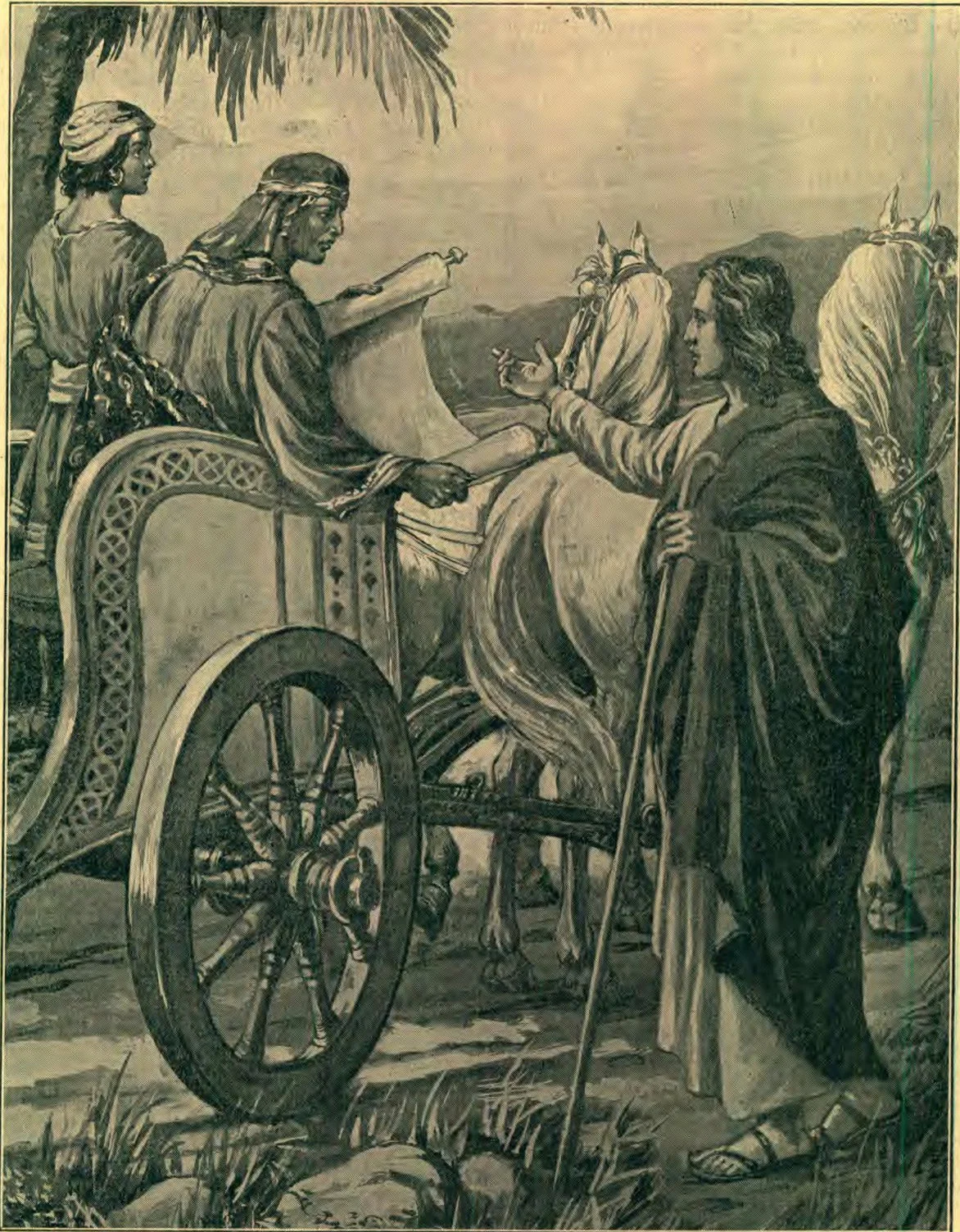
PHILIP INSTRUCTING THE EUNUCH
“Then Philip opened his mouth, and began at the same scripture, and preached unto him Jesus.” Acts 8:35.
PHILIP INSTRUCTING THE EUNUCH “Then Philip opened his mouth, and began at the same scripture, and preached unto him Jesus.” Acts 8:35.

You have reached the end of this edition.

The Youth’s Instructor · May 20, 1919