Your ShelfYour Projects

Review and Herald, Vol. 90, No. 3.

THE GALILEAN FISHERS
Earlier text: The Tithe and the Gospel

Those God-Made Men

EDW. J. URQUHART
By single act great men were never made; But conquering self in battles daily fought, And walking day by day the paths they ought, When crisis came then stood they unafraid,
While other hearts were crushed before the gale; The secret of their strength is traced to days Of patient toil in paths of duty's ways, Till stood they firm as oak within the vale.
But men guessed not the secret of their power Gained by a life of toil, of prayers, and tears, Which filled so very full the passing years— Trained thus by God to stand in tempest's hour.
And so when came the test, as tests will come, They chose the better part, while men looked on Ennobled by the deeds their hands had done, Inspired again to press toward God and home.
Thus when the day of need God's help demands, God has a man trained for the time and place, True to the trust and strengthened for the race: So comprehensive is our Father's plans.
Winton, Cal.

East Brazil Mission

We are indeed thankful to our Heavenly Father for his kind protection and his guidance in the work in our field. Looking back to the beginning of the work in this mission, we praise the Lord for what he has done. He opened one door after another for us, and we followed.
When we came to this field in April, 1910, we found eighteen believers, and no worker besides ourselves. Since that time we have gained one hundred forty-two members. Out of these we have taken natives and, with the help of the Mission Board, have developed workers. Of these developed in the field we have six canvassers, two canvassing agents, two Bible workers, and others in training for Bible work. This the Lord has wrought.
Since our canvassers’ institute last September our canvassers have done better work and have sold more books. We expect that the number of these workers will increase soon.
At present we are holding an institute for Bible workers, and at the same time doing practical work in the city of Bahia. We have studies on organization, methods of labor, and above all we study the Bible truths. One of the students has come from the state of Para, where, after accepting the truth, he worked for others, who also accepted the truth. He is now obtaining the necessary instruction, and will go back to present the message to the people living in the region of the Amazon River. Thus we are pushing forward farther to the north, until every state of Brazil will have a representative of the third angel’s message.
JOHN LIPKE.

An Outcrop of Christianity

THE readers of the REVIEW have been greatly interested and enlightened by the pen of Elder J. N. Anderson in his series of articles on missions. In speaking of China, he attributed the cause of the revolution chiefly to the influence of the missionary. In this connection I was peculiarly interested in a short article that appeared in the last issue of the Manila Times Weekly, one of our local papers. The following is a copy of it:—
“Recently, at one of the treaty ports of China, there met a leader of the republican movement that swept away the old monarchy, and a well-known American. Their talk was of the republic, the revolution that had brought it into being, and the chances of the new government in the difficulty and dangers that beset it. ‘What produced the revolution?’ asked the American. ‘The Christian missionary,’ responded the Chinese. ‘He came to give us a new religion; he gave us a new government, a new social order. His purpose was not to achieve what he did, but he is primarily and largely responsible.
“The Chinese people did not, to a large extent, accept his religion, although they have accepted many of its principles, but they did take from him the principles of his political and social life. They took his literature and its lessons. His presence, his teaching, his work, aroused the people to newer and larger realizations of life and of the world, and started the Chinese into the world. The machinery of his system helped. It taught foreign languages to many Chinese, and through those who support it in foreign countries, offered the means to hundreds of young Chinese to go abroad.
“The mission schools, hospitals, and refuges added to the spread of this new political and social knowledge among the people. The number of Chinese influenced by what the missions taught, unconsciously perhaps, of social and political science was enormous. The movement had its origin, growth, and culmination within the span of my life, and it has all passed under my eyes. I know the men who formed and fought the revolution, and I know the influences that controlled and inspired them. I repeat, the Christian missionary made the republic in China.” . . .
“Remarkable fruit is this to spring from the seeds of Christianity sown in China, but who will say that it is not good fruit? And when China shall have parted finally from the prejudices of the centuries, may not the chances of the missionary to win converts for his religious as well as his political creed be greater than before?”
E. M. ADAMS.

The Second Seventh-day Adventist Church of Detroit, Mich.

This church was organized Dec. 31, 1910, with a membership of sixteen, by Brother W. J. Owens. The present membership is twenty-two. This church has a great work before it in instructing and developing its own members, and in warning the thirty-five thousand colored persons in this city and its vicinity, to whom this final message, in all its clearness and purity, is due in this generation. Whoever will may join us and help work for the salvation of souls.
Brother Owens left this city about the middle of November, and the writer arrived here November 19, and began at once to endeavor to get hold of the work, and develop it.
Though few in number, we have had good services from the start in the church and Sabbath-school, with an interesting week of prayer, in which all the members took part, renewing their faith and courage.
There is a Help Band Society among the sisters, which is doing a good work in aiding the church. We hope to organize a Missionary Volunteer Society the first of the year. With a zeal born of Heaven, the members and friends have rallied to the church and cause by attending the meetings and bringing in tithe and offerings. The tithe for the last six weeks amounted to $123.02; Sabbath-school offerings, $12.22; church expenses, $19.94; Annual Offering, $9.55; Thirteenth Sabbath Offering (for South America), $2.65; other offerings, $4.18; total, $175.31.
The writer has had a warm reception from the leading ministers; has met several of the lawyers and doctors, and many of the people. He is devoting his afternoons and part of his evenings to giving Bible readings in the homes. Now is the time to do a judicious and most effective work in this city and its vicinity.
We were pleased to have a visit from Elder A. J. Haysmer, secretary of the North American Negro Department, Dec. 26, 1912. His remarks on “The Whole Duty of Man” were wholesome, timely, and instructive.
It should be remembered that Detroit is a great city, and that we have for it the greatest message ever entrusted to man. In order more effectively to give this truth, we need a better place of worship, and strong, pious workers whose hearts are filled with the love of the truth. We believe that the good hand of our God is with us.
W. H. GREEN.

"The International City"

Situated in the southern part of the Tartar city of Peking, just inside the great Tartar wall, is what is known as Legation Quarters. Assembled here are soldiers, sailors, and marines, representing the following nations: United States, Great Britain, Germany, France, Austria, Belgium, Italy, Japan, Holland, and Russia.
These men are brought together many times in parades, games, and pleasures, and I know if you could see them at any of these times you would be willing to do all you could for them. Perhaps your son is among the number, or perchance your brother or a friend is one of them. But aside from personal considerations, you all believe in the soon coming of our blessed Redeemer. Any one wishing to help these men will kindly send literature in any of the above tongues to the writer, who is one of them.
F. E. DARLING. United States Legation Guard, Peking, China.

Rome Determined to Rule

In the New York Times, Dec. 2, 1912, was this cable despatch:—
“BERLIN, December 1.—Germany’s twenty-four million Roman Catholics are on the threshold of a controversy with the kaiser’s government, which, according to their official spokesmen, presages a bitter renewal of Bismarck’s Kulturkampf crisis, and is pregnant with the most vital consequences to the security of Bethmann-Hollweg’s chancellorship. [Bethmann-Hollweg, the German chancellor, has died since this despatch was printed.—ED.]”
“The Roman Catholic Center party, together with the Conservatives, constitutes the only reliable parliamentary majority at the chancellor’s disposal. If the Centrists, as they now openly threaten, declare war on Bethmann-Hollweg, his position will be perilous in the extreme.
“The chancellor has promptly taken up the Catholic challenge, according to an ‘inspired’ manifesto, and an outbreak of open hostilities would seem to be imminent.
“Matters have been brought to a climax by the action of the federal council, under the leadership of Prussia, in rejecting the application of Bavaria for a more liberal interpretation of the anti-Jesuit laws. The council not only frowned upon the Bavarian government’s independent construction of the laws, but adopted a resolution which amounts to sharpening them.
“The Cologne Volks Zeitung, the official Catholic organ, and Germania, the Berlin organ, declare that the ‘Pope’s suspects in Germany will never tolerate the police régime of a Prussianized Germany, which now essays to impose upon them an anti-Jesuit propaganda, and are prepared to resort to political extremes such to annihilate it.’ The chancellor expects to address the Reichstag on Tuesday on home affairs. The Jesuit situation will figure prominently in his exposé. Meantime he is quoted by the well-informed Frankfurter Zeitung as having notified a prominent Catholic parliamentarian that ‘German patience with the dictatorial practises of the Vatican was approaching the point of exhaustion.’
“Prussian diplomatic relations with the Holy See, he affirmed, would be absolutely broken off the next time the Pope attempted to interfere with the sovereign rights of the state, as was recently the case in the encyclical relating to trade-unions.
“The chancellor warned the Catholic deputy that it was ‘the last papal intervention in the independence of interdenominational labor organizations which Prussia will tolerate.’
“It is not at all certain that Bethmann-Hollweg can unite the remainder of the Reichstag against the Catholic party. The great Radical classes oppose class legislation on principle, and have already given an indication of their readiness to join the Centrists in bringing about a repeal of the Jesuit laws.”

New Jersey

NEWARK.—About three years ago work among the Slavo-Bohemian people was started in the city of Newark. This work has been growing from the very first, and over a year ago a church was organized. To-day they have a membership of thirty-three, and eleven of these are brethren. About one third of the members are Poles, and we expect that in the near future a Polish church will be organized in this city.
About a year ago these brethren began to feel that they needed a place of worship, as it was very difficult to get halls suitable for their meetings. They began to pray and to plan for a building, and have continued to struggle and work until now they have a very neat, creditable building that will seat one hundred fifty persons. This building has been put up practically by the brethren of the church working nights and holidays. It is worth five thousand dollars, and they have been able to have it finished and furnished with an indebtedness of only sixteen hundred dollars.
Sunday, January 5, this building was dedicated to the service of God, and the brethren are happy and full of zeal to do aggressive work among their people. Truly God has been good to them, and we rejoice with them that we have such a creditable building which can be used to carry the truth to these nationalities. Elders W. H. Smith and J. G. Hanhardt, and Brother Paul Matula, who has been working for these nationalities, with the writer, conducted the dedicatory services.
The twenty-sixth of January we expect to dedicate the English church in Newark, which has been built practically in the same way that the other has been built, that is, by the brethren of the church. This building, when completed, will be worth about ten thousand dollars, and we expect to dedicate it free of debt.
We are glad for what the Lord has been doing for us here in New Jersey, and are looking forward to a year of blessing. While our people have been able to do so much for the work inside the conference, they have not forgotten their quota of the Fifteen-cent-a-week hundred seventy-two dollars more than their quota of the Fifteen-cent-a-week Fund.
A. R. SANDBORN.

Nebraska and Iowa

On Sabbath, Nov. 23, 1912, I met with the church at Blair, Nebr., where we held one meeting. A few came a long distance to meet with this little company. This was my first visit to this church, and before leaving I called on all the Sabbath-keepers in the place.
From here I went to Fort Calhoun, where I found a few faithful Sabbath-keepers. In the evening we all met at the home of Sister Sada Golds, and had a Bible reading on the power of God as manifested in the threefold message to prepare a people for the coming of Christ. We were pleased to see the interest that the children took in the Bible study.
From this place I went to Glenwood, Iowa, and spent a few pleasant hours in the homes of our people. At Red Oak we had one public meeting. I then went to Ladoga for two days, holding one public meeting in their new church. Their neat and well-arranged house of worship speaks well for the few faithful Sabbath-keepers in that place.
From here I went to Osceola, where we held two meetings on the Sabbath and one Sunday evening. The attendance was good, as the brethren of the Woodburn church and others had arranged to meet with us on the Sabbath. After the morning service, Brother C. W. Neal invited several of those with whom I had been acquainted for many years, and myself to take dinner at his home. As we sat around the long table so abundantly furnished with healthful food, the gathering seemed like old times to us who had been so long in the message; and while we talked of the coming of Christ and of the closing work on earth, our hearts were made to rejoice, and we could say, with the revelator, "Come, Lord Jesus," and come quickly.
In our work we endeavored to follow the good example of the apostle Paul in teaching the people publicly and from house to house the things that pertain to the kingdom of God. J. S. HART.

Mashonaland, South Africa

We reached Tsungwesi Mission May 30. Brother and Sister M. C. Sturdevant were glad to see us, for the work here had grown beyond the power of four hands to grasp. With one of the rooms of their house as a sleeping-room, and a hut of poles plastered with mud and roofed with thatch for a kitchen, we were made comfortable until we could build for ourselves.
After a few days’ rest, we were given work—teaching in the school, which we found not so very difficult, as English is taught to the older boys and girls, this being required by the Rhodesian government. This also gave us opportunity to learn the native language. We find we are slowly acquiring the language, for which we thank the Lord.
Brother and Sister Sturdevant have been working almost to the breaking point since opening this mission about two years ago. They realize the providence of God in giving them such an ideal location. The soil is very fertile, and the climate seems to be healthful. When we arrived, they were harvesting corn, which was as nice as any I ever saw in the States.
Between school hours we have been making brick and building our house, which is now nearly ready for use. It is built on high ground, so we get a very fine view. This is our first experience in making and laying brick. We find a missionary has to be able to turn his hand to almost everything. We shall have a good, substantial house.
At present we have about forty-five boys and girls staying at the mission, with twenty-five more coming to the day-school from their kraals. The natives are gradually turning toward us as they see that we are building on a sure foundation. We believe the Lord is going to do a good work in this place. We have a number of boys who seem to have bright minds, who we hope will develop into good teachers. We enjoy the work, and hope through the blessing of the Lord to see much fruit develop for his kingdom.
MR. AND MRS. C. L. BOWEN.

State and Church

Reports, Notes, and Comments Pertaining to the Current History of Religious Freedom, and the Campaign "to Make America Catholic."
Conducted by the Religious Liberty Association.
W. W. Prescott     -     -     -     -     SECRETARY

What the Lord's Day Alliance Is Doing

Organization and Purpose

FROM the date of its organization, Dec. 12, 1888, until June 22, 1909, this association was known as the American Sabbath Union. Since 1909 it has been called the Lord's Day Alliance of the United States. The work and purposes of this alliance may be seen from the following brief statements taken from a letter sent (1909) to every Sunday-school superintendent in the United States:—
“For twenty-one years the American Sabbath Union, indorsed by fourteen of the great denominations of America, has been laboring in defense of the sabbath [Sunday]. To meet present conditions, its constitution has been amended and its name changed to the Lord's Day Alliance of the United States. But the basis of the organization remains as from the beginning.
“The various forms of sabbath desecration as they exist in the usages of the individuals and corporations who profit by them, are here to stay, and stay they will unless Christian people join strength to strength to put them down.”
In order to carry out their plan, the leaders of this organization are seeking for “uniform Lord's day laws.” In a circular recently published, their objects are stated as, “(1) To preserve the Lord's day for America; (2) to secure an active alliance in every State not yet organized; (3) to induce the general government as far as possible to set the example of sabbath observance.”

Working for a National Sunday Law

Dec. 13, 1888, a public hearing was held before the Committee of Education and Labor, of the United States Senate, on the bill (S. 2983) entitled “a bill to secure to the people the enjoyment of the first day of the week commonly known as the Lord's day, as a day of rest, and to promote its observance as a day of religious worship,” known as the Blair National Sunday Rest Bill. As stated by one of its promoters, “the reason why such a law was desired was because nearly every State has its sabbath laws, but the national government has none, though greatly needed, since the question has become emphatically a national one, and the very perpetuity or loss of our national rest day, the Christian sabbath, seems to depend on its being protected by the government from its encroachments of organized capital and on the reenforcement of State laws by national.”
The American Sabbath Union was at that very time holding its first national convention. The founders and leaders in this organization being among the chief promoters of the bill already referred to, many of them were at the hearing, and did all they could to secure its passage. But the bill failed of passage. It did not even get out of committee. Ever since that time, however, this union has been working with increasing vigor in the interests of religious legislation, its chief object seeming ever to be to secure national Sunday legislation.

Closing of Exposition Gates on Sunday

Just before the Chicago World's Fair, in 1893, when Congress was considering an appropriation for this exposition, this union, in company with other like organizations, succeeded in getting a Sunday-closing clause inserted into the appropriation bill. This proviso made the closing of the gates of the fair obligatory upon acceptance of the appropriation. By strenuous lobbying at our national Capitol, Sunday-closing clauses were also incorporated in the appropriation bills for the St. Louis and Jamestown expositions of 1904 and 1907. The accomplishment of these undertakings was deemed great victories for the cause of so-called sabbath reform.
But the securing of legislation for the mere closing of the gates of these expositions for a little season did not go very far toward satisfying the demand for a permanent national Sunday law that would touch every individual and corporation in this nation. For several years the Lord's Day Alliance has been spending its energies in building up State alliances, protesting against Sunday sports and amusements, fighting the efforts to repeal obnoxious Sunday laws, threatening officials who refused to enforce religious laws, seeking the enactment of new legislation, and various other matters of like character.

Sunday Closing of Post-Offices

A few years ago the question of reducing Sunday labor in post-offices came up. This was almost immediately espoused by the alliance. The champions of Sunday legislation saw here a vast field for operation. By embracing the Sunday-closing-of-post-offices cause, a large army of government employees could thus be drawn to their standard. This is enthusiastically explained by the secretary of the alliance in his twenty-first annual report (page 5): “We feel that it is an achievement of great significance that we have for the first time in the history of sabbath reform work, secured the cooperation of a national branch of organized labor to stand with the churches in defense of the Christian rest day.”
At first only a compensatory law was sought; that is, should any clerk in the postal service be obliged to labor on Sunday, he should be given another day off during the following week. While many of those laboring to keep the government from becoming involved in religious legislation, did not recognize the danger wrapped up in this, it was appreciated and lauded by its champions as a long step toward their object. Said Mr. Grannis: “In January [1911] Congress passed the compensatory rest-time bill and squarely committed itself to the Sunday-closing movement.”
The Lord's Day Alliance at once realized the vantage-ground it had gained, and purposed to follow it up. In commenting upon this compensatory law, Mr. Grannis further said: “We feel confident that victory will soon be complete. But we must still move forward. What has been gained must be crystallized into a definite law. A bill to this end has already been introduced by Mr. Mann, of Illinois.” And, as is well known, Mr. Mann's bill passed, closing to the general public all first- and second-class post-offices in the United States on Sunday.

The Latest Effort to Secure a Sunday Law

No doubt encouraged by the success in securing the passage of the post-office Sunday-closing bill, the alliance has now turned its attention to the District of Columbia Sunday measures. There are pending in Congress at the present time three District Sunday bills. These are the Johnston bill (S. 237), Heflin bill (H. R. 14690), and the Howard bill (H. R. 25682).
There has recently come to the attention of the writer, from an official source, information that lays bare the plan which will probably be followed in regard to these Sunday bills. To make its efforts as effective as possible, the alliance has arranged to introduce a new bill as a substitute for the three already in Congress. All the forces it can command will then be concentrated upon this one measure.
As indicated in its title, this bill would “punish violations of the Lord's day in the District of Columbia.” It makes no exemptions, except for those engaged in work of necessity and charity; and provides for a punishment by a “fine of not less than twenty-five dollars nor more than fifty dollars for the first offense, and for each subsequent offense by a fine of not less than fifty dollars nor more than one hundred dollars and by imprisonment in the jail of the District of Columbia for a period of not less than one month nor more than three months, in the discretion of the court.”
Another opportunity will thus be offered for the friends of civil and religious freedom to make their influence felt. This can be done by petitioning their congressmen against the passage of any such measure.
C. E. HOLMES.

The Papal Divorce Court

WHILE the Papacy denounces divorces sanctioned by civil authority, the Roman Catholic Church by its ecclesiastical decree is really a universal divorce court. The flimsy grounds upon which separations are granted would not be recognized in Reno. There is no State of the American Union with divorce laws so loose that a marriage can be annulled upon such grounds as in the case of Tremblay versus Despatie, which has just been decided by the court of review in the province of Quebec. Napoleon Tremblay was married to Malvena Despatie on Oct. 25, 1904. After they had lived together for eight years he discovered that one hundred years ago the progenitors of himself and his wife were first cousins. He traced their lineage to the present day, and was able to adduce evidence to show that the woman whom he had married was his fourth cousin. They were both ignorant of this fact at the time of their marriage. It could be remedied to-day by the payment of five dollars for a dispensation. But the husband wanted to get rid of his wife, so he refused to pay the five dollars, and demanded as a right the annulment of his marriage. This was given to him upon the ground that the marriage of fourth cousins is prohibited by the laws of the Roman Catholic Church in Quebec. And what is more deplorable, the civil courts of that province have just confirmed the decision of the ecclesiastical court.
We shall carry the judgment of our readers when we say that no divorce court in the world would enable a man to escape the obligations which he assumed at marriage and to cast his wife adrift upon such a plea as that which has been successful in the tribunal of a church which claims to be the chief defense of the sanctity of the home.—The Sentinel, Toronto, Dec. 12, 1912.

The Industrial Feature in Mission Schools
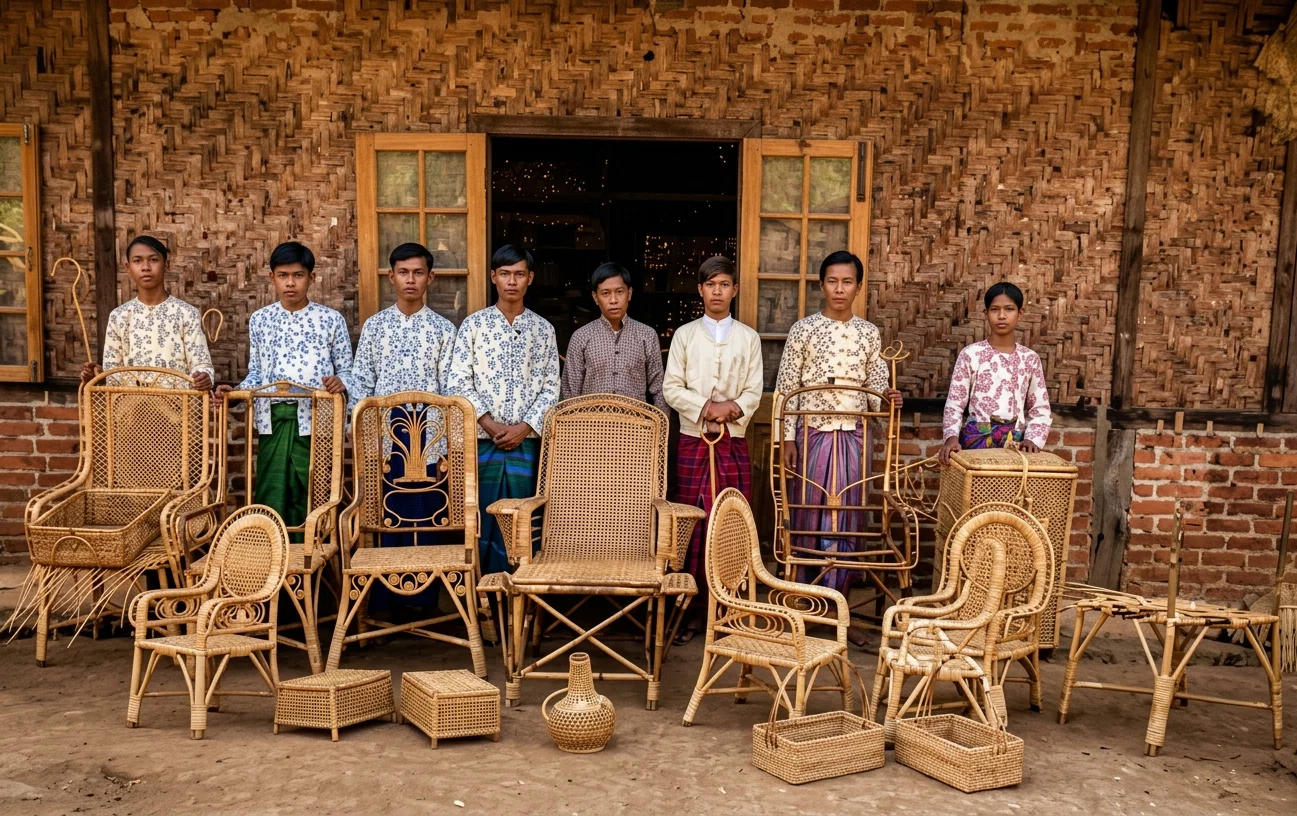
[This article was read at the biennial meeting of the India Union Mission. The accompanying illustration is one of the industrial classes at the school in Burma.—H. R. S.]
Here in the East industry suggests work, and work suggests a coolie, and a coolie suggests disgrace. Our great problem is how to show the people that industry and work are not synonymous with toil and drudgery, to show that the hand connected with the brain will do greater wonders than either working alone, and that labor is a great uplift toward a better life.
Two boys are removing some earth. One of them, after being compelled to throw aside his basket, which he fills with his hands and carries pressed against his chest, takes pick, shovel, and wheelbarrow. He allows mud to accumulate at the end of his shovel, and pushes and strains with both hands at the end of the handle. He gives a blow with the pick from the height of a foot above the ground. He puts his load near the handles of the barrow, and trundles it away to the tune of a whining wheel. That is toil. He is a coolie—a servant to his work. The other boy keeps his tools sharp, so that he will not have to “put to more strength.” His wheel is oiled, and he makes it carry the load. He swings the pick from over his head with the aid of his body, and gets a knee-push on the shovel handle. It need not be added that he moves twice as much material as his companion, with the same effort. That is work. He is a master workman—master of his work. We teach it is no disgrace to start as a coolie, but that it is so to remain one.
Vocational training in connection with schools for the development of the mind is now conceded by all leading educators to be a great good. The industrial phase of education has passed the experimental stage, at least in the West. Also the training of the hand has been added to the curriculum of many mission schools, and has been taught for a number of years with varying degrees of success. Coming closer to our own interests, Seventh-day Adventist missions, especially in Africa, have achieved remarkable results in this mode of education. Their industries have been largely confined to farming and dairying. In Burma we have started a school unique in many ways, chief among which is the fact that it depends very largely on a non-Adventist constituency for its support, and is engaging in wood, cane, and leather-working trades.
There is no school like it in this field, in that there is no Adventist school like it; for our work demands a different school than any other work. It is an experiment yet and a new thing, and therefore is in danger of being a wrong thing. Danger, I say, but so far our experience has proved no likelihood of its being wrong.
We need to make progress prayerfully. To an industrial school success means industrial and financial benefits; to a mission industrial school success means that and social and moral uplift added; to a Seventh-day Adventist mission industrial school success means all this, and in addition, saving souls for eternal life.
We have the boys now, but n-u-m-b-e-r-s does not spell success with us. We have received more donations from outsiders than is usual here in the East, but m-o-n-e-y does not come any nearer spelling success. Our achievements must be in soul-saving; and the trades are really successful only to the degree that they are conducive to that end. Our greatest danger lies in letting business get the upper hand. The school shows some lessons learned, but chiefly problems to be solved. While material additions to our facilities for work are greatly needed, we realize after all that our problems will be solved best by adding hard work, patience, and love together; by subtracting worry from business; by multiplying prayer by faith; and dividing responsibility by individual effort.
I shall state a few of our lessons which have not yet attained the growth of successes. Of nearly every Burmese boy who came to us, we found that he and work had had trouble and parted. So we hold out a place in the trades as a prize to be gained, and are not quick to accept a boy till he proves his worth. We do not urge lazy boys to work. We talk of the joys of work, and have work done before them. We have found that our boys want to learn all the trades we teach. We say they may, but one at a time. They do not reach a second. The boys will not stick to a trade long enough to learn, so we require a deposit at the beginning, which is not returned unless they stay by. The boys are not anxious to learn trades unless they get money for the work, so we pay them two pice an hour at first when they earn nothing, and later one anna an hour when they earn two annas. They understand the scheme, but prefer it to working for a time with nothing but skill for pay. We find the boys work better if they get the cash in hand and pay it back for their expenses, instead of having it applied on their account and never seeing it. So we do as they prefer.
MEIKTILA INDUSTRIAL SCHOOL
We have found it difficult to procure suitable manual teachers; and not being able to get even Christian mechanics, we have been only fairly successful in getting good morals, skilled workmanship, and teaching ability. We find also that our men are not very willing to teach their trades to Burmans, by whose ignorance they now profit. We must battle against indifference in both teacher and pupil.
As yet the trades do not pay as business propositions. Each department just about pays for cost of materials and wages of the teacher and boys. However, we have every reason to believe that with more room, facilities, and help, we can make the trades fully support themselves and add a little to the running expenses of the school. It is obvious that with our expenses and standard of work we can not successfully compete with the cheap labor which is done all around us. Our only chance to rival others in business is to pay boys less wage than men doing the same work, and to make something different. So we are specializing on mission furniture, shoes made on American lasts, and cane furniture after the Chinese patterns.
But what has industrial work to do with the salvation of souls?—Much in many ways. It enables us to get boys under our influence who would not otherwise come to a mission school. It occupies the time and interest of the boy who is inclined to go wrong. It gives boys better health, so that their minds are clear to comprehend truth and their hearts open to accept it. It uses strength that would otherwise be lost as a result of bad habits. It disciplines the boy, and saves the teacher that unpleasant task. It teaches habits of order, and “order is heaven’s first law.”
But experience speaks most emphatically, and ours has been that. Other conditions being equal, the boy who works with his hands and head at the same time is the most orderly, obedient, clear-headed, healthy, and susceptible to religious influences. The One who said, “In the sweat of thy face shalt thou eat bread,” and whose own Son was apprenticed to a carpenter, has not at this late day subtracted aught from the abundant blessings of the manual arts.
R. B. THURBER.

Christian Education

Conducted by the Department of Education of the General Conference
H. R. SALISBURY                     Secretary
Continue reading: News and Miscellany