Egyptian Cotton and Cairo Street at Atlanta Exposition
Page 1
The Youth’s Instructor
Jun 6, 1895
S. D. A. Publishing Association · Battle Creek, Mich. · Jun 6, 1895
Egyptian Cotton and Cairo Street at Atlanta Exposition
Mr. Frank Weldon, of the editorial staff of the Atlanta Constitution, is in correspondence with Osman Pasha Maher, a member of the royal land commission of Egypt, with a view to securing an exhibit of the cotton-raising industry of that country at the Cotton States and International Exposition. Cotton-picking begins there in September, and it is proposed to have some of the first of the crop prepared and shipped immediately. This will reach Atlanta in October. The cotton industry of Egypt may be further illustrated by pictures and models in plaster of the cotton plantations and laborers, and by models of the machinery used in preparing the cotton for market. This will be interesting to cotton-planters, the Egyptian methods being unlike those of other countries.
The famous Cairo Street of the World’s Fair will be seen at the Cotton States and International Exposition. A concession was granted during the past week to Mr. George Pangalo, who had the concession for Cairo Street at Chicago. Every one who was at Paris or at Chicago will remember Cairo Street. It was one of the most attractive features of the Plaisance. Mr. Pangalo will reproduce the same street at Atlanta, with such improvements as past experience has suggested. It is his idea to occupy somewhat less space at Atlanta, but to increase the number of features, in this way making the exhibition at once more condensed and more attractive. It is safe to say that the camels and the Arabs, the temples and the theaters, the oriental booths and the marriage processions, will prove as great attractions at Atlanta as they have wherever heretofore put upon exhibition.
THE NEW SOUTH.
By Rodney S. Owen
It is now more than thirty years since the Confederacy of the Southern States was laid prostrate in the dust by the terrible devastations of the great civil war. The southern people were then left in a most deplorable condition. Nearly every available man and boy from the age of fifteen to that of sixty had been pressed into service, and they had fought through privations and sufferings for a cause which they thought to be just, until the resources of the country were completely exhausted; and when the remnant of the defeated army came home from the fruitless struggle, they were weary and worn, without food, poorly clad, and their money worthless. None but those who passed through that experience can fully realize the desolate condition of the South at the close of that terrible war.
Then it was that the new South began the work of reconstruction and development. It was not long after the smoke of the last battle had cleared away before the hum of industry and the sweet songs of peace began to be heard in the land, and the signs of new life and enterprise began to appear. Cities and towns that had been laid waste began to be rebuilt, great plantations were cut up into smaller farms, and cottages are gradually taking the place of the mansions of the rich and the cabins of the slave.
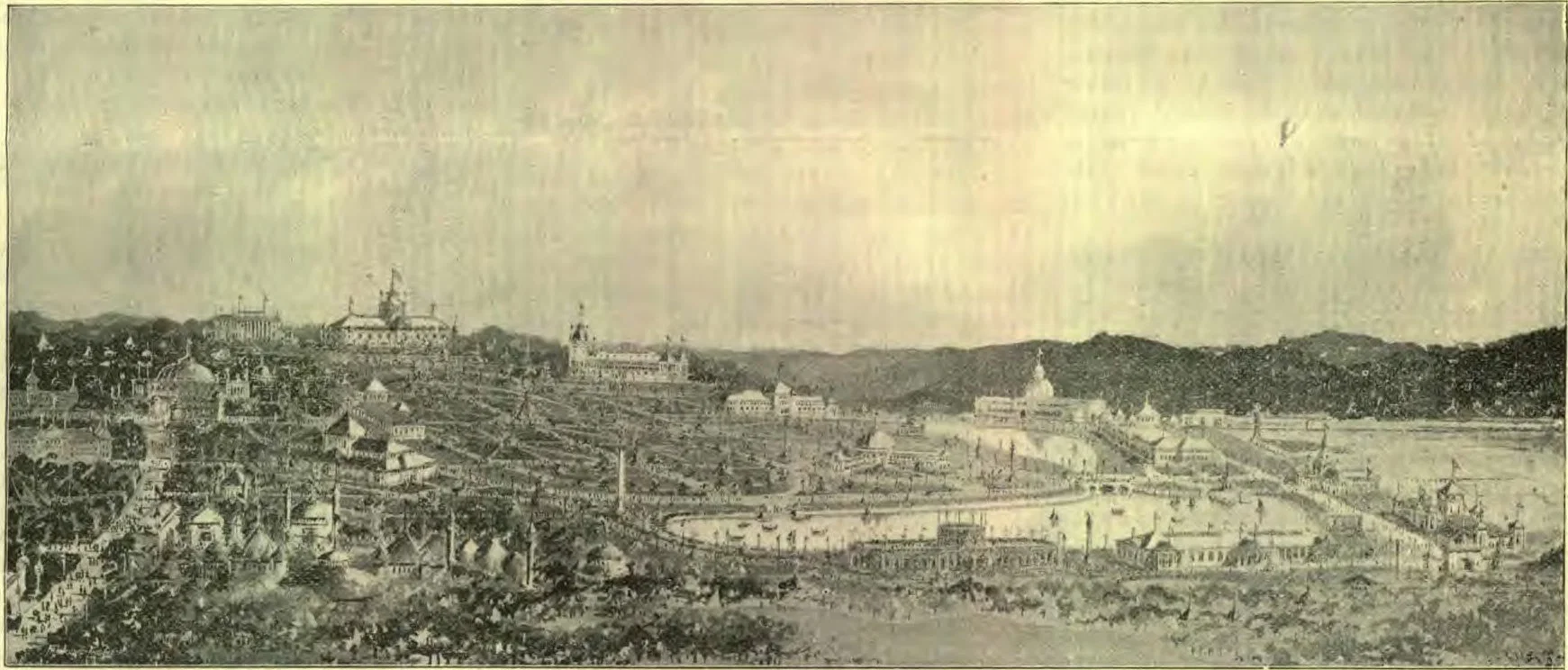
BIRD'S-EYE VIEW OF THE COTTON STATES AND INTERNATIONAL EXPOSITION.
After these thirty years, in which a new generation has grown to be the bone and sinew of the country, the world is to be invited to come to visit the sunny South, and view the achievements of this people, that it may render its own verdict as to whether or not the new South has done honor to itself in what has been accomplished. For this purpose the Cotton States and International Exposition will be held in Atlanta, Georgia, Sept. 18 to Dec. 31, 1895. It seems peculiarly fitting that Atlanta should be the place for this exposition. It was here that the desolation of the war was most keenly felt, and here the pulsations of the new life in the South have been the most active. Of nearly four thousand houses in Atlanta before its destruction, only four hundred were left standing at the close of the siege, and many of these were racked and shattered by the shells of the contending armies. From these smoldering ruins Atlanta has risen to a city of one hundred and eight thousand people. Its magnificent structures, both public buildings and private residences, are the pride of the South. It has sixty miles of paved streets and one hundred miles of electric railway; while ten lines of railway centering here extend to all quarters of the continent. RODNEY S. OWEN.
LOSS AND GAIN.
By Mrs. M. A. Holt
We often find that loss
Is priceless gain,
Which hides, like clinging moss,
The gold's bright grain.
We often find that gain
Is deepest loss,
And leaves a fadeless stain
And worthless dross.
And so we may not choose,
But fully trust
In God, who only knows
The gold from dust.
— Mrs. M. A. Holt.
EARLY EXPLORERS.
By Loretta Reisman
About two hundred and fifty years ago a youth called La Salle,—but whose real name was Robert Cavelier,—belonging to a wealthy family in France, gave up studying for the Catholic priesthood, and came to America, the new country. There were but few white people here then, but many Indian tribes held sway. He went to Montreal, Canada, where he had a brother, a Jesuit missionary. That was a small fort, where the Indians came to trade and be instructed. The first winter La Salle spent learning Indian languages and making friends with the Indians. They told him of a great river far to the west, whose valley was very fertile, and where they raised maize. They said it was much warmer in that river valley, and that deer, bear, and buffalo had their haunts there. Beautiful swans and birds of all descriptions made their homes there also, they declared.
The Jesuit missionaries at the fort became jealous of La Salle because he had so much influence among the Indians, and treated him badly; and as the climate there was so cold, La Salle decided to start out to find this beautiful valley and river described by the Indians. He took a few Indians along as guides and interpreters.
He had already formed the design of planting colonies in this valley along the river, and building up a new kingdom for the king of France. He did not know, but thought the river must empty into the ocean, so it would be necessary to build a fort at the mouth, and also at intervals along the river to protect it from the English and Spaniards. He built a fort on the northeast coast of Lake Ontario, and called it Frontenac. Here he left Father Hennepin in charge, while he himself went to France to get the king’s permission to explore and settle the valley with French people. He also needed money and supplies to carry out his scheme.
The king granted him the right he sought for, and his friends and relatives lent him money. He engaged ship carpenters, procured iron, cordage, and anchors for two vessels. He was introduced to a brave Italian officer named Tonti, who returned with him, and proved a valuable and trustworthy assistant. They reached Frontenac, and from there La Salle sent Hennepin and Lamotte with a party up the lakes in canoes, to find a suitable place for a fort, and where they could get timber to build their boat. They reached the Niagara River and falls. They then had to carry their freight twelve miles up above the falls, where they intended to build a fort and their boat. The Indians were very suspicious of them, and it was not safe to go ahead with the work until La Salle and Tonti, with their party, arrived and mollified the Indians with presents of hatchets, beads, and blankets, of which he always carried a supply for such purposes.
As they proceeded with the building of the ship, the Indians became very jealous. They had never seen such a monster boat, and their canoes seemed very insignificant beside it. They tried to burn it, but by constant watchfulness it was preserved, finished, and finally launched. It was named the “Griffin,” and was the first boat ever seen on Lake Erie.
La Salle sent parties on ahead up the lakes to trade for furs with the Indians, and prepare for his coming with the ship. Some of the men ran off with his goods; but when he reached Michilimackinac, he found some trusty ones left, who had collected quite a store of furs. He then sent the vessel back with the furs, and he with others proceeded in canoes; and that was the last time La Salle ever saw the “Griffin.” The pilot was an enemy to La Salle, and it is believed he wrecked her purposely.
La Salle and his men were overtaken by a storm, and suffered many hardships. When they landed, they were exposed to treacherous Indians. Finally they reached what is now called the St. Joseph River, in Michigan. Here they waited a long time for Tonti, who had been sent to Michilimackinac after some men who had squandered and stolen goods. When he arrived, they embarked in their canoes and ascended the river, looking for the Indian trail across to the Illinois River, for they wanted to go to a village of the Illinois Indians situated on that river. But the Indian guide was hunting in the woods, and they missed the trail, and had to return a long way. Then they shouldered their canoes and started across, finally coming to a sluggish branch upon which they again set their canoes, and rowed down to the Indian village of the Illinois. They found it deserted, as the Indians had gone off on their winter hunt. The adventurers found some covered pits of corn, however, and took some, La Salle intending to pay them on their return.
On the opposite side of the river was a lofty cliff, one hundred and twenty-five feet high. Once some Indians who had taken refuge there from a warlike tribe, had starved to death, so it was called “Starved Rock.” The party landed at the lower part of the Illinois River, and built another fort, which was the first attempt to settle in what came to be the State of Illinois. From there he sent Father Hennepin to explore the river to its mouth, and left Tonti “to hold the fort,” while he with others returned to Canada for more help. As they passed Starved Rock, he examined it, and sent word to Tonti to build a fort on it.
It was winter, and the party often had to wade through water, and drag their boats; and just as La Salle was returning, a messenger brought a letter from Tonti, saying that the men had deserted the fort, but had first destroyed it, and thrown everything into the river. They had been joined by the men at Michilimackinac and Niagara, and had plundered all the forts. But La Salle lost no time in lamentation; he began the work afresh. He took twenty-five men,—carpenters, joiners, masons, soldiers, and laborers,—and started again for the Illinois. Tonti and his party had started out to return, but were hindered by treacherous Indians. They passed the site now occupied by Chicago on their way up the lakes. It was very cold, and they had to grub up wild onions to keep themselves from starving. They met La Salle at Michilimackinac. This time they crossed Lake Michigan in canoes to the Chicago River, and then made sledges to transport their baggage and canoes to the head waters of the Illinois. They then rowed down to the Mississippi River, and on till they reached its mouth.
La Salle was very deeply in debt, and his creditors pressed him severely; but his courage never faltered. He went again to France, where the king fitted out three ships with colonists and provisions. They set sail, and in a few months landed far to the west of the mouth of the Mississippi, as they did not know just where it was. In time their provisions failed, the colonists died of disease or homesickness, and the forts were abandoned. The brave La Salle was treacherously killed. LORETTA REISMAN.
Montreal's Beautiful Location in Canada
THERE is no city in North America that has a more beautiful location than Montreal, Canada.
FIRE ISLAND’S NEW LIGHT.
“THE most powerful light in the world is now being set up on Fire Island, off New York City,” said an officer of the lighthouse board lately, to a writer for the Washington Star. “It will be ready for business by July 1 next. To ships it will be visible one hundred miles out at sea. I do not mean that the light itself will be seen at that distance, for that would be impossible, owing to the curvature of the earth; but the flash on the clouds in the sky will be discerned. In other words, from the point of view of the watchful skipper an intermittent glare will be observed, as if lightning were to show in the same quarter of the heavens at regular intervals of five seconds. Passengers on transatlantic steamers will thus receive a cheering signal of their approach to America.”
“The light will be electric, having a power of fifty million candles, without the lens. The lens, which was made in Paris, is of enormous size—about ten feet in diameter. It will increase the power to two hundred and fifty million candles. It is called a bivalve lens, being in two halves, like the shells of an oyster. The convex halves are separated by a distance sufficient to admit the body of a man, so that the carbons and other apparatus between them may be got at. This double lens, and the whole mechanical contrivance supporting it, rests in a circular trough filled with mercury. In fact, its entire weight rests upon the liquid quicksilver, so that it may be revolved almost without friction. Ordinarily, brass wheels are used for revolving lights in lighthouses.”
“The light is generated by enormously powerful dynamos. Of the latter there are two, so that in case one breaks down, the other may be used. It is a subject of regret to us that the lighthouse board is still obliged to maintain the electric light in Liberty’s torch in the harbor of New York. It is of no use worth mentioning to the mariners, and it costs six thousand dollars a year. It used to cost ten thousand dollars per annum, but we have cut off the electric searchlights, which formerly were allowed to throw a light upon the statue, and illuminate it. Liberty might be of some value for lighthouse purposes if she had been placed on the Roman Shoals, which would have afforded a more suitable location.”—The Week’s Current.
A WORLD’S FAIR IN 1896.
The Exhibition of Industries and Fine Arts which will be opened April 2, 1896, near the castle of Chapultepec, City of Mexico, will be of special interest to Americans. Under the enlightened rule of President Diaz, Mexico has had an opportunity to cultivate her great resources, and is now in a position to look for purchasers of her products, and to bid for the articles she requires. She needs agricultural and mining machinery, printing-presses, pianos, and canned goods, as well as thousands of other articles the United States can supply in return for minerals, cereals, fruits, and coffee. Important inducements are offered to exhibitors. California, Oregon, Nebraska, Kentucky, and Iowa have already appointed State commissioners to look after their interests.—Scientific American.
IN BEHALF OF THE NUNS.
The practice so common among Catholics of shutting up young women in convents, has, at different times, attracted the attention of those who recognize the great evil of so doing, and who wish to prevent its continuance. Of course the majority of those who enter these retreats do so of their own free will, urged on by the priests, who paint in lively colors the beauties of convent life, and impelled by a mistaken sense of duty; yet it is unquestionably true that there are very many of these self-imprisoned unfortunates, who, when the novelty of their seclusion has worn off, and the first strong impulses of their faith or fanaticism have abated, feel an irresistible longing to escape from this bondage of body and mind; but through fear of their superiors, and also by the dread of the punishment which they have been taught to believe God will inflict upon them, they bear the dull torture of their aimless and hopeless lives year after year, until death, their best friend, relieves them of the burden of a life which has long been intolerable.
It is in view of such cases that a late convention of Christian Endeavorers, at Sedalia, Mo., passed a resolution calling attention to the fact that in various places in the State “helpless girls and women had been illegally, cruelly, and without due process of law deprived of their liberty, and held indefinitely in a condition of slavery in prison houses not recognized by the laws of the land; namely, nunneries, convents, and other institutions of like nature, from which they cannot be released by existing laws, except by expensive litigation.” The convention prayed the governor of Missouri to recommend such legislation as would prevent the forcible detention of any woman or girl in such institutions.
The power and influence of the Catholic Church is so great that it is not likely that the governor will pay any attention to it. If he is a politician, he certainly will not. No politician does anything by which he may possibly lose a vote, unless by so doing he will gain more votes than he loses. Even what are called the platforms of our great political parties might better be styled political fly-traps; for they are arranged more with the idea of catching votes than as an exposition and statement of principles. So if escaped nuns shall be dragged back into captivity, as has sometimes been reported in the newspapers, little attention will be paid to the fact by the men who hold the offices in State or national affairs, or who hope to do so, for fear of losing the Catholic vote, which, as it is usually cast solid at the direction of the priests, decides the elections in a greater degree than is generally suspected.
No law can be formed, nor should be, to prevent young women of thirty years of age from entering a convent if they desire to do so. If at such an age they wish to shut themselves up for life from a sense of religious duty, they should have the privilege of doing it, unwise though it may be; but it does seem as if young and impressionable girls should be protected from undue influence in that direction, and that there should be some means of ascertaining whether those who have entered this life are forcibly detained against their will; and if they are, a way should be provided for their speedy release and protection from persecution afterward. This is from the civil-government standpoint, that the rights of all people shall be maintained.
Rome always resents with great indignation any and every hint or suggestion that her nuns, or “religieuses,” as she calls them, are not perfectly happy and holy; but governmental inspection of nunneries in Italy has cast a doubt that either of these qualities is in all cases maintained. Governmental inspection and regulation of nunneries is probably an impossibility, in this country, for reasons already assigned; but there is One who has seen all the wickedness practised in those secret corridors; all the heartaches and the unspeakable anguish have been noted; and it will all come in to the great examination, when God will render to every one according to his works.
The Utah Constitutional Convention.
The convention which has been sitting for some weeks past in Salt Lake City, Utah, engaged in framing a constitution for that prospective State, finished its work May 8, and by a unanimous vote indorsed the work accomplished; and the president of the convention and the delegates affixed their signatures to the document which they had prepared. Thus, when the people of Utah shall have ratified the work of this convention, they will have done all that they can do to form a State; the president of the United States must do the rest. If he approves the work they have done, Utah will come into the sisterhood of States. The constitution which has been adopted is said to be similar to those of California, Montana, and other States of the West. One feature of it is the smallness of the salary which the officers of the State will receive, the governor receiving only two thousand dollars a year.
The most remarkable thing about the constitution is its provision against polygamy, or plural marriages. This is distinctively forbidden. No other State has such a clause, but it was well known that without such a provision no president of the United States would consent to the statehood of Utah. The larger portion of the delegates were Mormons, as was the president of the convention. The constitution will be submitted to the people of Utah, and there is no question but that it will be ratified by a strong majority. Whether the provisions made against polygamy were made in good faith and will be respected by Mormons after Utah becomes a State, will be seen later. Much fear is expressed by the Gentile element of Utah and by Protestant ministers that when statehood is secured, the Mormons will control the State. But if the majority of the people of any State are of one religion, it must be expected that the people of that faith will hold the majority of the offices. There is no greater likelihood that the Mormons will control Utah than there is that the Roman Catholics will control New York or Louisiana. The majority of the people of a State have a right to rule in civil things; a good constitution will prevent their ruling in religious matters.
By this constitution woman suffrage is fully established in Utah. The Mormons were all in favor of this. Like every other religion, the Mormon religion finds its strongest devotees among its women. Even in regard to polygamy, there is reason to believe that the Mormon women would, with few exceptions, have voted for it, had the opportunity been given them. When religious faith will lead some women to immure themselves in convents, we need not be surprised that others will accept the position of plural wives. One position is no more repugnant to nature, reason, and revelation than the other. The people of Utah have made a great fight for statehood; their desires now seem to be in a fair way of realization. It is to be hoped that the constitution which they have formed will conserve the liberties of all the people, and that it will be respected in all its provisions.
END OF THE INCOME TAX.
THE income-tax law, which was a creation of the last Congress, and whose constitutionality has been a matter of discussion, has at last been entirely annulled by a decision of the United States Supreme Court. Reference has been made before in these columns to the divided condition of the court at the time of a previous sitting. May 20 what is apparently a final decision was handed down by Chief Justice Fuller, in which the whole law was declared to be unconstitutional, and therefore void. Four of the justices sustain Justice Fuller, and four dissent; so the court stood four against five. Justice Fuller held that it was a direct tax, and that the general government has no right to levy a tax of that nature until the States, upon application, had refused the sum required of them. There are two constitutional ways of governmental raising of money,—one by direct taxation, the other by duties on imports and excises. The first is to be used by the States, the last by the general government. When the federal government needs more money than it can procure by duties and excises, it can appeal to the States to raise sums according to their representation in Congress. This was not done, but the government attempted to raise money by a direct tax upon such people in the States as had an income of four thousand dollars per annum.
Justice Harlan, especially, delivered a very vigorous dissent. He and Justice White both declared that very grave consequences might follow the destruction of the law. Justice Jackson sided with the minority; Justice Shiras had changed his mind, and supported the chief justice. About eighty thousand dollars have been raised by this means, which will have to be refunded. The officials to whom the collection of the tax was committed have received directions to send to Washington, under seal, all their papers, documents, and records.
Exit the income tax!
Behring Sea Seal Fishery Regulations Strain US-British Relations
By M. E. K.
THERE is an opportunity for serious difference between the United States and Great Britain on the regulations growing out of the Paris decision in regard to the Behring seal fishery. The object of both nations is to prevent poaching. Each nation formulates its own regulations to enforce the decision. Last year both countries held that the possession of fire-arms by a ship was an evidence that she was a poacher. Under that regulation, Canadian vessels were seized and confiscated. Now England holds that seal-skins found on a ship, or blood as evidence of the slaughter, will be necessary as a proof sufficient for confiscation. The United States regulations are unchanged. Now the question is, Will England permit United States revenue cutters to seize and confiscate vessels upon what the United States considers evidence, but upon what she does not hold to be evidence? The Behring Sea question has been a source of much irritation between this country and England for many years, and it should be permanently settled in some way. M. E. K.
HOW SHALL WE LABOR FOR OTHERS?
By J. H. D.
OUR YOUNG PEOPLE AND THE CAMP-MEETINGS.—NO. 3.
HOW SHALL WE LABOR FOR OTHERS?
In our last we were speaking of a class of young people who are taken up with pleasure at our camp-meetings. What can the young Christian do for them?
If you manifest an interest in their foolish conversation, and are off to the city, lakes, or on the street-cars with them, thus showing you have no more sacred view of the meetings than they, you need not waste your time talking to them about giving their hearts to the Lord. They will think, if they do not say it, that they have as much religion as you have. If you have the courting spirit, and are seen much of the time with one of the opposite sex, you cannot be a laborer for the world-loving ones.
If you want to win souls to Christ, you must be in earnest. You will have no time to idle away. You have not come to camp-meeting to keep company with any young lady or gentleman. You have come to work. You have the burden of souls upon you, and cannot let a moment go to waste. You find so much to do that you are constantly employed in laboring for those who need help and have confidence in you, that you know how to lead them to Christ because you have been there yourself.
In the young peoples’ meetings you will be found always ready to engage in work. Your deportment on the ground will be such that you will be respected and welcomed by those who feel their need of help. Such a worker shows in his very countenance that he is acquainted with the Lord.
But how sad it is to plan for some young man or woman to engage in work, and about the first time they come into the meeting, they are coupled up with some one of the opposite sex! Wherever you see them, they are engaged in something more interesting to themselves than to the cause of God. You cannot trust such people. They are no help, because they are in a worse condition than those who make no profession at all.
Young man or woman, do you expect to attend the camp-meeting this year? I hope you will. Are you going for the purpose of receiving help, or are you going to gratify self? I trust the former is your motive. Go with the determination to do some good. Go to be an example of what a young Christian should be. Go to win others,—not to yourself, but to Christ. Be in earnest, and the Lord will make you useful. J. H. D.
SALVATION IN THE WORD.
By M. E. K.
To Timothy, his “own son in the faith,” the apostle Paul expresses himself in these words: “Take heed unto thyself, and unto the doctrine; continue in them: for in doing this thou shalt both save thyself, and them that hear thee.” 1 Tim. 4:16. The line of thought evidently begins in the thirteenth verse: “Till I come, give attendance to reading, to exhortation, to doctrine. Neglect not the gift that is in thee, which was given thee by prophecy, with the laying on of the hands of the presbytery. Meditate upon these things; give thyself wholly to them; that thy profiting may appear to all.” Reading, exhortation, doctrine, are the things to which Paul would direct the mind of his most faithful disciple. By reading is evidently meant the study of the Holy Scriptures. Timothy was a student of the word of God. “From a child” he had “known the Holy Scriptures,” which Paul assured him were able to make him “wise unto salvation.” The great source of wisdom was open to him, and the Spirit of God was his to help him to understand the word, as it is for every one who earnestly desires to know the will of God, that he may do it.
In that word he was to find the doctrine. He was not to find it in the notes, commentaries, glossaries, or opinions of even the wisest and the best of men; but he was to find it in the word itself. “Thy word is a lamp unto my feet, and a light unto my path.” What was the right way for Timothy is the right way for every one. “All Scripture is given by inspiration of God, and is profitable for doctrine.” Do we want doctrine,—true doctrine,—a doctrine free from the errors, mistakes, foolishness, and foibles of men? The Scriptures are the place to look for such doctrine. There an abundant supply can be found.
Having studied the Scriptures and become wise unto salvation, what is Timothy next to do? Was he to be idle, and keep to himself the fruits of the study and the gifts which were given him “with the laying on of the hands of the presbytery”?—No; he was to exhort others, teaching and imparting to them as far as possible what he had learned. He was not to do for others what they must do for themselves; but he was to direct them into the same green fields of truth wherein he had fed, that they might eat and be filled, and so be able to direct others to do the same. This was what Paul wished for Timothy; it is what Christ wishes for every one of his children; it is what they must do if they fulfil the object for which he has called them out of darkness into his marvelous light. In order to do this work, Timothy was exhorted to take heed. He was to take heed to the doctrine,—that it came from the Scriptures. Then it would be the truth, with no mixture of error. It would be powerful: “The word of God is quick, and powerful.” It makes those who receive it perfect, “that the man of God may be perfect.” It leads to good works,—“unto all good works.” It saves those who receive it. “Receive with meekness the engrafted word, which is able to save your souls.”
There was also a personal message to Timothy,—“thyself and the doctrine.” Not only was he to go to the Scriptures for doctrine, but he must make that seeking for light and truth a personal matter. He was to seek it first for the benefit of Timothy. He was not to study the Scriptures to make him mighty to confound the unbelieving Jews or to convince the darkened Gentiles that Jesus was the Christ, the Saviour of the world, and that he would save them. All that would come in as a natural consequence of his own spiritual enlightenment, when once he himself had received the divine illumination. This must be obtained first. So it was said, “Take heed unto thyself, and unto the doctrine; continue in them, for in doing this thou shalt both save thyself, and them that hear thee.”
A principle is here revealed that should never be forgotten by any one who hopes to be instrumental in the salvation of others. A saved sinner is the only properly authorized person to carry the news of the salvation of God to those who are not saved. Ordination to the ministry, even, may not be sufficient evidence that one can rightly point sinners to the Lamb of God. If the “laying on of the hands of the presbytery” is not accompanied by the unction of the Holy Spirit, there to remain; if there is not a manifestation of that Holy Ghost which once said, “Separate me Barnabas and Saul for the work whereunto I have called them,” then there is no certain evidence that the one upon whom hands are laid is a saved man, or that he may be the means of saving others. If one has received the doctrine, studying first for himself until he knows the doctrine,—knows from a personal experience its saving power,—then he is able to save himself, through his belief in the word, and others through him may be saved. Said the psalmist: “Restore unto me the joy of thy salvation; and uphold me with thy free Spirit. Then will I teach transgressors thy ways; and sinners shall be converted unto thee.”
M. E. K.
SINS OF OMISSION.
By J. H. D.
How often are we reproved by our consciences for omitting the following duties!—
1. Secret prayer.—Little time, little fervency, little intercession before God in the secret closet—how weak we become when the day is spent in the busy cares of life, unless some of its hours are spent in talking with the Lord!
2. To search the Scriptures.—The word of life gives us strength; yet how often is it neglected! We promise ourselves that we will do better to-morrow, but it will be no easier then than it was to-day.
3. To improve valuable moments.—In our studies, our work, or our sleep, many precious moments are unnecessarily wasted—a few minutes in idle conversation, another half hour idled away visiting to no purpose. So the hours and days fly away.
But for all these things we shall have to give an account in the judgment. Eccl. 12:14. Let us begin to-day to gain victories over these sins of omission, and thus gain the strength for the warfare against sin. J. H. D.
DATE OF THE SEVENTY WEEKS.
By M. E. K.
He who believes that Jesus is the Christ, and who wishes to find the termination of the seventy weeks, need not spend any time to find when the decrees of the kings of Persia for the restoration of Jerusalem were issued. The crucifixion of Christ marks a point in the prophecy from which we can reckon backward. He was to appear at the end of the sixty-ninth week of years, and was to spend one week,—seven years,—in the confirmation of the covenant. In the midst of, or middle of, that week, which could be no other than the week which followed the sixty-ninth week, he was to be cut off. The crucifixion of Christ having occurred in the midst of the seventieth week, one has only to reckon back sixty-nine and a half weeks, or four hundred and eighty-six and a half years, to come to the time of the decree referred to. We can also start from this same time, and reckon forward to the end of the twenty-three hundred years. The crucifixion of Christ is a great milestone in the history of the ages; and by it the prophecy of Daniel 9 was sealed up, or made sure. M. E. K.