Dan. 9:23: “Consider the vision”—let your mind now rest on the twenty-three hundred days, and I will explain them to you.
Verse 24: (1) “Seventy weeks”—seven times seventy make four hundred and ninety prophetic days, or four hundred and ninety literal years. (2) “Determined”—literally, cut off (from the twenty-three hundred days). (3) “Upon thy people and upon thy holy city”—allotted to the Jewish nation, in which they can decide whether they will be loyal to God, accept the Messiah, come out of bondage, and save their city (Jer. 17:23–27), or “finish the transgression” by rejecting the Messiah, and be lost. (4) “Make an end of sins”—or sin-offerings—to bring the Jewish typical service in the sanctuary to a close. (5) “Make reconciliation for iniquity”—the death of Christ, the Messiah and true Lamb of God. (See Rom. 5:10; Col. 1:20; Eph. 2:16; etc.) (6) “Everlasting righteousness”—the life of Christ, by which poor sinners who accept it are saved. Rom. 5:10; 1:16, 17. (7) “Seal up the vision”—make it sure, establish its truthfulness by a literal fulfilment. (See fulfilment of the seven weeks, sixty-two weeks, and one week.) (8) “Anoint the most holy”—preparatory to the ministration of Christ as high priest in the heavenly sanctuary.
Verse 25: (1) The “commandment to restore and to build Jerusalem” was made by the successive decrees of Cyrus, Darius, and Artaxerxes, kings of Persia. (See Ezra 6:14.) (2) “The going forth”—put into effective operation. This was some time in the autumn of B. C. 457, which was the seventh year of Artaxerxes. (See Ezra 7:7, 8, margin.) (3) “To restore”—not simply to build the city, the temple, and the walls, but restore—that is, reestablish the Jewish laws and worship. (See Ezra 7:25.) (4) “Messiah the Prince”—the anointed one, which was Christ. (See Acts 10:38.) This took place at his baptism in the autumn of A. D. 27. (See Mark 1:9, marginal date.) This brings us to the close of the sixty-nine weeks; and Christ went forth saying: “The time [the prophecy reaching to Messiah] is fulfilled.” Mark 1:14, 15. One half week (three years and six months) from A. D. 27 was the spring of A. D. 31, when Messiah was cut off (crucified). The last half week (three years and six months) brings us to the autumn of A. D. 34, during which time the disciples continued to work for the Jewish nation. Heb. 2:3. In A. D. 34, then, the seventy weeks closed, and in that year Stephen was stoned (Acts 7:59; 8:1, marginal date), and a persecution arose against the disciples which drove them from Jerusalem, and they “went everywhere preaching the word.” Acts 8:4. Then Philip went to Samaria, and preached Christ there. This shows clearly that the time allotted to the Jewish nation (Dan. 9:24), and the special instruction of Christ himself (Matt. 10:5, 6), had ceased by limitation.
We have thus used four hundred and ninety of the twenty-three hundred years, and have left eighteen hundred and ten years this side of A. D. 34: 34 + 1810 = 1844. Therefore we see that the time ends in the autumn of 1844. This, therefore, is the time when the “Son of man” (the Saviour) was brought before the Ancient of days, to enter upon the solemn judgment work—the cleansing of the sanctuary—at the close of which he would receive his kingdom, and come for his subjects. It must be that the Saviour will soon come again. (See Heb. 10:36; Mark 13:37.)
IMPORTANT LESSON.—In our study of the twenty-three hundred days, we should try to keep before the pupil’s mind, as well as our own, that we are seeking for the time of the judgment, in which the Lord decides who shall be permitted to live with him forever in his glorious kingdom.
1. At what time was Daniel’s mind directed to Jeremiah’s prophecy? Dan. 9:1, 2. (See note 1.)
2. Upon what point in that prophecy was his mind exercised? Verse 2.
3. What did he do? Verse 3.
4. For what objects was the burden of his prayer? Verses 16, 17.
5. With what words of entreaty did his prayer close? Verses 18, 19.
6. While he was praying, who came to him? Verses 20, 21.
7. What did he first say to Daniel? Verse 22.
8. When was he commanded to come and explain the vision? Verse 23.
9. How did he say Daniel was regarded in the heavenly courts? Verse 23.
10. How long a time did Gabriel say was allotted to Daniel’s people and city? Verse 24. (See note 2.)
11. What events would occur during that period? Verse 24.
12. With what commandment were the seventy weeks to begin? Verse 25.
13. How long from that date till Messiah the Prince? Same verse.
14. What was done during the first seven weeks? Same verse.
15. What is said of the city and sanctuary to which Daniel looked with so much interest? Verse 26.
16. When Messiah should come, what would he do? Verse 27.
17. When was Jesus crucified?—In the spring of A. D. 31. (See “Sanctuary and Its Cleansing,” pp. 82–90, and “Christ Our Advocate,” No. 128, Bible Students’ Library.)
18. Then when would the seventy weeks end?—In the autumn of A. D. 34.
19. Of what do the seventy weeks form a part?—Of the twenty-three hundred days of Dan. 8:14.
20. How much would remain of that period?—Eighteen hundred and ten years.
21. To what date would we be brought, then, for the end of the twenty-three hundred days?—The autumn of 1844.
NOTES.
1. Our last lesson closed with Daniel just recovering from sickness. As soon as he was able, he began once more “seeking for the meaning” of that part of the vision unexplained by Gabriel,—that is, the time. He studied the prophecies of Jeremiah, and found a period of seventy years of desolation to Jerusalem, where the temple and sanctuary had been located. He doubtless knew that those days were about at an end. “Now,” he questioned, “will the sanctuary at Jerusalem be cleansed at the end of the seventy years? If so, I can see when the twenty-three hundred days end.” He began by fasting and prayer to seek the Lord for light. He prayed: “Cause thy face to shine upon thy sanctuary that is desolate.” Verse 17. Gabriel brought Daniel’s mind away from the prophetic time in Jeremiah to the unexplained time in “the vision” (of Daniel 8); namely, the twenty-three hundred days.
2. He then began his explanation by showing Daniel that (1) seventy weeks, or four hundred and ninety prophetic days, of the twenty-three hundred days are allotted to the Jewish nation. (2) These days begin at the going forth of a commandment to restore and build Jerusalem. (3) Sixty-nine weeks, or four hundred and eighty-three years, will reach to Messiah. (4) Messiah would confirm the covenant with many (the Jews), for one week (seven years). (5) In the midst (middle) of that last week, or three and one-half years after the autumn of A. D. 27, the efficacy of the Jewish sacrifices would cease. (This Christ, the true sacrifice, caused to cease by dying on the cross in the spring of A. D. 31. Matt. 27:50, 51.) (6) Thus having given the starting-point and a historical forecast of the first four hundred and ninety years of the vision (Dan. 8:14), Gabriel placed in our hands a key which will open the way even to the end of the days, and to the sanctuary to be cleansed at that time. (7) In following out the instruction, we find that the days end in the autumn of 1844 A. D., and therefore the sanctuary to be cleansed is not in old Jerusalem, but the heavenly sanctuary, where Christ now ministers as our high priest.
ADDITIONAL NOTES.
The prayer of Daniel, and the results to him, and especially to the people of God at the present time, are an excellent illustration of that saying of James that the “effectual fervent prayer of a righteous man availeth much;” for while he was praying, the messenger from God, with blessing and light, came to him, with a personal greeting of comfort and hope, and instruction of great value to the people of God in future ages. God hears and answers prayer. But there is much that is called prayer that God cannot recognize as such. If we would study such prayers as that of Daniel, the penitential psalms, and the prayer of Jesus, and get into the spirit of such praying, we should get more frequent answers to our prayers than we now do. The angel was caused to “fly swiftly.” Daniel’s earnest prayer had reached the ear and moved the heart of God, and he would not keep him another moment in suspense.
The message of the angel to Daniel covered much more than Daniel had asked to know. The seventy years’ captivity, and the return of Israel to Jerusalem, were the themes that were agitating the mind of Daniel, and upon which he desired to be enlightened. The Lord gave him a view far beyond that. He alluded to the building of the “street” and the “wall”; but this was only a minor event in what was made known to the prophet. The whole time which God in his mercy had allotted to Israel was declared, and the events, of the most momentous importance, which would mark the time of the rejection of the Messiah, and by so doing, the God of their fathers, were made known. Thus does God often bestow upon his believing children more than they ask. (See Eph. 3:20, 21.)
The prophecy of Daniel 9 makes it forever sure that Jesus Christ is the Messiah which was promised to the world through the seed of Abraham and of David. The time when he should appear is definitely located in this prophecy. We know that at that time the Jewish people were in expectation that he would appear. At that time One came, who fulfilled the most minute specifications of the prophecy; but because of his humble origin and the purity of his life, which was a constant rebuke to the priests of the Jewish nation, he was rejected. The majority of the Jewish nation rejected him, and each successive generation of Jews has continued to do so; while in their scattered and persecuted condition they are unmistakable evidences that the prophecy of Daniel did fix the time of the coming of the Messiah, and that they crucified their King.
What may seem to be a casual statement in verse 26 has great force: “After three-score and two weeks shall Messiah be cut off, but not for himself.” It was a time of a national cutting off. The Jews were to be cut off from their long-sustained relation as the peculiar people of God. This was because of their sins. The last act in the national tragedy was their rejection of Jesus, and by their rejection he, too, was cut off, but not for “himself,”—not for his own sins. He was cut off for the sins of others—even for the sins of the whole world. It is written: “For the transgression of my people was he stricken.” M. E. K.
THE INTELLIGENCE OF ELEPHANTS.
THERE is no animal, beside man, so intelligent as the elephant, and many stories illustrating its intelligence have been related. The kings of the Eastern countries, especially of India, at an early period trained elephants for war, and they added much to the dignity of the barbaric courts of early times. An officer of the British army, Captain Martin, writing in the Brooklyn Eagle, tells some very surprising stories of the intelligence and sagacity displayed by the elephants in the British army in India. They are used for the transportation of the artillery, and upon drill they take their places and do what is required of them with the precision and regularity of trained soldiers. On one occasion a drunken gunner was picked up unconscious by his elephant, who held him in his place during an artillery parade, showing that the elephant had more sense than the man. The officer in command noticed it, and afterward sent for the soldier, and addressed him in the following language:—
“Gunner Burke, do not run away with the idea that I did not notice your drunken condition on parade yesterday. By right I should have had you confined to the guard-room; but my reasons for not doing so were simply because I knew you to be a clean and in every respect, except being too partial to beer, a good soldier. The noble act performed by your elephant showed that you were kind to it, and, further, should I have had you put in the guard-room, the elephant might possibly have thought it had done wrong in lifting you up, and perhaps at another time, when it might be really the means of saving your life by so doing, the elephant might let you lie to die. Just try to keep sober on the next afternoon parade.”
Elephants understand military rules quite as well as the soldiers, and when they break rules, they are punished, either by confinement, loss of food, or by whipping, which is inflicted by another elephant using a chain, under the direction of an officer. We close this sketch with the following extract descriptive of the trial and punishment of an elephant by a military court:—
“Shortly after this, I happened to be appointed a member of a court-martial ordered to assemble at Campbellpore for the purpose of trying elephant Abdul No. 15 for causing the death of Syce Ramboucles. This court-martial was certainly the most impressive one I had ever witnessed. The prisoner, with eyes filled with tears, was marched in front of us between an escort composed of No. 2 and No. 3 elephants. Along with them came all the witnesses. The president of the court-martial was Major Cameron, a gray-haired man of the Thirty-fourth Hogras Native Infantry, who had been for years in India. He read the charge: ‘Elephant Abdul is charged with causing the death of Syce Ramboucles, by catching him by the legs with his trunk, and beating his brains out against the wall of the grain hut.’ The first witness called was orderly Bombadier Roberts, who said he was in the lines at twelve o’clock, seeing the elephants fed. When the trumpeter sounded ‘feed,’ he saw Syce Ramboucles run with a bag of grain toward elephant Abdul. At this time all the other elephants were fed, consequently Syce Ramboucles was late in feeding elephant Abdul. He, the Bombadier, ordered the Syce to hurry and feed him, but he did not seem to move any quicker. As soon as he approached, elephant Abdul seized him by the legs, and dashed his brains out against the little grain hut. Eight Syces and the Jemmodah gave similar statements. When they had finished, the president, who had kept his head down the whole time, with the elephant’s defaulter sheet in front of him, suddenly looked up, and glared at the prisoner. Seeing the elephant’s eyes swimming with tears, he said: ‘It’s no use; that game won’t do me. I am quite accustomed to see tears, and never take any notice of them. I see by this defaulter book that you have been guilty of no fewer than sixteen crimes of injuring people, and I have not the slightest compassion for you.’ We members all agreed with the old major, and after a short adjournment, found Abdul guilty, and sentenced him to fifty lashes and two years’ imprisonment.”
“When the elephant was marched back a prisoner, he roared,—crying not from grief for having killed Ramboucles, though, but for his own sake. He anticipated some severe punishment, especially as he was marched to the prison shed, where only those who are awarded a long term of imprisonment are taken. Three days after this I was informed the flogging process would take place; and as I was very anxious to see how the gigantic Abdul would stand183his punishment, I resolved to be an eye-witness to this painful though necessary mode of enforcing discipline. The whole thing struck me as being a most peculiar sight, but rendered very distressing owing to Abdul’s pitiful howls; but you could not help laughing occasionally at the comical actions of the flogger. When I arrived on the scene, I found the whole battery drawn up in a square, fourteen elephants forming one side, and the non-commissioned officers and men the other three sides. In the center were two huge elephants,—the prisoner Abdul, and his flogger, Lalla No. 1. It always falls to the senior elephant’s lot to inflict the punishment. Besides these two elephants, all the officers of the battery, the provosts, the brigade major, and the doctor, were in the center, and elephants Nos. 2 and 3 stood on either flank as an escort in case the prisoner might try to escape. There were four great iron pegs driven into the ground, to each of which one of the prisoner’s legs was chained. Lalla No. 1 elephant stood by with a huge cable chain fastened around her trunk, waiting further orders. When all was pronounced ready, the doctor, who stood with a watch in his hand, gave the signal to begin. Lalla raised her trunk in the air, gave it two turns, and down came the cable with terrific force on Abdul’s back. A loud thud was heard, followed by an unearthly roar from the unfortunate Abdul. Again the doctor gave the signal, and down came the cable with terrific force, causing more roaring. Again and again it came down, until the full number of lashes was given, after which the prisoner was marched back to his quarters, trembling from head to foot, and having a few lumps on his back as the result of the lashing. The parade was dismissed, and things went on as usual. This is an exact description of how they use elephants in India, all of which can be verified by writing to the Civil and Military Gazette, Lahore, India.”
FRIENDS
By Emma L. Kellogg
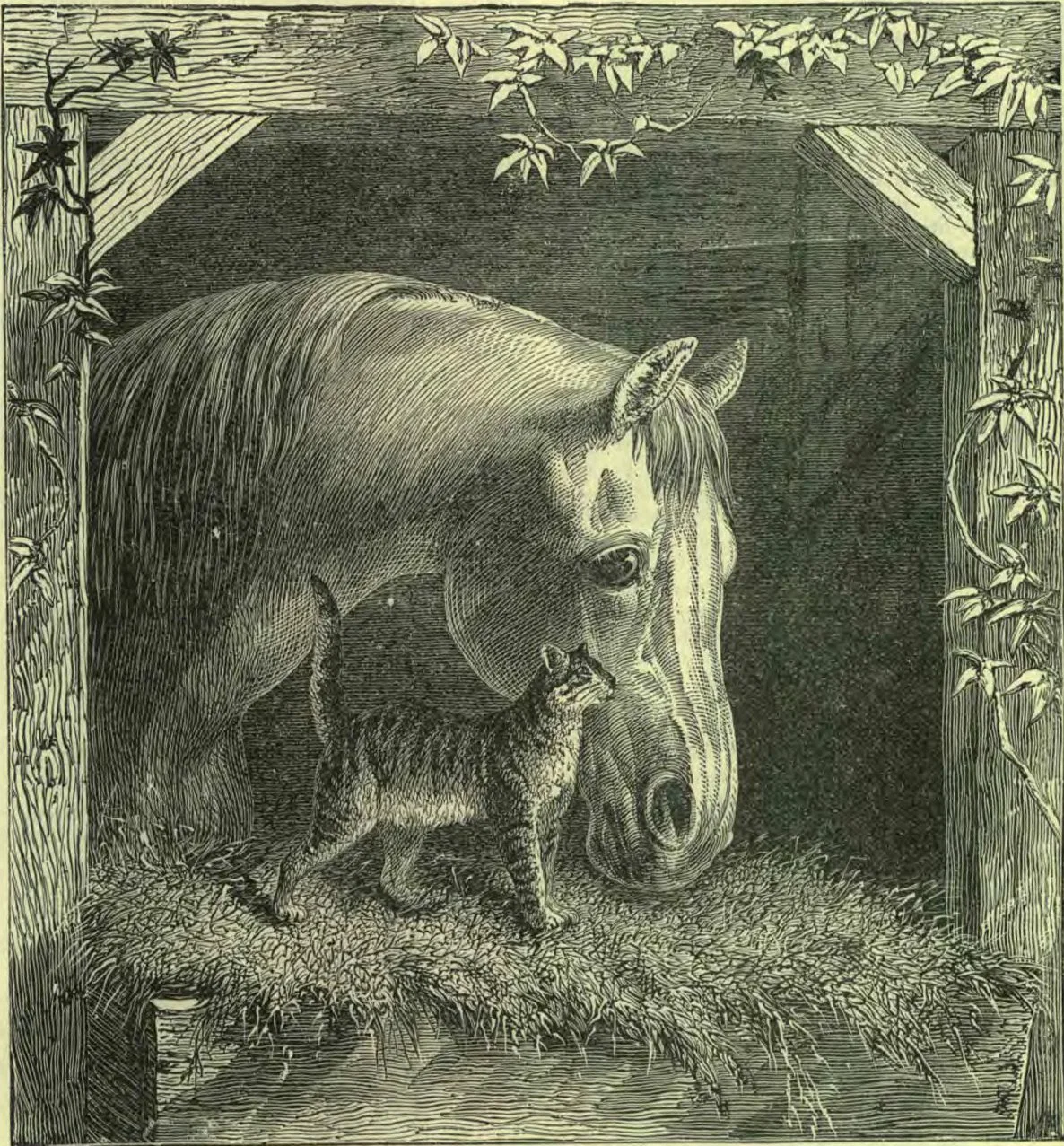
And why is it strange that a horse and a cat
Should be very good friends? Let us think about that.
The horse lives on clover; the cat lives on mice,—
Which to us may seem dreadful, but she thinks they're nice,—
And the mice eat the clover; the reason is plain—
The cat kills the mice that eat clover and grain!
But why should the cat like the horse? Let us think.
She likes a warm place in a corner, to blink
Her greenish gray eyes, and look out at the sun,
Or to watch for a mouse, and then after it run;
And where could a better place be, tell us, pray,
Than up in the manger upon the sweet hay,
Where the mice come so often to look for their share
Hid away in the grain bin? (They think it not fair
That they should go hungry from morning till night.)
And then the cat catches them—'tis her delight!
So Pusey and Dobbin are happy all day.
She catches the mice, and he eats grain and hay.
She rubs her red nose 'gainst his sleek, glossy hair,
While she picks up the hay with her claws hidden there.
She stands by his head, and purrs softly away,
While he answers back with an affectionate neigh,
For each knows the other is friendly and good,
And to live any other way certainly would
Be a strange contradiction; for every one knows
That a mutual interest makes friends, and not foes.
EMMA L. KELLOGG.
FRIENDS.
SYSTEMS OF HANDLING THE MAILS IN LARGE CITIES.
By E. G. Burdick
4.—SORTING, TYING OUT, AND POUCHING THE MAILS.
AFTER the letters have been canceled ready for sorting, they are taken by clerks to their respective cases, which I will now describe, giving the main separations made by them:—
The cases are made of three sections united in one by flaring out at either end of the central section just within easy reach of the clerk. The cases have all the way from one hundred and twenty to one hundred and eighty pigeon-holes, and are placed on tables made in shape like a part of a circle, and having six legs. In this office there are three Minnesota cases, one case each for Iowa, Wisconsin, and North and South Dakota.
States have all the way from five hundred to nineteen hundred post-offices; and the names and location of all of these, with also the railroads and routes they are on, must be known by the clerk. Each clerk is expected to know from one to six States by heart, and also to know all the post-offices on the main lines, called railway post-offices, in from five to seven States besides. Where a clerk attends to a part of a State only, it is called “separating,” and where he knows and sorts the entire State, it is called “throwing.” In their examinations these clerks throw ninety-nine and one hundred per cent correctly, throwing at the rate of from thirty to sixty letters a minute, or from twenty to thirty-six hundred an hour.
This department handles from eighty thousand to one hundred and ten thousand letters and circulars a day, averaging nine and one-half hours for a day’s work. There are six “shove,” or “separating,” cases in this office. These cases are labeled with all the names of all the States and Territories, also the largest cities in the United States. After the letters have been thrown in these cases, the clerks who throw the different States come and get their mail, and sort it in their cases.
The State cases are labeled with the names of all the large cities and towns and the principal railway post-offices in the State. The mail for the large offices in each State and the large cities in the United States is tied up in separate bundles. All mail for small cities and towns is thrown into the proper railway post-office pigeon-holes, and the clerks on those lines make the final separation. After all the sorting is done, then comes the “tying out,” as we call it. Before the mail is thrown, slips are prepared, with the name of the post-office to which the mail is going, and also the name of the office sending it out. The clerk who sorts the mail places his stamp on it, with the date and postmark. This slip is then placed in the case upside down, and when the hole is full, it is ready to tie out. This is done by placing this slip on the bottom of the package, with the information on the outside. In tying out the railway post-office packages, the slips are placed on the top of the package over the address.
On these slips is made a record, by the receiving post-office, of all letters missent. It is then returned to the clerk in whose package the mistakes are found, to correct him and make him more careful. When the mail is all tied out, it is taken to the “pouch rack,” which consists of a horse-shoe shaped rack to which are hung all the different pouches for the railway post-office lines. These pouches are made either of leather or of heavy ducking. Each pouch is labeled with the railway post-office or city to which it is going. When the time comes for the mail to go to the trains, these pouches are locked and taken to the dispatching room, and another pouch is labeled and put in its place, ready to be filled again. The clerk in charge of the dispatching rooms sorts it into its proper place; and when it is time to go to the trains, the mail-driver comes and carries it to the depot in the mail-wagon.
The paper mail is handled much as are the letters after they are ready for throwing in the pouches. The racks are much the same, only larger, and have a large round table, with a revolving top, on which the mail is dumped. When the sacks get full, or the time comes to “tie out,” they are fastened with a snap or check instead of being locked, and are taken to the dispatching room for sorting in the stalls.
E. G. BURDICK.
GERMAN STUDENT-LIFE.
By C. B. Morrill
Germany was celebrated for her universities at a period when she was celebrated for scarcely anything else; and even now, though she has become one of the greatest of nations, her glory in war and in politics has not dimmed nor outshone her glory in letters. The universities of Germany still hold a preëminence which gives to all connected with them a peculiar interest.
The German student is also celebrated, justly or unjustly, for dueling, beer-drinking, and hard study. Not that any individual student unites all these qualities in his own person, though for a rarity, such cases do occur now and then; but it is nevertheless true that the spirit of concentration, the spirit of “this one thing I do,” which is characteristic of the university, enters even into the dissipations of its students. “Both idleness and industry display an intensity,” says James Morgan Hart, “that we should look for in vain in an American college. The ‘rowers’ do nothing but row; the industrious do nothing but study.”
But the students do not all duel, nor do they all drink to excess. They have the time to themselves,—all there is of it,—and many of them, perhaps most of them, use it for study. As to our lives, though each one may waste his opportunities if he will, there is a judgment-day coming, so to the student comes a time of reckoning which will test the character of his scholarship. If he desires the degree and the honors which belong to one who has completed his education at the university, he must pass his university examination and write his theses; while if he hopes to enter the profession of the law or of medicine, or to receive a position in the state or in the church, he must pass the state examination. So, although many a fuchs, or freshman, squanders his first semester in the service of the beer-god, there are few whom the second year of residence does not bring to habits of industry and sobriety.
In harmony with the spirit of the university, the student is free to lay out his own plans of work, and to hear what lectures he chooses. He is expected, after a certain time, to have a plan; but he is free to form that plan himself, and in accordance with his own tastes and wishes.
Upon entering the university and paying the matriculation fee, each student receives from the questor—an officer whose duties correspond very nearly to those of the registrar in American universities—two very important documents,—the anmeldungs-buch and the “student-card.” The student-card is a certificate to the effect that the holder is a member of the university, and is under its exclusive jurisdiction. He is to carry it always upon his person, so that in case of arrest by town police, he can present it, and be turned over to the custody of the university. The anmeldungs-buch is a sort of blank-book with ruled columns, in which the student keeps an official record of his work. When he selects a course of lectures, he calls, after “hearing” for a week or two, on the professor to have his anmeldungs-buch signed. We are accustomed to make such arrangements with the shortest possible expenditure of time and in the most informal manner,—usually at the beginning or end of the lecture hour; but in Germany this occasion is a matter of ceremony, and must be performed in full dress with due observance of etiquette. The professor often detains his caller for a few moments, to make his acquaintance, and thus the pleasantest relations exist between the teacher and the taught. The signing of the book is in itself a very simple piece of business, and consists merely in the professor’s writing his signature in the line upon which the student has already written the name of the course. When the book is signed by the professor and receipted by the questor,—for each course has its own fees,—it lies idle until the close of the semester, when the professor signs again to certify that the lectures have been attended. This last is usually a mere matter of form, and is attended to with no ceremony whatever.
C. B. MORRILL.
The Way of Godliness
THE way of godliness is the way of unselfishness.
He Whom God Honors Is Most Exalted
He whom God honors is the most exalted.
STRAWBERRIES
By Charles Mackay
We owe thee much, resplendent June,
For fresh delights of morn or noon,
For lingering eyes with sunsets bright,
For deep serenities of night,
For foliage rich, and pomp of flowers,
For music of the skies and bowers,
For sweet fruition, early found,
And all the promise of the ground.
But, lovely June, although we prize
The charms thou spreadest to our eyes;
Though we admire thee, young and fair,
With jocund cheeks and flowing hair;
Although we love to hear the song
That floats thy leafy woods among,
We own a fondness as intense
For gifts that please another sense.
When swallows build beneath the eaves,
There grows, deep hidden under leaves,
Near to the ground, retiring, shy,
Tinged with the summer's earliest dye,
With bright complexion, healthy, clear,
The fairest berry of the year,—
The strawberry, profusely strewn,—
The jewel in the lap of June.
Happy is he who, now and then,
Can wander from the marks of men
To prune his trees, to trim his walks,
To lift his roses' drooping stalks;
Or, with his wife and children fair,
Eat his own fruits in open air,
And watch, well pleased, their bright eyes gleam
To feast on strawberries and cream.
Sweet are the grapes that bloom by Rhine;
Sweet are the Eastern date and pine;
Sweet are the oranges that grow
Where Guadalquiver's waters flow;
Sweet is the apple—sweet the pear—
But bright and beauteous though they be,
Give me, oh give the strawberry!
— Charles Mackay.
A PLUCKY JUDGE.
It is not often that men who sit on the judicial bench have an opportunity to turn police and arrest criminals, nor is it certain that they would always be successful should they attempt to do so. Judge Brentano, of Chicago, however, is an exception to the rule, as the following will show: Some time ago the judge was startled by cries from the house of a near neighbor. He left the breakfast-table, and hurried to his neighbor's house. As he entered, he met two men running out. The judge promptly collared both of them, and after a hard tussle, succeeded in holding them until he could call a patrol wagon, and have them taken to the police station. They had robbed the house, and both of them had revolvers; but the judge, single-handed and without arms, arrested and held them both. It is doubtful if there is a policeman in Chicago that could have done as well. Should the judge after this ever have occasion to lecture the police on the performance of their duties, they would have to admit that he is an authority in such matters. The fact that we do ourselves what we tell others they ought to do, goes a great way toward making our words of some effect.
SPANISH AMERICAN REVOLUTIONS.
By Editor
THE frequency of revolutions in the South and Central American republics makes it well nigh impossible to keep track of them. Revolutions seem to be indigenous to the soil of all Spanish American countries, and they spring up at all seasons of the year. France has been remarkable for the frequency of her revolutions, and we once saw a very humorous illustration of this. An inventor of a celebrated water-wheel published a paper to advertise his machine. On the first page of his paper was a picture of Uncle Sam holding out the water-wheel in his hand to France, represented by a woman, and saying: “Here! if it is revolutions you want, this will give you a thousand a minute!” It strikes us that something of this kind would have a ready sale in South and Central America!
There is one reason, however, for the frequent revolutions in the Spanish American States that is imperfectly understood by many. There are two conflicting elements in those countries, which will not coalesce any more than oil and water will unite. They are the Catholic Church on one side, and a liberal, progressive, and often free-thinking element on the other. Sometimes the church party has the control, and the liberals raise a revolution; then again the latter gain the control, and the clericals inaugurate a rebellion. Several of the late wars in South America have been of this character. Peru is now having a struggle of this kind, and the advantage appears to be upon the side of the clericals.
OUR PLANETARY NEIGHBOR.
The speculations that have been indulged in by men of science in regard to the planet Mars are well known. Mars and Venus are two planets which, as far as we can judge, have conditions suitable to sustain life. But since Venus is lost much of the time in an impenetrable mist, Mars receives the most scrutiny; and more calculations and speculations are made as to his condition. The latest observations indicate that Mars has an atmosphere, and that he has snow caps at his poles, which recede in summer until but a small field of snow, comparatively speaking, is left in the summer at each pole. Last October the snow appeared to have entirely vanished on Mars, which gives astronomers the impression that it was a remarkably hot summer there. The summer on Mars comes in the time of our autumn. The air on Mars is believed to be very thin, more so than the air on the highest mountains on the earth; but that is not a sufficient reason that there is no life on the planet. Animal life on this planet shows that it may be organized so as to exist in widely differing conditions.
One of the most remarkable opinions lately formulated by astronomers in regard to Mars is that it has no “weather,”—that is, it has no such sudden and violent changes as are experienced on the earth. The moisture is believed to fall there in the form of dew, and the snow is thought to be the successive deposits of minute particles as fine as dew. This reminds us of the description of the watering of the earth before sin entered it, when “there went up a mist from the earth, and watered the whole face of the ground.” It would seem that Mars is watered in that way. This would indicate that Mars is now as the earth was before sin entered it. As we look out in the evening at these glorious orbs, shining in all their brilliancy, it is good to believe that sin is unknown there.
QUEEN VICTORIA'S BIRTHDAY.
MAY 24 was the seventy-sixth anniversary of the birthday of Victoria, queen of England and empress of India. The British people throughout her vast empire, upon which the sun never sets, quite generally celebrated the occasion with banquets, speeches, and military parades. The people of the colonies, including our near neighbor, Canada, appear to join in this celebration with as much zest as the people of the British Isles themselves. Queen Victoria is one of the best sovereigns that has ever ruled over England, and she has the respect of the whole civilized world. She is the mother of a large family, and if some of them have gone wrong, it has been contrary to her motherly counsels. Age and infirmities are telling upon the queen, and there are rumors that she intends to abdicate in favor of her eldest son, Albert Edward, the Prince of Wales. He has not been a credit to himself and to his country in every respect; but he is said to possess many good qualities, and will doubtless make a king fully as good as the average. His wife, the Princess Alexandra, is much beloved by the English people, with whom, both rich and poor, she is a general favorite.
SEEKING JESUS.
An Indian boy lived in the far West. He heard that at the Indian school at Carlisle, Pa., he could learn to read and find the way to Jesus. He had no money to ride in the cars. He walked all the way. He was often hungry and very weary. When he reached the Alleghany Mountains, covered with snow, his moccasins were completely worn out, and his feet sore and numb. He traded his blanket for a pair of shoes, and walked on. Ragged and covered with dirt, he came to the school, and asked if he could learn to read the Bible, and find the way to Jesus. He had walked for six weeks, and had come over fifteen hundred miles. The teachers were very glad to keep him, and help him find Jesus.
You have not to travel so far to learn how to find Jesus. You have been taught by your mother and teachers that Jesus is very near you, and that at this time, if you will open your heart to his love, he will fill it full, and will shine in your heart brighter than the star that shone on the way of the wise men.—Christian Observer.
Actions, Looks, Words, and Steps as Alphabet of Character
ACTIONS, looks, words, steps, form the alphabet by which you may spell characters. — Lavater.
NOTICE!
By Editor
Our subscribers are hereby cautioned not to send money to the editors of the INSTRUCTOR, nor to send money-orders or drafts made payable to them. Lately a money-order, made payable to one of the editors, was received, and it had to be sent several hundred miles to the place where he was attending a camp-meeting to get his indorsement, so that the money could be collected. Make all money-orders and drafts payable to the Review and Herald.