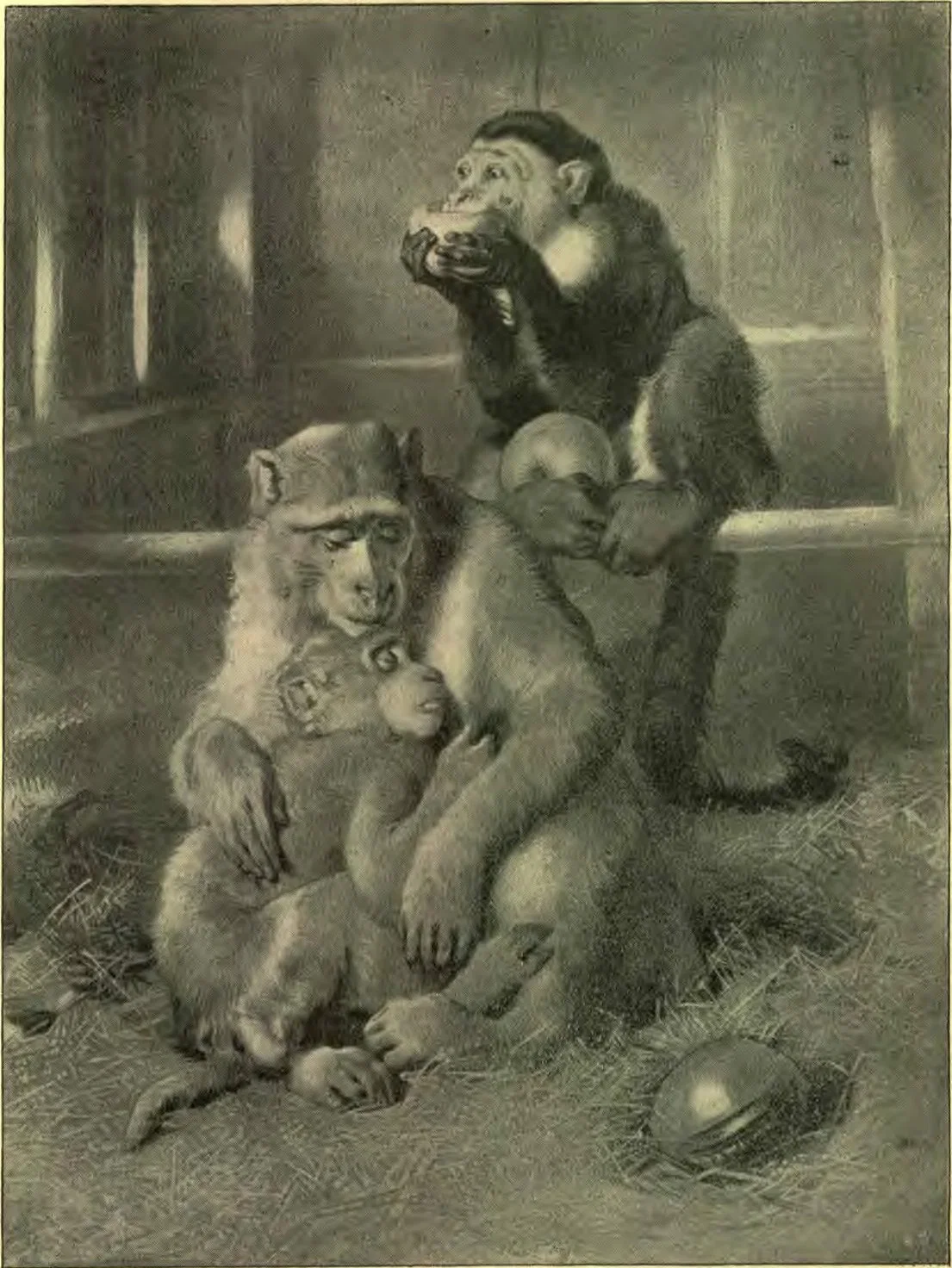
“WOULD you believe it, ma! Those thieving birds have carried off every one of my gold-drop plums. They’re a nuisance, and ought to be killed. The black rascals didn’t even leave a seed,” said grandpa to grandma as he sank into a splint-bottomed chair, weary from his walk through the orchard. He spoke in a disappointed tone; for he had watched the gold-drop plum-tree very carefully all summer, in order to get the fruit when it ripened. This particular variety did not appear to yield well. Three springs had come and gone since the tree was planted, each one clothing the plum-tree in robes of white bloom, but it had never before borne fruit. This year there were just five plums that came to maturity, and were fast turning yellow in the summer sunshine. Grandpa’s rheumatism had been worse, so he had not visited the orchard for several days, and now he had gone—only to find the tree empty.
Clarence was sitting on the porch railing, carving his name in a piece of redwood. Grandpa and grandma did not see his face flush, or hear the tumult going on within his breast as he listened to their remarks.
A neighbor boy had given Clarence a slingshot, which he had been permitted to use only on the conditions that he would not shoot at anything that had life, and that he would keep out of the range of all windows. The orchard was a favorite retreat, and one day he was playing he was David, and the gold-drop plum-tree was Goliath. He really did not intend to do any harm; but before he realized it, a rock went humming into the plum-tree, and down came a luscious, yellow plum. Clarence ran to the spot where it fell. The rind had burst, and of course grandpa would not care for it, so he would eat this one. It was oh, so sweet and juicy, he did wish for one more!
He counted them; there were one, two, three, four, left. So he took another aim, and down came all four, every one bursting from the fall. What was to be done? He had not intended to knock them all off; he did not want to take them to grandpa and confess what he had done; so he ate them, and hurriedly buried the seeds, seeking to cover his sin. But he found, to his sorrow, that an accusing conscience will not be quieted, even if covered. He felt miserable. He knew grandpa was disappointed not to taste the plums that he had watched so long, and he felt guilty not only of the sin of stealing, but also of lying. It is true he did not speak, but he had permitted grandpa to think that the innocent blackbirds had taken the plums when he knew they had not.
Two wretched weeks dragged by before he had courage to confess his cowardice. One morning at worship grandpa read from the Bible that charming account of the heavenly city, closing with the words: “Blessed are they that do his commandments, that they may have right to the tree of life, and may enter in through the gates into the city. For without are dogs, and sorcerers, and whoremongers, and murderers, and idolaters, and whosoever loveth and maketh a lie.”
The words were scarcely spoken before Clarence, unable to endure the strain longer, sobbed out the whole of his sad story. He ended by saying: “O grandpa! I just wish you’d give me a good whipping!” But grandpa thought Clarence had already been punished. EDITH O. KING.
How the Firecrackers Saved Ben
“BANG! Bang!—Bang!” went the heap of firecrackers in the back yard. Ben was having a grand time all to himself. It was morning, and he had put on an old coat, which he had not worn since the summer. In one of its pockets he came across some bunches of firecrackers left over from his Fourth-of-July celebration, and now he was making as much noise as possible with them.
Suddenly a head poked itself above the high board fence. “Hello there!” its owner called. “Guess you think you’re having a big picnic!”
Ben looked up. He did not care very much for Walter Marshall, the boy who had lately come to live next door; but Ben was a kind-hearted chap, so he answered: “Come along over and help.”
“I don’t see much fun in firecrackers,” replied the boy on the fence, not very politely. “Look here,” he added, “I’ve got a new kind that’s worth a bushel of yours.”
He held up a handful of slim, round objects, that, at that distance, looked very much like firecrackers . Ben’s match went out in his hand as he stopped to look.
“What kind are they?” he asked, approaching the fence.
Walter Marshall burst into a roar of laughter. “Well, you’re a goosy and no mistake!” he cried. “Why, you light ’em, same as your kind!” He struck a match, applied it to one end of one of the so-called firecrackers, and stuck the other end into his mouth. The smoke rolled up in a little blue cloud.
“Oh,” cried Ben, “cigarettes!”
“Yes, they’re fine. Every try one?6”
Ben never had; he had always agreed with his father that boys who smoked were “young idiots.” Still, he could not help thinking that Walter looked very manly, sitting up so straight there, with the smoke rolling from his mouth, and the cigarette held carelessly between his fingers. As he hesitated, Walter broke out: “Well, you ought to. It’s heaps of fun. How’ll you trade some firecrackers for one?”
Ben had an abundance of firecrackers, so he did not like to refuse. He could easily throw the cigarette away afterward, he told himself, and he would like just to hold it for a little while. So he handed up the required number of firecrackers, and took the little round white object, and slipped it into his pocket. He glanced rather nervously toward the house; he did not like to think of his mother seeing him with a cigarette in his hand. He went back to his fireworks, and Walter dropped off the fence, and left him alone.
And then Ben began to think; surely it would not hurt to take one puff.
He took the cigarette out of his pocket and looked at it. Just then he heard his mother’s voice; she was only giving some instructions regarding dinner, in the kitchen, but the sound of her voice made Ben jump. He plunged his hand back into his pocket, and turned down the garden path.
In a minute Ben felt startled by his own action. He was not usually easily frightened by anything, but here he was starting and running away at the sound of his own mother’s voice—that mother who was gentleness itself to her only child. Ben had yet to learn that wrong-doing is sure to make a coward of even the bravest boy.
The boy walked quickly to the end of the garden-path, until he came to a narrow place between the stable and the wall, which divided his father’s lot from his neighbor’s. He slipped into this passage, feeling decidedly mean and small, and starting nervously at every sound. What if his father were to come into the stable?
But in spite of all his doubts, Ben was bent on trying his new purchase; he would see if he couldn’t look as fine and grown-up as Walter Marshall had looked.
So Ben struck a match, at the same time slipping his hand into the pocket where the slim round object lay.
Suddenly he heard a sound; it was only Neddie, his donkey, stamping in the stable, and at any other time Ben would have known this; but just now any sound frightened him. In desperate haste he stuck the end of that slim little object into his mouth, and applied the match. He was in such a hurry he did not wait to see what he was doing, and afterward he could never tell just what happened next, but at that instant there was a terrible bang! and Ben dropped his cigarette, and stood holding his hands over his eyes, and stamping in an agony of pain.
“My eyes! Oh my eyes!” he groaned. The suffering lad staggered blindly out into the garden. His mother had heard his cries, and came running to the door. He remembered falling forward into her arms, and then the pain slowly left him, and he sank down in a faint.
When at last Ben came to himself, everything was very dark, and his face and eyes smarted terribly. He put up his hands, and felt a bandage across his eyes. Then he heard his father’s voice, and his mother’s, and a third with them, the doctor’s. They seemed very far away.
“Mother!” he whispered, “will—will I be blind?”
His mother took his hot hands in her cool ones. “No, dear, but you must keep still. The powder from the firecracker got into your eyes, but Dr. Barnes says they will be better before long, if you lie very still and keep quiet.”
“Of course,” cried Dr. Barnes, cheerily. “You’re all right, my man. You’ve had a narrow escape, but you’ll pull through. I really don’t believe youngsters ought to be allowed to meddle with such things,” he added, “they are sure to get their silly little heads into trouble.”
“I don’t understand it at all,” said Ben’s father. “Ben is always so careful. I never knew him to get hurt before, and I have allowed him to have all sorts of fireworks.”
“Well, he’d better leave them alone in future,” said the doctor, somewhat sharply, and having given further directions, he left the room.
“This is a new experience for you, Ben, my man,” said his father, laying a kindly hand upon his son’s poor, hot forehead. “I don’t see how you came to play such havoc with yourself.”
Ben lay silent for a minute. He felt as if the powder of a hundred firecrackers was burning him up. Something whispered, “Your father and mother need never know. They’ll think it was firecrackers did it.” But something else said, “You were a coward once. Now you’re paying for it. Don’t be one again.”
“It—it wasn’t a firecracker did it!” Ben exclaimed quite suddenly.
“Not a firecracker!” cried both his parents. “What was it?”
“It was a cigarette!”
“A cigar—what?”
“A—a cigarette.”
“The poor child’s delirious!” cried his mother, taking his hands in hers again.
“No, I’m all right,” said Ben, as calmly as he could. “I—I traded some firecrackers for a cigarette, and when I lit it, it blew all to pieces into my eyes.”
For answer Ben’s father went over to where the boy’s coat hung on a chair. He put his hands into the pockets, and drew out a bundle of matches and,—the cigarette that had been blamed for all the trouble.
“How many did you have, Ben?” he asked.
“Just one,” whispered Ben, in the depths of humiliation. For a moment he felt almost glad that his eyes were useless, he did not want to look at the faces of his parents, just then. His father’s next words surprised him.
“It’s just as I thought. He has been trying to smoke a firecracker in mistake. The cigarette’s here, Benny, and we may be very thankful that your eyes are safe, too.”
Ben was a wonderfully patient sufferer during the long, weary days that followed. He had learned a severe lesson, but he never forgot it. On the day when the bandage was taken from his eyes, and he looked at all the objects in the house, with new delight, his father pointed out to him a slim little white cylinder lying on the mantel-shelf.
Ben grew red up to the roots of his hair.
“I—I guess there’s not much danger of my trying another,” he said.
“I don’t think so, either, Ben,” said his father, with a smile. “And after all, when that is the case, I’m glad it turned out as it did; for if you had really smoked the cigarette, it would have done far more harm in the end than the firecracker did.”
And Ben, remembering certain things which cigarettes did to boys who were in the habit of using them frequently, thought so too.—The King’s Own.
The Changed Trees
By Frank Walcott Hutt
A QUEER old farmer dreamed one night;
Some trees had not been planted right;
And in his dream it seemed he went,
And all night long his strength he spent
Replanting here and there a tree
Where he was sure it ought to be;
And in the morning when he woke,
He climbed up in the tallest oak,
And looking quickly every way
He saw a bay-tree in the bay;
And just beyond the breaker’s reach
A beech-tree waving on the beach;
And, glistening in the morning rain,
A plane-tree nodding on the plain;
A plum-tree stood all out of plumb;
A box-tree had a box become;
The ash-tree in the ashes grew;
The yew became the pronoun you;
But further, as he looked about,
He found he’d left the hat-tree out;
And had forgotten utterly
The cross-tree and the family-tree.
FRANK WALCOTT HUTT.
X—The Way a Word Looks
By L. T. Curtis
When I meet a friend, I am generally so engrossed in talking or listening, that I scarcely ever notice how he is dressed. He may have a freckled face, or a red nose, or a glass eye, all of which peculiarities I at first noticed; yet, since we have become acquainted, these oddities have all vanished, and I see what he is, rather than how he looks.
Unfortunately, indeed, many an individual treats his word acquaintances in the same way. The first time they meet, something peculiar in the make-up of the word was observed. The peculiar way in which its letters were strung together was marked, but by and by it is known so well as to be recognized at a glance; often indeed recognized by certain intimate associates it has, and the time finally comes when the real form of the word is hardly seen at all.
Most Americans speak English in some fashion or other. If not skilled in oratory, everybody possesses some conversational ability. It is safe to say, further, that in this age of books and magazines, everybody reads, and thus secures a stock of information with which to converse. But reading alone does not familiarize one with the looks of a word, neither does careless, slipshod writing; for despite the fact that editors all over the land are complaining that every third American aspires to write novels, or rhyme, or newspaper articles, these same editors will also tell you that most of the matter they receive for publication must be carefully edited by correcting numerous errors in orthography, grammar, and rhetoric. The majority of people, however, seldom write English except in the form of letters, and this kind of composition does not tend to cultivate an acquaintance with the spelling of words; for their friends are too considerate of their feelings to criticise the way they spell, and business men are too busy to do so.
For the past few years it has fallen to my lot to dictate hundreds of letters and other matter to classes of shorthand students, and correct the typewritten transcripts. In this way I have been able to learn how likely bright young people are to know words well enough to read them, but not well enough to spell them. Again and again have I found it necessary to remind grammar-school graduates that planed, is not planned; occured, is not occurred; ect is not etc.; and that maintainance is not maintenance.
But misspelling a word does not consist merely in naming the wrong letters. At least half the mistakes are of this class: All ready, for already; alright, for all right; some time, for sometime; in as much as, for inasmuch as; any body, for anybody; partner-ship, for partnership; every thing, for everything; Seventh Day Adventists, for Seventh-day Adventists.
You would hardly think it possible for a young lady who had for years used sewing-machines, discussed sewing-machines, and read about sewing-machines, to spell it sewing-mashean, yet she did.
One would think it improbable that any one should make such a blunder as this: “We arrived in town alright, got the male, and then went to the auction sail.” I have seen just such blunders made, though not quite so close together.
Here are several words, some of which I find misspelled almost every day. Dictate them to your friends who think they are experts in writing English:—
If you will advise me, I will take your advice. He conceives the idea of deceiving them. Neither of my neighbors is proficient in grammar. It occurred at the beginning of the Conference. We have conferred with the committee on the subject of deferring the meeting. We have already7learned that they were all ready to start before noon. He has been managing his affairs so badly that they are now unmanageable. It is right that Mr. Wright should write you in reference to the rites of this society.
The real Christian assumes that his neighbors are honest and upright unless he has overwhelming proof to the contrary. Proof-readers, on the other hand, suspect every word to be wrong—to have its letters transposed, or inverted, or disarranged in some way, until they have proved by careful scrutiny that it is right. I wish (and I presume there are many who will say, “Those are my sentiments, too”) that the proof-reading of words was more in vogue, and the proof-reading of one’s acquaintances less so.
L. T. Curtis.
The Captain Inside
“MOTHER,” asked Freddie the other day, “did you know that there was a little captain inside of me? Grandfather asked me what I meant to be when I grew to be a man, and I told him a soldier. I mean to stand up straight, hold my head up, and look right ahead. Then he said that I was two boys,—one outside and one inside,—and that unless the inside boy stood straight, held up his head, and looked the right way, I never could be a true soldier at all. The inside boy has to drill the outside one, and be the captain.”—Selected.
MEMORY VERSE: “Come out from among them, and be ye separate, saith the Lord, and touch not the unclean thing.” 2 Cor. 6:17.
We know that the city of Jericho must have been a very wicked place, or God would not have destroyed all its inhabitants. He wanted to keep his people from being in any way led astray by their possessions; so he told them that they were not to keep any of the accursed things that belonged to the Canaanites, lest they should trouble the camp of Israel, and make it a curse.
The silver and the gold found in Jericho were to be devoted to the Lord, and everything else destroyed. When Achan put the gold and silver and the Babylonish garment under his tent, he thought it was hidden; but we see how it showed itself to the world.
The third verse of our lesson chapter shows that the Israelites were beginning to trust in themselves instead of in God. When the people advised Joshua to send only a few men to Ai, because it was a little city, they showed that they took some credit to themselves for the taking of Jericho.
From verses 6-8 we can see that Joshua and the Israelites had confidently expected victory. They were surprised, and greatly ashamed by their defeat. This was right. When we are doing what God has given us to do, we should never look for defeat, but always expect victory.
Verses 8 and 9 show why Joshua was so troubled when the conquered army returned to the camp. The Canaanites and all the inhabitants of the land had heard of the crossing of the Jordan, and of the taking of Jericho; and they trembled, and were afraid before Israel. But when they heard of their defeat at a little city like Ai, Joshua feared they would gather courage to come and fight against them. It was the God of Israel that they feared; and now they would think he could not be so powerful as they had believed. So his name was dishonored when his people were defeated. “What wilt thou do,” said Joshua, “unto thy great name?” Very likely those nations that afterward fought against Israel would never have dared to do so if it had not been for this failure.
This lesson shows what a terrible thing sin is, and how impossible it is to hide it. Do not think that you can cherish some secret sin in your own heart, and no one else be troubled by it. The sin of one man troubled the whole camp of Israel, and dishonored God before the world, until it was put away.
See how many opportunities Achan had to repent and confess his sin. First, when the defeated army returned in shame to the camp. He might then have confessed before the whole camp, and had the accursed thing destroyed, and he would have been saved.
Again: when God pointed out the sin without naming the sinner, he was giving Achan another chance to make his own confession. Then, as the lot came closer and closer, God was speaking to him, and leaving him a chance to tell what he had done. But not until the lot fell on him, and he was pointed out and condemned before the whole camp, would he confess his guilt. It was then too late for him to put away his sin, and he perished with the accursed things.
If we now confess our sins as God points them out to us by his Holy Spirit, we separate ourselves from them and are saved. But those who wait until the day of judgment, when their sins are brought home to them, and they stand condemned before all the world, will perish with the sins they have clung to, even though they acknowledge their guilt.
After the accursed thing was put away, all the men of war went up against Ai. God then delivered the city into their hands, and the shame of their defeat was wiped out by a glorious victory.
Questions
1. What command did God give about the things belonging to Jericho? Why were the Israelites not to keep any of them? Joshua 6:18; Deut. 7:26.
2. Who disobeyed this command of God? How did he try to hide his sin? Tell how the sin showed itself. What does sin always do? Joshua 6:18, last part of verse.
3. What did the request of the people about Ai show that they were beginning to do? How had they got the victory over Jericho? Does it make any difference to God how many or how few he has to work with? 2 Chron. 14:11.
4. How many went up to take Ai? Tell what happened to them.
5. How did Joshua and the Israelites feel when they heard the news? How did they show their distress? Why were they so troubled?
6. How had the Canaanites felt toward Israel? Why? What did Joshua fear would be the result of this defeat?
7. What did God tell Joshua to do? What is always the best thing to do when we have failed in anything?
8. Why were not the children of Israel able to stand before their enemies? What must be done before God could again go out with their armies and give them victory?
9. Tell how the sinner was discovered. What opportunities did Achan have to confess his sin? How long did he wait? What did Joshua say to him?
10. What was done to Achan because he did not confess his sin until he could hide it no longer? How are our sins pointed out to us? What should we do when we see that we have sinned? Prov. 28:13. If we do not confess our sins, what will at last become of us?
MEMORY VERSE: “The eyes of your understanding being enlightened; that ye may know what is the hope of his calling, and what the riches of the glory of his inheritance in the saints.” Verse 18.
In whom ye also, having heard the word of the truth, the gospel of your salvation,—in whom, having also believed, ye were sealed with the Holy Spirit of promise, which is an earnest of our inheritance, unto the redemption of God’s own possession, unto the praise of his glory. For this cause I also, having heard of the faith in the Lord Jesus which is among you, and the love which ye show toward all the saints, cease not to give thanks for you, making mention of you in my prayers; that the God of our Lord Jesus Christ, the Father of glory, may give unto you a spirit of wisdom and revelation in the knowledge of him; having the eyes of your heart enlightened, that ye may know what is the hope of his calling, what the riches of the glory of his inheritance in the saints, and what the exceeding greatness of his power to us-ward who believe, according to that working of the strength of his might which he wrought in Christ, when he raised him from the dead, and made him to sit at his right hand in the heavenly places, far above all rule, and authority, and power, and dominion, and every name that is named, not only in this world, but also in that which is to come: and he put all things in subjection under his feet, and gave him to be head over all things to the church, which is his body, the fulness of him that filleth all in all.—American Standard Revised Version.
Questions
1. What does the apostle say of the faith of those to whom he was writing?
2. What had they heard that led them to believe? What is the basis of all true faith? What was their experience as a result of this faith?
3. Of what is the Holy Spirit an earnest, or pledge? For how long a time is this pledge valid?
4. When will this purchased possession be ours? Where does the praise belong for all this gift?
5. What always accompanies faith?
6. What did the apostle do when he learned of the faith and love of the Ephesians? What lesson may we learn from this?
7. To whom did he pray? What did he ask for first? What is the source of such a blessing as this? John 16:13.
8. What will be the result of the spirit of wisdom and knowledge?
9. With this enlightenment, what three things shall we know?
10. In what will the hope we have in God meet its complete fulfilment?
11. How are the riches of our inheritance known here? Eph. 1:3.
12. What is the standard of the greatness of God’s power to us who believe?
13. What more did he do for Christ besides raising him from the dead?
14. How highly did he exalt him?
15. What has been put under his feet?
16. What is his relation to the church, which is made up of his followers?
Notes
1. God’s glory is his goodness. When Moses asked the Lord to show him his glory, he told him that he would let his goodness pass before him. And so for the great gift he has bestowed upon us—our eternal inheritance, the earnest, or pledge, or foretaste of which we already have in the Holy Spirit—the praise is to his glory, or goodness.
2. These long sentences of the apostle need much study. It is one sentence from verse 3 to verse 14 inclusive. Verses 15 to 23 are also comprehended in one sentence. We shall need to study them as a whole and in parts. Every clause has its weight, every word its meaning. Note in verses 18 and 19 that it is not mere intellectual knowledge which is desired for God’s people, but that the eyes of the heart—the seat of the emotions, affections, will, and thought—may be illuminated, enlightened, that we may see and know beyond mortal vision and mortal knowledge. And all this knowledge is summed up in “the hope of his calling,” “the riches of the glory of his inheritance,” and “the exceeding greatness of his power to us-ward who believe,”—power over sin, and, hence, power over death. To know these is to know all that is worth knowing.—S. S. Lesson Quarterly.
Church Etiquette
To know how to behave one's self in the house of God is the first lesson that should be learned by those who gather there to worship. The following excellent suggestions on this subject should be cut out, and slipped into your Bible, where you can read them often:—
“1. If possible, be in time. You need at least five minutes after coming in to get warm or cool, to compose your body and mind, and to whisper a prayer before the service begins.
“2. Never pass up the aisle during prayer or Scripture reading. If you do, your presence will distract the minds of many in the audience.
“3. Be devout in every attitude; all whispering should be studiously avoided. Find the hymn, and sing it if you can. Share the book with your neighbor.
“4. If the sermon has begun, take a seat near the door—no matter if you are ‘at home.’
“5. Be thoughtful for the comfort of others. Take the inside of the pew, if you are the first to enter, and leave all vacant space at the end of the aisle.
“6. Speak a bright, cheery word to as many as possible at the close of the service. If you are a stranger, ask one of the ushers to introduce you to the pastor, or to some of the church officers. This will always insure you a hearty welcome.
“7. Never put on your coat, overshoes, or wraps during the closing hymn, and do not make a rush for the door immediately after the benediction is pronounced.
“8. There should be no loud talking and jesting after the service is concluded. They are out of place in the house of God.”
It would seem as if the good sense and simple justice of this last suggestion are so apparent as to make the suggestion itself almost unnecessary; yet how often do we hear loud talking, boisterous laughing, and social chit-chat indulged in by those who are leaving God’s holy house. If one were to talk with those whose voices are loudest, whose actions the most blameworthy, they would no doubt be quick to admit the justice of the reproof. Often it is simply a lack of thought that leads to such grave disrespect to the place of worship; often, again, it is because of careless habits, long indulged, or by following the evil example of those who should know and do better. But whatever it is, no one should excuse himself from observing the few rules that should govern his behavior when attending any service in God’s house, or when leaving the place of worship after the service is over.
The Winner
By Dallas Lore Sharp
I HAD been watching the herring for an hour or more as they struggled through the sluice to the dam. The fall of the water over the gates was unusually heavy that day, as was also the run of herring. For a week they had been struggling in from the sea, but to-day they poured in by thousands. The stream was clogged.
Something—their increased numbers and greater rivalry, perhaps—had noticeably excited the fish. They seemed electric with it. Perhaps this school had been delayed by the cold April weather, and now must reach the pond to lay their eggs, and were in a hurry. Whatever the cause, they certainly seemed to be in a hurry: I had never seen them scramble over the shoals and over one another in quite this rush before.
The unusual excitement was less manifest in their mad rush upstream than in their still madder rush at the falls. On any running day a few of the stronger, bolder fish, finding their way barred by a four-foot dam, try to climb over through the down-pouring sheet of water. The vast majority, however,—not unlike, I suppose, the majority of men,—coming to the impossible barrier, stop in the easy pen built for them beneath the falls, and are content to be scooped out, for pickling and fishbait, though a few are carried up in barrels to the spawning-ponds.
But to-day it was different. Instead of the usual few there were many fighting to get over. I had watched them time and time again, but had never seen one pass the four feet of sheer falling water. In “Wild Life Near Home” I have described how they would dart through the foam into the great sheet of water, strike it like an arrow, rise straight up through it, hang an instant in midfall, and be hurled back and killed, often, on the rocks beneath.
To-day I felt a new thrill as I watched them. Something of the evident excitement among the fish possessed me. I somehow knew that the swimmers were on their mettle, that a record would be broken.
The falls were all a-flash and a-glitter with the darting fishes. Not only was there a greater number in the contest: there was also a much higher average jump than usual. Over and over again one would get within half a foot of the lip of the gate.
Soon I noticed that it seemed to be a certain fish that made this highest mark. I followed her as she fell back, and, though it was impossible through the foam and thick rush of other forms to keep her in sight, yet I am sure that each time she rose it was with a peculiar bound, showing a particularly long, lithe body. And each time she fell, peculiar good luck attended, or else it was that her superior sense and training served her; for each time she landed just between or just beyond the rocks.
Again she flashed through the foam, and hung, fixed like a silver arrow, in the dark water just below the edge. Again she fell. I was excited. Flash! flash! flash! a score of the shining ones shot into the falls, when over them, above them, flashed the long, lithe form of the winner, striking one of the weaker rivals beneath her just as she reached her highest mark, and bounding sidewise from her, glanced over the dam and was gone.
The record was broken, and within five minutes, by the same curious hap, another turned her silver side over the great hurdle, and dived into the quiet pool beyond.
It is a rather paradoxical state of things that creatures like these fish hate cloudy, cold weather and rain, and will not leave the ocean willingly for the shallow fresh waters unless the sun shines, and the wind suits, and the temperature is to their liking. There is some reason for the chickens’ staying in when it rains; but what need have herring of umbrellas?—Dallas Lore Sharp, in St. Nicholas.
A Prayer for Purity
Oh, that mine eye might closed be
To what becomes me not to see;
That deafness might possess mine ear
To what concerns me not to hear;
That truth my tongue might ever tie
From ever speaking foolishly:
That no vain thought might ever rest
Or be conceived within my breast;
That by each word, each deed, each thought,
Glory might to my God be brought!
But what are wishes? Lord, mine eye
On thee is fixed, to thee I cry.
Oh, purge out all my dross, my sin,
Make me more white than snow within;
Lord, wash and purify my heart,
And make it clean in every part;
And when ’tis clean, Lord, keep it so;
For that is more than I can do.
— Selected.
The Life of Seeds
A SERIES of interesting tests has lately been begun to determine how long the life-principle of seeds continues. Caskets containing a great variety of seeds were buried; and each year one of these caskets will be taken up, the seeds it contains planted, and their growth carefully watched. The Saturday Evening Post has these interesting paragraphs on the subject:—
“It is reported that in soil carried into Western valleys by hydraulic operations in the mountains, trees of a variety previously unknown either in the mountains or the valley spring up. Where did the seeds come from? Had they lain dormant for years, or perhaps ages, in the earth? The supposition is that they are the survivals of former forests. The theory awakens speculation as to the vitality of seed life.
“Often when sod land is broken for cultivation, noxious weeds spring up, which, so far as the farmer knows, never grew before in that locality. The theory is that the seed lay in the ground for generations, awaiting certain conditions necessary to cause it to germinate.
“In a park in Paris a series of Lathyrus, which had once been abundant, disappeared on account of the growing shade of trees. Thirty years from the time of the plant’s apparent extinction in that locality, the trees were thinned, and the leguminous vine reappeared. A more mysterious instance was that of plants of the rush genus (Juncus bufonius) making their appearance in earth obtained from a great depth in an excavation in Paris. In another section of France, on the banks of a ditch in a stretch of country reclaimed by drainage, alders suddenly began to grow broadcast. So far as human knowledge goes, that tree was never before known to exist in that or any neighboring locality. The supposition is that in some earlier period that part of the country was an alder forest, whose surviving seeds, after a lapse of ages, now reappear.
“The information along these lines is vague and unsatisfactory. Similarly, the statement that wheat found in Egyptian sarcophagi grew readily when planted, four or five thousand years from the time of harvesting, can not be accepted as proved. Yet, in the absence of definite knowledge, experts reserve opinion. It is to supply exact data on the subject that the burial of seed has taken place at Arlington.”