The Youth’s Instructor, Vol. 51, No. 26.

The Step Between

The Youth’s Instructor

Jul 2, 1903

Review and Herald Publishing Company · Battle Creek, Michigan · Jul 2, 1903

The Step Between

YOUTH in his pride beheld A long, long pathway go From Virtue’s height of peace and calm To the depths of sin and woe. And on the height he saw A saint with holy mien; And in the depths a sinner stood, A long, long way between.
Age in his wisdom saw A line, a narrow space, Between the thunders of God’s wrath, And the sunshine of his face. This side the line there stood A saint, washed white and clean; That side, a sinner, base and vile, And but a step between.
ELIZABETH ROSSER.

Gum Digging

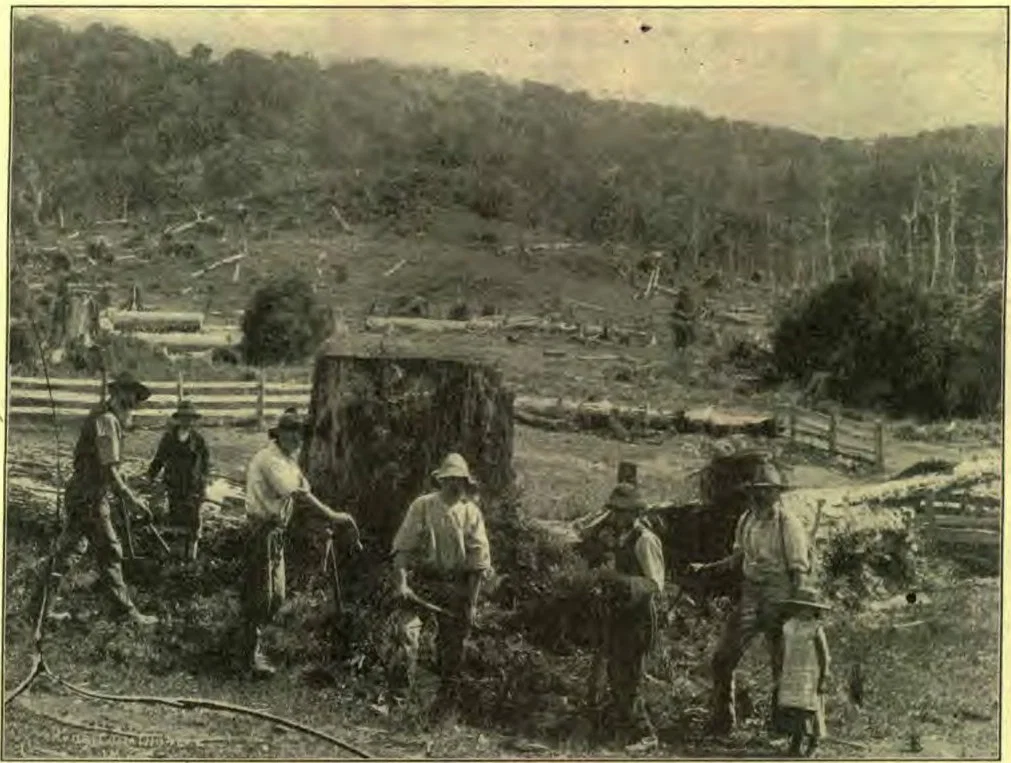
No forests that I have seen exceed in luxuriant and abundant growth those found in the northern extremity of New Zealand, where the semitropical climate, plenty of rain, and a rich soil combine to furnish magnificent examples of what nature can do. Various species of trees peculiar to this region are intermingled. The tongue-puzzling character of their native names forbids their repetition by a newcomer; so I shall not attempt it. Vines and creepers are interwoven among the branches, and hang in beautiful festoons to the ground. The rope-like “supple-jack,” extending from tree-top to ground, awaits the necks and limbs of visitors with many a noose. The provoking shrub, “wait-a-bit,” lurks here and there with a thousand fangs to seize the passer-by. But for these slight annoyances, one might fancy he were in an earthly paradise. The graceful nikau palm and the fern-tree furnish a beautiful undergrowth to the gigantic trees that tower a hundred feet overhead. Among these is found the stately kauri (pronounced cow’ry), a species of pine valuable for nearly all building purposes. It has a fine, dense grain, susceptible of a high finish. The trees often attain a height of one hundred and fifty feet, and are of great size. The demand for building timber is so great in Australasia that these grand forests are fast disappearing, and not many years will pass before they will be entirely gone.
When a kauri tree is wounded, a resinous gum exudes, forming in amber crystal bodies on limb or trunk, and finally falling to the ground. Being indestructible in soil or weather, it remains, and gradually sinks into the earth, where it may lie for ages. The soil absorbs certain deleterious qualities, and leaves the mass a beautiful transparent substance. This gum is used in the manufacture of varnishes, and in the printing or sizing of cloth, and commands a good price in London and New York.
At first kauri gum was picked up from the surface of the ground; but as soon as this visible supply was nearly exhausted, digging was resorted to, and far greater quantities were thus discovered. As time passes, and the price of the gum increases correspondingly, the digging goes deeper into the earth. At first lumps of gum were located by the use of long, sharp prods of steel; but now in many cases the ground is all turned up, so that nothing shall be lost.
The mind is lost in the contemplation of the ages in which these vast forests lived and died, and these deposits were placed by the hand of time.
A GROUP OF GUM DIGGERS AT THEIR WORK
G. C. TENNEY.

A Trip around Raiatea

AFTER nine months of earnest study and hard work, the students as well as myself hailed with joy the prospect of taking a week “off,” to sail around our little island. After talking the matter over, Mr. Cady, who, with his wife, was visiting us at the time, asked for an expression, so he could know how many would like to go. Do you think we wanted to go? Did you ever see a boy or a girl who did not want to go on an outing of that kind? I think you can easily guess that every one of us was ready for just such an experience.
This was on Monday, and we decided to start a week from that day, provided we could secure a suitable boat. During this week of anticipation and preparation, each one set about his duty with a lighter and happier heart, so the appointed day soon came. Before daylight all were up, only to find it raining hard. However, by seven o’clock the clouds rolled away long enough for us to get started. It did not take the boys long to load up the trunks and boxes containing the clothing, food, and necessary cooking utensils for our journey, and soon we were off to the beach, some going on foot, and a few on the wagon with the stuff. In a short time our boat arrived; but before we could get all the things on, the sun was again hid, and the rain fell in torrents. The ex-queen, seeing our trouble, invited us to stop with her till the showers were over. While waiting here, we prepared our luncheon, and asked her to eat with us. She was pleased to do this, and brought some of her native foods for us to try. Thus the time was pleasantly spent, and soon, the rain having ceased, we were off in our sailing-boat, singing as we went.
Our vessel was just large enough to shelter us and the baggage in case of storm. Our company numbered eleven,—Elder B. J. Cady and his wife, two girls, two children, and myself, besides the three boys of our school, who were to act as sailors, and the captain, a native.
The first day out was very pleasant, it being breezy, and just cloudy enough to shelter us from the burning sun, yet not rainy. We came to our first stopping-place, Opoa, in the middle of that afternoon. Here we wanted to find a sister of one of the girls, and also visit the great Marae. We soon found the people with whom the little girl lived. Everything about the place was kept up well and in good order, and the house itself was scrupulously clean and neat, showing that its inmates belong to the intelligent, thrifty class of natives. They urged us all to remain with them that night; and while we went to see the Marae, they set about to prepare dinner for us.
The Marae is a large heap of immense stones, upon which the natives formerly offered human sacrifices. Now they are all grown over with moss, ferns, and shrubs, and some of the tall, flat stones have fallen over, showing that it is a long time since this heathen worship was carried on. We are indeed thankful that the true God is known here; yet the people do not know him as a God who cleanses from all sin. Though nearly all the natives are members of the Protestant church, their lives show that they are not members in spirit and in truth. Their worship is mere form. They do not seem able to comprehend the teachings of the Bible, and apply them to themselves. They do not realize that their individual lives must be changed, that they must be born again, in order to be members of the true church. Hence it is hard to teach them the saving truths; for they do not feel their need of them, being quite satisfied with their present condition.
But we can reach the children and the youth, and educate them in the truth. This is what our little school is for. We hope to train some faithful workers, who can go out in the Spirit of the Lord to teach their own people.
When we returned from the Marae, we all went to the river to bathe, and then the evening meal was ready for us on the table. The natives never eat with white people, so this family ate as usual in the cook-house on the ground, using leaves for a tablecloth, while our family ate at the table in the living-room. We spent the evening singing our native hymns, which many gathered to hear. We were pleased to have the people come; but when we were too tired to sing any more, we would have been equally glad to have them go away. There was only one room in the house, and there we must sleep, as well as all the members of the family. The people did not come inside, but as the walls were only bamboo poles, they looked through the cracks. We think they had a curiosity to see how foreign ladies manage to undress and go to bed on the floor. They dress or undress anywhere, in public as well as in private. When they come to town, they wear their old clothes till they reach the village, and then change anywhere on the street or on the verandas of the stores.
The next morning we were up and off early. That day was rather calm, but by going ashore only once, and that just long enough to cook some food in a native oven, and to take a swim in the salt water, we managed to reach our next stopping-place just at dusk. It was raining hard, and we were wet and tired, but found no good landing-place, so a man met us with a canoe. In this he took us as far as he could for the coral rocks, carrying us the rest of the way. We were very glad for a quiet resting-place. We ate a luncheon and had worship with the family, and then went to bed again on the floor, with nothing but a blanket under us. This time we were in a frame house belonging to a half-caste.
The third morning we sailed again to reach the home of one of our brethren. He and his wife are the only representatives of the truth on the west side of the island. It being Wednesday evening, we had our prayer-meeting with them, and enjoyed much of God’s blessing. Being so far away, it is seldom we have the privilege of meeting to worship with them. From here we went to Tabaa, the other island which lies within our reef. On this island there are one family and one old man who are trying to keep the commandments of God. They were glad to see us, for they wish to know much more about the truth. They have no one there to teach them. They kept Brother and Sister Cady busy answering their many questions about the Bible. The evening was spent in visiting and singing. Many came to hear our gospel songs. There was perfect order and quiet. The people of this island do not seem so prejudiced as in some other places. We hope the way may be opened for some work to be done there to call out the Lord’s faithful ones.
On Friday noon we came back to Raiatea, bringing the oldest daughter of this Sabbath-keeping family, a girl of fourteen years, with us to attend our school. We were well pleased with her conduct in our home, but it was soon reported that she as well as her brother had the leprosy. Upon examining her, we found a spot on her body, which might look like the beginning of that terrible disease. On account of our family we could not keep her until we could ascertain what it really was. We were sorry to see her go back, but we still believe that if the Lord wills, she may yet return to live with us and learn to serve Jesus. We hope she may be healed of whatever her trouble is, and saved for the Master’s vineyard.
Upon our return we stopped with the other company of Sabbath-keepers on this island. Here we spent Sabbath and Sunday, and returned home on Monday, just one week from the day we left. We were glad to see our home in the valley again, and pronounced it the most beautiful spot on the island. In every respect we felt that our journey had been a prosperous one, and that we had the blessing of God with us. We have had many opportunities of witnessing for Jesus, and we trust that our conduct and conversation showed to the people what the Lord would have his children to be. We are striving to be “living epistles, known and read of all men,” so that when life’s journey is finished, we may be among those who shall be known and accepted of God.
ANNA M. NELSON.
Raiatea, Society Islands,
March 10, 1903.

True and Untrue

WHAT boy or girl has not seen the railway engine passing by at the rate of fifty miles an hour? How often we read of accidents resulting from the spreading of a rail, the washing away of a bridge, or the colliding of trains. What boy or girl has not stepped into the telegraph office, and heard the click! click! of the little machine? All over the country, under the sea and girdling the earth, the telegraph wires bear messages. What boy or girl has not seen a golden coin? A few years ago the world was startled by the discovery of gold in Australia, and recently in the Klondike. From all parts, men and women hastened to secure a fortune. What boy or girl has not seen or ridden on a bicycle or in an automobile? They are now common things. Up and down the hills they go. Not every boy or girl, however, has seen the submarine boat that sinks beneath the water, still pursuing its course, or the flying machine that passes through the air; yet such are in use. Not every boy or girl has seen the great iron-ships that cross the sea with as much ease as a small boat crosses the Mississippi, and with more safety, yet such by steam cross and recross the ocean.
Many years ago there lived in Yorkshire, England, a so-called prophetess, who went by the name of Mother Shipton. In 1448 her so-called predictions were published. Here is a list of them, all but one of which have been fulfilled:—
“Carriages without horses shall go, And accidents fill the world with woe. Around the earth, thoughts shall fly In the twinkling of an eye. The world upside down shall be, Gold shall be found at the root of a tree. Through hills, men shall ride, And no horse be at their side. Under water, men shall walk, Shall ride, shall sleep, shall talk. In the air, men shall be seen In white, in black, in green. Iron in the water shall float As easily as a wooden boat. Gold shall be found, and shown In a land that’s not now known. Fire and water shall wonders do; England shall at last admit a Jew. The world unto an end shall come In eighteen hundred and eighty-one.”
This is 1903, or twenty-two years later than the time predicted for the end of the world. How foolish for any one to make such predictions, when Jesus said, “Take heed that no man deceive you,” for “of that day and hour knoweth no man, no, not the angels of heaven, but my Father only.”
But will Jesus come?—Oh, yes, and blessed the day when he comes! And will there be no signs of his coming?—Yes, very many. If you read Matt. 24:5-31, you can count a list of more than you have fingers on your hands.
These things being true, what should we as boys and girls do? Suppose we let Jesus speak to us on this question. First, he says, “Watch, therefore;” and second, “Therefore be ye also ready.” Let us heed the advice of our blessed Master, and pray:— “Come, and begin thy reign Of everlasting peace; Come, take the kingdom to thyself, Great King of righteousness.”
Wm. P. Pearce.

Only a Song

Only a song, but, oh! the glad cheer of it,— Song of the meadow-lark, listen and hear of it, How, when the twilight was slowly descending O'er the wide prairies that seemed never ending, Boundless, unsmiling, the sky bending o'er me. Treeless, unbroken, they stretched far before me, The pathway I traveled seemed lonely and long Until he poured forth the glad notes of his song.
Only a song, but, oh! the glad cheer of it,— Brighter and sweeter than all you can hear of it; Other birds sing when the whispering winds bring them Song-hints so sweet that they can not but sing them, Or when skimming o'er clover-blooms, dainty and sweet, Or lilting where poppies nod in the gold wheat.
Only a song, but, oh! the glad cheer of it,— O'er the broad prairie, the brown and the drear of it; Brave little meadow-lark, my heart is swelling Full of thy song's joy that passes all telling. Learn it, my heart, though the way may be drear; Sing, for the old world has need of your cheer.
— Sara Schumucker, in S. S. Times.

Farming Beneath the Surface

VERY interesting and extensive farming operations are now carried on in the “sponge belt” of the Gulf of Mexico. The Saturday Evening Post gives the following facts concerning this industry:—
Over half a million dollars’ worth of sponges is now the value of the annual harvest of that protozoa from the Gulf side of the Florida coast.
This extensive sponge-cutting is so decreasing the supply, especially of what is known as the sheepswool variety, that the government is conducting experiments in planting sponges.
The natural sponge ground extends from St. Marks to Tampa Bay, one hundred and fifty miles, and from fifteen to twenty miles from the shore. By means of powerful water glasses the operators survey the sponge-fields, and with sharp grappling-forks cut and draw up the sponges. They can by this method harvest sponges growing at a depth of sixty feet.
The threatened exhaustion of the Florida coast sponge-fields, therefore, has awakened the United States government to the desirability of renewing them; and now thousands of sponge cuttings are being planted, some at Sugar Loaf Key, east of Key West, and others in Biscayne Bay.
In planting sponges the cuttings are secured to a support sufficiently durable to withstand salt-water corrosion and devastation wrought by the teredo and other aggressive mollusks.
While experiments in growing sponges have been made previously in other countries, Dr. H. F. Moore, who has charge of the Florida work, says that the experiments undertaken by the United States have demonstrated for the first time the practical utility of the project they forecast.
Ninety-five per cent of the cuttings planted along the Florida coast have healed, and are thriving sturdily. The cuttings that perished were mostly from yellow sponges. The sheepswool variety, which has a higher commercial value than the yellow kind, seems also to be the hardier.

Ancient Egyptian Obelisk in Central Park

In Central Park, New York City, is an ancient Egyptian obelisk, which, sixteen centuries before the opening of the Christian era, stood before the Temple of the Sun, in Heliopolis, near Cairo. It was presented by the khedive of Egypt to the United States in 1877, and erected on its present site in 1881. The cost for its removal was over a hundred thousand dollars, which sum was paid by wealthy citizens of New York City.

Home Life in Great Britain

EVERY Englishman must have a home, if it is only one little room in a garret. One corner must be his own, where he can reign supreme. There is none of that tendency to live an uneasy, demoralizing hotel life which is becoming so common in our country. Among all the best society of the English people, every effort possible is made to surround the home with safeguards, and so to separate it from the world that it may have a quiet, peaceable existence all its own. Mark Twain says that an Englishman builds a fine house, lays out its gardens, builds a wall around it thirteen feet high, puts broken glass bottles in the top of the wall, so that no one can climb over, shuts the gate and locks it, and is then thoroughly satisfied that he has a little corner of the world all to himself. At first thought this seems ridiculous to an American; and yet it is precisely what the Englishman does when he is forced to live within the limits of a great city. It looks cold and inhospitable to the man who is outside; but within these high walls are some of the finest and best regulated homes in the world.
While in London, I had the privilege of visiting the gardens of several such homes; and it has never been my pleasure to visit more charming spots than these. The garden is simply a vision of loveliness. Every little nook and corner has some artistic touch, some beautiful vine or shrub or tree. There is nothing regular or systematic about these gardens: they are laid out as nature lays out her wild woods. Less than fifty feet from the main street or from the house, I have seen secluded little nooks, where one can sit down, and not be able to see a solitary indication of being in a garden or in a city. Apparently he is in some secluded nook in a great forest. The artificial is entirely excluded; every touch of the gardener’s hand is a touch of nature.
I have been told that a favorite rule given by English gardeners for laying out the yard of a private residence is to stand on the front porch with a basket of potatoes, and throw the potatoes promiscuously over the yard, and then plant a tree or place a flower-bed wherever he finds a potato. At least it is true that the trees are scattered about as nature would plant them.
The lawns are kept with great care. It is said that a certain American millionaire, when visiting the home of an English nobleman, particularly admired the beautiful lawns around the Englishman’s private residence; and before he went away, he asked his host to explain to him just how he could make such lawns around his home in America. The gentleman sent for his gardener, who explained with great care all the processes by which a perfect lawn may be prepared, and then finished by saying: “Prepare the lawn in this way, and then care for it as I have told you, for a hundred years, and you will have a lawn like this.” An Englishman once advised an American to carpet his yards with brussells carpets rather than attempt to make a real lawn, if he wished to save expense.
The following beautiful paragraphs descriptive of the English rural instinct are taken from Rural Life in England in “The Sketch Book” by Washington Irving. If you have this book, or can obtain it, you will enjoy reading the entire chapter:—
“The taste of the English in the cultivation of land, and in what is called landscape gardening, is unrivaled. They have studied nature intently, and discover an exquisite sense of her beautiful forms and harmonious combinations. Those charms, which in other countries she lavishes in wild solitudes, are here assembled round the haunts of domestic life. They seem to have caught her coy and furtive graces, and spread them, like witchery, about their rural abodes.
“Nothing can be more imposing than the magnificence of English park scenery. Vast lawns that extend like sheets of vivid green, with here and there clumps of gigantic trees, heaping up rich piles of foliage; the solemn pomp of groves and woodland glades, with the deer trooping in silent herds across them; the hare, bounding away to the covert; or the pheasant, suddenly bursting upon the wing; the brook, taught to wind in natural meanderings, or expand into a glassy lake; the sequestered pool, reflecting the quivering trees, with the yellow leaf sleeping on its bosom, and the trout roaming fearlessly about its limpid waters, while some rustic temple or silvan statue, grown green and dank with age, gives an air of classic sanctity to the seclusion.
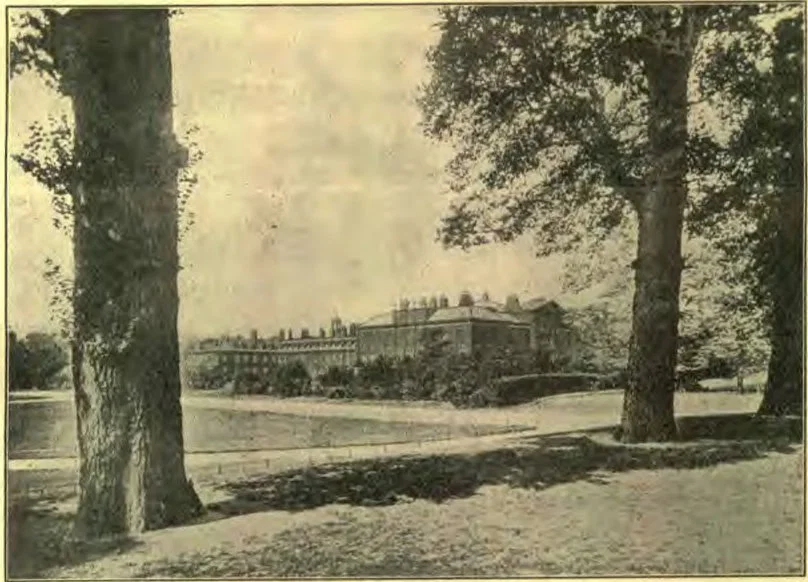
KENSINGTON PALACE
KENSINGTON PALACE
“These are but a few of the features of park scenery; but what most delights me is the creative talent with which the English decorate the unostentatious abodes of middle life. The rudest habitation, the most unpromising and scanty portion of land, in the hands of an Englishman of taste, becomes a little paradise. With a nicely discriminating eye, he seizes at once upon its capabilities, and pictures in his mind the future landscape. The sterile spot grows into loveliness under his hand; and yet the operations of art which produce the effect are scarcely to be perceived. The cherishing and training of some trees; the cautious pruning of others; the nice distribution of flowers of tender and graceful foliage; the introduction of a green slope of velvet turf; the partial opening to a peep of blue distance, or silver gleam of water,—all these are managed with a delicate tact, a pervading yet quiet assiduity, like the magic touchings with which a painter finishes up a favorite picture.
“The residence of people of fortune and refinement in the country has diffused a degree of taste and elegance in rural economy, that descends to the lowest class. The very laborer, with his thatched cottage and narrow slip of ground, attends to their embellishment. The trim hedge, the grass-plot before the door, the little flower-bed bordered with snug box, the woodbine trained up against the wall, and hanging its blossoms about the lattice, the pot of flowers in the window, the holly, providentially planted about the house, to cheat winter of its dreariness, and to throw in a semblance of green summer to cheer the fireside,—all these bespeak the influence of taste, flowing down from high sources, and pervading the lowest levels of the public mind.
“It is this sweet home-feeling, this settled repose of affection in the domestic scene, that is, after all, the parent of the steadiest virtues and purest enjoyments; and I can not close these desultory remarks better than by quoting the words of a modern English poet, who has depicted it with remarkable felicity:—
“‘Through each gradation, from the castled hall, The city dome, the villa crowned with shade, But chief from modest mansions numberless, In town or hamlet, shell’ring middle life, Down to the cottage vale, and straw-roof’d shed; This western isle hath long been famed for scenes Where bliss domestic finds a dwelling-place; Domestic bliss, that, like a harmless dove (Honor and sweet endearment keeping guard), Can center in a little quiet nest All that desire would fly for through the earth; That can, the world eluding, be itself A world enjoyed; that wants no witnesses But its own sharers, and approving heaven; That, like a flower deep hid in rocky cleft, Smiles, though ’tis looking only at the sky.’”
E. R. PALMER.

Putting in Time

It is a commonly heard expression: “I will put in the time some way!” What do we mean by it?—We mean that while we are waiting for somebody, or something, we will be doing something or other, we do not know what, but we will while away our time in some fashion. No one “puts in time” with a definite plan; it is always at blank haphazard. No one who “puts in time” expects definite results; he only expects to avoid ennui, and get through the hours till something comes along that is worth while.
But the expression is an admission that time is being put into something. Into what is it put?
Plainly it is being put into a hole, the big, black, bottomless pit of vacuity. Nothing comes out of that hole, though oceans of time flow in. It is one of the most greedy maws in the universe, and one of the least profitable. Time is far too valuable to throw in there. Time is the one thing that man can not make, nor can ever hope to make. Though it is given so freely, it is given most grudgingly—only a second at a time, and not for a king’s ransom a shred more than a second at a time. Moreover, time is what everything else that is worth while is made up of. Time is the universal solvent sought by the philosophers of the world; it may be transformed into all other valuables. Think of putting time into the yawning gulf of emptiness!
When next you have a chance to put in time, put it into a plan. Have a plan all ready, for you will have no chance to go after it. Time is the most volatile and effervescent of substances.
You may put it into a book you have at hand in your pocket. You may put it into an essay, half written, or half-outlined. You may put it into your Sabbath-school lesson, your next Young People's meeting. You may put it into the Bible—new reading, or heedful thought of what you read in the morning. Ah, there are so many fine places to put time in!
The difference between failure and success in life is largely in this matter of putting in time. Tell me how you spend your spare minutes, and I will tell you how to spend the rest of your life—and what salary you get for doing it! — Caleb Cobweb, in Christian Endeavor World.

Service the Law of Life

THE primary object of every gift bestowed upon us is that we may impart it. God has so arranged the economy of his gifts that we do not really receive the benefit from them ourselves until we have imparted them. Man does not receive anything, in the true sense, until he gives it away. We can not be blessed by simply receiving for ourselves. A blessing does not bless on its way in, but on its way out. We can not be blessed in a permanent way until we have taken the blessings bestowed, and passed them on.

A Lesson from Two Seas

Having by giving is in harmony with all God’s paradoxes. In the land of Palestine there are two seas. One is living; it receives its waters fresh from the streams and hills, and retains them just long enough to let them pass through it to the valley beyond. This is the Sea of Galilee. Note that it is kept fresh, pure, and living, not by what it receives, but by what it gives. No body of water in this world lives because waters flow into it, but because they flow out from it.
The other sea is dead,—the Dead Sea; the name tells the whole story. It receives pure water from the same sources as the Sea of Galilee, but retains it all within its own bosom, sending no stream of blessing forth. Therefore that which is life in Galilee is death in the Dead Sea. Thus God’s gifts to us become our condemnation and our death, if we retain them all within ourselves. We live and grow and flourish only as we give them forth.
“Looking unto Jesus, we see that it is the glory of our God to give. All things Christ received from God; but he took to give. So in the heavenly courts, in his ministry for all created beings: through the beloved Son, the Father’s life flows out to all; through the Son, it returns in praise and joyous service, a tide of love, to the Source of all.”

A Complete Circuit

Christ gives all things to us, that we may give all things to others, and they in turn may pass them on, until they at last return to the great Giver. “And thus through Christ the circuit of beneficence is complete, representing the character of the great Giver, the law of life.” We live as long as we are in the circuit, with the life and blessings of God passing unobstructed through us. We die when we seek to retain them for ourselves. The whole idea of the gospel is to teach the universe how to give. Lucifer obstructed that giving system, and sought to retain the gifts of God for his own benefit. Jesus Christ made the great, supreme sacrifice, to teach the universe that giving is the law of life. This great lesson is written in all nature, for “there is nothing save the selfish heart of man that lives unto itself.”

The Bumblebee and the Clover

In Australia there is no clover; not that clover would not grow there just as well as here, but there are no bumblebees, and clover depends for its life upon the service of the bumblebee. The people of New Zealand imported clover, but it would not grow until they imported bumblebees also. Thus the bee ministers to the life of the flowers, while they in return impart to it that which it needs to sustain its own life.

Living for Each Other

Man throws off from his body that which is the life of the flowers; the flowers throw off that which is life to man. Thus there is a relationship between man and the flowers, other than that which is established by their beauty. Every flower is supplying you with life, and you are supplying the flowers with that which is life to them. “Every tree and shrub and leaf pours forth that element of life without which neither man nor animal could live; and man and animal, in turn, minister to the life of tree and shrub and leaf.”
The strength of the sun evaporates the water in the seas and oceans, and the winds bear it over the land until it falls in showers to water the earth. The sun does this that it may serve the land and mankind; but it is itself glorified by this unselfish service, for the glorious sunsets and the rainbow are the direct result of it.
This principle holds good everywhere. Everything that lives serves something else. The Christian can never live except on that principle; for that is the foundation of the gospel, and that for which the gospel was given.

The Syphon

The syphon is perhaps the best illustration of this principle. A syphon is a bent pipe for conveying liquid from one vessel to another. With what is this pipe filled?—Air. You can not force the air out; the only way that it can be removed is by displacement—by putting something in its place. It must be dipped into the fountain and filled, and the air will go out. But to be filled is not enough; for if it is simply filled and left, its fulness will either evaporate or stagnate, although it came fresh from the fountain. You may be converted to God: you may know the blessings of the gospel; but if you stop there, these blessings will become a curse, because you are not imparting.
We must get this syphon into working order. Put one end into the fountain, remove the obstruction from the other end, and let it flow. It is not a great effort, not a great struggle; as soon as the obstruction is removed, the water will flow forth in a steady stream, and every drop that falls is an irresistible demand upon the fountain for a fresh supply,—a demand that it can not refuse.

The Result of Service

But there is something more yet: for every drop that falls, God multiplies the supply thirty-, sixty-, and an hundredfold. Suppose all Christians were living syphons, and drops were constantly falling from their lives upon the thirsty world around them, and they were receiving some thirty-, some sixty-, some an hundredfold, in the place of each drop: what would we have?—Showers of blessing. Some one has said that if one half of the time spent in praying for the Spirit were spent in fulfilling the conditions upon which it is promised, we would receive much more of it. When we get into the channel, the current of God’s life, as servants to labor, God will give us what we have looked and prayed for so long.
E. R. PALMER.

Unobeyed Orders

“They . . . told all these things unto the eleven, and to all the rest.”
We are ready to tell the eleven, With faces and hearts aglow, That the Lord has indeed arisen And before his own doth go, Through the old Galilean places, To the mountain of sacred tryst — To tell so fair an evangel Were a joy to be unmissed.
We are eager to tell the eleven How he sat with us at meat, And we scarce could speak for gladness, As the air grew strangely sweet; Till hence not a loaf unbroken, Or a cup with its wine unshed, But shall bring back the hour the Saviour Was known in the breaking of bread.
And still we tell the eleven, While, unknown and unconsoled, Vast kindreds, tongues, and peoples Are heirs of a tale untold. In the white light of death and judgment Sufficeth it then to attest, “We told the eleven, dear Master, But we told not ‘all the rest?’”
—Louise M. Hodgkins, in Zion’s Herald.

July Study of the Field

(July 11)
I. OPENING EXERCISES:—
Scripture Reading showing that the gospel is to go to the world.
2. Field Study:
(a) Experiences in Brazil. (Review and Herald, June 2.)
(b) Bolivia as a Mission Field. (Review and Herald, June 9 and 23.)
(c) Incidents from the Work in China. (Review and Herald, June 2 and 14.)
(d) Report of the Medical Missionary Work in Japan. (Review and Herald, June 9.)
(e) Report of Hillsdale Mission, Society Islands. (Review and Herald, June 23.)
3. Closing Exercises:
Prayer for Missions and Missionaries.

Royal, Oregon

The Society at Royal, Oregon, reports fifteen members, and holds weekly meetings on the evening after the Sabbath. The topics considered have been Temperance, general missionary work, and the INSTRUCTOR lessons. Some of the members have sold copies of “Christ’s Object Lessons,” others have sold and given away copies of The Life Boat. All are interested in Christian Help work. The secretary says: “I consider the interest good. The children are learning to work for God in the meetings, and are doing what they find to do in other ways.”

Keene, Texas

The Young People's work at Keene, Texas, is making encouraging progress. The Society now consists of fifty members, of whom several have recently joined. The studies in the INSTRUCTOR are followed, with much interest and profit to the members. The programs are planned so that different members take part. Often a quartet or other musical selection is introduced for variety. The Society sent one hundred copies of The Life Boat to two State prisons, and ordered five hundred copies to sell in its own vicinity. Other efforts are contemplated.

Young People's Society Work in Cedar Rapids

WE are pleased to give the following extract from a letter received concerning the Young People's work in Cedar Rapids, Iowa:—
“We now have an interesting Young People's Society. We organized with thirteen members, and we have in view about ten others whom we hope will unite with us. All over eight years old are in the organization. We are taking up the following lines of work: Paper, tract, Christian Help, and some of the older members may do something with ‘Christ's Object Lessons.’ Our members are getting considerably interested in missions. We have good meetings every Sabbath afternoon. We have an interesting and varied program, appropriate to the occasion.”
Continue reading: The Tale of a Plum-Tree