[By Addison Blakely, Ph. D., Lecturer in Political Science and History, University of Chicago.]
IN the course of English political development, as in the course of all political development, a thousand times there have arisen disputes between the ruler and the ruled as to the measure of governmental authority. At first, of course, the question arises merely as to particular acts; but as it is seen that each time aggression assumes a new form, the experience results in laying down general declarations of what the law limiting governmental power is. At first, these declarations are fragmentary and disconnected. But, as struggle after struggle goes on, as revolution after revolution takes place, as declaration after declaration is made, these great declaratory documents begin to assume completeness and largely cover the field on which governmental force most commonly trespasses. Thus the law limiting,—I was going to say,—but more properly declaring the limit of the proper sphere of action of government, develops and takes the form on its abstract side in declarations of rights, and in its more concrete form in those institutions which hold the official within well understood limits in the part he takes in wielding the force at the command of the State.
In its unwritten form the law is known as the common law, and in its written forms as Bills of Rights and Charters in England, and as Constitutions and Declarations of Rights in America. The most notable documents embodying this formerly unwritten law, are the Magna Charter of King John, the Petition of Rights of Charles I, the Bill of Rights and Act of Settlement of the Revolution of 1688, the Declaration of Independence of 1776, and the Federal Constitution of 1789.
“The common law of England,” says Chancellor Kent, “so far as it was applicable to our circumstances, was brought over by our ancestors upon their emigration to this country. The Revolution did not involve in it any abolition of the common law. It was rather calculated to strengthen and invigorate all the first principles of that law, suitable to our state of society and jurisprudence. It has been adopted, or declared in force, by the constitutions of some of the States, and by statute in others. And where it has not been so explicitly adopted, it is nevertheless to be considered as the law of the land, subject to the modifications which have been suggested, and to express legislative repeal.”
“They insisted,” says the Chancellor, speaking of the early New England settlers, “that they brought with them into this country the privileges of English freemen, and they defined and declared those privileges with a caution, sagacity and precision that have not been surpassed by their descendants. Those rights were afterwards, in the year 1692, on the receipt of their new charter, reasserted and declared.”
Several of the expressions in our Constitutions can be traced back to Magna Charter; and some to a half millennium earlier to the very earliest collections of English law, which would seem to indicate that they existed long before we had any transcript of the law at all.
In America, the first declaration of rights made by the colonies collectively was by the congress of delegates which met in New York in 1765. But a more complete and formal declaration was made by the first Continental Congress in 1774, which declared “that their ancestors, who first settled the colonies, were, at the time of their emigration from the mother-country, entitled to all the rights, liberties, and immunities of free and natural born subjects; and by such emigration they by no means forfeited, surrendered, or lost any of those rights; . . . that the respective colonies were entitled to the common law of England,” and so on.
“The rules of the common law which confine the discretion of Parliament within the ancient landmarks,” says Judge Cooley in “Constitutional Limitations,” “are rules for the construction of the powers of the American legislatures; and however proper and prudent it may be expressly to prohibit those things which are not understood to be within the proper attributes of legislative power, such prohibition can never be regarded as essential, when the extent of the power apportioned to the legislative power is found, upon examination, not to be broad enough to cover the obnoxious authority. The absence of such prohibition cannot, by implication, confer power.”
“Nor when fundamental rights are declared by the Constitution, is it necessary at the same time to prohibit the legislature, in express terms, from taking them away. The declaration is in itself a prohibition, and is inserted in the Constitution for the express purpose of operating as a restriction upon legislative powers.”
Legal rights, therefore, antedate any and all “declarations” of such rights. The term itself shows them to be prior, and that the “declaration” is merely nominal and not creative. The numeration, in formal shape, is merely for emphasis to make doubly sure of their enforcement, and to render a denial of such fundamental rights as difficult as possible.
PROTESTS AGAINST RELIGIOUS LEGISLATION BY CONGRESS.
As announced in our last issue, there is now before Congress a bill for a Sunday law for the District of Columbia. This effort to commit Congress to a course of religious legislation has not escaped the notice of all lovers of liberty in this country, and protests and petitions against it are being received from various quarters by those having the bill in charge. The Religious Liberty Association of the District of Columbia have entered protest against the passing of the measure, as follows:—
To the Honorable the Commissioners of the District of Columbia, and the Committees on the District of Columbia of the Congress of the United States.
Gentlemen: We enclose preamble and resolutions passed at a meeting of the International Religious Liberty Association of the District of Columbia in opposition to House Bill 167, introduced by Mr. Morse, of Mass., which is a bill for a Sunday law for the District of Columbia.
There are a number of reasons which might be given why the Commissioners of the District and the Congress of the United States should have nothing to do with any such proposals; but there is one consideration which so far overshadows all others in its importance as to render unnecessary, indeed, the presentation of any other in the same connection. We therefore confine ourselves to this one, and that is—
The bill, in its terms and in its intent, is distinctly religious, and being such it is entirely beyond the jurisdiction of Congress by the First Amendment to the Constitution which explicitly declares that “Congress shall make no law respecting an establishment of religion or prohibiting the free exercise thereof.”
1. In its terms the bill is distinctly religious, because in the first clause and in the seventh line it provides that those who are exempted from the operation of the law shall religiously observe Saturday instead of Sunday, thus making the government the judge of the character of the observance of the seventh day of the week by those who profess to believe in the observance of that day.
2. In its intent the bill is religious, because not one of the promoters of the bill would say for a moment that the acts prohibited in this bill were wrong in themselves, or at any other time than on the Sunday; and they are held to be wrong on that day only because of the character of the day, and not at all because of the thing done. In other words, it is the character of the day itself, and not the character of the thing done on the day, which determines the criminality of the action in this bill and all similar legislation. This demonstrates that it is the religious character of the day, and that only, which is held in view in the bill.
By these facts it is demonstrated that the bill, both in its terms and its intent, is distinctly religious. Further than this, the effect of its passage by Congress would inevitably be to involve the National Legislature in the decision of a religious controversy, for the reason that the bill forbids the doing of certain acts on “the first day of the week, commonly called Sunday.”
Assuredly your honorable body is not unaware of the fact that there is now rife throughout both the District of Columbia and the nation no inconsiderable controversy over this very question as to which day is the Sabbath. And it is well known by many that the chiefest object of this bill is to get Congress committed to the support of that party which insists that Sunday is the Sabbath. Is it the province of your honorable body or of Congress to decide this question? Yet more than this, if Congress should assume this prerogative and pass the bill declaring Sunday to be the Sabbath, would the question be decided? Would an act of Congress convince the Jew or the Christian Sabbatarian that he was wrong in his reading of the Scriptures, and in his consequent observance of the day which is the Sabbath?
The bill, being religious in its terms, in its intent, and in its inevitable effects, it follows conclusively that Congress is positively forbidden by the First Amendment to have anything at all to do with it.
For, that such is the intent of the First Amendment is evident from the following consideration. Amid the discussions and the interesting and important events that immediately preceded, and in fact led up to, the making of the Constitution as it is as respects religion, this whole question was widely discussed. And James Madison, upon a subject identical with this in principle, published these weighty words which we have adopted as our own:—
“We hold it for a fundamental and undeniable truth, that religion, or the duty which we owe to our Creator, and the manner of discharging it, can be directed only by reason and conviction, not by force or violence. The religion, then, of every man must be left to the conviction and conscience of every man; and it is the right of every man to exercise it as these may dictate.
“If religion be exempt from the authority of society at large, still less can it be subject to that of the legislative body. Either, then, we must say that the will of the legislature is the only measure of their authority, and that in the plenitude of that authority they may sweep away all our fundamental rights, or they are bound to leave this particular right untouched and sacred. Either we must say that they may control the freedom of the press; may abolish the trial by jury; may swallow up the executive and judiciary powers of the State—nay, that they may despoil us of our very right of suffrage, and erect themselves into an independent and hereditary assembly,22or we must say that they have no authority to enact into a law the bill under consideration.”
For these reasons, briefly stated, but sufficient, we protest against the consideration of this bill; and respectfully submit to the careful consideration of your honorable body, this our remonstrance.
ALLEN MOON, Pres.
In view of the introduction of this bill in the House, and in the Senate of a joint resolution proposing a religious amendment to the national Constitution, the following preamble and resolutions have been presented to the proper congressional committees by the same association:—
Preamble and Resolutions passed by the Religious Liberty Association of the District of Columbia.
WHEREAS, In obedience to the demands of many religionists there was introduced into the Congress of the United States the following proposed legislation: In the House of Representatives on Dec. 6, 1895, by Hon. E. A. Morse, a bill providing for the enactment of a Sunday law for the District of Columbia, and on Dec. 16, 1895, in the Senate by Senator W. P. Frye, a joint resolution proposing an amendment to the Constitution of the United States, for the recognition of Christianity as the common law of the land, and
WHEREAS, The passage of such legislation would commit the government to a system of religion, in direct opposition to the Declaration of Independence and the provisions and guarantees of the Constitution, and
WHEREAS, Civil government has no right to enforce religion, and exists to protect all citizens in their right to be religious or not provided they do not violate the civil rights of others; and rights of citizenship cannot rightfully be made dependent upon whether the person is religious or not, therefore,
Resolved, That the Religious Liberty Association of the District of Columbia do hereby earnestly protest against the consideration by Congress of any matter affecting the religious rights of the people, and appeal to the makers of the civil law to enact no legislation contrary to the provision of the Constitution which declares that “Congress shall make no law respecting an establishment of religion or prohibiting the free exercise thereof,” and
Resolved, That copies of this preamble and resolutions be transmitted to Congress and the Commissioners of the District of Columbia.
ALLEN MOON, Pres.
G. C. EMERY, Sec.
The Seventh-day Baptists, also, have prepared the following petition, and are forwarding the same, with signatures, to the committee having charge of the bill for the District of Columbia:—
To the Hon. J. W. Babcock, chairman, and to his associates, members of the Committee on the District of Columbia, to whom House Bill No. — entitled, “A bill to protect the first day of the week, commonly called Sunday, as a day of rest and worship in the District of Columbia,” has been referred:—
Gentlemen: We, the undersigned, citizens of the United States, and voters, do hereby respectfully and earnestly petition and pray that the bill named above be “adversely reported” by your honorable body, and for the following reasons:—
1. The National Constitution debars Congress from legislating on religious questions, as proposed in the bill under consideration, e. g., the expressed reason for prohibiting labor, business, etc., on Sunday is purely religious, viz., that it is “the Lord’s day; set apart by general consent in accordance with divine appointment as a day of rest and worship,” etc. The exceptions named as “works of necessity and mercy” originate from the ancient Jewish law of the Sabbath. Thus it is proposed to determine by statute and court what is proper to do or not to do on “a day of rest and worship,” made such “by divine appointment.”
2. This bill proposes “class legislation” on purely religious grounds, in that certain persons are exempted , providing they “religiously observe Saturday.” In case of trial, the courts must decide in what the “religious observance of Saturday” consists, and upon what grounds it rests.
3. Such a law would do grave injustice to a large number of citizens who deem all days of equal religious sacredness, and also to those who do not deem it a religious duty to observe either the seventh or the first day of the week as a “day of rest and worship.” Your petitioners also plead that the provisions of this bill are opposed to religious liberty in general, and to that freedom of thought and action in matters religious which the Constitution guarantees to all citizens, and that its enactment into law would open the way for endless unjust, unchristian and un-American interference in religious faith and practice on the part of Congress. For these and many other reasons your petitioners pray that this bill be “adversely reported.”
We are, of course, heartily in sympathy with this petition, and with the protest and preamble and resolutions here given. Let all lovers of liberty unite in opposition to these dangerous measures now claiming the support of this Government.
SUNDAY “LAWS” IN TRINIDAD, W. I.
By E. W. Webster
BY E. W. WEBSTER.
This colony has had a Sunday law for some time, but it is not severe enough to suit some of the leading churchmen. It permits business places to be open until 9 o’clock Sunday mornings, so that the poor people who have no way of preserving their provisions over night in this hot climate may have opportunity to get what little they are able Sunday morning. And some of them are so poor that they could not get food one day ahead, so the law as it is accommodates them somewhat.
But this is offensive to some who have keener senses of the way in which the day should be kept, and in 1893 they made an effort to “better” the law; but they were not successful,—all honor to the governor for it. The leading ministers of Port-of-Spain assembled and drafted a bill, and induced one of the members to introduce it into the Colonial Council on the 4th of Nov., 1895. It was accepted to be finally acted upon at the next meeting of the Council.
Immediately on hearing of it I sent the following protest to the governor, and about the same thing to three other members of the Council:—
Couva, Trinidad, Nov. 6, 1895.
SIR F. N. BROOME,
St. Anns, Port-of-Spain, Trinidad.
Your Excellency, Governor of Trinidad and Tobago:
I see by the Port-of-Spain Gazette of yesterday that an ordinance was introduced into the Council meeting on the 4th, by Mr. Alcazar, entitled, “Sunday Trading Ordinance.” I have not seen a draft of the bill, but its title indicates that it is likely to be one that will interfere in no small degree with the rights of the people. I beg not to be thought intrusive, nor to hint that your excellency is not fully able to decide such questions in the best interests of your subjects. On the contrary, your decision on a similar question in 1893 fully proves your excellent wisdom, and gives me the more boldness to address you on this issue.
I take the liberty to send you a small publication of the International Religious Liberty Association, of which I have the honor of being the colonial agent for Trinidad,—“The Sabbath Question in the Dominion Parliament,”—which I earnestly hope your excellency will have the time and disposition to peruse carefully, and which I hope will be not only interesting but profitable to you.
Please allow me also to call your mind to a few thoughts which, however, your highness may have entertained before:—
1. This bill is introduced through the instigation of a few of the high ecclesiastics, who, for the purpose of gaining their own ends, of augmenting their own power, pretend to have a great interest in the welfare of the people at large. These men have money enough to purchase their Sunday’s provision the previous day, also the ice and ice-chests with which to preserve it; is it then a small matter to deprive these hundreds of poor people, who must buy on Sunday or go hungry, the privilege of purchasing enough to give them a little comfort? This course is a sure way to make the people hate the day and the government. If the tables were turned what a protest would arise!
2. It is ostensibly to gain a better observance of the “sabbath.” But can a law enforcing idleness secure sabbath-keeping? Will the mass of the people who will thus be compelled to abstain from business on one day, have any better idea of sabbath-keeping? Can spirituality be enforced by civil enactments? If a better observance of the Sunday is what is wanted, why do not these men spend some of their energies in teaching the people what true Sabbath-keeping is, and get them to observe it from love to God, and not from fear of the civil law? It seems to me, your excellency, as though it was for patronage. Keep the people from secular business on Sunday and they may be more apt to attend religious services. Or, on the part of some of the merchants, they would like to keep the Sunday, but are afraid that if they do and others do not, their business will suffer one day’s trade, while their neighbor has that much the advantage of them. In other words, they would like to keep Sunday, but have not enough faith in God to do so if their trade is in danger of suffering a little; so they must make other merchants keep the day too, so they may keep it! The idea that we must compel all others to keep Sunday that we may do so, can be answered in one sentence: We cannot be Christians unless all others are too, so we must make a law to compel them to be Christians that we may enjoy that coveted privilege! I speak not against Christianity, but for it. It is higher than this.
3. It is a religious question, one upon which civil government has no authority from God to act. Where has God ever conferred upon any earthly government the right to make laws for him in things solely spiritual, as this is? Where has he ever commissioned his representatives on earth to make such demands upon any government? To do so is a usurpation by them of undelegated powers; as it would be also on the part of the government to accede to their demands in such matters. It is true that there are some who honestly wish to do something to bring about a better state of things in this matter; but are they not sadly mistaken to think that compliance with such laws is Sabbath-keeping? or even to think that it prepares the way and leads to it? It lowers the standard of religion, as it gives the people the idea that that is Sabbath-keeping, which is not.
4. It will work an evil to the government and prove a curse to the church. The courts would soon have their hands full of criminal cases for spiritual offenses. The subjects would be no better off with it, for they will feel that an unnecessary and unjust restraint is placed upon them, and would stealthily strive to avoid it; and thus they would be learning disobedience, and to resist just authority. It would be to teach them hypocrisy and incivility, and perhaps insubordination.
5. There are Jews and also Christians in this island who religiously observe the seventh day, and feel bound by the same command to work six days. Ex. 20:8-11. It would work great hardships to such were this ordinance passed. It would either deprive them of one-sixth of their time and cause them to violate their consciences (thus making them bad citizens), or, if they were too true to God to disobey him, would bring upon them fierce persecution by those who would be incensed against them enough to enforce the law or enter complaint; for they would have to obey God rather than man; or, losing heart, they would soon become the most irreligious and uncivil and dangerous persons on the island. And can your excellency tell who would sooner enforce the law than those who could find no better arguments to answer the23truths of the Bible that the seventh day is the Christian Sabbath and should be kept instead of the first day? And upon whom do you think it would sooner be enforced than upon those who deduce from the Scriptures unanswerable arguments that the seventh day is the Sabbath, and who have courage and religion enough to live out their convictions. A mistaken religious zeal leads to cruel deeds.
Trusting, Sir, that your excellency will have patience with this protest, and assuring you that I remember the exhortation to “pray for kings, and for those in authority,”
I am, with greatest respect,
Your obedient servant,
E. W. WEBSTER.
The following is his excellency’s reply:—
Government House, Trinidad, November 9, 1895.
Dear Sir,
I am directed by his excellency the governor to acknowledge the receipt of your letter of the 6th inst., inclosing a pamphlet entitled “The Sabbath Question in the Dominion Parliament.”
His excellency has been very much interested in the perusal of your letter, and of the publication you inclosed; and I am to thank you for your views on this important question.
Believe me, Sir,
Your obedient servant,
P. Sec.
E. W. Webster, Esq.
We promise the readers of the SENTINEL that they shall hear of the final action of the Council.
AN OLD BUT VALUABLE BOOK.
We are in receipt of a copy of a modern but faithful reproduction of the oldest historical literary and devotional work extant. This book contains an authentic account of the formation of this planet, of the origin of the human family, of the great convulsion of Nature which changed the face of the earth, formed our coal beds, and finally locked in the embrace of never-yielding ice lands that originally basked under summer skies. From it we learn of the peopling of the earth, discover the origin of the various races of men, behold the rise of civilization and trace the course of empire as westward it takes its way. And last but not least its pages tell of a new heaven and a new earth one day to spring at the divine fiat from the ashes of this present evil world wherein shall dwell only righteousness.
And yet the half has not been told; for this book tells the story of the cross, invites the sinner to repentance, offers pardon, and promises eternal life. The reader need not be told that the work we refer to is the Holy Bible; no other book does all nor a tithe of that which we have here stated, and all other books do any of it only as they draw from this one Book of books. Grand Book! Glorious mission!
But this particular copy of the Bible contains features all of which are not found in any copy of the Sacred Writings. It is self-pronouncing, all the proper names being divided into syllables with diacritical marking. Bound with it are copious helps consisting of illustrations, plates, maps, tables, index, concordance, etc., etc., making it one of the most, if not the most, complete teachers’ Bible published. This Bible is made by the International Bible agency of this city, to the manager of which we are indebted for an elegant copy, and who will cheerfully furnish further information upon application. Full particulars, prices, etc., will be furnished also by the Pacific Press Publishing Company, 43 Bond Street, New York.
ARRESTED FOR SUNDAY WORK.
A CORRESPONDENT in Indiana writes as follows:—
William Bailey, an employé at the C. & E. railroad shops at Huntington, Ind., owns a house and lot at a small place called Brown’s Corner, about seven miles from Huntington. The kitchen roof leaking, the rainy weather made it necessary to repair it at once. Being unable to get a day off, on Saturday, the 14th of December, he sent material for repairing the roof out to the Corner by his wife, and on Sunday went home and did the work. For this he was arrested and tried before Justice Scott Cole, at Huntington, and fined $1 and costs, amounting to $28.30. He refused to pay, and filed an appeal bond. Mr. Bailey is not a seventh day keeper. W. H. LENGEL.
The fact that Mr. Bailey is not a Sabbatarian cuts very little figure in this case. The State has no right to require any man to keep Sunday or any other day; and to do so is persecution whether the victim observes another day or not.
“I AM SURPRISED,”
Says Prof. E. A. Sheldon, President of the New York State Normal School, Oswego, “that so much that is valuable for one to know is brought into so small a compass, and sold for so small a price.” Yes,
The NEW WEBSTER DICTIONARY and COMPLETE VEST-POCKET LIBRARY
is full of happy surprises.
It successfully combines in one small volume of vest-pocket size.
A Dictionary of 45,800 words,A Complete Parliamentary Manual,
(Based on Roberts’ and Cushing’s)
A Literary Guide, etc.
—FOR THE VEST-POCKET OR THE WRITING DESK—
Simple, - - Handy, - - Reliable.
Just what everybody needs for every-day use. DO NOT DELAY TO ORDER. Sent post-paid as follows.—
FINE SILK CLOTH, Red edges, - - 25 cents.
MOROCCO, Gold edges, - - - 50 cents.
EXTRA MOROCCO, With Perpetual Memorandum, Three Years Calendar.
Stamp Holder, etc. - - 60 cents.
All three styles are indexed.
—ADDRESS—
PACIFIC PRESS PUB. CO.,
43 Bond St., New York City.
The Shepherd King
(Companion volume to “Good Shepherd.”)
A Book of Eighty-eight Pages, With Thirty-seven Pictures,
Many of which are full-page;
Illustrating the most striking events in the life of David.
The whole story is told in a most entertaining manner, and is highly instructive to the young and interesting to the old.
Bound in Lithographic Illuminated Covers, postpaid, 50c
Address, PACIFIC PRESS PUB. CO., 43 Bond St., New York.
BOOKS FOR THE CHILDREN.
We offer the following three books as the best of their kind we have been able to find. They are profusely illustrated, and the stories are told in a very simple yet highly entertaining manner. The books cannot fail to be exceedingly helpful to children in an educational way, and should be found in every home:—
LITTLE FOLKS’ BIBLE GALLERY
Has nearly 100 pages, and contains 43 Bible stories, each illustrated with a full-page picture. Size, 7x9 inches, bound in board lithograph covers. Price, by mail, post-paid, $1.00
BIBLE PICTURES AND STORIES
Has 45 full-page illustrations and an equal number of well-told Bible stories. Same style and size as “LITTLE FOLKS’ BIBLE GALLERY,” and is really a companion volume to it. Price, post-paid, $1.00
A mother, than whom none can be more careful and particular as to what her children have to read and study, speaking of these two little books, says: “Really it is a pity that any little child should not have the privilege of seeing these beautiful full-page pictures and hearing the well-told stories.”
Both “LITTLE FOLKS’ BIBLE GALLERY” and “BIBLE PICTURES AND STORIES” will be sent to one address, post-paid, for $1.75
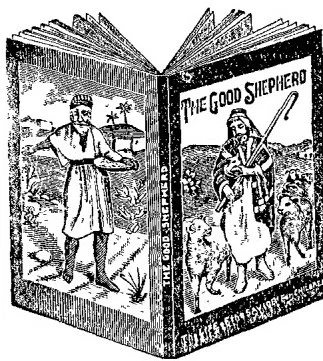
The Good Shepherd:
The Life of the Saviour for Children.
Beautifully Illuminated Covers!
Fifty-three Illustrations!
Interesting Reading!
Ninety-six pages,
Large print,
Good paper,
Strong binding.
This book, which is 8x10½ inches and ½ inch in thickness, tells the story of the life of Christ in a way that cannot fail to interest the little folks. It is exceptionally free from doctrinal errors, and should be in every family where there are children to be taught a Saviour’s love. The illustrations add very much to its educational value. Price, only 50 cents.
PACIFIC PRESS, 43 BOND STREET,
NEW YORK CITY
STORIES FROM THE ACTS OF THE APOSTLES
(Companion volume to “Good Shepherd.”)
A book of 88 pages, with 45 pictures, 22 of which are full-page, representing in a very instructive manner various scenes in the history of Peter, Paul, and others of the Apostles. The stories are arranged with special reference to the little children. Bound in lithographic illuminated covers, postpaid, 50c
PACIFIC PRESS PUBLISHING CO.,
43 BOND ST., NEW YORK CITY
Abiding Sabbath And Lord’s Day.
By Alonzo T. Jones
BY ALONZO T. JONES.
A pointed review of the $500 and $1,000 prize essays in support of the Christian Sabbath, so called. Those desiring some $1,000 reasons for keeping the first day of the week, will find them here. 173 pages, 20 cents. Pacific Press, 43 Bond St., New York City.
International Tract Society Appeals Factory Act Restrictions
IN their appeal to the Home Secretary, published in these columns two weeks ago, among other things, the directors of the International Tract Society, Limited, of London, very properly said:—
We have felt it not disrespectful to address you this note of remonstrance against the action of a law by which the work of our factory is stopped and our factory employés deprived of this means of earning a livelihood.
All just governments are instituted for the purpose of securing human rights. “The powers that be are ordained of God” for this very purpose; “they are God’s ministers, attending continually upon this very thing;” and Christians are entitled to share the benefits, the protection of government, equally with unbelievers. “I exhort, therefore,” writes the apostle, “that, first of all, supplications, prayers, intercessions, and giving of thanks, be made for all men; for kings, and for all that are in authority; that we may lead a quiet and peaceable life in all godliness and honesty.” 1 Tim. 2:1, 2.
Such being the purpose for which governments are ordained, and Christians being entitled to share the benefits, what could be more fitting than the act of the International Tract Society in calling the attention of the Home Secretary to the fact that the Factory Act, instead of protecting certain of the employés of the society, actually deprived them of the means of earning a livelihood! Fanaticism might have said, “We need not concern ourselves about our rights; God will protect us;” just as fanaticism has in some instances said, We need not work; God will feed us; and, We need not use remedies; God will heal us. But true faith uses rather the means that God has ordained for the securing of rights, the providing of food, and for the care of the body, asking his blessing the while upon the efforts put forth in his fear and for his glory.
The point made by the International Tract Society that the operation of the so-called Factory Act infringed the rights of its employés is well taken and is a credit both to the piety and the sagacity of its directors.
Brooklyn Churches Urged to Protest Excise Law Laxity
By Editor
WE have received a copy of a circular sent out January 9 by several temperance and religious societies of Brooklyn, calling for “a united and emphatic protest” by “the churches in Brooklyn” against the laxity in the enforcement of the excise laws in that city. “We have abundant evidence,” it says, “that no fewer than ninety per cent. of the licensed saloons are open on every Sunday and that liquor is sold in many of them to minors and drunkards, and that often the police freely enter these saloons for improper purposes at hours when the law requires them to be closed.”
We call attention to this circular because of the frank disclosure it makes of the real purpose of these excise laws, and the object of this protest, by saying: “At the beginning of a new municipal administration, the time is opportune for our citizens who believe in the sacredness of Sunday and in the sacredness of law, to enter a protest against this flagrant violation of the excise laws.” Why, then, according to this document, should the excise laws be enforced? The plain answer is, Because Sunday is a sacred day. The sacredness of law is also adduced; but the “law” itself, in this case, rests wholly upon the assumed sacredness of the day; so that this assumption is really the sole support for this demand that the saloons should observe Sunday according to the terms of the “excise laws.” In other words, these and all other Sunday “laws” are based upon the assumption that Sunday is a day which ought to be observed by rest and public worship, and therefore the excise Sunday “law” derives all the sacredness it has from the assumed sacredness of Sunday. But Sunday has no sacredness; for God, who alone can impart sacredness, never made it so. He made the seventh day sacred, but no other. Hence a “law” which owes its existence to the popular practice and belief based upon this assumption, cannot be sacred.
Law is sacred. It is sacred because justice and right are sacred. The law of justice covers the whole ground of human legislation; and when that legislation expresses the law of justice upon the point concerned, it is sacred. But when it is contrary to that law, it is certainly not sacred.
The fact that liquor is sold to minors and drunkards is a reason why the saloons should be closed, but it does not call for a protest from those who believe in Sunday sacredness, any more than from those who do not so believe. It is bad—exceedingly bad—that intoxicants should be sold to minors and drunkards; but it is no less bad that they should be sold to young men who are not drunkards, to make them such. It is bad that intoxicants should be sold on Sunday, or on any other day. Sunday prohibition cannot stop intemperance, even on that day. It can however exalt Sunday—a religious institution—and that is what it does. But no religious institution ought to be upheld by legislation.
Therefore the proper action is to protest against any law that does not aim to “excise” (cut off) the saloon completely. There is no more reason why intoxication and inciting thereto should be prohibited merely on Sunday, than there is why stealing or any other crime, and the inciting of people thereto, should be prohibited merely on Sunday.
Let all crimes be prohibited on all days and at all hours.
Seventh-day Baptists Resolve Sympathy for Persecuted Sabbath-keepers
By Editor
REFERRING to our leader of last week, Rev. A. H. Lewis, D. D., of Plainfield, N. J., calls our attention to the fact that the Seventh-day Baptists in their ninety-third anniversary held last August, passed the following resolution:—
Resolved, That we extend our heartfelt sympathy to those Sabbath-keepers of Tennessee, Maryland, Georgia, and other States, who have been, or who are now suffering from the malicious application of unjust Sunday laws.
This resolution though nothing more than was to be expected of such a liberty-loving people as Seventh-day Baptists is creditable to them, and certainly entitles the denomination to be noted as an exception to our statement, which however was intended to include only Sunday-keeping bodies. And since the matter has been called to mind we incline to the opinion that a Lutheran Synod somewhere in the West also took similar action.
No text of the Sacred Scriptures is more misinterpreted and misunderstood than Rom. 13:1. God never ordained injustice and oppression. Except in the nation of Israel, it is not, and never has been, personal sovereigns in themselves that have been referred to in the statement that “the powers that be are ordained of God.” It is not the persons that be in power, but the powers that be in the person, that are ordained of God. The inquiry of Rom. 13:3 is not, “Wilt thou then not be afraid of the persons?” but it is “Wilt thou then not be afraid of the power?” It is the powers and not the person or persons by whom the power is exercised, that is under consideration. God has ordained civil power for the administration of justice, and when those entrusted with the administration of that power are guilty of injustice and oppression they are guilty of usurpation. Having exceeded the limits of their God-ordained power they are in that usurpation no more the ministers of God than is the Christian minister the representative of Christ when he usurps and attempts to wield authority not given by the gospel commission.