Signs of the Times, Vol. 31, No. 4.

RIGHT MUST WIN
Earlier text: How They Became Convineced

SUGGESTIVE QUESTIONS

The Sabbath-school lessons have been discontinued. The Lesson Quarterly may be obtained, containing three months' lessons and notes, for five cents. Address, Pacific Press, Mountain View, Cal. The Sunday-school lessons will continue.
LESSON 6.—FEBRUARY 5.—JESUS AT JACOB'S WELL. Lesson Scripture, John 4 : 5–14, A. R. V.
(5) "So He cometh to a city of Samaria, called Sychar, near to the parcel of ground that Jacob gave to his son Joseph; (6) and Jacob's well was there. Jesus therefore, being wearied with His journey, sat thus by the well. It was about the sixth hour. (7) There cometh a woman of Samaria to draw water; Jesus saith unto her, Give Me to drink. (8) For His disciples were gone away into the city to buy food. (9) The Samaritan woman therefore saith unto Him, How is it that Thou, being a Jew, askest drink of me, who am a Samaritan woman? (For the Jews have no dealings with Samaritans.) (10) Jesus answered and said unto her, If thou knewest the gift of God, and who it is that saith to thee, Give Me to drink; thou wouldest have asked of Him, and He would have given thee living water. (11) The woman saith unto Him, Sir, thou hast nothing to draw with, and the well is deep; whence then hast Thou that living water? (12) Art Thou greater than our father Jacob, who gave us the well, and drank thereof himself, and his sons, and his cattle? (13) Jesus answered and said unto her, Every one that drinketh of this water shall thirst again; (14) but whosoever drinketh of the water that I shall give him shall never thirst; but the water that I shall give him shall become in him a well of water springing up unto eternal life."
Golden Text.—"Whosoever will, let him take the water of life freely." Rev. 22:17.

SUGGESTIVE QUESTIONS.

(1) In going from Judea to Galilee, on a certain occasion, to what city did Jesus come? Near what historic place was it? Verse 5. Note 1. (2) What noted landmark was there? On arriving at the well what did Jesus do? Why? What time of day was it? Verse 6. Note 2. (3) As Jesus sat by the well, who came to draw water? What did Jesus say to her? Verse 7. Note 3. (4) Where were the disciples at this time? Verse 8. (5) How did the woman reply to Jesus' request? Why was His request a surprise to the woman? Verse 9. Note 4. (6) How did Jesus answer the woman's question? Verse 10. Note 5. (7) By what reasoning did the woman show that she did not discern His meaning? Verse 11. (8) How did she show that she simply regarded Jesus as an ordinary Jewish traveler? Verse 12. Note 6. (9) What did Jesus say should come to every one who should drink of the water of that well? Verse 13. (10) How did He contrast that water with the water that He should give? Verse 14. Note 7.

NOTES.

1. Jesus was on His way from Judea to Galilee, because there was a growing impression that His work was in rivalry of that of John the Baptist. Jacob's purchase of this ground is recorded in Gen. 33:18-20; and the gift to Joseph is noted in chapter 48:22.
2. "The sixth hour" was at noon. The custom of oriental travelers was to start very early in the morning, so that by noon one walking would naturally be weary. This would especially be the case with one who bore such a weighty burden of spirit as Jesus did, and who habitually spent much of the night in prayer, besides laboring incessantly through the day.
3. Jesus asked a favor. He was in need of the water, and it was also a tactful way of getting the woman's attention; for most people are pleased to have others laid under obligation to them. And in the East there was much significance attached to giving and receiving a drink of water. It implied a covenant of hospitality, was like the covenant of bread-sharing, which constituted a truce, for the time being, between even deadly enemies.
4. Verse 9 shows that already the woman was prepared to enter into conversation.
5. By the "living water" Jesus referred to the divine grace which He alone could bestow, and which is as living water, purifying, refreshing, and invigorating the soul. By this direct reference to spiritual things we learn that Jesus did not waste any time or words in idle, common-place conversation. As in the interview with the autocratic ruler, Nicodemus, He ignored all compliments and flatteries, so with the lowly Samaritan woman, after she had supplied His immediate need, He began to impart to her that which would supply her greatest necessity.
6. The Samaritans, altho at variance with the Jews in many things, claimed descent from Jacob, and by their possession of land that he owned by purchase, claimed even a paramount relationship. Hence the significance of the woman's implied thrust at Jesus, who was a Jew, by asking Him if He were greater than "our father Jacob, who gave us the well."
7. "Jesus did not mean that one draught of the water of life would satisfy the receiver, but that whosoever would unite with Him would have within him a living fountain from which to draw strength and grace sufficient for all emergencies. Words and deeds of righteousness flow from it, and refresh the hearts of others, as well as the soul from which it springs. Jesus Christ, the never-failing Source of this fountain, cheers the life and brightens the path of all who come to Him for aid. Love to God, the satisfying hope of heaven, springs up in good works unto eternal life."—"Great Controversy," Vol. 2. And "love to God" consists in keeping His commandments. See John 14:15-17.

OUR DEAR LITTLE FRIEND:

Indeed I enjoy the weekly visits you give us. My sister and I both study our Sabbath-school lessons from the "Youth's Instructor," but "you" are just as welcome as ever. I really believe we could not be without you. Your stories are all so very interesting.
So here is fifty cents to pay for fifty-two visits another year.
Wishing you good success through the coming year, I remain,
One of your readers, IDA PETERSON.

Increase the Signs of the Times Club

Brother Chas. W. Peters of 916 Laguna Street, San Francisco, Cal., desires a large increase in his club of Signs of the Times that he may better supply the reading racks and cabins of about fifty fine Ocean Liners and hundreds of sailing vessels anchored in San Francisco Bay.
He is now receiving fifty copies but desires at least one hundred more. They will cost $22.50 for three months. Who will assist him? Orders for papers may be sent direct to the Signs of the Times, Mountain View, Cal.

Notes on Current Events

We urge our readers to more than glance at the article of Mr. Price on "The Evidence of Archeology." The facts presented and the argument itself are conclusive. Reading this, you will wish to read them all.
It is no matter of surprise to us that Dr. R. Heber Newton has announced himself a Spiritualist. It is the logical result of a belief in the soul's inherent immortality. All who continue to hold that belief, and live long enough, will be believers in Spiritualism, one of the marked delusions of the centuries, and especially of the last days.
A Good Day in Oakland.—For the first time in over four months the writer had the privilege and pleasure of meeting with the church in Oakland, January 7. While the Sabbath-school was smaller, the general congregation was not greatly diminished. Between the Sabbath-school and the service which followed one dear soul was buried in baptism. The celebration of the ordinances followed, and it was a good meeting indeed. May God bless our brethren in Oakland.
A Blessing, if True.—A news despatch from Buffalo, N. Y., reports that the Gratwick Pathological Laboratory of the University of Buffalo, which has for some years been investigating cancerous diseases, and has demonstrated "cancer to be a parasitic disease, infectious in type; that it has been transplanted and reproduced in perfectly healthy animals; that the reproduction has been true cancer, as it exists in the human, and that the disease in animals has been cured by the administration of a serum prepared in the Buffalo laboratory." All the cures thus far have been wrought upon mice. It is to be hoped that this is much more than Koch's reported cure of consumption.
A Good Day in Mountain View.—After a well-attended morning service in the forenoon, in the Pacific Press chapel, a large number repaired at 2.30 P.M. to the Baptist Church, where eleven—four brethren and seven sisters—were baptized by Pastor W. T. Knox. We are glad for this the first-fruits in our church here, and pray that there will be many more to follow. Our thanks are due to our Baptist friends for the use of their church and baptistry. May the blessing of God be with them.
A child of one and one-half years was recently brought to a New York infirmary for treatment. It had been compelled by its mother to labor day after day rolling little balls in paste to be used in certain millinery trimmings. After a few days' treatment the infant was taken back by its mother to continue its labors. The mother saved fifty cents a week by this kind of child labor. Think of the outrageous punishments required to "educate" such an infant to stick at such work day after day. It seems beyond belief in its inhuman conceptions.
Japan's rapid rise to a prominent place among progressive nations seems to have inspired new hopes in the heretofore sluggish yellow and brown races. China is being aroused to the possibilities that have so long lain dormant before the fast-encroaching white man. The people of India, too, are wondering why they, with all their millions of people, have so long been held subservient to a foreign power so greatly inferior in numbers. But it is not only Japan's unaided progress that has led them to ponder the situation, and to bestir themselves; there is the example of the Filipinos whose upward lift, under the tutelage of the United States, is leading the people of India to an unfavorable comparison of their condition under a British rule of a century and a half. For three hundred years the government of Spain held the Philippines under absolute sway, theoretically. That is, the people had no rights politically. Yet in five years' time, under the dominion of the United States, the Filipinos are enjoying political privileges far beyond those of the natives of India—with the promise and prospect of further rapid political recognition. While the government of a provincial territory by a republic at all may be subject to criticism from an American standpoint, the improvement of the Filipino situation is, from the standpoint of the British Indian subject, a matter for emulation, and it is causing no little unrest. Indian papers are calling attention to the fact that already three Filipinos are placed in the governor's council, while, in all of England's rule, not a native of India has been in the viceroy's council. The Indians are also quoting President McKinley's declaration of policy: "The Philippines are ours, not to exploit, but to develop, to civilize, to educate, to train, in the science of self-government." Yet it must not be forgotten that Japan's progress is mostly noted for her development as a military power; and this, more than anything else, has fired the ambition of the brown and yellow races. So that it is not far to see that a like development in China, India, and perhaps in the Philippines, would mean a preparation for a tremendous struggle for the mastery of Asia. The enemy of souls is endeavoring to pervert every line of human progress into the channel of war. And no wonder he is succeeding so well, when the so-called "Christian nations" pride themselves on being the great military and naval powers of earth.
Hazing and Its Results.—Of all the foolish, unmanly, cowardly customs of this present day, "hazing" in our great schools ranks A1. Pugilism is almost a virtue compared to it. How young bipeds, calling themselves men, can indulge in such cowardly pranks and have no respect left for themselves, is a mystery. A news despatch from Lyons, Mich., dated Jan. 12, 1905, runs as follows:
Frantically waving his hands before his face, as if vainly trying to beat off an imaginary foe, Henry Johnson, the nineteen-year-old son of Daniel S. Johnson, a well-to-do farmer, living near this village, died. The young man was brought home from the State Agricultural College a few days ago, a raving maniac, and his parents attribute his death to hazing.
Pugilism is regulated by the will of the pugilists. Each man has a fair chance. The victim of hazing is given absolutely no show for himself; for hazing is regulated by the caprice of ninnies. Let it be suppressed. It is below decency.
Might versus Right.—The motto upon which the warriors and nations of earth have almost always acted, whatever their profession, is that "Might is Right." God's motto, and the motto of all His true, wise followers is that "Right is Might." The first works out quicker results, tho never permanent. The working out of the latter seems slow to poor, impatient man. He wants to see present results to please him, and is unwilling to wait God's time. But let every soul know that iniquitous might is never right; for thus saith the Lord: "Their course is evil, and their might is not right." And this principle will ever prove true. God's right will ever in the end prove to be everlasting might.
That the Church of England is being permeated with Roman Catholicism has been further declared by the testimony of a titled witness. Lady Wimborne, it is said, has been visiting the schools which are dominated by the Anglican clergy in Dorsetshire, and testifies that she found the Roman mass imitated, transubstantiation plainly taught; in fact a Romanistic propaganda in the public schools.
The people of the United States pay to the school teachers of the whole country, annually, $148,173,487 for educating the children. It seems an anomaly that they should pay into the coffers of the saloonkeepers during the same time $1,200,000,000 to ruin these same children. That is the amount paid for liquor each year in this country, and there is no factor so potent in child ruin as this.

The Greatest of All

(1 Corinthians 13, American Standard Revised Version)
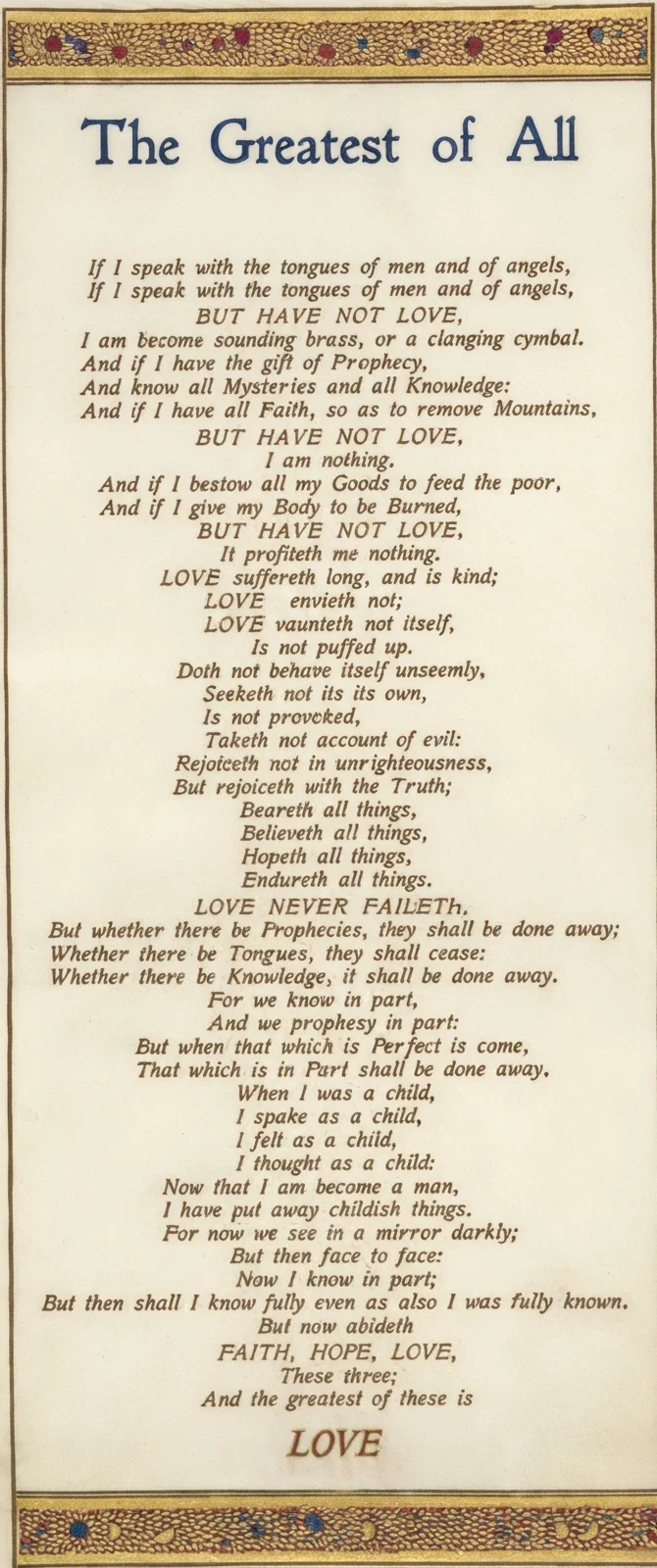
If I speak with the tongues of men and of angels, BUT HAVE NOT LOVE, I am become sounding brass, or a clanging cymbal. And if I have the gift of Prophecy, And know all Mysteries and all Knowledge: And if I have all Faith, so as to remove Mountains, BUT HAVE NOT LOVE, I am nothing. And if I bestow all my Goods to feed the poor, And if I give my Body to be Burned, BUT HAVE NOT LOVE, It profiteth me nothing. LOVE suffereth long, and is kind; LOVE envieth not; LOVE vaunteth not itself, Is not puffed up. Doth not behave itself unseemly, Seeketh not its own, Is not provoked, Taketh not account of evil: Rejoiceth not in unrighteousness, But rejoiceth with the Truth; Beareth all things, Believeth all things, Hopeth all things, Endureth all things. LOVE NEVER FAILETH. But whether there be Prophecies, they shall be done away; Whether there be Tongues, they shall cease: Whether there be Knowledge, it shall be done away. For we know in part, And we prophesy in part: But when that which is Perfect is come, That which is in Part shall be done away. When I was a child, I spake as a child, I felt as a child, I thought as a child: Now that I am become a man, I have put away childish things. For now we see in a mirror darkly; But then face to face: Now I know in part; But then shall I know fully even as also I was fully known. But now abideth FAITH, HOPE, LOVE, These three; And the greatest of these is # LOVE
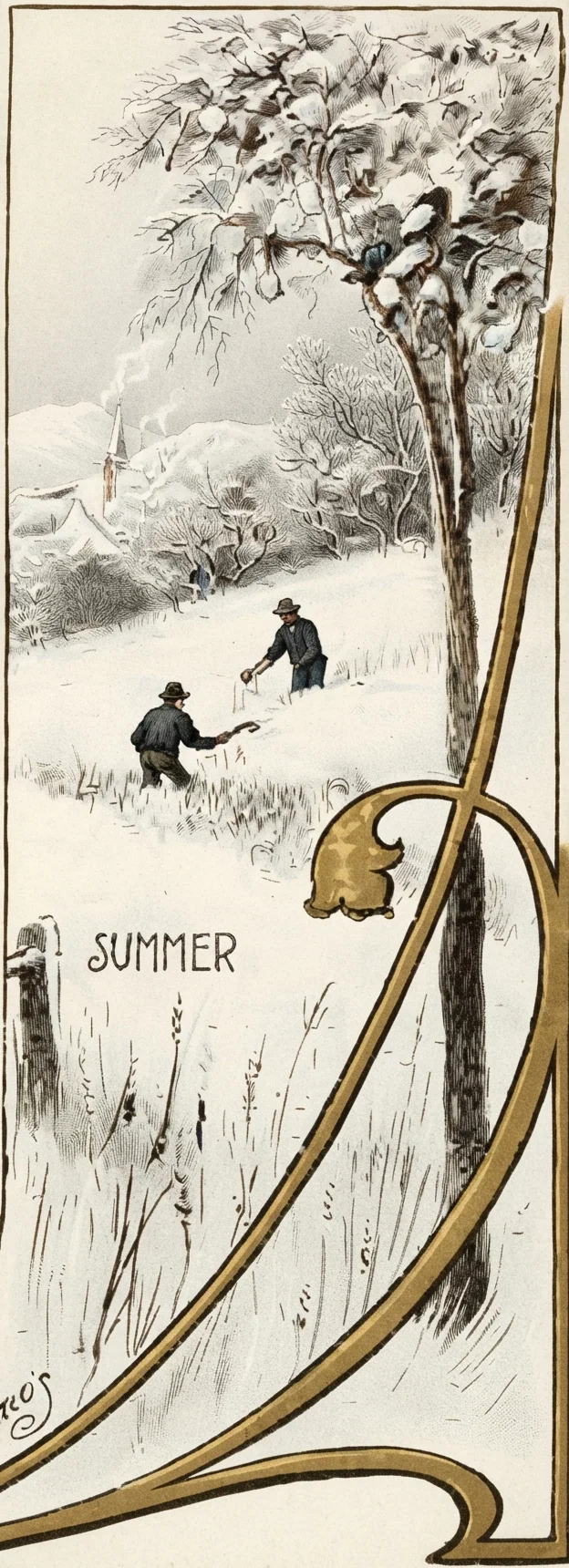
The contrast between the seasons.
WINTER
WINTER

You have reached the end of this edition.

Signs of the Times · Jan 25, 1905