The Youth’s Instructor, Vol. LI, No. 21

EDITH STARBUCK

The Youth’s Instructor

May 28, 1903

Review and Herald Publishing Company · Battle Creek, Michigan · May 28, 1903

EDITH STARBUCK

Eventide

Across the land the night's oncoming shadows In length'ning outlines fall; The setting sun's last rays of golden glory Fade on the mountain wall. The curfew bell afar its note is pealing, Telling the close of day; Up from the sea a cooling breeze comes stealing, Whispering its soothing lay:—
Sleep, for the night draws ’round thee; Sleep, for it brings thee rest; Sleep; leave care to the morrow; Sleep, for these hours are blest; Sleep, for each bright star above thee, Twinkling in heaven's blue, Tells of a Father loving, Who watcheth and careth for you.

EDITH STARBUCK

The White Birch of New England
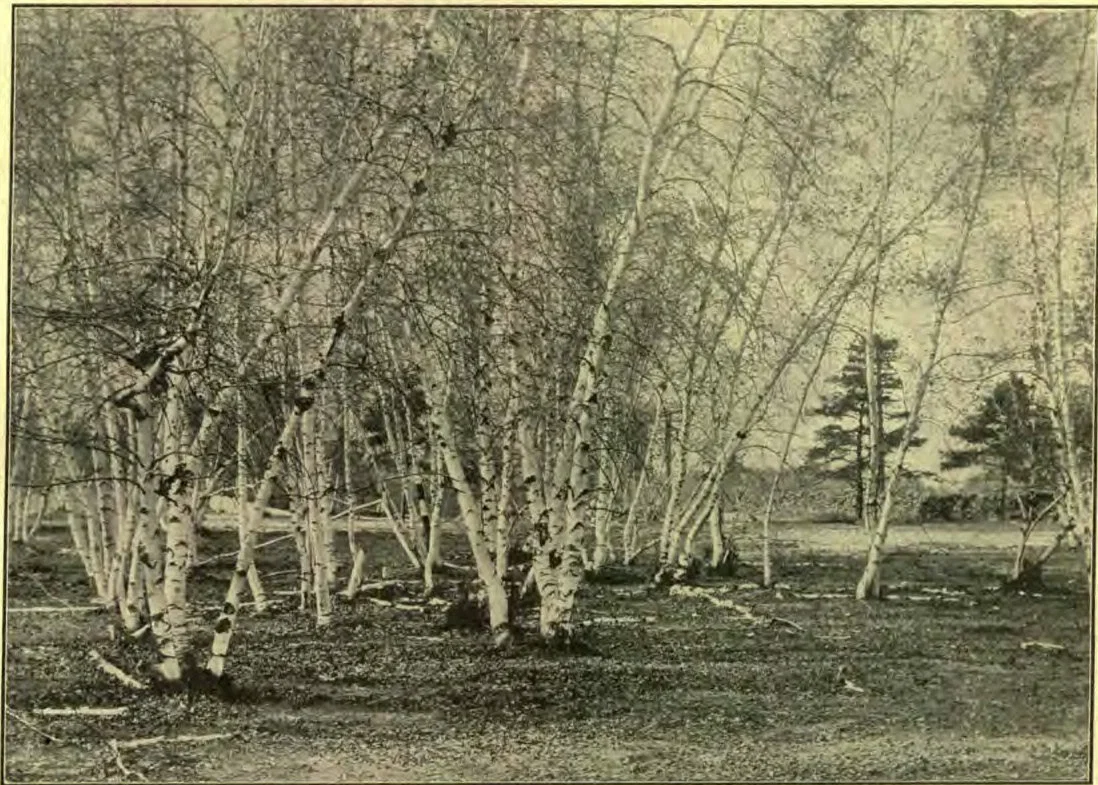
MANY an absent boy or girl, whose earliest recollections are associated with a home “far away on the hills of Old New Hampshire” or some other New England State, has longed for just one glimpse of a clump of white birches, with their dainty, sensitive leaves shimmering and fluttering in the slightest breeze, which was so peculiarly one of the features of the old home.
In New England, under the favorable climatic conditions, these trees attain to their greatest height and beauty, it being a not uncommon thing to see them fifty or sixty feet in height, and with a diameter of a foot to a foot and a half. The white birch prefers a cool climate, seeming to love the realm of the Frost King, although diminishing in size as we proceed into the regions of the “farthest north.” It even dares to brave the rigors of an arctic winter, and is found in far-away Greenland.
One of the most attractive features of this most attractive tree is the bark, which is smooth and silvery-white, its outermost layers being thrown off as the tree advances in age. The uses of this bark are legion. In the days before the white man came to these shores, the primitive forest-dwellers fashioned from it their graceful canoes; baskets were made from it, its fibers were twisted into a kind of coarse rope, and in time of famine it has even been steeped and served as food. At the present time it is used for many decorative purposes, that of writing-paper being one of the most familiar. Some affirm that it possesses medicinal properties of value in cases of fevers and eruptions.
The wood is white, firm, and tough, and has a variety of uses. It is much in demand for spools, barrels, and in wheel-making; in fine, it is one of man’s most useful forest friends. No doubt some of the older New England boys and girls will recall another use to which the “birch” has often been applied.
There are many species of birch, but the white birch is most picturesque. The bark is so strong and firm that the wood of the fallen tree will not rot entirely away as long as the case of bark remains sound and solid. The Indians appreciated this fact, and many a child of the forest lies sleeping in a shroud of birch bark, this being their primitive method of embalming the dead.
The birches are clannish trees, seeming to prefer growing in little clusters of their own kind, although individual trees scatter occasionally, being sometimes found among the evergreens, their silvery bark making a beautiful contrast against the dark background. Their favorite haunts are rocky old fields and abandoned farms, often some barren, sandy spot where no other trees grow; perhaps this explains why the birch clings so lovingly to New England. The saying “shaking like an aspen leaf” could be varied by saying “like a birch leaf;” for the leaves of this tree are so hung on the branches that they respond to the slightest flutter of the air.
AN ARTISTIC GROUP OF WHITE BIRCHES
The beauties of the birch tree furnish a fitting theme for the brush of the artist or the pen of the poet. A lover of nature has paid a fitting tribute to our theme under the caption, “My Lady Birch:” —
“You are indeed a lady, My tall and slender birch, And none will find a fairer one Wherever he may search.
“My lady birch, I wonder What does my presence give To one so very delicate, So finely sensitive.
“I only know there never Seem darker stains on me, Than when I come and look on you, And all your whiteness see.”
F. A. FROST.

The Young Man Who Resigned

A merchant pointed out to a new stenographer the other day several serious and wholly inexcusable mistakes which he had made. The stenographer colored at the first word of the lecture, and waited impatiently—and without listening—until it was ended. Then he resigned.
“Why do you resign?” asked the merchant.
“Because I won’t let any man take advantage of his power as an employer, and speak harshly to me.”
“What did I say?” asked the merchant.
“I don’t know just what it was. I only know you were jumping on me about my work.”
“Why did you leave the position you had before you came to us?” asked the merchant.
“For the same reason that I’m leaving here. The man thought he could jump on me just because I was an employee,” was the reply.
“But didn’t you make any mistakes? Was your work perfect?”
“Of course I made mistakes. Nobody is perfect.”
“Then you don’t permit any one to speak to you of your mistakes?”
“I don’t think harshness is the way to help a man to get along.”
“And you regard any form of reproof as harshness?”
The stenographer was silent.
“The only talk about your work that you will listen to is praise?”
The stenographer was silent.
“You can’t see that praise is not of the slightest value to you, that criticism is invaluable?”
The stenographer was silent.
“You can’t see that by speaking to you of your mistakes, I was showing myself to be your friend; that if I had passed over your mistakes, I should have been doing you an injury?”
The stenographer was silent.
“Don’t you think you’d better give me another trial?” asked the merchant.
“Yes,” said the stenographer. But he resigned again within a week, and was let go.
At first blush every employee who reads this story will scoff at this stenographer as an unusual example of inordinate vanity. But—isn’t the story worth thinking about? Is this stenographer so unusual, after all? Is such vanity rare, or is it only his courage of it that is rare?
It was by ambition that the angels fell. It is by self-excuse that men fall.
A very great man once said that no man had ever yet lifted his head so much as an inch above the mass of his fellows who had not the power of self-criticism—the ability to see his own faults either on his own initiative, or when some friend or foe pointed them out. The smaller kinds of superior men close their ears against their enemies, but learn when their friends are venturesome enough to criticise them. The larger kinds of superior men learn much from the frankness of friends, more from the fierce and scorching criticism of their unintentionally friendly foes. And on the day that a man ceases to be capable of self-criticism, ceases to be tolerant and eager for criticism from without, on that day his undoing begins.
Again and again you hear it said of a man, “He has reached his limit.” What does that mean? In every case, close study of the man and his career will show that he has reached that stage at which self-exaltation has succeeded in silencing self-criticism.
Study the man who works beside you. Study the man who was promoted the first of the year. Study the man who wasn’t—especially if he happens to be yourself. This is not a world of chance, but of causation. There was a “why” for the one man’s promotion, another “why” for the other man’s dismissal or failure to advance.
What the world most needs is not alms or crutches, but more friendly criticism, more self-criticism.
The place to begin to correct the evils in the social system is with the one member of it who is wholly under your control. Other corrections can wait. That one can’t. —George Horace Latimer, in Saturday Evening Post.

IX—Words in Overalls and Broadcloth

I HAVE as much respect for the grimy cap and greasy overalls of the locomotive engineer as for the classic cap and gown of the university president. That is making a rather strong assertion, you think, but I will put it stronger still, and then give my reasons for these views. I have more respect for the common workingman who toils faithfully and does his duty conscientiously than for the enthusiastic man of letters, the gifted artist, or the eloquent statesman. It is no credit to a man of this latter class to work long hours, to become utterly wrapped up in what he is doing, to have an insatiable ambition to do his work better than it ever was done before. Every hour of such effort sees something of beauty created, something done that will stand as a monument to his skill. A true painter, poet, preacher, or teacher can not fail to be an enthusiast in his work.
With the humble toiler it is different. What is it that impels the woodchopper to keep up his ceaseless hammering from sunrise to sunset? Not the beauty of anything he has made; for he has taken that stately tree, which was a thing delightful to look upon, and sawn and torn and hammered it into a heap of unsightly splinters. Not the hope of riches allures him; for his long hours of drudgery bring him but a mere pittance. Not the thought that his brain or his hand is being trained and disciplined for some higher vocation; for his fingers are stiffened and blistered, his nerves are made unsteady, and his mind is dwarfed with the dreary routine. Yet he toils, and the great army of drudgery-workers toil, not for the fascination there is in their work, not for the glory they expect to win thereby, but because they are unwilling to acknowledge that the world has no place for them, because they are willing to do their duty, and support themselves and those dependent upon them, by whatever honest calling the world offers.
What is true of men and women is true of words. We have a vast word-population that spend their lives in verbal drudgery. They are ugly in form; they are ungraceful; they go about in the coarse and soiled garb of a day-drudge. There is nothing poetic, nothing artistic, nothing musical that can possibly associate with them. They have ten times as much to do as their dignified, broadcloth-clad superiors. They are the words that plant and harvest the crops, and carry them to the farthest corner of the world. They are the words that build great cities, and supply their inhabitants with the necessities of life. They even build the classic piles of masonry, wherein man is made acquainted with the whole word-aristocracy—words wherein beauty and dignity and sublimity are combined, and where many a youth is trained to despise all that is commonplace and useful.
True, these overalls-clad words are not all and in all. Their angular look, their plebeian appearance, their calloused hands and plowboy gait would, of necessity, unfit them for a place in a poem, for a scholarly oration, or for the sacred utterance of prayer. There is a whole fraternity of sleek words, which keep themselves aloof from the bustle and jostle of every-day life; there are the words venerable with age; there are the polished, mellifluous words of Latin derivation, all of which are indispensable in expressing our choicest thought in the most beautiful way.
One of the most glaring mistakes that young people make in writing or speaking is to drag into the expression of their commonplace ideas these high-sounding words, which are as much out of place in such expression as a silk hat would be on one driving a garbage wagon.
On the other hand, there is a whole cult of verse-makers, mere mechanical rhymers, who, mistaking rhyme for poetry, fill the newspapers and periodicals with jingles, seldom containing a poetic idea, and constructed mostly of words from the gutter, or at best from the matter-of-fact commercial world.
There is no use saying that one class is more important than the other, any more than in saying that labor is more useful than capital; but the thing that young people should learn—and all others who have not yet learned it—is to keep words where they belong; for each class is indispensable in its proper place.
L. T. CURTIS.

NEWS NOTES

(From the Springtime Breeze)
We're pleased to state that Mr. Wren And wife are back, and at The Eaves.
The Robins occupy again Their summer home at Maple Leaves.
The garden restaurant reports A fresh supply of angleworms.
The Elms — that favorite of resorts — Has boughs to rent on easy terms.
We learn that Mrs. Early Bee Is still quite lame with frosted wings.
Ye Editor thanks Cherry Tree For sundry floral offerings.
Down Cistern-way a waterspout Has been a source of active floods.
We hear of rumored comings out Of some of Springville's choicest buds.
In case you run across Green Lawn, Don't wonder that he looks so queer;
'Tis only that he's undergone His first short hair cut of the year. — St. Nicholas.

Correct English

Is per properly used in the following sentence: “He sold his cattle for thirty dollars per head”?
No; the sentence should read, “He sold his cattle for thirty dollars a head.” Use a as a preposition before English words; per is Latin, and should be used only with Latin words; as, per annum, per centum, per diem, per capita.
Is it correct to say, “What are the news?”
News is a singular noun. The sentence should read, “What is the news?”
When the pronoun you is singular, does it not require the singular form of the verb; as, “You was late”?
“You was” is as much out of harmony with good English as “you is.” The pronoun you, even when referring to one person, always takes the plural form of the verb. Say, “You were late;” never, “You was late.”
What is the correct use of the word couple? Is it correct to speak of “a couple of apples,” “a couple of dollars,” “a couple of men”?
Couple, as a noun, implies two of the same kind, connected or considered together. The word is not a synonym of two. In such cases as those mentioned above, two is the proper word to use. A gentleman and lady betrothed or married constitute a couple.
One frequently hears the word pled (or plead) in such sentences as, “The lawyer pled earnestly.” Is it a good word?
The past tense of the verb to plead is pleaded. “Pled” has no place in correct English. In this connection, let me caution you against a few common misuses of the past tense of verbs. Do not say leant for leaned, lit for lighted, spat for spit, shrank for shrunk, sank for sunk, dove for dived, or het for heated.
Please give the correct pronunciation of envelope (as a noun), either, neither, depot, and advertisement.
Unaffected pronunciation requires us to say “ēn'vel-ōp,” “ē'ther,” “nē'ther,” “dē'pō,” and “ad-ver-tiz'ment.”
Is it correct to say, “All Christians should love one another”?
Yes; for each other always supposes but two: one another supposes three or more.
D. D. REES.

The Music of a Little River

THERE is no music like a little river’s. It plays the same tune (and that’s the favorite) over and over again, and yet does not weary of it like men fiddlers. It takes the mind out-of-doors; and though we should be grateful for good houses, there is, after all, no house like God’s out-of-doors.— Robert Louis Stevenson.

A Trip in Spain

One Day at the Escorial
Leaving Madrid at half-past eight in the morning, we reached the Escorial soon after ten. On the train, while our party engaged in conversation in French and German with an educated Spaniard, I noticed a Spanish peasant looking so eagerly at us that a gentleman near by was smiling at his expression. I approached the peasant, and began to talk with him. After questioning him about his village and occupation, he wanted to know where we came from, and what our business was. I told him we were in the book business, and taking my Spanish New Testament out of my pocket, began to read to him from Revelation 21. He listened attentively, and when I paused, took the book from my hand, and continued to read to me from the same chapter, pausing at every sentence to look at me, as if he feared that I might miss the full meaning of every point. When I offered him the book, he accepted it gratefully, and said: “I know a good many of these things. I have six sons, and we talk these things over. Those are the things that are worth talking about.” I then offered him El Faro and El Mensajero de la Verdad, which he immediately began to read with evident delight.
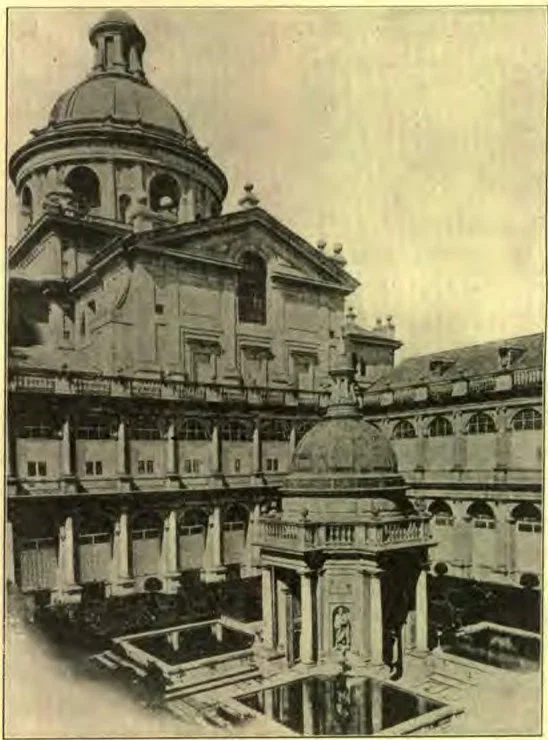
Soon our train reached the Escorial, and we began to ascend the hill, on the top of which stands the mausoleum, or Pantheon, of the Spanish kings. Connected with it is a church, a convent, and a palace. Together, they make an extended, massive stone edifice. It was constructed by Philip II, in memory of his father, Charles V. To give an idea of its enormous proportions, I will mention that the whole fabric has sixteen courts, two thousand six hundred and seventy-three windows, eighty-nine fountains, eighty-six staircases, twelve hundred doors, and that the total length of its corridors is said to be one hundred miles.
We first visited the church, which is devoted to St. Lawrence, a Spanish soldier and martyr. Fitly to describe the awe-inspiring architecture of the interior, the grandeur and beauty of its artistic decorations, the richness of its ornaments in bronze, gold, marble, jasper, and agate, would be a difficult task. The choir, at the opposite side from the main altar, has one hundred and thirty carved hardwood seats. In one corner, the last in the row, is the seat where Philip II used to sit in mass, and from which the officiating priest can be distinctly seen at the altar. It was while sitting here, that the king first learned the news of the battle at Lepanto against the Turks. He said nothing; but when mass was over, he ordered the Te Deum sung. Here also, while hearing mass, the same king received the sad news of the destruction of the Invincible Armada. He said, simply: “I sent my fleet to make war against the English, not against the elements.”
Next come the Pantheon, or royal tombs, situated in the vaults under the church proper. It is divided into two sections,—the Pantheon of the kings and the Pantheon of the infants. In the former are the kings, from Charles V down, in marble coffins. A new coffin is waiting for the present king, young Alfonso XIII, who is expected to visit the place for the first time in a few days. A solemn reminder it will be to him of the fleeting character of life. The latter section, containing the members of the royal family, is composed of several rooms. The floors are of marble, the ceilings of granite, the passage vaults from one room to the other of polished white marble.
Nothing richer can be seen than these coffins of the whitest of marble, with here and there a life-sized sculpture representing the dead. These tombs, begun in 1862, were executed by a sculptor who worked at them till his death.
A whole section of the building is devoted to “the palace,” a suite of rooms, parlors, and sleeping-rooms occupied by the royal family after the death of Philip II. The walls of all these rooms are covered with tapestry, on which the works of a few great painters were embroidered in the most vivid colors and with remarkable exactness. This in itself is a collection of great artistic and commercial wealth. The total number of these pictures is three hundred and thirty. A large dining-room in the chamber of the ambassadors may be mentioned as a truly royal apartment. Then come more rooms, with cases containing works of embroidery, made by royal hands, and with more paintings decorating the walls. Among these are life-size portraits of Charles V and Philip II. Both kings wear on their faces a striking expression of melancholy and doubt, with the addition of reckless obstinacy on the features of the son.
A CORNER OF THE ESCORIAL
And now we are led to the private apartments of Philip II, composed of a sleeping-room and a small office. The simplicity of these rooms, with their tile floors and whitewashed, unadorned walls, makes a striking contrast with all we have seen. Philip II is said to have remarked that his intention was to make a palace for God and a cell for himself. A small, dark room connects with the choir of the church. Here Philip II died in his bed while hearing mass. Over the door is the following inscription in Spanish:—
*In this little precinct Died Philip the Second When the world was too small For the son of Charles V.*
It was impossible for Brethren Wilkinson, Robert, and myself to refrain from a deep sense of sadness, mingled with gratitude to God, as we went through these buildings, which reveal some of the past glories of Spain, knowing how it has sunken in the scale of national greatness. Here are a few samples of the power of two men who dreamed and dared everything against the Protestant faith and nations. The gold of the world was theirs; at their bidding, streams of blood ran in the mad attempt to re-establish the supremacy of the pope, and effect the destruction of the gospel. But they failed, died in despair, and left their country exhausted and their people discouraged and reduced. And all this for blindly following the suggestions of the man of sin!
While thus musing among ourselves, and eating our lunch in an adjoining park, we were joined by our Spanish friend, who expressed to us some thoughts on the same line, which go to show how at least some Spaniards view the political and moral degeneration of their country. This he said, in substance:—
“In its many royal palaces, museums, and cathedrals, Spain possesses millions upon millions worth of works of art and jewels, which might as well be sold, and the proceeds used for schools and other beneficial institutions. Instead of that, we are all the time increasing our debt to maintain our army and navy. Our politics are rotten, justice is nowhere found. When we see how other countries, like England and the United States, are going ahead, we are heartily ashamed. Now let me tell you my candid opinion about the late war between the United States and Spain. The greatest mistake the United States made when they took Cuba and the Philippines from us, was that they did not take the whole motherland with the rest, and give us a decent form of government.”
Of course that would not have helped matters; but can you imagine anything sadder than these remarks, made by an intelligent Spaniard, speaking of his own fatherland?—a country coveted by all the great powers of history,—a country which yields the best grapes, olives, almonds, and pomegranates,—a country with a ravishing variety of climates, and one of the gems of this old earth? Are not that wistful look from the peasant, the speechless joy with which he pressed that New Testament in his hands, and the sad confession from the merchant, impressive appeals to your heart? Can we underestimate the bitter humiliation and sorrow concealed by these men, when we remember the natural pride of man? and can we longer refuse this country the light and help that we who possess the wonderful gospel of Jesus, can give it? Can we, “to men benighted, the lamp of life deny”?
That these lines may awaken in some heart a true missionary spirit for Spain, is my fervent prayer.
J. VUILLEUMIER.

The Better Things of Life

’Tis better to speak kindly words, ’Tis better to do kindly deeds, ’Tis better to know That the seed you may sow Will blossom as flowers, not weeds.
’Tis better to do with a will The duties that come, one by one; ’Tis better to say At the close of the day: “I have tried to leave nothing undone.”
’Tis better to cultivate love, Contented with blessings of worth; ’Tis better to fight For the cause that is right Than to covet the riches of earth.
’Tis better to smile, though the heart Be burdened with sorrow and pain; ’Tis better to smile, For ’tis always worth while, And we’ll never pass this way again.
BENJAMIN B. KEECH.

Young People as the Missionaries of the Future

The missionaries of the future will be drawn from the young people who are missionaries to-day.
It is not easy to defeat a man who can not be defeated. There is no man so weak as the man who “can’t,” no man so strong as the man who “can.” As a man “thinketh in his heart, so is he.”
The call of the hour is a call to service. It is the privilege of every young man to find his bearings even before he is ready for the service, and, under God, to learn what his future work is to be, then set his stakes, and work and pray to a definite end. Indefiniteness, a lack of earnest purpose, keeps a man turning around and around, and prevents him from accomplishing anything of real value.
Every ray of light God has given us in this message was intended for some one else as well as for us. We must be reflectors. The light must strike our lives, and be radiated out to the world. God has so arranged it in the economy of salvation that we never receive the blessings of his gifts until we impart them. When God bestows upon us a gift, we never have that gift until we give it away. This is one of the paradoxes of the gospel: that no man can have anything from God until he has imparted it. You may learn the greatest truth that God has ever given to the world; but you can never have that truth within your own heart until you have imparted it to others who are needy. E. R. P.

St. Louis Young People's Work

The following cheering report from our young people in St. Louis is found in a recent number of the Workers' Record. We are glad to “pass it on” here:—
Knowing how much I should enjoy a report from other young people in the State, I will tell you something we are doing here. We have no organized Society, but every one who comes is a member, the same as all church-members belong to the missionary society of the church. We have a leader and a secretary, and hold our meetings on Sabbath, about fifteen minutes after the close of the church service. We study the lessons given in the INSTRUCTOR, and each week a report is given of papers and tracts distributed, missionary visits made, or any other work that has been done. The “Busy Bees,” the sewing circle, meet on Sunday afternoon, and are doing quite a little to raise money for missionary work. A self-denial box, which is to be opened at the end of the month, grows heavier each week. Its contents will go with the funds from the Busy Bees to help Brother Owen in his school work.
Some of the Life Boat workers from Chicago were here, and several of our young people have been out selling this paper, averaging from five to thirty copies each in a week.
We are glad to see the missionary spirit growing. The Lord seems to be at work; let us be ready to work with him. MARY L. ZENER.

The Weekly Study

Praying for Definite Results

(May 31 to June 6)
The light that came on the United States in prophecy led the early pioneers to take up the warning against the enforcement of Sunday laws and general national apostasy long before they could see a visible movement in the direction of the evil thing. In the study of the subject last week all must have been impressed with the fact that what to our fathers in those days was a prophecy of coming danger, in regard to which they must give the warning message, is, in our day, a prophecy fulfilled, and day by day still fulfilling before our eyes. Another feature associated with the national apostasy in the last days, in the thirteenth of Revelation, is the miracle-working power of Satan in his warfare against the law and truth of God. This we should study.
But let us defer that subject a little, and make the topic of definite prayer the basis of our Bible study and main line of thought this week. Our young people mean sober, serious business in this matter of living the message and teaching it. The lesson that comes to us in all the study of the early days, when God gave to our fathers the great threefold message that is to finish his work in our day, is that God's work can never be done by man's power or effort merely. The work must be one of faith, and of absolute dependence upon the guidance of the Spirit of God. We have seen all along in our study the moving pillar of God's providence. God heard prayer, and sent direct answer, and guided the little flock by the spirit of prophecy.
Notice, in chapters XV and XVI, of “Rise and Progress,” how direct answers to prayer led Elders Smith and Loughborough into just the place of service God had for them, how Hiram Edson was directed to help, and how light came on Scripture truth as brethren prayed.
Let the Bible study for the day be upon this subject of direct answer to prayer for specific needs. More cases will readily be suggested than the leader of the study will be able to use—the experiences of Elijah and Elisha, of Daniel and other prophets, of the church praying for Peter in prison, of Paul's assurance from God in the tempest in the Adriatic, and of the help the prayers of the Corinthian believers (2 Cor. 1:8-11) were to him in his labors far distant from them. Note that prayer on earth is a real thing in heaven. Rev. 8:3, 4.
May we not make much more of our prayer seasons by making our prayers more definite? Why not take the mission fields week by week, and pray by name for the fields and for the workers in the fields? Prayer and missionary progress have always gone hand in hand, and I believe we must more definitely pray to God for the workers to be qualified and for the means necessary to send them, as well as for specific interests in our local work. Take, for instance, China this week. Name it before God, with its four hundred millions of souls. Pray him to bless Brother LaRue and Sister Ida Thompson, and Brother E. W. Wilbur and wife in Hongkong, where Brother LaRue for long years held the fort, waiting for us to send workers. Sister Thompson is teaching a Chinese school, and Brother Wilbur and wife are doing general mission work. Pray that Elder J. N. Anderson and wife, in Canton, may be blessed in the study of the language and in planning the work. Pray that Brother Pilquist and the new converts in far Honan, where our first church has been organized, may be bright and shining lights in Inland China. Pray that God may give us means and workers to do still more in that vast and waiting land. As reports are read, and the needs of the field studied, every member who is familiar with the needs may join in short-sentence prayers, specifically naming the need impressed on the heart, and asking God to supply the need. This is better than one or two long prayers. The burden of praying for the fields in this definite way will aid us in keeping acquainted with their needs and the names of the workers in them, through the study of the reports.
God loves this whole world, and the time has come to tell all the world about it. Let us encircle the world in our prayers to God.
W. A. S.

A Working Society

A GOOD report has been received from the Society at West Bay City, Michigan, which was organized last November. The membership is twenty-five. The Society holds weekly meetings, following the outlines of study given in the INSTRUCTOR. The following itemized report of work done is not only interesting, but may be suggestive to other Societies:—
“Given away, 123 copies of the INSTRUCTOR, 30 of the Little Friend, 21 of the Review, and 5 of Good Health; 39 copies of the Life Boat sold, 9 given away; 27 copies of the Signs sold, 21 given away; 1 copy of the Sentinel of Christian Liberty sold; 863 pages of tracts sold, 888 pages given away, 96 pages loaned; 18 garments made, 28 garments given away, 5 garments mended; given away, 5 cans of fruit, 4 loaves of bread, 1 sack of provisions, bananas and oranges to the sick; 2 loads of coal advanced to the sick; procured from city for needy, 1 cord of wood, and provisions amounting to $2.04; made 43 missionary visits, 4 visits to prison, 3 visits to hospital, 5 visits to Old Peoples’ Home; assistance given in housework and in caring for children, to rest tired mothers.”
This Society certainly shows a very practical spirit, and goes about its work in a sensible, methodical way. The Societies that are slow to take up such definite lines of work are missing valuable experiences and rich blessings.
L. F. P.

Prayer

HERE is a Leyden jar charged with electricity. Touch it, and the electricity must pass from the jar into your body.
Here is a reservoir full of water. Tap it at a lower level, and the water must flow out to serve your needs.
Here is a radiator through which steam is coursing. Approach it and stretch out cold hands toward it, and it must give up to you a part of its heat.
Here is a table weighted down with food, and you are healthy and hungry. Eat of the food, and it must yield up to you the strength of the soil and sun which it represents.
Here is a river flowing rapidly to the sea. Embark your skiff upon it, and it must carry you and your skiff down toward the ocean.
All these are only feeble illustrations of the absolute necessity with which the answer to prayer follows upon the prayer.
Is God bound?—Yes, in the same way in which he has bound his natural world which represents himself so accurately. It is his way of working. He chooses it. He exults in it.
When the woman touched Christ with the hand of faith, immediately he realized that virtue had gone forth from him. The touch of faith compelled it forth. It always did. It does so to-day.
Christ bade his followers to be absolutely responsive to the like faith-filled requests. If a man asked a coat, he was to have a cloak also. That is because Christ himself lives according to that law of response.
Prayer, therefore, is actual power with God. It is absolutely certain of a response from God. Speaking with entire reverence, God can not help responding to the prayer of faith.—C. E. World.

Prayer: The Key of the Day

PRAYER is the key of the day and the lock of the night. We should every day begin and end, bid ourselves good-morning and good-night, with prayer.—Berkeley.

The Carpenter-Bird

THERE is a cunning carpenter who's busy in our tree; He's making him a house to hold his tiny family, And finishing it up for them all tidy and all trim. Hark! Don't you hear his hammer on the old dead limb?
He must be much in earnest, for he works with such a will; I doubt if any carpenter can show a greater skill, Or toil with blither cheer until the day grows dim, With the “tap, tap,” of his hammer on the old dead limb!
Oh, can you not imagine how his heart with pride will stir When he gives a building lesson to each little carpenter? I know it is this thought that seems to bubble and to brim Whene’er I hear his hammer on the old dead limb!
— Selected.
Continue reading: Glimpses of Child Life in Japan