The Youth’s Instructor, Vol. 51, No. 21.

EDITH STARBUCK
Earlier text: EDITH STARBUCK

Glimpses of Child Life in Japan

KUMATARO was the name of a little Japanese boy who lived in the house adjoining mine in Tokyo, the capital of Japan. He was only three years of age, and I met him toddling along the narrow foot-path one morning as I started out for a walk.
“Master Bear,” for that is the literal translation of his name, was dressed in a very pretty light-blue kimono, or wrapper, with a bright-red sash, or obi. He wore little straw sandals and short white stockings called tabi, which reached to the ankles. These stockings were like mittens: they had a division between the great toe and the others, through which the thong was passed that held the sandal to the foot.
The top of his head was shaved, leaving a circle of hair extending around that made him look like one of those odd Japanese dolls we all have seen.
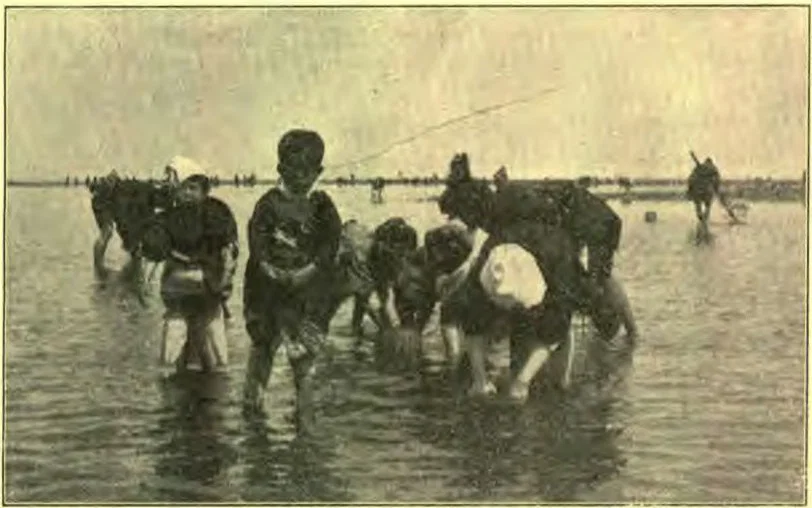
GATHERING SHELL-FISH — JAPANESE BOY AND GIRL IN THE FOREGROUND
His little legs were hardly strong enough to hold him up; still he toddled along with an air of dignity that was highly amusing. His dignity did not relax at my approach, and I could not help stopping, and making a low bow, in true Japanese style. I remarked most respectfully, “Kekko no tenki de gozaimasu,” which is the Japanese way of saying, “What a beautiful day this is!” I feared that my action might scare this little man, for I knew that a meeting with a white man would be regarded by many Japanese children much as suddenly confronting a Turk in a turban would be regarded by a timid American baby. Japanese children, as a rule, are rather apt to be afraid of foreigners, but this is not to be wondered at, for I found it to be a very general belief that white men carried away little Japanese children if they caught them out alone after dark. I often noticed, as I walked through the streets of Tokio, that crying children suddenly became as quiet as mice on seeing me, and gazed at me with large, frightened eyes. I wondered at this, until one day I overheard a nurse say to a little child, “Be still; here comes a white man, and he will carry you away if you do not behave yourself!”
I was, therefore, rather surprised when, instead of becoming frightened, Kumataro stopped and gravely returned my salutation ducking his little shaven head in the most approved Japanese fashion, and then resuming his lordly progress. I was, to say the least, somewhat taken aback at the coolness of this little man, especially when I observed that his mother, who stood in the doorway, had not failed to see the humor of it, and could hardly keep from laughing. After this first meeting I became very friendly with the boy.
Around my house was a pretty Japanese garden, which was separated from that of my neighbors by a bamboo fence. Consequently I saw Kumataro almost daily. Japanese houses are very lightly put together. The shoji, or doors, which also serve as windows, consist of light lattice frames three feet wide and six feet high. These are covered with thin but tough paper to admit the light, and they slide in grooves along the sides of the room. A narrow veranda usually extends around the house, and is closed at night by wooden shutters that likewise slide in grooves along the edge of the veranda.
The long, overhanging roof protects these paper windows and doors from the rain. Glass is rarely used for windows; and it was almost unknown in Japan until that country was thrown open to foreign nations about forty years ago. Many of the Japanese, especially the country people, are still so unaccustomed to glass windows that it has been found necessary, in many of the third-class compartments of railway carriages, to paste strips of paper across the windows in order to attract attention to the glass, for it has frequently happened that, in their ignorance, these people have stuck their heads through the window-panes of the carriages.
There is but little privacy in Japanese houses, for the reason that everything that is said on the other side of the paper doors can be overheard, and as these are usually left open, one can not help seeing much of the domestic life of one’s neighbors.
Thus I often observed little Kumataro at his meals, which, according to the custom of his country, he ate with chop-sticks instead of knife, fork, and spoon. It is very difficult for a stranger to handle these two little sticks; but Kumataro, who had been taught how to hold them properly managed them so easily that he was able to pick up any little morsel from his plate as easily as an American boy could with a fork.
Everything that is served at a Japanese dinner is cut into small pieces, that may be picked up and eaten with the chop-sticks. A dinner consists of a number of courses, such as soup made of bean-curd, fish, and mushrooms, or seaweed, which are served in lacquer bowls. This is followed by fish boiled with lotus-roots, and raw fish cut into thin slices and eaten with a sauce called soyu; also salad and pickled vegetables and soba, and a sort of buckwheat vermicelli. The Japanese eat very little meat, and rice takes the place of bread. Soup is usually served at the end as well as at the beginning of a dinner.
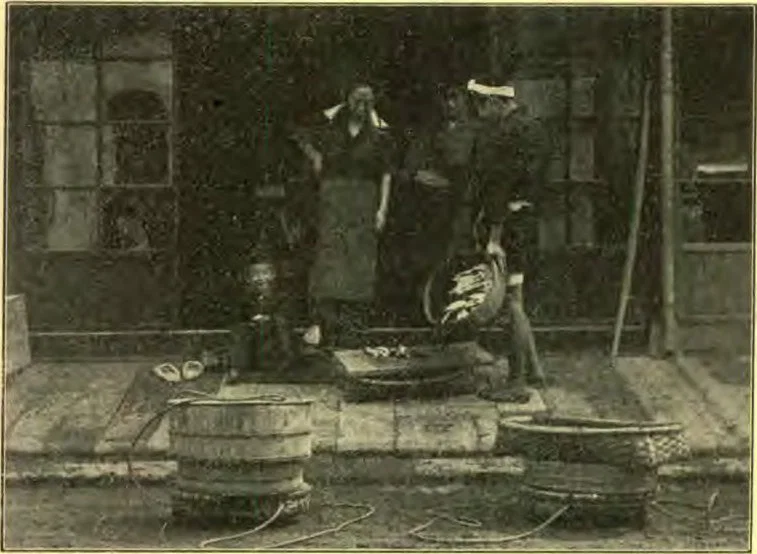
FISHMONGER AT THE DOOR OF A JAPANESE HOME
Tables and chairs are not used in Japanese houses, and our little friend, in accordance with the general custom in Japan, sat on the floor, with his dinner spread out before him on lacquer trays.
Whenever I called at Kumataro’s house, I was invited to be seated on the floor. The floor of a Japanese room is covered with fine straw mats, called tatame, which are always kept scrupulously clean, for a Japanese never enters a house with his shoes on. These are always left outside of the door, and he walks about on the matting in his stockings. Whenever a Japanese sits on the floor, he doubles his legs up under him, crosses his feet, and squats on his heels; and he can remain in this position for hours.
Kumataro had a brother named Matsujiro (literally “Pine-tree”). He was about five years of age, but passed for seven, for the Japanese have a curious method of computing age. No matter when a child is born, its age is always reckoned from the first of January. If, for instance, a boy is born in February, the first anniversary of his birth falls on the following first of January, and he is then said to be in his second year.
These two little youngsters, like most Japanese children, managed to have a very good time. They had many different ways of amusing themselves, and rarely quarreled with each other. When any disagreement arose, they generally settled it pleasantly, as in the following instance. Master Bear and his brother scrambled, one day, for the possession of a ball that I had thrown over into their garden. The elder boy succeeded in grabbing it, but the younger was by no means disposed to give up his claim to it. Instead of becoming angry and fighting about it, they decided to settle the question of ownership by means of a game known as ken. The game is played as follows:—
Two players, facing each other, throw out their right hands at the same time. As the hand is thrown forward, it assumes one of three positions. An open hand represents a sheet of paper. A closed hand represents a stone. The two first fingers extended, with the others closed, represents a pair of scissors.
The following are the points for the player to bear in mind in scoring the game:—
  1. Scissors can cut paper.
  2. Scissors can not cut stone.
  3. Paper can be wrapped around the stone.
If player No. 1 extends his two fingers and No. 2 his open hand, No. 1 wins, for the reason that scissors cut paper. On the other hand, if No. 2 had presented his fist, he would have been the winner, for scissors can not cut stone. Again, if No. 1 extends his open hand, and No. 2 his closed hand, the former wins, as the paper can be wrapped around the stone. In case both players make the same movement, it does not count, and they try over again. This expedient is resorted to not only by children, but by grown persons as well, who often settle trivial disputes in this peaceful manner.
The most popular, as well as the most familiar, of all children’s games is known as hyaku-min-shu, or “the poems of a hundred poets.” It is a card game, and is played as follows:—
Two hundred cards, each printed with the first or last half of one of these well-known poems, are used.
The cards representing the last half of these short poems are spread out on the floor, while the others are held by the players. Some one who has been appointed reads the beginning of the poem as he draws them from a pack.
The skill lies in quickly uniting the first half that the player holds to the second half on the floor, and the one who first gets rid of all his cards wins the game. It will thus be seen that in order to play this game skilfully, it is necessary to be perfectly familiar with these hundred poems, and it is, therefore, as instructive as it is amusing.—Theodore Wares, in St. Nicholas.
(Concluded next week)

Seeing the Blood

“FATHER, I can not sleep; the prophet’s words Ring in my ears; they fill my heart with fear; For am I not the first-born, and the one On whom the destroying angel’s shaft would fall Were not the token on the lintel found? Thrice have I named the patriarchs, and once The creatures great and small that Noah drove Before him in the ark, but all in vain. I can not sleep. O father! are you sure The blood is sprinkled, as God gave command?”
“Peace, peace, my child: just as the evening fell, The fairest lamb of all the flock was slain, And roasted then with purifying fire. With bitter herbs, and bread devoid of leaven, In haste we ate the Lord’s appointed feast. Nor were the means of saving thee forgot; Scarce was the yearling slain, ere I gave word For sprinkling of the blood upon the door. Sleep, then, my first-born. God’s avenging one Will see the signal and pass over thee.”
Thus on that dark night which God had chosen For passing throughout all fair Egypt’s land, To smite on every side the loved first-born, Sparing not e’en the firstlings of the flock, A Hebrew father soothed his restless child; Restless himself, as now with girded loins, Sandals upon his feet, and staff in hand, He waited for that solemn midnight hour, When God’s almighty arm should break the chain That bound his people to proud Pharaoh’s throne.
The bread unbaked was in the kneading-trough, The scattered flocks were gathered in the fold, And all betokened plans for hasty flight. There was a thrilling silence in the air; And quiet joy burned in the rabbi’s breast, Joy that was not unmingled with regret At leaving thus his birthplace, though it was A house of bondage, for the promised land.
The night wore on, And yet again the pleading voice was heard: “Father, sleep will not come; before my eyes I see the angel pass, and at our door Pause sadly, as though he wept to enter, Yet dared not hasten unavenging by. O father! if the blood has been removed, Or if the herd-boy heeded not thy voice, Then never shall my weary eyes behold The land of Canaan with its waving fields.”
“Rest, little one; faithful our Jared is. Not only on the side-posts of the door Should be the stain, but on the one above; So if some hungry dog should from its place One token lick, the others would remain. Sleep, my sweet child, for thou hast need of rest; The journey will be rough for little feet.”
The anxious voice was silent; for in that home Obedience reigned supreme, though not as yet The law had sounded forth from Sinai’s top; With patience dutiful she sought to woo Soft slumber to her long unclosed eyes; Sleep came at last, but with it dreams of fright Whereat she tossed, and moaned, and oft cried out.
The midnight hour drew near; unbroken still The darkness’ solemn hush; the child awoke With a loud cry, “Father! I thought I heard The cock’s shrill crow to meet the approaching morn. My heart is beating with a sickening dread Of danger near. O! take me to the door, And let me see the red blood sprinkled there.”
Lighting the torch, the father gently took His first-born in his arms and bore her forth— Started and paled to see no paschal sign, No warning that their door should be passed by: With trembling hand he snatched the hyssop then, Himself applied the blood with eager haste.
A long sigh of relief escaped the child; Almost before he placed her on the couch, Sweet sleep had fallen on her heavy lids, Nor when the “great cry” rose, did she awake; That agonizing wail of man and beast Reached not her ears with drowsy slumber sealed, And at the dawn they bore her sleeping still, Away from Egypt’s darkness and despair.
. . . . . . .
Christ, our blest Passover, is slain for us; The “blood of sprinkling” for our sins is shed; Have we the atoning sacrifice applied? Made sure our entrance to the promised land? —Selected.

The Love of a Friend

Not long ago a young man who had long been the victim of his habits, and had lost, as he thought, every friend on earth, went to the office of a man of high standing, whom he had known somewhat in a business way, and asked for a temporary loan.
The request was granted with so much of kindness, and such apparent lack of distrust, that the young man went out with quite a new feeling in his heart. To use any part of this money for drink or gambling seemed to him a crime. His first thought had been only to get the money; having it, he felt under bonds of honor for its use. He made honorable use of the sum in hand, started anew in his work, and for some time did better; nor did he fail to return the money he had borrowed. The man who had lent it to him received it back with a kind word, and expressed his friendly interest and his willingness to help again if necessary.
Unhappily, the young man fell again, and yet again, and was on the verge of despair and perhaps of suicide. He remembered the kindness of the friend, but he was ashamed to go to him again.
“He helped me because he trusted me,” he said to himself. “He could never trust me if he knew, and I will not lie to him.”
But at last, obeying an impulse of hope, he went to him again.
“I have come for help,” he said. “But I must tell you that I am not what you think me. I drink; I gamble; I am godless and friendless and hopeless.”
“Sit down,” said the older man. “No man is quite godless who has your sense of honor, and while I live, you shall not be friendless; and with God and one friend, no man need be hopeless. Come, I knew before that you had bad habits, but I trusted you.”
“You knew this before?”
“Yes; but I believed in you then, and I believe in you now. I don’t mean to preach to you. I will be a friend to you if you will let me. Will you let God befriend you, too?”
It would be a long story if all were told. There were fights with temptation, and times when it seemed as if all the effort had gone for nothing. There were disappointments and failures and relapses. But through it all the friend stood true, and inspired in the poor, tempted man a sense of honor and a hope that never quite gave way.
“I should have gone under long ago but for your friendship,” he said, many a time.
“And the friendship of God,” his friend added.
“Yes, but I should not have known God’s friendship but for yours. Your confidence in me inspired a love for you and a belief in God and a hope for myself that I could not otherwise have known.
Many people know of the warm friendship between these two successful and prominent men, but it is not every one who knows how a few years ago one of them was redeemed to sobriety and virtue by what he calls “the love of God made real by a friend.”—Youth’s Companion.

Two Ways

BRISK little chickadee / Perched on a hickory, / Right by a solemn old crow, / Chirped, “A fine day to you! / Thought I'd just say to you, / ‘Jolly fine day,’ ere I go!”
Then, as he sighed, the sad / Fellow replied: “Too bad! / Every bright day soon must end. / When it is clear, ah, me! / Then I’ve a fear ’twill be / Rain that the sky soon will send.”
“Why!” chirped the chickadee, / “Bad days go quick with me. / Sunshine will follow the rain. / Two ways to look at things!” / Then out he shook his wings, / Gaily sailed over the plain.
— Selected.

VESTA J. FARNSWORTH

Homeless

DID you ever think how you would feel if you had no home? What would you do if you had no father, no mother, no friends, to provide a house for you to live in, a bed where you can sleep, clothes to wear, food to eat, a school where you can learn, books and papers to read, and many other things to make you comfortable and happy?
Has God given you kind parents, and a pleasant home? Do not forget to thank him for these blessings. Do not complain if you can not have all the good things you would like. Remember the homeless boys and girls who would think themselves rich if they had half the things you possess, and ask God to help these poor children. Besides this you may be able to do something to help some one who is not as well off as yourself.

VESTA J. FARNSWORTH

INTERMEDIATE LESSON

X—Balaam Tries to Curse Israel

  • (June 6)*
LESSON SCRIPTURE: Numbers 22-24.
MEMORY VERSE: “Ye can not serve God and Mammon.” Luke 16:13.
The fear that came upon the people of Moab when Israel pitched their tents in the borders of that country was a direct fulfilment of God’s promise to his people. “The mighty men of Moab, trembling shall take hold upon them,” sang Moses, after Israel’s deliverance at the Red Sea; and the promise was later repeated in different forms. See Deut. 2:25; 11:25, etc.
“Balaam was once a good man and a prophet of God, but he had apostatized, and had given himself up to covetousness; yet he still professed to be a servant of the Most High. He was not ignorant of God’s work concerning Israel; and when the messengers announced their errand, he well knew that it was his duty to refuse the rewards of Barak, and dismiss the ambassadors. But he ventured to dally with temptation, and urged the messengers to tarry with him that night, declaring that he could give no decided answer till he had asked counsel of the Lord.”
By his very answers to the messengers of the king, they were led to doubt the sincerity of his refusal. “The Lord refuseth to give me leave to come with you,” he said, instead of telling them plainly that the Lord had commanded him not to curse Israel. “Balaam refuseth to come with us,” was the report of the ambassadors to the king; and he, thinking Balaam was not suited with the rewards offered, immediately sent other messengers, more in numbers than the first, with still richer gifts. Balaam had not gained the victory over his covetous spirit the first time; so he was tempted again, and this second temptation was stronger than the first. At the same time, his grudging obedience, his feeling of rebellion against God’s command, and his longing for the money and jewels and costly garments, made it still harder to overcome. Then, too, the powerful king held out the promise of “very great honor,” and promised to give Balaam whatever he should ask, adding the personal entreaty: “Let nothing, I pray thee, hinder thee from coming unto me.”
Balaam well knew that he could not curse the children of Israel unless the Lord permitted it; and he knew, too, from the command already given, that the Lord did not wish him to go. But instead of telling the messengers plainly that he could not go, instead of taking a firm stand on the side of right, he said, “Tarry here this night, that I may know what the Lord will say unto me.” By asking again to do what he had so emphatically been told not to do, Balaam greatly dishonored God. He showed that he loved his own way more than to please him whom he professed to serve.
When God sees that people are determined to follow their own evil inclinations, he allows them to take their own course, and suffer the consequences. In the night he came to Balaam, and said, “If the men come to call thee, rise up, and go with them; but yet the word which I shall say to thee, that shalt thou do.” In the morning the princes did not come to Balaam. “Annoyed at his delay, and expecting another refusal, they set out on their homeward journey without further consultation with him.” Now Balaam had no excuse. The men had gone away without even asking him what word he had received from the Lord. But he was so fearful of losing the reward that he went out hastily, and followed after them.
God was displeased when he saw Balaam so willing to do wrong in order to gain the rich gifts promised by the heathen king. “And the angel of the Lord stood in the way for an adversary against him.”
Balaam’s treatment of his beast shows plainly what spirit was guiding him. If he had been a true prophet, mercy and kindness would have appeared even in the treatment of the animal he rode. In no way do those who are children of God show their love for him more plainly than in the way they treat those who are weaker than themselves, and the animals God has placed under their care.
When Balaam’s eyes were opened, and he saw the angel of the Lord, with his sword drawn in his hand, the guilty feeling in his heart made him afraid, and, trembling, he fell upon his face. Even here the Lord gave Balaam one more chance to turn back. “Behold I went out to withstand thee,” he said, “because thy way is perverse before me.”
Balaam’s confession, “I have sinned,” was not made with true repentance of heart. He was not truly sorry; he still wanted to go on the errand that God had shown him so plainly was displeasing in his sight. “If it displease thee,” he said, “I will get me back again.” But God knew Balaam’s real wish; and he told him to go with the men, adding the parting warning that he should speak only as he was permitted.
Three different times Balaam tried to curse Israel; but each time he spoke, he blessed them. He also prophesied of Jesus, the world’s Redeemer.
Disappointed and angry, the heathen king sent Balaam away in disgrace. Thus Balaam had not only displeased God by his wicked course, but lost the rewards for which he had sold his soul.
“The fate of Balaam was similar to that of Judas, and their characters bear a marked resemblance to each other. Both these men tried to unite the service of God and Mammon, and met with signal failure. Balaam acknowledged the true God, and professed to serve him; Judas believed in Jesus as the Messiah, and united with his followers. . . . Both Balaam and Judas had received great light, and enjoyed special privileges; but a single cherished sin poisoned the entire character, and caused their destruction.”

Questions

  1. In what plain did Israel camp? How did the people of Moab feel? Of what was this a fulfilment?
  2. Who was Balaam? What message did the king of Moab send to him? By whom? Tell the story of their reception, and why they came away.
  3. What did the king think when he heard their message? What did he immediately do? How were these messengers received? Why was Balaam so anxious to curse God’s people?
  4. What did the Lord say to Balaam that night? How did Balaam show his great desire to go with these men? Tell what happened during the first part of his journey. How did he show what spirit was controlling him?
  5. When Balaam saw the angel, what did he do? What did he say? Was he really willing to go back? What did the angel of the Lord tell him plainly?
  6. How many times did Balaam try to curse Israel? Read the Lesson Scripture carefully, and give the story in your own words. Of whom did he prophesy? Num. 24:17.
  7. How did Balak feel when he heard the words of blessing upon Israel? Num. 24:10. What did he say to Balaam?
  8. What other sad record is given in God’s word of one who tried to serve both God and Mammon? What lesson can you find in the story of Balaam for people who live at this time?

X—A Message of Comfort

(June 6)
LESSON SCRIPTURE: 2 Thess. 1:1-12.
MEMORY VERSES: Verses 11, 12.
Paul, and Silvanus, and Timothy, unto the church of the Thessalonians in God our Father and the Lord Jesus Christ: Grace to you and peace from God the Father and the Lord Jesus Christ. We are bound to give thanks to God alway for you, brethren, even as it is meet, for that your faith groweth exceedingly, and the love of each one of you all toward one another aboundeth; so that we ourselves glory in you in the churches of God for your patience and faith in all your persecutions and in the afflictions which ye endure; which is a manifest token of the righteous judgment of God; to the end that ye may be counted worthy of the kingdom of God, for which ye also suffer; if so be that it is a righteous thing with God to recompense affliction to them that afflict you, and to you that are afflicted rest with us, at the revelation of the Lord Jesus from heaven with the angels of his power in flaming fire, rendering vengeance to them that know not God, and to them that obey not the gospel of our Lord Jesus; who shall suffer punishment, even eternal destruction from the face of the Lord and from the glory of his might, when he shall come to be glorified in his saints, and to be marveled at in all them that believe (because our testimony unto you was believed) in that day. To which end we also pray always for you, that our God may count you worthy of your calling, and fulfil every desire of goodness and every work of faith, with power; that the name of our Lord Jesus may be glorified in you, and ye in him, according to the grace of our God and the Lord Jesus Christ.—American Standard Revised Version.

Questions

  1. Who are the authors of the second epistle to the Thessalonians? How is the church described in verse 1?
  2. What blessing is pronounced upon them?
  3. What evidences of growth had been manifested in this church?
  4. To whom, and how frequently, were thanks returned for these blessings?
  5. What course had this church pursued that gave the apostles reason for glorying in them?
  6. Of what was their course a manifest token?
  7. Why were these tribulations and persecutions permitted? For what did they suffer?
  8. Of what were they assured?
  9. To what event are all Christians to look for deliverance? See also Matt. 16:27.
  10. What will be the experience of those who know not God, at this time?
  11. What will be their punishment?
  12. Why will the unbelieving be without excuse? Rom. 1:20, 21, 32.
  13. In whom will the Lord be glorified when he comes? By whom will he be admired?
  14. What inspired prayer is offered for God’s people in verse 11?
  15. Then from what source come the worthiness and the power to do good?
  16. What will be the result if we allow the Lord to do this work in our hearts?
  17. How fully will the Lord be glorified in us and we in him?

Note

The second epistle to the Thessalonians was written a year or more after the first. Its great theme is the coming of Christ. Both epistles were given not alone for those to whom they are immediately addressed, but for all in all time. The second epistle corrects some erroneous ideas the brethren had obtained; namely, that the coming of Christ then impended. The apostle tells them that other events must intervene before Christ comes. He shows them, however, the importance of that coming to God’s people in all ages; for at that time all will receive their reward, both good and evil.—S. S. Quarterly.

God's Love in Blossoms and Bloom

WHAT rosy tints, where might be dullest gray— What sweets, where might be odors of the tomb! Let him who doubts walk orchard-ward to-day, And feel God’s love in blush and breath of bloom. —Emma C. Dowd.

How Shall We Read?

It is our privilege to open God’s Book with the same eager joy as we open a letter from some dear friend. For the Bible is God’s letter to his children. It is his letter to you and to me,— a letter filled with just the help we need this day; just the counsel and admonition and warning that will save us from mistakes and guard us from sin; just the love that will sweeten our work, give satisfaction in our play, and fill our hearts with peace.
But sometimes in reading a letter, even from a dear human friend, we miss his meaning; we fail to comprehend what he is trying to tell us; we may perhaps so misunderstand, that what he meant as encouragement, may puzzle, perplex, or offend, when, if he were near, he could so explain his meaning, so clear away the difficulty, that we would receive just what he was trying to give. Again, we often find that in reading a letter the second time, or perhaps the third, we discover in its pages some little helpful, hidden phrase, some unnoticed, cheery word, some sweet shade of meaning, that we had missed entirely at first.
It is much this way in reading God’s letter to us. We need not expect to understand it clearly unless we read it, not simply as from him, but with him. Without his presence, unless he enlightens our understanding, we shall be like miners at work in the dark,— we shall not even see the priceless jewels that otherwise gleam from its pages. Therefore we should come to God’s word in a spirit of reverence, our hearts leaning toward him, and with the prayer that through it he will reveal himself to us, and make us understand his thoughts toward us. The prayer of the psalmist should be often on our lips: “Open thou mine eyes, that I may behold wondrous things out of thy law.” If we do come to God’s word in this way, really desiring to know his will in it, to become acquainted with him, to become like him, we shall find in it an inexhaustible treasure of counsel and comfort, and a sure defense in the hour of temptation.

Young People's Work in Tokyo, Japan

An interesting report of our “Young People’s Work in Tokyo, Japan,” written by Elder F. W. Field, has just been received. Look for it next week in the department devoted to the Young People’s Work.

Tempted as We Are

Jesus was “in all points tempted like as we are.” How familiar are these words! yet do we stop to think of their meaning as often as we should? Do we make this blessed fact a power in our lives? A wonderful sacrifice was made when Jesus laid down his life for men; but the sacrifice did not begin there. He did more than die for us: he lived for us. Every temptation, every trial, that can come to any of his followers he met victoriously.
There is no temptation that can come to children that he does not know; for he was a child. There is no sorrow that fills any child’s heart that he can not comfort; for he suffered, and his childish heart ached with the same sorrows that have come to children in every age.
And Jesus was a youth. Well does he know the snares and pitfalls that are spread for the feet of the youth,—the alluring promises and bright prospects that are held out before them. He, too, stood at the parting of the ways, and bravely chose the better part, even though it looked unattractive and hard to his young eyes; and because he chose thus, he is able to help you make the same choice, and abide by it.
Is it too much to suppose that, as Jesus grew older, he was tempted as young men and women are tempted now? that the world looked bright to him? that the way he was to walk looked dark and dreary? that ambition rose up in his heart, and bright visions of success beckoned him to leave his saw and plane, and go out in the world to win recognition and fame?—Certainly not; else he would not be able now to rebuke that ambition in the human heart,—to cleanse it, purify it, and make it a power in his service. The dingy little carpenter’s shop in the despised village of Nazareth was not a place that any bright young man would choose to fill, unless he chose it, as Jesus did, because it was his Father’s will.
Our Elder Brother’s life was never free from temptation. After the forty days and forty nights in the wilderness, the tempter left him, it is true, but only “for a season.” Again and again he returned, using every power at his command, every art of which he is master, to shake the will and purpose of Jesus, knowing that if he stood the test, he would be the Saviour of the world. Most happy is he who, in his hour of supreme trial, is able to say, as Jesus said, “The prince of this world cometh, and hath nothing in me.”
Let us not for a moment forget that we have a merciful and faithful High Priest, who, because “he hath suffered being tempted, is able to succor them that are tempted.” And that means you, dear young friends, in the temptations that come to you, the perplexities that puzzle you, the sorrows that grieve you. Perhaps you have a dear human friend who pities you, whose heart aches with yours, who would do anything in his power to help you. But no matter how kind he is, how wise, how loving, he can not strengthen your will, he can not cleanse your heart, he can not give you the grace to conquer the least sin that blackens your life. No; but there is One who can. Jesus “is able.” By every test that divine love could devise, he has shown that he is willing. Can you turn away from him, and all that he offers? Will you not rather accept his help, his succor, from this day forth?

Weak Spots

THERE was but one crack in the lantern, but the wind found it and blew out the candle. How great a mischief one unguarded point of character may cause us! One spark blew up the powder-magazine, and shook the whole country for miles around. One leak sank the vessel, and drowned all on board. One wound may kill the body, one sin destroy the soul.
It little matters how carefully the rest of the lantern is protected; the one point which is damaged is quite sufficient to admit the wind. And so it little matters how zealous one may be in a thousand things, if he tolerates one darling sin. Satan will find the flaw, and destroy all his hopes. We have need of very much watchfulness, and we have great cause to bless our merciful Lord, who prayed for us that our faith fail not.— C. H. Spurgeon.

Her Accomplishments

THE following list of a certain young woman’s “accomplishments” is worth passing on for other girls to read:—
“She knew how to forget disagreeable things.
“She mastered her art of saying pleasant things.
“She did not expect too much from her friends.
“She made whatever work came to her congenial.
“She relieved the miserable, and sympathized with the sorrowful.
“She never forgot that kind words and a smile cost nothing, but are priceless treasures to the discouraged.
“She did unto others as she would be done by; and now that old age has come to her, and there is a halo of white hair about her head, she is loved and considered.”

The Vesper Sparrow

WHEN faintly green is the forest, and freshly green is the hill, When earth in her glad awakening is doing the sun’s sweet will, What is it, what is it thou knowest, that is fairer, more exquisite still?
When blue are the sky and the mountains, when cloud-ships sail with the breeze, When all the world is a wonder of buds and blossoming trees, What is it that thou art singing that is sweeter, is sweeter than these?
Thy song is as simple as simple; thou hast no wonderful art; Just three little notes and a trill, and behold, what glory apart, What joy that is pain and longing thou sendest straight to the heart!
The magical beauty of springtime, it shall hasten away too fast To the pomp of the full-blown summer, no more; and, when that is past, The gorgeousness of autumn, and the snow-fields at the last.
But surely thou singest of something that is not of the earth nor year; We know not nor dream thy meaning, but ’tis marvelous sweet and dear. It may be thou art prophet of heaven in a world that has need to hear.
— Virginia Cabell Gardener.
Continue reading: A Child's Trust in the Father's Nearness