Your ShelfYour Projects

Signs of the Times, Vol. 31, No. 24.

THE GIFT OF GOD
Earlier text: Repeal Bad Laws

'WE ARE MADE A SPECTACLE UNTO THE WORLD, AND TO ANGELS, AND TO MEN.'

The Gospel of salvation through Christ, altho a science, is beautifully simple.
It is so simple that even a child can grasp its truths, and yet so deep and profound that it will be the study of the redeemed throughout eternity.
Man was not created a machine. God made him a free moral agent—free to obey the commandments of God or not, at his pleasure. At the same time, there was imparted to him a desire to do the will of God which was born from a deep love for Him, which in turn was caused by a sense of duty and a sense of the goodness of God. If man had never listened to the voice of the tempter, he never would have sinned, and his departure from principles of right and truth dates from the day that he listened to that voice.
It is commonly understood that the immediate cause of the trouble in heaven, which resulted in the expulsion of Satan, was the fact that Satan was not placed on an equality with Christ in consultation, regarding the creation of the world and its inhabitants.
The question is often asked, Why did not God destroy Satan immediately, and thus rid the universe of one who is the enemy of peace and happiness? God, in His wisdom and love, knew that if this were done, there would be some, especially among the angels, that to some extent sympathized with Lucifer, who would see no justice in His dealings, and who would condemn Him as unjust and cruel. So, that the awfulness of sin might be realized, and that all might know that the natural result of breaking the law of God is death, and that it leads only to misery, Lucifer was permitted to live.
As God can see the end from the beginning, so He realized that in creating this world, He was creating a race of sinners. He saw that Satan would gain possession of this world, and, as none of the other worlds would subject themselves to his power, Lucifer would concentrate all his energies on the carrying out and fulfilment of his plans with reference to this earth and its inhabitants.
Then, in the beginning, even before man was created, God knew that this world would be indeed an experiment station; that it would be a battle-field in which the greatest powers of the universe would be engaged, a conflict of truth with error, of faith with doubt, of Christ with Satan.
A plan was devised in the wisdom of God whereby man, even tho a sinner, could be raised to a higher plane than he could have occupied if he had never sinned, and thus the name of God be glorified. This raising of man was to be accomplished by the reverse of that which caused his fall. Because of doubt, man sinned, and came under the penalty of death, because of faith he is righteous and lives. Because of disobedience he lost his inheritance, but through obedience he is made a son of God and joint-heir with Jesus Christ. Thus through Christ man regains more than was lost through sin.
But of this we must not lose sight, that when the law of God was broken, it demanded the death of the sinner. Christ, in becoming our substitute and accepting the death due us, satisfied the claims of the law. Christ's life on earth was a perfect example, showing to all that man, tho born into a sinful world with a carnal mind, can live a life that is blameless. Thus through Christ, both by His death and by His life, we are saved. We are saved by His life, for He lives for us to-day, and pleads His own righteousness and His own spotless character in our behalf.
There are two standards in the world, and only two. These two standards represent opposite principles. Figuratively speaking, they are the two ways, one broad and the other narrow. Between these there is no neutral ground. They may also be represented by two rapidly-moving streams flowing side by side, but in opposite directions. These standards have nothing in common. A description of one will be a description of the other, with every statement reversed. These standards represent the two opposing forces which have chosen this world for a battle-ground.
It is a conflict in which all the universe is interested, and its consummation will forever settle the principle that righteousness will conquer unrighteousness, even tho under the most trying circumstances. At the close of this conflict the judgment and goodness of God will be vindicated and His throne established.
These opposing forces are at work in the hearts and minds of the children of men. One is a law of inclination and the other a law of duty. By the placing of the will on one side or the other, is the conflict decided in each of our cases. But through the death and resurrection of Christ, the victory has been won, and by faith those who have enlisted under the banner of Christ can look forward with joy to the consummation of their hopes.
"Nevertheless the foundation of God standeth sure, having this seal, The Lord knoweth them that are His. And, Let every one that nameth the name of Christ depart from iniquity."

CULTIVATE JOYOUSNESS.

Do NOT let the empty cup be your first teacher of the blessings you had when it was full. Do not let a hard place here and there in your bed destroy your rest. Seek, as a plain duty, to cultivate a buoyant, joyous sense of the crowded kindnesses of God in your daily life.—Alexander Maclaren.

FIFTY REASONS FOR SABBATH OBSERVANCE.

BY D. T. BOURDEAU.
THIRTY-SECOND. We observe it, aiming to keep all of God's commandments, that God may hear our prayers. 1 John 3 : 22: "And whatsoever we ask we receive of Him, because we keep His commandments, and do those things that are pleasing in His sight." If we knowingly and wilfully turned away from a single duty enjoined by the divine law, we could not expect that our prayers would be answered; for it is written: "He that turneth away his ear from hearing the law, even his prayer shall be an abomination." Prov. 28 : 9.
Thirty-third. We observe it because its observance by the people of God is thus sanctioned by the apostle to the Gentiles: "There remaineth therefore the keeping of the Sabbath for the people of God." Heb. 4 : 9, Greek. See also marginal reading of the English Bible with references. The Greek word we here translate the keeping of the Sabbath is sabbatismos, which Alexandre's "Greek-French Dictionary," whose object is to give the correct meaning of Greek terms, defines thus: "Observation on celebration du Sabbat;" a literal translation of which would be, observation or celebration of the Sabbath. This is what the ancient Greeks understood by the term under consideration, and it is what was understood by the term when Paul's epistle to the Hebrews was put into Greek. By the word Sabbath in the definition: "observation or celebration of the Sabbath," the seventh day of the week is intended. No other day of the week was regarded as the Sabbath to be observed by the people of God when Paul wrote to his Hebrew brethren; and what was true then with regard to the Sabbath is true now. Therefore there remaineth to the people of God at the present time the observation or celebration of the seventh-day Sabbath.
In the fourth chapter of Hebrews, Paul speaks of a rest that results from personal harmony with God, and whose culminating point and distinctive mark are the proper observance of the Sabbath. In this chapter he says, among other things: "For we which have believed do enter into rest, as He said, As I have sworn in My wrath, if they shall enter into My rest; altho the words were finished from the foundation of the world. For He spake in a certain place of the seventh day on this wise, And God did rest the seventh day from all His works. And in this place again, If they shall enter into My rest." Verses 3-5.
God rested and found refreshment and satisfaction on the first seventh day (Ex. 31 : 17 compared with Isa. 41 : 23), in seeing His own perfect character in His works, and in seeing that all the creatures and things He had made answered to His object in creating them, fulfilling perfectly the laws that governed in their creation, thus rendering just homage to their Creator. What delight and satisfaction God must have experienced on the first seventh day in seeing man, the crowning work of His creation, man made in his own image, perfectly happy in rendering perfect obedience to the laws of his Creator and of his being, thus showing love and gratitude to his Creator and reflecting His glory as seen in His inimitable perfections!
It was the design of the Creator in the beginning, that as He had entered into His rest and found spiritual refreshment and enjoyment in seeing His glorious attributes and perfect character in His perfect works, on the first seventh day, so human beings created in His own image, should each succeeding seventh day enter into rest, or sabbatize, and find refreshment, not only in not indulging in their ordinary occupations, but also in contemplating the glorious attributes and perfect character of their Creator in His works, and in seeing their own perfect traits of character in their own works wrought during the six preceding days. But the entrance and effect of sin in our world have made it impossible for man in his own strength to live aright during the six laboring days of the week, fully discern God's character in His works, and properly keep the Sabbath. But by faith in the great Creator and Restorer this can be done, and thus we may be enabled to say with Paul: "For we which have believed do enter into rest." "There remaineth therefore a keeping of a Sabbath to the people of God." Heb. 4 : 3, 9, marginal reading.
There is but one Sabbath the "observation or celebration" of which remains for the people of God under this dispensation, and that is the seventh-day Sabbath. It would therefore be very inconsistent to call "another day" mentioned by Paul in Hebrews 4, the Sunday-sabbath, as some have done. The day referred to was a period of probation in which it would be possible by faith to enter into the real, spiritual rest and truly keep the Sabbath, which most of the Jews in the wilderness did not do because of their unbelief.

BAPTISM.

1. What ceremony did Christ observe before entering upon His ministry? "And it came to pass in those days, that Jesus came from Nazareth of Galilee, and was baptized of John in Jordan." Mark 1:9.
2. What reason did Jesus give for desiring baptism? He said to John, "Thus it becometh us to fulfil all righteousness." Matt. 3:15.
3. What command did Christ give to His ministering disciples? "And Jesus came and spake unto them, saying, All power is given unto Me in heaven and in earth. Go ye therefore, and teach all nations, baptizing them in the name of the Father, and of the Son, and of the Holy Ghost; teaching them to observe all things whatsoever I have commanded you; and, lo, I am with you alway, even unto the end of the world." Matt. 28:18-20.
4. When multitudes were convicted of sin on the day of Pentecost, what counsel did Peter give them? "Then Peter said unto them, Repent, and be baptized every one of you in the name of Jesus Christ for the remission of sins, and ye shall receive the gift of the Holy Ghost." Acts 2:38.
5. Who, then, are proper subjects of baptism? "Then they that gladly received his word were baptized." Verse 41.
6. What was the manner of baptism recognized by the disciples at that time? As Philip preached the Gospel to the Ethiopian officer, while riding in the latter's chariot, "they came unto a certain water." Then, the officer having confessed his faith in Christ, "he commanded the chariot to stand still; and they went down both into the water, both Philip and the eunuch; and he baptized him." This was all under the special direction of the Spirit of God. See Acts 8:26-40.
7. What is the signification of baptism? It is a public profession of faith in the death and resurrection of Christ. "Buried with Him in baptism, wherein also ye are risen with Him through the faith of the operation of God, who hath raised Him from the dead. And you, being dead in your sins and the uncircumcision of your flesh, hath He quickened together with Him, having forgiven you all trespasses." Col. 2:12, 13.
8. What renewed obligation rests upon the baptized individual? "Know ye not that so many of us as were baptized unto Jesus Christ were baptized into His death? Therefore we are buried with Him by baptism into death; that like as Christ was raised up from the dead by the glory of the Father, even so we also should walk in newness of life. . . . Let not sin therefore reign in your mortal body, that ye should obey it in the lusts thereof." See Rom. 6:3-13.
9. What is the only allegiance of truly-baptized individuals? "Ye are all the children of God by faith in Christ Jesus. For as many of you as have been baptized into Christ have put on Christ. . . . Ye are all one in Christ." Gal. 3:26-28. "If ye then be risen with Christ, seek those things which are above, where Christ sitteth on the right hand of God. Set your affection on things above, not on things on the earth. For ye are dead, and your life is hid with Christ in God." Col. 3:1-3.
10. What other baptism is promised in connection with true repentance and water baptism? The baptism of the Holy Ghost. See Acts 2:38, quoted under question 4.

FROM TONGA, FRIENDLY ISLANDS.

BY E. S. BUTZ.
WE have published two tracts, which we are scattering broadcast here, and which have created quite an interest. One on the use of tobacco has opened up new thoughts to the natives, and the testimony everywhere among them is, “Mahuega aubito” (very precious indeed). Many said they were going to give up the use of tobacco, but they did not know what a hold it had upon them. We told them that they must seek the help of the Lord, or they would not succeed. Some gave it up for one day, others for a week or two, and then gave up the struggle; while a few have apparently overcome the habit.
The use of tobacco is begun in infancy by both sexes, and, with kava-drinking, is a part of their social fabric. On entering a house, if they have no kava, or do not care to go to the trouble of making it, the first word following the greeting is to apologize for not having any kava, and the next thing is for the girls or women to prepare cigarets, by rolling up the tobacco in a dry banana leaf. To neglect this is an insult. I will mention a case in point. A man took the tract home, and he and his mother decided to give up the filthy, demoralizing habit, and succeeded, after a long, hard struggle. But, alas! a few weeks later he was seen with a piece of tobacco behind his ear, where the natives regularly carry a piece, as a scribe does a pen. On being asked about it, he replied, “Mooni” (quite true); “but I had to prepare cigarets for visitors at the kava party, and I could not refuse smoking.” Six months ago I had the privilege of baptising the first native man, who had struggled over a year to overcome the tobacco habit. A great change is to be seen in the man since he left off the use of tobacco, kava, and pork—trinity of filth.
The latter part of 1903 I visited some outlying islands of this kingdom, and distributed literature in all of the villages. In one village I handed a quantity of tracts to a native minister, asking him to distribute them there. A week later he told Brother Tindale and me that half a dozen of the people there had come to him for more tracts, saying that they had formed a “union” to stop the use of tobacco. He answered them, “I brought this good thing to you, and you get the benefit of it, for it has led you to stop smoking; but I get no good from it, for I continue to smoke.” In talking with him, he did not seem to think that he needed to give it up.
I talked with an apparently nice old man, one of the oldest native ministers here; in fact, I took passage in his boat for ninety miles. He said, “True, it is bad to smoke,” and, “The tract is very, very good;” but he kept on smoking all the time. We stopped for a night at a little island. They wanted to prepare a pig and a fowl for me, but I told them I wanted only a kumala (sweet potato), with which I satisfied my hunger.
As I had been seasick, I lay down on a mat in one corner of the native house, and tried to sleep; but the islanders came in with kava and tobacco to honor the old minister. Soon the air was thick and foul with tobacco fumes. The kava-ring was formed by the natives sitting in a circle, cross-legged, on the floor-mat. The program consisted of a speech from the presiding orator, responded to by the speaker of our party, then a bowl (the half-shell of a large coconut) of kava each, and cigaret-smoking, sometimes passing a cigaret around, each man taking a puff from the same one. This program was faithfully carried out until a late hour, while I lay in the corner, my head almost bursting from the poison in the air. (It was raining outside, so I had to stay inside.)
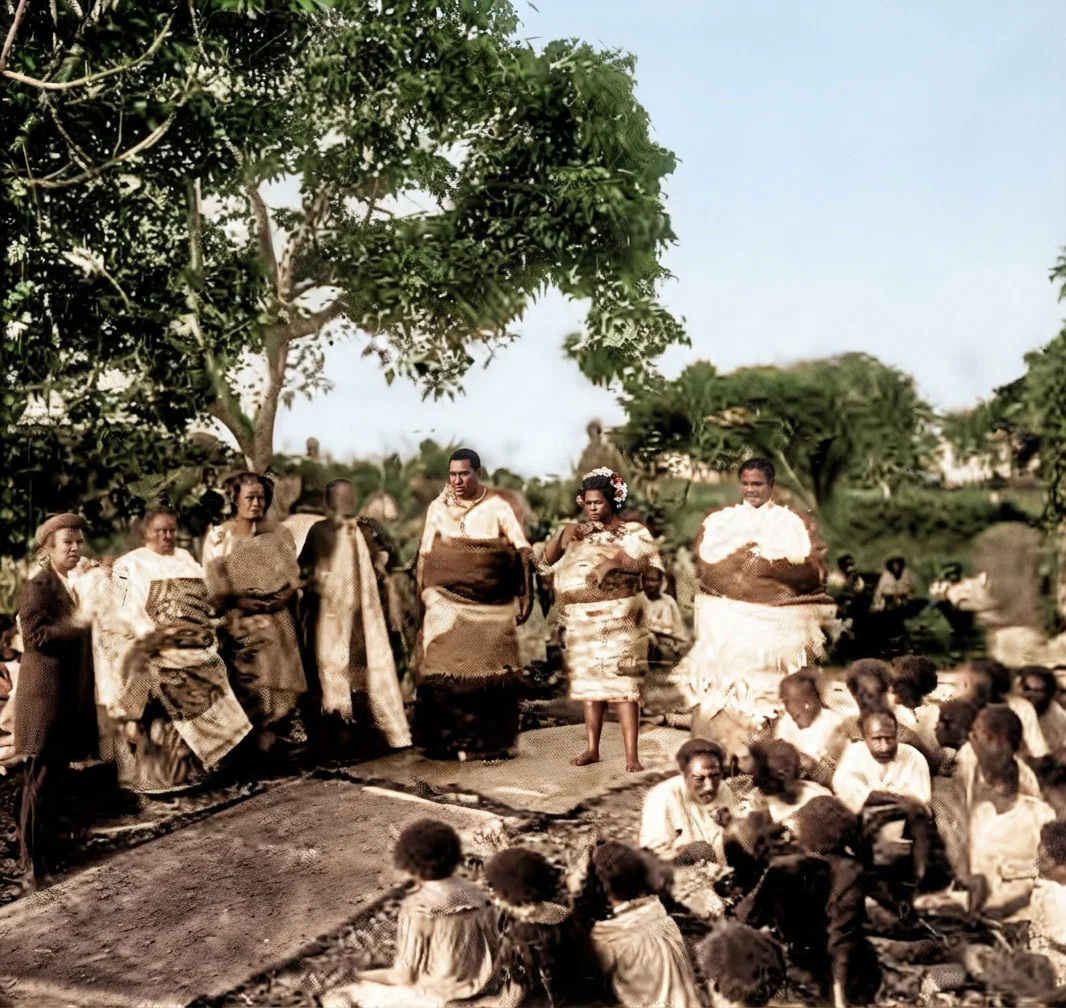
Marriage Ceremony among the Islanders.
The next morning our minister held a religious service with the flock who had regaled him the night before, and we came to Tonga over a high, stormy sea, glad to get home. I had planned on a four or five weeks' trip, but was away ten.
This minister told me that he remembered when the ministers did not use tobacco. He was at a meeting when a vote was taken as to whether or not they would use it, and he voted against its use. But the flesh prevailed over the spirit, and all use it now.
Not long ago I was told by our native brother that the leading white missionary asked his wife where her husband attended church. On being told that he worshiped with us, he replied, “Aho Titu” (“Seventh Day,” as we are called) is “lotu tabutabu” (a holy religion), but he thought the natives never could live up to it as it is too holy for them.
After returning home, I was kept busy building a small school-house, painting and repairing the house, and staining and varnishing the chapel seats and pulpit. We had no money to hire the work done, so the children—Alma, our little daughter, and three half-caste children we have living with us—and Mrs. Butz helped me build the school-house, all but putting up the rafters. Mrs. Butz also helped me paint the mission house outside and in; in fact, she did most of the painting while hearing the children's lessons. Since that time, however, we have a teacher from Australia.
Prejudice is gradually wearing away, as is illustrated by the following fact: When we came to Tonga, the Wesleyan minister would not recognize us in any way, but wrote a bitter article against us in the native paper. For two weeks Mrs. Butz nursed the wife of one of the Wesleyan European missionaries through a serious illness in the mission house, at their earnest solicitation. At the close they thanked her most heartily, and said they did not know how they could have gotten on without her.
Many of the natives recognize that we have “the truth,” are the “true church,” etc., but they are bound by custom, habits, and the church. Their social life makes it almost impossible for them to take their stand—impossible, but for the grace of God. They have a sense of right, but have not the courage of what little conviction they have. I think one of the worst effects of tobacco and kava is to deaden moral sense, and to cause them to be satisfied with themselves. The enervating climate also tends to make people indifferent. Pray that God will give us wisdom, and that His Holy Spirit will arouse the people from this state of lethargy. They are all members of the churches, and seem to think that is all that is necessary. In a most literal sense they “take no thought for the morrow.”—Record, Coorambong, N. S. W.

THE GOODNESS OF GOD.

BY MRS. SUSAN BIRDSALL ROBERTS.
“O that men would praise the Lord for His goodness.” O THAT our lives were one sweet song; One anthem of continued praise To Him who bought us with His blood, And crowns with good our passing days. What earthly potentate e'er gave His only, well-beloved son An ignominious death to die For crimes that he had never done? Good, do we say? Alas for words! For fitting words to speak His praise; We only know, and see, and feel The love that shines through all His ways. That love has crowned our every hour, Since first we learned to lisp His name; A tender Father, merciful; To-day as yesterday the same. This gracious Spirit comes alike To each receptive, waiting heart; The lowly and the meek to bless With largest measure of His grace, There to abide, nor thence depart.

CHRIST A MISSIONARY.

Christ was a home missionary, in the house of Lazarus.
Christ was a foreign missionary, when the Greeks came to Him.
Christ was a city missionary, when He taught in Samaria.
Christ was a Sabbath-school missionary, when He opened up the Scriptures, and set men to studying the Word of God.
Christ was a children’s missionary, when He took them in His arms, and blessed them.
Christ was a missionary to the poor, when He opened the eyes of the blind beggar.
Christ was a missionary to the rich, when He opened the spiritual eyes of Zaccheus.
Even on the cross, Christ was a missionary to the robber, and His last command was the missionary commission.—Amos R. Wells.

OUR WORK AND WORKERS.

A CAMP-MEETING is to be held in Goodrich, N. D., June 26 to July 3, and another like meeting at Towner, July 11-17.
AFTER a few weeks of labor at Basin, Mont., Brother W. A. Gosmer reports in the Bivouac that eight candidates had been baptized.
IT is announced in the Record that a church-school institute is to be held in Keene, Texas, commencing August 20 and continuing four weeks.
IN the Wisconsin Reporter, Brother J. B. Locken notes the baptism of eight candidates at Reeve, May 15. Five of these were pupils of the church school.
FROM the Record, of Cooranbong, N. S. W., we learn that Brother E. C. Davey and wife, both graduate nurses, have gone to Singapore, to unite with our mission there.
WRITING to the Record from South Australia, Brother Wm. Woodford reports the baptism of six persons at Adelaide, the capital. Other candidates were waiting another occasion. A mission was to be started at Petersburg.
A CAMP-MEETING under the auspices of Northern Illinois Conference is now in progress at Chicago. The location is Grove Avenue and 70th Street. It is very desirable that this be a revival meeting, and the managing brethren are doing all they can to have it so.
THE managers of the Hinsdale (Ill.) Sanitarium are pleased to announce that their new building is practically completed, well furnished throughout, thoroughly equipped with the latest medical appliances, and that they are now ready to receive patients. A descriptive catalog will be sent on application.
OF the work in Cincinnati, Brother C. A. Pedicord reports to the Welcome Visitor that two good sites had been found for Gospel tent-work—one at Westwood and one at College Hill. Two persons had been recently baptized, and four more were to be baptized on the 1st inst. The two first mentioned had come to a knowledge of the truth through the Bible work of Sister Annie Smith.
IN noting the influence of the SIGNS work in Greater New York, Brother George A. King says: “As a colporteur during the last six months in following the SIGNS work, I have homes for $500 worth of our best books, such as ‘Patriarchs and Prophets,’ ‘Daniel and Revelation,’ ‘Desire of Ages,’ ‘Great Controversy,’ ‘Heralds of the Morning,’ and others, as well as thousands of pages of tracts, besides nearly one hundred yearly subscriptions for the SIGNS OF THE TIMES.”

MISSION WORK AMONG THE KAFFIRS.

[Mrs. Jessie Hundley, in Herald of Light.]
ONE does not need to be in a heathen land long to realize how far short the Christian world has come, of fulfilling the divine commission. True, we have great reason to praise God for what has been accomplished. Many faithful witnesses to the truth have laid down their lives at their post away from sympathizing hearts. Often have our hearts gone up in thankfulness to God for the dear, faithful, self-denying missionaries, who have labored hard to translate the precious Bible and songs into so many different tongues, and to-day we are reaping the benefit of their labors.
Livingstone prophesied that the time would come when missionaries would reap souls for every sermon, and truly his words are being fulfilled in a very great measure to-day. Praise to our living Christ! In our seven months in South Africa, we have seen scores of souls crying to God for deliverance from sin. When they come to the altar, they know what they are coming for, and no one needs to urge them to pray. They often stop while seeking, and tell us God has shown them some restitution to make, and so often they empty their pockets of their pipes and their tobacco. Needless to say, our God comes to their rescue. A goodly number get established in Him. Please pray especially for the dear converts. Many of them have it hard, as their environments are everything but helpful. Thank God a million times for those who, like black Sammy Morris, know how to trust the living God! May He increase the number.
A lady said to me the other day, "You can't call these blacks heathen." Not call them heathen, when you see men of all ages clad in nothing but a blanket, and not always that? It is heart-breaking to go through the native locations and view the thousands of souls, so many half-clad, with seemingly no appreciation of anything better than their miserable surroundings. On the other hand, to look at the beautiful characters, educated, some really refined, and, thank God, transformed by the Spirit, we feel like redoubling our diligence for their redemption. Our work here has been mainly among the Kaffir tribes. They are beautiful, capable people, worthy of a much higher appreciation than they generally have. They are exceedingly cheerful and happy.
In all our services, even in the open-air meetings, they will kneel when we pray, or at least cover their faces with their hats or their hands. You never see any laughing or whispering during services, or looking about during prayer. Even the little children get down on their knees, and often on their faces, during a long prayer meeting. They are delighted to get the Bible in their own tongue.
An old, gray-headed man, blind, but happy in Jesus, was in our service yesterday with his wife. I shook hands with him after services, and asked him how long he had been a child of God; he answered, through an interpreter, "Ever since my mustache began to grow." I said, "And are you not tired of the way yet?" Laughing and rejoicing in the Spirit, he answered in the negative. I then quoted, "The path of the just is as the shining light, that shineth more and more unto the perfect day," and how he was melted, and praised God!
Maitland Bible School is placed among nearly 10,000 heathen, many of whom are raw from the interior. Our temporary school here is among quite as many, I think, with advantages for evangelizing the interior very great. Pray for us. Come, go, or send.

ATTENDANCE OF CHURCH MEMBERS AT CAMP-MEETING.

[This being the beginning of the camp-meeting season among our people, the following advice from “Testimonies for the Church” is worthy of special attention:]
BRETHREN and sisters, it would be far better for you to let your business suffer than to neglect the opportunity of hearing the message God has for you. Make no excuse that will keep you from gaining every spiritual advantage possible. You need every ray of light. You need to become qualified to give a reason for the hope that is in you, with meekness and fear. You can not afford to lose one such privilege.
Anciently the Lord instructed His people to assemble three times a year for His worship. To these holy convocations the children of Israel came, bringing to the house of God their tithes, their sin-offerings, and their offerings of gratitude. They met to recount God’s mercies, to make known His wonderful works, and to offer praise and thanksgiving to His name. And they were to unite in the sacrificial service which pointed to Christ as the Lamb of God that taketh away the sin of the world. Thus they were to be preserved from the corrupting power of worldliness and idolatry. Faith and love and gratitude were to be kept alive in their hearts, and through their association together in this sacred service, they were to be bound closer to God and to one another.
In the days of Christ these feasts were attended by vast multitudes of people from all lands; and had they been kept as God intended, in the spirit of true worship, the light of truth might through them have been given to all the nations of the world.
With those who lived at a distance from the tabernacle, more than a month of every year must have been occupied in attendance upon these holy convocations. The Lord saw that these gatherings were necessary for the spiritual life of His people. They needed to turn away from their worldly cares, to commune with God, and to contemplate unseen realities.
If the children of Israel needed the benefit of these holy convocations in their time, how much more do we need them in these last days of peril and conflict? And if the people of the world then needed the light which God had committed to His church, how much more do they need it now!

CALIFORNIA-NEVADA CONFERENCE MEETING.

THE thirty-fourth annual session of the California-Nevada Conference of Seventh-day Adventists will be held in Oakland, Cal., June 15-18. The first meeting will be called at 9 o'clock A.M. June 15. Each church in the conference is entitled to one delegate and an additional delegate for every twenty members.
A. S. KELLOGG, President.
J. S. OSBORNE, Secretary.

Thorough Conversion

THEY work thoroughly. No untempered mortar with them; they want souls converted, really converted. They don’t look for quantity so much as quality. One man saved, with his heart changed, is more to them than a dozen meetings when five hundred lift their hands for prayer, and go out to live the same old sinful lives. They want conversion that will stick by a sinner when men and meetings have passed. That will give him power to say No to sin and Yes to righteousness, no matter where he is or who is about him.—Talmage.

THE GRATITUDE OF THE LEPERS.

THE Indian Christian not infrequently appears to adopt an attitude of having, by reason of his change of faith, established a claim on his Mission for all the aid, not only in spiritual things, but in temporal things, that it can tender him. But generally speaking, our Christian lepers are singularly free from this spirit, and their appreciation of all the boons the Mission has brought them is undoubtedly sincere. This gratitude on the part of the Indian leper is no doubt due, in measure, to the striking contrast between his fate as a homeless, Hindu outcast and his condition of comfort and safety as an inmate of a Christian Asylum. Driven from the shelter of home when most in need of kindness and care; stricken with an incurable and loathsome malady which is relentlessly eating away, not only his life, but his very limbs; reckoned by his kindred as an unclean creature, on whom the curse of his gods has descended; the destitute leper represents the very lowest depth of human need. No wonder, then, that when banished from his village as a disgrace and a danger, he is welcomed into a home of hope and safety, he is grateful to those upon whom he has no claim, but who, constrained by the divine love, give him daily food and constant kindness. It is doubtless this practical embodiment of the compassion of Christ that leads so large a proportion of the inmates of the asylums to accept Christianity, so that there are now in connection with the sixty-eight stations of the Mission nearly 3,000 baptized Christian lepers. To them Christianity is more than dogma and doctrine, it is love—translated into act and fact. They can believe in a Saviour whose servants show them the only kindness they can find on earth. The home to which they have brought their breaking hearts and stricken bodies is to them a foreshadowing of the Father’s house of many mansions, and human love enables them to believe in the divine.—John Jackson.

Signs of the Second Coming of Christ

EDUCATION IN THE HOME. NO. 5.

Signs of the Second Coming of Christ.

"I TELL you, wife," said Neighbor Jones that night, when he reached home, "they are having very interesting Bible studies over at Mr. Hartman's; I learned a great deal to-night, for I joined their circle, at their invitation. They hold the next on Friday evening, and have invited us both. Let's go; what do you say?"
"What is the subject to be considered? perhaps we might go."
"A continuation of the subject of to-night, which was concerning the second coming of Christ."
"Well, these Adventists are queer people. They are forever harping about the end of the world, or the old Jewish Sabbath, or—"
"But hold; they were only having a Bible study with their own children, which surely they have a right to do; and surely, wife, if the church of Christ loves her Leader, she will be happiest when talking about His coming again. And then, really, when one comes to look the matter up, it is surprising how much there is said in the Bible about it. Really, I hope you will decide to go."
So it came to pass that the next Friday evening found Neighbor Jones and his wife at Brother Hartman's, Bible in hand; and, among the rest, seated close by Mattie's side, was the young friend, Josie Wilbur, who had not forgotten the appointment.
"I think it is needless to say," began Brother Hartman, "that we are all much pleased to see you, Mr. and Mrs. Jones, and you, Miss Josie, here to-night. I trust you will all be free to ask any questions, if you do not understand the points made."
"Our subject is still the coming of Christ and the signs preceding it. We have already touched upon one line of prophecy, and to-night will spend a little time upon another,—for it is not our purpose to exhaust the subject, but only to prepare our minds for further investigation and personal study. Elsie, will you please turn to the second chapter of Daniel, and read the thirty-first verse?"
"Thou, O king, sawest, and behold a great image. This great image, whose brightness was excellent, stood before thee; and the form thereof was terrible."
"Beth, who is this speaking to the king?"
"It is the prophet Daniel, papa."
"And the king's name?"
"Nebuchadnezzar. Daniel is telling the king the strange dream that the king had one night."
"That is good. Can you tell us, Miss Josie, how it was that the king asked Daniel for help?"
"Please, Mr. Hartman, I'd rather Beth would tell the story."
"Why, papa, it was because he could not find any one else who could tell him. God showed it to Daniel, and then Daniel told the king, and afterward explained what it meant. If he couldn't have done all this, I suppose that both he and the 'wise men' would have been killed."
"Well done! The book of Daniel is a wonderfully interesting one, and the interest is greatly increased by the fact that we know it to be the truth of God; and not only that, but it is especially necessary that this truth should be understood just now."
"Of what was the head of the image, which the king saw in his dream, composed, Mr. Jones?—verse thirty-two."
"This image's head was of fine gold."
"Of what material was the rest of the image composed, Mattie?"
"His breast and arms were of silver, and his sides and thighs were of brass, while the legs and feet were part of iron and part of clay."
"Finally, Mrs. Jones, what became of this strange image? please read the thirty-fifth verse."
"Then was the iron, the clay, the brass, the silver, and the gold, broken to pieces together, and became like the chaff of the summer thrashing-floors; and the wind carried them away, that no place was found for them; and the stone that smote the image became a great mountain, and filled the whole earth."
"Now we would be completely in the dark concerning this vision," said Brother Hartman, "were it not for the fact that the full explanation is given; but we are not left in the dark. So, since the Lord has taken such pains to tell us in His Word what is going to come to pass, isn't it a pity to be ignorant regarding it?"
"I believe the Lord says," commented Sister Hartman, that "the secret things belong unto the Lord our God; but those which are revealed belong unto us and to our children."
"That is true," remarked Mr. Jones, "and I am quite anxious to read the explanation of this strange dream. Of course I must have read it some time before now, but the fact is, I have not studied the Bible as I ought to have done," he continued, sadly.
"The head of gold represents the kingdom of Babylon, according to verse thirty-eight: 'Thou art this head of gold.' Verse thirty-nine declares that another inferior kingdom shall succeed this, which did occur B.C. 538."
"Will Elsie tell us the name of this successor to the Babylonish kingdom?"
"History says that the reign of the Medes and Persians began then. And these ruled over the known earth until, as it says in verse thirty-nine, still another kingdom of brass should succeed this."
Continue reading: A FATHER'S LOVE