Your ShelfYour Projects

Review and Herald, Vol. 84, No. 28.

The Likeness of Emmanuel
Earlier text: Leaves of the Tree of Life

Diet and Disease

J. R. LEADSWORTH, M. D.
“Because sentence against an evil work is not executed speedily, therefore the heart of the sons of men is fully set in them to do evil.” Perhaps there is no way in which the truthfulness of the preceding scripture is so abundantly illustrated as in the matter of eating and drinking. Since the experience of our first parents in Eden, men have been willing to rely upon the sense of taste rather than upon the voice of Inspiration or science as to whether a thing was good or bad. That God knew best what was for man’s physical and spiritual good in providing the original bill of fare, we can not gainsay. When deliverance was sent to Israel in Egypt, it was deemed wise to provide a fleshless diet in order that they might be a healthy, happy people. In that new earth state where “the inhabitant shall not say, I am sick,” it is written that “they shall not hurt nor destroy in all my holy mountain;” but the majority of people hope, rather, that they shall be able to get rid of the carnivorous appetite suddenly.
Too many people rely upon individual experience. After partaking of a juicy beef steak, they imagine a feeling of satisfaction that is not experienced in partaking of some of the natural flavored grains and fruits. Their gustatory sense tells them that it is good for food, and they are willing to believe it. Besides, they have been told that some people require flesh; that other food does not furnish sufficient strength. In fact, they are told that theirs is a case that seems to require a more concentrated diet.
That one can not rely wholly upon the sense of taste is well recognized by all food experts. In “Farmers’ Bulletin 74,” Department of Agriculture, we read: “In our actual practise of eating, we are apt to be influenced too much by taste, that is, by the dictates of the palate; we are prone to let natural instinct be overruled by acquired appetite, and we neglect the teachings of experience. We need to observe our diet and its effects more carefully, and regulate appetite by reason. In doing this we may be greatly aided by the knowledge of what our food contains, and how it serves its purpose in nutrition.”
Gautier, a French author of national reputation, says, on the same subject: “The appetite is not a good guide for us; we excite or appease it at will: it is for many people a function arising from their habits. In particular, in the case of meats, the more one eats, the more the stomach secretes digestive acid juices; and the more it secretes, the more one is induced to eat to weaken its impressions and to neutralize the stomachic acidity.”
That meat is not the most concentrated diet is also well known by those with even a limited experience in food values. While a few years ago, it was thought that, in order to strengthen invalids, it was necessary to feed them on the broth from the strong ox, it has become well recognized that such an article is a starvation diet. The stomach specialist is not slow to recognize that for weak digestion the malt or dextrinized grains are far superior to any production in the flesh line.
If it is true that a fleshless diet does not contain sufficient nourishment for mankind, then it can be truthfully said that a great majority of the population of the world are underfed. Seven eighths of all the people in the world do not eat meat. If it be true that some people require a more concentrated diet, it certainly is true of only a marked minority of mankind.
But if the wisdom of the Creator in the original plan needs confirmation, it is abundantly furnished by science in the chemical laboratory, and by use of the microscope. It is well known that the intestinal canal furnishes an excellent breeding place for several varieties of germs, the most constant of which is the bacilli coli. Recent experiments by Dr. Palier show that cultures of these bacilli taken from the bowel discharges of a non-flesh-eating animal have, practically, no effect when injected into another animal. But where these germs are cultivated on flesh food, after being taken from the first animal, or instead are taken from the bowel excretions of a carnivorous animal, their innocent nature is at once reversed. Instead of being inactive and inert, they become virulent, and set up many inflammatory conditions in the intestinal canal.
Dr. Senn recently noted, in extensive travels among the black people of Africa, that they were practically free from appendicitis. In accordance with these facts, Dr. Palier attributes the freedom of these people from appendicitis to their vegetable diet. He also adds that a diet of milk and vegetables should be protective against appendicitis and affections of the bile passages, all of which have been attributed to the colon bacillus. When it is known that in every fifteen grains of the bowel excretion there are said to exist about a billion germs, it would seem worth while to adopt a dietetic régime that would keep them as innocent as possible.
Los Angeles, Cal.

How the Minister’s Cause Was Won

The congregation at Holland Center used many times to wish that they might get some minister who would please Matthew Fairbanks, but somehow none could ever be found. According to Matthew Fairbanks’ ideas, they either preached too long or too short, visited too much or too little, were too much educated or else were not educated enough, were too narrow or too broad, and so on. And expressing his opinion as he did, freely and at all times, and being the successful man of business he was, he soon found followers. And somehow there was never good pastoral work done in that congregation at Holland Center.
The minister seemed to feel the chilliness of unfriendly eyes, and his sermons in some way fell to the ground. There being no one there to hold up his hands, he felt his helplessness. So, little by little, owing to Matthew Fairbanks, the critical feeling grew until each minister cut short his pastorate there with but small regret. The congregation dwindled more and more as time went on, and friction arose between the members.
“I’m sure I don’t know what in the world is the matter with us,” spoke up Mrs. Collier at prayer-meeting one evening. “Our members are growing fewer and fewer, the young people don’t like to come, and even the people outside are beginning to regard us with suspicion. We have good members. Why is it?”
There was no minister present that evening, and this was a prayer-meeting just by themselves, but no one answered the question, and the little woman sat down. But the reason of the condition of that church at Holland Center was due solely to one man, Matthew Fairbanks, who, on account of his criticizing, uncharitable, unjust, unchristian manner of talking, had brought things to just such an unhappy pass. The last minister had resigned and gone away, and a new one had taken his place. He was a clean-faced, ruddy young man, with frank eyes and a decided, businesslike manner.
“Well, Matthew,” asked old Caleb Powers, standing outside of his carpenter shop one morning, as Matthew Fairbanks passed by, “I hear you’ve got a new minister. Like him?”
Matthew stopped. “No, I don’t,” he replied, testily. “Thinks just because he’s out of college he knows it all. He’s gone and done away with the old hymn-books we’ve used for over twenty years, and got new ones.”
“Maybe they’re better than the old ones,” mildly suggested Caleb, but Matthew frowned.
“Instead of preaching Sunday nights, as he ought to, he’s begun a series of lectures, too,” went on Matthew, sternly.
“Guess he thinks you’ve been preached to enough,” remarked Caleb, with a laugh. “I myself can’t see that you’re any the better for it. What you need,” he added, with a shrewd look on his face, “is some one to get you out of the rut. You’ve had your way; let the new minister have his.”
But Matthew deigned no reply, and went on his way. Old Caleb looked after him thoughtfully.
“There ain’t a preacher in the whole of Christendom that could please that man,” he said to himself. “A pity, too, Matthew Fairbanks has the makin’ of a fine character, but that fault-findin’, criticizin’ way of his would kill any church on earth. I’ve always said,” continued the old man, “if a church-member sees everything wrong under the sun in his own church, he’d better, for that church’s good, be out of it.”
Just about that time Matthew Fairbanks’ only child fell sick. It seemed a trifling ailment at first, but as days passed, the slight cold developed into pneumonia. He had married late in life, and this little child, his only son, was the dearest object of his life. He was a sweet little boy of seven, with big brown eyes, a rosy mouth, and dimpled cheeks. How his father loved him! How he hung over him in speechless grief, as he grew no better!
“Matthew, you must rest,” his wife would tell him, but none of her entreaties could move him from that little white bed.
“He has only a chance,” the doctor finally acknowledged.
Matthew Fairbanks looked up. “I knew it!” he cried. “He will die!”
That afternoon the minister called. He had begged to be allowed to go up for only a minute.
Matthew sat by his child’s bed, his eyes sunken, his face white. He scarcely looked up at his visitor.
The little boy lay flushed and worn among the pillows, his breath short. The minister took a seat by him.
“Well, Jamie,” he began cheerily, taking up the little, wasted hand, “you’re pretty sick, aren’t you?—but see here, my boy. My wife and I have been thinking what would make you better, and finally we hit on this.” He took up a package as he spoke, and opened it.
The child looked at it with interest. He had roused a little.
“It’s a game, Jamie,” explained the minister, “and it’s called ‘The Merry Men of War.’ See, here are the soldiers, and you set them on this board on these pegs. At the end of the board opposite the men, is a little spring. Now you take this big marble and see if you can hit it. If you can, down goes your man—like this.” With a dexterous move of his wrist, he took a marble, touched the spring, and, quick as a wink, over toppled the tall soldier.
Jamie laughed—even laughed. He reached out to take one of the fascinating men of war, but he was too weak.
“Papa,” he said feebly, turning to his father, “come and see them. Will you play them with me?”
“Yes, my boy, yes,” replied Mr. Fairbanks, huskily.
Jamie was worse that night, but he babbled of the toy soldiers, and how he was going to play with them when he got well.
As morning dawned, it seemed that the frail life must go out, but some little thread held him to life.
“It seems to be a matter of mere will power,” spoke up the doctor, as restoratives were administered. “He’s clinging to something.”
And then Matthew Fairbanks thought of the toy soldiers, ‘The Merry Men of War,’ that Jamie and he were to play together when he grew better, and how, too, the minister had done his best to impress the child with the thought that they would make him better.
“He’s living so he can play that game,” thought the father.
Jamie did not die, but slowly and surely came back to life, and during his convalescence ‘The Merry Men of War’ were never off his coverlet, except as his bed was made. He played with them at morning, he played with them at night, he played with them at all times.
One day while Jamie slept, with a soldier clasped in the frail hand, Matthew Fairbanks fell on his knees and asked the pardon of his Heavenly Father. The scales had fallen from his eyes, and he saw himself as he really was, the one cause of all the discord in the Holland Center church, from which so many bitter springs had sprung.
“I’ll never, dear Father,” he prayed, “never so long as I have life, speak one word against thy messengers again. O Lord, I’ve been wicked; I’ve been bitter; I’ve been censorious. And thou hast heaped coals of fire upon my head. When the minister brought my child that game, it came to me: Would I have done the same in his case? He knew the unkind things I had said of him. He knew the seeds of strife I had sown, but he came, Lord, he came—came into the enemy’s house because he had thy Spirit.”
And down there by Jamie’s bed as he wept and prayed, it seemed to him that, for the first time in his life, he felt the full sunshine of his Father’s love. A new Matthew Fairbanks got up from his knees by that bed and went about his business. The first thing he did was to go to the minister, and, with tears in his eyes, ask his forgiveness.
“No matter what others attribute Jamie’s recovery to,” he said, brokenly, “I know—I feel sure—it was owing to you. And God revealed to me by that gracious act my own wrong-doing. Can you forgive me?”
The minister wrung his hand. There were tears in his eyes, too. “Praise the Lord,” he said, brokenly. “Take ye away the stone. I’ve been praying for that, and he has.”
The church at Holland Center grows now, the minister stays, and the right feeling prevails; and Matthew Fairbanks no longer finds fault, but is the minister’s right hand in everything, and especially in all good works.
And why?—Because by a single loving act toward a little sick child that minister, through God, wrought—shall I say it?—almost a miracle.—Susan Hubbard Martin.

His Day of Rest

He never had time to rest, and he never had time to play; When a man should be at his best, he was old and wrinkled and gray; He never had time to care how others were getting along, He never had time to share the joy of the singer's song.
He labored early and late, rudely pushing ahead; Pleasure, he thought, could wait; he would seek it some day, he said. Deaf to the cries of those who struggled in vain below, He heaped new woe on their woes, permitting his greed to grow.
He never had time to pause for the purpose of giving praise; He craved no public applause, nor hunted for peaceful ways; He never had time to waste on the song that the lover sings, He never had time to taste the sweetness that kindness brings.
He hurried early and late, roughly pushing ahead; Pleasure, he thought, could wait; he would seek it some day, he said; Old and wrinkled and gray when a man should be at his best, He died on the dismal day when he meant to begin his rest.
— S. E. Kiser.

G. A. IRWIN

From Gwelo to Mozambique, Africa

G. A. IRWIN
FRIDAY evening, March 29, I left Gwelo on the Beira and Mashonaland Railway train for the Port of Beira, on the Indian Ocean, to take the vessel on my homeward trip. Between Bulawayo and Beira, a distance of six hundred and seventy miles, there are three principal stations; namely, Gwelo, Salisbury, and Umtali. Gwelo is the center of a number of gold-mines, and the district is full of ancient workings. It is also the center of government for the district, and home of the native commissioner, and headquarters of the police. The town has an altitude of 4,600 feet, and a white population of 451.
Salisbury has an altitude of 4,825 feet, and a white population of 1,726. The place came into prominent notice during the Matabele war of 1890, when a fort was hastily constructed, and used by the white people for defense. Salisbury is at present the capital of Southern Rhodesia, and also the center of supplies for a number of gold-fields lying between the town and the Zambesi River to the north. A railroad eighty-four miles long connects Salisbury with a group of mines in the Lo Magundi district. The old stage line, running from Beira to the interior, passed through this place. This has now been superseded by the B. & M. R. R., which was completed in May, 1899. Salisbury is also an important missionary center. A general missionary convention was held here a little over one year ago, at which all the societies operating in the northern part of South Africa were represented, either by a delegate in person or by a paper prepared by some representative upon an assigned topic. A paper from Brother Anderson upon the subject of industrial training in connection with mission work, was read before the convention, and called forth a lively discussion, the position taken by Brother Anderson receiving the hearty indorsement of a large number of delegates. I arrived in Salisbury at half-past seven in the morning, where I had to change trains, and wait for over an hour before going on to Umtali.
Umtali is one hundred and seventy miles southeast of Salisbury, and is located just on the border between Southern Rhodesia and Portuguese East Africa. It has an altitude of 3,649 feet, and a white population of 688. In addition to being the distributing center of the gold-fields of British Manicaland and the eastern gate of the chartered companies' territory, it is the headquarters of the Beira and Mashonaland Railroad, whose repair shops are located near the town. This place, on account of its fine water-supply and generally healthful surroundings, is called the “Eden of Rhodesia.”
Leaving here at half-past seven in the evening, our next place was Beira, which we reached at half-past eleven Sunday forenoon, March 31. A distance of fifty or sixty miles inland from Beira, lies one of the most unhealthful regions in all Africa. Much of it is low, marshy land, below the level of the sea, covered with a growth of coarse grass or reeds, at whose base the ground is covered from one to three feet deep with water as black as ink. It is said that even in the dry season, few persons escape fever who spend three successive nights in this region.
The work of building the railroad through this place was all done by Kafirs, but not one of the engineers and foremen escaped fever, and many died.
Beira is built on a sand-bank lying between the ocean and the estuary formed by the junction of the Pungwe and Busi Rivers. Sixteen years ago there was not a house in the place, but now it contains a population of 3,379, divided as follows: whites, 1,438; Asiatics, 287; and natives, 1,654. The natives are all Kafirs, and the finest specimens of physical manhood I saw in all my travels through Africa. Having a fine harbor, and being the seaport outlet of the B. & M. R. R., Beira is rapidly growing into prominence.
The first settlement of the Portuguese on this part of the coast was at Sofala, a few miles farther south, which had been visited by Vasco da Gama in 1502, and where the Portuguese built a fort in 1505. It was then an Arabic town, and famous as the place whence most of the gold brought down from the interior was exported. From the fact that portions of the interior as far back as Mashonaland and Southern Rhodesia are literally honeycombed with ancient workings, and in many places are found ruins of ancient forts and temples, it is supposed that Sofala was the golden Ophir to which King Solomon sent a fleet of ships every three years, and from which he is supposed to have obtained enormous quantities of gold. The glory and importance of the place has now departed, and hereafter the growing town of Beira will be the port whence the products of the interior will find their way out to the different trade marts of the world. A high and substantial sea wall has been built all along the river side of the town to protect it from the strong tide, which has a rise and fall of twenty-two feet.
Owing to the presence of tsetse and hippo flies, whose bite or sting causes the death of horses, mules, and cattle, the traffic of the town is carried on by means of small trams propelled by strong Kafir men over a track two feet wide. The line is owned by a company, and each individual pays an annual rental for the use of a car, and the privilege of running it on the track.
Early in the morning of April 2, my boat, the “Prinzregent,” belonging to the German East African Steamship Company, arrived, and we were permitted to go on board at 2:30 P. M. The tide was then at its lowest ebb, and we had to go down a long stairway by the side of the sea wall, and pick our way through mud and slime until we came to the small boat that was to carry us and our luggage out to the ship. The water was so shallow that the boat could not be gotten up to the bank by several feet. While I was standing and wondering how we were going to get into the boat without getting our feet wet; all at once a big six-foot Kafir stuck his head between my legs from behind, and before I had time to think what was going on, I found myself on his shoulders astride his neck, being carried through the water and safely deposited in the boat.
At 4:30 P. M. the anchor was taken up, and the “Prinzregent” steamed quickly out of the Beira harbor and headed northward for Chinde, which is located at the mouth of the Zambesi River, where we arrived the next morning at half-past six, and anchored six miles out at sea, there being a sand-bar in front of the place, which prevents vessels of the tonnage of the “Prinzregent” (6,300) from going closer with safety.
There were five missionaries on board, returning to their station in Nyassaland from a vacation at the Cape. These, with some other passengers, were put over the side of the vessel in a large basket, and lowered into the tender below, which was to take them ashore. We lay at anchor all day, waiting for the return of the tender with expected passengers from Nyassaland and the upper Zambesi country. There being no breeze, the heat of the sun was almost unbearable; hence we were extremely glad when the boat returned with the passengers, and we again put to sea.
Since leaving Beira we have been sailing in the Mozambique Channel, which separates the large island of Madagascar from the mainland of Africa. This channel is over eight hundred miles long, with an average width of three hundred and seventy-five miles.
Madagascar belongs to a native tribe of people known as the Hovas, but by a treaty signed Dec. 12, 1885, it was declared a French protectorate. It is the third largest island in the world, having an area of 228,500 square miles. Its population is 3,500,000. There are forty-three mission stations on the island, the majority of which are under the auspices of the London Missionary Society and the Norwegian and Swedish missions. No effort has as yet been made by our people to enter the island with the third angel's message.
On the morning of April 5 we awoke to find the vessel anchored in the bay in front of the town of Mozambique. The town is located on an irregular-shaped island, possibly two and one-half miles long, with an average width of three fourths of a mile. It is a quaint old town, having its beginning somewhere in the sixteenth century. The streets are narrow and irregular; most of the buildings are made of stone and plastered on the outside. The most interesting building in the place is a large fort, or castle, standing upon the point of the island, facing the ocean. It is both a massive and elaborate structure, considering the times in which it was built. It must have covered four acres of land. The outside walls were constructed of stone and concrete, and were fully twelve feet thick. The work must have been done by slave or convict labor, and evidently covered quite a period of years.
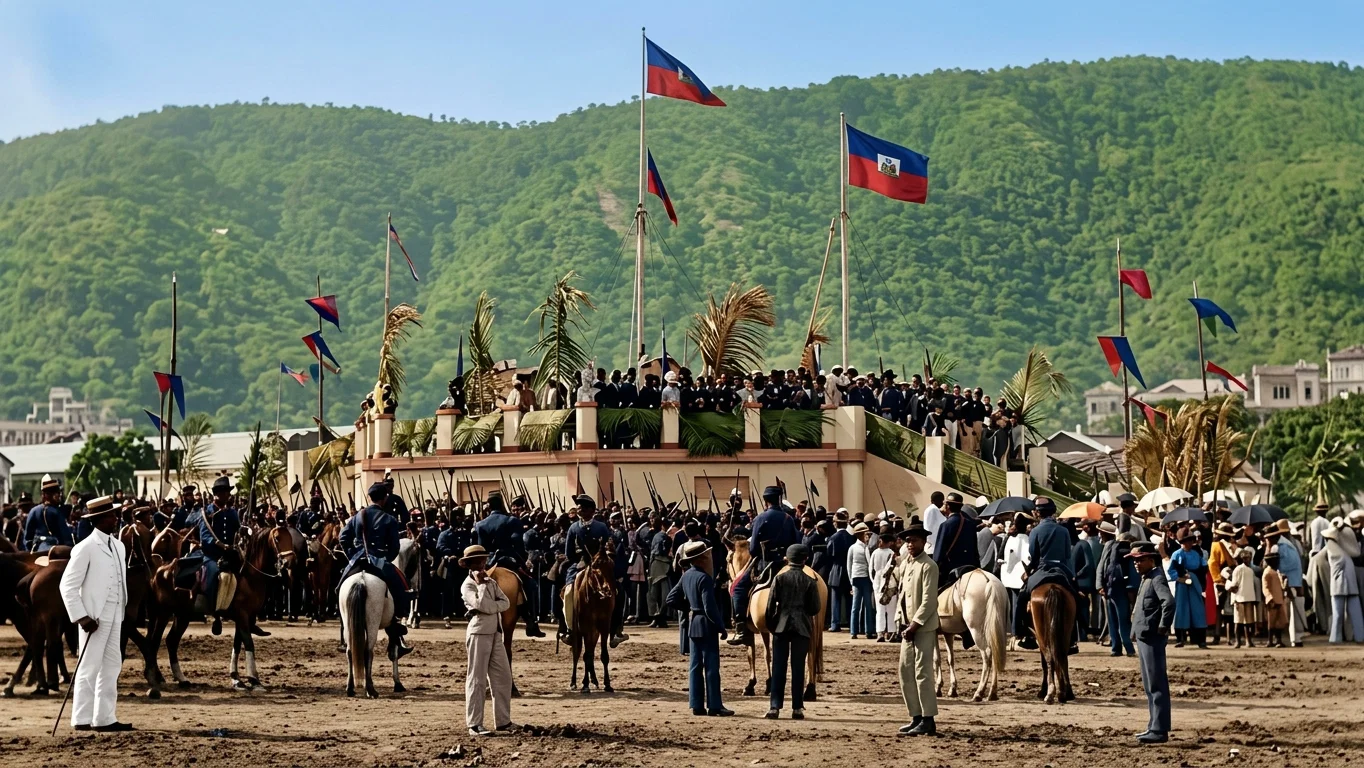
THE CELEBRATION OF AGRICULTURAL FETE, PORT AU PRINCE, HAYTI
A Portuguese inscription on one of the inner walls states that it was dedicated Dec. 20, 1666. Mozambique is the capital of Portuguese East Africa. Its residents are divided between Portuguese, Arabs, Indians, and African natives. The place is so hot that Europeans do not care to remain long in the town.

Why Did He Begin?

"Mama," said little Harry, as he was looking out of the window, "Why does that man stagger through the streets?"
"Because he is drunk."
"But, mama, why does he not stop drinking?"
"Either because he can not, or he thinks he can not."
"Well, then," said the innocent little one, looking into his mother's eyes with all earnestness, "why did he ever begin?"
What a work is here suggested for parents and teachers—to train children in such habits of total abstinence that they will never take the first.—Selected.

Marriage Customs in Tibet

In Tibet marriage is often a convenient fiction, and may be adjusted as a temporary bargain.

W. JAY TANNER

Hayti

W. JAY TANNER

Hayti was discovered by Christopher Columbus, on Dec. 6, 1492. The name of the island is said to have meant, in the native Indian language, “high, mountainous land.” But Columbus thought that it resembled Spain, and therefore he gave it the name of Hispaniola, or “Little Spain.” Subsequently, under the French, it was for many years known as Saint Dominique; but on the declaration of Haytian independence in 1804, the aboriginal name was revived and adopted.
In point of size among the West Indian islands, Hayti is second only to Cuba, her next-door neighbor on the west. It has an area of over twenty-eight thousand miles, or more than the combined areas of Vermont, New Hampshire, Massachusetts, and Rhode Island. The present population is estimated at one million and a half. The republic of Hayti in the west, sometimes known as the Black Republic, because it is dominated by negroes, has two thirds of the population, and one third of the land area, of the island; while the remaining portion is under the rule of Santo Domingo.
At the time of its discovery, the island was well populated by Indians, whom the Spanish represent as mild and hospitable in habits and manners. But these have long since disappeared, and a mixed population, from Europe and Africa, has taken their place.
The history of the means by which the Spaniards exterminated the original inhabitants is somewhat similar to their relationship with the original Mexicans and Peruvians. “It would appear that the first rupture between the Indians and the Spaniards took place in 1493, at the garrison left by Columbus near Cape Haytien, on his first departure for Spain.” “History informs us that the Spaniards, having ill-treated the Indians, were fallen upon by them, and utterly exterminated. This unhappy event led to all the rest of the bloodshed and murder which afterward took place between the Spaniards and the natives of Hayti, thus showing how utterly vague is all merely nominal Christianity.
“Various indications of gold having presented themselves, the love of that idol was soon vehemently developed, and the unhappy Indians were, erelong, dragged forth from the quiet of ages past, and as slaves, to which state they were reduced, were compelled to hunt the worshiped metal either in the streams or in the mines. But the Indians of the tropics soon sank beneath this weight of woe, and even speedily disappeared, to the perpetual dishonor of their rapacious, though nominally Christian, masters.”
The case of the queen of Xaraqua might be cited as an illustration of the perfidity and cruelty of the times. This queen ruled in the south, whereas the field of Spanish exploit was in the north. The latter had recently been in conflict with, and had conquered two cauques, or native chiefs, whose territory was near their own; and although the queen was on friendly terms with the Europeans, yet it was decided that she and her inoffensive people must be destroyed. To accomplish this, the Spanish governor sent word to the queen that he expected to pay her a friendly visit. He took with him five hundred well-armed troops, and was met in the way by the queen and the major part of her subjects, bearing palm branches and bouquets of tropical flowers. The queen did all she could to honor and feast her guests. In return for these favors, the Spaniards offered to feast the queen “in European style.”
In the course of this feast, ostensibly in honor of the queen, but in reality for the purpose of accomplishing her destruction, the commander ordered an evolution of the troops which brought the Spanish soldiers and the people in separate groups facing each other. The unsuspecting people, the queen in their midst, were regarding the wonderful doings of the Europeans with confidence and admiration, when suddenly, and without warning, the soldiers opened fire upon them. Needless to say the slaughter of the day was dreadful. Twelve of the defenseless natives were impaled together on a sharp stake, in honor, the historian tells us, of the twelve apostles! The queen herself was taken prisoner, bound, and dragged to the northern part of the island, where she was finally garroted, and her lifeless body left impaled.
But the cruel extermination of the Indians was not the only evil result of the Spaniards’ greed for gold. “The great scarcity of hands for working the mines, and for other exhausting toils which were first imposed on the Indians, soon originated the idea of seeking help elsewhere; hence Africa was thought of, and from whence the white man delayed not to drag by thousands the unhappy Africans from their ancient shores; and having shackled both soul and body, promptly set his more hardy limbs to work, thus soon lashing from him unbounded wealth.”
In 1602 the French wrested the western part of Hayti from the Spanish, and at different times the entire island has been under their control. However, the latter sought for wealth from the products of the soil, rather than from the already exhausted mines. “The elements and resources of every kind of wealth being found on these fertile shores, the active spirit of the French soon turned all to good account, and the result of their industrial powers became a subject of both wonder and admiration. Indeed, so great was the development of the unbounded resources of this fertile land, that it soon acquired the distinguished title of Le Paradis des Français (Paradise of the French) . . . Riches and luxury assumed a scale of even grandeur, as may be seen at the present day in the northern part of the Haytian republic, by such remains of ancient seats as plainly indicate the style of former days, when the positions of high and low were almost fabulous in their extremes of ease and misery.”
As might be expected, this abuse of power and of the blessing and bounties of nature, instead of following the evolution theory and developing into something still more grand and more worthy of the intelligence and refinement of the times and people, became the cause of fearful days for the colonists,—days that could be outmatched only by the reign of terror in the home land,—days that brought an end to the sovereignty of France over the richest and fairest of the Antilles.

MRS. J. J. NETHERY

Egypt

MRS. J. J. NETHERY
The American Mission of Presbyterians has several good schools in this country, and has done much in instructing the natives. Brother Awada was the first one of their converts, and their first minister. Now he is one of our conference ministers. So we see that many of the other denominations are going before and preparing the way for the third angel's message to reach hearts.
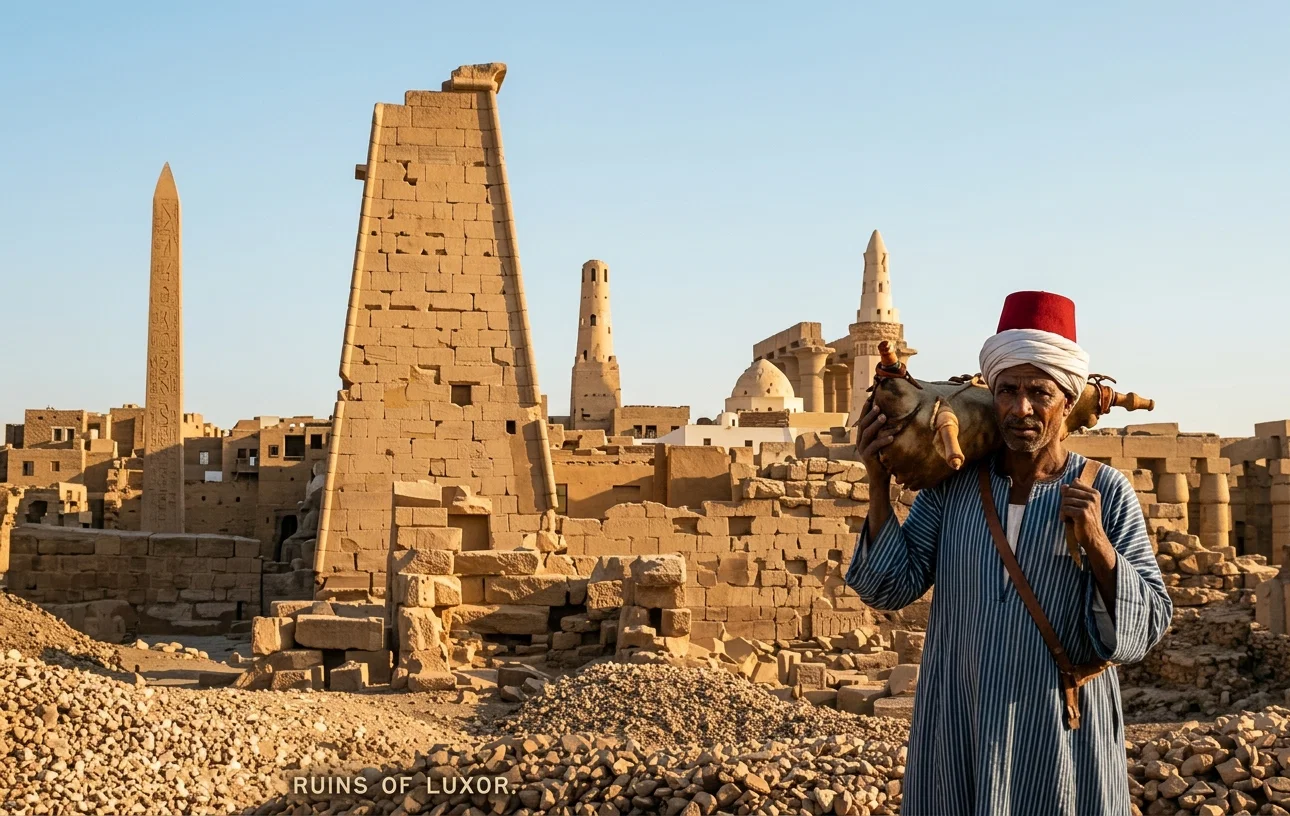
RUINS OF AN ANCIENT TEMPLE AT LUXOR, EGYPT. A NATIVE WATER-CARRIER
We visited a number of native homes, some of which were poor types of what we would call homes. At one place where we held a Bible study through an interpreter, we found several women gathered, all sitting around on the floor, which was by no means clean. When Mr. Nethery entered, they all began to draw their head coverings over their faces, as it is counted a shame for a woman to have her face uncovered in the presence of a man, unless he is a relative. The Mohammedan woman wears a veil stretched across her face just below the nose. She also wears a nose-piece, which covers her nose, so only her eyes are visible. But the Coptic woman, who believes in Christ, wears a black mantle with a cape over her head, which she holds together under her chin with her hand; but when she is out on the street, and sees a man approaching, she shuts the cape together over her face. It seems a very bad custom; but very few natives can be induced to dispense with it, except some of the girls who are being trained in mission schools. Even our Egyptian sisters follow their old customs.
Brother Awada dresses in European costume when on the street, except the red felt tarbush, which he wears all the time. The higher class of natives wear this article of head-dress, as it is counted a dishonor to one's country not to wear the tarbush, unless it is replaced by the turban, which is worn by all classes, and consists of a twisted strip of cloth wrapped around the head. They never remove their head-gear while in the house; and with such heat on their heads, both summer and winter, a great number of them are bald. Most of the men who live in the cities wear long flowing black gowns, which sweep through the dust as they walk.
We tried to eat dinner in real native fashion, in one of the Egyptian homes. There were no plates, knives, or forks. A bowl of soup was placed on the table, in the center, and a part of a loaf of bread was put at each plate. Each person was supposed to break off a chunk of bread, and dip it into the soup, and partake. They all seemed to relish the soup, but my husband and I decided that we had poor appetites, after seeing several hands dip in. The women ate in the kitchen, on the floor; but as I was an American, they granted me the privilege of eating with the men. But we did not want for something to eat; for this same family had a beautiful orange-grove, laden with delicious ripe fruit. They also had lemons, pomegranates, dates, figs, bananas, and grapes, but oranges and lemons were the only fruits ripe.
It is just these kinds of homes that missionaries must enter to give the gospel. In this home there is one woman who has lately begun the observance of the Sabbath. And, although living almost in the same house with pigeons, goats, donkeys, etc., still we hope the Lord will lift her to a higher standard. The way some live is surely beyond description; but we know that there are going to be a few from Egypt who will be saved. We pray that the Lord will bring intelligent natives into the truth who can work among their own people. We are thankful for Brother Awada as a native laborer. And then there are two bright young men who have recently begun to keep the Sabbath. They speak English well, and are teachers, and we pray that ere long they may be developed into workers.
Alexandria, Egypt.
Continue reading: Liberty in Bavaria, Germany