The Youth’s Instructor, Vol. 43, No. 47.

THANKSGIVING HYMN
Earlier text: THANKSGIVING HYMN

THE NORTH AMERICAN PIGEON.

[WHEN the writer was a boy, nothing was more commonly seen in the spring and autumn than were these birds. About forty years ago they nested in great numbers in the woods in the Province of Quebec, close to the border of Vermont. At that time the very light of the declining sun was obscured by vast flocks of these birds, when in the afternoon they returned from their foraging to their nests at the foot of the mountain. Hunters took them there by thousands. They were knocked off the trees with poles, and strung on sticks like fish, and so brought out of the woods on the hunters’ backs. After that for many years they were constant visitors, and “pigeon stew” was a common dish on farmers’ tables in those days. No wild bird excelled them in beauty and swiftness of flight, and to this day we recall the sound of the sudden rush of wings, as one of those swift couriers of the air passed us, and was a half mile away before we could look up to see which way he had gone. But they are never to our knowledge now seen in northern Vermont, where they used to be so plentiful, and we have not seen one since 1872, when we saw a few in northern New York. We have often wondered what has become of them, but the following interesting article by Chief Pokagon, which appeared in the Chautauquan of November of the present year, shows that these beautiful birds, like the American bison, have perished by the hands of the unscrupulous hunters.—M. E. K.]
The migratory or wild pigeon of North America was known by our race as “o-me-me-wog.” Why the European race did not accept that name was, no doubt, because the bird so much resembled the domesticated pigeon; they naturally called it a wild pigeon, as they called us wild men.
This remarkable bird differs from the dove, or domesticated pigeon, which was imported into this country, in the grace of its long neck, its slender bill and legs, and its narrow wings. Its length is sixteen and one half inches. Its tail is eight inches long, having twelve feathers, white on the underside. The two center feathers are longest, while five arranged on either side diminish gradually, each one-half inch in length, giving to the tail when spread an almost conical appearance. Its back and upper part of the wings and head are a darkish blue, with a silken, velvety appearance. Its neck is resplendent in gold and green, with royal purple intermixed. Its breast is reddish brown, fading toward the belly into white. Its tail is tipped with white, intermixed with bluish black. The female is one inch shorter than the male, and her color less vivid.
It was proverbial with our fathers that if the Great Spirit in his wisdom could have created a more elegant bird in plumage, form, and movement, he never did.
When a young man, I have stood for hours admiring the movements of these birds. I have seen them fly in unbroken lines from the horizon, one line succeeding another from morning until night, moving their unbroken columns like an army of trained soldiers pushing to the front, while detached bodies of these birds appeared in different parts of the heavens, pressing forward in haste, like raw recruits preparing for battle. At other times I have seen them move in one unbroken column for hours across the sky, like some great river, ever varying in hue; and as the mighty stream, sweeping on at sixty miles an hour, reached some deep valley, it would pour its living mass headlong down hundreds of feet, sounding as though a whirlwind was abroad in the land. I have stood by the grandest waterfall of America, and regarded the descending torrents in wonder and astonishment, yet never have my astonishment, wonder, and admiration been so stirred as when I have witnessed these birds drop from their course like meteors from heaven.
While feeding, they always have guards on duty to give alarm of danger. It is made by the watch-bird as it takes its flight, beating its wings together in quick succession, sounding like the rolling beat of a snare drum. Quick as thought each bird repeats the alarm with a thundering sound, as the flock struggles to rise, leading a stranger to think a young cyclone is then being born.
I have visited many of the roosting places of these birds, where the ground under the great forest trees for thousands of acres was covered with branches torn from the parent trees, some from eight to ten inches in diameter. At such a time so much confusion of sound is caused by the breaking of limbs and the continual fluttering and chattering, that a gun fired a few feet distant cannot be heard, while to converse so as to be understood is almost impossible.
About the middle of May, 1850, while in the fur trade, I was camping on the head waters of the Manistee River, in Michigan. One morning on leaving my wigwam I was startled by hearing a gurgling, rumbling sound, as though an army of horses laden with sleigh-bells was advancing through the deep forests toward me. As I listened more intently, I concluded that instead of the tramping of horses it was distant thunder; and yet the morning was clear, calm, and beautiful. Nearer and nearer came the strange commingling sounds of sleigh-bells, mixed with the rumbling of an approaching storm. While I gazed in wonder and astonishment, I beheld moving toward me in an unbroken front millions of pigeons, the first I had seen that season. They passed like a cloud through the branches of the high trees, through the underbrush, and over the ground, apparently overturning every leaf. Statuelike I stood, half concealed by cedar boughs. They fluttered all about me, lighting on my head and shoulders; gently I caught two in my hands, and carefully concealed them under my blanket.
I now began to realize they were mating, preparatory to nesting. It was an event which I had long hoped to witness; so I sat down and carefully watched their movements, amid the greatest tumult. I tried to understand their strange language, and why they all chatted in concert. In the course of the day the great on-moving mass passed by me, but the trees were still filled with them, sitting in pairs in convenient crotches of the limbs, now and then gently fluttering their half-spread wings, and uttering to their mates those strange, bell-like wooing notes which I had mistaken for the ringing of bells in the distance.
On the third day after, this chattering ceased, and all were busy carrying sticks with which they were building nests in the same crotches of the limbs they had occupied in pairs the day before. On the morning of the fourth day their nests were finished, and eggs laid. The hen birds occupied the nests in the morning, while the male birds went out into the surrounding country to feed, returning about ten o’clock, taking the nests, while the hens went out to feed, returning about three o’clock. Again changing nests, the male birds went out the second time to feed, returning at sundown. The same routine was pursued each day until the young ones were hatched and nearly half grown, at which time all the parent birds left the brooding grounds about daylight. On the morning of the eleventh day after the eggs were laid, I found the nesting grounds strewn with egg shells, convincing me that the young were hatched. In thirteen days more the parent birds left their young to shift for themselves, flying to the east about sixty miles, when they again nested. The female lays but one egg during the same nesting.
Both sexes secrete in their crops milk or curd with which they feed their young, until they are nearly ready to fly, when they stuff them with mast and such other raw material as they themselves eat, until their crops exceed their bodies in size, giving to them an appearance of two birds with one head. Within two days after the stuffing they become a mass of fat, a “squab.” Then the parent birds drive them from the nests to take care of themselves, while they fly off within a day or two, sometimes hundreds of miles, and again nest.
It has been well established that these birds look after and take care of all orphan squabs whose parents have been killed or are missing. These birds are long lived, having been known to live twenty-five years caged. When food is abundant, they nest each month in the year.
Their principal food is the mast of the forest, except when curd is being secreted in their crops, at which time they denude the country of snails and worms for miles around the nesting grounds. Because they nest in such immense bodies, they are frequently compelled to fly from fifty to one hundred miles for food.
During my early life I learned that these birds in spring and fall were seen in their migrations from the Atlantic to the Mississippi River. This knowledge, together with my personal observation of their countless numbers, led me to believe they were almost as inexhaustible as the great ocean itself. Of course I had witnessed the passing away of the deer, buffalo, and elk, but I looked upon them as local in their habits, while these birds spanned the continent, frequently nesting beyond the reach of cruel man.
Between 1840 and 1880 I visited in the States of Ohio, Indiana, and Michigan many brooding places that were from twenty to thirty miles long and from three to four miles wide, every tree in its limits being spotted with nests. Yet notwithstanding their countless numbers, great endurance, and long life, they have almost entirely disappeared from our forests. We strain our eyes in spring and autumn in vain to catch a glimpse of these pilgrims. White men tell us they have moved in a body to the Rocky Mountain region, where they are as plenty as they were here; but when we ask red men about them, who are familiar with the mountain country, they shake their heads in disbelief.
A pigeon-nesting was always a great source of revenue to our people. Whole tribes would wigwam in the brooding places. They seldom killed the old birds, but made great preparation to secure their young, out of which the squaws made squab butter, and smoked and dried them by thousands for future use. Yet under our manner of securing them they continued to increase.
White men commenced netting them for market about the year 1840. These men were known as professional pigeoners, from the fact that they banded themselves together, so as to keep in telegraphic communication with these great moving bodies. In this they became so expert as to be almost continually on the borders of their brooding places. As they were always prepared with trained stool pigeons and flyers which they carried with them, they were enabled to call down the passing flocks, and secure as many by net as they were able to pack in ice and ship to market. In the year 1848 there were shipped from Chattaraugus county, New York, eighty tons of these birds; and from that time to 1878 the wholesale slaughter continued to increase, and in that year there were shipped from Michigan not less than three hundred tons of these birds. During the thirty years of their greatest slaughter there must have been shipped to our great cities five thousand seven hundred tons of these birds; allowing each pigeon to weigh one-half pound would show twenty-three millions of these birds. Think of it! And all these were caught during their brooding season, which must have decreased their numbers as many more. Nor is this all. During that time hunters from all parts of the country gathered at these brooding places, and slaughtered them without mercy.
In the above estimate are not reckoned the thousands of dozens that were shipped alive to sporting clubs for trap shooting, as well as those consumed by the local trade.
These experts finally learned that the birds while nesting were frantic after salty mud and water, so they frequently made, near the nesting places, what were known by the craft as mud beds, which were salted, to which the birds would flock by the million. In April, 1876, I was invited to see a net over one of these death pits. It was near Petoskey, Michigan. I think I am correct in saying the birds were piled one upon another at least two feet deep when the net was sprung, and it seemed to me that most of them escaped the trap; but on killing and counting, there were found to be over one hundred dozen, all nesting birds.
When squabs of a nesting became fit for market, these experts prepared with climbers would get into some convenient place in a tree top loaded with nests, and with a long pole punch out the young, which would fall with a thud like lead on the ground.
(To be concluded next week.)

SABBATH-SCHOOL HINTS.

“GRIEVE not the Holy Spirit of God.”
The Lord is more willing to give us his Spirit, than we are to give good gifts to our dearest friends.
“If we will open the door to Jesus, he will come in and abide with us; our strength will always be reenforced by his actual representative, the Holy Spirit.”—Mrs. E. G. White.
The Spirit speaks to us through the Scriptures; therefore we should study them prayerfully, that we may be able to recognize the voice of God in them to us. “Search the Scriptures; for in them ye think ye have eternal life.”
“We may tarry all night in the fields, like Jacob, but unless we know the Scriptures, we have not the ladder whose top reaches unto heaven, along which our thoughts, like angels, may ascend and descend.”—Gordon.
We wrestle not against flesh and blood, but against the prince of darkness. We need divine power to meet this adversary. Luther relates one of his experiences with Satan as follows: “Once upon a time the Devil said to me, ‘Martin Luther, you are a great sinner, and you will be damned!’ ‘Stop! stop!’ said I; ‘one thing at a time. I am a great sinner, it is true, though you have no right to tell me of it. I confess it. What next?’ ‘Therefore, you will be damned.’ ‘That is not good reasoning. It is true I am a great sinner, but it is written, “Jesus Christ came into the world to save sinners;” therefore, I shall be saved! Now go your way.’” J. H. D.

Simon Pokagon, Last Pottawattamie Chief, Honored at Fair

SIMON POKAGON, of Michigan, is a full-blooded Indian, the last Pottawattamie chief of the Pokagon band. He is author of the “Red Man’s Greeting,” and has been called by the press the “red-skin poet, bard, and Longfellow of his race.” His father, chief before him, sold the site of Chicago and the surrounding country to the United States in 1833 for three cents an acre. He was the first red man to visit President Lincoln after his inauguration. In a letter written home at the time he said: “I have met Lincoln, the great chief; he is very tall, has a sad face, but he is a good man. I saw it in his eyes and felt it in his hand-shaking. He will help us get payment for Chicago land.” Soon after thirty-nine thousand dollars was paid. In 1874 he visited President Grant. He said of him: “I expected he would put on military importance, but he treated me kindly, gave me a cigar, and we smoked the pipe of peace together.” In 1893 he procured judgment against the United States for over one hundred thousand dollars still due on the sale of Chicago land by his father. He was honored on Chicago Day at the World’s Fair by first ringing the new Bell of Liberty, and speaking in behalf of his race to the greatest crowd ever assembled on earth.
— Chautauquan.

A REAL THANKSGIVING DAY.

“Mandy, Mandy,” rang loud and clear on the crisp November air, and the echoes repeated “Mandy, Mandy,” but no answer came to the call. Mrs. Jackson stood on the door-step of a commodious farmhouse. Her sleeves were rolled up above her elbows, and her large gingham apron bore traces of flour, for she was making preparations for the dinner for the next day, which was Thanksgiving day. A neighbor had stepped in for a few moments to tell the news, and had asked for Mandy.
“I wonder where the child has gone. I hope she is not in danger anywhere,” said Mrs. Jackson; for she was one of those motherly souls who are always solicitous for the welfare of those around them.
“You are always worrying about the child; one would think she was your very own,” said Mrs. Brown.
“She has been a great help to my husband and me all these years, and a great comfort, too, and we love her as our own; and since this trouble about the loss of the deed to the farm that grandfather Jackson bought of old Luther Smallby, and the claim that young Luther makes to the place because we can’t find the deed or a record of it, we would not know what to do without her.”
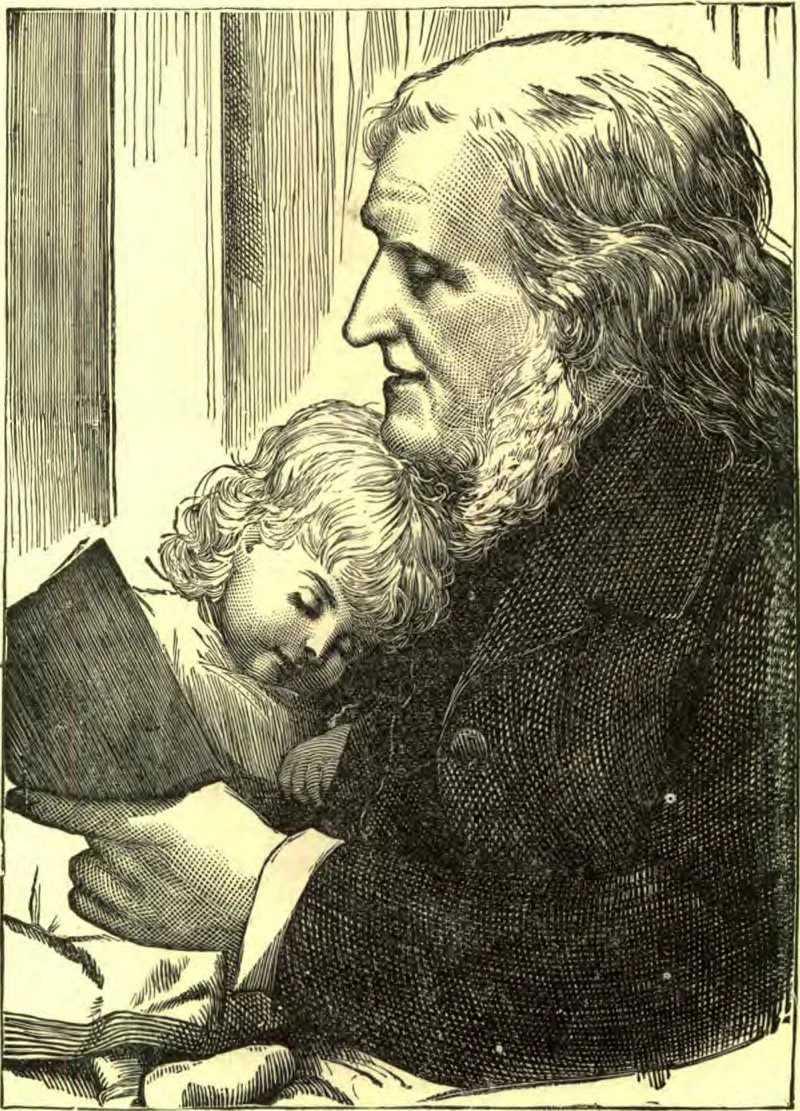
“Yes, it’s twelve years to-morrow since Mandy came; for it was on Thanksgiving morning we found her on the door-step. We couldn’t bear to send her to the poorhouse, so we concluded to keep her. Grandfather did not care much for her at first, but after a little they became great friends, and it was a sight to see her golden curls close to his white hair as she went to sleep in his arms.
“One of their favorite walks was down to the old house, which the men use for a shop now. He used to build a fire in the fireplace, and they would watch it for a long time; but grandfather has been dead now for these eight years, and things have changed since then. Well, well, how time does fly! Like as not Mandy is down to the old house now,” and raising her voice once more she called, “Mandy—e!”
Just at that moment a young girl with a broom in her hand came running up the path with the speed of a deer, her hair flying in the wind, and joy beaming from her eyes. As soon as she was near enough to be heard, she shouted triumphantly, “I’ve found it! I always thought it must be somewhere in the old house; and when I took the broom-handle to kill a big spider on the chimney cupboard, a board slipped down, and there was a paper folded up very neatly. I read just enough to know it was the deed, and then I ran home. O, I am so glad! now you and father won’t have to give up the farm.” And seizing the dinner-horn, she blew such a blast as had not been heard on that farm for years.
Mr. Jackson came hurrying in from the wood-lot, thinking that the house must be on fire; but he soon learned why he had been called.
A happier trio never sat down to supper than and father and mother Jackson and their little adopted daughter, Mandy.
Father Jackson thanked God for all his benefits, and good mother Jackson could find no fault with the hand of Providence; and when the collection was taken the next day for the benefit of the poor, she gave with a liberal hand, saying softly to herself, “Thou shalt open thine hand wide unto thy brother, to thy poor, and to thy needy, in thy land.”
EMMA L. KELLOGG.

A SELFISH SISTER.

One day when Grace’s father came from the post-office, he put into her hand a package with her name on it. The little girl opened it with nimble fingers, and was wild with joy at beholding a light-blue book, with gilt letters on the outside, and little stories and bright-colored pictures within. She clapped her hands, saying eagerly: “How kind Uncle John is, to send me such a beautiful present! O I am so glad!”
Grace took her book and sat down in an easy-chair, and was looking at the pretty pictures, when her brother Harry came and sat down beside her, and tried to look at them with her. Little Joe also came and peeped over her shoulder. “Go away!” cried Grace in a vexed tone. “You trouble me. I don’t want you here.”
“But I want to see the painted pictures; do let me,” begged Harry.
“Me too,” said Joe.
“You can’t,” replied Grace. “Do go away. I do wish you would let me alone.”
Joe went off crying.
Half an hour later, Harry asked Grace to let him take the book “just five minutes—long enough to see a few pictures.”
“No, you shall not have it for one minute,” was the unkind sister’s answer. “You are always begging for something. I don’t like boys, anyway.”
Harry went out of doors, and Grace enjoyed the book alone. Soon she took some paper, and began to print a letter of thanks to Uncle John; but she tipped the inkstand over, and the black ink ran down over some of the pictures, and stained the blue cover and gilt letters. “O dear! O dear! the ink is running all over my new book,” cried Grace, in distress.
Harry came in, and helped her wipe up the ink, but the stains could not be got off. “Don’t cry,” said he; “I’m real sorry for you.”
Soon after supper an expressman left a box with strips of boards a little apart on the sides to give light and air to a black spaniel within. It was Uncle John’s gift to Harry. The boy was as happy as he could be. “O you dear, beautiful doggy! I love you!” cried Harry, stroking his soft, shaggy head.
The dog jumped upon him, and licked his new master’s hand fondly. The dog’s name was Don, and he had a silver-plated collar around his neck.
Grace stood gazing upon him, and exclaimed: “He is the prettiest dog I ever saw. He is a beauty.”
“Sister, you may play with my dog all you want to,” said Harry.
“Don can make two happy as easily as one.”
Do you wonder that Grace was ashamed of her selfishness, and asked her brother to forgive her?—Sunday-School Visitor.

SOMETHING FOR ALL.

THE late Robert Louis Stevenson had a happy way of applying religion to life, and showing how it should work out in practise. Talking one day to the children at a school in Samoa about the parable of the talents, he told them there were three they all possessed,—tongues, that they must use to be cheerful, and make those happy who were around them; faces, that they must keep as bright as a new shilling, so that they might shine like lamps in their homes; hands, that they must keep employed in useful work cheerfully done; and if they spent their lives in doing these things for the good of others, they might be told at last: “Inasmuch as ye have done it unto one of the least of these my brethren, ye have done it unto me.”—Selected.

A THING OF JOY AND PAIN.

ANOTHER little wave Upon the sea of life; Another soul to save, Amid its toil and strife.
Two more little feet To walk the dusty road; To choose where two paths meet, The narrow and the broad.
Two more little hands To work for good or ill; Two more little eyes, Another little will.
Another heart to love, Receiving love again; And so the baby came, A thing of joy and pain. — Household

AMERICAN ADVERTISING.

AMERICANS are noted for the whole-hearted way in which they do their work, and their way of advertising is no exception to their general way of doing business. One way quite common here is for the people of a town or section of country, if it is noted for any production, to join together some day, and make a grand display of this production. The great corn festivals which have been held in Sioux City, Iowa, are illustrations of this idea. There corn was artistically made into a thousand things from furniture to pictures—a beautiful and striking display of this valuable product of America. The producers of other products are falling into line, and are advertising the specialties of their section of country. Lately we have read accounts of a fruit festival. The large village of Glenwood, Iowa, was taken possession of by the fruit farmers in the vicinity, and the town was literally painted red with fruit. The fronts of houses and the trees of the parks were festooned with fruit. Many of the designs were of the most artistic character. Three thousand bushels of apples were used, and other fruits in the same ratio. Everything was free, and all trains passing through the town that day were stopped until train hands and passengers were loaded down with fruit! It is easy to see that should any of those passengers think of moving to a fruit country, they would quickly decide where to go. Fruit buyers would also know where to go to obtain a supply. We shall expect to see other products advertised in a similar manner.

THE THIMBLE.

A THIMBLE was originally a thumb-bell, because it was worn on the thumb, as sailors still wear their thimbles. It is a Dutch invention, and in 1884, in Amsterdam, the bicentennial of the thimble was celebrated with a great deal of formality. This very valuable addition to my lady’s work-basket was first made by a goldsmith named Nicholas van Benschoten, the ancestor of the American family of Van Benschotens. And it may further interest colonial dames to know that the first thimble made was presented in 1684 to Anna van Wedy, the second wife of Kiliaen van Rensselaer, the purchaser of Rensselaerwyck, and the first Patroon. Madame van Rensselaer’s memory was duly honored in Holland on the occasion of the thimble bicentennial. In presenting this useful gift, Van Benschoten begged Madame van Rensselaer “to accept this new covering for the protection of her diligent fingers as a token of his esteem.” It was not until 1695, just two hundred years ago, that the thimble was introduced into England by a Hollander named John Lofting, who opened a thimble manufactory at Islington.—Harper’s Bazar.

“GREAT MEN.”

AMONG the lawyers of Boston who knew the late Rufus Choate, there are many stories told of his wit and his cleverness, which have escaped his biographers, although they are quite as characteristic of the man as many things which are preserved with the utmost care.
Many of these anecdotes bear upon his personal peculiarities, and not a few have reference to that handwriting which was so marvelously bad that it seems impossible that any one should ever have been able to decipher its crooked hieroglyphics.
It is said that upon one occasion Mr. George Ticknor, the well-known authority upon Spanish literature, happened to sit beside Mr. Choate in the court room when the latter was bending his brows over a bit of his own manuscript, which he evidently found it pretty hard to decipher.
“Mr. Choate,” the other said, “I have a manuscript at home of which the writing closely resembles yours.”
“Ah,” Mr. Choate responded; “who wrote it?”
“Philip II of Spain.”
“Ah!” said Mr. Choate again. “Great man, Philip II.” Then he added, with that twinkle in his eye which was so irresistible, “Great man; much in advance of his time.” — Youth’s Companion.

ARE YOU A MISSIONARY?

SOPHIA had been praying for twelve years to become a foreign missionary. One day she prayed so, and the Father said, “Sophia, stop; where were you born?”—“In Germany, Father.” “Where are you now?”—“In America, Father.” “Well, are you not a foreign missionary already?” Then the Father said to her, “Who lives on the floor above you?”—“A family of Swedes.” “And who above them?”—“Why, some Switzers.” “Who in the rear?”—“Italians.” “Who a block away?”—“Some Chinese.” “And you have never said a word about my Son! Do you think I will send you thousands of miles to the foreigner and heathen when you never care enough about them at your own door to speak with them about their souls?”—Selected.

A SCOTCH VERDICT.

A GOOD story is told of a Scotchman residing in San Francisco, who had all his wits about him. He was the most argumentative and the calmest of men. They use firearms rather inopportunely at times out there, and early one morning, when the Scotchman (whom we will call Mr. M’Gregor) was returning home, he was thus accosted by an American citizen, suddenly holding up a pistol:—
“Throw up your hands!”
“Why?” asked Mr. M’Gregor, calmly.
“Throw them up!”
“But what for?”
“Put up your hands,” insisted the footpad, shaking his pistol. “Will you do what I tell you?”
“That depends,” said Mr. M’Gregor. “If ye can show me any reason why I should put up ma hands, I’ll no say but what I wull; but yer mere requaist wad be no justification for me to do so absurd a thing. Noo, why should you, a complete stranger, ask me at this ’oor o’ the mornin’ on a public street ta pit up ma hands?”
“Dash you,” cried the robber, “if you don’t quit gassin’ and obey orders, I’ll blow the top of your head off!”
“What! Faith, man, ye must be oot o’ yer heed. Come, noo, poor buddy,” said M’Gregor, soothingly, coolly catching the pistol and wresting it with a quick twist out of the man’s hand. “Come, noo, an’ I’ll show ye where they’ll take care o’ ye. Hech! Dinna ye try to fecht, or I’ll shoot ye. By the way, ye might as weel put up yer ain hands, an’ just walk ahead o’ me. That’s it. Trudge awa’, noo.”
And so Mr. M’Gregor marched his man to the city prison, and handed him over to Captain Douglass.
“It wudna be a bad idea to put him in a strait jacket,” he said serenely to the officer. “There’s little doot but the buddy’s daft.”
And he resumed his interrupted homeward walk.—Selected.

KEEP OFF THE ICE.

We do not mean by the above heading that boys and girls should never go on the ice to slide or skate; but we do mean to advise them to keep off the ice where there is deep water beneath, until it is certain that the ice will hold them. Every winter many young people are drowned by breaking through the ice, and we have seen two cases already where children venturing upon thin ice were drowned. We once visited a family living on an island in Lake Champlain. There were two noble boys in the family, of about thirteen and fifteen years of age respectively. The next year we were made sad to learn that one of those boys had broken through the ice while skating, and had been drowned. It was many weeks before his body was recovered. Children should curb their very natural desire to go skating, until the ice is very firm, and they should not indulge in foolish skating near open water. They should also listen to their parents and those older than themselves, as to when it is safe to go skating. We hope none of the young readers of the INSTRUCTOR will go upon the ice contrary to the advice or commands of their parents, or when their parents do not know they are going. Life is too precious to be lost for a little enjoyment that might be deferred until it may be had with perfect safety, a few days or weeks later. When the ice gets firm, skating may be indulged in moderately. It is a healthful exercise, but it should not be allowed to encroach upon duty.

Thanksgiving Day.

What if the gold of the corn lands Is faded to somber gray? And what if the down of the thistle Is ripened and scattered away? There's gold in the gathered harvest: There's homely and heartsome cheer; And so we will be full joyous— The day of thanksgiving is here.
A sigh for the vanished splendor Of the autumn's purple and red— For the goldenrod that is whitened, For the gentian bloom that is dead; Then turn to the hearthstone cheery; Behold, 't is the time of year To count our blessings and mercies— The day of thanksgiving is here.
Bare and brown in the shadows, The meadowland meets the gaze, Where the bold, blithe bee went seeking Its sweets in the summer days. The honey is stored in plenty, So what if the winter is near? The time is not one for repining— The day of thanksgiving is here.
The fruit has matured in its season, The sunshine has ripened the seed; Then sing to the Lord of the harvest A song of thanksgiving indeed. The morn and the noon have passed by us; 'T is the sweet afternoon of the year; So let not your tribute be lacking— The day of thanksgiving is here.
— Hattie Whitney.

You have reached the end of this edition.

The Youth’s Instructor · Nov 21, 1895