The Youth’s Instructor, Vol. 31, No. 37.

THE LAPLANDERS

The Youth’s Instructor

Sep 12, 1883

S. D. A. Publishing Association · Battle Creek, Mich. · Sep 12, 1883

THE LAPLANDERS.

Have you ever heard of these strange people? I hear many voices already answering, O yes, we know about them. They live in Lapland, a country in the northern part of Russia; and wrapped closely in their furs, they drive the reindeer over the frozen snow.
Probably you have all seen pictures of them in your geographies, and have learned several things about them; but if you will go with me to their far-away homes in the cold, frozen regions of the north, we may learn something more about them.
You will find there no long stretches of fertile prairie, green meadows, and waving grain. Yet the Laplander, on the bleak and desolate mountainside, in his tent of reindeer skin, is as happy as any of us. In that cold country the day is six months long, and it is also their summer time. But the winter night is also six months long. Just think of it! how glad they must be to see the sun rise!
There are three classes of the Lapps,—the mountain, the wood, and the fisher Lapps. The mountain Lapps are the wealthiest class, their property consisting of herds of reindeer. The fisher Lapps live in abject poverty and wretchedness. The wood Lapps are the intermediate class, herding the reindeer in winter and fishing in summer.
They are a dwarfish race. The men do not exceed five feet in height, many not even reaching four feet, and the women are considerably shorter. They are thick-set and clumsy; their skin is tawny; and their long, dark hair, falling in dangling masses, adds to their wild look.
The dwellings of the mountain Lapps are constructed of poles tied together at the top, and extending outward and downward at the base, which is scarcely ever more than six feet in diameter. In summer they are covered with a coarse cloth, and in winter with an addition of skins. The hearth is a pile of stones in the center, and in the roof immediately above is a square opening for the escape of smoke and the admission of snow, rain, and air. The dairy, or storehouse, is outside of the tent. It is nothing more than a shelf raised between two trees, so as to be out of the reach of dogs and wolves. There they keep their supply of curds, cheese, and dried reindeer meat. Their food in summer is milk and cheese; in winter, the fat and meat of the reindeer.
In the warmer weather they wear a tunic of coarse cloth, which reaches to the knees, and is fastened at the waist with a belt, or girdle. In winter they are so packed up in skins that they look more like bears than human beings. Their boots or shoes are made of the raw skin of the reindeer, with the hair outward. These shoes are very thin, yet the Laplander wears no stockings. His shoes are lined with the cyprus grass. It is placed in his shoes, so that it not only protects his feet from the cold, but his legs also. But as it wards off the cold in winter, so in the summer it keeps the feet cool, and is consequently used at all seasons. The dress of both men and women is alike, but the women are more ornamented with rings and chains.
The daily occupation of the mountain Lapp is the herding of reindeer. The families are far apart; for the lichen or moss on which the reindeer feeds is scant, and grows very slowly. They seldom camp at one place longer than two weeks. When the pasturage is fully exhausted, the tent is taken to pieces, and in less than a half an hour packed, with all the household furniture, upon the backs of the reindeer, which, bound together five and five, are led by the women over the mountains. The father of the family precedes the march to select a proper place for the new encampment, and his sons or servants follow with the remainder of the herd.
Living thus apart from the civilized world, the Lapps are extremely superstitious. They have those among them who claim to be religious teachers, but they are doubtless as ignorant as the people themselves. Efforts have been made to teach them the gospel of Christ, but they still pay secret homage to their gods, and faithfully believe in ghosts, witchcraft, and above all in Trolls, the evil spirit of the woods. The Aurora Borealis fills them with terror, for they believe it to be a sign of divine wrath. They generally shout and howl during the whole duration of the grand phenomenon.
They believe the bear is the most cunning and gifted of all created beings. They suppose that he hears all that is said about him, and take care never to say anything disrespectful of him. But the excellent flavor of the meat, and the value of the fur, sometimes prove too great a temptation, so they venture to slay him. This they do with great ceremony, and afterward bury his remains, thinking he will be resurrected. They detest wolves, believing them to be creatures of the devil, and never use a gun to kill them, as it would ever afterward be accursed. They use clubs to kill them, and then bury the clubs.
In winter they not only travel in their sledges drawn by reindeer, but also on foot, by using “skids,” or skates. They are usually as long as the person who wears them, and with these the Laplander flies over the snow with the rapidity of a bird, scaling the mountains and darting down the valleys. Strange as this mode of life seems, they love their wild wanderings, and cannot be induced to leave their country. A Polish nobleman traveling in Russian Lapland took a Lapp girl with him to St. Petersburg, where she received superior training, and made rapid progress. She seemed perfectly reconciled to her new home; but after a while, seeing a Lapp family with a herd of reindeer near the great city, she was possessed with a great longing to return home. She began to decline in health, and finally disappeared. It was found, upon inquiry, that she had returned to her family. Another story is told of a young Lapp who enlisted in a regiment passing through his country. After twenty years of service in the Swedish army, he at length attained the rank of captain. But he had a strong desire to visit his family and country. Scarcely had he seen his native mountains, and spent a few days among his countrymen and the reindeer, than he at once quitted the service, and resumed the wandering life of his youth.
A writer in describing this country says: “Lapland is rich in grand and picturesque features. In summer, countless rivulets meander through valleys of Alpine verdure, and broad, pellucid rivers rush down the slopes in thundering cataracts, embracing islands clothed with pine trees of incomparable dignity and grace. Whoever has grown up in scenes like these, and been accustomed from infancy to the uncontrolled freedom of the nomad state, receives impressions never to be erased; and thus we cannot wonder that the wild Laplander believes his country to be a terrestrial paradise, and feels nowhere happy but at home.” E. L. R.

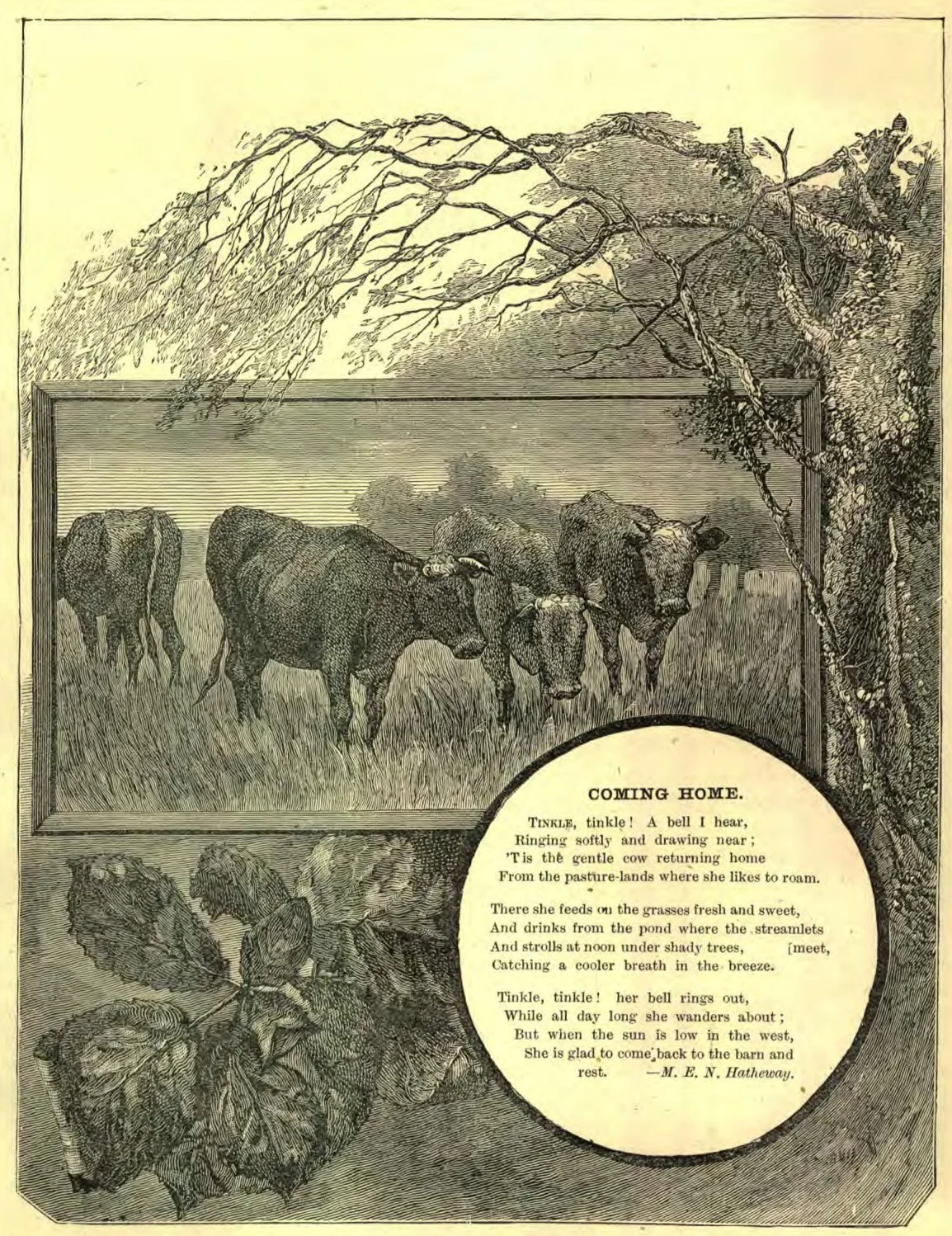
Coming Home.

Tinkle, tinkle! A bell I hear, Ringing softly and drawing near; 'Tis the gentle cow returning home From the pasture-lands where she likes to roam.
There she feeds on the grasses fresh and sweet, And drinks from the pond where the streamlets meet, And strolls at noon under shady trees, Catching a cooler breath in the breeze.
Tinkle, tinkle! her bell rings out, While all day long she wanders about; But when the sun is low in the west, She is glad to come back to the barn and rest. —M. E. N. Hathaway.
COMING HOME.
COMING HOME.

THE HORSE-SHOE CURVE.

There are, in Pennsylvania, among the short, broken ranges of the Alleghanies, many scenes which might rival those of Switzerland in beauty and grandeur.
Fred, as he stood, one bright morning, at the window of one of the Pittsburg and Ft. Wayne cars, was strangely impressed with the mountain scenery, though he was an Eastern lad, and no stranger to hills and hilly country.
For hours he had been looking out into the clear, frosty sunshine, and away up to the snow-covered summits of the surrounding mountains. He fancied he saw rainbows on the crisp edges of the snow-drifts; for the sunlight was dazzling in its brightness, and the snow-crystals were slowly melting. He noted the fringes of icicles hanging to some of the jutting rocks; he watched the stir of busy life in the valleys far below him; he saw the little farm-houses, with queer Dutch ovens outside, fields and gardens, blue smoke curling up among the trees, but all so far down that it seemed like a picture to him.
At last the boy wearied of these, and exclaimed as he discontentedly rubbed the coal-dust from the window,—
“Father, I wish there was something new to see. I’m tired of the mountains.”
“Coming to the Horse-shoe, soon,” said the conductor, who had been standing in the opposite corner, balancing himself and whistling meditatively for some moments.
“Coming to what?” inquired Fred’s father, while the boy sat down to listen.
“The Horse-shoe, we call it. A curve in the mountains, up here a few miles. It may interest you to see what can be done in the way of building railroads.”
“Thank you,” said Fred’s father, while Fred himself turned to the window with renewed interest.
Presently the brakemen began swinging themselves off the platforms, as if watching for something, which caused the young traveler to ask,—
“Are we almost there?”
“Almost,” replied the obliging conductor. “You will see the place in a moment. The track is laid on the side-hill. A deep gorge is on the right, and a solid wall of rock on the left. It took some hard digging and blasting to get a ledge wide enough for the double track you can see yonder.”
Fred looked, and saw, a little distance ahead, a line of hills, one of which turned back upon itself in a curve so sharp and sudden as to look in shape like a horse-shoe, while the iron track seemed to wind along its concave wall like a thread.
Fred shuddered a little as he noticed how very deep the valley was, and how steep its stony sides; and it is not strange that a little thrill of awe and terror crept through his mind as he thought of the dangerous result of a broken tie, a misplaced rail, or an unsafe axle.
He noticed, too, that the rails were but a foot from the edge of the precipice, and gave a little sigh of relief on seeing that a sturdy switch-tender had turned the heavy train to the inner track as they neared the dangerous place.
“How can we go round there without running off?” exclaimed Fred excitedly.
“By taking care to go slowly,” answered the conductor. “The man at the engine must watch his work every moment. If he should forget his duty even once, the train would probably be thrown down the rocks by its own weight and speed.”
Being now at the place, Fred was intent upon the scenes without.
“Hurrah!” he shouted, “another train on the other side of the curve.”
“No; it is our own locomotive. It has turned, and is going the other way; and this long train will soon follow,” said Fred’s father.
“Railroad men do wonderful things,” said Fred. “That was a grand sight, but I was glad we were on the inside track, away from the edge, and close to the rocks.”
Mr. H. felt that the boy was impressed with what he had seen, and said cheerily,—
“Yes, Fred; that was a strange place, and it was a very narrow pathway to pass so safely. Do you think we can find a lesson in what we have seen?”
“Hardly,” was the doubtful reply.
“The narrow road behind us has made me think of another ‘narrow way’ which you have heard of, and are trying to follow, I hope. For a few years I can take your hand and help you. After that time, you must be your own engineer, and guide your own train. What will be necessary then?”
“To go slowly, as we did a few minutes ago, and to think as I go along,” was the wise reply.
“What more?”
“Not forget, and grow careless.”
“Something more.”
“To keep from the edge of the path, I suppose.”
“Ah! yes. There is always a valley of temptation at the edge of the straight and narrow way. It is never safe to venture to the edge. Better take the inside track. And now, how can we surely do this?”
Fred was puzzled now, though generally ready to answer his father’s odd questions. At last, after remembering what he had just seen, he exclaimed earnestly,—
“Why, if there was a rock along the ‘narrow way,’ I should think you meant to keep close to it,” and the boy waited for his father to explain.
“There is a Rock, Freddy, one that is so strong, and safe, and sure, that you can always be safe when near it. I mean the ‘Rock Christ Jesus.’ If I knew my boy would always do this, I would not dread to think of his growing to be a man.” Fred looked up into the fond fatherly eyes, and said, softly,—
“I’ll try.”
And he looked down into the valley and up at the walls on the other side more thoughtfully than before. The lesson was short, but as the conductor, who had listened unobserved, went on with his work, he said to himself, “Go slowly, take the inside track, and keep close to the Rock.” And so two lessons were gathered and learned from a glimpse of the Horse-shoe Curve.—Selected.

DON’T BRAG.

“If you think it so easy to do, try it,” said a lad in our hearing to one who had sneered at the weight he was lifting; and with his words, down upon the sidewalk went the bundle in question.
Nothing daunted, the boaster took hold, but found to his dismay that the weight the other had carried, he could only lift a few inches from the ground.
“I didn’t know it was so very heavy,” said the lad sheepishly.
“Better not talk of what you don’t know about,” said the other, gathering up the unwieldy bundle in his arms, and trudging off with it.
And just so we thought. And yet all over the world we hear folks talking of what they do not know anything about. It is a bad practice, and one it is foolish to indulge in. And of all things, we should look out before bragging.

IF!

If all the flowers in all the world Were changed to shining gold, And every bush in the garden hung As full as its boughs would hold; If every tree in the groves and woods Was glistening silvery white With dollars and halves and quarters, too, Solid and round and bright,— Would all the silver and all the gold Make earth a lovelier place? We’d sigh for sight of an opening rose, Or a pansy’s dewy face.
We’d give the glaring blossoms away, And all the silver sheen, For dear Dame Nature’s tender flowers, And leaves of beautiful green. —Sidney Dayre.

The Bible: Enduring Study and Eternal Life

THERE is no other book which so well repays continual study as the Bible; there is no other book which is at once so old and so new; there is none other which contains the words of eternal life in God's own setting.

IN THE CAVE.

Near our home is a cave. Through its wide avenues and narrow passages, or beside its deep chasms, one may wander for hours. A stranger could not find his way through such labyrinths without a guide.
I had promised my little boy and girl a visit to this great wonder of nature. One fine morning we set out for our trip. The sun was shining brightly, but our guide carried two torches, one of which he lighted as soon as we entered the cave. Three other visitors went with us: one of them had great faith in himself, and so carried his own torch. We wandered along for some time in company, but the self-reliant man soon wished to make researches other than our guide thought safe, so he began to wander from us. Three times I heard the guide say, “Do not go far in that direction; there are chasms and dangerous paths there;” but this man wished to search for himself, and said that as he carried his own torch, there was no danger. Finally, our way led us in an opposite direction, and we advised our companion to follow the guide with us, but he refused, asserting again that no danger could befall him while he carried a torch to show the way. Then we left him, and finishing our exploring, went to our home.
The guide remained near the entrance to the cave, and told us afterward that it was because he felt anxious about the safety of the self-willed man within. All day he watched, but the wanderer did not appear; then the friends of the lost man had the cave searched, but no trace of the man could be found. There was then no doubt that, persisting in his self-confident course, he had wandered from path to path, seeking to know where each led, until his torch had gone out, and hopeless and helpless, he had fallen into one of the chasms and been lost.
This sinful world is a cave through which we all have to pass. Many are lost, as was the poor man in the cave, by taking reason as their torch, and saying that they need no other guide, but will search out the way themselves. Reason may be a good torch for us, but we are not to depend upon it; rather, it should direct us to the true Guide; then we will be using our torch wisely, and shall be safe. If the lost one had used his to light the way to the guide, while yet he heard his voice calling, the poor man might have been saved. So with us; if our reason leads us to Jesus, we are making good use of it, but when we allow it to lead us in and out of the winding paths of sin, we may find no way of escape; and at last, as we hurry first in one direction and then in another, our light goes out, and we are left in the dark—lost, lost eternally. Not time only, but an eternity, depends on our being led safely through this cave. As we are all in, and wish to get safely through, let us put ourselves under the care of Jesus the Guide. Fix your eyes upon him, determining never to stray. By going to him often in prayer, you will be drawn toward him; and when you give your hearts entirely into his keeping, you will be sure of a safe guide.—S. S. Visitor.

AFTER THE CONFLICT.

To know, whatever battles we have lost, Whatever victories missed on our life's field, That we have fought as bravely as the most, And till our strength forsook us, would not yield— This is our victory.
To know, whatever wreaths deck other brows, However loud the pean, long the train, That we have steadfast stood to all our vows, And though to death are wounded, they remain— This is our victory.
—Good Cheer

SKIPPING THE HARD POINTS.

Boys, how do you think a conqueror would succeed who should go through a country he was trying to subdue, and whenever he found a post hard to take, pass around it? Don't you think the enemy would buzz wild there, like bees in a hive? And when he was well in the heart of the country, don't you fancy they would swarm out and harass him terribly?
Just so, I want you to remember, will it be with you; if you skip over the hard points in your lessons, and leave them unlearned, you have left an enemy in the rear that will not fail to harass you, and mortify you times without number.
“There was just a little bit of my history lesson I had not read,” said a vexed student to me; “and it was just there the professor had to call upon me at examination. There were just two or three examples I had passed over, and one of those I was asked to solve on the blackboard.”
The student who is not thorough is never well at his ease; he cannot forget the skipped problems, and the consciousness of his deficiencies makes him nervous and anxious.
Never laugh at the slow, plodding student; the time will surely come when the laugh will be turned. It takes time to be thorough, but it more than pays. Resolve, when you take up a new study, that you will go through with it like a conqueror. Don’t skip the hard points.—Selected.

FAITHFULNESS

“Faithful over a few things.”—Matt. 25: 21, 23.
The servant who had only two talents to trade with, but traded faithfully with them, had just the same glorious words spoken to him as the servant who had five talents: “Well done, good and faithful servant; thou hast been faithful over a few things; . . . enter thou into the joy of thy Lord.” Think what it would be to hear the Lord Jesus saying that to you—really to you! Oh, how sweet! how blessed! How you would listen to that gracious voice saying those wonderfully gracious words to you!
But could he say them to you? Are you “faithful over a few things”? He has given every one—even the youngest—a few things to be faithful over, and so he has to you. Your “few things” may be very few and very small things, but he expects you to be faithful over them.
What is being faithful over them? It means doing the very best you can with them; doing as much for Jesus as you can with your money, even if you have very little; doing as much for him as you can with your time; doing whatever duties he gives you as well as ever you can—your lessons, your work, the little things that you are bidden or asked to do every day, the little things that you have promised or undertaken to do for others. It means doing all these just the same whether others see you or know about it or not.
You are sad when you think of all this; you recollect many things in which you have not been quite faithful; you know you do not deserve to have him call you “good and faithful servant.” But come at once to your gracious Lord, and ask him to forgive all the unfaithfulness, and to make you faithful to-day. And then, no matter how small a thing it is, you will find it a help to recollect, “Faithful over a few things.”
“Only, O Lord, in thy dear love Fit us for perfect rest above; And help us, this and every day, To live more nearly as we pray.”
—Frances Ridley Havergal.

The Value of Intimate Knowledge of Scripture

THERE is no man more likely to do a good life-work effectively than he who knows the Bible intimately.

NEW-TESTAMENT HISTORY.

LESSON 152.—REVIEW.
  1. What was taught by certain men who came down from Jerusalem to Antioch? Acts 15:1.
  2. Who disputed with them?
  3. How was it finally thought best to settle the dispute?
  4. Give the substance of Peter’s speech before the council.
  5. Who were the next speakers?
  6. What did they declare?
  7. What argument did James advance?
  8. What decision was made by the council?
  9. What messengers were sent with Paul and Barnabas to Antioch?
  10. What proof of the decision of the council was put into the hands of the apostles, that they might have something to show to the churches wherever they went?
  11. What caused Barnabas and Paul to go different ways when they went out to visit the churches?
  12. Who accompanied Paul when he set out on his journey?
  13. Tell where and how he secured another helper.
  14. Why did Paul circumcise this young man?
  15. Describe Paul’s journey through Asia Minor.
  16. What instruction did he receive at Troas?
  17. Describe the voyage from Troas to Philippi.
  18. How did Paul find opportunity to preach the gospel to some of the Philippians?
  19. Where were the apostles entertained?
  20. How did they get into trouble?
  21. What cruel treatment did they suffer?
  22. How were they delivered from prison?
  23. Describe the conversion of the jailer and his family.
  24. How were the magistrates put in fear?
  25. How were the apostles brought out of prison?
  26. Tell how they left the city.
  27. Describe their next journey.
  28. Tell how and with what success Paul preached the gospel in Thessalonica.
  29. What trouble did the apostles have at this place?
  30. Where did they go next?
  31. Describe the character and course of the Bereans.
  32. How was the good work at this place interrupted?
  33. How was Paul’s safety secured?
  34. Where did he next preach?
  35. What opportunity did he find for speaking to the people?
  36. Where did they finally take him?
  37. Give a brief synopsis of Paul’s speech on Mars’ hill.
  38. Who were converted by it?
  39. Where did Paul next go?
  40. How did he there find access to the people?
  41. What did he do when the Jews opposed themselves and blasphemed?
  42. What leading men among the Jews believed his preaching, and treated him kindly?
  43. What message did he here have from the Lord?
  44. What attempt was made to drive him from the place?
  45. How did it succeed?
  46. How long did Paul remain in Corinth?

The Quiet, Unconscious Work of Influence

THE best work of the true parent and teacher is quiet, unconscious work. It is not what a man says or does purposely and with direct intention that leaves the deepest mark in the world and in other lives, but it is the unconscious, unpurposed influences which go out from him like the perfumes from a garden, whether he wakes or sleeps, whether he is present or absent. God seems to blight the things we are proud of, and to make them come to naught. Then, when we are not intending to do anything grand, he uses us and our work for noble purposes, and to make lasting impressions on the world and its life. It is the quiet, unheralded lives that are silently building up the kingdom of heaven.—Selected.

KATYDIDS AND CRICKETS.

COME, put on your hats, and we'll take a walk down this shady lane to the old stone wall. Did you wake up last night? If you did, perhaps you heard some musicians playing on their fiddles; and may be you heard these same players get into a quarrel about somebody named Katy. Like most people who get to quarreling, they talked very loud; some said “Katy didn't” and some said “Katy did.” I listened a long while, but I couldn't find out what Katy did do; could you?
Wouldn't you like to know how these musicians look? Hunt carefully among the leaves on this bush, and perhaps you will find one. Here, he's hopped out on my apron; nothing but a grasshopper after all! He's nearly an inch and a half long. When he lifts up his wings, you see that his body is pale green, much lighter than the wings. He has a fine, thin pair of wings, that, when he is not flying, he folds up under a pair of wing-covers. These wing-covers are so large that they cover not only the delicate wings, but the whole body, meeting together on the underside like the two leaves of a pea pod.
The lady katydids are real still; it is only the male katydids that make the noise. Look! this little fellow on my apron is going to give us some music. Do you see how he does it? He rubs the upper edge of one wing-cover against the other. Katydids do not breathe through lungs, as you and I do; but all through the body, the wings, and even the legs, are little tubes that carry air to every part of the insect. They live on grasses, grains, and flower buds. The Indians think they are good to eat, and gather a great many of them, which they roast, grind into flour, and make up into cakes. Do you think you would like to eat them?
Then, I heard another kind of singers, too, last night. We'll walk down to the stone wall, and see if we can find them. There one goes into that little hole under the wall! Let us poke a straw or blade of grass into the hole, and then pull it out. He will be sure to come out clinging to the end of the straw; for although he is such a good singer, he is a bad fellow; he fights with everything that comes in his way. He has a rusty, black coat, and we call him a cricket.
He has a cousin, that lives in the trees, and has a much stronger voice. He has an ivory white coat, and his wife, who is larger, has a dress nearly white, with a little green on the wings. They are shy, and very hard to catch, so I don't think we could find any if we tried.
Too many crickets are apt to hurt a garden, because they eat the newest parts of plants, the melon and squash-vines, and the like; though they do some good by eating bugs.
They live in great numbers in the warm States of the South, and often hurt the tobacco plants by eating holes in the leaves. But I don't believe we would care if they ate up all the tobacco plants, do you?
W. E. L.

THE WONDERFUL SECRET.

Once on a time there was a king who had a little boy whom he loved very much. So he took a great deal of pains to make him happy. He gave him beautiful rooms to live in, and pictures, and toys, and books without number. He gave him a graceful, gentle pony, that he might ride when he pleased, and a rowboat on a lovely lake, and servants to wait on him wherever he went. He also provided teachers, who were to give him a knowledge of things that would make him good and great.
But for all this, the young prince was not happy. He wore a frown wherever he went, and was always wishing for something that he did not have.
At length, one day, a magician came to the court. He saw the scowl on the boy’s face, and he said to the king,—
“I can make your son happy, and turn his frowns into smiles. But you must pay me a great price for telling him the secret.”
“All right,” said the king; “whatever you ask I will give.”
So the price was agreed upon and paid, and then the magician took the boy into a private room. He wrote something with a white substance upon a piece of white paper. Next he gave the boy a candle, and told him to light it and hold it under the paper, and then see what he could read. Then he went away.
The boy did as he had been told, and the white letters on the paper turned into a beautiful blue. They formed these words:—
“Do a kindness to some one every day.”
The prince made use of the secret, and so became the happiest boy in the realm.—The Myrtle.

THE PROUD POPPIES.

There bloomed in a lovely garden A group of poppies gay,— A mother and grown-up daughters,— And splendid clothes had they.
“Just see how they all admire us, Because so gaily dressed! Our robes of scarlet and purple By far outshine the rest.
“The rose’s satin seems faded, Marigold’s yellow crown Looks dim, and pray, who could fancy Lily’s colorless gown?”
So they shook their silken dresses, And spread their skirts out wide, And danced in the golden sunshine, In a flutter of foolish pride.
Just then a passing zephyr Gave them a playful shake; O poppies! without your garments A pitiful sight you make.
On the ground their shining dresses, Purple and scarlet gay, All crushed, and ragged, and dusty, In dire confusion lay.
Quickly their beauty had vanished, Gone was their silly pride, And nobody cared for the poppies, Whether they lived or died.
The lesson my story teaches The children have surely guessed: Better be modest and humble Than ever so gaily dressed.
— Youth’s Companion.

PROGRESSIVE SERIES OF BIBLE LESSONS

FOR SABBATH-SCHOOLS.
BY G. H. BELL.
No. 1.—BIBLE LESSONS FOR LITTLE ONES.—ADAM TO MOSES. This first volume presents the story of events from the time of Adam to that of Moses, in very simple language, suited to the youngest minds. Besides its fifty-two lessons, it contains valuable notes and hints to the teacher concerning the best methods of imparting instruction to very young children. 84 pages. 15 cts.
No. 2.—BIBLE LESSONS FOR LITTLE ONES.—EGYPT TO CANAAN. This volume is a continuation of No. 1, covering the history of the children of Israel in their journeyings from Egypt to Canaan. It is adapted to older children than the preceding, and the first five lessons consist of a general review of the first book, covering briefly the historical events presented there. 120 pages. 20 cts.
No. 3.—MOSES TO SOLOMON. In this volume new features are introduced; viz., the presentation of all difficult Bible names, and a series of maps, with notes of explanation, both geographical and historical, adding greatly to the interest and value of the book. 132 pages. 25 cts.
No. 4.—FROM THE BEGINNING OF SOLOMON'S REIGN TO THE REBUILDING OF THE TEMPLE AFTER THE CAPTIVITY. This volume is one of the most interesting of the series, giving an account of the glorious reign of Solomon, a brief notice of all the kings of Judah and Israel, the captivity of the Jews, their return to Jerusalem, and the rebuilding of the temple. The leading prophets and their work are presented and made prominent, and the historical events which they predicted are briefly set forth. 162 pages. 25 cts.
No. 5.—FROM THE REBUILDING OF THE TEMPLE BY ZERUBBABEL TO THE SENDING OUT OF THE TWELVE DISCIPLES BY THEIR LORD. Continuing the historical narrative of the previous book, this volume embraces the work of Ezra, Nehemiah, and Malachi, the connection between the Old Testament and the New, the history of John the Baptist, the birth, childhood, baptism, and ministry of Christ to the sending out of the twelve disciples to preach the gospel. Geographical and historical descriptions are embodied in the lessons themselves, and are brought out by questions, like other parts of the lesson. 172 pages. 25 cts.

Letter Budget.

Alma Draper sends a letter from Brighton, Ohio. She is fourteen years old. She and her five brothers and two sisters all go to Sabbath-school. They like to read the Instructor. She is trying to be a good girl. This is her first letter to the Budget.
Edgar A. Weeks writes from Memphis, Mich. He says: “I am twelve years of age. I have two brothers and one sister. I go to Sabbath-school every Sabbath. We have taken the Instructor ever since I was large enough to read it, and I like the paper very much. I am trying to do right.”
Lulu J. Bremner writes from Richland, Nebraska. She says: “I am ten years old. I have two brothers younger than myself, and a little baby sister six months old. We keep the Sabbath with papa and mamma. We live seven miles from the church, and do not go there very often. We take the Instructor, and I do so love to read it that I can hardly wait to get it. I am trying to be a good girl.”
Nettie Langdon writes from Mendon, Mich. She says: “I have written before for the Budget, but did not see my letter printed, so I have written again. The Sabbath-school is held at our house. I like to get the lessons. I have taken this paper about four years, and like it very much. I am trying to do right.”

You have reached the end of this edition.

The Youth’s Instructor · Sep 12, 1883