The Youth's Instructor, Vol. LIII, No. 23

The Personality of God

The Youth's Instructor

June 6, 1905

Review and Herald Publishing Assn. · Washington, D. C. · June 6, 1905

The Personality of God

“No man hath seen God at any time.” John 1:18. No mortal can see his face and live. Ex. 33:20. He dwells in light unapproachable. 1 Tim. 6:16. The matchless splendor, the transcendent glory, which surrounds the eternal God no pen can ever portray, nor human mind comprehend. His effulgence is above the brilliancy of the sun. Acts 26:12, 13; Rev. 1:16. His very throne is like the burning flame. He is the creator and upholder of the boundless universe. He has filled by his power the fathomless regions of space with worlds, suns, and systems, and fixed by a word their orbit. Before his eternal and incomparable greatness, nations are but a drop in the bucket, and the small dust in the balance. Never by searching can we find out God. Job 11:7; Isa. 40:28. All effort to fully comprehend him stuns the imagination, and overwhelms the reason.
But notwithstanding his incomprehensibility, let it never be forgotten that God is a real being, a personality, and dwells in a particular place. The Father is a person; the Son also, though separate and distinct from his Father. He does not dwell in beasts and birds, in the trees, and in the grass as the Buddhist believes, but he dwells in heaven, between the cherubim. The “Most High dwelleth not in temples made with hands.” Acts 7:48. “Who is like unto the Lord our God, who dwelleth on high.” Ps. 113:5. “Hear thou in heaven thy dwelling-place.” 1 Kings 8:39; 2 Chron. 6:30, 39. “Give ear, O Shepherd of Israel, thou that leadest Joseph like a flock; thou that dwellest between the cherubims, shine forth.” Ps. 80:1. In the earthly sanctuary there was a cherubim on either end of the mercy-seat, and the Lord said, “I will commune with thee from above the mercy-seat, from between the two cherubims which are upon the ark of the testimony.” Ex. 25:22. This was an example and shadow of heavenly things. It reveals God in a definite locality. Christ ascended to his Father in heaven (John 20:17), and taught us to pray to our Father in heaven. Matt. 6:9.
To deny the personality of God is the most arrant unbelief. It is well-nigh blasphemy. It demolishes at a stroke the divinity of God, and virtually abolishes the Deity. It overthrows the foundation of the Christian religion, by substituting the pagan notion of a god who is everywhere equally present, working through nature, dwelling in plants and animals, for the God of Christianity, who has his abode in heaven. The God of the Bible dwells in heaven, has a real throne, surrounded with an innumerable host of real angels, who are sent forth as messengers throughout his endless universe. Of this there is abundance of Bible testimony. Let us study carefully a few texts:
“And the Father himself, which hath sent me, hath borne witness of me. Ye have neither heard his voice at any time, nor seen his shape.” John 5:37. These words of Jesus state as truly that the Father has shape as that he has a voice. It would be as sensible to deny the one as the other. And that which has shape must be material, and be in some particular place more than another. The same thing is stated in Phil. 2:5, 6. “Let this mind be in you, which was also in Christ Jesus: who, being in the form of God, thought it not robbery to be equal with God.” This scripture tells us that God has a form, and that Christ bore the image of his Father.
Again we read: “God, having of old time spoken unto the fathers in the prophets by divers portions and in divers manners, hath at the end of these days spoken unto us in his Son, whom he appointed heir of all things, through whom also he made the worlds; who being the effulgence of his glory, and the very image of his substance, and upholding all things by the word of his power, when he had made purification of sins, sat down on the right hand of the Majesty on high.” Heb. 1:1–3, R. V. From this we see that the Father has a “substance,” and that his only begotten Son bears his “very image,” though a distinct and separate being, or, as Rotherham’s translation says, “an exact representation of his very being.” In view of this we can readily understand why Jesus said, “He that hath seen me hath seen the Father.” John 14:9. In form and character he was the very image of the Father, and to see him was to see the Father. But both have form and substance, as the texts declare.
In the creation of man in the beginning the Father entered into consultation with his Son, and said, “Let us make man in our image, after our likeness.” Gen. 1:26. And the record states, “So God created man in his own image, in the image of God created he him; male and female created he them.” Verse 27. Webster defines “image” as “a similitude of any person or thing, sculptured, drawn, or otherwise made perceptible to the sight.” Then as Adam stood in his primeval innocence, as he came from the plastic hand of his Creator, he bore not only his character, but his image in outward form as well. If the language of these scriptures does not convey clearly the fact that God is a real person, it is hard to conceive of any language that would do so.
Furthermore, we read of Moses, Aaron, Nadab, Abihu, and seventy of the elders of Israel, who went up in the mount, “and they saw the God of Israel,” and speak of his hands and his feet. Ex. 24:9–11. In response to the request of Moses to behold the glory of God, the Lord told him that he could not see his face, “for there shall no man see me, and live.” But the Lord said, “Behold, there is a place by me, and thou shalt stand upon a rock: and it shall come to pass, while my glory passeth by, that I will put thee in a cleft of the rock, and will cover thee with my hand while I pass by: and I will take away mine hand, and thou shalt see my back parts: but my face shall not be seen.” Ex. 33:18–23. This language is certainly descriptive of a real being. It speaks of his face, feet, hands, and back parts.
Then, wrapped in holy vision, seers of long ago have seen God, and recorded in the Bible the most sublime description of him. “I beheld till the thrones were cast down, and the Ancient of days did sit, whose garment was white as snow, and the hair of his head like the pure wool: his throne was like the fiery flame, and his wheels as burning fire. A fiery stream issued and came forth from before him: thousand thousands ministered unto him, and ten thousand times ten thousand stood before him: the judgment was set, and the books were opened.” Dan. 7:9, 10. A similar description is given by John. Rev. 1:12–18. Both of these are descriptions of a real being before whom angels stand. They speak of his head, hair, eyes, feet, hands, and face. To treat this as figurative is to make the most sublime description of the eternal God ever written by the pen of mortals, meaningless. Another servant of the Lord beheld in vision the same glorious image, and has given a similar description. “I saw a throne, and on it sat the Father and the Son. I gazed on Jesus’ countenance, and admired his lovely person. The Father’s person I could not behold, for a cloud of glorious light covered him. I asked Jesus if his Father had a form like himself. He said he had, but I could not behold it, for, said he, if you should once behold the glory of his person, you would cease to exist.”—“Early Writings,” page 45.
“The Father was enshrouded with a body of light and glory, so that his person could not be seen, yet I knew that it was the Father, and that from his person emanated this light and glory. When I saw this body of light and glory rise from the throne, I knew it was because the Father moved. . . . The glory, or excellency, of his form, I never saw: no one could behold it and live; yet the body of light and glory that enshrouded his person, could be seen.”—Id., Supplement, page 8.
How exceedingly precious the promise that while we can not see our Father now because of sin, the day is drawing on apace when we “shall see his face” (Rev. 22:4), when we shall be changed, and shall “see him as he is.” 1 John 4:2. G. B. THOMPSON.

Korean Sketches

Hats and Other Head-gear
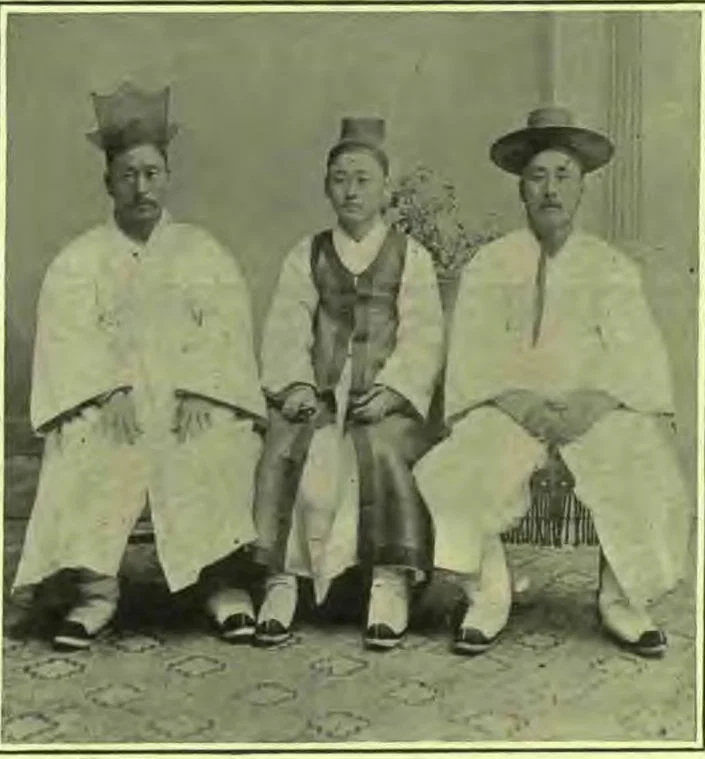
A CERTAIN author of a book on Korea has an entire “Chapter on Hats;” so I need not offer any apology for devoting one of these short sketches to the subject.
The use and significance of these head-dresses can best be explained by first describing the manner of wearing the hair. The hair is left to grow long by men, women, and children. No part of the face or scalp is ever shaved or clipped, so there are no native barbers in Korea. If, perchance, a Korean has his hair cut, or his face shaved, he is departing from the traditions of his forefathers.
Unmarried boys and men wear the hair in a long braid, like the Chinese, except that it is not pieced out with silk cord. But why say unmarried boys?—Because in Korea many boys are married while yet in their early teens. The rule seems to be, the better the circumstances of the family, the younger the boys are married; for a poor young man must defer marriage till he can support a wife.
After marriage, the hair is combed up and tied, then twisted into a slender pug at the crown of the head. When the hair is dressed in this way, loose locks are liable to hang down the neck and about the temples. To keep these in place, a band about three inches wide, woven of horsehair, or sometimes of human hair, is bound about the head, from the forehead to the base of the skull. This is not worn by all.
Unmarried boys and men may not wear any kind of hat or head-dress. After marriage even till middle age, a tall, four-sided, horsehair coronet may be worn. The man on the left in our illustration wears such a one. It is open at the top, hence affords no protection to the head. A modified form lacks the lower, outside crown. Aged men may wear a box-shaped hair coronet, closed at the top. The form shown upon the head of the man in the center of our illustration, is that worn by scholars. These hair head-dresses are commonly worn about home, in the house as well as out.
The form of hat worn by the third man in the picture, is that commonly worn upon the street. It is made of white or black gauze cloth over a very light bamboo frame. The white one is the mourning hat, and is now almost universally worn in memory of the empress, who died some years ago. But the black hat may be worn if a piece of white paper is pasted over the crown.
There is a curious tradition about the origin of this form of hat. Long ago a certain Korean king wished to restrain his excitable subjects from the frequent broils and fights which disturbed the peace of his realm. So he enacted that the men should use earthenware hats; and further decreed that whoever got his hat broken should be punished. So it was not necessary for the prosecuting attorney to prove that a man had quarreled; the broken hat was all the evidence required. We are not told how long this unique law remained in force; but even after its abrogation, hats of the same shape continued to be worn, even to the present time.
Then there is the cap worn as a sign of mourning for one’s relatives. This is made of a piece of coarse linen, and so formed that the crown resembles the roof of a house, with the gable ends at the sides. Very rigid rules govern the wearing of this cap. It may not be worn longer than three years in any case. The length of time it should be worn for the death of father, mother, and other relatives, is definitely prescribed. This cap is worn about home; but during a journey or on the street, it is replaced by a splint hat as large as a market-basket. Such hats may be easily picked out in the illustration accompanying No. V of this series.
Then there are sun-shades, varying in size from that of a broad-brimmed straw hat to a large clothes-basket. These also are made of splints, and may be distinguished in the illustration mentioned above.
Korean etiquette does not require that the hat shall be removed upon entering a house. So even in church, horsehair coronets, mourning caps, and hats with tapering crowns, all remain upon the heads of the worshipers during the service. Again we lay aside our prejudices, and appear not to be shocked, that we may become “all things to all men.” F. W. FIELD.

In the Heart of the Woods

Such beautiful things in the heart of the woods! Flowers and ferns, and the soft green moss; Such love of the birds, in the solitudes, Where the swift wings glance, and the tree tops toss; Spaces of silence, swept with song, Which nobody hears but the God above; Spaces where myriad creatures throng, Sunning themselves in his guarding love.
Such safety and peace in the heart of the woods, Far from the city's dust and din, Where passion nor hate of man intrudes, Nor fashion nor folly has entered in. Deeper than hunter's trail hath gone Glimmers the tarn where the wild deer drink; And fearless and free comes the gentle fawn, To peep at herself o'er the grassy brink.
Such pledge of love in the heart of the woods! For the Maker of all things keeps the least, And over the tiny floweret broods, With care that for ages has never ceased. If he care for this, will he not for thee,— Thee, wherever thou art to-day? Child of an infinite Father, see! And safe in such gentlest keeping stay.
— Margaret E. Sangster, in Sunday School Times.

Frozen Mortar

EIGHT houses fell on a recent Sunday in New York. They collapsed without warning. Every day the building inspector had reported those houses as being in first-class condition. That inspector has come to grief, but too late to save the houses. Moreover, nine other apartment houses, built since the first of December, and practically completed, must at once come down.
And why? Why all this waste? Why this danger to human life?

Frozen mortar.

The contractors could not wait for warm weather. In defiance of the law, which absolutely forbids building when the weather is cold enough to freeze mortar, they pushed ahead, though every day the thermometer was below the danger point. And that was the result. The mortar did not grip the bricks, and the buildings crumbled.
Let me remember this the next time I am in a hurry about my life building. Am I ready for this important task? Have I prepared myself for it? Are brains and heart all ready? Have I strength enough to carry it through? Have I ever a surplus of all these, to meet the unexpected hindrances that are sure to arise?
If not, the mortar is stiff.
Better wait.— Caleb Cobweb.

The Soul Bears Its Own Witness

“THE soul itself its awful witness is. Say not in evil doing, ‘No one sees.’”

Wait and You'll See

IN a busy schoolroom the little people were sewing picture-cards. One tiny maiden was perplexed about the other side of the picture, and with a face all clouded came to the teacher, saying, “How shall I do that?”
“I will show you when you come to it,” was the ready answer.
In a few moments again the question was asked, “But how shall I do that?”
Again the answer, this time in a firm voice, “I will show you when you come to it, dear.”
A few more stitches were taken, when once more the little girl in a sweet, coaxing voice said, “But please tell me how to do that.”
This time the answer was very emphatic: “Irene, you go right on working where you are; when you come to the other side, I will show you.”
Like a flash of light came the thought to the teacher herself, who had for many days been dreading a trial seen in the distance. “You go right on working where you are, and your Heavenly Father will show you, when you come to it, how to be brave and how to act wisely.”
O, the comfort and the restfulness of the thought!—Delia C. Post.

I. I. NAY

June

AGAIN the scented breath of June Is floating on the breeze; Again the leaves and blossoms Have covered shrubs and trees; Again the birdlings’ merry songs Ring out o’er land and seas.
All nature lifts her voice in song, For summer days are here: The snow and ice of Winter’s days Have flown from Summer’s cheer. We gaze no more on frosty peaks Nor woodlands bare and dread.
The birds and blossoms seem to sing Their thanks for summer days; And, in accordance with the earth, Our thanks to Him we raise. The transformation is his own; To him belongs the praise.
So in the winters of our lives His love will also grow. Again the buds of spring will bloom; Again the breezes blow, If we but trust his promises, And serve him here below.

I. I. NAY

The Baby Went Alone

THE baby wished to join his little sister, who had gone to the home of a small friend for the afternoon.
She had gone while baby was asleep, and so he had been left behind.
“Don’t cry,” said his mother; “you shall go. I will take you.”
“No!” wailed the fretful baby, “I want to do own self!”
“But you will fall. See how rough and icy the way is.”
“Want to do own self,” wailed the obstinate baby, with his eyes shut.
So his mother brought his wraps, and when he was well bundled, sent him out. Then she took her stand in the window to watch.
Slowly the unsteady little feet advanced, and in a moment down he fell. But he was a brave baby, and with a brave face he picked himself up. A few more steps, and down he went again, fall succeeding fall, till his tender body was sadly shaken and bruised.
Then came his mother, swiftly, and picked up in her arms a very meek baby, who was tired of going “own self.”
We are all God’s babies, self-willed and able, until we try to go “own self” through the world. But when our spirits are jarred and wounded from many a fall, how glad we are to rest in our Father’s arms, never to go “own self” any more!—William Zachary Gladwin.

What Is Going On in the World

THE Remington-Martin Paper Company has purchased 650,000 spruce seedlings from Germany to start a pulp forest. It is estimated that an acre will bear eighty cords of wood.
AN organization of eight thousand men has already been formed for work on the Panama Canal. This organization will be rapidly increased, so that the work may progress with more than anticipated speed.
THE project of draining and reclaiming the Everglades of Florida, with their three million acres, is now under consideration. There is a company already waiting to do the work as soon as the State legislature grants permission.
“JOHN D. ROCKEFELLER'S wealth in silver dollars would, some one has estimated, weigh as much as two first-class battle-ships; in one-dollar bills it would make a double girdle around the earth, and leave a beautiful remnant of dollar bills fifteen hundred miles long.”
ICE-CREAM is shipped from the United States to China and India. The large ocean steamers are provided with enough for the trip across to Europe and for the return journey. If it is poor ice-cream, it does not keep well; but that made of pure cream is preserved perfectly in the cold storage room.
THE lower house of the Michigan Legislature recently passed what is said to be the most sweeping anti-trust measure ever passed in this country. It defines and declares illegal all corporations which aim at monopoly of any business. It nullifies any agreement binding individuals not to engage in a certain occupation.
ONE of the greatest engineering undertakings of its kind ever attempted in this part of the country is more than half finished off the New Jersey coast at Greenville. It is the elevating of the bay to a dry-land surface by the Pennsylvania Railroad for a freight terminal. The filling in alone is being done at a cost of $12,132 an acre.
SIXTY thousand Japanese, it is estimated, have already arrived in Korea, since the occupation of the country by the little warriors. Wonderful transformations are taking place. The Korean emperor and his corrupt court are said to be dismayed at what the Japanese have accomplished, and are hoping for the success of the Russians, who upheld the worst influences of his majesty's reign.
MESSRS. JULES LANG AND SON have devised a pot for the manufacture of glass that will make it possible to manufacture three times as much glass in a given time, without any extra fuel consumption, as by the old method. The pot has capacity for a ton of glass, and allows an uninterrupted flow of material, while the other pot necessitated an elapse of several hours before the glass materials in the crucible could be withdrawn. This must lessen the price of glass.
“F. M. COCKRELL, Jr., son of ex-Senator Cockrell, is the inventor of a sugar-cane cutter that promises to revolutionize the sugar-planting industry of the South, and at the same time to make its inventor a millionaire. His machine will do the work of more than a hundred men. It cuts, strips, and tops the cane, and is pronounced by experts a wonderful machine, that will mean as much to the sugar-cane industry as did the cotton-gin to the cotton business.”

Marvelous Bird Travelers

A MAN who travels ten thousand miles in a year is counted a “globe-trotter” of unusual energy. But our common night-hawk, which every American boy and girl knows, thinks nothing of having a summer home up in Alaska and a winter resort in Argentina, and traveling the seven thousand miles between twice a year. Its annual trip often covers one hundred fifteen degrees of latitude.
And some of our shore birds, a government naturalist—Mr. Wells W. Cooke—tells us, are still more inveterate voyagers, making extra flights, and covering sixteen thousand miles or so a year, apparently for the pure pleasure of travel.
Voyaging by the air-line is sometimes extremely rapid transit. The summer warbler that spends the winter in Central America and the nesting season at Great Slave Lake, far up in the Arctic, travels twice as fast as the spring does. One hundred sixteen miles a day is the record, so far, to Great Slave Lake, the speed always increasing as the birds move northward.
The robin is an old-fashioned, leisurely tourist in comparison with some other species. It never goes more than seventy miles a day. The average rate, for all migrating birds, from New Orleans to Minnesota, is about twenty-three miles a day. But after leaving Minnesota several species of feathered migrants make first forty, then seventy-two, and finally one hundred and fifty miles a day before they reach Alaska.
The bird traveler that gives the naturalist the hardest transportation problem to solve is the red-eyed vireo. It winters in Central America, and appears each spring at the mouth of the Mississippi, traveling twenty miles a day. At this leisurely rate it proceeds for six weeks, all the way up to the latitude of northern Nebraska. Then suddenly, in the space of twenty-four hours, and before a single red-eyed vireo has been seen anywhere in the region between, numbers of the birds appear in British Columbia, a thousand miles to the northwest.
This puzzling performance is repeated every year. Unless the red-eyed vireo flies a thousand miles in a single night, how does it manage this bewildering schedule? Nobody knows; but then, nobody knows, either, where the chimney-swift goes for five months out of every year.
Great flocks of chimney-swifts, with numberless fledglings among them, leave the United States every autumn. Their movements can be easily followed till their various migrating bands join into a countless host on the northern coast of the Gulf of Mexico. One day they are there; the next day they are—nowhere.
Five months later, in March, a joyful twittering far up in the air heralds their reappearance on the same spot, plump and brisk after their winter sojourn. But where the winter has been spent only the swifts know. It used to be a tradition (made out of “whole cloth”) that they hibernated in the mud. But that merely showed the hopeless attitude of men’s minds toward the problem, for no swift was ever found in the mud in any known spot. What mud? Where? was therefore the natural question, never answered, and leaving the mystery deeper—and muddier—than ever.
The bobolinks, on the contrary, are so open in their movements that the passage from Florida to Cuba and thence to South America is known as the “bobolink route.” So energetic and brave is this plump little traveler in feathers, that it often compasses in a single long ocean flight the seven hundred miles from Cuba to South America, while many other species, which also use the “bobolink route,” stop at Jamaica, apparently dreading the long trip across the Caribbean Sea.
The golden plover, too, has a yearly schedule of travel known to the naturalist in every detail.
In June it reaches the “barren grounds” far in the Arctic circle, where Greeley found these bird voyagers as far north as latitude eighty-one degrees. The nests are built on the moss, close above the frozen ground, the young are reared, and then the flocks hasten to Labrador in August, where the crowberry grows for their benefit so thickly that when they leave the feasting-place in the fall, their bodies are plump almost to bursting, and their very flesh is stained red with the crimson juice of the berries they have eaten.
They strike straight for the Antilles, and for South America beyond—more than twenty-five hundred miles in all. The plover can swim, however, and rest on the ocean wave; and on the way down it frequently feeds in the Sargasso Sea, where, far out in the Atlantic, thousands of square miles of seaweed teem with marine life.
After resting a few weeks in the Antilles, the plover starts afresh, this time for Patagonia and southern Argentina. Unlike other birds, it puts its whole mind to traveling, and flies both night and day. Six months in Patagonia, and then back it travels to the arctic, by way of Guatemala, Texas, and the Mississippi. The whole yearly route forms a great, irregular ellipse, eight thousand miles long and three thousand miles across at its widest point. Surely, marvelous as were the stories about the migration of birds believed by the ignorant in early unscientific times, the truth is, as usual, stranger than fiction, and the air-line is more adventurous than any railroading that man has ever done.—Priscilla A. Leonard, in Youth’s Companion.

Soil for Roses

A FAMOUS English gardener once heard a nobleman say, complainingly, “I can not have a rose garden, though I have often tried, because the soil round my castle is too poor for roses.”
“That is no reason at all,” replied the gardener. “Any ground can be made fit for roses, if pains are taken to prepare it.”
It was a wise saying, and it is true in other places than rose gardens. Some young people say, “I can’t be cheerful,” or “I can’t be sweet-tempered,” or “I can’t be forgiving,” as if they were not responsible for the growths in their soul garden, because the soil is poor. But “any ground can be made fit for roses,” and any heart can be made fit for the loveliest blossoms of character, if God is allowed to prepare it for their growth.—Selected.

Speed of a Rattler

IN this wide world there are several things that are swifter than a rattlesnake, but they can probably be counted on the fingers of one hand. One of these things is a bullet, whereby hangs the explanation why it is easy to shoot the head off a rattler, though a marksman finds it difficult to place a bullet along the fat seven-foot line between the neck of the reptile and the tip of its tail.
It has long been regarded as a curious coincidence that even the man not famed for accuracy has had no trouble in blowing the head off a diamond back. In the diamond back country only one explanation is offered for this: it is the snake, and not the man, that does the aiming.
At close quarters the instant the muzzle of a six-shooter is thrust toward a rattlesnake the infallible eye catches the range, and in the fraction of a twinkle the deadly head has aligned itself. As the gun roars and darts its tongue of flame, the head of the creature is torn clean off as if severed with a knife, and the viper lies writhing, emitting a defiant rattle even as its grim, relentless heart ceases its beat.—Pearson’s Magazine.

Young People's Societies of Southern California

This report is for the eight Societies of Southern California for the quarter ending March 31, 1905. There are two hundred sixty-seven members, and their activity in missionary work is revealed by the following summary:—
Missionary letters written ............... 158 Missionary letters received ............... 17 Missionary visits .......................... 84 Bible readings or cottage meetings ......... 27 Subscriptions taken for periodicals ......... 18 Papers sold ................................ 133 Papers mailed or given away ................ 1,330 Books sold ................................. 16 Books loaned ............................... 17 Pages of tracts sold ....................... 352 Pages of tracts given away ................. 3,062 Hours of Christian Help work ............... 38 Persons supplied with food ................. 9 Articles of clothing given away ............ 181 Paid for supplies .......................... $ 1 85 Offerings for home mission work ............ 20 50 Offerings for foreign mission work ......... 14 38
The members have also been supplying reading-matter to racks in public places, such as hotels, stores, and depots. They have visited hospitals and Detention Homes. One society reports seven young persons baptized. The Young People's work is going steadily forward. We have from twelve to fifteen racks for the free distribution of our periodicals, such as Signs of the Times, YOUTH'S INSTRUCTOR, Review and Herald, Watchman, and tracts. The good done by these silent messengers of truth can not be estimated. Nearly every Society has at least one rack, and from that to five or six. They are usually placed in conspicuous places in public buildings, such as hotels, stores, and depots.
One of the Societies has made a number of these boxes. It is very little trouble to make an attractive distributor. Usually some motto is displayed to call attention to the nature of the reading-matter, such as “His Glorious Appearing,” “Is the End Near?” Any one with a little skill in the use of carpenter's tools can, in a short time, make one with two or three apartments, and the motto should be printed neatly by some one who understands the work, as it is a daily exponent of a great truth.
We are glad to note the advance steps taken in the missionary garden work, which, like everything else that is for the furtherance of the message of salvation, is opposed by the enemy of all truth,—but this opposition proves only the more conclusively that there is a blessing in it that he does not want us to have. Our first attempt in this work was no exception to this rule, and for a time it appeared as if our efforts were fruitless; but at least one Society is enjoying the blessing of nearly an acre devoted to this cause. When the plans were first made public, forecasts of failure and financial loss were to be heard on every hand, but after it was demonstrated that this was the Lord's work by some going forward in faith, the clouds of darkness were dispelled, and many gladly accepted the opportunity of having a hand in the work; one gave the use of a team and harrow, another the use of a team and plow, another volunteered the service of a horse and wagon for delivering the crop at harvest; and so the work went joyfully forward. Peas, lettuce, spinach, and potatoes were planted; the harvesting began at one end of the garden before the planting was finished on the other. The expenses of seed and other things having now been more than paid by the sales of the produce, a generous sum is still expected from the remaining crop.
There is an interesting incident connected with this, our first attempt, that encourages us, and proves that the Lord has a care for his work. Within a few hours after each of the first three plantings, which were several days apart, we had a generous shower of rain. We did not notice the first shower so much, only were thankful for it, as we had expected to irrigate, which is quite expensive. The second time we were also very glad for the rain, and also noticed the coincidence a little more, and praised the Lord a little more for his goodness; but the third time, though we had been having rains at intervals during the winter, proved to us that “the Lord knoweth them that are his,” and is only waiting to second every effort put forth to hasten his coming to gather his children.
The Self-denial Box plan for the help of the colored work in the South, has been taken up by some of our Societies, with many blessings and good results. The plan we have adopted is first to distribute the boxes among the members of a Society, and then to appoint a member to visit each one owning a box, and collect the money and encourage the giver, presenting to him the needs of the field, and keeping him informed as to the progress of the work. In this way one Society has given from five to six dollars a month to this worthy cause. “They helped every one his neighbor; and every one said to his brother, Be of good courage.”
As the spirit of prophecy has spoken so plainly and so frequently of late concerning the work in the South, telling us that it will soon be impossible to work there, we have turned much of our attention to this field; one of the Societies adopted the plan of making a collection of clothing, second hand, but in very good condition, and sending it to the workers among our colored brethren in answer to appeals from them. At first we thought we had no more than we absolutely needed for our own use, but when we came to pack for the shipment, we found we had over one hundred articles, from boys' stockings to men's overcoats, the entire lot being worth not less than sixty dollars, second-hand value. By such gifts the workers are better able to gain the confidence of those for whom they labor; and if this can be the means of saving but one soul, the joy of that one through the ages of eternity will amply repay us for a little sacrifice now.
We are also interested in the house-to-house work with both books and papers, especially the Signs of the Times. And while some—many of us in fact—have to contend with a timorous nature, yet the joy of leading a soul from darkness to light helps us to rise above the weaknesses of the flesh, and rejoice with the angels of heaven.
The nature of some of the “missionary visits” in this report is that of ministering to the spiritual needs of the afflicted in the county hospital and the unfortunates in the Detention Home. The INSTRUCTOR and Little Friend are used to good advantage in this work, and if our Saviour, who spent so much of his time while on earth in liberating those whom Satan had bound, enjoyed this work among the sick, can we not reasonably say that he no less enjoys seeing his followers engaging in the same work?
Another report says: “Many of the younger members of our Society are interested in visiting some old ladies who are sick. They take them flowers, and sing for them.” So the Lord has a work for each one of his children, whether young or old. What a grand work to be engaged in!
The smallest Society in the conference reports over five hundred papers sold and given away during the last quarter. This Society has but twelve members, and reports other work in addition to this, such as loaning and selling books, giving away tracts and other reading-matter—an object-lesson for those of us who are not so zealous in the Lord's work.
One Society, during the last quarter, has done something in each line of work mentioned in the report blanks, except two,—that of selling papers, and selling tracts. This Society reports over 1,750 pages of tracts given away and one hundred eighty papers. Thus the leaves of truth are being scattered “as the leaves of autumn.” Our increase in membership during the last quarter is fifty-nine, or nearly thirty per cent.
This report does not represent all the work done by the different Societies, but gives an idea of how the Lord is leading out in the work here, and how he will bless those who will in any way answer his call. As we study the different mission fields and see their need, and read the earnest appeals of even the heathen who sit in darkness and the shadow of death, for some one to come and give them the light of life, our hearts are stirred within us to pray the Lord of the harvest that he will send forth more laborers into the vineyard. “Also I heard the voice of the Lord, saying, Whom shall I send, and who will go for us? Then said I, Here am I; send me.” Isa. 6:8. E. C. SILSBEE.
Continue reading: Dimensions of Panama Canal